
Quick Answer: What Are the Most Famous Landmarks in Egypt?
The most famous landmark in Egypt is the Great Pyramid of Giza, the largest pyramid on the Giza Plateau and the only surviving Wonder of the Ancient World.
Other famous Egyptian landmarks include the Great Sphinx of Giza, Step Pyramid of Djoser, Karnak Temple, Luxor Temple, Valley of the Kings, Hatshepsut Temple, Abu Simbel Temple, and Philae Temple.
For a first trip, Cairo/Giza, Luxor, and Aswan provide the strongest concentration of famous landmarks. Travelers with additional time can add Alexandria, Abu Simbel, the Western Desert, or Sinai.
Top 10 Famous Landmarks in Egypt
Famous landmarks in Egypt in 2027 range from the Pyramids of Giza and ancient temples of Luxor to Islamic Cairo, Alexandria’s Mediterranean monuments, and natural wonders such as the White Desert and Siwa Oasis. For first-time visitors, the most important Egyptian landmarks are concentrated around Cairo and Giza, Luxor, Aswan, and Abu Simbel. This makes it possible to combine several of Egypt’s most famous places in one well-planned trip.
This guide covers the most important ancient Egyptian landmarks, historical places, famous buildings, religious monuments, and natural attractions to help you decide what to include in your Egypt itinerary.
| Landmark | Location | Best Known For |
|---|---|---|
| Great Pyramid of Giza | Giza | Last surviving Wonder of the Ancient World |
| Great Sphinx | Giza | Monumental lion-bodied sculpture |
| Step Pyramid of Djoser | Saqqara | Early monumental pyramid architecture |
| Karnak Temple | Luxor | Vast ancient temple complex |
| Valley of the Kings | Luxor | Royal New Kingdom tombs |
| Luxor Temple | Luxor | Monumental temple in central Luxor |
| Hatshepsut Temple | Luxor | Terraced mortuary temple |
| Abu Simbel | Aswan Governorate | Colossal rock-cut temples |
| Philae Temple | Aswan | Island temple complex |
| Saladin Citadel | Cairo | Major medieval Cairo landmark |
These sites cover several different periods of Egyptian history. Travelers interested mainly in pharaonic monuments should focus on Giza, Saqqara, Luxor, Aswan, and Abu Simbel, while visitors interested in medieval Egypt should reserve additional time for Historic Cairo.
Why Is Egypt Famous for Landmarks?
Egypt is known for ancient history and landmarks because important monuments survive from multiple periods of its civilization.
The country is most famous for ancient Egyptian pyramids, temples, tombs, statues, and archaeological sites, but its heritage extends much further. Cairo contains major Islamic and Coptic landmarks, Alexandria preserves evidence of its Greco-Roman and Mediterranean history, and Egypt also has distinctive natural landscapes in the Western Desert, Sinai, and along the Red Sea.
This variety is one reason a well-planned Egypt tour package can combine archaeological sites, museums, religious monuments, Nile scenery, and desert landscapes rather than focusing exclusively on the pyramids.
Ancient Egyptian Landmarks
1. Great Pyramid of Giza
The Great Pyramid of Giza is Egypt’s most recognizable landmark and usually the first ancient monument travelers associate with the country.
Built for Pharaoh Khufu, the pyramid dominates the Giza Necropolis on the western edge of Greater Cairo. Its scale, age, engineering, and survival make it one of the most important historical monuments anywhere in the world.
A typical Giza visit includes the Great Pyramid, the Pyramid of Khafre, Pyramid of Menkaure, panoramic viewpoints, and the Great Sphinx.
Visitors who want more than an exterior view should check the current rules and ticket arrangements before visiting. Interior access may require a separate ticket and can be uncomfortable for people who dislike confined spaces. Read the practical guide to going inside the pyramids before deciding whether to add the interior experience.
Allow at least half a day for the wider Giza Plateau rather than treating the Great Pyramid as a quick photo stop.

2. Great Sphinx of Giza
The Great Sphinx of Giza is one of the most famous landmarks of Egypt and an essential part of a visit to the Giza Plateau.
The enormous limestone sculpture has the body of a lion and the head of a human. It stands close to the pyramid complexes and is generally associated with Pharaoh Khafre.
The Sphinx is especially impressive when viewed together with the pyramids behind it because the setting helps visitors understand the monumental scale of the entire Giza necropolis.
Travelers planning a dedicated pyramid day can explore additional ideas in this guide to things to do in Giza.

3. Pyramid of Khafre
The Pyramid of Khafre is the second-largest of the three main Giza pyramids.
From certain viewpoints it can appear taller than the Great Pyramid because it stands on slightly higher ground. The surviving casing stones near its upper section also make it particularly useful for understanding how the pyramids may once have appeared.
It is best visited as part of the complete Giza Plateau rather than as an isolated monument.
4. Pyramid of Menkaure
The Pyramid of Menkaure is the smallest of Giza’s three principal pyramids, but it remains an important part of the necropolis.
Its smaller size helps visitors appreciate that the Giza Plateau was not built as one monument. It developed as a complex royal funerary landscape containing pyramids, temples, causeways, tombs, and other structures.
Visiting all three main pyramids provides a much clearer understanding of Giza than photographing the Great Pyramid alone.
5. Step Pyramid of Djoser and Saqqara
The Step Pyramid of Djoser is one of the most important ancient Egypt landmarks because it represents an early stage in the development of monumental stone architecture and pyramid building.
It stands within the wider Saqqara necropolis, south of Giza.
Saqqara deserves more attention than many first-time visitors give it. The archaeological area contains pyramids, tombs, decorated chambers, temples, and structures representing a very long period of Egyptian history.
The site is particularly useful for travelers who want to understand how pyramid construction developed before the famous Giza monuments.
A strong archaeology-focused day can combine Saqqara with ancient Memphis and Dahshur.
6. Dahshur Necropolis
The Dahshur Necropolis is one of the best places to understand the architectural experimentation that preceded the Great Pyramid.
Its most famous structures include the Bent Pyramid and Red Pyramid.
Compared with Giza, Dahshur can offer a different archaeological experience because the surrounding desert landscape makes the monuments feel more isolated.
Travelers particularly interested in pyramid history should consider a route covering Saqqara, Dahshur, and Giza rather than visiting Giza alone.
7. Memphis
Ancient Memphis was one of the most important cities of ancient Egypt.
Today, visitors generally combine the archaeological remains of Memphis with Saqqara and Dahshur because the sites are geographically related and collectively provide a broader picture of the Memphite region.
Memphis is less visually dramatic than Giza, but it adds historical context to an archaeology-focused itinerary.

Famous Landmarks in Luxor
Luxor has one of the greatest concentrations of ancient Egyptian monuments in the country.
The modern city and surrounding archaeological areas occupy part of ancient Thebes. Major attractions are divided between the east and west banks of the Nile.
If ancient temples and tombs are your main reason for visiting Egypt, explore the wider selection of Luxor attractions and things to do before deciding how many days to stay.
8. Karnak Temple
Karnak Temple is one of Egypt’s most important temple complexes.
Rather than being a single building, Karnak developed over centuries through the work of different rulers. Its temples, pylons, courts, obelisks, sacred spaces, and monumental columns make it one of the most impressive archaeological sites in Egypt.
The Great Hypostyle Hall is one of its best-known features.
Most visitors should allow at least two hours, although travelers with a strong interest in archaeology can easily spend longer.

9. Luxor Temple
Luxor Temple stands in the heart of modern Luxor and is one of the easiest major ancient landmarks to incorporate into a city stay.
Its central location creates a striking contrast between ancient architecture and modern urban life.
Luxor Temple is particularly atmospheric later in the day and after sunset when the monument is illuminated.
Karnak and Luxor Temple are connected historically by the Avenue of Sphinxes, making the two sites a natural pairing when exploring the East Bank.
10. Valley of the Kings
The Valley of the Kings is one of the most famous historical places in Egypt.
Located on Luxor’s West Bank, the valley served as a royal burial area during the New Kingdom. Its tombs were cut into the desert landscape rather than built as monumental pyramids.
The tomb of Tutankhamun made the valley internationally famous, but many other royal tombs contain impressive corridors, chambers, inscriptions, and painted decoration.
Not every tomb is open at all times, and some may require additional tickets. Current access should therefore be checked close to the date of travel.
11. Temple of Hatshepsut
The Temple of Hatshepsut is one of the most distinctive ancient buildings in Egypt.
Its terraces rise against the cliffs at Deir el-Bahari on Luxor’s West Bank, creating one of Egypt’s most recognizable archaeological settings.
The temple is associated with Hatshepsut, one of ancient Egypt’s best-known female rulers.
Because the site has limited natural shade, visiting earlier in the day is usually more comfortable, especially during warmer months.

12. Colossi of Memnon
The Colossi of Memnon are two enormous seated statues on Luxor’s West Bank.
They once stood at the entrance to the mortuary temple of Amenhotep III.
A visit is generally short, making the Colossi easy to combine with the Valley of the Kings, Hatshepsut Temple, and other West Bank monuments.
13. The Ramesseum
The Ramesseum was the mortuary temple of Ramesses II.
It receives fewer visitors than some of Luxor’s headline attractions, but its ruined pylons, columns, reliefs, and fragments of colossal statues make it valuable for travelers interested in archaeology.
It can be particularly worthwhile on a second day of West Bank sightseeing when you have already visited the Valley of the Kings and Hatshepsut Temple.
14. Luxor Museum
The Luxor Museum complements the archaeological sites around the city.
Rather than replacing temple and tomb visits, the museum helps travelers view selected objects in a controlled setting and better understand the material culture associated with ancient Thebes.
It is a useful addition when spending two or more days in Luxor.
Famous Landmarks in Aswan and Southern Egypt
Aswan offers a different atmosphere from Cairo and Luxor. Granite landscapes, Nile islands, Nubian heritage, temples, and access to Abu Simbel make the region important for both cultural sightseeing and Nile itineraries.
Read more about the city of Aswan if you are deciding how long to stay before or after a cruise.
15. Abu Simbel Temples
Abu Simbel is one of the most famous landmarks in southern Egypt.
The site is best known for the colossal statues of Ramesses II at the entrance to the Great Temple. Nearby is the smaller temple associated with Queen Nefertari and the goddess Hathor.
The temples are also famous because they were relocated during the international campaign to protect Nubian monuments threatened by the creation of Lake Nasser.
Abu Simbel can be reached from Aswan by road or air. Because the journey can make for a long day, travelers should plan transportation and timing in advance.
16. Philae Temple
Philae Temple is one of Aswan’s essential landmarks.
The temple complex is now located on Agilkia Island and is reached by boat, making the journey part of the experience.
Philae is closely associated with the goddess Isis and contains courtyards, pylons, reliefs, and later additions that reflect the site’s long history.
It combines particularly well with the Unfinished Obelisk and Aswan High Dam on a standard Aswan sightseeing day.
17. Unfinished Obelisk
The Unfinished Obelisk offers something different from Egypt’s completed temples and monuments.
Still attached to the bedrock of an ancient granite quarry, it provides useful evidence of how enormous stone monuments were worked.
The site helps visitors understand the practical side of ancient Egyptian construction rather than only seeing finished monuments.

18. Elephantine Island
Elephantine Island lies in the Nile at Aswan and has a long history connected with Egypt’s southern frontier and trade routes.
It offers archaeological remains as well as views of the Nile landscape.
Travelers staying more than one night in Aswan may find it a worthwhile addition beyond the standard Philae–High Dam itinerary.
19. Aswan High Dam
The Aswan High Dam is a modern Egyptian landmark rather than an ancient monument.
Its construction transformed the Nile Valley and contributed to the creation of Lake Nasser.
It also provides important context for understanding why major Nubian monuments, including Abu Simbel and Philae, had to be relocated.
Famous Landmarks in Cairo
Cairo landmarks are not limited to the pyramids. The city contains Islamic, Coptic, medieval, modern, and museum attractions representing very different periods of Egyptian history.
Travelers with limited time can use a structured Cairo itinerary to separate Giza sightseeing from Historic Cairo and museum visits.
20. Saladin Citadel
The Saladin Citadel is one of Cairo’s major medieval landmarks.
Its elevated position provides broad views across the city, while the complex contains several historically important structures.
The Citadel is often combined with nearby mosques and Historic Cairo attractions.
21. Mosque of Muhammad Ali
The Mosque of Muhammad Ali is one of the most recognizable buildings within the Citadel.
Its domes, minarets, courtyard, and prominent position make it a major feature of Cairo’s skyline.
Visitors should dress respectfully when entering active religious sites and follow local instructions concerning shoes and photography.
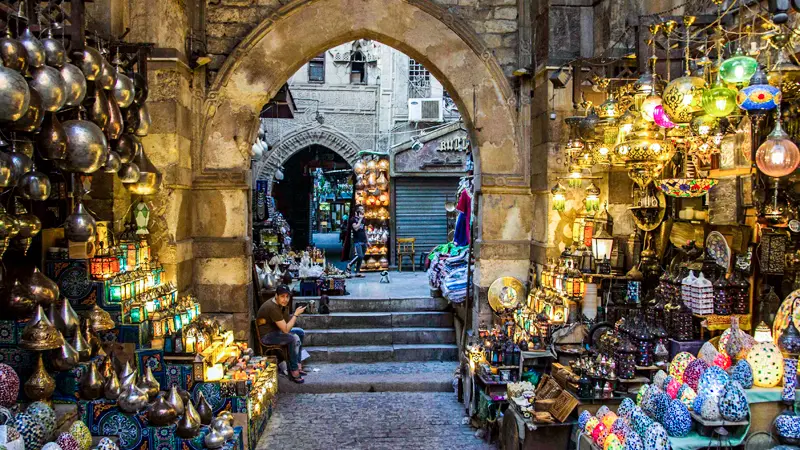
22. Al-Muizz Street
Al-Muizz Street is one of the most rewarding places for exploring historic Islamic architecture in Cairo.
The surrounding area contains mosques, madrasas, historic houses, mausoleums, and other buildings from different periods.
It pairs naturally with Khan el-Khalili and is particularly atmospheric later in the day.
Visitors who want to experience more than ancient Egyptian monuments should make time for this part of the city.
23. Coptic Cairo and the Hanging Church
Coptic Cairo provides a very different perspective on Egypt’s religious and cultural history.
One of its best-known sites is the Hanging Church, along with the Church of St. Sergius and Bacchus and the Ben Ezra Synagogue.
This area can be combined with other attractions in Old Cairo for a half-day or longer cultural itinerary.
24. Egyptian Museum
The Egyptian Museum in Cairo has played a central role in displaying ancient Egyptian antiquities for generations.
Egypt’s museum landscape has changed significantly with the development of newer institutions, so travelers should check current collections, opening information, and exhibition arrangements before deciding which museums to visit.
If you are choosing between Cairo’s major collections, this comparison of the Egyptian Museum and Grand Egyptian Museum can help you decide whether to visit one or both.
25. Grand Egyptian Museum
The Grand Egyptian Museum near the Giza Plateau is an important addition to a Cairo and Giza itinerary.
Its location makes it practical to combine museum time with the pyramids, although attempting to see both comprehensively in a rushed half-day can reduce the quality of the experience.
Travelers who want to build the museum into a guided itinerary can explore Grand Egyptian Museum tours.
Famous Landmarks in Alexandria
Alexandria offers a different historical character from Cairo, Luxor, and Aswan. Its identity reflects ancient Mediterranean, Greco-Roman, Islamic, and modern influences.
For travelers considering an overnight stay or day trip, the guide to Alexandria city provides a broader introduction to the destination.

26.Catacombs of Kom el-Shoqafa
The Catacombs of Kom el-Shoqafa are among Alexandria’s most important archaeological landmarks.
The underground burial complex is especially interesting because its decoration reflects a mixture of Egyptian, Greek, and Roman influences.
Visitors should expect stairs and enclosed underground spaces.
27.Citadel of Qaitbay
The Citadel of Qaitbay stands on Alexandria’s Mediterranean waterfront.
Built in the 15th century, the fortress occupies a strategic coastal location associated with the area of the ancient Lighthouse of Alexandria.
The sea views and waterfront setting make it one of the city’s most recognizable landmarks.
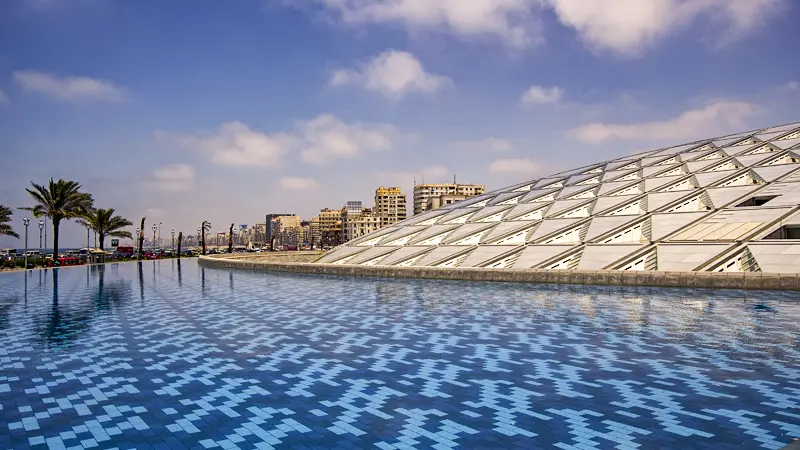
28.Bibliotheca Alexandrina
The modern Library of Alexandria is a contemporary cultural landmark inspired by Alexandria’s ancient scholarly legacy.
It provides a useful contrast to the city’s archaeological sites and demonstrates that Alexandria’s identity is not limited to surviving ancient ruins.
29.Pompey’s Pillar
Pompey’s Pillar is one of Alexandria’s best-known ancient monuments.
The monumental column stands within the archaeological area of the Serapeum and can be incorporated into an itinerary that also includes the Catacombs and waterfront attractions.
Natural Landmarks in Egypt
Not every famous landmark in Egypt was built by humans. The country also contains distinctive deserts, oases, mountains, coastlines, coral environments, and protected natural areas.
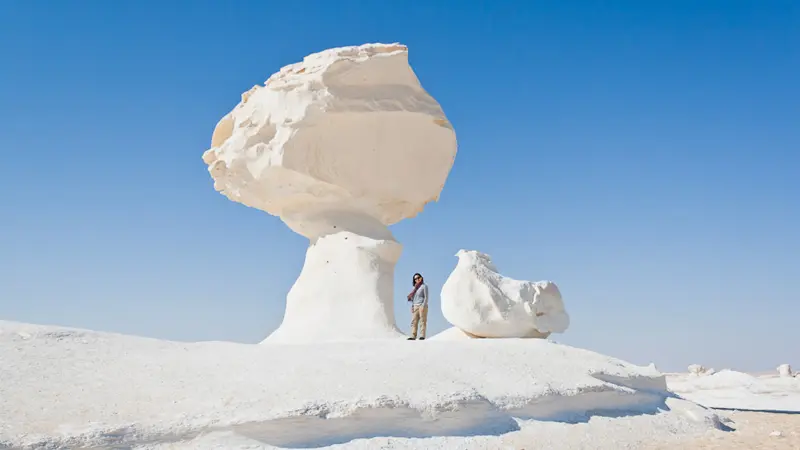
30.White Desert
The White Desert is one of Egypt’s most unusual natural landscapes.
Its pale limestone and chalk formations have been shaped by erosion into distinctive forms across the desert.
Trips usually require suitable desert transportation and careful planning. Travelers considering this region should use an experienced operator rather than treating it as a normal self-guided sightseeing destination.
31.Siwa Oasis
Siwa Oasis is one of Egypt’s most distinctive oasis destinations.
It combines desert landscapes, salt lakes, palm groves, traditional settlements, springs, and archaeological sites.
Siwa requires substantially more travel time than Cairo or Luxor, so it works best for visitors with longer itineraries rather than travelers trying to see Egypt’s major landmarks in one week.
32.Ras Mohammed National Park
Ras Mohammed National Park is one of Egypt’s best-known natural attractions near Sharm El Sheikh.
The protected area is associated with Red Sea marine environments, reefs, coastal landscapes, snorkeling, and diving.
It demonstrates how different Egypt’s natural landmarks can be from its archaeological attractions.
33.Mount Sinai and Saint Catherine
Sinai combines natural landscapes with major religious and historical significance.
The Monastery of Saint Catherine is one of the region’s most important cultural landmarks, while Mount Sinai attracts visitors interested in hiking, religious heritage, and desert scenery.
The area requires different planning from the Nile Valley because of its mountainous environment and travel distances.
Which Egyptian Landmarks Should First-Time Visitors Prioritize?
For most first-time travelers, the strongest route is:
-
Cairo and Giza for the pyramids, Sphinx, major museums, and Historic Cairo.
-
Luxor for Karnak, Luxor Temple, Valley of the Kings, and West Bank monuments.
-
Aswan for Philae, Nubian heritage, and Nile scenery.
-
Abu Simbel if the itinerary allows enough time.
-
Alexandria, the Western Desert, or the Red Sea as extensions.
A traveler with only five days should not try to cover every major landmark in Egypt. Concentrating on Cairo and Luxor usually produces a more manageable trip.
With seven to ten days, it becomes easier to combine Cairo with Luxor and Aswan.
For a ready-made starting point, compare Egypt itineraries and tour packages before deciding how many regions to include.
Cairo vs Luxor vs Aswan: Which Has the Best Landmarks?
| Destination | Main Landmarks | Best For | Suggested Stay |
|---|---|---|---|
| Cairo/Giza | Pyramids, Sphinx, museums, Citadel, Historic Cairo | First-time visitors and broad history | 2–4 days |
| Luxor | Karnak, Valley of the Kings, Luxor Temple, Hatshepsut Temple | Ancient temples and tombs | 2–3 days |
| Aswan | Philae, Elephantine, Nubian sites | Nile scenery and southern Egypt | 2–3 days |
| Abu Simbel | Rock-cut temples | Monumental temple architecture | Day trip or overnight |
| Alexandria | Catacombs, Qaitbay, Bibliotheca | Mediterranean and Greco-Roman heritage | 1–2 days |
The best destination depends on your interests. Cairo offers the broadest variety, Luxor has an exceptional concentration of pharaonic monuments, and Aswan combines archaeological sites with a slower Nile setting.
Can You See Egypt’s Famous Landmarks on a Nile Cruise?
A Nile cruise is one of the most practical ways to connect several famous landmarks in Upper Egypt, particularly between Luxor and Aswan.
Cruise itineraries commonly provide access to major sites in Luxor and Aswan and may stop near temples such as Edfu Temple and Kom Ombo Temple.
However, a Nile cruise does not replace Cairo and Giza. The Pyramids, Sphinx, Cairo museums, and Historic Cairo need to be added separately.
Travelers interested in combining both can compare Egypt tours with a Nile cruise.
How Many Days Do You Need to See Egypt’s Famous Places?
Around 7–10 days is a practical starting point for travelers who want to see the Pyramids of Giza, Cairo, Luxor, and Aswan without compressing every destination into extremely short visits.
A five-day itinerary normally requires significant prioritization.
Seven days can cover Cairo plus key Upper Egypt highlights.
Eight to ten days allows a more comfortable Cairo, Luxor, and Aswan route.
Twelve to fourteen days creates room for additions such as Abu Simbel, Alexandria, the Red Sea, or the Western Desert.
Travelers with more time can use a 10-day Egypt itinerary as a framework and adjust it according to their interests.
Best Time to Visit Egypt’s Landmarks
For many travelers, the cooler months are the most comfortable period for intensive sightseeing, especially at exposed archaeological sites.
Winter generally offers more comfortable daytime temperatures, but popular sites may also be busier.
The shoulder seasons can offer a useful balance depending on your tolerance for heat and your travel dates.
Summer requires more careful scheduling. Early starts, water, sun protection, and breaks become particularly important at open-air sites such as Giza, Saqqara, and Luxor’s West Bank.
For a broader seasonal comparison, read the guide to the best time to visit Egypt.
What Should You Wear When Visiting Egyptian Landmarks?
Comfortable, lightweight clothing is usually the most practical choice for archaeological sightseeing.
Walking shoes are important because many sites involve uneven stone, sand, slopes, stairs, or long distances between monuments.
A sun hat, sunglasses, sunscreen, and water are useful for outdoor attractions.
When visiting mosques, churches, monasteries, and other active religious sites, clothing should also respect local expectations.
Before departure, use this practical Egypt packing guide to prepare for the season and destinations on your itinerary.

Are Egypt’s Famous Landmarks Suitable for Families?
Many Egyptian landmarks can be rewarding for children, especially the pyramids, Sphinx, temples, museums, and Nile experiences.
The main challenge is usually pacing.
Long archaeological days, midday heat, early departures, and repeated temple visits can become tiring for younger travelers.
Families often benefit from shorter sightseeing periods, private transportation, flexible meal stops, and a mix of archaeological and recreational activities.
Travelers visiting with children can explore family tours in Egypt when planning a more flexible route.
Are Egypt’s Landmarks Wheelchair Accessible?
Accessibility varies considerably between Egyptian landmarks.
Some museums, visitor areas, and modern facilities are easier to navigate than ancient tombs, pyramids, temples, and archaeological terrain.
Sites may include sand, uneven stone, steep ramps, narrow entrances, stairs, or long walking distances. Accessibility can also vary within the same attraction.
Travelers with mobility requirements should therefore evaluate each site individually rather than assuming an entire destination is accessible or inaccessible.
For detailed planning, see the guide to wheelchair accessibility in Egypt and available wheelchair-accessible Egypt tours.
Common Mistakes When Visiting Famous Landmarks in Egypt
One common mistake is trying to visit too many sites in a single day. Giza, Saqqara, Historic Cairo, and major museums all deserve enough time to be experienced properly.
Another is underestimating travel distances. Cairo traffic, the journey between Aswan and Abu Simbel, and transfers between different regions can consume a significant part of the day.
Visitors also sometimes focus exclusively on the most famous monument and miss the surrounding archaeological context. Giza makes more sense when its pyramids, Sphinx, temples, and wider necropolis are considered together.
Finally, do not assume ticket policies, opening hours, tomb access, museum collections, or photography rules will remain unchanged through 2027. Check current information shortly before your visit.
Expert Tips for Planning an Egypt Landmarks Itinerary
- Group attractions geographically whenever possible. Visit Giza attractions together, organize Luxor by East Bank and West Bank, and combine nearby Aswan attractions.
- Start exposed archaeological sites early when conditions are more comfortable.
- Avoid adding a long-distance transfer immediately after an already demanding sightseeing day.
- Use a knowledgeable guide at sites where historical context significantly improves the experience, particularly large temple complexes and archaeological areas.
- Leave some flexibility in the itinerary for changing opening arrangements, traffic, weather, and personal energy levels.
If you prefer not to build every transfer and sightseeing day yourself, a tailor-made Egypt trip can connect the major landmarks around your preferred travel pace.

FAQs About Famous Landmarks in Egypt
What is the most famous landmark in Egypt?
The Great Pyramid of Giza is generally considered Egypt’s most famous landmark. It is the largest pyramid on the Giza Plateau and the only surviving Wonder of the Ancient World.
What are the top 5 landmarks in Egypt?
For a first visit, five of the most recognizable landmarks are the Great Pyramid of Giza, Great Sphinx, Karnak Temple, Valley of the Kings, and Abu Simbel.
What are the three main pyramids in Egypt?
The three principal pyramids on the Giza Plateau are the Great Pyramid of Khufu, Pyramid of Khafre, and Pyramid of Menkaure.
Is Luxor worth visiting after seeing the pyramids?
Yes. Giza and Luxor offer very different archaeological experiences. Giza is famous for Old Kingdom pyramid complexes, while Luxor is especially known for New Kingdom temples, royal tombs, and the monuments of ancient Thebes.
How many days should I spend in Luxor?
Two full sightseeing days are a practical minimum for many first-time visitors: one for the East Bank and another for the West Bank. Additional time allows visits to secondary temples, museums, and nearby sites.
Is Abu Simbel worth the trip from Aswan?
Abu Simbel is particularly worthwhile for travelers interested in monumental temple architecture and Ramesses II. The main consideration is the additional travel time required from Aswan.
Can I visit Cairo and Luxor in one trip?
Yes. Cairo and Luxor are commonly combined, and adding Aswan creates one of the most comprehensive first-time routes through Egypt.
Are there famous natural landmarks in Egypt?
Yes. Major natural attractions include the White Desert, Siwa Oasis, Sinai mountains, Red Sea reefs, and Ras Mohammed National Park.
What famous landmarks are in Alexandria?
Alexandria’s best-known landmarks include the Catacombs of Kom el-Shoqafa, Citadel of Qaitbay, Bibliotheca Alexandrina, and Pompey’s Pillar.
Are the Pyramids of Giza close to central Cairo?
The pyramids are in Giza within the Greater Cairo metropolitan area, but journey times depend heavily on the starting point and traffic conditions.
Can I see the major landmarks of Egypt in seven days?
Seven days can cover several major landmarks if the itinerary is carefully planned, particularly Cairo/Giza plus Luxor and possibly Aswan. However, a longer trip provides a more comfortable pace and allows additional destinations.
Final Thoughts: Which Famous Landmarks in Egypt Should You Visit in 2027?
The famous landmarks in Egypt in 2027 offer much more than the Pyramids of Giza.
A first-time journey can begin with the Great Pyramid and Sphinx, continue south to Karnak, Luxor Temple, Valley of the Kings and Hatshepsut Temple, then follow the Nile toward Philae and Abu Simbel.
Travelers with more time can expand the journey into Historic Cairo, Alexandria, Saqqara, Dahshur, Siwa, the White Desert, Sinai, or the Red Sea.
The best itinerary is not necessarily the one containing the greatest number of landmarks. It is the one that gives you enough time to understand and enjoy the places you have traveled to see.
For travelers ready to turn these landmarks into a complete itinerary, compare Egypt tour packages or build a personalized route with Egypt tailor-made holidays.
