
Quick Answer: What are the Catacombs of Kom El Shoqafa, and are they worth visiting in 2027?
The Catacombs of Kom El Shoqafa are an underground Roman-era burial complex in Alexandria, Egypt, dating mainly to the second century AD. Famous for combining ancient Egyptian, Greek, and Roman art, the catacombs contain a spiral staircase, funerary banquet hall, rock-cut sarcophagi, and remarkable images of Anubis. They are worth visiting for their architecture, history, and unusual religious symbolism. Allow approximately 60–90 minutes.
Beneath the busy streets of Alexandria lies an archaeological site where an Egyptian god wears Roman military clothing, Greek architectural features frame burial chambers, and stone corridors reveal how families commemorated their dead nearly 2,000 years ago.
The Catacombs of Kom El Shoqafa are among the most distinctive surviving monuments of Roman Alexandria. Unlike Egypt’s famous pyramid complexes, these tombs were created in a multicultural Mediterranean city where traditional Egyptian beliefs continued alongside Greek and Roman customs.
For travelers planning a visit in 2027, the experience is both fascinating and practical to understand in advance. The underground route involves stairs, some areas are inaccessible, and knowing which carvings to examine can make a considerable difference.
Catacombs of Kom El Shoqafa at a Glance
| Visitor Information | Details |
|---|---|
| Official attraction name | Catacombs of Kom El Shoqafa |
| Alternative spellings | Kom el-Shoqafa, Kom al-Shuqafa, Kom El-Shukafa |
| Location | Karmouz area, Alexandria, Egypt |
| Country | Egypt |
| Historical period | Roman Egypt |
| Principal construction period | Late first to second century AD |
| Continued use | Approximately through the fourth century AD |
| Original purpose | Family burial complex, later expanded into a larger necropolis |
| Architectural structure | Three underground levels, with access restrictions |
| Famous feature | Anubis depicted wearing Roman military clothing |
| Typical visit duration | 60–90 minutes |
| Recommended time for enthusiasts | Up to 2 hours |
| Foreign adult admission | EGP 200 at the October 2026 official rate |
| Foreign student admission | EGP 100 at the October 2026 official rate |
| Published opening time | 9:00 AM daily |
| Published last entry | 4:00 PM outside Ramadan |
| Accessibility | Underground stairs and confined passages; confirm current accommodations |
| Best nearby archaeological stop | Pompey’s Pillar and the Serapeum site |
Important 2027 planning note: The ticket prices and published operating arrangements above were checked against official information available in October 2026. They are not guaranteed 2027 rates. Confirm the latest arrangements before purchasing tickets or finalizing an itinerary.
What Makes the Catacombs of Kom El Shoqafa Special?
The Catacombs of Kom El Shoqafa are important because their architecture and decorations combine several cultural traditions within a single Roman-era burial complex.
They demonstrate that the history of ancient Egypt did not end with the pharaohs.
Egyptian religious symbols continued to be used under Roman rule, while local communities adopted Greek architectural forms, Roman decorative conventions, and new ways of organizing burial spaces.
The result is not simply a Roman cemetery with Egyptian decorations.
It is evidence of how people in Alexandria adapted different beliefs and artistic languages to express ideas about death, protection, remembrance, and the afterlife.
Three details make the site particularly memorable.
An Egyptian God Appears as a Roman Soldier
One of the catacombs’ most famous carvings depicts Anubis, the jackal-headed Egyptian deity associated with embalming and the dead, wearing elements of Roman military dress.
The combination is immediately recognizable once someone points it out.
Anubis remains an Egyptian god, but his appearance incorporates the visual language of Roman power and protection.
This image is a particularly accessible example of cultural interaction in Roman Egypt.
Families Gathered Underground to Remember the Dead
The catacombs contain a triclinium, a funerary banquet chamber where commemorative meals could take place.
A visitor expecting only rows of graves may be surprised to discover space designed for people who were still alive.
Burial was not necessarily the end of a family’s connection to the deceased. Funeral rituals and later remembrance could include shared meals, offerings, and ceremonies.
The Tombs Follow a Vertical Underground Design
The principal complex is organized around a descending staircase and a series of subterranean chambers.
This makes the visit different from walking through a conventional museum or a surface-level archaeological site.
You move from modern Alexandria into spaces excavated directly from the rock, with the architecture gradually revealing its ceremonial purpose.
The experience is especially rewarding when visitors understand the sequence of rooms rather than treating the catacombs as an underground maze.
Where Are the Catacombs of Kom El Shoqafa Located?
The Catacombs of Kom El Shoqafa are located in the Karmouz area of western Alexandria, in northern Egypt.
The surrounding district is an ordinary urban neighborhood rather than a large archaeological park. That contrast is part of the experience: the entrance leads from the modern city into a substantial ancient burial complex below ground.
The attraction is relatively close to Pompey’s Pillar and the remains of the Serapeum of Alexandria.
This makes the two archaeological sites a practical pairing.
The catacombs are farther from Alexandria’s eastern waterfront attractions, including the Bibliotheca Alexandrina, and from the coastal Citadel of Qaitbay.
A car or taxi is usually more convenient than walking between all of these locations.
How Far Are the Catacombs from Central Alexandria?
The distance depends on your starting point.
From central Alexandria and the Raml Station area, expect several kilometers of urban travel. Road traffic, the exact pickup location, and the route can affect the journey.
Pompey’s Pillar is much closer, approximately a short walk or drive away, depending on the entrance route and personal mobility.
Travelers unfamiliar with Alexandria should ask their driver for the Catacombs of Kom El Shoqafa in Karmouz rather than simply requesting the “Roman tombs.”
Several archaeological sites in Alexandria contain ancient burials, so the complete attraction name reduces confusion.
For broader geographical context and accommodation planning, see our guide to Alexandria, Egypt.
The History of the Catacombs of Kom El Shoqafa
The history of the Catacombs of Kom El Shoqafa begins in the Roman period, when Alexandria was one of the Mediterranean world’s major urban centers.
The earliest parts of the burial complex are generally dated to the late first or early second century AD, with substantial development during the second century.
The site continued to be used and expanded in later centuries.
Understanding this history helps explain why its architecture contains such an unusual mixture of traditions.
Alexandria Before the Catacombs Were Built
Alexandria was founded in 331 BC under Alexander the Great.
During the following Ptolemaic period, the city became the capital of a Greek-ruled kingdom in Egypt and an important center of Mediterranean commerce, scholarship, and culture.
Its population included people from different linguistic, religious, and cultural backgrounds.
Egyptian temples and religious traditions coexisted with Greek institutions, and new religious practices developed through contact between communities.
In 30 BC, Egypt became a Roman province following the defeat of Cleopatra VII and Mark Antony.
Alexandria remained an important city under Roman administration.
By the time the Kom El Shoqafa burial complex developed, Egyptian funerary imagery already had a long history, while Greek and Roman customs were deeply established in the city.
The catacombs reflect this environment.
They were not created during the Old Kingdom or the era of the pyramid builders. They belong to a much later stage of Egyptian history.
From a Private Family Tomb to a Larger Cemetery
Archaeological interpretations generally suggest that the central monument began as a substantial private family burial complex.
Its carefully planned architecture, ceremonial spaces, and decorated burial chamber indicate considerable investment.
Over time, the complex appears to have expanded to accommodate additional burials.
Corridors and burial niches increased the available space, gradually transforming the original monument into a larger necropolis.
A necropolis is an organized cemetery or burial area, often containing numerous tombs.
The Egyptian Ministry of Tourism and Antiquities describes Kom El Shoqafa as a burial complex that initially belonged to a wealthy Roman-period family and later became more widely used.
The expansion is important because the catacombs were not necessarily planned as one enormous cemetery from the beginning.
Their present arrangement reflects development over time.
Who Built the Catacombs of Kom El Shoqafa?
The catacombs were constructed during the Roman occupation of Egypt, probably for an affluent Alexandrian family.
The identities of the original owners are not securely established.
Although the tombs are commonly described as Roman, that does not mean the people associated with them followed only Roman cultural traditions.
The architecture demonstrates the interaction of Egyptian religious beliefs with Greek and Roman artistic conventions.
It would therefore be misleading to assign a simple modern ethnic identity to the tomb’s original occupants based on its decorative style alone.
What can be said confidently is that the builders belonged to the cultural world of Roman Alexandria.
When Were the Catacombs Used?
The site’s principal phases fall within the Roman imperial period.
| Historical Period | Significance |
|---|---|
| 331 BC | Foundation of Alexandria under Alexander the Great |
| 30 BC | Egypt becomes part of the Roman Empire |
| Late 1st–2nd century AD | Principal early development of Kom El Shoqafa |
| 2nd–4th centuries AD | Continued funerary use and expansion |
| Around the end of the 4th century AD | Burial use is generally considered to have ended |
| 1900 | Modern rediscovery becomes widely associated with the site |
| 2025–2026 | Visitor-service improvements and expanded electronic ticketing arrangements are reported |
The timeline illustrates why the catacombs should be understood within Roman Egyptian history rather than as a monument of the pharaonic dynasties.
How Were the Catacombs of Kom El Shoqafa Discovered?
The modern discovery of the catacombs is commonly dated to 1900.
A frequently repeated story claims that a donkey fell into an underground opening, drawing attention to the buried complex.
The donkey account is a popular discovery anecdote, but it should not be treated as a fully established archaeological explanation without supporting documentation.
Archaeological investigations in the surrounding area were already taking place around this period.
The more important historical fact is that excavations brought renewed attention to an extensive Roman-era funerary monument that had disappeared from ordinary urban view.
The discovery helped scholars better understand burial practices in ancient Alexandria.
Why Is It Called Kom El Shoqafa?
The name Kom El Shoqafa is commonly understood to refer to a mound of pottery fragments or broken pottery.
The name is associated with the accumulation of ceramic remains in the area.
One traditional explanation connects some of these fragments with vessels used during funerary commemorations and meals.
However, the precise history of every deposit should not be inferred from the name alone.
The connection between pottery, remembrance, and funerary customs remains useful for understanding the site’s cultural setting.
Alternative English spellings include Kom el-Shuqafa, Kom al-Shoqafa, Kom al Shuqafa, and Kom el-Shoqafa.
These different transliterations refer to the same archaeological site in Alexandria.
What Can You See Inside the Catacombs of Kom El Shoqafa?
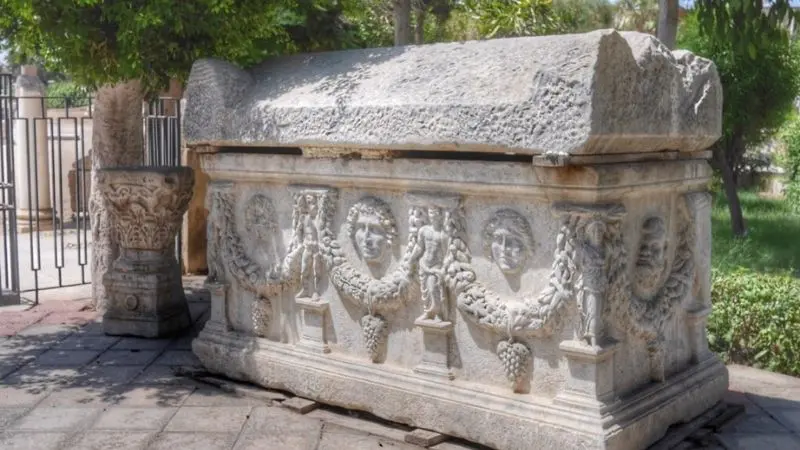
The principal attractions are the spiral staircase, rotunda, triclinium, main burial chapel, decorated sarcophagi, funerary reliefs, and associated burial chambers.
The full ancient complex extends across three levels, but modern visitors should not assume that every level or passage is accessible.
The layout has developed over centuries, and conservation requirements can affect the visitor route.
The Spiral Staircase: Descending Into the Necropolis
The visit begins with a descent by a substantial spiral staircase arranged around a central shaft.
The architectural design allowed people to reach the underground rooms while providing a functional connection between the surface and the burial complex.
The central shaft is commonly understood to have assisted in moving materials and the dead into the lower areas.
This arrangement is practical as well as ceremonial.
The staircase also establishes the atmosphere of the site.
As visitors descend, the surrounding rock and enclosed structure create a very different sense of space from Alexandria’s open streets.
The descent is one of the most memorable parts of the experience, but it also presents an important accessibility limitation.
Visitors must be comfortable negotiating the stairs and returning by the same general route.
There is no reason to rush.
Allow people ahead of you enough room, keep one hand available for support, and avoid looking at your phone while walking down.
The staircase is part of the archaeological monument, so visitors should treat it carefully.
The Rotunda: A Central Underground Space
At the lower end of the staircase, visitors encounter the rotunda and connecting spaces.
The rotunda serves as an important circulation point within the original monument.
Its rounded form contrasts with the straighter corridors and burial chambers elsewhere in the complex.
Rather than imagining the structure as a collection of disconnected tombs, think of the rotunda as a central element organizing movement through the underground architecture.
From this area, passages lead toward significant funerary rooms.
The spatial arrangement shows how the builders combined engineering and ceremonial design.
It also helps explain why the principal burial chamber feels more elaborate than the surrounding corridors.
The visitor progresses from an access route into spaces with increasing religious and funerary significance.
The Triclinium: Where the Living Remembered the Dead
One of the most revealing spaces is the triclinium, a chamber associated with funerary banquets.
The term comes from the Greco-Roman dining tradition of reclining during meals.
In the catacombs, stone seating or reclining arrangements were carved into the architecture.
Such spaces were connected with funerary meals and commemorative gatherings.
They show that the dead continued to have a place in the social and religious lives of their families.
For modern visitors, this chamber changes the way the whole site should be interpreted.
The catacombs were not simply built to store bodies.
They also provided places for ceremonies and acts of remembrance.
The triclinium is therefore an important piece of evidence for social practices in Roman Alexandria.
It demonstrates how dining customs associated with the Mediterranean world could become part of local funerary traditions.
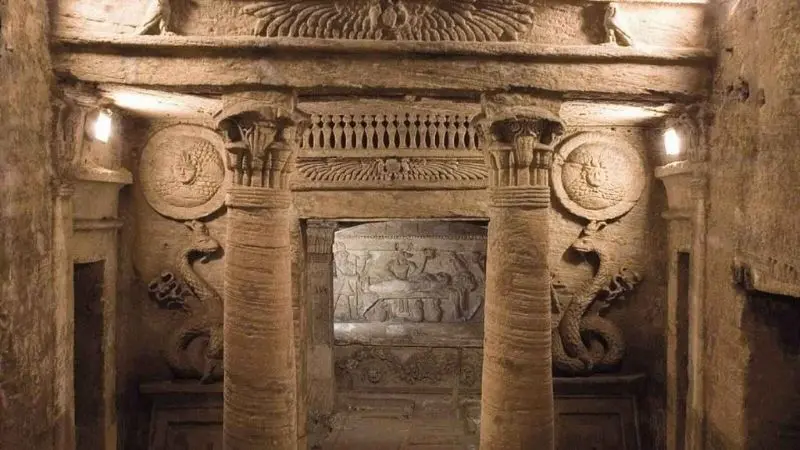
The Main Burial Chamber: The Architectural Centerpiece
The main decorated tomb is the most significant artistic space within the complex.
It contains three substantial rock-cut sarcophagi and relief decoration influenced by several cultural traditions.
The chamber’s architectural treatment resembles a sacred or ceremonial setting rather than a plain storage space for burials.
Visitors can examine columns, carved architectural details, religious imagery, and sculpted elements surrounding the sarcophagi.
The combination is especially striking because the decoration does not belong to one simple artistic tradition.
Egyptian gods appear in scenes framed by Greco-Roman architectural conventions.
The burial chamber expresses ideas about protection, transformation, and the continuation of existence after death.
It also reveals the status and aspirations of those associated with the tomb.
Considerable resources and skilled craftsmanship would have been required to create such elaborate underground stonework.
The Three Sarcophagi: What Do the Carvings Mean?
The principal burial chamber contains three prominent sarcophagi carved from the surrounding rock.
Their architectural and decorative treatment reflects Roman-period funerary art.
The reliefs include religious scenes connected with Egyptian beliefs about death and resurrection.
The central sarcophagus and related imagery are particularly important.
A prominent funerary scene depicts Anubis attending to a body on a ceremonial bed, a representation associated with embalming and preparation for the afterlife.
Other deities and sacred objects appear within the decorative program.
These are not merely ornamental designs.
They relate to religious ideas that had developed in Egypt over many centuries.
The preservation of this imagery during the Roman period illustrates the continued importance of traditional Egyptian funerary beliefs.
It does not establish that every burial followed identical rituals, however.
Individual funerary practices could vary according to family, resources, social position, and religious preferences.
Anubis Wearing Roman Armor: The Most Unusual Detail
One of the best reasons to visit Kom El Shoqafa is to examine the figure of Anubis.
In ancient Egyptian religion, Anubis was strongly associated with embalming, burial protection, and the passage between life and death.
His traditional appearance is that of a jackal-headed deity.
Inside the Alexandria catacombs, Anubis is depicted with Roman military elements.
One representation also combines the deity with serpentine features, reflecting the interaction of Egyptian and wider Mediterranean symbolism.
This is a powerful example of religious syncretism.
Syncretism occurs when ideas, imagery, or practices from different religious traditions become combined or adapted.
The image does not mean the Romans simply replaced Anubis with a Roman god.
Instead, it shows an Egyptian deity represented through a visual vocabulary that would have been familiar within the Roman imperial world.
The protective role of Anubis remained meaningful.
His Roman-style presentation gave that role an additional artistic expression.
For travelers familiar with conventional images of ancient Egyptian gods, this is one of the site’s most rewarding details.
It also offers a reason to learn more about ancient Egyptian gods and goddesses before visiting.
Horus, Thoth, Osiris and Other Funerary Symbols
The catacombs’ imagery becomes easier to interpret when the major deities are understood in relation to Egyptian beliefs about death.
Anubis is associated with embalming and burial protection.
Osiris is associated with the afterlife, regeneration, and the possibility of renewed existence.
Horus is connected with divine kingship, protection, and the restoration of order.
Thoth is associated with knowledge, writing, and ritual authority.
These roles could overlap in funerary religious settings.
A single scene might include several deities because each contributed a different aspect of protection or transformation.
The Apis bull and other religious symbols also appear within the decorative tradition of the tombs.
Serapis, a deity strongly associated with Greco-Roman Alexandria, represents another important example of the interaction between Egyptian and Greek religious ideas.
Not every image should be interpreted as evidence of one unified religion.
The site instead demonstrates the complexity of religious life in a city where traditions were frequently adapted.
The Hall of Caracalla: History and Uncertainty
The Hall of Caracalla is another area associated with the Kom El Shoqafa complex.
It is often connected in popular accounts with the Roman emperor Caracalla and a violent episode in Alexandria during his reign.
Caracalla ruled from AD 211 to 217.
Ancient historical accounts describe severe violence in Alexandria under his authority.
However, the traditional association between a particular underground burial space and these events is not secure enough to present as proven.
The presence of human and animal remains has contributed to different interpretations of the area’s history.
The name should therefore be understood as a conventional identification rather than definitive archaeological proof of a particular incident.
For travelers, the room illustrates an important principle: archaeological sites often preserve genuine physical evidence alongside historical interpretations that remain uncertain.
Understanding that distinction makes the visit more informative.
Access to subsidiary chambers can vary, so check the permitted visitor route during your visit.
The Tigrane Tomb and Other Funerary Remains
Kom El Shoqafa is associated not only with the principal catacomb but also with other funerary remains recovered in the surrounding area.
These include the tomb often referred to as the Tigrane or Tigra Tomb.
It is known for its surviving funerary decoration and the combination of Egyptian and Greco-Roman artistic elements.
Additional architectural fragments, sculptural remains, and funerary objects help illustrate the wider archaeological landscape of ancient Alexandria.
Visitors should not assume that every object mentioned in historical accounts is displayed in its original position.
Some material has been moved, conserved, or exhibited elsewhere.
The arrangement of surface displays can also change.
Allow a little time to inspect any accessible above-ground displays before leaving, rather than focusing exclusively on the descent.
Can You Visit All Three Underground Levels?
The Catacombs of Kom El Shoqafa were constructed across three underground levels, but this does not mean tourists can freely explore all three today.
The lowest areas have historically experienced water-related access problems.
Certain passages may be restricted because of conservation requirements, safety considerations, or ongoing work.
A visitor ticket gives access to the permitted visitor route, not unrestricted entry to the entire ancient necropolis.
This distinction matters if you have seen floor plans, documentaries, or photographs showing spaces that are not included in a standard visit.
The best approach is to concentrate on the principal decorated chambers that are accessible.
Those spaces contain the most important artistic features of the site.
How to Understand the Egyptian, Greek and Roman Influences
The architectural character of the catacombs is sometimes described as a blend of Egyptian, Greek, and Roman styles.
That description is accurate in broad terms, but the individual influences are worth distinguishing.
| Cultural Tradition | Visible or Historical Influence | What It Tells Visitors |
|---|---|---|
| Ancient Egyptian | Anubis, funerary deities, mummification-related reliefs | Egyptian beliefs about death remained influential |
| Greek and Hellenistic | Architectural forms and aspects of the tomb arrangement | Alexandria retained a strong Hellenistic cultural inheritance |
| Roman | Imperial-period funerary decoration and military imagery | Roman political and artistic influences shaped local expression |
| Shared Alexandrian culture | Combination of different traditions within one monument | Cultural practices could interact rather than remain separate |
Were the Catacombs Egyptian or Roman?
The most accurate description is that Kom El Shoqafa is a Roman-period Egyptian funerary complex.
It was created within Egypt under Roman rule.
Its architecture and decoration reflect several cultural traditions.
The Egyptian religious elements are not accidental additions to an otherwise unrelated monument.
They form part of the central funerary program.
At the same time, the arrangement and appearance of the tomb reflect the cosmopolitan world of Alexandria.
Calling the site simply “Roman” can obscure its Egyptian religious content.
Calling it a purely pharaonic tomb would be equally misleading.
Why Did Roman-Era Families Use Egyptian Gods?
Traditional Egyptian funerary religion had developed sophisticated explanations of death, protection, resurrection, and the afterlife.
These beliefs remained meaningful after Egypt came under Greek and then Roman rule.
Egyptian deities could be adopted or represented in settings influenced by wider Mediterranean culture.
Their appearance within Roman-era tombs therefore does not necessarily indicate cultural contradiction.
For people living in ancient Alexandria, multiple traditions could exist within the same social environment.
The visual combination in Kom El Shoqafa reflects this historical reality.
Catacombs of Kom El Shoqafa Tickets and Entrance Fees for 2027
The official ticketing information checked in October 2026 lists foreign adult admission at EGP 200 and eligible foreign student admission at EGP 100.
These are the latest verified rates used in this guide, not confirmed prices for the entire 2027 travel year.
Official Ticket Prices
| Visitor Category | Published Price, October 2026 |
|---|---|
| Foreign adult | EGP 200 |
| Foreign student | EGP 100 |
| Egyptian adult | EGP 30 |
| Egyptian student | EGP 10 |
| Children under 6 | Free under the published policy |
The official platform also lists free-entry provisions for qualifying Egyptian visitors with disabilities and Egyptian visitors above 60 years of age.
Eligibility and documentation requirements should be checked before visiting.
The published student policy requires valid student identification and specifies a maximum eligible age of 24.
International travelers should not assume that a student card alone guarantees discounted admission.
The applicable nationality category, age, and proof of eligibility all matter.
How Much Will the Catacombs of Kom El Shoqafa Cost in 2027?
A final 2027 ticket price cannot be guaranteed based on the October 2026 schedule.
For preliminary budgeting, travelers can use the published foreign adult rate of EGP 200 as a historical reference, then update the figure when their travel date approaches.
Additional expenses may include:
-
Transport to and from the attraction.
-
A professional guide, if booked separately.
-
Entry to nearby archaeological sites.
-
Food and refreshments.
-
Any special photography permissions, where applicable.
-
The cost of a private or organized Alexandria excursion.
Do not assume the entrance ticket includes a private guide or admission to another archaeological site.
Those arrangements depend on the specific product purchased.
Can You Buy Catacombs of Kom El Shoqafa Tickets Online?
Yes. The Egyptian Ministry of Tourism and Antiquities operates an official electronic ticketing service for participating archaeological sites, including Kom El Shoqafa.
Visitors should select the correct attraction, ticket category, and intended visit date.
Electronic ticketing and self-service purchase facilities have been introduced at the site.
In-person purchasing arrangements may also be available, subject to the current system.
If you book an organized excursion, confirm whether the entrance fee is already included.
Some tour products combine transport, guiding, and admission. Others quote a base price that excludes individual attraction tickets.
Is Advance Booking Necessary?
Advance booking can be helpful, but travelers should not assume that every independent visit requires a reserved time slot.
The practical decision depends on official ticketing arrangements, expected visitor demand, and whether you are following a fixed schedule.
Advance purchase is particularly useful for cruise passengers or travelers with limited sightseeing time.
For a flexible independent visit, checking the current official booking process before departure is normally sufficient.
Always keep your ticket or electronic confirmation accessible during the visit.
Catacombs of Kom El Shoqafa Opening Hours in 2027
The official ticketing platform lists opening from 9:00 AM, with a last-entry time of 4:00 PM during both summer and winter.
During Ramadan, the published last-entry time is 3:00 PM.
The Ministry’s visitor information describes the corresponding standard closing time as 5:00 PM and Ramadan closing as 4:00 PM.
These two types of information should not be confused.
Last entry is the latest time visitors are admitted. Closing time is when the site finishes operating.
| Period | Published Opening | Published Last Entry | Published Closing |
|---|---|---|---|
| Standard summer schedule | 9:00 AM | 4:00 PM | 5:00 PM |
| Standard winter schedule | 9:00 AM | 4:00 PM | 5:00 PM |
| Ramadan schedule | 9:00 AM | 3:00 PM | 4:00 PM |
Verification note: These schedules reflect official information available in October 2026. Seasonal policies, exceptional closures, or operating arrangements may change during 2027.
What Is the Best Time of Day to Visit?
A morning visit is usually the most practical choice.
Arriving close to opening time gives travelers more flexibility if the site is busy or if they want to continue to Pompey’s Pillar.
Morning visits also work well for organized Alexandria itineraries because archaeological sites with earlier closing times can be completed before the waterfront attractions.
The catacombs are underground, so the experience is less dependent on direct sunlight than an outdoor temple.
However, outside temperatures still matter when traveling between attractions.
Avoid planning your arrival close to the published last-entry time.
A visit shortly before closing may feel rushed, especially if you want to study the reliefs carefully.
How Long Do You Need at the Catacombs of Kom El Shoqafa?
Most travelers should allow approximately 60–90 minutes.
The ideal duration depends on whether you are visiting independently, traveling with a guide, or studying the decorative details in depth.
| Traveler Type | Recommended Time | Main Priority |
|---|---|---|
| Short sightseeing visit | 45–60 minutes | Principal underground chambers |
| First-time visitor | 60–90 minutes | Architecture, main tomb, religious carvings |
| Archaeology enthusiast | 90–120 minutes | Decoration, spatial layout, interpretation |
| Guided visit | Approximately 60–90 minutes | Historical and artistic explanation |
| Family with children | Approximately 45–75 minutes | Main highlights and manageable pace |
These are editorial planning estimates, not official visit durations.
A guided experience may take longer if the group pauses frequently for explanation.
The site should not be rushed simply because it has a relatively compact visitor route.
Much of its importance lies in the details.
A traveler who spends several minutes examining the main tomb may gain more from the visit than someone who walks through every accessible corridor without understanding the imagery.
Is the Catacombs of Kom El Shoqafa Safe and Accessible?
The catacombs are an established archaeological visitor attraction, but the underground environment creates limitations that travelers should consider.
The most important concerns are stairs, enclosed spaces, uneven surfaces, and the physical demands of moving through a historic structure.
Is There Wheelchair Access?
The principal visitor route involves a descending staircase and underground chambers.
A step-free alternative or visitor lift cannot be confirmed from the available official information.
Travelers who require wheelchair access should therefore avoid assuming that the main underground route is accessible.
Contact the attraction or tour operator before booking and ask specifically about the areas currently open to visitors with mobility limitations.
Accessibility improvements at archaeological sites are developing, but general projects to improve visitor services do not guarantee that an ancient underground monument has a usable step-free route.
Travelers comparing accessible alternatives may find our guide to wheelchair accessibility in Egypt helpful when planning the wider trip.
Is the Catacombs of Kom El Shoqafa Suitable for People With Claustrophobia?
The visit may be uncomfortable for people who are sensitive to underground or enclosed spaces.
The staircase and some connecting passages create a sense of depth and enclosure.
The main chambers provide more space, but visitors still need to descend and return through the underground route.
People with severe claustrophobia should consider whether the experience is appropriate.
A traveler who becomes uncomfortable in caves, narrow tunnels, or underground monuments may prefer an outdoor Alexandria attraction.
There is no requirement to visit the deepest accessible space to appreciate the historical importance of the site.
Can Older Travelers Visit?
Age alone does not determine whether a visit is suitable.
The more relevant questions are whether the traveler can comfortably negotiate the staircase, maintain balance on stone surfaces, and walk through the accessible underground sections.
Older visitors with good mobility may enjoy the catacombs without difficulty.
Anyone recovering from surgery or managing significant knee, hip, or balance problems should evaluate the route more carefully.
A private guide can help with pacing and interpretation, but guiding services do not remove the physical limitations of the historic structure.
Can Children Visit the Catacombs?
Yes, children can visit when accompanied and supervised appropriately.
The strongest considerations are their comfort with stairs, dark or enclosed environments, and archaeological sites that must not be touched or climbed.
Families should explain the experience before descending.
Younger children may find the underground architecture exciting, while others may become uncomfortable in enclosed spaces.
Strollers are not a practical substitute for walking through the historic staircase.
Parents should plan a shorter visit if necessary and avoid trying to cover every available chamber.
Practical Safety Advice
Wear comfortable shoes with a reliable grip.
Move slowly on the staircase and watch for uneven surfaces.
Keep bags compact so they do not obstruct narrow passages.
Follow signs and barriers, particularly around archaeological areas closed for conservation.
Do not climb onto sarcophagi or carved stone.
If a section is closed, do not assume it is safe to enter merely because the passage appears physically accessible.
The monument’s preservation depends on visitors respecting restrictions.
What Should You Wear and Bring?
Comfort and mobility are more important than elaborate travel clothing.
The catacombs are not a religious site requiring a specific modern dress code, but practical, respectful clothing is appropriate.
Useful items include:
-
Comfortable walking shoes.
-
Lightweight clothing suited to Alexandria’s weather.
-
A small backpack or crossbody bag.
-
A charged phone containing your ticket details.
-
Student identification if claiming a student rate.
-
Drinking water for before and after the underground visit.
-
A light layer during cooler months.
-
Any personal medication you routinely need.
Avoid large, awkward luggage.
The underground architecture is not designed for travelers carrying suitcases or bulky equipment.
A small flashlight may be useful in some archaeological settings, but visitors should follow the site’s current rules and avoid directing strong light at fragile surfaces.
Visitors should not rely on having reliable mobile reception in every underground area.
Download essential details before entering.
Can You Take Photos Inside the Alexandria Catacombs?
The official ticketing information available in October 2026 states that photography using a mobile phone is free of charge.
That does not mean every form of photography is automatically permitted.
Rules concerning professional cameras, tripods, lighting equipment, flash, and commercial photography may differ.
Always follow posted instructions and directions from site staff.
Best Photography Opportunities
The most distinctive subjects include the descending staircase, the arrangement of the rotunda, the decorated main tomb, and the figure of Anubis in Roman military clothing.
A photograph of the main tomb can communicate the artistic character of the site more effectively than a generic image of an underground corridor.
Where photography is permitted, steady framing and available light are preferable to intrusive equipment.
Do not enter restricted spaces to obtain a better angle.
For visitors seeking catacombs of Kom El Shoqafa photos, images of the Anubis reliefs and the main burial chamber are particularly useful for understanding what makes the monument unique.
Photography Etiquette
Remember that this is an ancient burial site.
Avoid touching reliefs, leaning against fragile architectural elements, or blocking access for other visitors.
If the galleries are busy, take photographs efficiently and move aside.
The best photography does not require interfering with the monument.
How to Get to the Catacombs of Kom El Shoqafa
The easiest way to reach the catacombs from most Alexandria hotels is by private car, taxi, or ride-hailing service.
The attraction is located inland from the Mediterranean waterfront, in a dense urban district.
Public transportation is possible in Alexandria, but first-time international visitors may find it less convenient when following a multi-attraction itinerary.
From an Alexandria Hotel
A taxi or private transfer is generally the simplest option.
Tell the driver that you are visiting Kom El Shoqafa in Karmouz.
If you are visiting independently, confirm the fare or ride-hailing estimate before departure.
Traffic conditions vary, especially during busy urban periods.
Travelers staying along the Corniche should not assume that the catacombs are immediately beside the waterfront.
The route crosses different parts of the city.
From Alexandria Railway Station
Visitors arriving from Cairo commonly use Alexandria’s main railway services.
Alexandria’s Misr Station and Sidi Gaber are important rail stops, depending on the selected service.
A taxi or arranged pickup is a practical way to complete the journey to the catacombs.
Confirm where your train actually stops before planning the transfer.
Arriving at the wrong station can create an unnecessary detour.
For a one-day visit, it is helpful to arrange the first sightseeing stop and the return railway journey in advance.
From Cairo to the Alexandria Catacombs
A Cairo-to-Alexandria day trip is possible, but it should be planned as a full travel day.
Visitors generally have two main options: travel by road or use an intercity train followed by local transportation.
| Travel Option | Advantages | Limitations |
|---|---|---|
| Private vehicle | Direct hotel pickup and flexible sightseeing order | Road traffic can significantly affect travel time |
| Intercity train | Avoids some road-travel inconvenience and suits independent travelers | Requires station transfers and careful scheduling |
| Organized day excursion | Combines transport, guiding, and several attractions | Less freedom to change the itinerary |
| Self-drive rental vehicle | Greater independence | Urban navigation and parking may be stressful |
Road journeys between Cairo and Alexandria commonly require several hours each way, with actual duration dependent on traffic, route, and starting point.
Train travel also requires time for station transfers and local transport.
Do not plan an Alexandria day trip as though the catacombs are a short journey from central Cairo.
An early departure and an appropriately timed return are important.
Travelers deciding how to combine Cairo with the Mediterranean coast can use our Cairo itinerary guide to plan the wider sightseeing sequence.
From Alexandria Cruise Port
Cruise passengers can visit Kom El Shoqafa as part of an Alexandria shore excursion.
The most important consideration is the ship’s departure time.
A port-day itinerary should include sufficient time for travel, attraction visits, security procedures, and the return journey.
Do not assume the full duration of your ship’s port call is available for sightseeing.
An organized excursion can be useful when several attractions must fit into a fixed schedule.
Travelers can explore relevant options through Alexandria port shore excursions.
Before booking, confirm whether the excursion includes admission tickets, guiding, transport, pickup arrangements, and a guaranteed return schedule.
Should You Visit Independently or Book a Guided Tour?
Both approaches are reasonable.
The better choice depends on your interest in archaeology, available time, transport arrangements, and budget.
Independent Visit
An independent visit works well for travelers who are comfortable arranging local transportation and exploring archaeological sites at their own pace.
You can decide how long to spend in the main burial chamber and whether to continue to nearby attractions.
The main limitation is interpretation.
Many of the catacombs’ most important features become more meaningful when their religious and artistic context is explained.
Visitors unfamiliar with Roman Egypt may miss important details in the reliefs.
Guided Archaeological Visit
A knowledgeable guide can explain the relationship between the original family tomb, later burial areas, architectural forms, and funerary symbolism.
This is particularly useful for understanding why Anubis appears in Roman attire.
A guide can also help distinguish historical evidence from popular stories.
The main value is interpretation rather than simply being escorted through the underground passages.
Travelers interested in ancient history may find the additional context worthwhile.
Private Alexandria Day Tour
A private day tour is appropriate for travelers who want to combine the catacombs with several other attractions and avoid organizing individual transfers.
The itinerary can be adjusted around interests such as archaeology, museums, Mediterranean history, or family-friendly sightseeing.
Before confirming any tour, compare what is actually included.
Questions to ask before booking:
-
Does the price include the catacombs entrance ticket?
-
Is the guide qualified to explain Greco-Roman archaeology?
-
Is Pompey’s Pillar included?
-
How much time is allocated to the catacombs?
-
Is the itinerary private or shared?
-
Can the order of attractions change if opening hours change?
-
Are pickup and return transfers included?
The cheapest quoted excursion is not necessarily the best value if important entrance fees or transfers are excluded.
Best Time to Visit the Catacombs of Kom El Shoqafa in 2027
The catacombs can be visited throughout the year, subject to official opening and access arrangements.
Because much of the attraction is underground, it is less directly exposed to the weather than Alexandria’s outdoor monuments.
However, the season still affects transport, walking comfort, and the rest of the sightseeing day.
Spring: March to May
Spring is generally a comfortable period for exploring Alexandria.
Outdoor sightseeing is usually more pleasant than during the hottest summer months.
It is a good season for combining Kom El Shoqafa with the Mediterranean waterfront, museums, and historic monuments.
Visitor demand can vary around holidays.
A morning visit remains a sensible choice.
Summer: June to August
Alexandria’s coastal location gives it a different summer atmosphere from Cairo and Upper Egypt.
Humidity can make outdoor travel uncomfortable, even though the city is influenced by Mediterranean conditions.
The underground nature of the catacombs offers some protection from direct sunlight.
However, visitors still need to travel between attractions.
Plan outdoor sites around your comfort with heat and humidity, and avoid unnecessary long walks during the hottest part of the day.
Autumn: September to November
Autumn is an attractive period for an Alexandria cultural itinerary.
Conditions generally become more comfortable as the season progresses.
Travelers can combine archaeological visits with coastal sightseeing without making the underground tombs the sole focus of the day.
Autumn is particularly useful for visitors who prefer historical attractions to summer beach activities.
Winter: December to February
Winter can bring cooler temperatures, wind, and rain to Alexandria.
The catacombs remain an interesting attraction, but travelers should plan the wider sightseeing day with weather conditions in mind.
A light jacket and suitable footwear can be helpful.
If the weather is unsettled, an itinerary emphasizing archaeological interiors and museums may be more comfortable than one focused entirely on coastal walking.
For additional seasonal context, our Egypt weather by month guide explains how conditions vary across the country.
Which Season Is Best Overall?
Spring and autumn are generally the most comfortable choices for combining the catacombs with a full day of Alexandria sightseeing.
Winter is also worthwhile for travelers interested in museums and cultural attractions.
Summer remains possible, particularly when transport is arranged efficiently.
The best season ultimately depends on the wider Egypt itinerary rather than the catacombs alone.
What Are the Best Attractions Near the Catacombs?
Kom El Shoqafa fits naturally into an Alexandria itinerary focused on archaeology and the city’s Greco-Roman history.
The most efficient nearby pairing is Pompey’s Pillar.
Other important attractions require additional travel across the city.
| Attraction | Main Interest | Suggested Visit Duration | Best Reason to Combine |
|---|---|---|---|
| Pompey’s Pillar and Serapeum | Roman monument and religious history | 45–60 minutes | Close to the catacombs |
| Kom el-Dikka | Roman urban archaeology | 45–75 minutes | Complements the funerary history |
| Greco-Roman Museum | Artifacts and wider historical context | 60–120 minutes | Explains the city’s multicultural past |
| Bibliotheca Alexandrina | Modern cultural institution and exhibitions | 60–120 minutes | Connects ancient and modern Alexandria |
| Citadel of Qaitbay | Coastal fortress and maritime history | 60–90 minutes | Offers a contrasting outdoor experience |
These durations are planning recommendations, not official visit limits.
Pompey’s Pillar and the Serapeum
Pompey’s Pillar is one of the most practical attractions to visit after the catacombs.
The monument stands within an archaeological area associated with the ancient Serapeum of Alexandria.
Despite its popular name, the column was erected in honor of the Roman emperor Diocletian, not Pompey the Great.
The Serapeum was an important religious complex associated with Serapis, a deity whose worship reflected connections between Egyptian and Greek traditions.
This makes the site an especially meaningful companion to Kom El Shoqafa.
The catacombs reveal cultural interaction in funerary practices, while the Serapeum illustrates it within the religious landscape of the city.
See our guide to Pompey’s Pillar in Alexandria for more historical context.
Kom el-Dikka and the Roman Theater
Kom el-Dikka preserves important archaeological evidence of urban life in Roman and late antique Alexandria.
The site includes a theater-like performance space, remains of baths, educational or lecture facilities, and residential structures.
It offers a useful contrast with the catacombs.
Kom El Shoqafa helps explain how people buried and commemorated their dead.
Kom el-Dikka helps visitors imagine other aspects of urban life, including public architecture, learning, housing, and recreation.
Together, the two sites create a broader understanding of Roman Alexandria.
Travelers with a strong interest in archaeology may prefer this combination over trying to see every waterfront attraction in the same day.
Bibliotheca Alexandrina
The modern Bibliotheca Alexandrina is one of the city’s principal cultural landmarks.
It is not the surviving original Library of Alexandria.
Instead, it is a modern institution inspired by Alexandria’s historic association with scholarship and learning.
Depending on current access arrangements, visitors may explore exhibition areas, cultural facilities, and museum spaces.
The library provides a change of pace after the underground catacombs.
Its location near the waterfront also makes it useful when moving from inland archaeological sites toward central Alexandria.
Our guide to the Library of Alexandria provides additional background.
Citadel of Qaitbay
The Citadel of Qaitbay stands near the location of Alexandria’s ancient Pharos lighthouse.
The surviving fortress dates to the Mamluk period rather than the Roman era.
It therefore represents a much later chapter of the city’s history.
Its coastal position, defensive architecture, and harbor views offer a strong contrast with the catacombs.
Travelers interested in photography may particularly appreciate the difference between the enclosed underground tombs and the open Mediterranean setting.
For further planning, explore the Citadel of Qaitbay.
Other Things to Do in Alexandria
Travelers with more time can explore additional museums, historic neighborhoods, waterfront areas, and modern cultural attractions.
Alexandria is not simply a collection of ancient monuments.
It remains a working Mediterranean city with a distinctive urban identity.
For a broader selection, see our guide to things to see in Alexandria, Egypt.
How to Plan an Alexandria Itinerary Around the Catacombs
The catacombs are best used as an anchor for an itinerary rather than treated as an isolated excursion.
The most efficient sequence depends on where you are staying and whether you are traveling from Cairo or arriving by cruise ship.
Option 1: A Half-Day Archaeological Visit
This option works well for travelers already staying in Alexandria.
Suggested sequence:
-
Arrive at Kom El Shoqafa around 9:00 AM.
-
Spend approximately 60–90 minutes exploring the permitted underground route.
-
Continue to Pompey’s Pillar and the Serapeum.
-
Allow 45–60 minutes for the second site.
-
Finish with a café or lunch stop.
This plan is relatively compact and avoids unnecessary movement across the city.
It is especially suitable for visitors interested in Roman Egyptian history.
If an additional archaeological site is important, Kom el-Dikka can be added with extra transport time.
Option 2: One Full Day in Alexandria
A full day allows travelers to combine the catacombs with a wider experience of Alexandria.
| Suggested Time | Activity |
|---|---|
| 9:00–10:15 AM | Catacombs of Kom El Shoqafa |
| 10:30–11:30 AM | Pompey’s Pillar and Serapeum |
| 11:45 AM–12:45 PM | Kom el-Dikka or another central archaeological stop |
| 1:00–2:00 PM | Lunch |
| 2:15–4:00 PM | Bibliotheca Alexandrina or a museum, subject to opening arrangements |
| Late afternoon | Qaitbay waterfront area or another coastal stop |
This is a suggested sequence, not a guaranteed timed tour.
Actual entry schedules, traffic, meal durations, and local conditions may require changes.
The Bibliotheca Alexandrina and museum facilities operate according to their own schedules.
If a particular indoor attraction is essential, check its opening times first and build the rest of the day around that requirement.
Trying to complete every attraction in one day can reduce the time available at each.
For most first-time visitors, a combination of the catacombs, Pompey’s Pillar, and two additional attractions is more satisfying than an overly ambitious itinerary.
Option 3: Alexandria Day Trip from Cairo
Travelers staying in Cairo can visit Alexandria in one long day.
The principal challenge is transportation.
An early departure is necessary to preserve enough time for sightseeing and the return journey.
A practical itinerary might include:
-
Early departure from Cairo.
-
Morning arrival in Alexandria.
-
Catacombs of Kom El Shoqafa.
-
Pompey’s Pillar.
-
Lunch.
-
One major coastal or cultural attraction.
-
Return to Cairo.
Travelers should resist the temptation to include too many sites.
Even when distances appear manageable on a map, city traffic and visitor procedures take time.
If visiting Alexandria is a major priority, an overnight stay allows a more relaxed experience.
Option 4: Archaeology-Focused Alexandria Visit
Travelers interested primarily in the ancient city may prefer an itinerary focused on historical interpretation.
Begin at Kom El Shoqafa to understand funerary architecture.
Continue to the Serapeum to examine a major religious setting.
Then visit Kom el-Dikka for evidence of urban life.
Finally, consider the Greco-Roman Museum to connect archaeological sites with artifacts and the wider historical timeline.
This sequence offers a more coherent introduction to ancient Alexandria than visiting several unrelated attractions solely for photographs.
It is particularly appropriate for history enthusiasts, students, and travelers familiar with the major monuments of Cairo and Luxor.
Are the Catacombs Worth Visiting Compared With Other Egyptian Tombs?
Yes, particularly for travelers interested in the Roman period and cultural interaction.
However, Kom El Shoqafa offers a different experience from Egypt’s most famous tombs.
The distinction matters when setting expectations.
| Site | Historical Context | Main Visitor Experience |
|---|---|---|
| Kom El Shoqafa, Alexandria | Roman Egypt | Greco-Roman and Egyptian funerary art |
| Valley of the Kings, Luxor | Mainly New Kingdom | Royal tombs and painted afterlife scenes |
| Saqqara, near Cairo | Multiple periods | Pyramid complexes, mastabas, and burial architecture |
| Giza Necropolis | Mainly Old Kingdom | Monumental pyramids and royal funerary landscape |
The comparison does not mean one site is inherently better.
Each represents different historical periods, architectural traditions, and funerary practices.
Kom El Shoqafa vs the Valley of the Kings
The Valley of the Kings is associated with royal burials during Egypt’s New Kingdom.
Its tombs are famous for decorated corridors, royal funerary texts, and scenes of the afterlife.
Kom El Shoqafa belongs to a later historical period under Roman rule.
Its principal attraction is the mixture of cultural influences in an Alexandrian burial setting.
Travelers who have already visited royal tombs in Luxor may find the contrast particularly interesting.
Kom El Shoqafa vs Saqqara
Saqqara contains archaeological remains spanning a much longer historical period.
It is particularly famous for the Step Pyramid of Djoser and extensive Old Kingdom funerary structures.
Kom El Shoqafa is more compact and focused on the Roman-era funerary world.
Saqqara is better suited to studying the development of Egyptian monumental burial architecture across different periods.
Kom El Shoqafa is especially valuable for understanding how funerary traditions changed and interacted in Alexandria under Roman rule.
Should You Prioritize the Catacombs Over the Pyramids?
For a first trip to Egypt with limited time, the Giza Pyramids are usually a higher priority because of their historical importance and monumental scale.
However, that does not make Kom El Shoqafa redundant.
The catacombs reveal aspects of Egyptian history that are not represented by the Old Kingdom pyramids.
Travelers visiting Alexandria should consider the catacombs one of the city’s most meaningful archaeological experiences.
The main decision is not whether they are more important than Giza.
It is whether their distinctive Roman Egyptian history matches your interests and itinerary.
Common Mistakes to Avoid When Visiting
A successful visit depends less on complicated preparation than on avoiding a few misunderstandings.
Expecting Every Underground Level to Be Open
The ancient complex has three levels, but visitor access can be restricted.
Do not purchase a ticket expecting unrestricted exploration.
Visiting Without Understanding the Religious Imagery
The main burial chamber contains far more historical information than is immediately obvious.
Learning about Anubis and the Greco-Roman setting beforehand makes the carvings easier to appreciate.
Confusing Closing Time With Last Entry
The published standard closing time and last-entry time are different.
Plan to arrive well before the last admission period.
Arranging Too Many Alexandria Stops
The city is larger and more spread out than a short list of attractions may suggest.
Allow sufficient transport time.
Ignoring the Physical Demands
The staircase and underground environment are not suitable for everyone.
Mobility and comfort with enclosed spaces should be considered before booking.
Assuming Guided Tours Include Every Ticket
Check the inclusions carefully.
A quoted tour price may or may not cover admission, transport, or other attraction fees.
Believing Every Popular Story
The donkey discovery story and the traditional association of the Hall of Caracalla with a particular massacre are widely repeated.
They should not be treated as equally established archaeological facts.
Interesting Facts About the Catacombs of Kom El Shoqafa
The Site Is Part of Alexandria’s Multicultural History
The catacombs illustrate cultural interaction within Roman Alexandria.
This is particularly evident in the combination of traditional Egyptian deities and Greco-Roman visual conventions.
The Main Tomb Is Approximately 20 Meters Deep
A UNESCO description of Alexandria’s archaeological remains identifies the principal Kom El Shoqafa structure as a three-tier underground monument approximately 20 meters deep.
This is a description of the ancient structure, not a guarantee that tourists can descend to its deepest point.
A Roman-Style Banquet Room Exists Within the Tomb
The triclinium demonstrates that the monument had a ceremonial function beyond burial itself.
Its architecture helps explain how funerary remembrance could involve gatherings and meals.
The Main Sarcophagi Were Carved Into the Rock
The principal sarcophagi form part of the rock-cut architectural arrangement.
They should not be imagined simply as freestanding containers placed inside an otherwise empty room.
The Name Refers to Pottery Fragments
Kom El Shoqafa is commonly interpreted as a reference to accumulated pottery fragments.
The name connects the archaeological landscape with the material traces found in the area.
The Catacombs Are Associated With a UNESCO Tentative List Proposal
The wider archaeological heritage of Alexandria, including Kom El Shoqafa, appears in Egypt’s UNESCO Tentative List proposal titled “Alexandria, ancient remains and the new library.”
A Tentative List entry is not the same as inscription on the UNESCO World Heritage List.
It would therefore be inaccurate to describe the catacombs as an independently inscribed UNESCO World Heritage Site.
The Monument Was Not Built for Cleopatra
Although Cleopatra VII is closely associated with Alexandria, the principal development of Kom El Shoqafa occurred after her lifetime.
The catacombs belong to Roman Egypt, not the final decades of the Ptolemaic kingdom.
The Site’s Most Important Feature Is Its Cultural Combination
The historical importance of Kom El Shoqafa is not based simply on depth, size, or the number of graves.
Its strongest significance lies in its surviving evidence of Roman Egyptian funerary art and religious interaction.
Who Should Visit the Catacombs of Kom El Shoqafa?
The catacombs are particularly rewarding for travelers interested in ancient history, archaeology, religious symbolism, and unusual architectural spaces.
They are also a strong choice for visitors who want to see a different side of Egypt beyond the pyramids and temples.
Best Suited For
- Ancient history enthusiasts: The site reveals how Egyptian funerary traditions continued under Roman rule.
- Archaeology travelers: The rock-cut architecture and development of the necropolis provide important material for understanding funerary spaces.
- Museum and culture visitors: The combination of several traditions offers an engaging subject for historical interpretation.
- Photography enthusiasts: Where permitted, the main burial chamber and distinctive reliefs provide unusual archaeological subjects.
- Alexandria day-trip visitors: The catacombs fit naturally with Pompey’s Pillar and other major attractions.
- Travelers returning to Egypt: Visitors who have already explored Giza, Saqqara, or Luxor may particularly appreciate the contrast.
Who Might Prefer Another Attraction?
The catacombs may be less suitable for visitors who cannot comfortably use a substantial staircase.
People with severe claustrophobia may also prefer an open-air attraction.
Families with very young children should consider the underground conditions and the amount of supervision required.
Travelers who have little interest in archaeology and limited time in Alexandria may prefer a coastal landmark, museum, or other activity that better matches their preferences.
There is no single attraction that suits every visitor.
The best itinerary reflects personal interests and practical needs.
Frequently Asked Questions About the Catacombs of Kom El Shoqafa
Are there mummies inside the Catacombs of Kom El Shoqafa?
The catacombs were created for funerary purposes, and their decorative scenes include imagery associated with Egyptian embalming and burial traditions. However, visitors should not expect the experience to resemble a museum exhibition filled with preserved mummies. The principal attractions are the underground architecture, burial chambers, sarcophagi, and reliefs.
Is the Catacombs of Kom El Shoqafa the tomb of Cleopatra?
No. The Catacombs of Kom El Shoqafa are Roman-period burial structures dating principally to a period after Cleopatra VII’s death in 30 BC. They are not an identified burial place of Cleopatra or Mark Antony. The location of Cleopatra’s tomb remains a separate archaeological question.
Are Kom El Shoqafa and Pompey’s Pillar the same attraction?
No. Kom El Shoqafa is an underground Roman-era funerary complex. Pompey’s Pillar is a monumental column at the nearby Serapeum archaeological site. Both are important to Alexandria’s ancient history, but they have different purposes, architectural forms, and admission arrangements.
Can you visit the Alexandria catacombs without a tour guide?
Yes. The catacombs can be visited independently under the normal visitor arrangements. A guide is not inherently necessary for admission. However, a knowledgeable guide can make the religious carvings, architectural layout, and historical context easier to understand, particularly for visitors unfamiliar with Roman Egypt.
Is Kom El Shoqafa the largest catacomb in Egypt?
Kom El Shoqafa is one of Egypt’s most notable and extensive Roman-era catacomb complexes. Claims that it is the largest in Egypt or the world depend on the definition and comparison being used. Its archaeological importance does not require an unsupported ranking.
Are the catacombs connected to tunnels beneath all of Alexandria?
There is no established evidence that the standard visitor complex forms part of a single publicly accessible tunnel network extending beneath the whole city. Ancient Alexandria contained numerous underground structures, tombs, and archaeological remains, but these should not be confused with one continuous underground route.
Is it possible to visit Kom El Shoqafa during Ramadan?
The official ticketing information includes Ramadan operating arrangements, with a published opening time of 9:00 AM and last entry at 3:00 PM. The exact schedule may change, so travelers visiting during Ramadan in 2027 should confirm the applicable hours shortly before their planned visit.
Are there toilets and visitor facilities at the site?
Visitor-service improvements have been undertaken at the archaeological site, including electronic ticketing facilities. However, the precise availability, location, and accessibility of amenities should be confirmed before relying on them. Travelers with specific accessibility or medical requirements should make arrangements in advance.
Do the catacombs have a special dress code?
There is no generally published requirement for a special religious dress code at Kom El Shoqafa. Comfortable clothing and supportive walking shoes are the most practical choices. Visitors should avoid footwear that makes the staircase or uneven historic surfaces more difficult to negotiate.
Is the Catacombs of Kom El Shoqafa included in Alexandria tours?
Many Alexandria sightseeing itineraries include the catacombs, particularly those focusing on the city’s archaeological heritage. However, inclusion is not universal. Travelers should check whether their selected itinerary includes the site, how much time is allocated, and whether the published price covers entrance fees.
Final Tips for Visiting the Catacombs of Kom El Shoqafa in 2027
The Catacombs of Kom El Shoqafa offer an opportunity to understand a period of Egyptian history that is sometimes overshadowed by the pyramids and pharaonic temples.
Their importance lies in the details: Egyptian gods represented through Roman artistic conventions, a funerary banquet chamber designed for remembrance, and a substantial underground complex built in the multicultural city of Alexandria.
For most visitors, approximately 60–90 minutes is sufficient to appreciate the principal accessible chambers.
A morning visit followed by Pompey’s Pillar is one of the most efficient ways to explore the area’s archaeology.
Before traveling in 2027, confirm the current ticket price, last-entry time, underground access arrangements, and any temporary conservation restrictions.
If you’d prefer to combine the catacombs with Alexandria’s other historical attractions without arranging individual transfers, Egypt Time Travel can help develop an itinerary through its tailor-made Egypt holidays options.
The most rewarding way to experience Kom El Shoqafa is to approach it not simply as an underground cemetery, but as evidence of how different cultural traditions shaped life and death in ancient Alexandria.
