
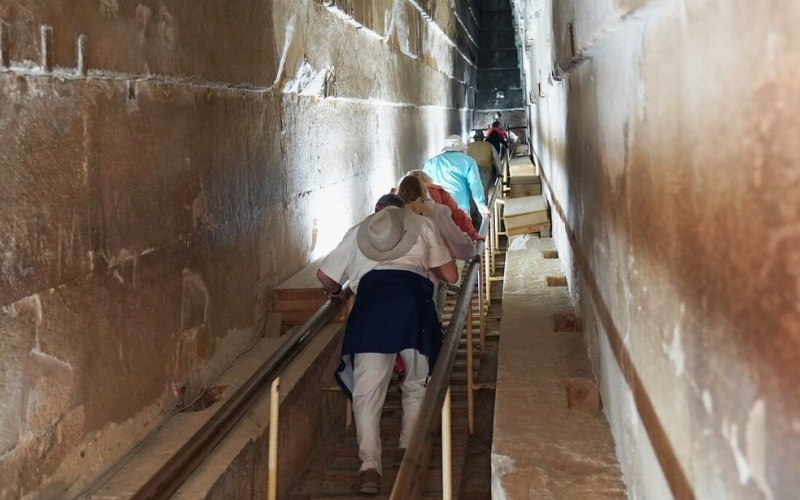
Can you go inside the pyramids? Yes — in 2026, you can still climb into the Great Pyramid of Giza, walk through the Grand Gallery, and stand inside the King’s Chamber where Khufu was once believed to rest.
This guide covers every pyramid you can enter, current ticket prices, the best private access tours available, and the exact tips you need before you go. By the end, you will know precisely which pyramid to choose, what it costs, what it feels like inside, and how to book the experience without wasting a single hour of your trip to Cairo.
If you have ever looked at a photo of the Giza plateau and wondered whether those enormous stone triangles are hollow shells or something you can actually walk into, you are not alone. It is one of the most searched questions about Egypt, and for good reason — the answer changes how you plan your entire Cairo itinerary. Some pyramids are open every day.
Some require a separate ticket bought on arrival. A few need special government permission arranged weeks in advance. This article untangles all of it, section by section, so you leave knowing exactly what to book and why.
Can You Go Inside the Pyramids? The Honest Answer for 2026 Travelers
Yes, you absolutely can go inside the pyramids, but not every pyramid, and not without a plan. This is the single most common misunderstanding travelers have before their first trip to Egypt: they assume all three Giza pyramids work the same way, or that a general entry ticket automatically includes interior access. It doesn’t. Understanding this distinction now will save you time, money, and disappointment on the day of your visit.
At Giza, three pyramids stand on the plateau — Khufu (the Great Pyramid), Khafre, and Menkaure — and all three have interior chambers that are open to visitors. Beyond Giza, the pyramids at Saqqara and Dahshur also allow interior access, and in some ways their interiors are more impressive than what you’ll find inside the Great Pyramid itself, since a few of them still show original decorative elements.
So when people ask “can you go inside of the pyramids,” the real answer is: yes, at multiple sites across Egypt, though the experience, price, and physical demand differ quite a bit from one pyramid to the next.
Here’s what surprises most first-time visitors. The general Giza Plateau ticket, which everyone buys to enter the site, only covers the grounds — the panoramic viewpoints, the area around the Sphinx, and the exterior of all three pyramids.
It does not include stepping inside any of them. Interior access is always a separate, additional ticket, sold at a different booth, with a different price for each pyramid. Miss this detail and you could stand at the base of the Great Pyramid with zero chance of walking through the entrance that day, simply because the interior tickets sold out that morning.
Quick tips before you plan further:
- Interior tickets are limited in number each day, so arriving early genuinely matters, especially for the Great Pyramid.
- Children under six are usually free at the gate, but many operators do not allow young children inside the narrow interior passages for safety reasons.
- If your goal is simply to say “I went inside a pyramid,” the smaller pyramids of Khafre or Menkaure are cheaper, less crowded, and just as authentic.
- If your goal is the flagship experience, the Great Pyramid of Khufu is the one to prioritize, and it deserves its own dedicated ticket strategy, covered later in this guide.
- Photography is typically restricted or requires an extra fee inside the chambers, so check the current rule before you go so you’re not caught off guard.
The takeaway for anyone researching this before a 2026 trip is simple: going inside a pyramid in Egypt is entirely possible and one of the most memorable things you’ll do on the trip, but it takes a small amount of planning that most tourists skip. The rest of this guide walks through exactly which pyramid to choose, what tickets to buy, and how a private access tour can remove all of the guesswork for you.
Can You Go Inside the Great Pyramid of Giza? What the Khufu Interior Is Really Like
Can you go inside the Great Pyramid of Giza? Yes, and it remains one of the only surviving structures from the ancient world you can physically enter. The Great Pyramid of Giza, also called the Pyramid of Khufu or Cheops, is the largest of the three pyramids on the plateau and the last standing wonder of the ancient world still open to the public in this way. Walking inside it is not like touring a museum. It is a raw, physical, slightly claustrophobic climb through solid stone, and that is exactly what makes it unforgettable.
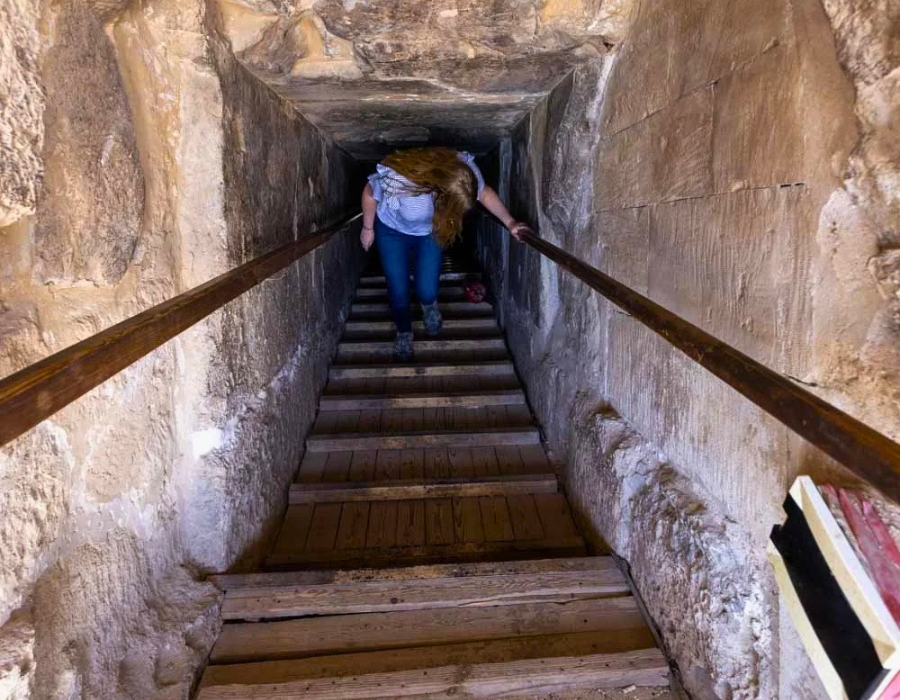
Here is what actually happens once you’re inside. After entering through the designated entrance on the north face, you descend briefly before turning upward into the Ascending Passage — a narrow, low corridor that requires most adults to bend forward at the waist for several minutes.
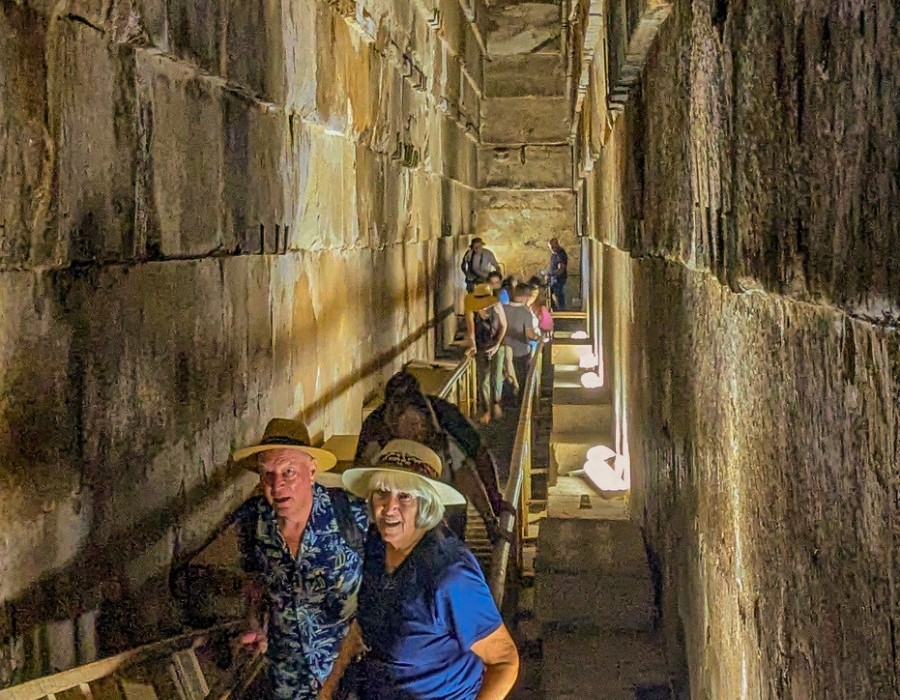
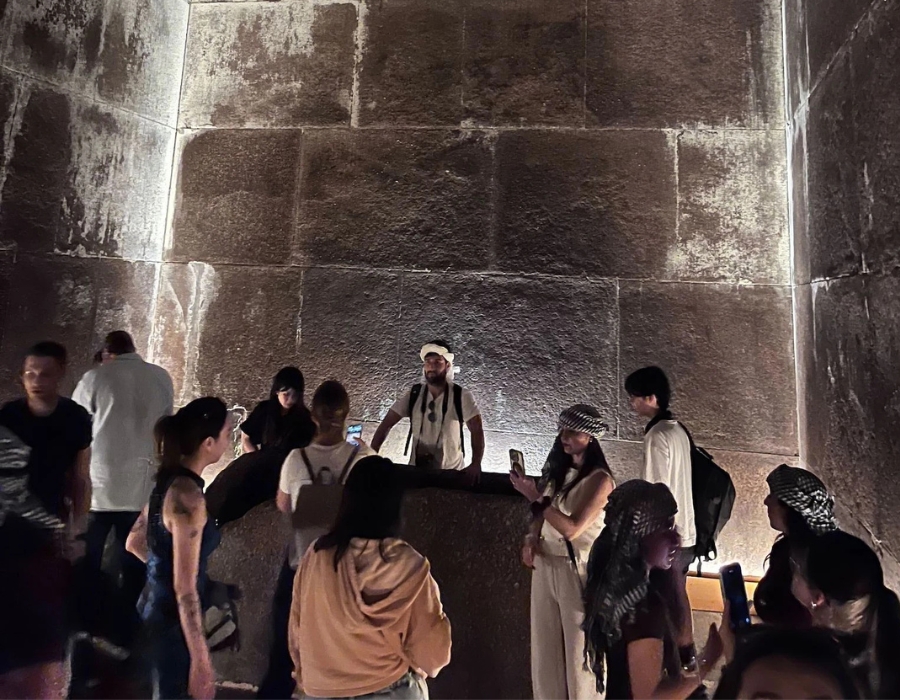
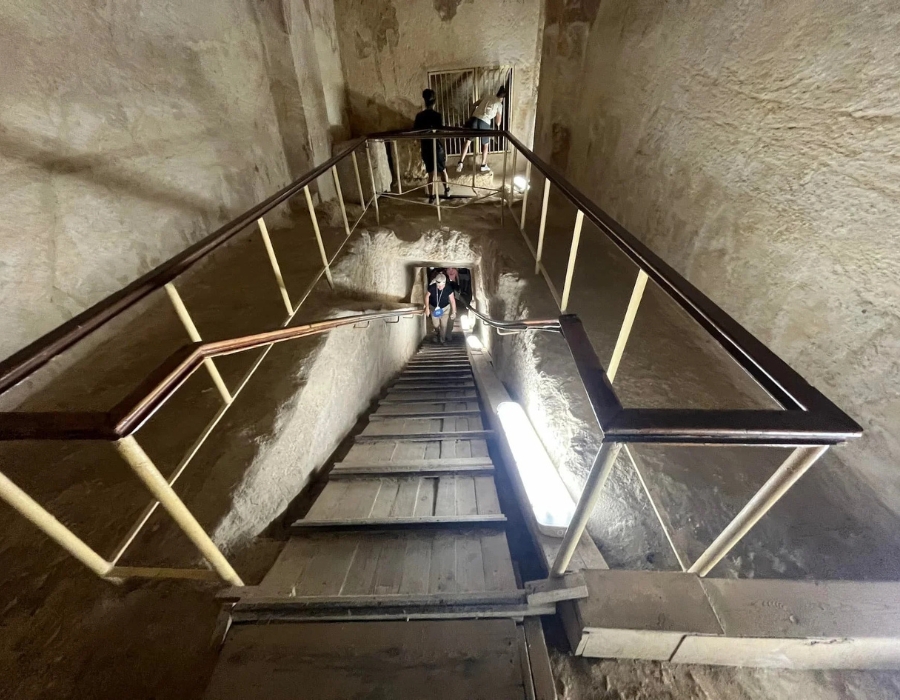
This opens into the Grand Gallery, a soaring corbelled corridor roughly 8.6 meters high, which is genuinely the most visually striking part of the entire interior. From there, a shorter final passage leads into the King’s Chamber, a bare granite room containing an empty stone sarcophagus. There are no hieroglyphics, no painted scenes, and no treasure — the chamber was stripped centuries ago. What remains is the scale, the silence, and the fact that you are standing inside a structure built more than 4,500 years ago.
Many travelers researching “can you go inside the great pyramid” expect a decorated tomb similar to what they’ve seen in documentaries about the Valley of the Kings in Luxor. That’s a different kind of site entirely.
The Great Pyramid’s interior is architectural, not artistic — its power comes from the engineering, not decoration. Managing that expectation ahead of time genuinely changes how much people enjoy the visit.
| What to Expect Inside the Great Pyramid | Details |
|---|---|
| Entry point | North face, original robbers’ tunnel entrance |
| Passages | Narrow, low ceilings, steep incline, requires stooping |
| Main highlight | The Grand Gallery — tall, dramatic, well worth the climb |
| Final chamber | King’s Chamber — bare granite, empty sarcophagus |
| Ventilation | Limited; can feel hot and stuffy, especially at midday |
| Physical difficulty | Moderate to high; not ideal for those with joint or heart conditions |
| Average time inside | 20–30 minutes round trip |
Tips for visiting the Khufu interior:
- Go early morning if possible; the passages heat up quickly once the sun is high and crowds build.
- Wear closed, comfortable shoes with grip — the ramps inside can be smooth and slightly slippery.
- If you are prone to claustrophobia, be honest with yourself beforehand; the ascending passage is genuinely tight for a sustained stretch.
- Bring nothing you’re not willing to carry hunched over — bags, cameras, and loose items get awkward fast in the low passages.
- Book your interior ticket alongside a private guide if you want the historical context explained as you go, since there’s no signage inside to tell the story for you.
For most travelers weighing whether the Great Pyramid of Giza is worth going inside, the answer is yes, once, as a genuine bucket-list moment — but going with a knowledgeable guide transforms it from a strange climb through stone into a proper understanding of how and why it was built.
Which Pyramid Can You Go Inside? Comparing Khufu, Khafre, and Menkaure
This is the question that trips up almost every first-time visitor to Giza: which pyramid can you go inside, and does it matter which one you choose? All three of the main pyramids at Giza technically allow interior access, but they are not interchangeable experiences. Choosing the right one — or choosing to do more than one — depends on your budget, your fitness level, and how much time you have on the plateau.
The Great Pyramid of Khufu is the largest, the most expensive to enter, and the most physically demanding, but it carries the most historical weight since it is the only one of the Seven Wonders of the Ancient World still standing.
The Pyramid of Khafre, the second-largest, sits slightly higher on the plateau because of its position, and still retains a section of its original polished limestone casing near the summit, which is a detail most visitors miss unless a guide points it out. Its interior chamber is smaller than Khufu’s, but the descent is comparably steep. The Pyramid of Menkaure, the smallest of the three, has the least crowded interior and, in some ways, one of the more interesting descents, with granite-lined lower passages that hint at what all three pyramids may have looked like on the inside when they were first built.
| Pyramid | Interior Difficulty | Typical Crowd Level | Best For |
|---|---|---|---|
| Khufu (Great Pyramid) | High — steep, low passages, longest climb | Very high, sells out early | First-timers wanting the flagship bucket-list moment |
| Khafre | Moderate — steep but shorter | Moderate | Travelers who want a genuine interior experience without the Khufu queue |
| Menkaure | Low to moderate — shorter passages | Low | Families, budget travelers, or those short on time |
A detail worth knowing: you are not limited to choosing just one. Many travelers who ask “can you go inside the giza pyramids” plural, meaning more than one on the same day, are pleasantly surprised to learn that yes, you can buy interior tickets for two or even all three pyramids if the tickets are available and your schedule allows it. Doing both Khufu and Menkaure in the same visit, for example, gives you the flagship experience plus a quieter, more contemplative second interior without a huge jump in cost.
Tips for deciding which pyramid to enter:
- If you only have time or budget for one, choose Khufu for the historical significance, or Khafre if you want a similar experience with a shorter queue.
- If traveling with children or anyone with mobility concerns, Menkaure is the gentler option.
- If you’re a photography enthusiast, note that most interiors restrict or heavily limit camera use, so temper your expectations regardless of which pyramid you pick.
- Ask your guide about the casing stones still visible near the top of Khafre — a detail almost never mentioned on generic group tours.
- If your schedule allows a full day at the plateau, doing all three interiors back-to-back gives you a genuinely rare comparative understanding of ancient Egyptian pyramid construction across three generations of the same royal family.
Whichever pyramid you choose, the deciding factor for most travelers in 2026 isn’t really which one is “best” — it’s how much time, energy, and budget you want to dedicate to the interior experience versus the rest of your Cairo itinerary, which typically includes the Sphinx, the Solar Boat Museum, and often Saqqara or Dahshur as well.
What’s Actually Inside the Great Pyramids of Egypt
Once you’ve decided to go inside the pyramids of Giza, it helps to know exactly what you’re walking toward, because the interiors are very different from what most people picture. Inside the great pyramids of Egypt, you won’t find painted tomb walls, golden artifacts, or elaborate hieroglyphic inscriptions like those found in Luxor’s Valley of the Kings. What you’ll find instead is raw architectural achievement: massive interlocking limestone and granite blocks, precisely cut passageways, and chambers built with an accuracy that still puzzles engineers today.
Inside the Great Pyramid of Khufu specifically, there are three known chambers: the unfinished Subterranean Chamber cut into the bedrock below the pyramid’s base (not open to general visitors), the so-called Queen’s Chamber roughly halfway up the structure (also generally closed to the public), and the King’s Chamber at the heart of the pyramid, which is the room visitors actually reach.
The King’s Chamber is built entirely from red granite transported from Aswan, hundreds of kilometers south, and contains a plain, lidless sarcophagus, too large to have been brought in after construction, meaning it was placed inside the chamber as the pyramid was being built around it.
The journey to get there is arguably more memorable than the chamber itself. The Grand Gallery, which precedes the King’s Chamber, is the true architectural showpiece of the interior — a long, high-ceilinged corridor with a corbelled roof, meaning each course of stone steps slightly inward as it rises, a construction technique that distributes weight without using an arch. Standing at the base of the Grand Gallery and looking up is, for many visitors, the moment that makes the entire visit worthwhile.
Inside Khafre’s pyramid, the interior is smaller and simpler, with a single burial chamber cut partly into bedrock and partly into the pyramid’s masonry, but it delivers the same sensation of descending into solid stone. Inside Menkaure’s pyramid, visitors pass through a granite-lined antechamber before reaching the burial chamber, which once contained a beautifully carved basalt sarcophagus (now lost at sea after the ship transporting it to England sank in the 1830s, a story most guides enjoy telling in detail).
| Chamber/Feature | Pyramid | What You’ll See |
|---|---|---|
| Grand Gallery | Khufu | Soaring corbelled ceiling, the interior’s most photographed feature (where photography is permitted) |
| King’s Chamber | Khufu | Red granite room, empty sarcophagus, dramatic acoustics |
| Burial Chamber | Khafre | Smaller chamber, part bedrock, part masonry |
| Granite Antechamber | Menkaure | Detailed stonework leading to the burial chamber |
Tips for understanding what you’re seeing:
- Ask your guide to point out the granite versus limestone sections; the contrast tells you a lot about ancient logistics and how far these materials traveled.
- Look up in the Grand Gallery — the corbelling technique is one of the most impressive engineering details in the entire complex.
- Don’t expect color or inscriptions; the emotional impact here comes from scale and precision, not decoration.
- If detailed wall art and inscriptions are what you’re after, plan a Luxor extension to your Egypt itinerary alongside your Cairo pyramid visit.
- Take a moment of silence inside the King’s Chamber if the crowd allows it; the acoustics are unusually resonant and it’s worth experiencing without noise.
Knowing what’s actually inside before you go is what separates a slightly confusing 20-minute climb from a genuinely moving encounter with one of the most studied structures on Earth.
Cheops Pyramid Location and Where the Pyramids in Egypt Actually Are
A surprising number of travelers arrive in Cairo assuming the pyramids sit somewhere remote in the desert, hours from the city. In reality, the Cheops pyramid location — Cheops being the Greek name for Khufu — is on the Giza Plateau, roughly 15 to 20 kilometers southwest of downtown Cairo, and easily reachable within 30 to 45 minutes depending on traffic. It is, quite literally, on the edge of the city; some hotel rooftop views in Giza look directly out onto the pyramids themselves.
But Giza is only one of several places where are the pyramids in Egypt located. Ancient Egyptians built pyramids across a stretch of the western desert along the Nile for roughly a thousand years, and several of these sites are open to visitors today, each with a different interior experience.
| Site | Distance from Cairo | Notable Pyramid | Interior Access |
|---|---|---|---|
| Giza | ~15–20 km | Khufu, Khafre, Menkaure | Yes, all three |
| Saqqara | ~30 km | Step Pyramid of Djoser | Yes, recently reopened underground chambers |
| Dahshur | ~40 km | Bent Pyramid, Red Pyramid | Yes, especially the Red Pyramid |
| Meidum | ~100 km | Collapsed Pyramid of Meidum | Limited, less commonly visited |
| Abusir | ~25 km | Pyramid of Sahure | Rarely open, mostly exterior visits |
Dahshur deserves special mention for travelers who have already asked “can you go inside the egyptian pyramids” and want a second, less crowded interior experience after Giza.
The Red Pyramid at Dahshur is considered by many Egyptologists to have one of the most impressive interiors of any pyramid in Egypt, with a tall corbelled chamber similar in style to the Grand Gallery at Giza, but visited by a fraction of the tourists. It’s often added to Giza day tours as a half-day extension for travelers who want to go deeper into pyramid architecture beyond the main plateau.
Tips for planning around location:
- If your hotel is in downtown Cairo, budget 45 minutes to an hour each way to Giza depending on traffic, especially during morning rush hour.
- Staying in Giza itself, rather than downtown Cairo, means you can reach the plateau in minutes and catch it at opening time before the tour buses arrive.
- Combining Giza with Saqqara and Dahshur in a single day is possible with a private driver and guide, but rushed with public transport or budget group tours.
- The Great Sphinx sits right next to the Giza pyramids, not somewhere separate, so you don’t need to plan a second trip to see it.
- If your itinerary includes Luxor, remember that those tombs and temples are a different region entirely, roughly 500 kilometers south, and require a separate leg of the trip, usually by short domestic flight.
Understanding the geography ahead of time makes a real difference to how you structure your Egypt itinerary, especially if you’re trying to fit Giza, Saqqara, and Dahshur into a single, efficient day without sacrificing time inside the pyramids themselves.
Giza Pyramid Interior Tickets and Prices in 2026
Pricing at the Giza plateau works on a base-plus-add-on system, and it consistently confuses first-time visitors, so it’s worth breaking down clearly. Every visitor first pays a general admission ticket to enter the plateau grounds.
This covers the exterior views, the area around the Sphinx, and access to the site generally, but it does not include entry inside any pyramid. Each pyramid interior is then sold as a separate ticket, at a separate price, often from a separate ticket booth located in a different part of the site.
Prices at Egyptian archaeological sites are adjusted periodically, and in recent seasons the cost of entering the Great Pyramid specifically has increased more than the other tickets, reflecting both its popularity and the strictly limited daily capacity. Below are the typical ranges travelers should budget for in 2026, though we always recommend confirming exact current pricing when you book, since rates can shift with little notice.
| Ticket Type | Typical 2026 Price Range (Foreign Visitors) | Notes |
|---|---|---|
| General Giza Plateau entry | Around 700 EGP | Required for everyone; covers grounds and exterior views |
| Great Pyramid of Khufu interior | Roughly 900–1,500 EGP | Strictly limited daily tickets; buy early in the day |
| Khafre interior | Roughly 100–280 EGP | Considerably cheaper than Khufu |
| Menkaure interior | Roughly 200 EGP | Shortest queue of the three |
| Student discount | Around 50% off with valid ISIC card | Applies to most ticket categories |
| Children under 6 | Free | Interior access for young children often restricted regardless |
Tips for booking tickets smartly:
- Arrive at opening time, typically 8:00 a.m., if you want to guarantee a Great Pyramid interior ticket; they are limited to a set number per day and often sell out by mid-morning, especially in the busy winter season.
- Carry a small amount of Egyptian pounds as backup even though card payment is now widely accepted at the main ticket booths.
- Prices can and do change without much advance notice, so treat any number you read online, including in this guide, as a planning estimate rather than a guarantee.
- If ticket logistics sound stressful, booking through a private tour operator that handles ticket purchases in advance removes the entire headache, and often secures your interior slot before the public booths even open.
- Combining your ticket purchase with a private guide is almost always better value than paying separately, since a knowledgeable Egyptologist adds context you simply won’t get from a ticket stub alone.
This is exactly the kind of logistical friction that turns a simple bucket-list visit into a stressful morning if left unplanned. It’s also exactly where a local travel agency earns its value — not by making the pyramids cheaper, but by making sure you’re never the traveler standing at the ticket booth at 11 a.m. being told the Great Pyramid interior sold out two hours ago.
Private Access Tours: Go Beyond the Standard Ticket
For travelers who want more than the standard walk-through, Egypt Time Travel offers a set of private access experiences at Giza that go well beyond what a general interior ticket provides. These are not the tours you’ll find bundled into a large group bus itinerary — they involve special permissions, smaller groups, and access to parts of the plateau most visitors never even know exist.
Private Access Tour to the Great Pyramid of Khufu (Cheops)
This is the flagship experience for travelers who want to go inside the great pyramid of Giza without the pressure of racing the clock against sold-out ticket counters.
Our private access tour secures your Khufu interior ticket in advance, pairs you with a private Egyptologist guide, and times your entry to avoid the worst of the midday crowds and heat. Instead of shuffling through the Ascending Passage behind a large tour group, you move at your own pace, with someone beside you who can explain the engineering of the Grand Gallery and the history of the King’s Chamber as you experience it, not from a laminated pamphlet afterward.
Private Access Tour to the Sphinx Hall
Most visitors see the Great Sphinx only from the standard viewing platforms, unaware that a rarely visited chamber, referred to as the Sphinx Hall, sits associated with the Sphinx Temple complex just in front of the monument.
Our private access tour to the Sphinx Hall takes you closer to this area with a dedicated guide, offering context on the Sphinx’s construction, the temple’s alignment with the sun, and theories about its original purpose that simply aren’t covered on standard group itineraries. This is the tour for travelers who feel like they’ve “seen” the Sphinx a hundred times in photos and want to actually understand what they’re looking at.
Private Access Tour to the Osiris Shaft in the Giza Pyramids
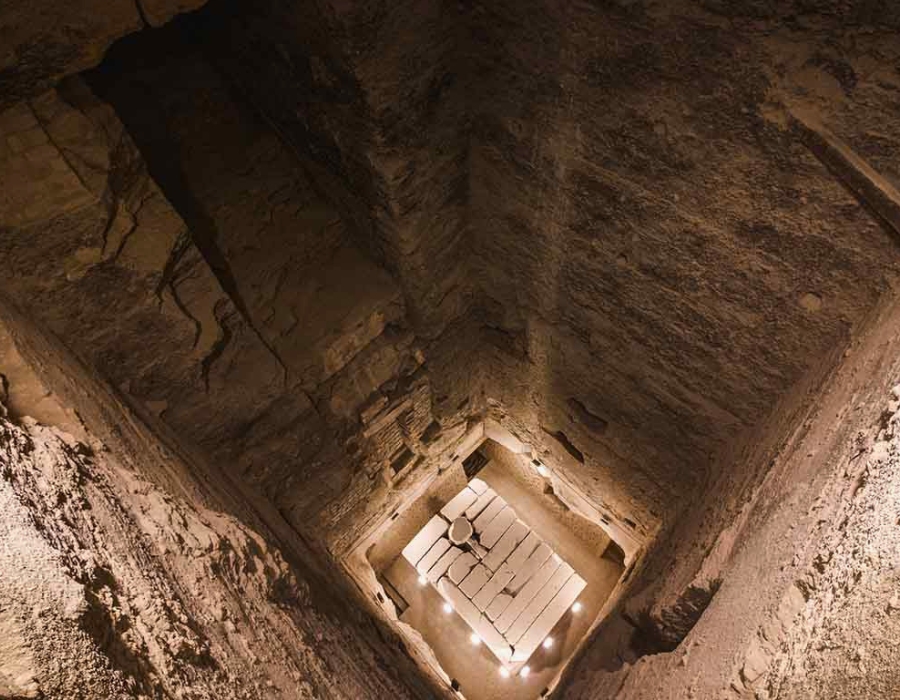
This is, without question, our most unique offering, and one of the most atmospheric experiences on the entire plateau. The Osiris Shaft is a deep, multi-level underground structure near the causeway between the Sphinx and Khafre’s pyramid, closed to the general public and accessible only with special permission from Egypt’s Ministry of Tourism and Antiquities.
Descending nearly 30 meters below ground level through three distinct levels, this tour takes you to a chamber long associated with the myth of Osiris, complete with a stone sarcophagus-like feature on the lowest level. It is dim, quiet, and genuinely eerie in the best way — a world away from the crowds above ground, and an experience very few travelers to Egypt ever get to have.
| Private Access Tour | What Makes It Different | Ideal For |
|---|---|---|
| Great Pyramid of Khufu (Cheops) | Pre-secured tickets, private Egyptologist, timed entry | Anyone prioritizing the flagship interior experience without the queue |
| Sphinx Hall | Rarely visited area, deeper historical context | History enthusiasts wanting more than the photo-stop view |
| Osiris Shaft | Special government permission required, restricted access | Adventurous travelers seeking a genuinely rare experience |
Tips for choosing a private access tour:
- Book at least two to three weeks ahead for the Osiris Shaft specifically, since special permission requests take time to process.
- Combine the Khufu interior tour with the Sphinx Hall visit for a full morning that covers both flagship experiences without backtracking across the site.
- Ask about small-group or fully private options if you want a completely uninterrupted, unhurried visit.
- These tours pair naturally with a Saqqara or Dahshur half-day extension if you have a full day available.
- Because permissions and availability shift, confirm your exact date with our team early, especially if you’re traveling during Egypt’s busy winter season.
Can You Go Inside the Sphinx? Clearing Up a Common Misconception
Alongside “can you go inside the pyramids,” one of the most frequently asked follow-up questions is whether you can go inside the Great Sphinx itself. The honest answer is no — the Sphinx, unlike the pyramids, is a single carved limestone monument, not a hollow structure with internal chambers to walk through. There is no interior passage or chamber inside the body of the Sphinx that tourists can access.
That said, this is a myth that refuses to die, partly fueled by decades of speculation, documentaries, and even a few genuine archaeological curiosities. There is a small shaft on the Sphinx’s back, discovered in the 20th century, but it leads only a short distance and holds no chambers of significance; it is not open to the public and offers nothing resembling the interior experience of the pyramids.
What visitors can experience, however, is the Sphinx Temple directly in front of the monument, and the closely associated area we mentioned above, sometimes referred to as the Sphinx Hall — this is where our private access tour adds real value, since it gets you closer to the archaeological context around the Sphinx rather than promising something the monument simply doesn’t have.
It’s worth setting this expectation clearly before your trip, because more than a few travelers arrive hoping for a Sphinx interior experience similar to the pyramids and are disappointed to learn it doesn’t exist in that form. The good news is that what you can experience around the Sphinx — the temple, the causeway connecting it to Khafre’s pyramid, and the surrounding archaeological area — is genuinely fascinating once someone explains what you’re looking at.
Tips regarding the Sphinx visit:
- Don’t book a tour promising Sphinx “interior access” in the same sense as the pyramids; treat any listing like that with healthy skepticism.
- Visit the Sphinx Temple area with a guide who can explain the solar alignment theories connected to its construction.
- Combine your Sphinx visit with the Khafre causeway walk for a fuller sense of how the entire funerary complex connected together in antiquity.
- Early morning or late afternoon light gives the best photography conditions at the Sphinx, avoiding the flat glare of midday sun.
- If mystery and hidden chambers are what draw you to Giza, the Osiris Shaft tour delivers that experience far more authentically than any Sphinx-related claim.
Tips for Going Inside the Pyramids in 2026: What Every Traveler Should Know
Going inside a pyramid is a bucket-list moment, but it’s also a physically specific experience that catches some travelers off guard. Whether you’re heading into Khufu’s Great Pyramid or one of the smaller interiors, a bit of preparation makes the difference between a rushed, uncomfortable ten minutes and a genuinely memorable part of your trip.
Heat and ventilation are the two biggest factors people underestimate. The interior passages were built thousands of years ago with no modern airflow systems, and body heat from other visitors adds up quickly in the narrow corridors.
Visiting during Egypt’s hotter months, or later in the day once temperatures on the plateau have climbed, makes the interior noticeably more uncomfortable. Early morning visits, ideally right at opening, are cooler, quieter, and give you a better chance at securing same-day interior tickets before they run out.
Physical demand is the second major factor. Entering the Great Pyramid specifically involves a sustained stooped climb through the Ascending Passage, which can be tough on the back, knees, and hips, particularly for older travelers or anyone with joint issues. There are no elevators, no rest points, and limited space to pause if the passage is busy.
If you have any concerns about mobility or existing health conditions, the smaller and shorter interiors at Khafre or Menkaure are a genuinely good alternative that still delivers the “I went inside a pyramid” experience with less physical strain.
| Consideration | Recommendation |
|---|---|
| Best time of day | Early morning, right at opening |
| Best time of year | October to April for cooler temperatures |
| Clothing | Breathable fabric, closed comfortable shoes |
| Claustrophobia concerns | Consider Khafre or Menkaure over Khufu |
| Photography | Check current rules; often restricted or limited inside chambers |
| Hydration | Carry water for before and after; not permitted inside the chambers themselves |
Additional tips that make a real difference:
- Book your interior ticket as part of a guided tour rather than relying on same-day availability, especially during Egypt’s busy winter travel season from November through February.
- Leave bulky bags and unnecessary items in your vehicle; you’ll want your hands as free as possible in the ascending passage.
- If traveling with older relatives or anyone with health concerns, discuss the physical demands honestly before booking, and consider splitting the group so some go inside while others enjoy the exterior views and photo opportunities.
- Pace yourself; there’s no need to rush through the passages, and taking a moment inside the Grand Gallery is genuinely one of the highlights of the entire trip.
- Trust a local guide’s read on crowd levels; experienced Egyptologists know which hours tend to be quieter even within the same day.
None of these tips are meant to discourage you — quite the opposite. Going inside the pyramids remains one of the most rewarding things you can do in Egypt, and a little preparation is really all it takes to make sure the experience matches the anticipation you’ve built up for it.
How to Book Your Pyramid Interior Experience the Right Way
By now, the practical picture should be clear: yes, you can go inside the pyramids of Giza and several other Egyptian sites in 2026, but getting the experience right depends heavily on timing, ticket strategy, and who you book with. This is the part of the trip where working with a specialized local operator genuinely changes the outcome, not just the convenience.
A private, well-organized pyramid interior tour solves three problems at once. First, it removes the ticket uncertainty — instead of hoping the Great Pyramid interior tickets haven’t sold out by the time you arrive, your tickets are secured in advance.
Second, it adds context that a bare ticket simply can’t provide; walking through the Grand Gallery with an Egyptologist who can explain the corbelling technique and the theories around the pyramid’s construction is a fundamentally different experience than reading a small plaque, if there even is one.
Third, it lets you combine experiences efficiently, pairing the Great Pyramid interior with the Sphinx Hall, the Osiris Shaft, or a half-day extension to Saqqara and Dahshur, all coordinated so you’re not wasting hours in Cairo traffic moving between disconnected bookings.
| Booking Approach | Pros | Cons |
|---|---|---|
| Buy tickets independently at the gate | Flexible, cheapest on paper | Risk of sold-out interior tickets, no guide context, time lost navigating separate booths |
| Join a large group tour | Set schedule, budget-friendly | Rushed interior visits, less flexibility, larger crowds inside chambers |
| Book a private access tour | Guaranteed tickets, expert guide, flexible pacing, access to restricted sites like the Osiris Shaft | Slightly higher cost, requires advance booking |
Tips for booking smoothly:
- Book at least two to three weeks ahead if you want access to restricted experiences like the Osiris Shaft.
- Confirm exactly which pyramid interiors are included in your tour price before the day of your visit, since not every package includes Khufu’s interior by default given its higher cost.
- Ask whether your guide is a licensed Egyptologist, not just a general tour driver, if historical depth matters to you.
- Request an early morning start time specifically to beat both the heat and the crowds inside the passages.
- Pair your Giza day with a private, air-conditioned vehicle transfer rather than public transport, especially if your itinerary also includes Saqqara or Dahshur the same day.
A Quick History Snapshot: Who Built the Pyramids and Why It Matters to Your Visit
Knowing a little history before you go inside the great pyramids of Egypt changes the visit from “an old stone building” to something you actually feel connected to. The Great Pyramid of Giza was built as the tomb of the Pharaoh Khufu, who ruled during Egypt’s Fourth Dynasty, roughly 2560 BCE.
It’s estimated to have taken around 20 years to complete, using an enormous, coordinated workforce of skilled laborers, not slaves as popular myth long suggested — archaeological evidence from workers’ villages near the plateau points to organized, paid crews housed and fed as part of a major state project.
The Pyramid of Khafre, Khufu’s son, was built next, and despite appearing taller in photographs, it’s actually slightly smaller than his father’s pyramid; the illusion comes from its position on higher bedrock.
Khafre’s pyramid is also closely associated with the Great Sphinx, which many Egyptologists believe was carved during his reign, possibly bearing his own facial features, though this remains debated. The Pyramid of Menkaure, the smallest of the three, was built by Khafre’s son and marks something of a shift — later pyramids across Egypt were generally smaller than the Giza trio, suggesting either changing resources, priorities, or construction philosophy in the centuries that followed.
Understanding this family lineage — grandfather, father, and son standing shoulder to shoulder on the same plateau — adds a layer of meaning that most travelers don’t expect going in. It’s part of why going inside more than one pyramid interior, rather than just Khufu’s, gives you a genuinely richer sense of how Egyptian pyramid-building evolved even within a single generation.
| Pyramid | Built By | Approximate Date | Relationship |
|---|---|---|---|
| Great Pyramid (Khufu) | Pharaoh Khufu | c. 2560 BCE | Grandfather |
| Khafre’s Pyramid | Pharaoh Khafre | c. 2530 BCE | Son of Khufu |
| Menkaure’s Pyramid | Pharaoh Menkaure | c. 2510 BCE | Grandson of Khufu |
Tips for getting more out of the history:
- Ask your guide about the workers’ village excavations near Giza; it’s one of the most interesting, and least publicized, archaeological stories connected to the pyramids.
- Look for the remaining casing stones near the summit of Khafre’s pyramid, one of the few places you can still see what the smooth, polished exterior of all three pyramids once looked like.
- Consider reading a short introduction to Old Kingdom Egypt before your trip; even twenty minutes of background makes the interior visit noticeably more meaningful.
- Don’t skip the Solar Boat Museum near the Great Pyramid if you have extra time; the reconstructed royal boat found buried beside Khufu’s pyramid gives real insight into how these projects were resourced.
- If the family history angle interests you, ask about extending your trip to Abu Sir and Saqqara, where later Old Kingdom pyramids show how the design continued to evolve after Giza.
Sample One-Day Giza Itinerary: Fitting the Pyramid Interiors Into Your Schedule
If you’re wondering how to actually structure a day so that you can go inside the pyramids without missing anything else on the plateau, here’s a realistic, tested itinerary that balances interior visits, the Sphinx, and travel time without leaving you exhausted by lunchtime.
| Time | Activity |
|---|---|
| 7:30 AM | Depart hotel, private vehicle to Giza Plateau |
| 8:00 AM | Arrive at Giza, purchase or confirm general entry and Great Pyramid interior tickets |
| 8:15 AM | Enter the Great Pyramid of Khufu — Grand Gallery and King’s Chamber |
| 9:00 AM | Panoramic viewpoint photo stop, all three pyramids in one frame |
| 9:30 AM | Optional interior visit to Khafre or Menkaure |
| 10:15 AM | Visit the Great Sphinx and Sphinx Temple area |
| 11:00 AM | Solar Boat Museum (optional, near the Great Pyramid) |
| 11:30 AM | Depart for Saqqara or Dahshur (optional half-day extension) |
| 1:00 PM | Lunch at a local Giza restaurant with plateau views |
This structure works because it front-loads the most physically demanding part of the day — the Great Pyramid interior — while the morning is still cool and the crowds are thinner. It leaves flexibility for a second pyramid interior or a Sphinx-focused stop, and still gets you out before the midday heat peaks, particularly important during Egypt’s warmer months.
Tips for building your own version of this itinerary:
- If the Osiris Shaft is part of your plan, it typically needs to be scheduled as its own dedicated block, given the special permissions involved, rather than squeezed into a packed general itinerary.
- Travelers combining Giza with Saqqara and Dahshur in one day should expect a long, rewarding day, generally nine to ten hours door to door, so pace your energy accordingly.
- If you’d rather take things slower, split the plateau visit and the Saqqara/Dahshur extension across two separate mornings instead of cramming everything into one day.
- Always build in a buffer for Cairo traffic, especially if you’re staying downtown rather than in Giza itself.
- A private guide can adjust this itinerary in real time based on ticket availability and crowd levels on the day, something a fixed group tour schedule usually can’t do.
Frequently Asked Questions About Going Inside the Pyramids
Can you go inside the pyramids in Egypt?
Yes. Multiple pyramids across Egypt, including all three at Giza, plus sites at Saqqara and Dahshur, allow interior access with a separate paid ticket in addition to general site entry.
Can you go inside the Great Pyramid of Giza?
Yes, the Great Pyramid of Khufu (Cheops) has an interior ticket that leads visitors through the Ascending Passage, the Grand Gallery, and into the King’s Chamber.
Which pyramid can you go inside at Giza?
All three main pyramids — Khufu, Khafre, and Menkaure — have interior access available, each with its own separate ticket and price.
Can you go inside the Great Pyramid?
Yes, though it involves a steep, narrow climb through stone passages. It’s the most physically demanding of the three Giza pyramid interiors but also the most historically significant.
Where are the pyramids in Egypt located?
The main pyramid fields are at Giza, Saqqara, and Dahshur, all within roughly 40 kilometers of central Cairo, with additional, less-visited sites further south, such as Meidum.
What is the Cheops pyramid location exactly?
Cheops, another name for Khufu, refers to the Great Pyramid at Giza, located about 15 to 20 kilometers southwest of downtown Cairo.
Can you go inside the Sphinx?
No, the Sphinx is a solid carved monument without an accessible internal chamber, though the surrounding Sphinx Temple area can be explored with a guide.
Can you go inside the Mayan pyramids the same way you can in Egypt?
Not typically in the same sense. Mayan pyramids are generally stepped temple platforms, and interior chamber access is far less common and varies significantly by site and current preservation rules.
Do I need to book pyramid interior tickets in advance?
It’s strongly recommended, especially for the Great Pyramid of Khufu, since daily interior tickets are limited and can sell out by mid-morning, particularly during Egypt’s busy winter season.
Is it worth going inside the pyramids if I’m not particularly interested in history?
Most travelers find it worthwhile purely as a physical and atmospheric experience, even without deep historical interest, though a knowledgeable guide adds significantly to the value of the visit either way.
Can you go inside the pyramids of Giza with young children?
It’s possible, but many operators recommend against taking very young children into the narrow, steep interior passages for safety reasons. The exterior visit, Sphinx viewing, and Solar Boat Museum remain excellent options for families with small children who skip the interior climb.
What is the Osiris Shaft, and is it included in a standard Giza ticket?
The Osiris Shaft is a restricted underground structure near the Giza causeway, not included in any standard ticket. It requires special permission from Egypt’s Ministry of Tourism and Antiquities, arranged through a private access tour like the one offered by Egypt Time Travel.
How long does it take to go inside the Great Pyramid of Giza?
The full round trip through the Ascending Passage, Grand Gallery, and King’s Chamber typically takes twenty to thirty minutes, though this can vary depending on crowd levels inside the passages on the day.
Can you go inside the pyramids at night?
Standard daytime tickets do not include after-hours interior access. Special evening experiences at the Giza plateau, such as the sound and light show, take place outdoors and do not include entry inside the pyramid chambers themselves.
Conclusion: Book Your 2026 Pyramid Experience with Egypt Time Travel
So, can you go inside the pyramids in 2026? Yes — and now you know exactly which ones, what it costs, what to expect inside, and how to avoid the common mistakes that leave other travelers standing outside a sold-out ticket booth.
From the Grand Gallery inside the Great Pyramid of Khufu to the rarely seen depths of the Osiris Shaft, this is one of the most rewarding travel experiences Egypt has to offer, and it deserves to be planned properly rather than left to chance on the day.
This is exactly where Egypt Time Travel comes in. As the best travel agency in Egypt in 2026, we specialize in exactly this kind of experience: private access tours to the Great Pyramid of Khufu, exclusive visits to the Sphinx Hall, and special-permission access to the Osiris Shaft, all arranged with licensed Egyptologist guides who turn a simple climb through stone into a genuinely unforgettable part of your trip. We handle the ticket logistics, the timing, and the permissions, so all you have to do is show up and experience it.
If you’ve made it this far in your research, you’re clearly serious about doing this trip right. Don’t leave your pyramid experience to a rushed group tour or a same-day gamble at the ticket booth.
Reach out to Egypt Time Travel today, tell us your travel dates, and let us build your private pyramid access tour around exactly what you want to see. Your journey inside one of the last surviving wonders of the ancient world starts with a single booking — make it with the team that knows the Giza plateau better than anyone else.