
Quick Answer: What is the Great Pyramid of Cheops?
The Great Pyramid of Cheops, also known as the Pyramid of Khufu or Great Pyramid of Giza, is an ancient Egyptian royal tomb built around 4,500 years ago for Pharaoh Khufu during the Fourth Dynasty. Located on the Giza Plateau near Cairo, it originally stood approximately 146.5 meters (481 feet) tall. It is the largest pyramid at Giza and the only surviving Wonder of the Ancient World.
The Great Pyramid was already more than 2,000 years old when many of the world’s best-known ancient monuments were built. Today, its enormous limestone blocks, remarkably precise architecture and surviving internal chambers continue to attract travelers and researchers.
Its scale is impressive from a distance, but the details are even more revealing. The pyramid once had a smooth white exterior, contains a soaring Grand Gallery and still holds an empty granite sarcophagus in the King’s Chamber.
For travelers planning to visit in 2027, one important detail is easy to miss: seeing the pyramid from outside and entering its interior are different experiences, with separate admission requirements.
Understanding the history, layout and practical realities of visiting will help you decide how to spend your time at Giza.
What Is the Great Pyramid of Cheops, and Why Is It Famous?
The Great Pyramid of Cheops is the oldest and largest of the three principal pyramids on the Giza Plateau. It was constructed for King Khufu, an Egyptian pharaoh of the Fourth Dynasty, during the Old Kingdom.
The monument is famous for its enormous size, precise construction and exceptional survival.
It is also the last surviving structure from the traditional list of Seven Wonders of the Ancient World.
Great Pyramid of Cheops: Essential Facts
| Feature | Details |
|---|---|
| Ancient monument | Great Pyramid of Giza |
| Other names | Pyramid of Cheops, Pyramid of Khufu |
| Location | Giza Plateau, Giza, Egypt |
| Pharaoh | Khufu, known as Cheops in Greek |
| Historical period | Old Kingdom, Fourth Dynasty |
| Construction | Approximately 26th century BCE |
| Original height | Approximately 146.5 meters (481 feet) |
| Present height | Approximately 138.5 meters (454 feet) |
| Original base length | Approximately 230.3 meters per side |
| Primary material | Limestone |
| Interior materials | Limestone and granite |
| Estimated stone blocks | Commonly estimated at approximately 2.3 million |
| Main internal spaces | Subterranean Chamber, Queen’s Chamber, Grand Gallery, King’s Chamber |
| Original function | Royal funerary monument |
| World Heritage status | Part of the Memphis and its Necropolis UNESCO World Heritage site |
| Ancient Wonder status | Only surviving Wonder of the Ancient World |
The dimensions and block count are commonly cited estimates, with minor variations between surveys and publications.
The monument originally formed part of a much larger royal funerary complex, including temples, subsidiary pyramids, boat pits and surrounding tombs.
To understand the whole archaeological landscape, explore the Giza Necropolis, which includes more than the three famous pyramids.
Is the Pyramid of Cheops the Same as the Great Pyramid of Giza?
Yes. The Pyramid of Cheops, Pyramid of Khufu and Great Pyramid of Giza are three names for the same monument.
Khufu was the pharaoh’s Egyptian name, while Cheops is the name used by ancient Greek writers.
Travel guides, maps and archaeological publications use both names.
The Great Pyramid should not be confused with the neighboring Pyramid of Khafre or Pyramid of Menkaure.
Is the Great Pyramid Really the Largest Pyramid in Egypt?
The Great Pyramid of Khufu is generally recognized as the largest Egyptian pyramid by its original height and volume.
The Pyramid of Khafre can appear taller from certain viewpoints because it stands on higher ground. Its actual structure is smaller.
The Great Pyramid is also an important milestone in the development of royal Egyptian architecture. Its design represented the culmination of generations of experimentation with large stone monuments.
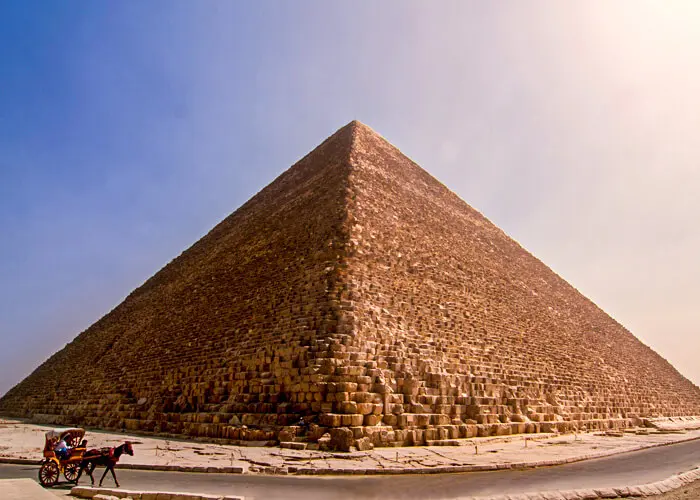
Where Is the Great Pyramid of Cheops Located?
The Great Pyramid of Cheops stands on the Giza Plateau, west of the Nile River and southwest of central Cairo.
Giza is part of the Greater Cairo metropolitan area, meaning travelers do not need to make a separate journey to another Egyptian city to visit the pyramids.
The location is approximately 15 kilometers southwest of central Cairo in a straight line, although road journeys are longer.
The Great Pyramid occupies the northeastern part of the principal pyramid group.
From different points on the plateau, visitors can see the pyramids of Khufu, Khafre and Menkaure, the surrounding desert, Cairo’s urban skyline and the Great Sphinx.
Why Did the Ancient Egyptians Choose Giza?
Giza offered several advantages for royal pyramid construction.
First, the plateau contains substantial limestone bedrock. Builders could obtain large quantities of stone near the construction site.
Second, its elevated position provided a solid foundation for enormous monuments.
Third, the plateau was accessible from the Nile valley, where river transport helped move workers, materials and supplies.
Ancient Egypt’s landscape was different from today’s urban environment. Areas that are now built up were once associated with Nile floodplains, waterways and agricultural land.
The western desert edge also held religious meaning. In Egyptian funerary traditions, the west was associated with the setting sun and the realm of the dead.
The location therefore served practical, political and spiritual purposes.
Is the Great Pyramid in Cairo or Giza?
The Great Pyramid is geographically in Giza, not within central Cairo.
However, many visitors describe the pyramids as being in Cairo because Giza forms part of the Greater Cairo urban area.
When arranging transportation, use the Giza Plateau entrance or designated visitor center as your destination rather than simply entering “Cairo pyramids.”
For nearby activities beyond the pyramid complex, see things to do in Giza.
Who Was King Cheops, the Pharaoh Behind the Great Pyramid?
King Cheops was Pharaoh Khufu, a ruler of Egypt’s Fourth Dynasty during the Old Kingdom.
He is best known for commissioning the Great Pyramid at Giza.
Khufu succeeded his father, Sneferu, whose ambitious pyramid-building projects helped develop the techniques later used at Giza.
Khufu inherited a powerful monarchy with the administrative capacity to organize materials, labor, food distribution and major construction projects.
His pyramid demonstrates the scale of the Egyptian state’s resources during this period.
Khufu’s Place in Egyptian History
Khufu ruled during one of the most important periods in the development of ancient Egyptian royal architecture.
The Fourth Dynasty followed earlier experiments with stepped and smooth-sided pyramids.
Sneferu, Khufu’s father, was associated with major pyramid projects at Meidum and Dahshur. These structures show that the Great Pyramid did not emerge suddenly from an unknown technology.
Instead, it developed from accumulated experience in quarrying, surveying, stone transport and monument design.
Khufu’s reign belonged to the Old Kingdom of Egypt, when royal pyramid construction became a defining expression of kingship.
The reign dates provided by historians can differ because ancient Egyptian chronological evidence is incomplete.
A commonly used chronology places Khufu in the 26th century BCE.
Was Khufu a Powerful Pharaoh?
The Great Pyramid indicates that Khufu commanded considerable organizational and economic resources.
Thousands of people would have been required to quarry stone, move materials, prepare food, manage equipment and coordinate construction.
However, the existence of a large monument does not reveal everything about Khufu’s personality or the daily experience of ordinary Egyptians under his rule.
Ancient Greek accounts, written long after Khufu’s lifetime, sometimes portrayed him negatively.
Those accounts should not be treated as straightforward eyewitness histories.
Archaeological evidence offers a more complex picture of royal administration, specialized labor and organized construction.
For a broader biography, including Khufu’s family and historical significance, see King Khufu.
Did Khufu Personally Build the Great Pyramid?
Khufu commissioned the monument, but he did not physically construct it himself.
The project depended on administrators, architects, surveyors, quarry workers, stone haulers, craftsmen and supporting laborers.
Hemiunu, an important royal official, is often associated with the supervision of the Great Pyramid project.
His exact responsibilities cannot be reconstructed in complete detail.
The achievement should therefore be understood as both a royal commission and an enormous collective construction effort.
When Was the Great Pyramid of Cheops Built?
The Great Pyramid of Cheops was built during the 26th century BCE, approximately 4,500 years ago.
Many historical summaries place its completion around 2560 BCE, although exact construction dates remain debated.
The Egyptian Ministry of Tourism and Antiquities estimates that building the monument may have taken approximately 10 to 20 years.
This should be treated as a historical estimate, not a precisely recorded construction schedule.
A Brief Timeline of the Great Pyramid
| Period | Development | Why it matters |
|---|---|---|
| Third Dynasty | Monumental stone construction advances under Djoser | Establishes an important architectural foundation |
| Early Fourth Dynasty | Sneferu commissions major pyramids | Smooth-sided pyramid design develops |
| 26th century BCE | Khufu’s Great Pyramid is constructed | Royal pyramid building reaches an exceptional scale |
| Later Fourth Dynasty | Khafre and Menkaure develop neighboring complexes | Giza becomes a major royal necropolis |
| Ancient and medieval periods | The pyramid attracts travelers and receives further attention | The monument remains culturally significant |
| 19th–20th centuries | Modern archaeological investigation expands | Internal structures and surrounding remains are documented |
| 1954 | Major boat discoveries beside the pyramid | Reveals important evidence about royal funerary practices |
| 2017 | ScanPyramids reports a large internal void | Modern imaging advances understanding |
| 2023 | Researchers publicly identify a hidden northern corridor | Provides new evidence about the pyramid’s internal architecture |
| 2025 | Additional scientific studies analyze the corridor | Helps confirm and characterize previously detected structures |
The most interesting part of this timeline is that the pyramid remains an active subject of archaeological investigation.
Its construction belongs to the distant past, but research into how it was designed and built continues.
How Old Will the Great Pyramid Be in 2027?
The Great Pyramid will be approximately 4,500 to 4,600 years old in 2027, depending on the construction date used.
Because the exact completion year is uncertain, presenting a precise age down to a single year would be misleading.
The important historical point is that the monument was already ancient long before classical Greece or the Roman Empire.
Its survival represents an extraordinary continuity between the earliest periods of monumental Egyptian architecture and the present.
Why Was the Great Pyramid of Cheops Built?
The Great Pyramid was constructed as a royal funerary monument for Pharaoh Khufu.
It formed the central feature of a larger burial and mortuary complex intended to support the king’s transition into the afterlife.
Ancient Egyptians believed that death did not necessarily mark the end of existence.
Royal funerary architecture was connected with ideas of rebirth, divine kingship, religious rituals and the continued existence of the deceased king.
The pyramid’s enormous scale also demonstrated the power and resources of the monarchy.
Was the Great Pyramid a Tomb?
Yes. The Great Pyramid is widely understood by Egyptologists as the tomb of Khufu.
Its architecture includes a King’s Chamber containing a granite sarcophagus, internal passageways, carefully planned structural spaces and associated funerary buildings outside.
The larger complex included a mortuary temple, a causeway and subsidiary monuments connected with the king’s burial and cult.
No surviving royal mummy has been securely identified as Khufu’s.
That absence does not demonstrate that the pyramid was never intended as a tomb.
Ancient Egyptian royal burials were vulnerable to robbery, disturbance and reuse over thousands of years.
What Did the Pyramid Mean to Ancient Egyptians?
The pyramid represented more than a physical burial container.
It was part of the religious system through which the deceased king was transformed and maintained as a powerful figure in the afterlife.
Solar symbolism became increasingly important in Egyptian kingship, and pyramids are often discussed in connection with the king’s relationship to the sun god Ra.
The pyramid’s form may have carried religious symbolism, but individual interpretations should not be presented as universally proven facts.
Its associated temples and offering rituals provide stronger evidence for its funerary function.
Why Was the King’s Tomb So Enormous?
The size reflected a combination of religious beliefs, royal authority, engineering ambition and available resources.
Earlier Egyptian rulers had already developed increasingly sophisticated royal tombs.
Khufu’s builders took that development further by constructing an exceptionally large monument with a carefully designed internal system.
The pyramid’s scale was therefore not simply a matter of placing more stone in one location.
It required a political and administrative organization capable of sustaining a long-term project.
How Tall and Wide Is the Great Pyramid of Cheops?
The Great Pyramid originally stood approximately 146.5 meters (481 feet) tall.
Today, its height is approximately 138.5 meters (454 feet), mainly because its original summit and much of the exterior casing have been lost.
Each side of the original square base measured approximately 230 meters.
These measurements help explain why the pyramid remains so impressive even when viewed beside modern buildings.
Great Pyramid Dimensions Explained
| Measurement | Approximate value |
|---|---|
| Original height | 146.5 m / 481 ft |
| Current height | 138.5 m / 454 ft |
| Original base length | 230.3 m / 756 ft |
| Base perimeter | 921 m / 3,022 ft |
| Original slope | Approximately 51°50′ |
| Estimated original volume | Approximately 2.6 million cubic meters |
Measurements vary slightly according to methodology and the parts of the monument being surveyed.
The pyramid’s nearly square base is one of its most remarkable design features.
Its orientation closely follows the cardinal directions, demonstrating advanced surveying abilities.
Why Is the Great Pyramid Shorter Today?
The difference between its original and modern heights comes mainly from the loss of exterior material.
The pyramid once had a pointed upper section and smooth casing stones covering its rougher structural core.
Over thousands of years, many casing stones were removed or lost.
The monument’s modern appearance is therefore different from the structure that Khufu’s builders completed.
The remaining stonework allows researchers to reconstruct much of its original geometry.
How Heavy Is the Great Pyramid?
The total mass of the Great Pyramid is commonly estimated in the millions of metric tons.
Exact calculations depend on assumptions about the density of the stone, the number of blocks and the volume of internal spaces.
Individual limestone blocks vary substantially in size and weight.
Many of the ordinary masonry blocks are estimated to weigh several tons, while some granite blocks used in the interior are far heavier.
The important engineering question is not simply the overall weight.
It is how ancient builders transported, positioned and stabilized so much material without modern hydraulic cranes or powered construction machinery.
Was the Great Pyramid the Tallest Building in the World?
The Great Pyramid is generally recognized as having been the tallest human-made structure in the world for roughly 3,800 years.
Its original height exceeded that of earlier monuments by a remarkable margin.
The achievement becomes more striking when placed in historical context.
The pyramid was built in an era without modern steel construction, internal combustion engines or computer-assisted engineering.
Its dimensions were established through surveying, geometry, material knowledge and practical building techniques.
What Did the Great Pyramid Originally Look Like?
The Great Pyramid originally had a much smoother and lighter appearance than the stepped limestone surface visible today.
Its structural core was covered by finely finished white limestone casing stones.
Many of these stones came from Tura, across the Nile from the Giza Plateau.
The polished exterior would have created a striking visual contrast with the surrounding desert.
Rather than the rough outline familiar to modern visitors, the monument would have appeared as a smooth geometric form.
Was the Great Pyramid Once White?
Yes. The original exterior was covered with pale, fine-quality limestone.
The stone’s light color and finished surface would have reflected sunlight differently from the rough exposed core seen today.
It is reasonable to imagine the original monument as bright and visually prominent.
However, descriptions claiming that the pyramid functioned like a giant mirror or was visible from enormous distances should not be repeated as precise scientific facts without supporting evidence.
The surviving casing remnants and archaeological studies provide a better basis for understanding its appearance.
What Happened to the White Limestone?
Much of the original casing disappeared over time.
Stone removal, weathering and later building activity contributed to the changes.
Some casing blocks were reused in other structures, while others were damaged or detached.
This process did not occur all at once.
The monument gradually acquired its present rough appearance across many centuries.
A close look at the remaining lower courses reveals how carefully the original stone surfaces were fitted.
Did the Pyramid Have a Gold Capstone?
The claim that the Great Pyramid definitely had a solid gold capstone is not supported by secure archaeological evidence.
Ancient Egyptian pyramids sometimes had decorated pyramidions, or small pyramid-shaped top stones.
Some were associated with reflective or gilded surfaces.
The exact appearance and material of Khufu’s original pyramidion are unknown.
A gold-covered summit is therefore better described as a possibility sometimes discussed in popular accounts, not an established historical fact.
How Was the Great Pyramid of Cheops Built?
The Great Pyramid was built using large-scale quarrying, stone transport, carefully organized labor and construction methods developed over generations.
Researchers generally agree on the broad framework.
Limestone was quarried and shaped, materials were transported using human labor and water routes, and blocks were moved into position through practical mechanical systems.
However, the complete sequence of lifting methods and ramp arrangements remains debated.
Where Did the Building Stones Come From?
Most of the pyramid’s core limestone came from local quarrying areas on or near the Giza Plateau.
This was an important practical advantage.
Moving millions of blocks across long distances would have created far greater transportation difficulties.
The fine exterior casing limestone came from Tura.
Granite used in the King’s Chamber and other internal features came from the Aswan region in southern Egypt.
These different sources demonstrate that the construction project operated through a wider transportation and supply network.
The ancient Nile was central to that system.
How Were Heavy Stones Transported?
Ancient Egyptians could move heavy objects using wooden sledges, ropes, prepared surfaces and coordinated labor.
Water could reduce friction when sand was appropriately moistened.
Riverboats and canals also played important roles in moving stone and supplies.
One of the strongest pieces of evidence for the Great Pyramid’s material supply system is the ancient diary associated with an official named Merer.
The papyrus records movements of limestone from Tura toward the construction area associated with Khufu.
It provides rare documentary evidence of organized stone transport during the king’s reign.
The diary does not explain every construction technique, but it confirms that large-scale material delivery was carefully managed.
Did Builders Use Ramps?
Ramps are central to many archaeological explanations of pyramid construction.
Researchers have proposed straight ramps, zigzag ramps, spiral arrangements and combinations of different systems.
Each proposal attempts to explain how stone could have been raised as the building became taller.
The difficulty is that a complete construction ramp has not survived at the Great Pyramid.
Archaeologists must therefore work from physical evidence, comparisons with other construction sites and engineering calculations.
No single detailed ramp model has achieved universal acceptance.
The most responsible answer is that ramps and leverage probably played important roles, while the precise methods used at every stage remain uncertain.
Who Designed the Great Pyramid?
Hemiunu, a high-ranking official associated with Khufu’s reign, is frequently identified as a likely supervisor of the project.
He held important administrative titles and was buried in a large mastaba tomb at Giza.
His association with the Great Pyramid is reasonable, but assigning every architectural decision to one named individual would go beyond the surviving evidence.
Such a project required collaboration between surveyors, quarry specialists, builders and administrators.
How Was the Pyramid So Precisely Aligned?
The Great Pyramid’s sides are closely aligned with the cardinal directions.
This precision has generated substantial interest in ancient Egyptian surveying techniques.
Astronomical observation is one of the major explanations proposed for establishing orientation.
The builders may have used observations of stars, alongside practical surveying instruments, to determine directions.
The exact procedure remains a topic of research.
There is no need to invoke unknown technology to recognize the achievement.
Ancient Egyptian specialists had extensive practical experience with land measurement, geometry and observations of the sky.
Were the Great Pyramids Built by Slaves?
The popular image of the pyramids being constructed entirely by enslaved people working under whips is not supported by the archaeological evidence.
Excavations near Giza have revealed settlements, food-production facilities, administrative spaces and burial areas associated with the construction workforce.
These finds indicate organized labor and logistical support.
Workers included skilled specialists and people engaged in various forms of state-organized labor.
Egyptian labor systems were complex and should not be equated automatically with modern employment.
Nevertheless, the evidence contradicts the simplistic idea that the Great Pyramid was built exclusively by chained slaves.
What Was Daily Life Like for the Pyramid Builders?
The construction of the Great Pyramid required much more than stonecutting.
Workers needed food, water, accommodation, tools, medical attention, transport and supervision.
Supporting the workforce was itself a major undertaking.
The archaeological remains around Giza demonstrate that the pyramid project was connected to organized production and distribution systems.
Food and Supplies
Large groups of workers needed dependable food supplies.
Archaeologists have identified evidence of bread production, food preparation and animal consumption at settlements associated with pyramid construction.
These activities required agricultural resources and transportation.
Supplies had to reach the plateau regularly.
The organization behind feeding workers may have been nearly as important as the engineering involved in placing the stones.
Skilled Workers and Construction Teams
Not everyone involved in the Great Pyramid project performed the same tasks.
Quarry workers extracted limestone.
Stone specialists shaped and fitted blocks.
Transport teams moved materials.
Surveyors monitored measurements and alignment.
Other workers maintained tools, prepared food and coordinated deliveries.
Work teams also left identifying marks and inscriptions in some ancient Egyptian construction contexts.
Together, these forms of evidence reveal a complex organization rather than a single undifferentiated labor force.
What Makes the Construction Achievement Important?
The Great Pyramid demonstrates the interaction between technical knowledge and state organization.
Its builders had to solve practical problems involving measurement, transportation, stability and the management of thousands of people.
The monument also had to remain structurally sound under an enormous weight of stone.
The fact that it survives after approximately 4,500 years shows that the builders made effective decisions about foundations, materials and load distribution.
Not every detail is understood, but the surviving structure provides powerful evidence of ancient Egyptian engineering ability.
What Is Inside the Great Pyramid of Cheops?
Inside the Great Pyramid of Cheops, visitors can experience a system of narrow passages, ascending corridors, the Grand Gallery and the King’s Chamber.
Other internal spaces include the subterranean chamber, Queen’s Chamber and additional structural voids.
Not every known space is open to tourists.
The normal visitor experience focuses on designated passages leading toward the King’s Chamber.
The interior is very different from the ornate burial chambers seen in some other Egyptian royal tombs.
There are no extensive colorful murals or large galleries filled with artifacts.
The attraction is the architecture itself.
Inside the Great Pyramid: Main Features
| Internal feature | What it is | Typical visitor relevance |
|---|---|---|
| Historic northern entrance | Original entrance area on the north face | Can be observed externally where permitted |
| Descending Passage | Narrow corridor sloping downward | Important architectural feature; access varies |
| Ascending Passage | Corridor leading toward upper spaces | Part of the visitor approach |
| Grand Gallery | Tall, corbelled ascending passage | Major highlight of the interior |
| King’s Chamber | Granite chamber containing an empty sarcophagus | Principal visitor destination |
| Queen’s Chamber | Chamber below the King’s Chamber | Not normally part of the standard route |
| Subterranean Chamber | Unfinished-looking chamber cut into bedrock | Generally not on the ordinary visitor route |
| Upper relieving chambers | Structural spaces above the King’s Chamber | Not open to regular visitors |
| ScanPyramids voids | Research-detected internal spaces | Not accessible to tourists |
Interior access can change because of conservation work, safety assessments and operational decisions.
The Original Entrance
The original entrance lies on the northern face of the pyramid, above ground level.
It was part of the carefully planned passage system.
Visitors generally enter through a different opening lower on the north face rather than through the original entrance.
This lower opening is often associated with a passage made or enlarged in the medieval period.
The precise history of some early interventions is more complicated than popular stories suggest.
The entrance area reveals the difference between the original architectural design and later efforts to gain access.
The Descending Passage
The Descending Passage leads downward toward the bedrock beneath the pyramid.
It is narrow and steep, reflecting the monument’s unusual internal design.
The passage connects with the subterranean chamber system.
For ordinary visitors, its importance is mainly architectural and historical because the route to the King’s Chamber generally follows the ascending system instead.
The Descending Passage helps demonstrate that the Great Pyramid contains more than a single corridor leading to one burial room.
The Ascending Passage
The Ascending Passage rises toward the upper chambers.
Its narrow dimensions require visitors to move carefully and, in some sections, bend or crouch.
The experience can be physically demanding, especially during busy periods.
The passage leads toward the Grand Gallery.
This change from a low, restricted corridor to a much taller interior space creates one of the most memorable moments of entering the monument.
The Grand Gallery
The Grand Gallery is among the Great Pyramid’s most remarkable architectural features.
It is a high, steeply ascending passage with carefully arranged stone walls.
Its corbelled design creates a distinctive narrowing profile as the walls rise toward the ceiling.
The structure is approximately 47 meters long.
Unlike the compact passages leading toward it, the gallery produces a surprising sense of vertical space.
Its exact function within the construction and closure system has been studied and debated.
For travelers, the Grand Gallery is often more impressive than the destination chamber because its size and engineering are immediately visible.
Look at how the stone courses project inward as the gallery rises.
Those carefully arranged blocks demonstrate the builders’ ability to manage loads and create stable spaces within an enormous mass of masonry.
The King’s Chamber
The King’s Chamber is the principal room reached on the usual interior visitor route.
It is constructed from large granite blocks and contains an empty granite sarcophagus.
The room is comparatively plain.
Visitors expecting gold decoration, wall paintings or an intact royal burial may be surprised by its simplicity.
Its significance lies in the precision of its construction and its position inside the pyramid.
The granite used here came from the Aswan region, far south of Giza.
Transporting and installing these massive stones was one of the project’s notable engineering challenges.
Is Khufu’s Sarcophagus Still Inside?
Yes. An empty granite sarcophagus remains in the King’s Chamber.
It is one of the few prominent objects visitors can see inside.
The sarcophagus is not an intact royal burial.
No securely identified mummy of Khufu is present.
Its survival contributes to the interpretation of the chamber as a royal burial space.
Visitors should not expect to see a body, coffin decoration or funerary treasure.
The Queen’s Chamber
The so-called Queen’s Chamber is another important space inside the Great Pyramid.
Despite its modern name, there is no secure evidence that it was built as the burial place of one of Khufu’s queens.
The chamber lies below the King’s Chamber and has a distinctive gabled ceiling.
Its intended function remains debated.
The naming of this chamber is a useful reminder that labels given to ancient spaces do not always reflect their original purpose.
Travelers should not assume that the chamber contains, or once contained, the body of a queen.
The Subterranean Chamber
The Subterranean Chamber was cut into the bedrock beneath the pyramid.
Its unfinished appearance has generated debate about changes to the monument’s design.
Researchers have proposed different interpretations of its intended function.
Some theories suggest the original internal plan may have changed during construction.
Others emphasize that incomplete architectural elements do not necessarily establish a complete construction sequence.
The evidence is important, but explanations should remain cautious.
This chamber is generally not part of the ordinary tourist route.
The Relieving Chambers Above the King’s Chamber
Above the King’s Chamber is a system of additional spaces constructed with large stone elements.
These are commonly called relieving chambers.
They are associated with the management and distribution of structural loads above the granite room.
The chambers contain important archaeological evidence, including quarry marks and inscriptions linked to construction teams.
They are not open to standard visitors.
Their significance is architectural and historical rather than visual tourism.
What Are the Narrow Shafts Inside the Pyramid?
The Great Pyramid contains narrow channels extending from the upper chambers.
These are often described as shafts.
The channels have attracted considerable attention because some of them appear to relate to the external faces of the pyramid, while others terminate within the structure.
Researchers have proposed ventilation, religious and astronomical interpretations.
Not all proposed explanations can be demonstrated.
It is particularly important not to treat every astronomical theory as an established fact.
The shafts provide evidence of unusual internal planning, but their complete original purpose remains uncertain.
For additional guidance about pyramid interiors, see can you go inside the pyramids?.
Is It Worth Going Inside the Great Pyramid of Cheops?
Going inside the Great Pyramid is worth considering if you are particularly interested in ancient engineering, architecture or the experience of standing within a Fourth Dynasty monument.
However, it is not essential for every visitor.
The interior contains narrow passages, steep sections and relatively plain chambers.
Someone expecting elaborate artwork, large exhibition rooms or an easy walk may be disappointed.
The exterior and surrounding complex provide an excellent experience without entering.
Who Will Enjoy the Interior Most?
Entering the Great Pyramid is especially rewarding for travelers who:
-
Want to experience an original ancient structure from inside.
-
Enjoy archaeological architecture and construction techniques.
-
Are interested in the Grand Gallery and King’s Chamber.
-
Do not mind enclosed spaces and steep passages.
-
Have sufficient mobility for a demanding route.
The experience can be memorable because so much of the monument remains physically present.
Visitors see stonework rather than reconstructed exhibits.
There is little separating the modern traveler from the architecture of the ancient building.
Who Might Prefer to Stay Outside?
Some travelers may enjoy the pyramid more from the exterior.
This includes people with significant mobility limitations, serious difficulty using stairs, claustrophobia or concerns about heat and enclosed spaces.
Families with very young children should also consider whether the children can manage the climb safely.
The interior is not a conventional museum and does not provide an easy alternative route through the monument.
There may also be periods when visitor numbers make passages feel crowded.
If the interior sounds uncomfortable, it is reasonable to skip it.
Seeing the Great Pyramid from outside is still an extraordinary cultural experience.
Exterior vs Interior: Which Experience Is Better?
| Experience | Main attraction | Physical difficulty | Best for |
|---|---|---|---|
| Great Pyramid exterior | Monumental size, stonework and photography | Low to moderate, depending on walking | Most visitors |
| Great Pyramid interior | Grand Gallery and King’s Chamber | Moderate to demanding | Architecture enthusiasts |
| Giza panorama | Views of the principal pyramids | Usually easier with site transport | Photographers and families |
| Grand Egyptian Museum | Artifacts, interpretation and exhibitions | Generally more manageable | Museum visitors and mixed-age groups |
Our recommendation: If this is your first visit to Egypt, prioritize the whole Giza Plateau before deciding whether the interior is necessary.
If you have sufficient time, mobility and interest, going inside adds an experience that cannot be replicated by photographs.
What Has Modern Science Discovered Inside the Great Pyramid?
Modern scientific research has revealed previously unknown internal spaces within the Great Pyramid.
These discoveries are important because they demonstrate that a monument studied for centuries can still contain architectural features that researchers have not fully understood.
However, a detected void does not automatically mean a hidden tomb, treasure room or secret passage for tourists.
What Is the ScanPyramids Project?
ScanPyramids is a scientific research initiative that uses non-destructive technologies to investigate Egyptian pyramids.
Its methods have included cosmic-ray muon imaging and other techniques that help researchers study structures without dismantling ancient stonework.
Muons are particles produced through interactions involving cosmic rays.
They can pass through substantial amounts of material, and their detection can help scientists identify differences in density.
By studying how these particles travel through the monument, researchers can identify potential empty spaces within the stone mass.
This approach is particularly valuable for protecting a fragile archaeological site.
The Big Void Detected in 2017
In 2017, researchers reported a substantial previously unknown void inside the Great Pyramid.
The feature is located above the Grand Gallery and has an estimated minimum length of around 30 meters.
The finding was supported by multiple muon-detection approaches.
Its significance lies in the strong evidence that an additional large internal space exists.
The precise architectural purpose of this void remains uncertain.
It should not be described as a newly discovered royal burial chamber because that interpretation has not been established.
The Hidden Corridor Announced in 2023
In 2023, researchers announced further details of a corridor-shaped structure behind the stone chevrons on the pyramid’s northern face.
The corridor is approximately nine meters long.
It was identified through scientific investigation using non-destructive methods.
The finding raised new questions about the pyramid’s design and possible construction functions.
The corridor’s existence is important, but its precise original purpose has not been established.
What Did Research in 2025 Add?
Scientific studies published in 2025 further investigated the northern corridor using techniques including ground-penetrating radar, ultrasonic testing and electrical resistivity tomography.
These studies helped confirm and characterize the corridor through several independent forms of measurement.
This is an important distinction.
The research strengthened understanding of a known research target; it did not establish the existence of a secret city beneath the Giza Plateau.
The findings demonstrate how modern imaging, engineering and archaeology can work together.
Can Visitors See These Hidden Spaces?
No. The newly investigated voids and corridor are not part of the ordinary tourist route.
The King’s Chamber and Grand Gallery remain the main experiences associated with interior admission.
Some scientific spaces are inaccessible because of their location, physical configuration or conservation requirements.
Visitors should not expect to buy a separate ticket for the ScanPyramids discoveries.
Claims that tourists can freely explore newly discovered chambers should be treated skeptically unless officially confirmed.
Are There More Discoveries to Come?
Further research may improve understanding of the monument.
New measurements, surveys and archaeological interpretations could provide additional information.
However, future discoveries cannot be predicted confidently.
An identified anomaly is not proof of a particular object, room or historical event.
Responsible archaeological reporting separates a measured feature from speculation about its meaning.
What Else Can You See Around the Great Pyramid?
The Great Pyramid is only one part of Khufu’s larger funerary landscape.
Visitors who spend all their time photographing the main structure may overlook monuments that explain how the ancient complex originally functioned.
These nearby remains add historical context.
Khufu’s Mortuary Temple
The mortuary temple stood near the eastern side of the pyramid.
It was part of the religious complex where rituals and offerings honored the deceased king.
Much of the original structure has disappeared.
The surviving remains nevertheless show that the pyramid was not designed to operate as an isolated monument.
Royal funerary buildings formed connected architectural and ritual landscapes.
The Causeway and Valley Temple System
Egyptian pyramid complexes commonly included a causeway connecting an upper funerary temple with a valley temple closer to the cultivated land and waterways.
This arrangement linked the royal funerary area to the broader Nile valley.
At Giza, evidence for these components varies between royal complexes.
Khafre’s valley temple is particularly prominent today.
Understanding the temple and causeway system helps explain how the pyramids functioned during ancient religious ceremonies.
The Queen’s Pyramids
Several smaller pyramids stand near the Great Pyramid.
These are traditionally associated with royal women connected with Khufu’s family.
They provide evidence of the wider dynastic burial landscape.
Although much smaller than the Great Pyramid, their presence demonstrates how important relatives of the king could be incorporated into the monumental complex.
Their condition and access arrangements differ from those of the main pyramid.
Surrounding Mastaba Tombs
The Giza Plateau contains numerous mastaba tombs.
A mastaba is a type of ancient Egyptian tomb with a generally rectangular, flat-roofed superstructure.
Important officials and royal family members were buried in cemeteries near the principal pyramids.
The locations and scale of these tombs reflect aspects of the political and social organization of the Old Kingdom.
Where tombs are open to visitors, they can sometimes offer decorative details that the Great Pyramid’s interior lacks.
Access varies by monument.
The Boat Pits
Boat pits near the Great Pyramid are among its important archaeological features.
The discovery of dismantled wooden boats beside the pyramid contributed greatly to understanding royal funerary practices.
The boats are often discussed in relation to burial ceremonies, transport and solar religious beliefs.
Their exact functions remain subjects of interpretation.
The surviving evidence should not be reduced to a single unquestioned explanation.
What Happened to Khufu’s Solar Boat?
Khufu’s famous reconstructed wooden boat was discovered beside the Great Pyramid in 1954.
The boat is one of the most important surviving examples of ancient Egyptian wooden construction.
It was originally displayed at the Giza Plateau in a dedicated building near the pyramid.
That arrangement has changed.
The first reconstructed Khufu boat was transferred to the Grand Egyptian Museum in 2021.
Why Is the Boat Important?
The vessel provides rare physical evidence of sophisticated ancient Egyptian woodworking and boat construction.
Its survival allows researchers to study structural techniques, wood components and methods of assembly.
The boat also helps explain the importance of water transport and ritual symbolism in ancient Egyptian royal life.
Its exact use remains debated.
Some explanations emphasize funerary transport.
Others focus on symbolic connections with the sun god and the king’s afterlife.
Both reflect the wider importance of boats in ancient Egyptian culture.
What About the Second Khufu Boat?
A second dismantled boat was discovered in another pit beside the Great Pyramid.
Its conservation and reconstruction represent an exceptionally complex restoration project.
Public reconstruction work began at the Grand Egyptian Museum in December 2025.
The project is expected to extend over several years, so travelers in 2027 should not assume that the second vessel will already be fully assembled.
Museum exhibition areas and access arrangements should be confirmed before visiting.
Is the Old Solar Boat Museum Still the Place to Go?
Travelers should not rely on older guides suggesting that the reconstructed Khufu boat remains inside its former museum beside the Great Pyramid.
Its relocation changed how visitors experience this important artifact.
The relationship between the boat pits at Giza and the museum display provides a useful opportunity to connect archaeology with conservation.
The Solar Boat Museum history is part of that story, but the display location needs to be understood in the context of the Grand Egyptian Museum.
Should You Combine the Great Pyramid With the Grand Egyptian Museum?
Combining the Great Pyramid with the Grand Egyptian Museum is an excellent option for travelers who want both archaeology and museum interpretation.
The pyramid allows visitors to experience the monument itself.
The museum provides a broader understanding of Egyptian history through artifacts, exhibitions and conservation work.
These are complementary experiences, not duplicates.
What Does Each Visit Offer?
| Great Pyramid and Giza | Grand Egyptian Museum |
|---|---|
| Ancient monuments in their original setting | Museum collections and interpretation |
| Exterior pyramid architecture | Artifacts and historical context |
| Optional interior passage experience | Exhibitions and conservation displays |
| Outdoor walking and viewpoints | Predominantly indoor museum experience |
| Understanding royal funerary landscapes | Understanding Egyptian civilization across periods |
A traveler who has only one morning may prefer to concentrate on the Giza Plateau.
Someone with a full day can consider combining the site with selected museum galleries.
The Grand Egyptian Museum is substantial enough to deserve its own dedicated visit, particularly for travelers interested in Ancient Egypt.
How Much Time Should You Allocate?
Allow approximately three to four hours for a comfortable visit to the principal Giza Plateau monuments.
If entering the Great Pyramid, include additional time for ticketing, queues and the interior route.
For the Grand Egyptian Museum, allow several hours depending on how many galleries you wish to explore.
Trying to see every major feature of both places in a short morning will likely feel rushed.
Visitors who want a fuller experience can explore Grand Egyptian Museum tours as part of their planning.
Great Pyramid of Cheops Tickets and Entrance Fees for 2027
Visiting the Great Pyramid generally involves two separate admission decisions.
The first is entering the Giza Plateau.
The second is whether to purchase additional admission to the Great Pyramid’s interior.
A general Giza Plateau ticket should not be assumed to include the King’s Chamber route.
This distinction is particularly important for travelers buying tickets or arranging private tours.
Which Ticket Do You Need?
| What you want to do | Admission requirement |
|---|---|
| See the Great Pyramid from the grounds | Giza Plateau admission |
| Photograph the pyramid from permitted viewpoints | Giza Plateau admission |
| Visit the main pyramid group and Sphinx area | Giza Plateau admission |
| Enter the Great Pyramid of Khufu | Additional Great Pyramid interior ticket |
| Enter another ticketed pyramid | Separate admission where available |
| Visit the Grand Egyptian Museum | Separate museum admission |
2027 ticket prices are not yet confirmed.
Official published information available during the preparation of this guide distinguishes general plateau admission from the Great Pyramid interior charge. Because prices may change and some published booking information differs, a single fixed figure should not be presented as a guaranteed 2027 price.
Check the Egyptian government’s official monument ticketing system shortly before your visit.
Are Student Tickets Available?
Discounted student admission has been offered at Egyptian archaeological attractions.
Eligibility usually depends on the current official rules and accepted identification.
International students should not assume that an ordinary school card will be accepted.
Confirm the required documents and age conditions before purchasing a discounted ticket.
If a student category is unavailable for your circumstances, budget for the standard admission.
Can You Buy Great Pyramid Tickets Online?
Official online ticketing has become an important part of visiting Egyptian monuments.
Where the relevant ticket category is available, advance online purchase can help visitors plan their arrival.
However, online availability, payment requirements and booking procedures may change.
Use the current official Egyptian monument booking service rather than relying on old screenshots or unverified third-party instructions.
An online booking should clearly identify whether it covers general Giza entry, the Great Pyramid interior or both.
What If the Interior Is Temporarily Closed?
Interior access may be affected by conservation, maintenance or operational requirements.
Purchasing or planning a Giza Plateau visit does not guarantee that every pyramid interior will be accessible.
If entering Khufu’s pyramid is a major reason for your trip, verify access close to your visit date.
If the interior is unavailable, you can still plan a worthwhile experience around the exterior, subsidiary monuments, panoramic viewpoints and the Sphinx.
Is a Guide Included With Admission?
An entrance ticket should not be assumed to include a private Egyptologist guide.
Guiding services, transportation and admission fees may be separate components of a tour.
When comparing packages, ask exactly what is included.
Some tours include the Giza Plateau ticket but exclude special-entry tickets.
That difference matters when comparing total costs.
Great Pyramid Opening Hours: When Can You Visit?
The Great Pyramid is a daytime visitor attraction, but the exact operating timetable should be checked before arrival.
Published schedules can differ between the broader Giza Plateau and individual monuments.
Seasonal arrangements, religious holidays and maintenance work can also affect access.
For 2027 planning, allow enough flexibility to accommodate changes.
Is Morning the Best Time to Visit?
Morning is generally the most practical period for exploring the Great Pyramid.
Temperatures are often more comfortable, especially during warmer months.
The light can be attractive for photography, and travelers have more time available for the rest of the archaeological site.
An early start also reduces the risk of spending the hottest part of the day walking across exposed areas.
However, arriving early does not guarantee empty monuments.
Group tours and visitor numbers vary.
Can You Visit the Pyramid at Sunset?
Sunset views of the pyramids can be beautiful from permitted surrounding locations.
However, the archaeological site is not automatically open for standard tourist access until sunset.
The official closing time may be earlier.
Do not confuse watching the sunset from an external viewpoint with being allowed to remain inside the monument complex.
If sunset photography is a priority, plan a legally accessible viewing location separately.
Is the Great Pyramid Open Every Day?
The monument is normally presented as a daily attraction, subject to official operating schedules.
Nevertheless, maintenance, special events and site-management requirements can affect access.
Always check the current schedule rather than assuming that a previously published timetable will remain unchanged.
How Do You Get to the Great Pyramid From Cairo?
Most international travelers reach the Great Pyramid by road from Cairo or Giza.
Common options include private transportation, licensed taxis, ride-hailing services and organized tours.
The best option depends on your accommodation, budget and comfort with local traffic.
From Central Cairo
Travel time depends heavily on traffic and the location of your hotel.
A journey from central Cairo or the Egyptian Museum area may take approximately 30 to 75 minutes in ordinary circumstances, with longer journeys possible during severe congestion.
These are planning estimates, not guaranteed transfer times.
Leave additional time if you have a timed ticket or another important booking afterward.
From Giza Hotels
Some hotels in Giza are much closer to the pyramid complex.
Staying nearby can make an early visit easier.
However, being geographically close to the pyramids does not automatically mean the hotel is close to the operating visitor entrance.
Road layout, traffic patterns and entrance arrangements still matter.
Before choosing accommodation, consider both the view and the practical route to the archaeological site.
For broader accommodation planning, see where to stay in Cairo.
From Cairo International Airport
Cairo International Airport is a major arrival point for international travelers.
The airport lies well northeast of the pyramids.
A direct road transfer may take around an hour or longer, depending on traffic and the destination entrance.
It is usually better not to schedule a tightly timed pyramid visit immediately after an international flight.
Immigration procedures, baggage collection and traffic can create delays.
Travelers arriving after a long overnight flight may prefer to visit the following morning.
Should You Use a Taxi, Ride-Hailing Service or Private Driver?
Ride-hailing services can be practical for independent travelers who want a direct journey without organizing a full-day tour.
Confirm the correct entrance and drop-off point.
Private drivers offer more flexibility when combining Giza with the Grand Egyptian Museum, Saqqara or another attraction.
Guided tours can provide historical interpretation and simplify coordination.
Public transportation may be economical, but it can require transfers and additional travel from stations to the visitor facilities.
For families, seniors and travelers with limited time, direct transportation is often the simplest option.
How Does Transportation Work Within the Giza Plateau?
Giza has introduced a revised visitor transport system with electric shuttle vehicles serving different parts of the archaeological area.
Visitors should not assume that a private vehicle can drive freely between every monument.
The exact route, permitted vehicle access, boarding points and services may change.
Plan to use the designated visitor facilities and official on-site transport where available.
This is especially useful because the archaeological area is large.
Walking between all major viewpoints can be tiring in hot weather.
What Is the Best Time of Year to Visit the Great Pyramid?
October through April generally offers more comfortable conditions for visiting the Great Pyramid than the hottest summer months.
The main difference is temperature.
Most of the archaeological site is outdoors, with little shade across exposed parts of the plateau.
A comfortable day can make a significant difference to how much visitors enjoy exploring.
Winter: December to February
Winter is a popular period for visiting Giza.
Daytime temperatures are often mild, making extended walks more comfortable.
Mornings and evenings can be cool, so a light jacket may be useful.
The season also attracts many international travelers.
Expect popular viewpoints and monuments to be busy at times.
Spring: March to April
Spring can provide pleasant sightseeing weather.
Temperatures generally rise as the season progresses.
Wind and dust can occasionally affect visibility and comfort.
Check the forecast rather than relying on average climate descriptions.
A clear morning can be particularly rewarding for pyramid photography.
Summer: June to August
Summer is considerably hotter.
Outdoor sightseeing requires more attention to hydration, sun protection and rest.
Visitors should plan early starts and avoid unnecessary walking during periods of intense heat.
The pyramid’s interior can also feel warm or uncomfortable because of restricted spaces and visitor traffic.
Do not assume that entering the monument will provide the same relief as visiting an air-conditioned museum.
Autumn: September to November
Autumn becomes increasingly comfortable as temperatures decline.
October and November are especially appealing for travelers interested in archaeological sightseeing.
Conditions vary from day to day, and warm afternoons are still possible.
For a broader seasonal comparison, consult Egypt weather by month.
Best Season Comparison
| Season | Main advantage | Main consideration |
|---|---|---|
| Winter | Comfortable walking conditions | Popular travel period |
| Spring | Pleasant weather on many days | Occasional wind and dust |
| Summer | Longer daylight and possible quieter periods | High temperatures |
| Autumn | Improving temperatures | Early autumn can remain hot |
The best season depends on personal heat tolerance, travel dates and whether you plan to combine the pyramids with other Egyptian attractions.
What Should You Wear and Bring to the Great Pyramid?
Comfortable clothing and suitable footwear matter more than formal appearance.
The archaeological site includes uneven ground, exposed stone surfaces and long outdoor walking routes.
Visitors planning to enter the pyramid should also consider the restricted interior passages.
Recommended Packing Checklist
-
Comfortable walking shoes with reliable grip.
-
Lightweight, breathable clothing.
-
Sun hat or cap.
-
Sunglasses.
-
Sunscreen.
-
Refillable water bottle.
-
Light jacket during cooler months.
-
Small day bag that meets current site rules.
-
Phone or camera.
-
Valid ticket and required identification.
-
Payment card and some Egyptian pounds for permitted incidental expenses.
Avoid carrying unnecessary heavy equipment.
Large bags can be inconvenient when moving through narrow spaces or using the site’s transport system.
Are Shorts Allowed at the Pyramids?
Ordinary tourist clothing, including practical shorts, is generally acceptable at the Giza archaeological site.
The pyramids are not subject to the same clothing expectations as functioning mosques.
Comfort and sun protection should guide clothing choices.
Light trousers can be more comfortable than shorts for some visitors, particularly when sitting, climbing or spending extended periods in the sun.
Do You Need Special Shoes?
Specialized hiking boots are not normally required for the main visitor areas.
Comfortable trainers or walking shoes are usually suitable.
Flat, slippery sandals can be less practical.
Inside the pyramid, reliable grip is particularly valuable because the passages involve slopes and confined movement.
Can You Take a Backpack Inside?
Bag rules can vary.
Security staff may restrict certain items or require additional screening.
Travelers should confirm current policies before arrival.
A small day bag is generally more practical than a large backpack.
Even where bags are allowed, carrying one through a narrow passage can make the experience harder.
Can You Take Photos Inside the Great Pyramid?
Photography policies can change according to conservation requirements, the monument and the equipment being used.
Visitors should check the current official instructions before entering.
Do not assume that permission to photograph the exterior automatically allows every form of photography inside.
Flash photography, tripods, professional equipment and filming arrangements may be restricted.
Best Exterior Photography Locations
Different parts of the Giza Plateau offer very different compositions.
Near the base of the Great Pyramid: A low angle emphasizes the size of the limestone blocks and the enormous height of the structure.
From an oblique corner: Two pyramid faces become visible, creating a strong geometric image.
From designated panoramic viewpoints: Visitors can photograph the main pyramid group and better understand the relationship between Khufu, Khafre and Menkaure.
From the Sphinx area: Certain viewpoints place the Great Sphinx and the pyramids within the same landscape.
When Is the Light Best?
Morning and late-afternoon light can produce attractive shadows and reveal stone textures.
The best direction depends on the exact viewpoint.
Midday light may create a flatter appearance, especially during clear summer weather.
However, strong sunlight can also emphasize the sharp geometric form of the pyramid.
Photography does not require perfect weather.
Dusty skies can soften distant views, while clear air can make architectural details more visible.
Can You Climb the Great Pyramid?
Visitors should not attempt to climb the exterior of the Great Pyramid.
Unauthorized climbing is prohibited and can lead to legal penalties.
It also creates serious safety risks and can damage ancient masonry.
Use authorized paths, viewing areas and the officially permitted interior route instead.
The monument deserves protection as much as admiration.
Is the Great Pyramid Accessible for Wheelchair Users?
The exterior areas of the Giza Plateau may offer some opportunities for wheelchair users, but the site’s accessibility varies by location.
Uneven surfaces, sandy ground, slopes, transport arrangements and distances can make certain areas challenging.
The interior of the Great Pyramid is not a conventional wheelchair-accessible route.
Its steep passages, narrow corridors and restricted spaces prevent independent wheelchair access to the King’s Chamber.
Which Experiences Are More Accessible?
Visitors with mobility limitations may prefer to focus on:
-
Exterior views from accessible or vehicle-served areas.
-
Designated viewpoints.
-
Photographic stops close to permitted transport routes.
-
Museum visits with suitable accessibility facilities.
-
A private itinerary with fewer walking sections and planned rest stops.
Accessibility should be assessed individually.
A person who uses a wheelchair may have different needs from someone who walks independently but cannot manage steep passages.
What Should Travelers Confirm Before Booking?
Ask the operator or attraction about the current entrance layout, step-free routes, adapted transportation, accessible restrooms and assistance arrangements.
Do not assume that electric shuttle vehicles are all wheelchair accessible.
Specific vehicle availability should be confirmed.
For wider practical advice, see is Egypt wheelchair friendly?.
Can Seniors Visit the Great Pyramid?
Yes. Many older travelers can enjoy Giza comfortably, particularly when transportation and walking distances are planned carefully.
Entering the Great Pyramid is a separate decision.
Travelers should consider balance, knee and hip comfort, heat tolerance, ability to crouch and confidence in enclosed spaces.
An older visitor who prefers not to enter the pyramid can still see its most impressive exterior features.
Age alone does not determine suitability.
The relevant factors are physical comfort and individual circumstances.
How Long Do You Need to Visit the Great Pyramid of Cheops?
The amount of time depends on whether you want a brief visit, an interior experience or a more complete exploration of Giza.
A quick photograph does not require the same schedule as a guided archaeological visit.
Suggested Visit Durations
| Visit style | Suggested duration | What you can reasonably include |
|---|---|---|
| Short visit | 60–90 minutes | Great Pyramid exterior and limited nearby views |
| Standard Giza visit | 3–4 hours | Main pyramids, panorama and Sphinx |
| Detailed archaeological visit | 4–5 hours | Main monuments, interior admission and selected additional remains |
| Giza plus museum | Most of a day | Giza Plateau and selected Grand Egyptian Museum galleries |
These durations are planning recommendations rather than guaranteed schedules.
Queues, ticket availability, transportation and weather can affect the actual time needed.
Is One Hour Enough?
One hour is enough to appreciate the size of the Great Pyramid from outside and take photographs.
It is not enough for a thorough visit to the whole Giza Plateau.
Travelers who have only an hour should concentrate on the Great Pyramid rather than trying to visit every major monument.
Trying to include the interior, Sphinx, panoramic viewpoint and neighboring pyramids in such a short period is unrealistic.
Is Half a Day Enough?
Half a day is sufficient for most first-time visitors to experience the principal monuments of Giza.
A sensible plan includes the Great Pyramid exterior, selected views of Khafre and Menkaure, the Sphinx and a panoramic stop.
Interior entry can be included when available, but additional time should be allowed.
Visitors especially interested in archaeology may want a longer visit.
A Practical Half-Day Great Pyramid Itinerary
A well-planned half-day visit should prioritize the Great Pyramid while leaving enough time for the surrounding monuments.
The following sequence is designed for first-time travelers.
Actual movement should follow the operating visitor transport routes and entrance arrangements.
Stop 1: Arrive and Explore the Great Pyramid
Begin at the designated visitor entrance and proceed toward Khufu’s pyramid.
Spend time observing the monument from different angles.
Look for the scale of the limestone courses, the geometry of the faces and the relationship between the pyramid and nearby smaller structures.
If you have reserved interior admission, this can be a good point to complete the visit.
Allow approximately 45 to 90 minutes, depending on whether you enter.
Stop 2: See the Pyramid of Khafre
Continue toward the neighboring Pyramid of Khafre.
Its position on higher ground often creates the illusion that it is taller than Khufu’s pyramid.
It is actually smaller.
Look near its upper section for surviving smooth casing stones.
The contrast with the exposed surface of the Great Pyramid helps visitors imagine how the pyramids originally appeared.
Stop 3: Compare the Pyramid of Menkaure
The Pyramid of Menkaure is the smallest of Giza’s three main royal pyramids.
Its more compact dimensions provide an interesting comparison with the enormous monument built for Khufu.
The pyramid is also associated with distinctive lower granite casing.
Seeing the three principal monuments together makes the development of Giza’s royal landscape easier to understand.
Stop 4: Visit a Panoramic Viewpoint
Use the permitted on-site transport system to reach a designated panoramic viewpoint.
This is one of the most useful stops for photography.
From suitable locations, the relationship between the three main pyramids becomes clearer.
Take time to identify which monument belongs to which ruler.
The apparent order and relative size can change depending on the viewing angle.
Stop 5: Explore the Great Sphinx
Finish with the Great Sphinx of Giza.
The colossal limestone statue combines a human head with a lion’s body.
It is generally associated with Khafre’s royal complex, although scholarly questions remain about aspects of its history.
The Sphinx is an essential part of the wider Giza archaeological landscape.
Its presence helps connect the pyramids to the religious and political symbolism of the Fourth Dynasty.
Should You Add Another Attraction?
If you have limited time, do not automatically add a distant site.
A relaxed exploration of Giza is often more satisfying than rushing between several monuments.
If you have a full day, the Grand Egyptian Museum is a logical addition.
Travelers who want to see another stage in pyramid development can instead plan a separate visit to Saqqara or Dahshur.
Great Pyramid vs Khafre vs Menkaure: What Is the Difference?
The three principal pyramids at Giza were constructed for different Fourth Dynasty kings.
They belong to the same broad historical period but differ in size, design and surviving architectural details.
Understanding these differences improves the visitor experience.
| Feature | Khufu | Khafre | Menkaure |
|---|---|---|---|
| Common name | Great Pyramid | Second Pyramid | Third Pyramid |
| Relative size | Largest | Second largest | Smallest |
| Original height | About 146.5 m | About 143.5 m | About 65 m |
| Present visual feature | Massive exposed limestone core | Casing near summit | Smaller form and granite casing remains |
| Main historical significance | Peak scale of Giza pyramid construction | Major royal complex associated with the Sphinx | Later stage of Fourth Dynasty pyramid building |
| Visitor appeal | Scale and interior architecture | Dramatic appearance and position | Architectural comparison |
Which Pyramid Looks the Tallest?
Khafre’s pyramid can appear taller because it stands on higher terrain.
The difference becomes clearer from carefully chosen viewpoints.
Original structural measurements confirm that Khufu’s pyramid was larger.
Which Pyramid Should You Enter?
Khufu’s interior is particularly famous for the Grand Gallery and King’s Chamber.
Other pyramids may offer different passage layouts and experiences.
However, interior opening arrangements and ticket categories vary.
Choose based on what is currently open, your interests and physical comfort.
If your main goal is to experience an ancient pyramid interior rather than a specific chamber, an alternative may sometimes be suitable.
Which Pyramid Is Best for Photography?
No single pyramid is best from every angle.
Khufu’s pyramid is particularly impressive when photographed close to its base.
Khafre offers strong compositions because of its height, position and surviving casing.
Menkaure is useful for showing the scale differences between the three monuments.
The panoramic areas offer the best opportunity to place them in context.
What Are the Biggest Myths About the Great Pyramid?
The Great Pyramid has inspired scientific research, historical debate and imaginative speculation for centuries.
Not every popular claim is supported by evidence.
Separating established facts from unresolved questions makes the monument more interesting, not less.
Myth: The Pyramid Was Built by Aliens
There is no credible archaeological evidence that extraterrestrial beings constructed the Great Pyramid.
The monument belongs to a documented sequence of Egyptian pyramid development.
Earlier pyramid experiments, quarrying evidence, worker settlements and ancient administrative records help explain the achievement.
The precise construction methods remain debated, but incomplete knowledge does not establish an extraterrestrial explanation.
Myth: The Pyramid Was Built in a Single Year
There is no reliable evidence that the Great Pyramid was completed in one year.
Its construction required extensive quarrying, transportation and carefully coordinated labor.
Official archaeological summaries commonly estimate a construction period of roughly 10 to 20 years.
The exact duration remains uncertain.
Myth: The King’s Chamber Contains Khufu’s Mummy
No securely identified mummy of Khufu is currently displayed inside the Great Pyramid.
The King’s Chamber contains an empty granite sarcophagus.
Travelers should not expect to see preserved royal remains.
Myth: The Pyramid Contains Endless Underground Tunnels
The Great Pyramid has a documented internal passage system and scientifically detected voids.
That does not establish claims about vast networks of underground cities or unrestricted tunnels.
The wider Giza Plateau contains many archaeological structures, but extraordinary claims about undiscovered networks require credible evidence.
Readers interested in evaluating these stories can explore claims about a hidden city under the Giza pyramids.
Myth: Everything Inside the Pyramid Has Been Explained
This claim is also incorrect.
Researchers continue to investigate internal spaces, construction methods and architectural functions.
The difference is that unanswered questions are not the same as evidence for sensational explanations.
Scientific uncertainty is a normal part of archaeological research.
Myth: The Pyramids Were Built to Match Orion’s Belt Exactly
The relationship between Egyptian pyramids and the stars has attracted substantial speculation.
Ancient Egyptian religion certainly included important astronomical beliefs.
However, the popular claim that the arrangement of the three Giza pyramids was deliberately designed as a precise terrestrial representation of Orion’s Belt is not an established archaeological conclusion.
Claims of exact celestial alignment should be evaluated using historical, astronomical and archaeological evidence.
Myth: Every Pyramid Was Built the Same Way
Egyptian pyramids developed over several dynasties.
Their dimensions, internal arrangements, materials and construction techniques differ.
The Step Pyramid of Djoser, Sneferu’s pyramids and the monuments at Giza reveal an evolving architectural tradition.
The Great Pyramid should be studied within that sequence rather than treated as an isolated event.
What Other Ancient Pyramids Should You Visit Near Giza?
Travelers who enjoy the Great Pyramid may find Egypt’s earlier pyramid sites equally interesting.
Saqqara and Dahshur are especially useful because they explain how pyramid architecture developed before Khufu.
These sites also provide a different visitor experience from the more famous Giza Plateau.
Saqqara: The Earlier Step Pyramid
The Necropolis of Saqqara includes the Step Pyramid of Djoser.
The monument belongs to the Third Dynasty and is a major milestone in the history of large-scale stone architecture.
Its stepped form differs substantially from the smooth-sided Great Pyramid.
Visiting Saqqara helps travelers understand that pyramid architecture evolved through experimentation.
Saqqara also contains important tombs and other monuments from multiple historical periods.
Dahshur: The Development of Smooth-Sided Pyramids
The Dahshur Necropolis is associated with major pyramid projects of King Sneferu.
The Bent Pyramid is particularly important because of its changing slope.
The Red Pyramid represents a major step toward the stable smooth-sided forms later developed at Giza.
A visitor who sees Dahshur before Giza can better appreciate the engineering experience inherited by Khufu’s builders.
Can You Visit Giza, Saqqara and Dahshur in One Day?
It is possible with an early start and efficient private transportation.
However, the experience can become demanding.
A rushed itinerary may leave little time for exploring individual monuments.
For most first-time travelers, Giza alone deserves at least half a day.
Archaeology enthusiasts may prefer to spend a full day comparing the sites, while travelers seeking a relaxed pace could divide them across two days.
How Can Families Visit the Great Pyramid Comfortably?
The Giza Plateau can be an excellent experience for families, but the amount of walking and time spent in the sun should be considered.
Children may be more interested in the enormous stone blocks, panoramic views and Sphinx than in long historical explanations.
A well-paced visit usually works better than attempting to see every monument.
Visiting With Young Children
Choose a manageable route and allow regular breaks.
Bring sufficient water and sun protection.
Avoid scheduling the visit during the hottest period of the day.
The Great Pyramid interior can be difficult for children who dislike confined spaces or cannot comfortably manage steep passages.
Parents should assess the route before purchasing special-entry tickets.
Visiting With Teenagers
Teenagers interested in engineering, archaeology or historical puzzles may particularly enjoy the pyramid’s construction story.
The Grand Gallery can help bring the technical achievement into focus.
Comparing the original white casing, current exposed blocks and modern scientific findings offers a more engaging narrative than memorizing dates.
A visit can also connect ancient history with contemporary technologies used in archaeological research.
Combining Giza With a Museum
A museum can be a useful complement because it explains the objects and beliefs associated with the monuments.
However, combining two major attractions in one day may be tiring for younger children.
A shorter Giza visit followed by lunch and a selected museum experience may be more successful.
For a family-oriented itinerary, prioritize quality over the number of stops.
How Can You Avoid Common Great Pyramid Visiting Mistakes?
Many disappointing Giza experiences result from planning problems rather than problems with the monument itself.
The Great Pyramid remains one of Egypt’s most impressive attractions, but expectations matter.
Mistake 1: Assuming One Ticket Covers Everything
General site admission and pyramid interior entry are different categories.
Verify what your ticket or guided tour actually includes.
Mistake 2: Expecting a Decorated Royal Tomb
The King’s Chamber is architecturally important but visually plain.
Travelers hoping to see extensive wall paintings may find royal tombs in Luxor more aligned with their interests.
Mistake 3: Visiting During Extreme Midday Heat
The plateau has exposed areas where walking can become uncomfortable.
An early start and sensible route make a significant difference.
Mistake 4: Underestimating the Distance Between Monuments
The archaeological site is large.
Use the designated on-site transport arrangements when appropriate.
Mistake 5: Treating the Interior as an Easy Walk
The narrow passageways and steep slopes can be challenging.
Visitors should assess their own mobility and comfort.
Mistake 6: Relying on Outdated Museum Information
Khufu’s reconstructed boat was transferred away from its former Giza display location.
Check current exhibition arrangements before planning your visit.
Mistake 7: Believing Every Dramatic Discovery Headline
A newly detected void does not automatically mean a treasure chamber.
Look for evidence-based scientific findings.
Mistake 8: Spending Too Little Time at Giza
The Great Pyramid is part of a wider archaeological landscape.
A rushed visit may prevent you from appreciating the neighboring pyramids, tombs and Sphinx.
Mistake 9: Accepting Unclear Optional Services
Confirm the price, duration and details of any optional service before agreeing.
Be clear about transportation, guiding and additional activities.
Mistake 10: Planning Too Many Attractions in One Day
Giza, the Grand Egyptian Museum, Saqqara and Dahshur are all valuable attractions.
They do not all need to be visited in one exhausting itinerary.
A realistic schedule improves the experience.
Is the Great Pyramid of Cheops Worth Visiting in 2027?
Yes. The Great Pyramid of Cheops remains one of Egypt’s most important archaeological monuments and a highly rewarding experience for most first-time visitors.
Its appeal comes from a rare combination of historical age, monumental architecture and the opportunity to see an ancient royal structure in its original landscape.
The Great Pyramid is not a reconstructed attraction.
Visitors can observe stonework built during Egypt’s Fourth Dynasty and, when access is available, enter passages within the monument itself.
Why It Remains Special
The pyramid is the only surviving Wonder of the Ancient World.
It represents a remarkable achievement in surveying, transport, construction and the organization of labor.
Its architecture also connects with ancient Egyptian beliefs about kingship, death and rebirth.
Modern research continues to improve our understanding of its internal spaces.
The monument therefore combines established history with ongoing scientific investigation.
What Should First-Time Visitors Prioritize?
Prioritize the Great Pyramid exterior, the neighboring royal pyramids, a panoramic viewpoint and the Sphinx.
Add the interior if you are comfortable with narrow passages and particularly interested in ancient architecture.
Add the Grand Egyptian Museum if you want to see the artifacts and wider historical context associated with Egyptian civilization.
What About Travelers Who Have Already Visited?
Repeat visitors can focus on aspects they may have missed.
These include the surrounding cemeteries, smaller royal pyramids, funerary landscape and engineering details.
The development of ScanPyramids research also provides a new perspective on a familiar monument.
Seeing the Great Pyramid again with more historical knowledge can reveal details that are easily overlooked during a first visit.
Frequently Asked Questions About the Great Pyramid of Cheops
How old is the Great Pyramid of Cheops?
The Great Pyramid of Cheops is approximately 4,500 to 4,600 years old. It was built during the 26th century BCE for Pharaoh Khufu of Egypt’s Fourth Dynasty. Its precise construction and completion dates remain debated, so descriptions using an exact age to the year should be treated cautiously.
Who built the Great Pyramid of Cheops?
The Great Pyramid was commissioned by Pharaoh Khufu, known as Cheops in Greek. Its construction involved a large organized workforce of stone specialists, transport teams, surveyors, administrators and supporting laborers. Hemiunu is frequently associated with supervising the project, although the complete management structure is not known.
How many blocks were used to build the Great Pyramid?
The Great Pyramid is commonly estimated to contain approximately 2.3 million stone blocks. This is a traditional estimate rather than a count of every individual block. The stones vary considerably in size and weight, and the monument contains different materials and internal spaces.
Why is the Great Pyramid called Cheops?
Cheops is the Greek form of the name Khufu. Ancient Greek writers used this name when describing Egypt’s pyramids and kings. Modern Egyptological writing often uses Khufu, while travel guides commonly use both names. The Great Pyramid of Cheops and Pyramid of Khufu refer to the same monument.
What is the temperature inside the Great Pyramid?
The interior may feel warmer or more humid than visitors expect, especially in narrow passages with other people present. Conditions depend on the season, visitor numbers and ventilation. Claims that the entire pyramid always maintains one exact temperature should not be treated as reliable visitor guidance.
Can tourists visit the King’s Chamber?
Tourists can normally visit the King’s Chamber when the designated Great Pyramid interior route is open and they have the appropriate admission. Access may change because of conservation or site operations. The route includes narrow and steep passages and is not suitable for everyone.
Can you see Khufu’s mummy inside the pyramid?
No. Khufu’s mummy has not been securely identified and is not displayed in the Great Pyramid. Visitors to the King’s Chamber can see an empty granite sarcophagus. The chamber itself is relatively plain and does not contain an intact royal burial collection.
Is the Great Pyramid older than Stonehenge?
The answer depends on which construction phase of Stonehenge is being compared. Stonehenge developed through several stages, including early earthworks that predate the Great Pyramid and later stone arrangements that overlap broadly with or postdate it. It is misleading to assign all of Stonehenge one construction date.
Are the hidden chambers inside the Great Pyramid open to visitors?
No. The research-detected voids and northern corridor studied by ScanPyramids are not ordinary tourist spaces. They have been investigated using scientific equipment and non-destructive methods. Visitors should not expect these areas to be included in a standard interior ticket.
Was the Great Pyramid built before the Sphinx?
The Great Pyramid is associated with Khufu, while the Great Sphinx is commonly associated with Khafre, who ruled later in the Fourth Dynasty. Under this widely accepted chronology, the Great Pyramid predates the Sphinx. Some aspects of the Sphinx’s early history remain debated.
Can you see the Great Pyramid without going inside?
Yes. Visitors can experience the Great Pyramid’s exterior and surrounding archaeological landscape without entering its internal passages. General Giza Plateau admission is separate from the additional ticket required for the Great Pyramid interior. Exterior visits are a good option for travelers who prefer open spaces or have mobility limitations.
Can you visit the Great Pyramid and Grand Egyptian Museum on the same day?
Yes. The two attractions are geographically close enough to combine in one day with suitable transportation and planning. Allow several hours for Giza and additional time for museum galleries. Travelers who want to explore both extensively may prefer separate visits.
Final Thoughts: Why the Great Pyramid Still Matters
The Great Pyramid of Cheops is more than the largest monument on the Giza Plateau.
It is evidence of a civilization capable of organizing a remarkably ambitious construction project, developing sophisticated architectural techniques and expressing deeply held beliefs through monumental design.
Its original white limestone exterior, impressive internal chambers and enormous stone structure reveal different aspects of ancient Egyptian achievement.
Modern research continues to raise new questions while providing stronger answers about the monument’s construction and internal architecture.
For travelers planning a visit in 2027, the best approach is to explore the Great Pyramid as part of the wider Giza landscape.
Give yourself enough time to appreciate the exterior, understand the relationship between the royal pyramids and decide whether entering the King’s Chamber suits your interests and physical comfort.
If you would prefer a visit with private transportation, historical interpretation and a schedule adapted to your needs, Egypt Time Travel can help arrange private pyramid tours in Egypt around your travel dates.
A well-planned visit makes it easier to appreciate what is certain, understand what remains unknown and enjoy one of the most remarkable surviving structures from the ancient world.
