
Quick Answer: What Is the Pyramid of Khafre?
The Pyramid of Khafre is the second-largest of the three main pyramids at Giza, Egypt. It was built for the Fourth Dynasty pharaoh Khafre, son of Khufu, around the middle of the third millennium BC. Originally about 143.5 meters (471 ft) high, it stands about 136.4 meters (448 ft) today and is recognizable by the surviving smooth limestone casing near its summit. The Pyramid of Khafre—also called the Khafre Pyramid, Pyramid of Chephren, Khefren Pyramid, or Pyramid of Khafra—is one of the defining monuments of the Giza Necropolis.
Although it is slightly smaller than the Pyramid of Khufu, Khafre’s pyramid can appear taller when viewed from parts of the Giza Plateau. This visual effect is not accidental: the monument occupies higher ground, and its sides are also somewhat steeper than those of Khufu’s Great Pyramid. The Egyptian Ministry of Tourism and Antiquities specifically notes that Khafre selected higher ground for his pyramid complex.
For travelers planning to see the Pyramid of Khafre in 2027, however, the monument is much more than the middle pyramid in the familiar Giza skyline. Its surviving casing stones, underground chambers, granite sarcophagus, mortuary temple, valley temple, causeway, and close archaeological relationship with the Great Sphinx make it one of the best places to understand how an Old Kingdom royal pyramid functioned as an entire funerary complex.
This guide explains its history, dimensions, interior, construction, archaeological context and practical visitor considerations.
Pyramid of Khafre Facts at a Glance
| Fact | Pyramid of Khafre |
|---|---|
| Location | Giza Plateau, Giza, Egypt |
| Builder | Pharaoh Khafre |
| Dynasty | Fourth Dynasty |
| Period | Old Kingdom |
| Approximate era | Mid-third millennium BC |
| Original height | About 143.5 m / 471 ft |
| Current height | About 136.4 m / 448 ft |
| Approximate base length | About 215.25 m / 706 ft per side |
| Pyramid type | True, smooth-sided pyramid |
| Position at Giza | Middle of the three principal pyramids |
| Relative size | Second-largest of the three principal Giza pyramids |
| Main material | Local limestone |
| Exterior casing | Fine limestone, with substantial remains near the summit |
| Burial chamber | Cut partly into the bedrock |
| Sarcophagus | Granite |
| Associated ruler | Khafre, son of Khufu |
| Associated monument | Great Sphinx |
| UNESCO context | Memphis and its Necropolis – Pyramid Fields from Giza to Dahshur |
| Other names | Pyramid of Chephren, Khefren Pyramid, Khafra Pyramid |
The official Egyptian monument database gives Khafre’s original pyramid height as approximately 143.5 meters. The commonly cited surviving height is approximately 136.4 meters.
Where Is the Pyramid of Khafre Located?
The Pyramid of Khafre is located on the Giza Plateau in Giza, Egypt, southwest of central Cairo and immediately beside the Great Pyramid of Khufu and the Pyramid of Menkaure.
Its approximate coordinates are 29.976° N, 31.131° E.
It forms part of the larger Giza Necropolis, an archaeological landscape containing royal pyramids, queens’ pyramids, mastaba tombs, temples, causeways, boat-related features and the Great Sphinx.
The Giza pyramid fields also form part of UNESCO’s World Heritage property Memphis and its Necropolis – the Pyramid Fields from Giza to Dahshur. UNESCO describes this broader archaeological zone as extending from the Giza Plateau south through major necropolises including Saqqara and Dahshur.
Visitors researching the wider area can also explore our guide to the best things to do in Giza rather than treating the pyramids as isolated monuments.

Who Was Pharaoh Khafre?
Khafre was a Fourth Dynasty Egyptian pharaoh and a son of Khufu, the king associated with the Great Pyramid. The Egyptian Ministry of Tourism and Antiquities dates his reign approximately to 2558–2532 BC, although ancient Egyptian chronology varies somewhat between scholarly reconstructions.
Khafre is also known by several alternative spellings:
-
Khafra
-
Khefren
-
Chephren
-
Chefren
The variations partly reflect the different ways an ancient Egyptian royal name has been rendered through Egyptian, Greek and modern languages.
Khafre belonged to one of the most consequential periods of monumental construction in ancient Egypt.
His father Khufu commissioned the largest pyramid at Giza. Khafre followed with the second great pyramid complex. Menkaure, probably Khafre’s son, built the third principal pyramid. The Ministry describes Menkaure as most likely the son of Khafre and grandson of Khufu.
Together, their monuments dominate the royal cemetery at Giza.
For a wider understanding of royal chronology and kingship, see the guide to ancient Egyptian pharaohs and the Old Kingdom of Egypt.
When Was the Pyramid of Khafre Built?
The Pyramid of Khafre was constructed during Egypt’s Fourth Dynasty in the Old Kingdom, roughly 4,500 years ago.
It is generally assigned to Khafre’s reign in the middle of the third millennium BC. Exact calendar dates for Old Kingdom rulers vary between chronological systems, so claims that the pyramid was completed in one exact modern-calendar year should be treated cautiously.
The Egyptian Ministry currently places Khafre’s reign at approximately 2558–2532 BC.
The sequence is more important than a disputed exact year:
Sneferu’s pyramid experiments → Khufu’s Great Pyramid → Khafre’s pyramid complex → Menkaure’s pyramid complex
Earlier royal projects at Meidum and Dahshur had already transformed Egyptian pyramid engineering. Khufu then constructed the Great Pyramid at Giza. Khafre inherited an established architectural tradition but created a complex with its own distinctive design, including exceptionally substantial mortuary and valley temples.
Travelers interested in how pyramid architecture developed can compare Giza with the Necropolis of Saqqara, home of the Pyramid of Djoser, and the Dahshur Necropolis.
How Tall Is the Pyramid of Khafre?
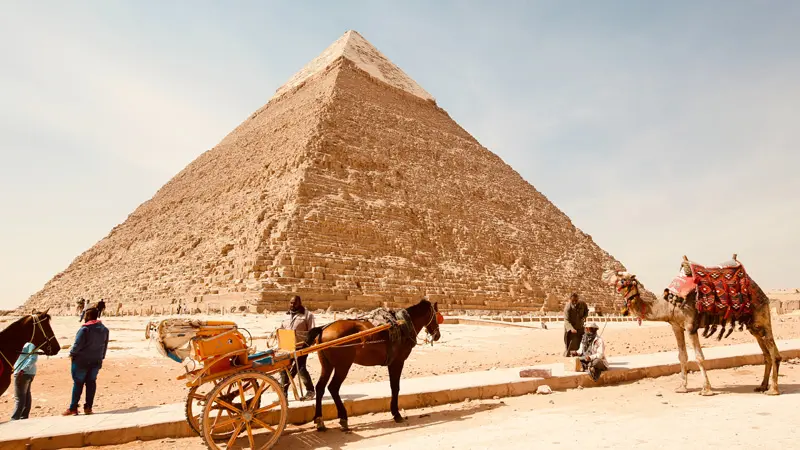
The Pyramid of Khafre was approximately 143.5 meters (471 feet) high when completed. Its present height is generally given as approximately 136.4 meters (448 feet).
That difference exists because the monument no longer retains its complete original apex and exterior casing.
| Measurement | Approximate figure |
|---|---|
| Original height | 143.5 m / 471 ft |
| Current height | 136.4 m / 448 ft |
| Base length | 215.25 m / 706 ft |
| Approximate slope | 53°10′ |
| Position among Giza pyramids | Second-largest |
The Ministry’s official description confirms the original 143.5-meter measurement, while modern architectural references commonly record the surviving structure at about 136.4 meters.
This distinction matters because searches for “Pyramid of Khafre height” often produce both figures without explaining why they differ.
143.5 meters = reconstructed original height.
136.4 meters = approximately how high the surviving pyramid stands today.
Is Khafre’s Pyramid Taller Than the Great Pyramid?
No. Khafre’s pyramid was not originally taller than Khufu’s Great Pyramid, and it is not taller today.
Khufu’s pyramid originally reached approximately 146.5 meters, compared with approximately 143.5 meters for Khafre’s. The Egyptian Ministry confirms Khufu’s original measurement and identifies it as the largest of the three principal Giza pyramids.
Yet photographs can make Khafre’s pyramid look equal in height—or occasionally even taller.
The reason is geography.
The Ministry explains that Khafre built his monument on slightly higher ground, helping it appear comparable in height to his father’s pyramid.
Khafre’s pyramid also has a steeper slope.
| Feature | Khufu | Khafre |
|---|---|---|
| Original height | About 146.5 m | About 143.5 m |
| Current status | Largest Giza pyramid | Second-largest Giza pyramid |
| Base | Larger | Smaller |
| Slope | About 51.8° | About 53.1° |
| Major surviving upper casing | No | Yes |
| Position | Lower relative ground | Higher relative ground |
The result is one of the most effective visual illusions at Giza: the smaller pyramid can look taller from certain viewpoints.
Why Does the Pyramid of Khafre Still Have a Smooth Top?
The smooth-looking section near the summit consists of surviving outer casing stones.
This is perhaps the easiest way to identify Khafre’s pyramid from a distance.
The pyramid’s structural core was made primarily from local limestone. It was originally covered by a smoother exterior layer of high-quality limestone. The Egyptian Ministry states that the fine white limestone used for the casing came from Turah, south of modern Maadi, and was transported to the area by ship.
Most of that outer surface disappeared over the centuries, exposing the rougher core blocks underneath.
Near the top, however, a substantial section survives.
This gives modern visitors something particularly valuable: a visual indication of how dramatically different the Giza pyramids originally appeared.
They were not designed to look like the rough, stepped stone surfaces familiar from modern photographs. Their visible outer faces were much smoother.
Khafre’s surviving casing therefore provides physical evidence of the finished architectural appearance of an Old Kingdom royal pyramid.
What Was the Pyramid of Khafre Made Of?
The Pyramid of Khafre consists primarily of limestone.
Its core was constructed from blocks of local limestone, while finer limestone was used for much of the original exterior casing. The Ministry identifies the high-quality casing material as limestone quarried at Turah.
The wider complex also incorporated other prestigious materials.
Khafre’s Valley Temple, for example, used massive limestone blocks with granite facing and alabaster flooring.
This combination demonstrates an important point about pyramid architecture: the visible pyramid was only one part of a much more elaborate building program.
Stone selection depended on function.
Local limestone could provide enormous structural mass. Finer limestone created a smoother exterior. Granite was used strategically in areas where durability, symbolism or architectural effect justified the greater effort required to transport and work it.
What Is Inside the Pyramid of Khafre?
Inside the Pyramid of Khafre is a relatively restrained system of descending and horizontal passages, two entrances, a subsidiary chamber and a main burial chamber containing a granite sarcophagus.
Visitors expecting an interior resembling Khufu’s Great Pyramid should adjust their expectations.
Khafre’s interior does not contain an equivalent of the Great Pyramid’s enormous Grand Gallery.
Instead, much of its internal arrangement lies at or beneath the level of the pyramid’s base.
The known system includes:
-
An upper entrance on the northern side.
-
A descending passage.
-
A second, lower entrance.
-
Passages cut into the bedrock.
-
A subsidiary chamber.
-
Security features associated with the passage system.
-
A horizontal approach toward the main chamber.
-
The burial chamber.
-
Khafre’s granite sarcophagus.
The Egyptian Ministry’s official gallery specifically identifies the burial chamber, a chamber with a pointed ceiling and the pyramid’s cladding stones among the important surviving features.
If going inside an Egyptian pyramid is an important part of your trip, see our detailed guide explaining whether you can go inside the pyramids.
What Is the Burial Chamber Like?
The main burial chamber is partly associated with the natural bedrock beneath the pyramid rather than being positioned high inside the masonry.
It is approximately 14.15 meters long and 5 meters wide, with a gabled limestone roof.
The chamber is architecturally much simpler than the dramatic sequence of spaces inside Khufu’s Great Pyramid, but that simplicity can make its engineering easier to understand.
The room contains a granite sarcophagus set partly into the floor.
The survival of the sarcophagus makes the chamber particularly important archaeologically because it helps clarify the funerary purpose of the structure even though Khafre’s royal burial did not survive intact.
No confirmed mummy of King Khafre remains inside the pyramid today.
Was Khafre’s Mummy Found Inside the Pyramid?
No confirmed mummy of Pharaoh Khafre has been discovered inside his pyramid.
This is an important distinction because searches for “Khafre mummy” or “King Khafre mummy” sometimes produce confusing or speculative claims.
The monument was entered long before modern archaeology developed, and its royal burial had already been disturbed.
A granite sarcophagus survives in the burial chamber, but the king’s mummy and original royal funerary assemblage were not recovered there by modern archaeologists.
Therefore, statements describing a known, securely identified “mummy of Khafre” should be treated skeptically unless supported by new archaeological evidence.
Is the Pyramid of Khafre Really Khafre’s Tomb?
The archaeological interpretation is that the pyramid formed the royal funerary monument of Pharaoh Khafre.
Its identity is supported not merely by the pyramid itself but by its place within a coherent royal complex incorporating temples, causeway architecture and royal statuary.
Understanding an Egyptian pyramid only as a “giant tomb” oversimplifies its function.
The royal pyramid belonged to a broader system concerned with:
-
royal burial;
-
ritual transformation after death;
-
maintenance of the deceased king’s cult;
-
presentation of royal authority;
-
offerings;
-
religious symbolism;
-
monumental landscape design.
The Ministry notes that priests maintained royal mortuary cults in pyramid temples and presented offerings to the deceased king.
Khafre’s pyramid was therefore the focal monument of a funerary complex, not an isolated stone structure.
The Pyramid Complex of Khafre Explained
Khafre’s complex incorporated several interconnected architectural elements.
The principal sequence can be understood as:
Valley Temple → Causeway → Mortuary Temple → Pyramid
The Great Sphinx and Sphinx Temple are also closely associated geographically and archaeologically with this zone.
This arrangement created a ceremonial landscape extending from the lower edge of the plateau toward the royal pyramid.
The Ministry emphasizes that Khafre’s mortuary and valley temples were larger than those belonging to earlier pyramid complexes and are among the best preserved from the Old Kingdom. Their increasingly sophisticated layout helped establish a pattern followed by later Old Kingdom royal monuments.
That makes the pyramid complex of Khafre historically significant even apart from the pyramid’s extraordinary size.
Khafre’s Mortuary Temple
The mortuary temple stood near the eastern base of the pyramid.
This was part of the ritual infrastructure required to maintain the king’s posthumous cult.
Egyptian royal funerary architecture was intended to operate beyond the moment of burial. Priests, offerings, ceremonies and dedicated architectural spaces supported the continued cult of the deceased ruler.
Khafre’s mortuary temple is important because its plan became influential in later Old Kingdom pyramid architecture.
Rather than viewing the eastern temple as an optional addition, it is more accurate to understand the pyramid and temple as parts of the same funerary program.
Khafre’s Causeway
A long causeway connected the upper mortuary complex with the lower Valley Temple.
Causeways in pyramid complexes were functional ceremonial connections rather than ordinary roads.
At Giza, the terrain itself becomes part of the architecture: the visitor moves from the lower zone upward toward the pyramid.
Khafre’s causeway is also central to understanding the spatial relationship between his pyramid and the Great Sphinx of Giza.
Khafre’s Valley Temple
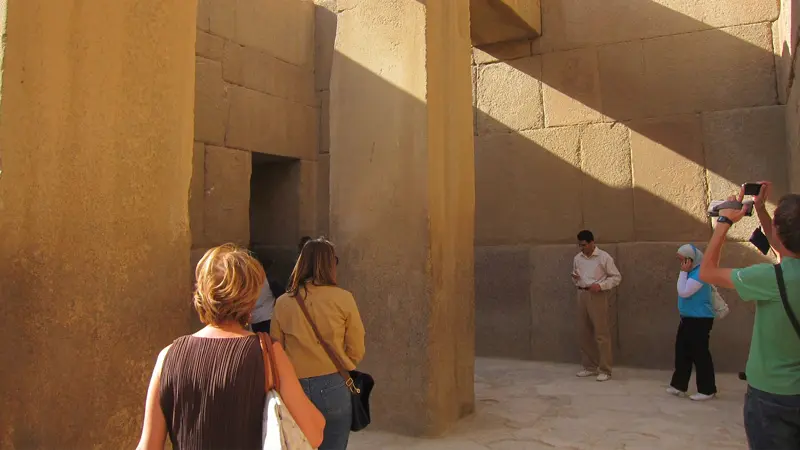
Khafre’s Valley Temple is one of the most impressive surviving structures associated with his reign.
The Ministry describes it as being constructed from massive limestone blocks faced with granite, with alabaster flooring and monolithic granite pillars in its broad hall. Niches once accommodated royal statues.
This is where architecture and royal sculpture intersect.
One of the most famous surviving statues of Khafre shows the king seated with the falcon god Horus positioned protectively behind his head.
The Ministry identifies this granodiorite statue as one of the outstanding works associated with the complex and notes that statues of the king from the site are displayed at the Egyptian Museum.
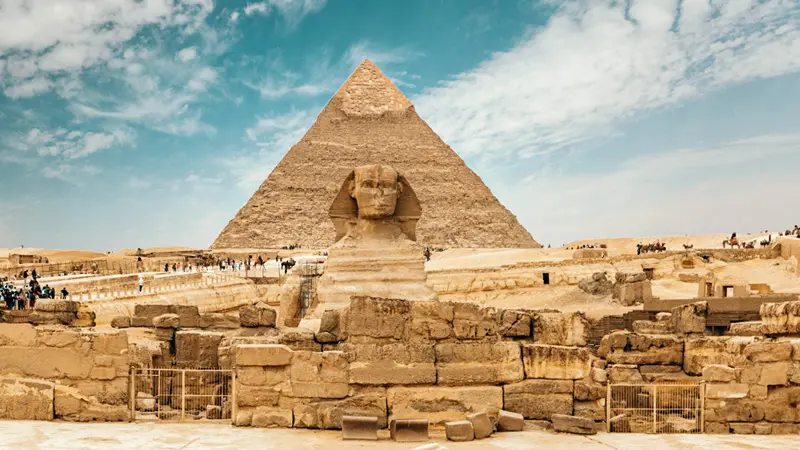
What Is the Connection Between Khafre and the Great Sphinx?
The Great Sphinx is strongly associated archaeologically with Khafre’s reign and pyramid complex, although discussion of its precise history has generated debate.
The official Egyptian Ministry states that the evidence points toward the Great Sphinx being carved during Khafre’s reign. It notes the physical relationship among the Sphinx, Sphinx Temple, Khafre’s Valley Temple and the lower section of Khafre’s causeway.
The Sphinx was carved directly from the limestone bedrock and depicts a royal human head on a lion’s body.
The Ministry also reports similarities between the Sphinx’s facial characteristics and surviving statues of Khafre.
For visitors, the important relationship is spatial as well as historical:
Khafre’s Pyramid → Mortuary Temple → Causeway → Valley Temple → Sphinx zone
Seeing these structures together makes the Giza Plateau much easier to understand.
The Great Sphinx of Giza therefore deserves to be studied as part of the wider Fourth Dynasty monumental landscape rather than as an isolated sculpture.
Pyramid of Khafre vs Pyramid of Khufu
The Pyramid of Khufu is larger, but Khafre’s pyramid preserves features that make the two monuments rewarding to compare.
| Feature | Pyramid of Khufu | Pyramid of Khafre |
|---|---|---|
| Pharaoh | Khufu | Khafre |
| Relationship | Father | Son |
| Dynasty | Fourth Dynasty | Fourth Dynasty |
| Original height | Approx. 146.5 m | Approx. 143.5 m |
| Relative size | Largest at Giza | Second-largest |
| Terrain | Lower | Higher |
| Slope | Gentler | Steeper |
| Upper casing | Mostly lost | Significant casing survives |
| Interior | More complex | Comparatively simpler |
| Famous internal feature | Grand Gallery | Bedrock-level burial system |
| Associated landscape | Khufu complex | Khafre complex and Sphinx zone |
The Great Pyramid remains the largest and is the only surviving monument traditionally counted among the Seven Wonders of the Ancient World.
Khafre’s pyramid, however, gives visitors something Khufu’s largely cannot: a substantial surviving section of the original exterior casing.
Together, they show two closely related but distinct approaches to royal monumentality.
Pyramid of Khafre vs Pyramid of Menkaure
The difference between Khafre and Menkaure is much more dramatic.
Menkaure’s pyramid originally stood approximately 65 meters high, less than half the original height of Khafre’s.
| Feature | Khafre | Menkaure |
|---|---|---|
| Original height | Approx. 143.5 m | Approx. 65 m |
| Position | Middle principal pyramid | Southern/smaller principal pyramid |
| Relative size | Second-largest | Smallest of main three |
| Notable casing | Limestone survives near top | Granite used extensively in lower casing |
| Associated ruler | Khafre | Menkaure |
Menkaure nevertheless introduced its own striking use of granite casing, particularly around the lower portion of the monument.
Read the dedicated guide to the Pyramid of Menkaure to compare all three royal monuments more closely.
Is the Pyramid of Khafre the Second-Largest Pyramid in Egypt?
Khafre’s pyramid is the second-largest of the three principal pyramids at Giza and is commonly described as Egypt’s second-largest pyramid in terms of its monumental scale.
Its original height of approximately 143.5 meters placed it just below Khufu’s Great Pyramid.
However, phrases such as “second-largest pyramid in the world” can become ambiguous because “largest” can refer to height, base area, or volume, and pyramid-like structures elsewhere are sometimes measured differently.
For accurate historical writing, the clearest description is:
The Pyramid of Khafre is the second-largest and second-tallest of the three main pyramids at Giza.
For the broader Egyptian pyramid landscape, see how many ancient pyramids are in Egypt.
Why Was the Pyramid of Khafre Built?
The pyramid was constructed as the central monument of Khafre’s royal funerary complex.
Ancient Egyptian royal tomb architecture was connected to beliefs about kingship, death, rebirth and the continuing existence of the ruler after death.
A royal pyramid complex did several things simultaneously.
It provided a monumental burial place.
It created spaces for funerary ceremonies.
It supported an ongoing mortuary cult.
It projected royal power.
And it connected the deceased ruler with the religious ideas surrounding regeneration and eternity.
The pyramid therefore had practical, political, religious and symbolic dimensions.
Readers interested in the beliefs surrounding Egyptian royal burial can explore ancient Egyptian culture and the wider history of ancient Egypt.
How Was the Pyramid of Khafre Built?
No surviving ancient instruction manual explains the entire construction process of Khafre’s pyramid.
What archaeology does show is a highly organized state project capable of quarrying, transporting, shaping and placing enormous quantities of stone while coordinating labor, food, tools, architecture and logistics.
The pyramid’s core primarily used locally available limestone.
Fine limestone casing came from Turah.
Other parts of the complex incorporated granite and alabaster.
Construction would have required several coordinated operations:
-
Surveying and preparing the site.
-
Quarrying local stone.
-
Transporting higher-quality stone from more distant sources.
-
Preparing the pyramid’s foundation.
-
Establishing accurate orientation and dimensions.
-
Building the core in successive courses.
-
Constructing the passage and chamber system.
-
Building temples and the causeway.
-
Installing exterior casing.
-
Completing ritual and architectural spaces around the monument.
The exact ramp systems, lifting methods and construction sequences remain subjects of scholarly investigation.
It is therefore better to distinguish archaeological evidence from modern reconstruction instead of claiming that one unproven pyramid-building theory has been conclusively established.
Who Actually Built Khafre’s Pyramid?
The evidence from Giza supports a large, organized labor force working within a state-supported system—not the simplistic popular image of huge numbers of enslaved people being driven to build the pyramids.
The Ministry’s description of the Workers’ Town and Cemetery at Heit al-Ghurab is particularly important.
Archaeological remains there include houses, storage facilities, streets, administrative buildings and large galleries. The Ministry associates the settlement with workers involved in the pyramid complexes of Khafre and Menkaure.
Animal remains indicate substantial food provisioning, while skeletal evidence reveals both physically demanding work and healed injuries. The Ministry interprets this as evidence that workers were supplied with food and medical care.
This does not answer every question about labor organization, but it gives archaeology—not movie imagery—a central role in understanding who constructed Giza.
What Happened to the Pyramid’s Casing Stones?
Most of the polished outer casing disappeared over centuries.
Stone from ancient monuments was sometimes removed and reused in later construction, while natural deterioration and human activity also altered the structures.
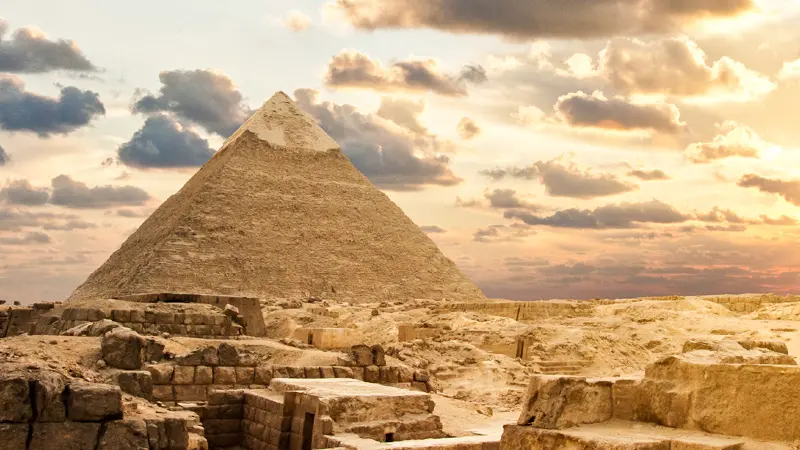
Khafre’s pyramid is exceptional because a large patch of casing remains near the summit.
Look closely from the plateau and you can see the contrast:
Lower pyramid: rougher exposed core masonry.
Upper pyramid: smoother surviving casing.
That contrast makes Khafre one of the clearest places in Egypt to visualize how a finished smooth-sided pyramid differed from its modern weathered appearance.
What Happened to Khafre’s Body and Treasure?
They have not survived in the pyramid in an archaeologically secure royal burial.
Like many Egyptian royal tombs, Khafre’s pyramid was disturbed long before modern archaeological investigation.
The absence of a mummy or treasure today does not mean that the structure was never a royal tomb.
Ancient tomb robbery was a persistent problem in Egypt. Centuries later, New Kingdom kings would eventually be buried in concealed rock-cut tombs at the Valley of the Kings rather than beneath enormous visible pyramids. The Egyptian Ministry explicitly identifies tomb robbery as one factor behind the later choice of secluded underground royal tombs.
Khafre’s surviving sarcophagus and the surrounding funerary complex remain central evidence for the monument’s intended function.
Who Rediscovered the Interior of Khafre’s Pyramid?
European exploration of the monument intensified during the nineteenth century.
Italian explorer Giovanni Battista Belzoni entered the burial chamber in 1818 after locating a passage into the pyramid.
Belzoni is an important figure in the early modern exploration of Egyptian monuments, although his methods belonged to an era very different from modern archaeology.
His name remains associated with the modern history of Khafre’s interior.
But “rediscovered” should be used carefully.
The pyramid was an ancient monument known locally for centuries, and its chambers had already been disturbed long before Belzoni reached them. He did not discover an untouched royal tomb.
Can You Go Inside the Pyramid of Khafre in 2027?
Access inside individual Giza pyramids can be controlled separately from general admission to the plateau and may change because of conservation, maintenance or operational decisions.
The Egyptian Ministry’s current Giza Plateau information specifically states that the standard area-entry ticket does not include the Pyramid of Khafre, along with several other separately controlled monuments.
That distinction is essential for 2027 travelers.
Do not assume that buying general admission to Giza automatically provides interior access.
Also do not assume that because the interior is available during one travel period it will necessarily remain open throughout 2027.
Before your visit:
-
Check the official Egyptian monuments information.
-
Confirm whether Khafre is open internally on your exact date.
-
Check whether a separate ticket is required.
-
Verify current prices.
-
Buy only through authorized channels.
-
Keep your general Giza Plateau ticket where required.
Pyramid of Khafre Tickets and Prices for 2027
Official 2027 prices should be checked again close to your travel date.
As of the official information checked for this guide, the Egyptian Ministry lists standard Giza Plateau area admission for foreign visitors at EGP 700 for adults and EGP 350 for eligible students. The same official listing explicitly states that this area ticket does not cover entry to the Pyramid of Khafre.
| Ticket | Current official reference | 2027 advice |
|---|---|---|
| Giza Plateau – foreign adult | EGP 700 | Recheck before travel |
| Giza Plateau – foreign student | EGP 350 | Recheck eligibility and price |
| Khafre interior | Separate from area admission | Confirm availability and current price |
| Khufu interior | Separate ticket | Confirm current price |
| Menkaure interior | Separate ticket | Confirm availability |
These are reference prices available at the time this guide was researched, not guaranteed 2027 prices.
Egypt can revise archaeological-site admission charges. Interior openings may also change.
For that reason, a trustworthy 2027 guide should not present today’s Khafre admission arrangement as an immutable future price.
Pyramid of Khafre Opening Hours for 2027
The official Egyptian monument database currently lists the Giza Plateau from 8:00 AM to 4:00 PM daily on the page checked for this guide.
However, individual monuments, ticket offices, seasonal schedules and internal pyramid access can operate differently.
Opening hours may also change before or during 2027.
Treat the published schedule as a planning reference rather than a permanent guarantee.
For a 2027 visit:
-
verify hours shortly before arrival;
-
arrive earlier rather than close to closing time;
-
allow several hours for the plateau;
-
check whether interior pyramid tickets have separate availability;
-
consider heat and sun exposure when planning your route.
What Is It Like Inside Khafre’s Pyramid?
Going inside Khafre’s pyramid is primarily an architectural and archaeological experience, not a decorative tomb experience.
Do not expect painted walls like those in many New Kingdom tombs at Luxor.
Instead, expect confined stone passages, changes in floor level, descending sections and a stark burial chamber.
The value comes from physically experiencing the geometry of a Fourth Dynasty pyramid.
You are moving through the internal architecture of a monument constructed roughly four and a half millennia ago.
For some travelers, that is extraordinary.
For others, the narrow and enclosed environment can be uncomfortable.
Is Going Inside Khafre’s Pyramid Difficult?
It can be physically uncomfortable for some visitors.
Potential challenges include:
-
confined passages;
-
low ceilings in sections;
-
steep or sloping movement;
-
bending or crouching;
-
heat;
-
limited ventilation compared with outdoor spaces;
-
close proximity to other visitors;
-
a strong sense of enclosure.
Travelers with significant mobility limitations, severe claustrophobia or medical conditions affected by confined spaces should assess the experience carefully.
The archaeological value of Khafre does not depend on entering it. You can still understand the monument exceptionally well from its exterior, temple complex and surrounding plateau.
For travelers who require mobility planning, see our guide to wheelchair accessibility in Egypt and our Egypt wheelchair-accessible tours.
How Long Should You Spend at the Pyramid of Khafre?
Allow approximately 30–60 minutes around Khafre itself if you are visiting the exterior and examining the surrounding architecture.
Allow more time if interior access is available and important to you.
For the wider Giza Plateau, most first-time visitors should think in terms of several hours, not a quick photo stop.
A well-paced visit can include:
-
Great Pyramid of Khufu;
-
Pyramid of Khafre;
-
Pyramid of Menkaure;
-
panoramic viewpoint;
-
Great Sphinx;
-
Valley Temple area;
-
selected tombs or additional monuments where accessible.
If archaeology is one of the main reasons for your Egypt trip, a private guided visit can provide significantly more context than simply moving between photo stops.
Best Time of Day to Visit the Pyramid of Khafre
For many travelers, morning is the most practical period.
Earlier visits generally offer more time before closing and can reduce exposure to the strongest midday heat, particularly in warmer months.
The plateau is large, exposed and sunny.
Your ideal timing should consider:
-
season;
-
temperature;
-
photography priorities;
-
crowd levels;
-
interior ticket availability;
-
how many monuments you want to visit.
Winter can provide more comfortable daytime temperatures, while summer requires more careful heat management.
For seasonal planning, compare the best time to visit Egypt with the detailed Egypt weather by month.
Best Places to Photograph the Pyramid of Khafre
The pyramid changes dramatically depending on where you stand.
Useful photographic perspectives include:
From Near the Great Pyramid
This angle emphasizes the relationship between Khufu and Khafre and demonstrates how elevation affects their apparent heights.
From the Panoramic Area
A wider view can frame Khufu, Khafre and Menkaure together.
From the Sphinx Area
This creates the famous visual relationship between the Sphinx and Khafre’s pyramid.
Be careful with photographs from this direction: perspective can visually compress the distance between monuments.
Near Khafre’s Base
Closer views reveal the enormous core blocks and surviving casing high above.
For the most useful photography, capture both wide landscape images and detail shots of the casing. The combination tells a much richer architectural story than a single frontal photograph.
Why Is the Pyramid of Khafre Important?
Khafre’s pyramid is significant for at least five distinct reasons.
It Is One of the Great Fourth Dynasty Royal Pyramids
It represents the peak era of Old Kingdom monumental pyramid construction.
Its Upper Casing Survives
The casing provides rare visual evidence of how smooth-sided pyramids originally appeared.
Its Funerary Complex Is Exceptionally Important
The surviving temples and causeway reveal that a pyramid was part of a much larger ritual landscape.
It Is Closely Connected with the Great Sphinx
Official Egyptian archaeological interpretation links the Sphinx strongly with Khafre’s reign and complex.
It Helps Explain the Development of Pyramid Architecture
Khafre stands within a sequence stretching from earlier experiments at Saqqara, Meidum and Dahshur to the monumental Giza complexes.
For travelers focused on archaeology, the monument fits naturally into archaeology tours of Egypt or broader ancient Egypt tours.
Common Myths About the Pyramid of Khafre
The monument attracts both legitimate archaeological questions and unsupported claims.
Separating them improves understanding.
Myth: Khafre’s Pyramid Is the Tallest at Giza
It is not. Khufu’s pyramid was originally taller.
Khafre appears taller from some viewpoints because of its elevated position and steeper sides.
Myth: Khafre’s Mummy Was Found Inside
No securely identified mummy of Khafre has been recovered from the pyramid.
Myth: The Pyramid Still Has Its Original Point
The summit is not fully intact. What makes the upper area distinctive is surviving exterior casing.
Myth: The Entire Pyramid Was Always Rough
No. Much of its exterior was originally covered by smoother fine limestone.
Myth: The Pyramid Was Built in Isolation
No. It belonged to a complex containing temples, a causeway and associated funerary architecture.
Myth: We Know Exactly How It Was Built
Archaeology provides substantial evidence about materials, labor, quarrying and organization, but the complete construction sequence and precise lifting systems remain subjects of research.
Pyramid of Khafre and the Giza UNESCO World Heritage Site
Khafre’s pyramid lies within the UNESCO World Heritage property Memphis and its Necropolis – the Pyramid Fields from Giza to Dahshur.
UNESCO’s protected cultural landscape extends far beyond the three famous pyramids.
It incorporates an extraordinary sequence of archaeological sites documenting the development of monumental Egyptian funerary architecture, including Giza, Saqqara and Dahshur.
This broader context matters.
The Pyramid of Khafre is not an isolated wonder from an unexplained moment in history. It belongs to a long architectural evolution.
At Saqqara, Djoser’s Step Pyramid represents an early breakthrough in monumental stone construction.
At Dahshur, pyramid builders experimented with true smooth-sided forms.
At Giza, Khufu, Khafre and Menkaure developed enormous royal complexes.
Seeing those places together reveals an architectural sequence that a single Giza visit cannot fully communicate.
How Does Khafre Fit Into the History of Egyptian Pyramids?
The Pyramid of Khafre belongs near the culmination of a long process of architectural experimentation.
A simplified sequence is:
Mastaba tombs → Step Pyramid → transitional pyramids → true pyramids → giant Giza pyramids
Djoser’s monument at Saqqara transformed stacked mastaba-like forms into a monumental step pyramid.
Fourth Dynasty projects under Sneferu advanced the engineering of true pyramids.
Khufu then commissioned the Great Pyramid.
Khafre continued the Giza tradition while developing an unusually impressive temple complex.
Menkaure followed with a smaller but architecturally sophisticated monument.
For readers comparing Egypt’s pyramid sites, the guide to how many ancient pyramids are in Egypt provides useful broader context.
Visiting Khafre, Khufu and Menkaure Together
For first-time visitors, the three main pyramids should be understood as a connected archaeological landscape.
A logical sequence is:
1. Great Pyramid of Khufu
Start with the oldest and largest of the three.
2. Pyramid of Khafre
Compare the steeper profile, higher ground and surviving casing.
3. Pyramid of Menkaure
Observe the major reduction in scale and different use of casing materials.
4. Panoramic viewpoint
See how all three relate spatially.
5. Great Sphinx and Valley Temple
Finish in the lower section of Khafre’s complex.
This route turns a collection of famous landmarks into an intelligible historical landscape.
For a broader itinerary, see how to enjoy the Giza Pyramids complex.
What Else Should You See Near the Pyramid of Khafre?
Do not leave Giza immediately after photographing the three pyramids.
The plateau contains much more archaeological information than the famous skyline suggests.
Important nearby features include:
-
Great Sphinx;
-
Khafre Valley Temple;
-
Khafre’s causeway;
-
mortuary temple remains;
-
queens’ pyramids;
-
mastaba cemeteries;
-
workers’ archaeological areas;
-
additional tombs where public access is available.
Travelers with more time can combine Giza with the Grand Egyptian Museum tours to connect the monuments with objects and royal material culture from ancient Egypt.
What Should You Wear and Bring?
The Giza Plateau is an exposed archaeological landscape.
Useful items include:
-
comfortable walking shoes;
-
breathable clothing;
-
sun protection;
-
hat;
-
water;
-
sunglasses;
-
small practical day bag;
-
phone or camera;
-
valid student identification if claiming an eligible student ticket.
Avoid planning the visit as though you will simply step from a vehicle, take one photograph and leave.
Walking surfaces can be uneven, distances are meaningful and shade can be limited.
Our complete what to pack for Egypt guide covers broader trip preparation.
How to Visit the Pyramid of Khafre from Cairo
Giza is part of the Greater Cairo urban area, making the pyramids accessible as a day visit from Cairo.
Travel time varies substantially with your starting point and traffic.
A practical Giza day can combine:
-
Pyramid of Khufu;
-
Pyramid of Khafre;
-
Pyramid of Menkaure;
-
Great Sphinx;
-
Valley Temple;
-
Grand Egyptian Museum, depending on your itinerary and available time.
Travelers building a longer stay can use our Cairo itinerary to combine Giza with other major archaeological, Islamic, Coptic and museum sites.
Should You Visit Khafre with a Guide?
You can physically visit the Giza Plateau independently, but a knowledgeable guide can add substantial value if your priority is history rather than photography alone.
A good archaeological explanation should help you understand:
-
why Khafre’s pyramid appears taller;
-
what the casing stones reveal;
-
how the complex was organized;
-
where the causeway ran;
-
what happened in the Valley Temple;
-
how the Sphinx relates to the complex;
-
how Khafre compares with Khufu and Menkaure;
-
which claims about pyramid construction are evidence-based.
This is particularly useful because the monument’s significance is distributed across a landscape rather than concentrated in one decorated interior.
Private Pyramid Tours and Archaeological Visits
Travelers who want Giza incorporated into a larger Egypt itinerary can consider a dedicated Egypt pyramids tour or browse Egypt trips to the pyramids.
For travelers interested primarily in archaeology and ancient history, Egypt archaeology tours can connect Giza with Saqqara, Dahshur, Luxor, Abydos, Aswan and other major sites.
A private arrangement is particularly useful when you want more time at Khafre’s complex instead of following a standard photo-stop schedule.
Planning a Pyramid of Khafre Visit in 2027
For a smoother visit, use this sequence.
Step 1: Verify Official Opening Information
Check the current Giza Plateau schedule shortly before your visit.
Step 2: Confirm Khafre Interior Access
General Giza admission does not automatically mean the interior is included.
Step 3: Check Current Ticket Prices
Do not rely on screenshots or old blog prices.
Step 4: Decide Whether You Actually Want to Enter
The interior is historically fascinating but physically confined.
Step 5: Allocate Enough Time
Allow several hours for the main Giza monuments.
Step 6: Study the Complex, Not Just the Pyramid
Include the causeway, Valley Temple and Sphinx area.
Step 7: Compare All Three Main Pyramids
Khufu, Khafre and Menkaure make more sense when studied together.
Step 8: Add Saqqara or Dahshur If Archaeology Is Your Priority
This reveals how pyramid architecture developed rather than presenting Giza without context.
For complete trip organization, use our Egypt trip planner or guide to planning a trip to Egypt.
Who Should Visit the Pyramid of Khafre?
Khafre is especially rewarding for:
First-time Egypt visitors
It is one of the three defining monuments of Giza.
Ancient-history enthusiasts
The pyramid connects architecture, religion, kingship and Old Kingdom state organization.
Architecture enthusiasts
Its geometry, surviving casing and temple complex provide exceptional evidence of Fourth Dynasty building.
Families with curious children
The visual comparison between Khufu, Khafre and Menkaure can make pyramid history easier to understand.
Photographers
Changing viewpoints dramatically alter the relationship between Khafre, Khufu and the Sphinx.
Archaeology-focused travelers
The wider complex offers considerably more than the pyramid exterior.
Commercial CTA: Explore the Giza Pyramids with Egypt Time Travel
Understanding the Pyramid of Khafre becomes much easier when Giza is explored as a complete archaeological landscape rather than as three separate photo stops.
Egypt Time Travel can incorporate Khafre, the Great Pyramid, Menkaure, the Great Sphinx and other Giza highlights into a private Cairo itinerary or a longer journey through Egypt.
Explore our best Egypt pyramid tours or request a personalized itinerary through our Egypt tailor-made holidays.
A customized trip can also connect Giza with Saqqara, Dahshur, Cairo’s museums, Luxor and Aswan according to your available time and archaeological interests.
Frequently Asked Questions About the Pyramid of Khafre
What is the current height of the Pyramid of Khafre in meters?
The Pyramid of Khafre currently stands approximately 136.4 meters (448 feet) high. Its reconstructed original height was approximately 143.5 meters (471 feet). The reduction reflects the loss of material from the original summit and exterior over thousands of years.
Where is the Pyramid of Khafre located?
The Pyramid of Khafre is located on the Giza Plateau in Giza, Egypt, beside the Great Pyramid of Khufu and the Pyramid of Menkaure. It forms part of the Giza Necropolis and the UNESCO World Heritage property encompassing the pyramid fields from Giza to Dahshur.
Who built the Pyramid of Khafre?
The pyramid was commissioned for Pharaoh Khafre, a Fourth Dynasty king and son of Khufu. Large organized workforces supported by the Egyptian state constructed the Giza monuments. Archaeological evidence from the workers’ settlement provides important information about their lives and organization.
When was the Pyramid of Khafre built?
The Pyramid of Khafre was built during Egypt’s Fourth Dynasty in the Old Kingdom, in the middle of the third millennium BC. The Egyptian Ministry dates Khafre’s reign approximately to 2558–2532 BC, although precise Old Kingdom chronologies differ among scholars.
Why does Khafre’s pyramid look taller than Khufu’s?
Khafre’s pyramid stands on higher ground and has somewhat steeper sides. These factors can make it appear taller from certain viewpoints. In reality, Khufu’s Great Pyramid was originally approximately 146.5 meters high compared with about 143.5 meters for Khafre.
What is inside the Pyramid of Khafre?
The interior contains descending and horizontal passages, two entrance systems, a subsidiary chamber and the main burial chamber. The burial chamber includes a granite sarcophagus. Unlike Khufu’s pyramid, Khafre’s does not contain a monumental Grand Gallery.
Was Khafre’s mummy found?
No securely identified mummy of Pharaoh Khafre has been recovered from his pyramid. The burial had been disturbed before modern archaeological investigation, and the surviving granite sarcophagus was not found with an intact royal mummy.
Why are there limestone blocks still covering the top?
Those blocks are surviving parts of the pyramid’s original fine limestone casing. Much of the casing elsewhere was lost over the centuries, leaving the rougher core visible. Khafre’s surviving upper casing is one of the monument’s most recognizable characteristics.
Is Khafre the second pyramid of Giza?
Yes. Khafre’s monument is commonly called the second pyramid of Giza because it is the second-largest of the three principal pyramids and was constructed after Khufu’s Great Pyramid.
Is the Pyramid of Khafre the same as the Pyramid of Chephren?
Yes. Chephren and Khefren are alternative forms of Khafre’s name. Pyramid of Khafre, Pyramid of Chephren and Khefren Pyramid therefore refer to the same monument.
Can tourists enter the Pyramid of Khafre?
Interior access is sometimes available, but opening arrangements can change. General Giza Plateau admission does not automatically include Khafre’s interior. Travelers visiting in 2027 should confirm the pyramid’s current opening status, separate admission requirements and price before arrival.
Is the Pyramid of Khafre worth visiting if I do not go inside?
Yes. Much of Khafre’s archaeological significance is visible outside the pyramid. The surviving casing, mortuary temple, causeway, Valley Temple and relationship with the Great Sphinx make the complex worthwhile even without entering the burial chamber.
Conclusion: Why the Pyramid of Khafre Deserves More Than a Photo Stop
The Pyramid of Khafre in 2027 should not be treated merely as the pyramid behind the Sphinx or the slightly smaller neighbor of the Great Pyramid.
It is a monumental royal tomb at the center of one of the most informative surviving funerary complexes of Egypt’s Old Kingdom.
Its original height of approximately 143.5 meters, current height of about 136.4 meters, elevated location and steeper profile explain why it can appear larger than it really is. Its surviving upper casing provides a rare glimpse of the smooth exterior that once transformed the appearance of Egyptian pyramids.
More importantly, Khafre’s mortuary temple, causeway, Valley Temple and archaeological relationship with the Great Sphinx demonstrate that a pyramid was never simply a giant triangular building.
It was the focal point of an interconnected sacred landscape.
When you visit Giza, look beyond the familiar silhouette. Compare Khafre with Khufu. Examine the casing. Follow the direction of the causeway. Study the Valley Temple. Look back toward the pyramid from the Sphinx.
That wider perspective turns the Pyramid of Khafre from a famous photograph into a much clearer expression of ancient Egyptian architecture, religion, royal power and engineering.
