
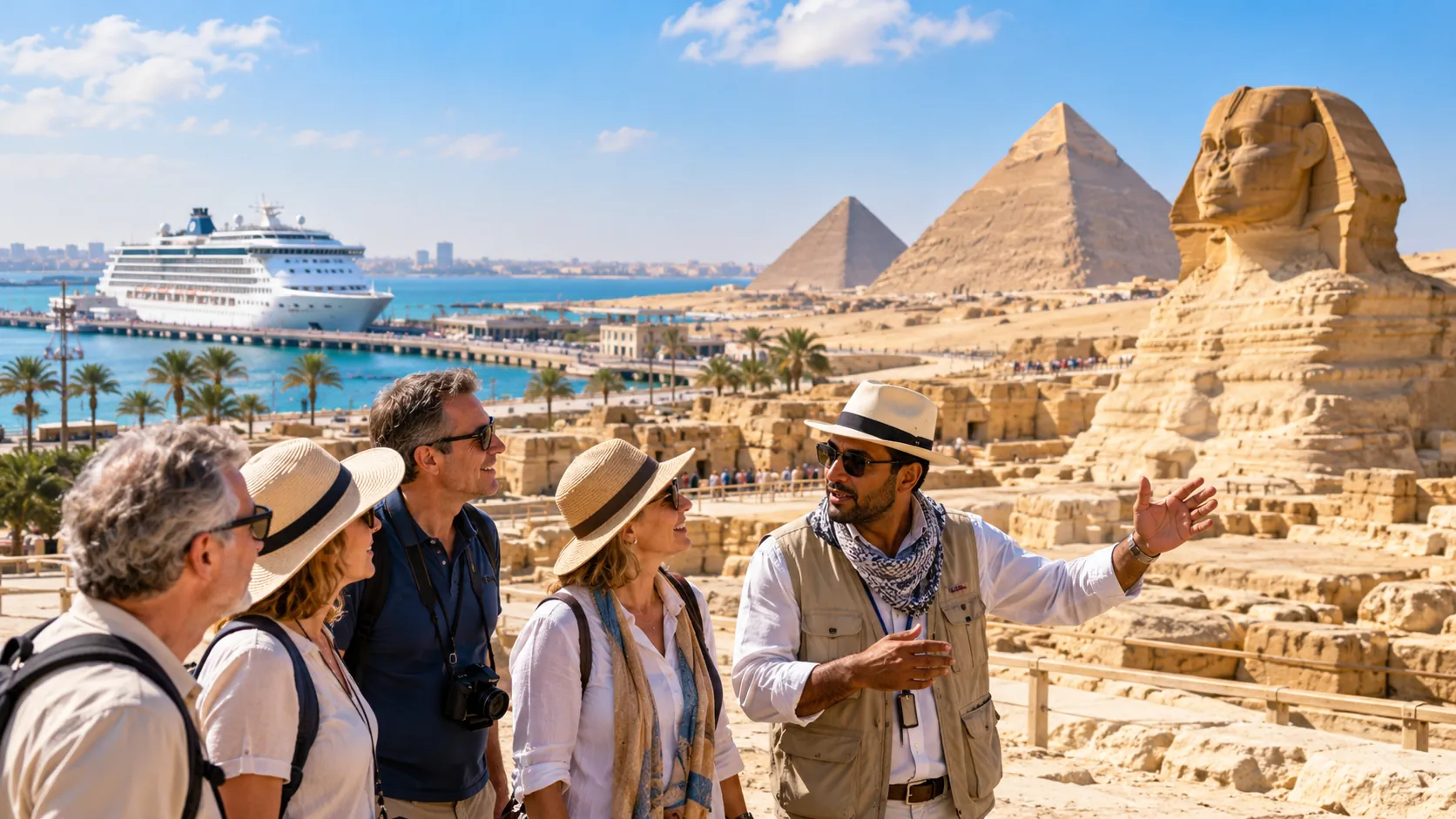
Quick Answer: What are the best Egypt shore excursions in 2027?
The best Egypt shore excursions in 2027 depend on your cruise port and available time ashore. Alexandria offers Mediterranean history and longer trips to the Giza Pyramids. Port Said and Ain Sokhna provide access to Cairo, while Safaga is the main cruise gateway to Luxor’s temples and royal tombs. Sharm El Sheikh is ideal for Red Sea snorkeling. Always plan around your ship’s confirmed all-aboard time.
A cruise stop in Egypt can take you from a modern passenger ship to a 4,500-year-old pyramid, an underground Roman burial complex, or the monumental temples of ancient Thebes. Yet the experience you can realistically enjoy depends less on the number of attractions advertised than on the location of your ship.
Consider the difference between Alexandria and Safaga. Alexandria sits on Egypt’s Mediterranean coast and offers nearby Greco-Roman landmarks, while Safaga is on the Red Sea, several hours by road from Luxor. Both can deliver memorable excursions, but they require entirely different plans.
For travelers arriving in 2027, the most important decision is choosing an excursion that fits the port, the available hours, and the ship’s boarding deadline.
This guide explains the main Egyptian cruise ports, the best sightseeing options, approximate driving times, realistic itineraries, excursion costs, entry requirements, and practical considerations for booking private or cruise-line tours.
What Are Egypt Shore Excursions, and How Do They Work?
Egypt shore excursions are organized sightseeing experiences designed for passengers visiting Egypt during a cruise ship’s scheduled port call.
Unlike conventional land tours, shore excursions operate within a fixed arrival and departure window. Passengers normally disembark, meet their guide or transport provider, explore selected attractions, and return to their ship before the designated all-aboard time.
The types of excursions available depend on the destination and can include:
-
Historical excursions: Guided visits to pyramids, temples, museums, tombs, and archaeological sites.
-
Cultural excursions: Exploring traditional markets, historic neighborhoods, religious monuments, and local food.
-
Coastal excursions: Beach visits, snorkeling, diving, and boat trips along the Red Sea.
-
Adventure excursions: Desert safaris, approved off-road experiences, and selected outdoor activities.
-
Private excursions: Customized trips with a dedicated guide and vehicle.
-
Small-group excursions: Shared transport and guided activities involving a limited number of travelers.
-
Overnight excursions: Extended sightseeing arrangements possible only when the cruise schedule and immigration conditions permit.
A shore excursion is therefore a form of land excursion, but not every day tour is suitable for cruise passengers.
A regular Cairo tour might finish whenever sightseeing is complete. A Cairo shore excursion must account for the journey back to the correct cruise terminal, port security procedures, and the ship’s boarding deadline.
That difference should influence every booking decision.
Travelers planning sightseeing before or after their cruise can also explore Egypt day tours and guided excursions, which allow greater flexibility than most port visits.
Egypt Cruise Ports at a Glance: Which Excursions Are Possible?
Egypt’s major cruise gateways connect visitors to substantially different destinations. Alexandria and Port Said serve the Mediterranean region, while Ain Sokhna and Safaga are associated with the Red Sea and Gulf of Suez.
Sharm El Sheikh is another potential cruise destination, particularly for itineraries that include South Sinai.
The table below provides a practical overview.
|
Egyptian Cruise Port |
Best Excursion |
Approximate Driving Time Each Way |
Suggested Shore Time |
|---|---|---|---|
|
Alexandria |
Alexandria city attractions |
Usually 20–60 minutes between port and principal city sights, depending on access and traffic |
5–8 hours |
|
Alexandria |
Giza Pyramids and Cairo |
3–4 hours |
11–13+ hours |
|
Port Said |
Port Said and Suez Canal heritage |
Mostly local transfers |
4–6 hours |
|
Port Said |
Cairo and Giza Pyramids |
3–4 hours |
11–13+ hours |
|
Ain Sokhna |
Cairo, Giza Pyramids and museums |
1.5–3 hours |
9–12+ hours |
|
Safaga |
Luxor temples and Valley of the Kings |
3–4 hours, sometimes longer |
11–14 hours |
|
Safaga |
Red Sea relaxation or snorkeling |
Varies by departure location; Hurghada is roughly 1–1.5 hours away |
5–9 hours |
|
Sharm El Sheikh |
Ras Mohammed and Red Sea marine activities |
Approximately 30–60 minutes by road for selected land-access points, plus any boat travel |
4–8 hours |
Driving times are approximate planning estimates, not guaranteed journey durations. They can change with the actual berth, traffic, security procedures, route, and weather. Suggested shore times include more than attraction-visiting time and must be checked against the ship’s schedule.
Which Port Is Best for the Pyramids of Giza?
Ain Sokhna is often the most convenient Red Sea cruise port for a Giza Pyramids excursion because its road journey is generally shorter than those from Alexandria or Port Said.
Alexandria and Port Said can also work, particularly when the cruise ship remains in port for a sufficiently long day.
Which Port Is Best for Luxor?
Safaga is the practical choice for a road-based shore excursion to Luxor.
Located on the Red Sea coast, Safaga connects cruise passengers with the ancient city of Thebes, including Karnak Temple, the Valley of the Kings, and the Temple of Hatshepsut.
Which Port Is Best for a Relaxed Excursion?
Alexandria is excellent for travelers interested in shorter sightseeing transfers, historical landmarks, and Mediterranean scenery.
Sharm El Sheikh and Safaga offer possibilities for relaxation and marine activities, provided suitable excursions are available and the ship’s location permits practical access.
Alexandria Egypt Shore Excursions: Ancient History or the Pyramids?
Alexandria shore excursions are among the most varied options for cruise passengers visiting Egypt.
Founded by Alexander the Great in 331 BCE, Alexandria became a major center of Mediterranean trade and intellectual life during the Ptolemaic period. The ancient city was associated with the famous Library of Alexandria and the Pharos lighthouse, one of the Seven Wonders of the Ancient World.
Today, the modern city combines archaeological remains, historic fortifications, coastal neighborhoods, and cultural institutions.
Cruise travelers arriving at Alexandria Port generally face two main choices: spend the day exploring Alexandria itself or travel inland toward Cairo and Giza.
Option 1: Explore Alexandria’s Historical Attractions
For many passengers, staying in Alexandria offers the best balance of sightseeing and manageable travel time.
A guided city excursion can include several of the following attractions.
Qaitbay Citadel
The Citadel of Qaitbay stands on the eastern harbor waterfront, near the site traditionally associated with the ancient Lighthouse of Alexandria.
The fortress was constructed during the reign of Sultan Qaitbay in the 15th century, long after the lighthouse had disappeared.
Its defensive architecture, sea views, and maritime setting make it one of Alexandria’s most recognizable landmarks.
Allow approximately 45–75 minutes for a typical visit, depending on access and personal interest.
Catacombs of Kom El Shoqafa
The Catacombs of Kom El Shoqafa are an underground Roman-era burial complex containing a remarkable combination of Egyptian, Greek, and Roman artistic traditions.
Visitors can observe how religious imagery from different cultures was incorporated into funerary decoration.
The underground passages and stairways make this attraction particularly interesting for archaeology enthusiasts, although accessibility is limited.
Plan approximately 45–75 minutes, allowing for entry procedures and the conditions inside.
Bibliotheca Alexandrina
The modern Library of Alexandria commemorates the city’s ancient intellectual legacy.
It is a contemporary cultural and research institution rather than a surviving section of the original ancient library.
Its architecture and exhibitions provide a different perspective on Alexandria’s identity.
Access to specific museums, exhibitions, and interior spaces depends on current opening schedules and admission arrangements.
Pompey’s Pillar
Pompey’s Pillar is a monumental Roman column associated with the Serapeum area of ancient Alexandria.
Despite its familiar name, the surviving column was erected in honor of the Roman emperor Diocletian, not Pompey the Great.
The site illustrates Alexandria’s importance under Roman rule and complements the city’s catacombs and coastal monuments.
Suggested One-Day Alexandria Shore Excursion
For a port call allowing approximately seven or eight usable hours, consider this sequence:
|
Stage |
Suggested Activity |
Approximate Time |
|---|---|---|
|
Morning |
Port meeting and transfer |
30–60 minutes |
|
First visit |
Catacombs of Kom El Shoqafa |
60 minutes |
|
Second visit |
Pompey’s Pillar |
40–60 minutes |
|
Midday |
Lunch and local transfer |
60 minutes |
|
Afternoon |
Qaitbay Citadel |
60 minutes |
|
Final visit |
Bibliotheca Alexandrina or waterfront sightseeing |
60–90 minutes |
|
Return |
Drive to the approved port entrance |
Allow a separate boarding buffer |
This is an illustrative sightseeing plan, not a fixed departure schedule. The order should be adjusted to opening hours, traffic, and the ship’s actual arrival.
For travelers with less time, Qaitbay Citadel and the Bibliotheca Alexandrina can make a rewarding combination without attempting every attraction.
Additional inspiration is available in the guide to historical and cultural places to see in Alexandria.
Option 2: Shore Excursion from Alexandria to the Giza Pyramids
Many travelers searching for Alexandria Egypt shore excursions are actually looking for the opportunity to see the Pyramids of Giza during a Mediterranean cruise.
This is possible on some extended port calls, but the journey requires careful planning.
The Giza Plateau is southwest of central Cairo, and the drive from Alexandria Port can take approximately three to four hours each way, sometimes longer under difficult traffic conditions.
That means a significant part of the day will be spent in the vehicle.
Once at Giza, the main attractions include:
-
The Great Pyramid of Khufu.
-
The pyramids of Khafre and Menkaure.
-
The Great Sphinx.
-
The surrounding archaeological landscape and designated viewpoints.
The Giza Necropolis developed primarily during Egypt’s Old Kingdom, particularly the Fourth Dynasty. It is one of the world’s most important surviving ancient monumental landscapes.
The Great Pyramid was constructed for Pharaoh Khufu and is the only surviving wonder of the traditional Seven Wonders of the Ancient World.
Can You Visit the Grand Egyptian Museum from Alexandria Port?
Yes, the Grand Egyptian Museum can be included in selected Alexandria-to-Giza excursions when the port call is long enough.
The museum is located near the Giza Plateau and offers collections that explain the history, art, religion, and material culture of ancient Egypt.
As of October 2026, the museum’s official visitor information includes the Tutankhamun galleries, principal exhibition galleries, monumental entrance spaces, and the Khufu boats display.
The museum uses advance online ticketing with selected entry times. This requirement is important when organizing a shore excursion.
A traveler with only a few hours at Giza should not automatically attempt to combine a lengthy museum visit with comprehensive pyramid sightseeing.
For detailed options, see guided tours of the Grand Egyptian Museum.
Practical recommendation: If visiting the pyramids is your main reason for going ashore, prioritize the Giza Plateau. Add the Grand Egyptian Museum only when the confirmed schedule leaves enough time to enjoy it without compromising the return journey.
Are Alexandria Shore Excursions Worth Booking Through Royal Caribbean?
Royal Caribbean passengers visiting Alexandria can compare the shore excursions offered for their particular sailing with tours operated independently.
Royal Caribbean’s published excursion policy includes return assistance for guests participating in its own delayed shore excursions. The same protection does not automatically apply to independently booked tours.
Independent operators may offer smaller groups, flexible sightseeing, or customized itineraries, but travelers should obtain written clarification about delays and missed-departure responsibilities.
Availability of Royal Caribbean shore excursions in Alexandria is itinerary-specific; a tour offered on one sailing should not be assumed available on another.
Best Alexandria Excursion for Different Travelers
-
First-time visitors to Egypt: Giza Pyramids if the port call is long enough.
-
History enthusiasts: Catacombs, Pompey’s Pillar, and Qaitbay Citadel.
-
Families with younger children: A shorter Alexandria city itinerary.
-
Travelers who prefer less driving: Alexandria’s principal city sights.
-
Visitors interested in architecture: Bibliotheca Alexandrina and the waterfront.
-
Travelers with mobility restrictions: Customized routes selected according to step-free access and walking conditions.
Travelers ready to compare specific options can browse Alexandria Port shore excursions.
Port Said Shore Excursions: Cairo, Giza and the Suez Canal
Port Said occupies a distinctive position at the Mediterranean entrance to the Suez Canal.
Unlike Alexandria, whose identity is strongly connected with ancient Greek and Roman history, Port Said developed during the construction of the modern canal in the 19th century.
The city became closely associated with international shipping, maritime trade, and the strategic importance of the route connecting the Mediterranean and Red Seas.
Port Said shore excursions generally focus on either Cairo and Giza or the local history and waterfront character of the Suez Canal region.
Cairo and the Pyramids from Port Said
A Cairo excursion from Port Said is a substantial full-day journey.
The drive to the Giza area commonly requires around three to four hours each way, depending on road conditions and the precise departure point.
A realistic itinerary usually concentrates on the pyramids and one additional experience rather than attempting to cover all of Cairo.
Possible combinations include:
Giza Pyramids and the Great Sphinx
This is the most straightforward option for travelers prioritizing Ancient Egypt.
The Great Sphinx of Giza is a monumental limestone sculpture traditionally associated with the pyramid complex of Pharaoh Khafre.
Visitors can combine the Sphinx area with exterior views of the major pyramids, subject to the current site’s visitor routes and admission arrangements.
Giza Pyramids and the Grand Egyptian Museum
This combination provides an opportunity to see the monumental royal landscape alongside collections of ancient Egyptian objects.
However, a full museum visit can require several hours on its own.
Passengers should decide whether they value additional gallery time more than visiting several separate archaeological sites.
Cairo Cultural Excursion
Travelers who have already visited Giza might instead consider selected monuments in Islamic or historic Cairo.
Potential attractions include the Citadel of Saladin, major mosques, and historic marketplaces.
For a long-distance port excursion, it is generally wiser to choose one geographical cluster rather than crossing Cairo repeatedly.
Port Said City and Suez Canal Experiences
Visitors who prefer to avoid a long return journey can explore the maritime character of Port Said.
Possible activities include:
-
Viewing parts of the Suez Canal shipping corridor from authorized public areas.
-
Exploring historic architecture and established city streets.
-
Visiting accessible waterfront districts.
-
Learning about the 19th-century development of the canal.
-
Enjoying Egyptian cuisine at a suitable local restaurant.
-
Taking a guided orientation tour focused on the city’s commercial and maritime history.
The Suez Canal officially opened in 1869 and transformed shipping routes between Europe and Asia by allowing vessels to avoid the much longer passage around southern Africa.
Its development also profoundly affected Egypt’s political and economic history.
A Port Said shore excursion is particularly appealing for travelers interested in modern history, engineering, and global trade.
However, observing ships from the waterfront is different from arranging a vessel excursion through the canal. Canal access, boat movements, and navigation are regulated, and passengers should not assume that sightseeing boats can enter commercial shipping areas freely.
What About Tours from Port Said to Alexandria?
Port Said-to-Alexandria excursions may be possible on sufficiently long calls, but they involve another substantial road journey.
They are generally less attractive than exploring Alexandria directly when your cruise includes an Alexandria port call elsewhere in the itinerary.
For cruises visiting both ports, a more geographically efficient approach is often:
-
Port Said: Cairo and the Giza Pyramids.
-
Alexandria: Qaitbay Citadel, the catacombs, and the library.
This avoids repeating long transfers to Cairo while allowing travelers to experience different parts of Egypt.
For available departures and itinerary options, explore Port Said shore excursions.
Ain Sokhna Shore Excursions: The Red Sea Gateway to Cairo
Ain Sokhna, also written as Ain El Sokhna or Sokhna, lies on the western shore of the Gulf of Suez.
Its position makes it an important cruise gateway for travelers interested in Cairo and the Giza Pyramids.
Compared with the longer inland journeys from Alexandria or Port Said, road travel from the Sokhna port area to Cairo can be more manageable.
Nevertheless, visitors must distinguish between a port’s geographic location and the actual time required to leave the terminal, obtain transport, reach an attraction, and return.
What Are the Best Ain Sokhna Shore Excursions?
Giza Pyramids and the Sphinx
This is one of the strongest choices for first-time visitors.
A typical excursion concentrates on the major pyramids, selected viewing areas, and the Great Sphinx.
Depending on time and ticket availability, passengers may also be able to visit the interior of a pyramid.
Interior access requires separate planning because opening arrangements, admission categories, and permitted visitor numbers can differ.
Grand Egyptian Museum
A museum-focused excursion is suitable for travelers who want to understand Egyptian civilization through original artifacts, monumental sculptures, and curated exhibitions.
The museum is particularly useful for visitors who value historical interpretation as much as architectural landmarks.
Travelers should reserve the appropriate admission slot and allow enough time for security and gallery visits.
Saqqara and Memphis
Visitors who have already experienced Giza may prefer a different Old Kingdom itinerary.
The Necropolis of Saqqara contains the Step Pyramid of Djoser, an early major stone pyramid complex associated with the Third Dynasty.
Nearby Memphis was an important ancient administrative and religious center.
These attractions are historically significant, but combining them with Giza and a museum on a single shore excursion can create an excessively crowded schedule.
Historic Cairo
For travelers interested in Egyptian religious architecture, a Cairo itinerary might include selected Islamic or Coptic monuments.
A visit to Coptic Cairo can introduce visitors to the city’s long Christian history, while Islamic Cairo offers a different architectural and cultural landscape.
The most practical route depends on the actual port call and traffic conditions.
Important: Ain Sokhna Is a Working Commercial Port
One frequently overlooked issue is port access.
Ain Sokhna’s cruise facilities are associated with an active commercial port environment. Certain cruise operators advise passengers that independent walking or taxi pickup inside the port is restricted.
MSC Cruises, for example, advises its passengers that third-party excursion operators require appropriate authorization to access the port premises.
This means you should not assume that an independently booked driver can meet you at the gangway.
Before paying for an excursion, confirm:
-
Whether the tour operator has the necessary access permission.
-
Whether passengers will be collected inside or outside the terminal.
-
Whether a shuttle transfer is needed.
-
Who pays any additional shuttle or access charges.
-
How the driver will be identified.
-
What happens if disembarkation is delayed.
These practical questions can be more important than whether a tour advertises an additional sightseeing stop.
Sample Ain Sokhna to Giza Excursion
For a sufficiently long port call, a reasonable itinerary could follow this sequence:
-
Complete ship disembarkation and port formalities.
-
Meet the approved driver at the agreed collection point.
-
Travel toward Giza in an air-conditioned vehicle.
-
Visit the Giza Plateau and major pyramid viewpoints.
-
Explore the Great Sphinx area.
-
Enjoy lunch, if included and time permits.
-
Visit the Grand Egyptian Museum only if the reserved entry time and remaining schedule allow.
-
Begin the return journey with a substantial time allowance before boarding.
The plan should be designed backwards from the ship’s all-aboard time, not forwards from the first attraction.
Passengers considering this route can compare Sokhna Port shore excursions.
Safaga Egypt Shore Excursions: Luxor’s Temples and Royal Tombs
Safaga is one of the most important Red Sea cruise ports for archaeological excursions.
Its location provides access to Luxor, the modern city associated with ancient Thebes.
Luxor was a major religious and political center during Egypt’s New Kingdom, when pharaohs constructed monumental temples and royal burial complexes on both sides of the Nile.
Today, the city’s archaeological landscape includes Karnak Temple, Luxor Temple, the Valley of the Kings, and the mortuary temple of Queen Hatshepsut.
For travelers passionate about Ancient Egypt, a Safaga-to-Luxor day trip can be one of the most rewarding excursions on an extended Red Sea cruise.
However, it is also among the most demanding because of the road journey.
How Long Is the Safaga to Luxor Day Trip?
The journey between Safaga Port and Luxor generally takes approximately three to four hours in each direction, and additional time may be necessary depending on port clearance and road conditions.
Passengers should therefore anticipate a full-day experience.
An excursion advertised as including several hours of guided sightseeing must be checked carefully: the duration shown online might refer to the time spent at the attractions rather than the complete port-to-port journey.
A proper Safaga-to-Luxor itinerary must account for:
-
Disembarkation and meeting arrangements.
-
The outbound drive.
-
Site ticketing and security.
-
Travel between Luxor’s east and west banks.
-
Guided sightseeing and refreshments.
-
The return drive to Safaga.
-
A safety margin before the cruise ship’s all-aboard deadline.
A short cruise call may not provide sufficient time for this excursion.
Karnak Temple: Monumental Architecture on the East Bank
The Karnak Temple Complex is one of the most significant religious landscapes of ancient Egypt.
Its construction and expansion continued under numerous pharaohs over many centuries.
The complex was strongly associated with the worship of Amun-Ra and the religious importance of ancient Thebes.
One of the most remarkable surviving areas is the Great Hypostyle Hall, famous for its enormous sandstone columns.
Travelers can also see monumental gateways, obelisks, courtyards, and sacred architectural spaces.
A guided visit typically requires at least 60–90 minutes, although a more detailed exploration could take considerably longer.
Karnak is an excellent choice for visitors who want to understand the scale of New Kingdom temple construction.
Valley of the Kings: The Royal Burial Landscape
The Valley of the Kings lies on Luxor’s west bank.
It served as a major burial area for pharaohs and selected members of the royal family during the New Kingdom.
The valley is especially famous for the discovery of Tutankhamun’s tomb in 1922 by Howard Carter’s archaeological team.
Rather than constructing enormous visible pyramids, New Kingdom rulers developed rock-cut tombs with decorated chambers and passageways.
Many tombs contain religious texts and images associated with the king’s journey into the afterlife.
The selection of tombs open to visitors can change for conservation reasons.
Standard admission may cover a specified selection of tombs, while certain special tombs require additional tickets.
Do not assume that the tomb of Tutankhamun or another individually ticketed burial chamber is included in the basic excursion price.
Temple of Hatshepsut: The Female Pharaoh’s Mortuary Temple
The Temple of Hatshepsut stands beneath the limestone cliffs of Deir el-Bahari on Luxor’s west bank.
Its terraces and colonnades create one of the most distinctive architectural compositions in Egypt.
Hatshepsut ruled during the 18th Dynasty and commissioned monumental buildings that emphasized her royal legitimacy and religious authority.
The temple’s surviving reliefs help illustrate important aspects of her reign, including religious ceremonies and royal expeditions.
For shore-excursion travelers, the site also provides a striking contrast with the underground tombs of the Valley of the Kings.
Colossi of Memnon
The Colossi of Memnon are two enormous seated statues of Pharaoh Amenhotep III.
They originally stood before the entrance to his vast mortuary temple on Luxor’s west bank.
Today, the Colossi of Memnon remain a familiar landmark for excursions traveling between Luxor’s western archaeological sites.
Because the principal statues are generally viewed from the roadside visitor area, the stop can be relatively brief.
Suggested Safaga to Luxor Day Trip
A practical itinerary should prioritize quality over the number of advertised attractions.
|
Stage |
Experience |
Suggested Allocation |
|---|---|---|
|
Early morning |
Safaga Port clearance and departure |
According to ship schedule |
|
Outbound journey |
Drive to Luxor |
Approximately 3–4+ hours |
|
First major visit |
Karnak Temple |
60–90 minutes |
|
Transfer and lunch |
Cross toward Luxor’s west bank |
45–75 minutes |
|
Second major visit |
Valley of the Kings |
60–90 minutes |
|
Third major visit |
Temple of Hatshepsut |
45–60 minutes |
|
Brief stop |
Colossi of Memnon |
10–20 minutes |
|
Return |
Drive to Safaga Port |
Approximately 3–4+ hours, plus boarding margin |
This is an ambitious illustrative schedule. The actual number of visits may need to be reduced because of traffic, admission queues, operating hours, and the available port window.
For a shorter visit, Karnak Temple and the Valley of the Kings are often the strongest combination.
A traveler especially interested in Hatshepsut can substitute her temple for another stop or request additional time there.
Is an Overnight Luxor Excursion Better?
An overnight excursion can provide a more relaxed experience if the ship remains at Safaga long enough and passengers are permitted to spend the night ashore.
It may allow additional visits to Luxor Temple, museums, or archaeological sites that would be difficult to include in one day.
However, overnight excursions require more planning.
The arrangements should explicitly cover the hotel’s location, immigration permissions, luggage, the ship’s next departure time, and the possibility of itinerary changes.
Travelers wanting additional time in the city can consider extending their holiday with dedicated Luxor guided tours.
Alternative Safaga Excursions: Hurghada and the Red Sea
Not every passenger visiting Safaga wants a long archaeological day.
The Red Sea coast offers a different experience centered on beaches, marine life, and outdoor activities.
Possible alternatives include:
-
Snorkeling from approved marine departure points.
-
Beach relaxation at suitable coastal properties.
-
Glass-bottom or semi-submarine boat experiences.
-
Carefully organized desert excursions.
-
Selected water sports.
-
Day trips toward Hurghada, depending on the available time.
Hurghada is a major Red Sea resort city north of Safaga, but activities departing from Hurghada still require road transfers and coordination with the cruise schedule.
Passengers interested in marine excursions should also consult the guide to snorkeling in Egypt.
For excursions specifically designed around a Safaga cruise stop, explore Safaga Port shore excursions.
Sharm El Sheikh Shore Excursions: Reefs, Sinai and Coastal Adventures
Sharm El Sheikh occupies the southern tip of the Sinai Peninsula, where the Gulf of Aqaba and Gulf of Suez meet the wider Red Sea.
The area is internationally recognized for diving, snorkeling, coral reefs, and resort tourism.
When cruise itineraries include an appropriate Sharm El Sheikh call, marine activities are usually more realistic than attempting a distant archaeological journey.
Ras Mohammed National Park
Ras Mohammed National Park is a protected area near Sharm El Sheikh known for its marine ecosystems, coral reefs, and coastal desert landscapes.
Excursions may involve boat-based snorkeling, designated land-access routes, or guided nature experiences.
The exact itinerary depends on the operator, weather, environmental regulations, and permitted visitor areas.
Snorkeling conditions can be influenced by wind, currents, visibility, and the condition of the sea.
Travelers should not assume that every advertised snorkeling location will be accessible on their chosen day.
Tiran Island and Marine Excursions
The waters around Tiran Island are associated with prominent reef systems and marine excursions.
Boat tours marketed around the Tiran area commonly focus on nearby snorkeling or diving sites, rather than necessarily landing on the island itself.
The difference matters because marine navigation permissions, protected areas, and weather can affect the route.
Passengers should verify whether a tour includes snorkeling equipment, a suitable guide, transfers, marine fees, and any necessary safety equipment.
Sharm El Sheikh City Experiences
For travelers who prefer to remain on land, a guided tour may include selected viewpoints, markets, or resort districts.
Short city excursions can be especially suitable for passengers who have limited time ashore or do not want to participate in water-based activities.
Independent transport arrangements should be confirmed before disembarkation, particularly when ship and port access procedures restrict pickup locations.
Can You Visit the Pyramids from Sharm El Sheikh?
A pyramids excursion from Sharm El Sheikh is substantially more complicated than one from Ain Sokhna.
The destination is far away by road, and an air-based itinerary would require suitable flights, airport transfers, check-in time, and enough margin to return before the ship departs.
It should not be treated as a standard short shore excursion.
Travelers planning a longer stay in Sinai can explore trips to the Pyramids from Sharm El Sheikh, but flight availability and total travel time must be checked for the actual dates.
For cruise passengers with limited time, Red Sea snorkeling and local excursions are usually more practical.
Browse Sharm El Sheikh tours for additional activity ideas.
How to Choose the Best Egypt Shore Excursions for Your Cruise
The best excursion is not necessarily the tour featuring the largest number of attractions.
A better approach is to select the experience that delivers the greatest value within the time available, with reasonable comfort and a dependable return plan.
Choose According to Your Main Travel Interest
|
Traveler Interest |
Recommended Excursion |
Best Cruise Port |
|---|---|---|
|
Seeing the Great Pyramids |
Giza Plateau and the Sphinx |
Ain Sokhna, Alexandria or Port Said |
|
Ancient temples |
Karnak Temple and Luxor’s west bank |
Safaga |
|
Archaeological tombs |
Valley of the Kings |
Safaga |
|
Greek and Roman history |
Alexandria catacombs and historical landmarks |
Alexandria |
|
Modern Egyptian history |
Suez Canal and maritime heritage |
Port Said |
|
Ancient Egyptian artifacts |
Grand Egyptian Museum |
Ain Sokhna or suitable Cairo excursions |
|
Snorkeling |
Red Sea reefs and supervised marine activities |
Sharm El Sheikh or Safaga |
|
Family-friendly sightseeing |
Short city tours or relaxed coastal activities |
Alexandria, Sharm El Sheikh or Safaga |
|
Photography |
Giza, Karnak, Qaitbay Citadel or the Red Sea |
Depends on the subject |
|
Limited mobility |
Customized excursions with appropriate transport |
Depends on accessibility needs and port facilities |
Private Shore Excursions vs. Small-Group Tours
Private excursions provide a dedicated vehicle and usually allow greater flexibility regarding sightseeing priorities, rest breaks, and the pace of the day.
Small-group excursions distribute transportation and guiding costs among several passengers. They may offer better per-person value, but participants generally follow a shared schedule.
For long journeys such as Safaga to Luxor or Alexandria to Cairo, private transport can offer useful flexibility. However, no vehicle can eliminate traffic delays or guarantee that a cruise ship will remain in port.
For shorter excursions within Alexandria, a small group may be sufficient if the itinerary and pickup arrangements are well organized.
How Many Attractions Should You Visit in One Day?
A practical rule is to choose one major experience and add secondary stops only after accounting for road travel.
For example:
-
Alexandria: Three or four nearby attractions can form a substantial city tour.
-
Giza: The pyramids and Sphinx may be enough for a shorter visit.
-
Luxor: Two major archaeological sites and one brief stop can provide a rewarding day.
-
Sharm El Sheikh: A marine excursion can be the main activity without adding several unrelated destinations.
-
Port Said: A local heritage excursion can focus on the canal and the city’s history.
A tightly scheduled day that allows genuine time at two remarkable places is often more satisfying than a tour that rushes through five.
How Much Are Excursions in Egypt in 2027?
Egypt shore excursion prices vary according to the port, distance, group size, services included, and the time of year.
Long-distance excursions generally cost more than local city tours because they require substantial transportation, fuel, driver time, and guide arrangements.
The following amounts are broad planning allowances in US dollars, informed by publicly advertised excursion rates available in October 2026. They are not confirmed Egypt Time Travel prices or guaranteed rates for 2027.
|
Excursion Type |
Indicative Planning Budget Per Person |
Main Cost Considerations |
|---|---|---|
|
Alexandria local sightseeing |
$60–$180 |
Guide, vehicle, admissions and duration |
|
Cairo or Giza from a cruise port |
$120–$450+ |
Long transfers, group size, museums and tickets |
|
Safaga to Luxor day excursion |
$130–$400+ |
Long-distance transport, guide and archaeological admission |
|
Red Sea snorkeling or marine excursion |
$50–$180+ |
Transfers, boat, equipment, marine fees and lunch |
|
Exclusive private arrangements |
Highly variable |
Number of passengers, vehicle category and itinerary |
These are indicative budgeting ranges rather than quotations. Solo private excursions can be substantially more expensive per person, and premium or extended arrangements may exceed the ranges shown. Always obtain a date-specific written quotation.
What Is Usually Included in an Egypt Shore Excursion?
A well-defined guided package may include:
-
Collection from an agreed port meeting point.
-
Return transfer to the cruise terminal.
-
Air-conditioned transportation.
-
An English-speaking guide or Egyptologist, where specified.
-
Admission tickets to the listed attractions, if included.
-
Bottled drinking water.
-
Lunch, where advertised.
-
Port-related transportation arrangements.
-
Applicable taxes and service charges.
However, packages are not standardized.
A tour described as including the pyramids may cover admission to the Giza Plateau without including a separate ticket to enter the Great Pyramid.
Likewise, a Luxor tour might include admission to the Valley of the Kings but exclude specific premium tombs.
Costs That May Not Be Included
Before confirming your excursion, clarify whether the price covers:
-
Special tomb or pyramid interior tickets.
-
Grand Egyptian Museum admission.
-
Optional camel or horse rides.
-
Alcoholic or specialty beverages.
-
Gratuities.
-
Personal shopping.
-
Additional port shuttle transfers.
-
Snorkeling equipment or environmental fees.
-
Overnight accommodation, where relevant.
A transparent quotation should distinguish mandatory charges from optional purchases.
Is It Cheaper to Book Excursions in Egypt?
Booking an independent local excursion can sometimes be cheaper than purchasing a comparable tour through a cruise line.
However, the lowest advertised price does not necessarily represent the best overall value.
An inexpensive tour may exclude tickets, involve a larger group than expected, or require passengers to pay separately for transportation from a restricted port entrance.
Compare the final price for the same itinerary, not just the advertised starting amount.
For a group of four or six travelers, a private vehicle can become more economical on a per-person basis because the fixed transportation costs are shared.
For solo travelers, a group excursion may offer better value.
How to Find Genuine Shore Excursion Deals
Look for meaningful value rather than promotional language.
Useful opportunities may include:
-
Shared private transport among friends traveling on the same ship.
-
Bundled entrance tickets and lunch.
-
Small-group departures with clearly stated participant limits.
-
Multi-port arrangements when your cruise visits several Egyptian ports.
-
Flexible booking terms if a cruise call is canceled.
-
Early planning that provides more choice of guides and vehicles.
Always confirm the complete cost in writing before paying.
Booking Excursions in Egypt: Cruise Line, Private Operator or Independent Travel?
Travelers generally have three ways to organize their time ashore.
Each option offers a different balance of convenience, flexibility, and responsibility.
|
Booking Method |
Advantages |
Limitations |
Best For |
|---|---|---|---|
|
Cruise-line excursion |
Coordinated arrangements and cruise-line return assistance under applicable policies |
Less flexibility and potentially larger groups |
First-time cruisers and long-distance excursions |
|
Private local operator |
Customized sightseeing, dedicated transport and flexible pace |
Passengers remain responsible for understanding independent-tour return risks |
Families, couples and small groups |
|
Self-guided visit |
Freedom to choose activities and manage spending |
Transport, port access, timing and missed-departure risks fall on the traveler |
Short local visits with straightforward access |
Booking Through Your Cruise Line
Cruise-line shore excursions can be especially convenient when the destination is several hours from the port.
The cruise company normally coordinates excursion departure times with ship operations and provides guidance on where passengers should assemble.
Return policies vary by company.
For example, Royal Caribbean states that it will wait for delayed guests on its own excursions or arrange their return when waiting is impossible, subject to its published terms.
Passengers should review their own cruise operator’s current policy rather than assuming that every company offers identical protection.
Booking with an Independent Egyptian Tour Operator
Independent shore excursions are attractive to travelers who want a personalized experience.
A private tour can be designed around specific interests, such as ancient pyramids, museum collections, architectural photography, or family activities.
However, a reliable independent operator should be able to explain:
-
Exactly where the tour begins.
-
How the guide accesses the port.
-
What the driver knows about the ship’s schedule.
-
How additional road delays are handled.
-
Which sightseeing stops can be canceled if necessary.
-
What happens if the ship arrives late or skips the port.
-
Whether missed-ship assistance is offered and what its contractual limits are.
A supplier’s promise to return passengers on time is not the same as a cruise company’s contractual obligation to wait.
Travelers should understand that difference before booking.
Can You Book a Shore Excursion After Arriving at the Port?
Sometimes, but it is not the most dependable approach for an excursion that requires extensive travel.
Restricted port access, limited authorized transport, guide availability, and advance museum reservations can make last-minute arrangements difficult.
For long-distance routes such as Safaga to Luxor, arranging a tour ahead of arrival is strongly preferable.
For short city excursions, same-day arrangements may be possible where local transport and port rules permit them.
Travelers comparing excursions through cruise-booking agencies, including Vacations To Go, should distinguish between cruise booking services and the operator actually responsible for conducting a land excursion. Confirm whose cancellation terms, insurance, and return arrangements apply.
The Most Important Shore Excursion Rule: Plan Around the All-Aboard Time
The critical deadline is not the time your cruise ship leaves the harbor.
It is the time by which passengers must be back onboard.
Cruise operators usually publish an all-aboard time that precedes departure.
The precise deadline varies according to the sailing, port procedures, and the cruise line.
Example: How Much Time Do You Really Have in Alexandria?
Imagine the following illustrative schedule:
|
Planning Item |
Time |
|---|---|
|
Ship arrives |
7:00 AM |
|
Ship’s all-aboard deadline |
6:30 PM |
|
Available interval before the deadline |
11 hours 30 minutes |
|
Estimated disembarkation and port exit |
45 minutes |
|
Outbound journey |
3 hours |
|
Return journey |
3 hours |
|
Recommended additional contingency allowance |
1 hour 30 minutes |
|
Remaining sightseeing and meal time |
Approximately 3 hours 15 minutes |
This example explains why an advertised 12-hour port call does not necessarily mean 12 hours of sightseeing.
Even with an early arrival, a long excursion to Giza may leave only a few hours at the destination.
The key is to plan from the return deadline backwards.
Why Travel Time Estimates Are Not Enough
A map application may provide a useful indication of the journey between two cities, but it cannot reliably predict every factor affecting a particular cruise excursion.
Possible delays include:
-
Port security and passenger clearance.
-
Road congestion near Cairo.
-
Unexpected traffic incidents.
-
Roadworks.
-
Weather conditions.
-
Changes to vehicle routes.
-
Museum or archaeological-site queues.
-
Additional inspections or administrative requirements.
A dependable plan incorporates sufficient flexibility to reduce these risks.
How Much Time Should You Allow Before Boarding?
For a short excursion near the port, a smaller contingency may be reasonable if the route and access arrangements are straightforward.
For longer journeys to Cairo or Luxor, a more substantial return margin is appropriate.
An allowance of around 90 minutes to several hours before the ship’s all-aboard time may be useful for planning long-distance excursions, depending on the route and local conditions. It is not a guarantee and does not replace the cruise line’s requirements.
The exact margin should be agreed with a knowledgeable operator who understands the terminal’s access procedures and the actual journey.
Ship Time vs. Egypt Local Time
Another important source of confusion is the difference between ship time and local time.
A cruise ship does not necessarily change its onboard clocks in the same way as the local destination.
Egypt also uses seasonal daylight-saving time under its current rules.
For 2027, passengers should confirm:
-
Which clock the cruise itinerary uses.
-
The ship’s stated all-aboard time.
-
The local time displayed by the tour operator.
-
The meeting time shown on the excursion voucher.
A two-hour scheduling misunderstanding can cause a serious problem even when the excursion itself is well organized.
Do Cruise Passengers Need a Visa for Egypt in 2027?
Entry requirements depend on nationality, immigration status, the cruise itinerary, and the arrangements applicable to the specific port call.
Some cruise passengers arriving in Egypt for a short transit visit may qualify for an excursion or transit permission arranged through the cruise operator.
That does not mean every passenger can enter Egypt without a visa.
The requirements for a passenger arriving and departing on the same ship may differ from those of someone flying to Egypt, staying overnight, or leaving a cruise permanently.
What Should You Confirm Before Sailing?
Ask your cruise line or appropriate Egyptian immigration authority:
-
Whether your nationality requires a visa or qualifies for a cruise-specific entry arrangement.
-
Whether the cruise operator handles the necessary immigration formalities.
-
Whether your passport meets the applicable validity requirements.
-
Whether overnight travel or rejoining the ship at another port changes your immigration status.
-
Whether any additional documentation is needed for children.
-
Whether your chosen independent excursion is covered by the arrangements described.
Egypt’s official electronic visa system advises eligible applicants to apply at least seven days before departure. Requirements for a particular nationality and cruise itinerary must still be checked individually.
Passengers from the United States, United Kingdom, Canada, Australia, and European countries should not assume identical entry rules merely because they are traveling on the same cruise.
The distinction is particularly important for dual nationals, passengers with different passport types, and travelers planning to remain in Egypt after disembarkation.
For broader guidance, consult Egypt Time Travel’s article on entry requirements for Egypt.
Important for 2027: Visa policies and cruise transit arrangements can change. Obtain confirmation for your exact passport, port and sailing before departure.
Best Time of Year for Egypt Shore Excursions
The most comfortable season depends on whether the excursion is focused on archaeological sightseeing or marine activities.
For Cairo, Luxor, and other inland destinations, cooler months are generally more pleasant for extensive walking.
For the Red Sea, warm weather can support marine activities throughout much of the year, but wind, water conditions, and local operating rules influence individual excursions.
|
Season |
Cairo and Alexandria |
Luxor and Safaga |
Sharm El Sheikh and Red Sea |
|---|---|---|---|
|
December–February |
Generally cooler and comfortable for city sightseeing; occasional rain in Alexandria |
Pleasant for archaeological visits, with cooler mornings |
Mild winter conditions, but wind and cooler water may affect activities |
|
March–April |
Often suitable for sightseeing, with occasional wind or dust |
Increasingly warm, especially later in spring |
Favorable for many coastal activities when conditions permit |
|
May–September |
Hot weather can make long outdoor visits tiring |
Very hot conditions can make extensive sightseeing demanding |
Water activities may remain attractive, subject to heat and marine conditions |
|
October–November |
Generally comfortable for sightseeing |
Often a good period for major archaeological excursions |
Frequently suitable for coastal activities, subject to local weather |
These are broad seasonal patterns rather than a forecast for any particular 2027 sailing.
What Is the Best Season for a Safaga to Luxor Day Trip?
October through April is generally preferable for travelers who want to explore Luxor’s temples and tombs with less exposure to extreme summer heat.
Early morning sightseeing can be especially valuable.
Even during cooler months, travelers should prepare for direct sunlight, long walks, and limited shade at some archaeological sites.
Is Summer a Bad Time for Egypt Excursions?
Not necessarily, but summer requires different expectations.
A brief Alexandria sightseeing tour or supervised Red Sea activity may be manageable for many travelers.
A long midday visit to open-air archaeological sites in Luxor can be much more physically demanding.
Families traveling with children, older visitors, and anyone sensitive to high temperatures should select activities and timings carefully.
For additional seasonal guidance, explore Egypt’s weather by month.
What to Expect on an Egypt Shore Excursion
An organized excursion typically begins with disembarkation instructions from the cruise line.
Passengers may need to assemble in a designated onboard area before proceeding through the terminal.
Depending on the port, they may walk to an approved meeting point, take a shuttle, or be met by authorized excursion staff.
After meeting the guide and driver, the group begins its planned route.
Transportation and Road Conditions
Long-distance excursions generally use private cars, minibuses, or larger coaches.
Air-conditioned vehicles are particularly important for visits during warmer months.
Passengers should ask whether their vehicle provides seat belts for every traveler and appropriate child seating where required.
For journeys involving several hours on the road, comfort and reliability deserve as much consideration as the vehicle’s appearance.
Professional Guides and Egyptologists
Some excursions include a licensed Egyptologist guide with specialist knowledge of ancient Egyptian history and archaeology.
Other experiences may use a local sightseeing guide or activity instructor.
The distinction matters.
A specialist guide can add substantial value when explaining Karnak Temple, royal tomb decoration, or the historical development of the Giza Plateau.
For a snorkeling trip, professional marine safety knowledge and appropriate supervision may be more important.
Always confirm the guide’s language and qualifications rather than assuming that every advertised excursion includes an Egyptologist.
Shopping Stops and Souvenir Purchases
Certain guided excursions include visits to markets, craft workshops, or souvenir shops.
Some travelers enjoy these experiences. Others prefer to spend every available minute at archaeological attractions.
A private excursion should clearly explain whether shopping stops are scheduled, optional, or avoidable.
For long-distance shore excursions, unnecessary stops can reduce the time available at the main destination.
Meals and Drinking Water
For a full-day excursion, a meal break can provide welcome rest.
However, lunch takes time, especially when a group must be seated and served together.
A simple prearranged meal may be more practical than a lengthy restaurant visit when the itinerary is tight.
Carry drinking water and ask in advance whether the operator can accommodate dietary restrictions.
Photography and Site Rules
Photography is permitted in many Egyptian visitor areas, but conditions may differ between archaeological sites, tombs, museums, and special exhibitions.
Some venues restrict flash photography, tripods, professional equipment, or filming.
Rules can change.
Always follow posted notices and the instructions of authorized site staff.
Do not assume that purchasing a general entrance ticket automatically permits every type of photography.
Are Egypt Shore Excursions Suitable for Families, Seniors and Travelers with Disabilities?
Many Egypt shore excursions can be adapted for different age groups and mobility requirements, but not every attraction offers the same level of physical accessibility.
The biggest challenges often involve walking surfaces, steps, temperatures, transfer distances, and access to specialized vehicles.
Egypt Shore Excursions with Children
For families with young children, the most suitable itinerary usually combines manageable travel times with a limited number of attractions.
Possible options include:
-
Alexandria city sightseeing with regular breaks.
-
The Giza Pyramids from Ain Sokhna when the cruise schedule allows.
-
Short Red Sea coastal experiences.
-
Family-oriented boat activities with suitable safety provisions.
-
Museum visits with sufficient time for rest and refreshments.
A long Safaga-to-Luxor excursion can be rewarding for older children interested in Egyptian history, but the road journey may be tiring for younger passengers.
Parents should verify child-seat availability, minimum ages for water activities, and whether children receive reduced admission prices.
Egypt Shore Excursions for Seniors
Older travelers may appreciate private transportation, flexible walking distances, and itineraries that allow sufficient rest.
However, age alone is not an appropriate measure of whether someone can participate.
The important factors are individual mobility, stamina, and the physical conditions of the selected attractions.
At Giza, uneven surfaces and exposed walking areas require consideration.
In Luxor, some royal tombs contain steep or narrow passages, while large temple complexes involve substantial walking.
At Alexandria’s catacombs, underground stairways may be a significant obstacle.
Wheelchair-Accessible Shore Excursions
Accessibility should be evaluated individually for each attraction and vehicle.
A tour described as accessible may offer step-free transport without guaranteeing complete wheelchair access inside every monument.
Travelers should request confirmation of:
-
Wheelchair-accessible vehicles and suitable restraints.
-
Lift or ramp availability.
-
Dimensions and weight limitations.
-
Accessible toilets.
-
Walking or rolling distances.
-
Uneven ground, stairs, sand, and slopes.
-
Whether assistance is provided for transfers.
-
The accessibility of the precise route being offered.
For a broader understanding of the challenges and possibilities, see wheelchair accessibility in Egypt.
A carefully selected, shorter excursion is usually preferable to a tour that promises accessibility without explaining how it will be delivered.
What to Pack for an Egypt Shore Excursion
Most Egypt shore excursions require only a modest day bag, but several items can make the difference between a comfortable visit and a difficult one.
Essential Packing Checklist
For temple and mosque visits, choose clothing that respects the specific venue’s requirements.
Religious sites may require additional coverage or removal of footwear in designated areas.
Passengers planning snorkeling or diving should also check whether towels, fins, masks, life jackets, or wetsuits are supplied.
For more preparation advice, see the Egypt travel packing guide.
Egypt Cruise Excursions vs. Nile Cruise Excursions: What Is the Difference?
Egypt shore excursions and Nile cruise excursions are related types of travel experiences, but they are not interchangeable.
An ocean-cruise shore excursion typically begins at a Mediterranean or Red Sea port and uses road or local marine transport to reach attractions.
A Nile cruise operates along the river within Egypt, commonly between Luxor and Aswan.
What Do Nile Cruise Excursions Include?
Traditional Luxor–Aswan Nile cruise itineraries often feature excursions to:
-
Karnak Temple.
-
Luxor Temple.
-
Valley of the Kings.
-
Temple of Hatshepsut.
-
Temple of Edfu.
-
Temple of Kom Ombo.
-
Philae Temple near Aswan.
The precise program depends on cruise direction, duration, docking arrangements, and the package purchased.
Unlike a single Safaga-to-Luxor shore excursion, a multi-day Nile cruise can distribute archaeological visits across several days.
This provides more time for major monuments and the river landscape.
Travelers who wish to explore ancient Upper Egypt in greater detail can compare Egypt Nile cruise experiences.
Can You Take a Nile Cruise During a One-Day Ocean Cruise Stop?
A conventional multi-night Nile cruise is not practical during a single port call.
A brief local Nile boat ride near Cairo is a different activity and may fit selected itineraries, depending on travel time.
A passenger who wants a full Luxor-to-Aswan journey should arrange a separate land-based Egypt vacation before or after the ocean cruise.
Common Mistakes to Avoid When Booking Egypt Shore Excursions
Several planning mistakes can turn a promising itinerary into an unnecessarily stressful day.
Mistake 1: Assuming Every Egyptian Cruise Port Is Near the Pyramids
Egypt is geographically large, and the pyramids are not conveniently located near every cruise destination.
Safaga and Sharm El Sheikh are better associated with Luxor and the Red Sea respectively than with a straightforward road excursion to Giza.
Always check the actual cruise port before choosing attractions.
Mistake 2: Confusing Docking Time with Sightseeing Time
A 12-hour port call may leave only a few hours at the destination after disembarkation, travel, and a safe return margin.
Ask for a schedule showing departure from the port, arrival at the first attraction, and the intended time of return.
Mistake 3: Booking Too Many Attractions
Cairo’s major attractions cannot all be experienced properly during a short port visit.
The same applies to Luxor.
Choose your priorities and allow the operator to remove secondary stops when necessary.
Mistake 4: Assuming an Independent Tour Has the Same Protection as a Cruise-Line Excursion
A private operator may offer a contractual return policy, but the cruise line is not automatically obligated to wait for independently touring passengers.
Read the relevant terms before booking.
Mistake 5: Ignoring Port Access Restrictions
Some commercial ports require authorized transport and do not permit passengers to walk freely to waiting taxis.
Confirm the collection location and access arrangements before arrival.
Mistake 6: Overlooking Special Entrance Tickets
Pyramid interiors, particular royal tombs, and museum experiences may require additional admission or advance reservations.
Ask for an itemized inclusion list.
Mistake 7: Booking an Excursion Without a Port-Cancellation Policy
Cruise itineraries can change.
Weather, operational conditions, port restrictions, and regional developments may cause a ship to cancel or replace a scheduled call.
A good booking agreement should explain the applicable refund or rebooking rules.
Mistake 8: Treating Google Maps Driving Time as a Guaranteed Schedule
Online routing estimates are useful planning references.
They are not a substitute for current local knowledge, confirmed port access, and realistic contingency time.
Mistake 9: Ignoring Seasonal Conditions
Luxor’s summer heat and Red Sea wind conditions can influence comfort and activity availability.
Select excursions according to both the destination and the season.
Mistake 10: Choosing the Lowest Price Without Comparing Services
An excursion costing less upfront may exclude museum tickets, meals, approved port collection, or suitable transport.
Value depends on the complete experience and the risks involved.
Suggested Egypt Shore Excursion Plans for Different Cruise Itineraries
The following combinations illustrate how travelers can make the most of different port sequences.
They are planning examples, not confirmed 2027 cruise itineraries.
Itinerary 1: Alexandria and Port Said
Best for: Travelers interested in the pyramids and Mediterranean history.
Alexandria stop
Spend the day visiting Qaitbay Citadel, the catacombs, and selected parts of the historic city.
Port Said stop
Take a carefully timed full-day excursion to the Giza Pyramids, assuming the port call is sufficiently long.
Why this works: Each port serves a different purpose, reducing repeated travel and providing greater geographical variety.
Itinerary 2: Ain Sokhna and Safaga
Best for: First-time visitors focused on Ancient Egypt.
Ain Sokhna stop
Explore Giza and, if timing permits, the Grand Egyptian Museum.
Safaga stop
Visit Karnak Temple and selected west-bank archaeological sites in Luxor.
Why this works: Travelers experience two major centers of ancient Egyptian history: the Old Kingdom pyramids around Giza and the New Kingdom temple and burial landscape of Luxor.
Itinerary 3: Safaga and Sharm El Sheikh
Best for: Travelers who want both archaeology and Red Sea activities.
Safaga stop
Choose either a Luxor archaeological excursion or a more relaxed Red Sea activity.
Sharm El Sheikh stop
Enjoy a properly organized snorkeling or coastal experience.
Why this works: The itinerary can balance a demanding inland day with a shorter excursion focused on the marine environment.
Itinerary 4: Alexandria Only
Best for: Passengers with a single Egyptian cruise stop.
If your ship remains in Alexandria for an extended period and seeing the pyramids is your main goal, investigate a private Giza excursion with a realistic schedule.
If your port call is shorter, choose Alexandria’s archaeological and maritime attractions instead.
Why this works: The entire day is organized around what can be accomplished without risking the return deadline.
Itinerary 5: A Short Port Call of Six to Eight Hours
Best for: Travelers who prefer moderate activity and less time in vehicles.
Select a local excursion rather than a long-distance journey.
Possible choices include Alexandria sightseeing, Port Said maritime heritage, or suitable Red Sea activities from Sharm El Sheikh.
Why this works: Less time on the road creates greater flexibility and reduces pressure on the schedule.
How to Plan and Book Your Egypt Shore Excursion for 2027
Once you know the cruise port and date, organizing an excursion becomes much easier.
The following process helps reduce uncertainty.
Step 1: Confirm Your Cruise Details
Collect the exact ship name, date of arrival, cruise port, expected docking time, all-aboard deadline, and the port’s local time.
Check whether the ship will dock alongside a terminal or use tender arrangements.
Do not finalize a long-distance itinerary using an unconfirmed port schedule.
Step 2: Choose Your Main Attraction
Decide whether your priority is the pyramids, Luxor’s temples, Alexandria’s archaeological sites, the Grand Egyptian Museum, or the Red Sea.
Avoid choosing a destination simply because it is famous.
The right excursion is one that suits the port and the amount of time available.
Step 3: Confirm the Practical Travel Time
Request an estimate for the complete excursion, including port collection, driving, sightseeing, and return.
Ask specifically whether the advertised duration includes the road journeys.
Step 4: Compare the Complete Inclusions
Check transportation, guide services, entrance tickets, lunch, special admissions, port fees, and optional activities.
Obtain the final total for your group.
Step 5: Verify Cancellation and Missed-Port Terms
Cruise changes are an important consideration when booking independently.
Request written terms covering delayed arrivals, missed ports, and excursion cancellations.
Step 6: Confirm the Meeting Arrangements
Receive clear instructions identifying the meeting location and the person responsible for collecting you.
For restricted terminals, confirm the necessary access permission or shuttle arrangements.
Step 7: Reconfirm Shortly Before Arrival
Check your ship’s latest schedule and the excursion details before reaching Egypt.
If the cruise itinerary changes, contact the operator as soon as practical.
Step 8: Enjoy the Excursion Without Rushing the Return
A well-designed day should leave time to appreciate the main attraction rather than constantly worrying about the ship.
Keep the agreed return plan and avoid adding spontaneous stops that could compromise it.
Frequently Asked Questions About Egypt Shore Excursions
What are the best Egypt shore excursions for first-time visitors?
For first-time travelers, the best Egypt shore excursions usually include the Giza Pyramids from Ain Sokhna, Alexandria, or Port Said, and the temples and royal tombs of Luxor from Safaga. Alexandria offers excellent historical sightseeing without requiring a long trip inland. The ideal excursion depends on your exact port, available time, and personal interests.
How far are the Pyramids from Alexandria Port?
The Giza Pyramids are approximately three to four hours by road from Alexandria Port under many normal driving conditions, although the journey can take longer. Passengers should allow sufficient time for the return drive, port procedures, and the ship’s all-aboard deadline. An excursion to Giza is most appropriate when the cruise has an extended port call.
Is the Safaga to Luxor day trip worth it?
A Safaga-to-Luxor excursion can be extremely rewarding for travelers interested in Ancient Egypt. It provides access to major New Kingdom monuments, including Karnak Temple and the Valley of the Kings. However, the journey is long, often requiring several hours in each direction. The excursion is best suited to passengers with sufficient time ashore and an interest in archaeological sightseeing.
Can I book a private Egypt shore excursion for two people?
Yes. Private Egypt shore excursions can be arranged for couples and small groups, subject to the operator’s availability and access permissions. A private tour typically provides dedicated transportation and more flexibility than a shared coach excursion. The price per person may be higher for two travelers because the vehicle and guide costs are shared among fewer passengers.
What happens if my cruise ship skips an Egyptian port?
If your cruise ship cancels a scheduled Egyptian port call, the treatment of your shore excursion booking depends on the supplier’s terms. Cruise-line excursions commonly have missed-port refund provisions, while independent operators set their own policies. Before booking, request written clarification about refunds, rescheduling, and nonrefundable third-party costs.
Are excursions in Egypt safe for cruise passengers?
Many cruise passengers visit Egypt through organized excursions, but safety cannot be guaranteed. Conditions vary by destination, transport provider, activity, and the current security environment. Choose appropriate transport, follow official port procedures, use qualified guides, and check current government travel advice for the areas you intend to visit. Long-distance excursions should include realistic return margins and clear contingency arrangements.
Do I need a hotel near Egypt’s shore excursion destinations?
Most Egypt shore excursions do not require hotel accommodation because passengers return to their cruise ship the same day. A hotel becomes relevant for authorized overnight trips or travelers extending their holiday before or after the cruise. For longer stays, accommodation near Giza or central Cairo may suit pyramid and museum sightseeing, while a hotel in Luxor is more convenient for multi-day Upper Egypt visits.
Are Egyptian shore excursions suitable for travelers who do not speak Arabic?
Yes. Many excursion providers offer English-speaking guides, and some can arrange other languages on request. Travelers from the USA, UK, Canada, Australia, and Europe should confirm their preferred guiding language before booking. A guide can be especially valuable for archaeological sites where historical context, interpretation, and navigation improve the experience.
Can I pay for Egypt shore excursions in US dollars, euros or British pounds?
Many tourism operators quote private excursions in US dollars or other major currencies, but payment methods and accepted currencies depend on the supplier. Egyptian pounds may be useful for some local purchases. Confirm whether credit cards, bank transfers, or cash are accepted, and check any conversion or transaction fees. Do not assume that every museum, restaurant, or vendor will accept foreign cash.
Should I tip my guide and driver in Egypt?
Tipping is customary in many Egyptian tourism settings, but the amount depends on the service, duration, group size, and your satisfaction. Some excursion packages include service charges without including personal gratuities. Ask the tour provider for clarification and make your own decision. The guide to tipping in Egypt explains the broader local context.
Do Egypt shore excursions include entrance tickets?
Some Egypt shore excursions include the admission fees for all listed attractions, while others charge tickets separately. Special pyramid interiors, individual royal tombs, and selected museum experiences may require additional admission. Before booking, request a written list identifying the attractions and tickets included in the price.
How early should I book Egypt shore excursions for 2027?
Booking before departure is generally advisable, especially for long-distance private tours, larger families, accessible transportation, and activities requiring advance admission reservations. There is no universal minimum booking period, but organizing transport and guides several weeks or more ahead of the cruise can provide greater choice. Always confirm that the excursion can be adjusted if the ship changes its schedule.
Final Recommendations: Making the Most of Egypt Shore Excursions in 2027
The best Egypt shore excursions are built around realistic travel times, carefully chosen attractions, and a dependable plan for returning to the ship.
For most travelers, the main recommendations are straightforward:
-
Choose Alexandria for Mediterranean history or a carefully planned trip to Giza.
-
Choose Port Said for Suez Canal heritage or a long-distance Cairo excursion.
-
Choose Ain Sokhna for access to the Giza Pyramids, Cairo, and major museums.
-
Choose Safaga for Luxor’s temples, royal tombs, and selected Red Sea activities.
-
Choose Sharm El Sheikh for snorkeling, coastal scenery, and suitable Sinai excursions.
The most enjoyable port day is not necessarily the one that covers the most ground. It is the one that allows you to experience the places you care about while returning to your cruise ship with time to spare.
For travelers planning a Mediterranean, Red Sea, or world cruise in 2027, Egypt Time Travel can help develop a private itinerary around confirmed arrival times, sightseeing preferences, group size, and travel requirements.
Explore the available Egypt shore excursion options or contact Egypt Time Travel to request a customized proposal for your cruise date.
