
Quick Answer: What is the Egyptian Gods Family Tree?
The Egyptian Gods Family Tree explains the relationships between ancient Egypt’s gods and goddesses. Its best-known branch is the Ennead of Heliopolis: Atum created Shu and Tefnut, whose children Geb and Nut became the parents of Osiris, Isis, Set, and Nephthys. Osiris and Isis were also the parents of Horus. However, Egyptian mythology contains several family traditions, so not every god belongs to one fixed genealogy.
The Egyptian gods were not simply a collection of powerful figures with animal heads. They formed families, married, raised children, fought over inheritances, protected one another, and sometimes challenged their own relatives for control of the universe.
One of the most important relationships was between Osiris, Isis, and their son Horus. Their story helped explain why Egyptian pharaohs ruled, what happened after death, and how order could survive conflict.
Yet the family connections were not always consistent. Anubis had different parents in different traditions. Hathor could be described as a daughter of Ra and a partner of Horus. Amun and Ra could merge into Amun-Ra without becoming two generations of the same family.
Understanding these relationships transforms the experience of visiting Egypt. Scenes at Karnak, Philae, Edfu, Dendera, and other temples begin to look less like collections of unfamiliar deities and more like episodes in interconnected stories.
This guide explains the main divine family tree, the relationships between famous Egyptian gods and goddesses, their powers, the differences between competing traditions, and the places where travelers can recognize these mythological families today.
What Is the Family Tree of the Egyptian Gods?
The family tree of the Egyptian gods is a mythological genealogy describing how deities originated, how they were related, and how their powers passed between generations.
Unlike a modern family record, an Egyptian gods family tree does not follow one universally accepted sequence.
Ancient Egypt existed for thousands of years. Its religious beliefs developed across different cities, temples, historical periods, and priestly traditions.
Each important religious center could emphasize a different creator god or divine family.
The most familiar example comes from Heliopolis, an ancient religious center near modern Cairo. Its priests described a family of nine major deities known as the Ennead.
Other cities developed different traditions.
Memphis emphasized the creator god Ptah. Thebes became strongly associated with Amun, Mut, and Khonsu. Dendera celebrated Hathor, while Edfu honored Horus.
These local traditions were not necessarily treated as competing religions. Egyptian religious thought could accommodate several explanations of creation and divine identity.
A god might be considered the child of another deity in one setting but a manifestation of that same divine power somewhere else.
This is why a complete Egyptian mythology family tree needs both a central genealogy and an explanation of its alternatives.
How to Read an Egyptian Gods Family Tree
Three types of relationships are particularly important:
-
Parent and child: A divine genealogy, such as Isis and Osiris being the parents of Horus.
-
Husband and wife: A partnership between deities, such as Amun and Mut at Thebes.
-
Divine identification: Two gods sharing or combining aspects of their identities, such as Amun-Ra.
The third category is especially important because combining two divine identities is not the same as establishing a biological family relationship.
Names such as Ra-Atum, Amun-Ra, and Ra-Horakhty reflect theological associations rather than ordinary parent-child connections.
For a broader introduction to the pantheon, explore the ancient Egyptian gods and goddesses and their religious roles.
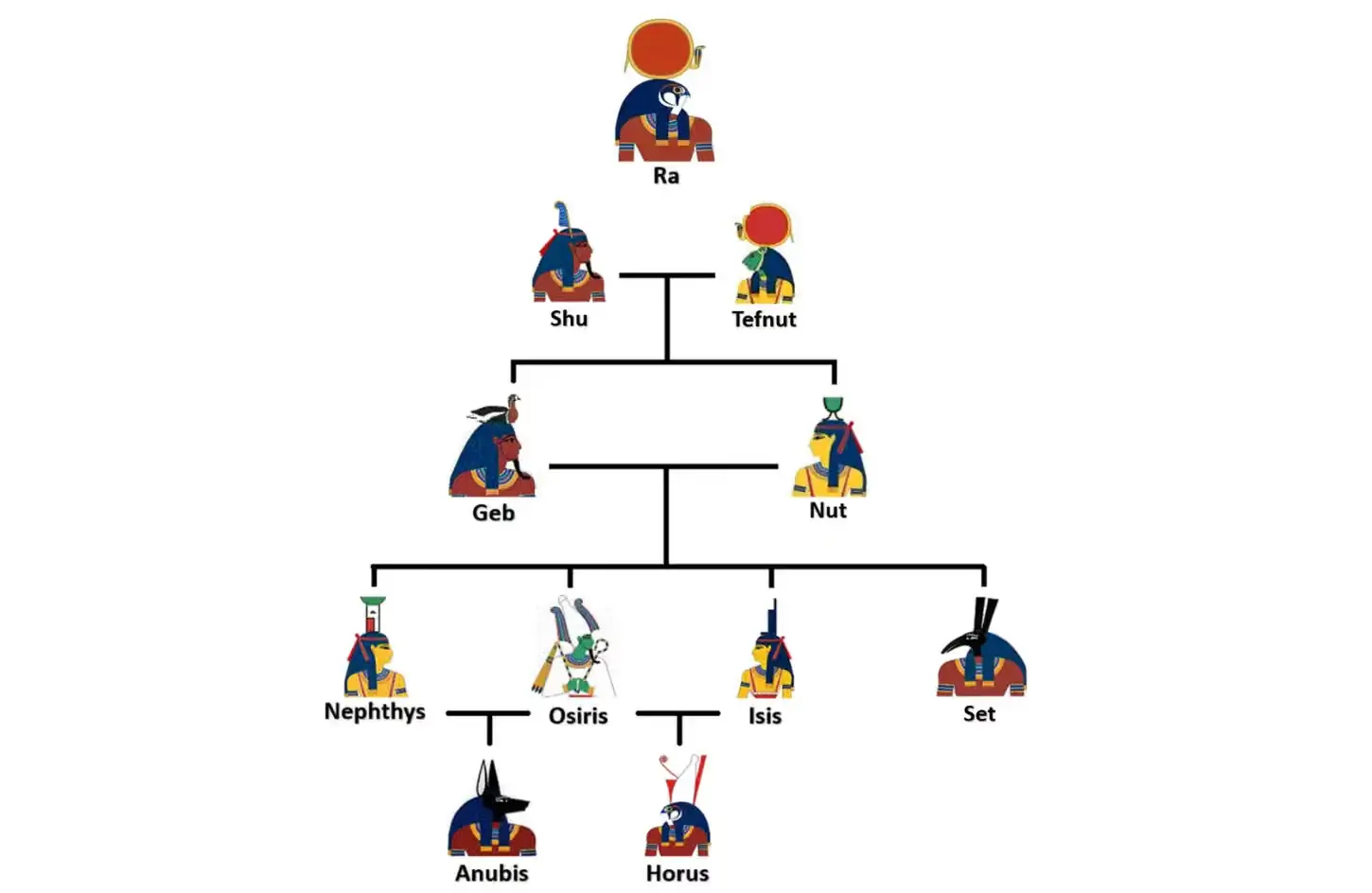
Egyptian Gods Family Tree Chart: Names and Relationships
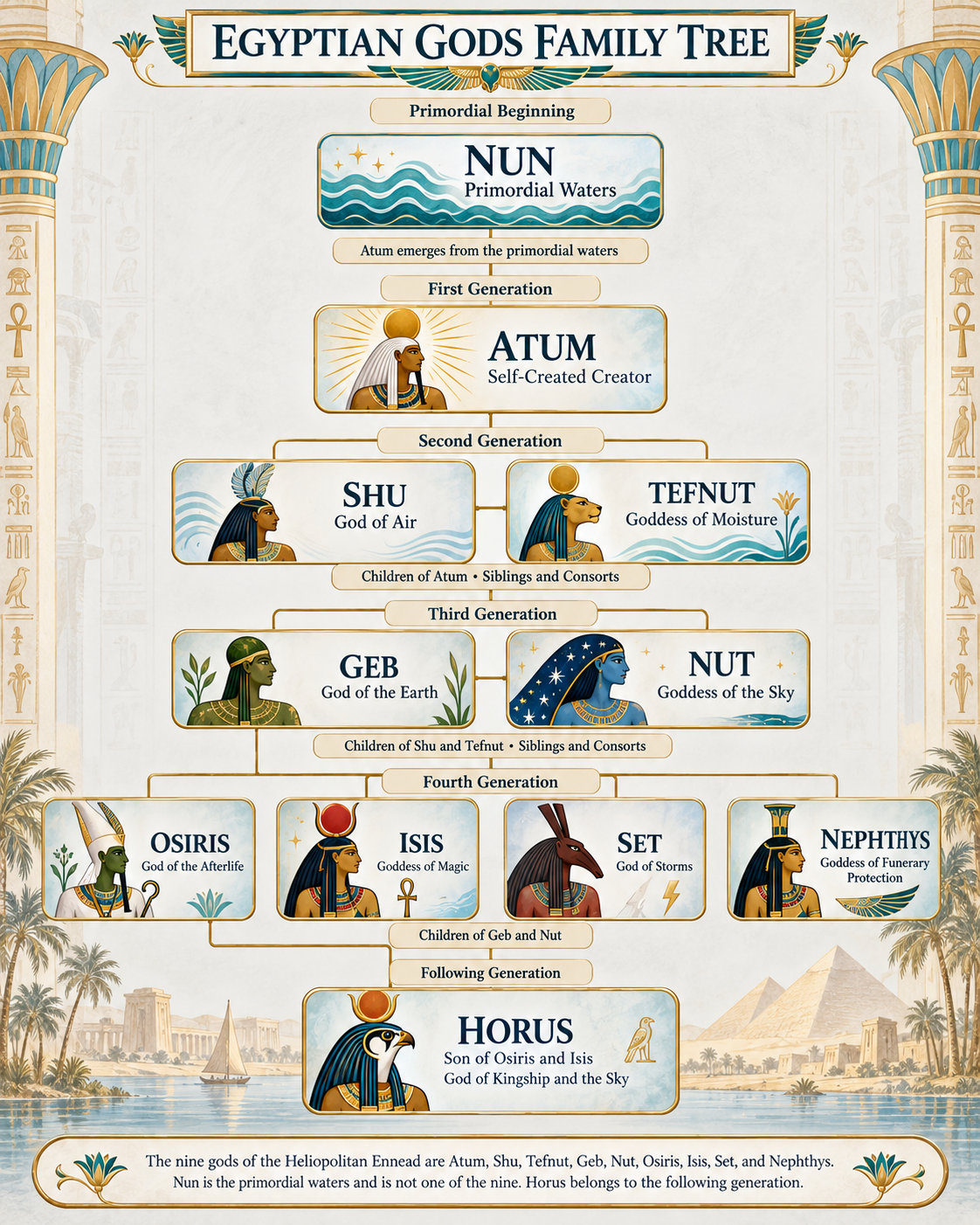
The following simplified ancient Egyptian gods family tree shows the main Heliopolitan genealogy.
It begins with the self-created god Atum and follows the generations that eventually produce Osiris, Isis, Set, Nephthys, and Horus.
The Main Egyptian Gods Family Tree
The Main Egyptian Gods Family Tree
Discover the nine gods of the Heliopolitan Ennead, from the creator Atum to the divine siblings Osiris, Isis, Set, and Nephthys, followed by Horus.
Atum emerges from the primordial waters
Siblings and Consorts
Siblings and Consorts
The Four Children of Geb and Nut
Siblings and Consorts
Siblings and Traditional Consorts
Important relationships in this chart:
-
Atum is the original creator.
-
Shu and Tefnut are the children of Atum and form a divine pair.
-
Geb and Nut are the children of Shu and Tefnut and also form a divine pair.
-
Osiris, Isis, Set, and Nephthys are the four children of Geb and Nut.
-
Osiris and Isis are siblings and consorts.
-
Set and Nephthys are siblings and traditionally associated as consorts.
-
Horus is the son of Osiris and Isis in the central Osiris myth.
-
Horus is not one of the standard nine members of the Great Ennead.
Nun, the primordial waters, represents the condition from which Atum emerges. Nun is not normally counted among the nine members of the Ennead.
The chart is deliberately limited to the best-known lineage. Other gods, including Anubis, Ra, Hathor, Thoth, Amun, and Bastet, require additional branches or explanations.
The Egyptian Gods Family Tree by Generation
|
Generation |
Gods and goddesses |
Relationship |
Main responsibilities |
|---|---|---|---|
|
Primordial beginning |
Nun |
Primordial waters associated with creation |
Pre-creation, boundlessness |
|
First generation |
Atum |
Self-created creator |
Creation, completion, solar power |
|
Second generation |
Shu and Tefnut |
Children of Atum |
Air, atmosphere, moisture |
|
Third generation |
Geb and Nut |
Children of Shu and Tefnut |
Earth, sky, cosmic structure |
|
Fourth generation |
Osiris, Isis, Set, Nephthys |
Children of Geb and Nut |
Afterlife, magic, disorder, protection |
|
Following generation |
Horus |
Son of Osiris and Isis |
Kingship, sky, rightful succession |
This arrangement explains how the divine universe developed from primordial creation into a world governed by natural forces and royal authority.
It also provides the foundation for Egypt’s most famous mythological family conflict.
Who Are the Nine Major Egyptian Gods in Order?
The nine major gods of the Heliopolitan Ennead are Atum, Shu, Tefnut, Geb, Nut, Osiris, Isis, Set, and Nephthys.
Their order follows the generations of the creation myth rather than a ranking from most powerful to least powerful.
The Nine Gods of the Ennead
|
Order |
Egyptian deity |
Family relationship |
Main power or association |
|---|---|---|---|
|
1 |
Atum |
Original creator |
Creation and the setting sun |
|
2 |
Shu |
Son of Atum |
Air and separation of earth and sky |
|
3 |
Tefnut |
Daughter of Atum |
Moisture and cosmic balance |
|
4 |
Geb |
Son of Shu and Tefnut |
Earth and fertility |
|
5 |
Nut |
Daughter of Shu and Tefnut |
Sky, stars, divine motherhood |
|
6 |
Osiris |
Son of Geb and Nut |
Afterlife, resurrection, regeneration |
|
7 |
Isis |
Daughter of Geb and Nut |
Magic, protection, motherhood |
|
8 |
Set |
Son of Geb and Nut |
Storms, deserts, conflict |
|
9 |
Nephthys |
Daughter of Geb and Nut |
Mourning, funerary protection |
The sequence is a practical way to read the family tree. Ancient religious texts did not always present the final four siblings in an identical order.
1. Atum: The First God in the Family Tree
Atum stands at the beginning of the classic Heliopolitan genealogy.
According to this creation tradition, Atum came into existence from the primordial waters before the ordered world had been formed.
He then produced Shu and Tefnut, beginning the next generation of gods.
Atum’s name is associated with completeness. His creative role represents the transformation of an undifferentiated beginning into an organized universe.
He also possessed important solar characteristics.
Ancient Egyptian theology frequently connected Atum with Ra, particularly through the changing phases of the sun.
Atum could represent the setting sun, while Khepri represented the sun’s emergence at dawn.
These identities expressed different aspects of a continuous divine process.
Family relationship: Father of Shu and Tefnut.
Main powers: Creation, completion, solar renewal.
Common representation: A human figure wearing the double crown of Upper and Lower Egypt.
Atum matters because the entire Ennead develops from his creative power.
2. Shu: The God Who Separated Earth and Sky
Shu was a god associated with air and the space between earth and heaven.
He was one of the first two deities produced by Atum.
His partner was his sister Tefnut, the goddess associated with moisture.
Together, Shu and Tefnut became the parents of Geb and Nut.
One of Shu’s most recognizable mythological responsibilities was holding Nut, the sky goddess, above Geb, the earth god.
This separation created the space in which living beings could exist.
Ancient artists sometimes represented Shu standing between the two, with his raised arms supporting Nut’s arched body.
Family relationship: Son of Atum; partner of Tefnut; father of Geb and Nut.
Main powers: Air, atmosphere, cosmic separation.
Common representation: A male figure with an ostrich feather on his head.
Shu’s position in the genealogy represents more than the birth of another god. It explains how the physical universe acquired structure.
3. Tefnut: The Goddess of Moisture
Tefnut was the female counterpart and partner of Shu.
She was associated with moisture and possessed protective and sometimes fierce characteristics.
Ancient Egyptian depictions often show her as a woman with the head of a lioness.
Her pairing with Shu created a balance between aspects of the atmosphere.
Their children were Geb, the earth, and Nut, the sky.
Tefnut also participated in traditions involving the departure and return of a powerful goddess, themes that appear in other Egyptian myths involving solar and feline goddesses.
Family relationship: Daughter of Atum; partner of Shu; mother of Geb and Nut.
Main powers: Moisture, protection, cosmic balance.
Common representation: A lioness-headed woman, sometimes wearing a solar disk.
Tefnut illustrates how the early generations of Egyptian gods personified natural conditions rather than simply acting as humanlike characters.
4. Geb: The God of the Earth
Geb personified the earth in the Heliopolitan creation tradition.
He was the son of Shu and Tefnut and the brother and partner of Nut.
Unlike several other ancient mythological traditions, Egyptian religion commonly represented the earth as male and the sky as female.
Geb was associated with the fertile land that supported life.
His relationship with Nut also formed the transition between cosmic creation and the more familiar stories of divine kingship.
Their children included Osiris, Isis, Set, and Nephthys.
In the mythology of royal succession, Geb was particularly important because kingship could pass from him to Osiris and eventually to Horus.
Family relationship: Son of Shu and Tefnut; partner of Nut; father of Osiris, Isis, Set, and Nephthys.
Main powers: Earth, fertility, divine inheritance.
Common representation: A reclining male figure beneath the sky goddess.
5. Nut: The Goddess of the Sky
Nut was one of the most recognizable goddesses of ancient Egypt.
She personified the sky and was frequently portrayed as a woman whose body arched above the earth.
Stars might decorate her body, emphasizing her celestial character.
Her father Shu separated her from Geb, creating the heavens above the earth.
Nut was also associated with the daily journey of the sun.
In some traditions, the sun entered her body at sunset and was reborn at dawn.
This process connected Nut with regeneration, the afterlife, and the hope of renewed existence.
Her protective role explains why representations of Nut frequently appeared in funerary contexts.
Family relationship: Daughter of Shu and Tefnut; partner of Geb; mother of the four principal divine siblings.
Main powers: Sky, cosmic protection, rebirth.
Common representation: An arched woman, sometimes covered with stars.
Images of Nut inside coffins and tombs demonstrate how ideas from the Egyptian gods family tree influenced beliefs about death and survival.
6. Osiris: The God of the Afterlife
Osiris was one of the most important figures in Egyptian religious belief.
He was the son of Geb and Nut, the brother and husband of Isis, and the father of Horus.
According to the central myth, Osiris ruled before being killed by his brother Set.
His death did not end his divine existence.
Through the actions of Isis and other gods, Osiris was restored and became ruler of the realm of the dead.
He represented the possibility of regeneration after death.
Family relationship: Son of Geb and Nut; husband of Isis; father of Horus.
Main powers: Afterlife, resurrection, regeneration, funerary judgment.
Common representation: A mummified figure with a distinctive crown, crook, and flail.
Osiris became a model for the deceased person’s hoped-for transformation into a renewed existence.
7. Isis: The Goddess of Magic and Motherhood
Isis was the sister and wife of Osiris and the mother of Horus.
Her importance extended far beyond her position within the divine family.
She was associated with magic, motherhood, healing, protection, and royal legitimacy.
When Osiris was killed, Isis searched for him and helped restore his body.
She then protected their son Horus while he was vulnerable to Set.
Her actions connected maternal protection with the preservation of rightful kingship.
Isis was frequently represented with a throne-shaped sign on her head or with cow horns surrounding a solar disk.
Family relationship: Daughter of Geb and Nut; wife of Osiris; mother of Horus.
Main powers: Magic, healing, protection, motherhood.
Common representation: A woman with a throne-shaped headdress, sometimes nursing Horus.
Isis became particularly prominent beyond Egypt during the Greco-Roman period, when her worship spread across parts of the Mediterranean world.
8. Set: The God of Storms and Conflict
Set, also written Seth, was the brother of Osiris, Isis, and Nephthys.
He was associated with desert regions, storms, physical strength, and disruptive power.
In the Osiris myth, Set killed his brother and attempted to control the kingship that Horus later claimed.
This conflict became one of the best-known stories in Egyptian mythology.
However, describing Set only as an evil god oversimplifies his role.
In some religious traditions, Set used his strength to defend the solar god against threatening forces.
His importance and reputation also changed over different periods of Egyptian history.
Family relationship: Son of Geb and Nut; brother of Osiris; traditional partner of Nephthys; uncle of Horus.
Main powers: Storms, desert strength, conflict, protection in certain contexts.
Common representation: A human body with the head of the distinctive, difficult-to-identify Set animal.
Set illustrates an important principle: Egyptian gods could possess both dangerous and protective characteristics.
9. Nephthys: The Protective Goddess of the Dead
Nephthys was the sister of Osiris, Isis, and Set.
She was traditionally associated with Set as his consort, but she also played an important protective role in the Osiris myth.
Nephthys helped Isis mourn and care for Osiris after his death.
The two goddesses frequently appeared together in funerary representations.
Their protective gestures symbolized the care that the deceased needed for successful passage into the afterlife.
Nephthys was commonly shown as a woman wearing hieroglyphic signs representing her name.
Family relationship: Daughter of Geb and Nut; sister of Isis and Osiris; traditional consort of Set.
Main powers: Funerary protection, mourning, guardianship.
Common representation: A woman wearing the signs for an enclosure and basket on her head.
Her connection with Anubis appears in several traditions, but the details of that relationship require special attention.
The Osiris Family Tree: Egypt’s Most Important Divine Conflict
The story of Osiris, Isis, Set, and Horus is central to understanding how ancient Egyptian mythology linked family relationships with political and religious authority.
It is also one of the clearest examples of how a divine family could explain the succession of Egyptian kings.
How Osiris Became Ruler of the Dead
Osiris was associated with legitimate kingship and the ordered world.
His brother Set challenged him and, in the best-known versions of the myth, killed him.
Accounts of the murder and the treatment of Osiris’s body differ between texts and periods.
The central idea, however, remains consistent: Osiris’s death threatens the rightful order of the world.
Isis searches for her husband, while Nephthys and other divine helpers assist in his protection and restoration.
Through powerful rituals and magic, Osiris receives renewed existence.
But he does not simply return to rule the living world as before.
Instead, Osiris becomes the central ruler of the dead.
The story therefore separates two forms of kingship: authority among the living and authority in the afterlife.
This relationship helps explain the importance of Osiris in funerary texts, decorated coffins, and tomb scenes.
How Isis Protected Horus
Horus was the child of Osiris and Isis.
According to the myth, his father had been killed before Horus could establish his claim to the throne.
Isis protected the young god, frequently in a marshland setting associated with the Nile Delta.
The child Horus was threatened by dangers including hostile divine forces and harmful creatures.
Isis used protective magic to preserve his life.
These stories helped establish her reputation as an especially powerful mother and protector.
The image of Isis nursing Horus became one of the most recognizable mother-and-child representations in ancient Egyptian art.
It was also important in amulets and protective objects.
Why Horus Fought Set
When Horus reached maturity, he claimed the kingship associated with his father Osiris.
Set opposed this claim.
Their contest involved disputes, confrontations, and divine judgments that vary across different versions of the story.
One important literary account, commonly called The Contendings of Horus and Set, presents the struggle through a series of episodes before the divine court.
The eventual recognition of Horus as the legitimate ruler was essential to the mythology of Egyptian kingship.
Horus represented the living king, while Osiris represented the deceased ruler.
Through this relationship, the transition from one pharaoh to the next became part of a larger sacred pattern.
The central relationships are straightforward:
|
Egyptian god |
Relationship to Horus |
Importance in the myth |
|---|---|---|
|
Osiris |
Father |
Source of rightful royal inheritance |
|
Isis |
Mother |
Protector and supporter of Horus |
|
Set |
Uncle |
Rival for the throne |
|
Nephthys |
Aunt |
Protective figure connected with the Osiris family |
|
Geb |
Grandfather |
Earlier divine authority associated with kingship |
|
Nut |
Grandmother |
Sky goddess and mother of the four divine siblings |
The story was not simply entertainment. It gave religious meaning to the stability and continuity of kingship.
Horus Family Tree: Was Horus the Son of Isis or the Brother of Osiris?
Horus was the son of Isis and Osiris in the famous Osiris myth. However, ancient Egyptian religion also recognized other forms of Horus, including an older sky-god tradition.
This creates an important distinction.
Horus the Younger: Son of Isis and Osiris
Horus the Younger is the divine child who survives the death of his father and challenges Set for royal authority.
This is the Horus most relevant to the Osiris family tree.
He appears in several forms, including Horus the Child, known in Greek as Harpocrates.
Representations of the child god may show a sidelock of youth and a finger raised toward the mouth.
These features indicate childhood, not a command for silence.
When portrayed as a mature ruler, Horus commonly appears as a falcon-headed god wearing royal crowns.
Horus the Elder: An Older Falcon and Sky Deity
Horus the Elder, often called Haroeris or Harwer, was another important manifestation of Horus.
Some mythological traditions identify an elder Horus as a child of Geb and Nut, placing him in the generation of Osiris and his siblings.
This is different from the younger Horus, who is the son of Osiris and Isis.
Egyptian religious traditions could also overlap or combine these identities.
Consequently, the name Horus does not always identify the same family relationship in every inscription.
The practical distinction: When studying a genealogy, identify which form of Horus the source describes before assigning his parents.
This is especially useful at Kom Ombo, where Harwer was one of the temple’s principal deities.
What Is the Relationship Between Horus and the Eye of Horus?
The Eye of Horus, also known as the Wedjat Eye, was a symbol associated with protection, restoration, and wholeness.
Its mythology connects with Horus’s struggle against Set.
In important versions of the story, the eye is damaged and subsequently restored, giving the symbol its protective meaning.
The Eye of Horus should not automatically be treated as identical to the Eye of Ra.
Both symbols share solar and protective associations, but their mythological contexts can differ.
The distinction is explained further in our guide to the Eye of Ra and Eye of Horus.
Anubis Family Tree: Who Were His Parents?
Anubis was the jackal-associated god of embalming, burial protection, and funerary transitions. His parentage differs between ancient Egyptian traditions and later accounts.
The frequently repeated claim that Anubis was the son of Osiris and Nephthys represents one influential version rather than the only ancient tradition.
Anubis as the Son of Osiris and Nephthys
In the well-known account preserved by the Greek writer Plutarch, Nephthys gives birth to Anubis after a relationship with Osiris.
Isis later discovers the child and raises him.
This story places Anubis within the extended Osiris family.
Under that arrangement:
-
Osiris is his father.
-
Nephthys is his mother.
-
Isis becomes his adoptive or protective mother.
-
Horus is connected to him through Osiris.
This family connection helps explain why Anubis and Osiris frequently appear together in funerary religion.
However, Plutarch wrote during the Roman period, long after many Egyptian religious traditions had developed.
His narrative should not be treated as the earliest or only account.
Other Traditions About Anubis’s Origins
Earlier Egyptian religious material associates Anubis with different divine relationships.
In some traditions, he is connected with Ra as a son. Other accounts give him different genealogical associations, including with Osiris.
These variations reflect the changing place of Anubis within Egyptian religion.
Anubis was already a significant funerary deity before the Osiris myth became central to many surviving representations of the afterlife.
His role could remain recognizable even when his genealogy changed.
What Did Anubis Actually Do?
The identity of Anubis is better understood through his responsibilities than through a single fixed set of parents.
He was associated with:
-
Protecting the dead and their burial places.
-
Embalming and mummification.
-
Supervising funerary preparations.
-
Guiding the deceased through aspects of the afterlife.
-
Participating in the judgment of the dead.
In scenes showing the weighing of the heart, Anubis commonly supervises the balance.
The god Thoth records the result, while Osiris presides over the judgment in the wider funerary setting.
Anubis and Osiris were therefore closely connected by function as well as by some genealogical traditions.
This is why Anubis appears on coffins, funerary papyri, tomb walls, and protective objects.
Are All Egyptian Gods Related to Each Other?
No. Egyptian gods were not all members of one fixed family. Ancient Egypt had multiple creation traditions, divine families, and local religious systems that developed and interacted over time.
The Ennead is the best-known genealogical structure, but it does not contain the entire Egyptian pantheon.
Several other family groups were particularly important.
Amun and Amun-Ra Family Tree: The Divine Family of Thebes
Amun became one of the most influential gods of ancient Egypt, especially during the New Kingdom.
His major religious center was Thebes, the ancient city associated with modern Luxor.
Amun’s family was different from the Heliopolitan Ennead.
Amun, Mut, and Khonsu
The most familiar Theban divine family consisted of three deities:
|
Deity |
Family role |
Main association |
|---|---|---|
|
Amun |
Father |
Hidden divine power, creation, kingship |
|
Mut |
Mother and consort |
Divine motherhood, protection, queenship |
|
Khonsu |
Son |
Moon, healing, protection |
This family is commonly called the Theban Triad.
Amun was frequently represented as a man wearing a tall crown with two feathers.
Mut was a mother goddess associated with protection and royal imagery.
Khonsu was a moon god, sometimes depicted as a youthful figure with a sidelock and a lunar disk.
The Theban family shows how religious centers could organize major gods into a recognizable household.
Visitors can explore their associations at Karnak Temple, which contains monuments connected with Amun and Khonsu, while the wider Karnak religious landscape also includes the precinct of Mut.
Was Amun-Ra the Father of Khonsu?
In the standard Theban Triad, Khonsu is the son of Amun and Mut.
Because Amun was closely identified with Ra, inscriptions could refer to Amun-Ra as the divine father.
Amun-Ra was not a completely separate individual who replaced Amun within the family.
Rather, the combined name expressed an important theological identification between Amun and the sun god Ra.
This is a key difference between Egyptian genealogy and ordinary ancestry.
Combining divine names could express unity of power without creating another generation.
Where Did Amun Come From?
Amun’s origins cannot be reduced to one universal parentage.
His identity developed through several religious traditions.
In the Hermopolitan creation system, Amun and Amaunet were associated with the primordial gods.
In Theban theology, Amun could possess elevated creative authority.
His prominence changed significantly over Egyptian history as Thebes became a powerful political and religious center.
For this reason, an Amun family tree and an Amun-Ra family tree are best presented as overlapping theological traditions rather than one unchanging pedigree.
Ptah Family Tree: The Divine Family of Memphis
Memphis, an important ancient Egyptian capital near modern Cairo, possessed its own major religious traditions.
Ptah was the city’s principal creator god.
In Memphite theology, creation could occur through divine thought and speech, rather than through the reproductive genealogy emphasized in the Heliopolitan tradition.
Ptah also formed a famous divine family.
Ptah, Sekhmet, and Nefertem
|
Deity |
Family role |
Main association |
|---|---|---|
|
Ptah |
Father |
Creation, craftsmanship, artisans |
|
Sekhmet |
Mother and consort |
Power, destruction, disease, healing |
|
Nefertem |
Son |
Lotus, fragrance, renewal |
Ptah was frequently depicted as a closely wrapped male figure holding a staff composed of sacred symbols.
Sekhmet appeared as a lioness-headed goddess, often wearing a solar disk.
Nefertem was strongly associated with the lotus, a symbol of renewal and the sun’s emergence.
The grouping demonstrates how divine families could combine cosmic creation, protective strength, and the renewal of life.
Was Sekhmet Always the Mother of Nefertem?
Sekhmet was Nefertem’s mother in the classic Memphite Triad.
However, Nefertem could be associated with other maternal figures, including Bastet, in different settings.
Egyptian mythology did not always insist upon exclusive genealogical identities.
For a closer look at Sekhmet’s associations with power and protection, see our guide to the Egyptian goddess Sekhmet.
How Was Ptah Different from Atum?
Both Ptah and Atum could serve as creator deities, but their mythological explanations of creation emphasized different processes.
Atum generated the other gods through a sequence of divine generations.
Ptah, in influential Memphite theology, brought creation into being through intellectual and verbal power.
These traditions were not simply different lists of ancestors.
They expressed different understandings of how divine power created an ordered world.
Hathor Family Tree: Was Hathor the Wife of Horus?
Hathor was associated with motherhood, music, love, joy, the sky, and divine protection.
Her family relationships varied according to religious context.
In some traditions, Hathor was regarded as the daughter of Ra.
At Edfu and Dendera, she was especially connected with Horus.
Hathor and Horus of Edfu
Horus of Edfu and Hathor of Dendera formed an important divine partnership.
Their religious relationship was celebrated through festivals and temple rituals linking their cult centers.
The child god Ihy was associated with Hathor and, within this local divine family, with Horus.
Ihy was connected with music and jubilation.
This family can be summarized as:
Horus of Edfu + Hathor of Dendera → Ihy
However, this does not mean every form of Horus had Hathor as a wife or that every Egyptian text described the same arrangement.
Horus was also the son of Isis and Osiris in the central Osiris myth.
Local divine families and the wider mythological genealogy served different religious purposes.
Was Hathor the Daughter of Ra?
Hathor was frequently described as a daughter of the sun god Ra and could embody the Eye of Ra.
This association expressed her relationship with solar power and divine protection.
It also connected Hathor with stories in which a powerful goddess could possess both nurturing and dangerous characteristics.
The goddess’s identity was more complex than a simple title such as goddess of love.
Her protective, celestial, maternal, and sometimes destructive aspects all contributed to her religious importance.
The best location for exploring Hathor’s imagery in Egypt is the Temple of Dendera, famous for its Hathor-headed columns and decorated ceilings.
Bastet Family Tree: Who Were Bastet’s Parents?
Bastet was a protective goddess associated with cats, domestic wellbeing, music, joy, and aspects of solar power.
She was especially important at Bubastis in the Nile Delta.
Bastet was commonly identified as a daughter of Ra.
Her solar connection helps explain why she could appear in traditions involving the Eye of Ra.
Was Bastet Related to Sekhmet?
Bastet and Sekhmet shared feline characteristics and could express different aspects of protective divine power.
Bastet became particularly familiar through cat imagery.
Sekhmet was strongly associated with the lioness and formidable divine strength.
Both possessed solar associations.
They were sometimes closely identified or compared in Egyptian religious thought, but they should not automatically be described as literal sisters in every Egyptian genealogy.
The relationship was often theological rather than an ordinary sibling connection.
Did Bastet Have Children?
Bastet could be connected with child deities in local religious traditions.
Nefertem, for example, was sometimes described as her son, although the familiar Memphite Triad identifies Sekhmet as his mother.
This variation demonstrates how a god could become associated with more than one maternal figure.
For travelers interested in Bastet’s religious meaning and symbolism, our guide to Bastet, the Egyptian goddess provides additional context.
Thoth and Ma’at Family Tree: Knowledge, Truth, and Divine Order
Not every major Egyptian deity was defined by a single famous parent-child relationship.
Thoth and Ma’at are especially useful examples.
Thoth: The God of Writing and Wisdom
Thoth was associated with writing, language, wisdom, calculation, the moon, and divine recordkeeping.
He was commonly represented as an ibis-headed man or as a baboon.
In the mythology of the afterlife, Thoth often acted as a recorder and divine official.
He also assisted other gods through knowledge and specialized powers.
Different religious traditions assigned Thoth different origins and associations.
Therefore, a chart that labels Thoth as the child of one particular deity without qualification may be misleading.
His importance rests primarily on his intellectual, lunar, and administrative roles.
Ma’at: The Goddess of Truth and Order
Ma’at represented truth, justice, balance, and the correct ordering of the universe.
She was commonly depicted as a woman wearing an ostrich feather.
Ma’at was closely associated with Ra and was described as his daughter in important traditions.
Her feather also became central to the symbolism of funerary judgment.
In the weighing of the heart, the deceased person’s heart was judged against the standard represented by Ma’at.
This expressed the idea that moral conduct and cosmic order were connected.
Were Thoth and Ma’at Husband and Wife?
Some Egyptian traditions closely associated Thoth and Ma’at, including as divine partners.
However, this relationship was not the foundation of one universally accepted family tree.
Their connection is also understandable through their roles.
Ma’at represents the principles of truth and order.
Thoth records, communicates, and helps administer divine decisions.
Together, they express how cosmic law and accurate judgment should operate.
Their importance becomes particularly clear when studying ancient Egyptian symbols and funerary texts.
Khnum Family Tree: The Gods of Elephantine and the Nile
Khnum was an important creator god associated with the Nile’s First Cataract region, the annual inundation, and the formation of living beings.
He was commonly represented as a ram-headed god.
In some creation traditions, Khnum shaped people on a potter’s wheel, emphasizing his role in the formation of life.
Khnum, Satet, and Anuket
The best-known divine family of Elephantine, near Aswan, consisted of Khnum, Satet, and Anuket.
In one important local tradition:
-
Khnum was the father.
-
Satet was his consort.
-
Anuket was their daughter.
Satet was associated with the southern frontier and the Nile’s waters.
Anuket was also connected with the Nile region, particularly the area around the First Cataract.
An important example of this family appears in the Famine Stela on Sehel Island, where the divine triad receives offerings from King Djoser in the narrative.
However, the relationships between these goddesses and Khnum were not described identically in every period.
Some earlier traditions assigned different family relationships to the deities.
This is another reason to distinguish specific temple traditions from a universal Egyptian family tree.
Travelers interested in the Elephantine deities can explore the archaeological remains of Elephantine Island during a visit to Aswan.
Sobek Family Tree: The Crocodile God’s Relationships
Sobek was an ancient Egyptian god associated with crocodiles, water, fertility, strength, and protection.
His importance was especially visible in the Faiyum region and at Kom Ombo.
Sobek’s family relationships differed between local religious traditions.
Did Sobek Have a Wife and Child?
At Kom Ombo, Sobek was associated with Hathor as a consort and Khonsu as a child within the temple’s local divine arrangements.
This is particularly interesting because Khonsu is much more widely recognized as the son of Amun and Mut at Thebes.
Both arrangements belong to the complexity of Egyptian religious tradition.
The same divine name could participate in different local families.
The dual temple of Kom Ombo was also dedicated to Harwer, or Horus the Elder.
Its two principal cults occupied parallel architectural sections.
This design makes Kom Ombo an especially useful place to understand why the family tree of the Egyptian gods cannot always be represented by one set of lines.
The Hermopolitan Gods: A Different Explanation of Creation
Hermopolis, known in ancient Egyptian as Khmunu and associated with modern el-Ashmunein, developed another influential creation tradition.
Rather than emphasizing a genealogy beginning with Atum, this tradition featured eight primordial deities known as the Ogdoad.
The gods were commonly arranged into four male-female pairs:
|
Divine pair |
Primordial association |
|---|---|
|
Nun and Naunet |
Primordial waters |
|
Heh and Hauhet |
Limitlessness or infinity |
|
Kek and Kauket |
Darkness |
|
Amun and Amaunet |
Hiddenness or invisibility |
Names and interpretations could vary in different versions of the tradition.
These gods represented conditions that existed before the emergence of the ordered cosmos.
The Hermopolitan Ogdoad was not simply an extension of the nine gods of Heliopolis.
It represented another explanation of creation.
How Was the Ogdoad Different from the Ennead?
The Ennead of Heliopolis was organized as a genealogy across generations.
The Ogdoad of Hermopolis was organized primarily as pairs representing primordial conditions.
Both systems explained the emergence of existence, but they emphasized different relationships.
The Heliopolitan genealogy makes it comparatively easy to follow parents and children.
The Hermopolitan tradition is better understood through complementary divine pairs and the transformation of primordial conditions.
This distinction is particularly important when comparing an Egyptian gods genealogy chart with a list of creation gods.
Who Are the 12 Main Egyptian Gods?
There is no single universally accepted list of exactly 12 main Egyptian gods.
Ancient Egyptian religion did not establish one fixed group of 12 that governed every city and period.
However, a practical introductory list of 12 widely recognized deities includes the following:
|
God or goddess |
Main role |
Recognizable characteristic |
|---|---|---|
|
Ra |
Sun and solar creation |
Falcon head with sun disk |
|
Osiris |
Afterlife and resurrection |
Mummified body and distinctive crown |
|
Isis |
Magic, protection, motherhood |
Throne sign or cow horns with disk |
|
Horus |
Sky and kingship |
Falcon or falcon-headed figure |
|
Set |
Storms and disorder |
Head of the Set animal |
|
Anubis |
Embalming and funerary protection |
Jackal or canine head |
|
Thoth |
Wisdom, writing, moon |
Ibis head or baboon form |
|
Hathor |
Joy, motherhood, music |
Cow horns, sun disk, Hathor-faced capitals |
|
Amun |
Hidden power and kingship |
Tall double-plumed crown |
|
Bastet |
Protection and feline symbolism |
Cat or cat-headed woman |
|
Sekhmet |
Power, disease, healing |
Lioness head |
|
Ptah |
Creation and craftsmanship |
Closely wrapped human figure |
This is a useful educational selection, not a canonical ancient list.
Atum, Nut, Geb, Ma’at, Nephthys, Khonsu, and many other gods were also extremely important.
The influence of a deity depended partly on religious location, historical period, and the aspect of Egyptian life being considered.
For example, Osiris was especially significant in funerary religion, while Amun became central to royal and temple religion at Thebes.
A god’s importance cannot be measured only by how frequently that god appears in modern mythology books.
Egyptian Gods Names List: Other Important Deities and Their Powers
A complete list of all Egyptian gods is difficult to establish because Egyptian religion included numerous local, regional, and specialized divine beings.
Some possessed several names or forms.
Others were identified with more widely worshipped gods.
The following Egyptian gods names list expands beyond the main Ennead and the 12 familiar deities.
|
Egyptian deity |
Main association |
|---|---|
|
Khepri |
The rising sun and renewal |
|
Ra-Horakhty |
Solar power and Horus of the horizon |
|
Aten |
The sun disk, especially important during Akhenaten’s reign |
|
Mut |
Motherhood and the Theban divine family |
|
Khonsu |
Moon, protection, healing |
|
Nefertem |
Lotus, fragrance, regeneration |
|
Ihy |
Music and celebration |
|
Ma’at |
Truth, justice, cosmic order |
|
Neith |
Creation, warfare, weaving, protection |
|
Khnum |
Creation, pottery, Nile inundation |
|
Satet |
Southern frontier and Nile waters |
|
Anuket |
Nile region and First Cataract |
|
Sobek |
Crocodiles, water, strength, fertility |
|
Hapi |
Nile inundation and abundance |
|
Wadjet |
Cobra protection and Lower Egypt |
|
Nekhbet |
Vulture protection and Upper Egypt |
|
Taweret |
Pregnancy, childbirth, household protection |
|
Bes |
Household protection, childbirth, music |
|
Montu |
Warfare and strength |
|
Wepwawet |
Opening the ways, processions, funerary associations |
|
Seshat |
Writing, measurement, recordkeeping |
|
Serket |
Protection against venom and funerary guardianship |
|
Heka |
Magic and divine magical power |
|
Min |
Fertility and generative power |
|
Renenutet |
Nourishment, harvests, protection |
These names demonstrate why an ancient Egyptian god family tree cannot contain every deity without becoming difficult to interpret.
Not all divine beings had clearly recorded parents, spouses, or children.
Some were defined mainly by their activities, places of worship, symbolic forms, or relationships to particular rituals.
Others changed significance during different periods of ancient Egyptian culture.
How Did Egyptian Gods Become Related to Each Other?
The relationships between Egyptian gods served several purposes.
They connected the creation of the universe to the natural world, explained the transfer of royal power, and gave human communities meaningful models of protection and regeneration.
Divine Families Explained the Natural World
The earliest generations of the Ennead represent cosmic conditions.
Atum initiates creation.
Shu and Tefnut represent important aspects of the atmosphere.
Geb and Nut establish the earth and sky.
Their descendants introduce stories of conflict, kingship, and the afterlife.
The genealogy moves from the organization of nature to the organization of society.
That progression gives the family tree a deeper meaning than a list of relatives.
It connects the existence of the world with the responsibilities of its rulers.
Divine Families Explained Kingship
The relationship between Osiris and Horus was especially important to royal ideology.
Osiris represented the deceased ruler.
Horus represented the living king and the continuity of legitimate kingship.
The succession from Osiris to Horus expressed the hope that royal authority could survive death and political conflict.
This did not mean Egyptian pharaohs were literally members of a biological family descended from Osiris in the same way ordinary families recorded ancestors.
Instead, kingship possessed a divine identity and religious meaning.
The pharaoh could be associated with Horus while alive and with Osiris in funerary contexts.
Divine Families Explained Protection
Isis protecting Horus provided a powerful model of maternal care.
Nephthys protecting Osiris expressed another form of guardianship.
Anubis watching over the dead represented the importance of correct funerary treatment.
Sekhmet and Bastet offered different expressions of protection through feline divine imagery.
The relationships among these gods helped Egyptians understand how divine support operated in different circumstances.
Divine Families Connected Temples and Cities
Amun, Mut, and Khonsu helped establish a shared religious identity at Thebes.
Ptah, Sekhmet, and Nefertem formed an important family at Memphis.
Horus and Hathor linked the cult centers of Edfu and Dendera.
Khnum, Satet, and Anuket were associated with the Nile region around Elephantine.
These connections gave divine families a geographic dimension.
Understanding Egyptian religion therefore requires both a family tree and an awareness of where each tradition developed.
How Were Egyptian Gods Different from Egyptian Pharaohs?
An Egyptian gods family tree and an ancient Egyptian pharaoh family tree describe two different kinds of relationships.
The first belongs to mythology and religion.
The second concerns historical rulers and their human families.
Divine genealogies explain creation, symbolic authority, and relationships among deities.
Royal genealogies concern dynastic succession, parentage, marriages, and political inheritance.
The two systems were closely connected through royal ideology, but they should not be merged into a single literal genealogy.
Why Were Pharaohs Associated with Horus?
The reigning pharaoh was closely identified with Horus in Egyptian royal ideology.
The Horus name was one of the important components of formal royal titulary.
This association connected the king with the divine principle of legitimate rule.
When a ruler died, funerary traditions associated that ruler with Osiris.
The mythological relationship between father and son therefore provided a model for succession.
For readers researching historical ruling families rather than mythology, the ancient Egyptian pharaohs are a separate subject.
Did Pharaohs Claim Divine Ancestry?
Egyptian royal ideology could represent rulers as children or chosen representatives of important gods.
These claims expressed religious authority and legitimacy.
Certain royal inscriptions and temple scenes presented divine birth narratives.
Such scenes should be interpreted within their religious and political context.
They are not equivalent to independently verified biological genealogies.
Understanding the distinction helps avoid confusion when comparing myths, royal inscriptions, and historical records.
How Can You Identify Egyptian Gods in Temple Carvings?
Ancient Egyptian artists used recognizable forms, crowns, animals, symbols, and written names to identify deities.
Learning a few visual clues can make temple visits much easier to understand.
Animal Heads and Divine Symbols
|
Visual clue |
Deity often associated with it |
What to remember |
|---|---|---|
|
Falcon head |
Horus or Ra-Horakhty |
Crown and context help distinguish the form |
|
Jackal or canine head |
Anubis |
Common in funerary scenes |
|
Ibis head |
Thoth |
Writing, knowledge, recordkeeping |
|
Lioness head |
Sekhmet, Tefnut, or another feline goddess |
Identification often requires inscriptions |
|
Cat head |
Bastet |
Protection and domestic associations |
|
Crocodile head |
Sobek |
Water, strength, Nile-related worship |
|
Ram head |
Khnum or certain forms of Amun |
Horn shape and context matter |
|
Cow horns and sun disk |
Hathor or Isis |
Both goddesses could share this headdress |
|
Ostrich feather |
Ma’at |
Truth and cosmic balance |
|
Mummified human figure with crown |
Osiris |
Afterlife and regeneration |
A single physical feature is not always enough to identify a deity.
A solar disk, for example, could appear with several gods and goddesses.
Likewise, more than one deity could possess a lioness head.
The safest method is to combine appearance with inscriptions, temple location, and the surrounding scene.
How to Recognize Divine Family Scenes
When looking at a temple wall, consider four questions.
-
Are the figures identified by hieroglyphic names?
-
Does the scene show a known divine family, such as Amun, Mut, and Khonsu?
-
Is a child deity marked by a sidelock of youth?
-
Is the pharaoh offering to the gods rather than appearing as one of their children?
These details help distinguish a divine family portrait from a religious ceremony.
How Funerary Objects Reveal Divine Relationships
Funerary objects often emphasize the family surrounding Osiris.
Isis and Nephthys may appear as protective figures.
Anubis may supervise embalming or aspects of judgment.
Horus may represent protection or royal inheritance.
One particularly important group consists of the Four Sons of Horus.
They were associated with the protection of the deceased and with organs preserved during mummification.
|
Son of Horus |
Usual head form |
Organ traditionally protected |
|---|---|---|
|
Imsety |
Human |
Liver |
|
Hapi |
Baboon |
Lungs |
|
Duamutef |
Jackal |
Stomach |
|
Qebehsenuef |
Falcon |
Intestines |
Their appearances are especially familiar from canopic jar lids.
The exact relationship between these protective gods and a conventional biological family should not be assumed from their collective title alone.
For additional explanation of the objects and their functions, see our guide to ancient Egyptian canopic jars.
Where Can You See the Egyptian Gods Family Tree in Egypt?
The best places to recognize relationships between ancient Egyptian gods are temples and museums where divine families appear in reliefs, statues, inscriptions, and ritual scenes.
Different sites reveal different branches of Egyptian mythology.
There is no single monument that presents the entire pantheon as one complete modern-style family tree.
Instead, visitors encounter the gods through the traditions associated with each religious center.
Karnak Temple, Luxor: Amun, Mut, and Khonsu
Karnak is one of the most important locations for understanding the Theban divine family.
Amun was the central deity of the great temple complex.
Mut was associated with a separate precinct, while Khonsu possessed his own temple within the broader Karnak landscape.
The gods were connected through the religious identity of Thebes.
Karnak also contains extensive royal reliefs in which kings present offerings to the gods.
These scenes demonstrate how the pharaoh interacted with divine authority.
Look for: Amun’s tall feathered crown, the royal offering scenes, and representations or inscriptions relating to the Theban Triad.
Suggested visit: Allow at least two to three hours for a general exploration of the main Karnak complex, with additional time for specialized interests.
Karnak is especially valuable for travelers interested in the relationship between gods, kingship, and state religion.
Temple of Philae, Aswan: Isis, Osiris, and Horus
The Temple of Philae is one of the strongest locations for exploring the Osiris family.
The main temple was dedicated to Isis.
Its decoration reflects her importance as a goddess of motherhood, protection, and divine power.
Philae also contains a mammisi, or birth house, associated with the divine child Horus.
Scenes represent the relationship between Isis and her son.
These images make the divine genealogy particularly accessible because the mother-child relationship is recognizable even to visitors unfamiliar with hieroglyphs.
The temple complex was relocated from its original island to nearby Agilkia during the international campaign to protect Nubian monuments threatened by rising waters.
Look for: Isis with Horus, royal offerings to Isis, and the birth-house scenes.
Suggested visit: Approximately one and a half to two hours for a standard temple visit, excluding possible transfers, queues, and additional exploration.
Philae is particularly suitable for visitors who want to connect mythology with understandable family relationships.
Temple of Edfu: Horus and Divine Kingship
The Temple of Edfu is dedicated to Horus and is one of Egypt’s major surviving temple complexes.
Much of the standing temple dates to the Ptolemaic period.
Its reliefs provide extensive religious material involving Horus, temple ritual, royal offerings, and his associations with other deities.
Large falcon statues near the entrance emphasize the god’s identity.
Edfu is especially useful for understanding why Horus represented kingship and how his mythology continued to influence temple religion long after the earliest Egyptian dynasties.
Look for: Falcon statues, royal crowns, representations of Horus, and scenes involving Hathor.
Suggested visit: Approximately one and a half to two hours.
For travelers who already understand the Osiris family tree, Edfu adds another dimension to Horus’s religious identity.
Temple of Dendera: Hathor and Her Divine Family
Dendera is an important religious center associated with Hathor.
Its surviving temple contains monumental columns decorated with her distinctive face.
The ceilings and wall carvings preserve extensive religious and astronomical imagery.
The relationship between Hathor and Horus of Edfu was particularly important in regional temple ritual.
Their divine partnership provides an example of how gods from different cities could become connected through ceremonial relationships.
Look for: Hathor-faced capitals, the sistrum-shaped associations of her imagery, and scenes connected with the temple’s divine family.
Suggested visit: Approximately two hours for the principal areas, allowing more time for detailed study.
Dendera is especially worthwhile for travelers interested in Egyptian goddesses and temple iconography.
Temple of Abydos: Osiris and the Royal Afterlife
Abydos was one of the most important religious centers associated with Osiris.
Its sacred landscape became closely connected with funerary beliefs and the mythology of divine regeneration.
The Temple of Seti I at Abydos contains important religious reliefs and decorated chapels dedicated to major deities.
The association with Osiris makes the site valuable for understanding the relationship between the deceased king and the divine ruler of the afterlife.
Look for: Osiris imagery, divine offerings, and scenes involving important gods connected with royal and funerary religion.
Suggested visit: Approximately two to three hours for a general visit to the main temple, with additional time if other archaeological areas are included and accessible.
The Temple of Abydos is particularly rewarding for visitors interested in more detailed religious history.
Temple of Kom Ombo: Sobek and Horus the Elder
The Temple of Kom Ombo is unusual because it was dedicated to two principal deities.
One side was associated with Sobek, the crocodile god.
The other was associated with Harwer, or Horus the Elder.
The temple contains parallel arrangements reflecting its dual dedication.
It is a particularly good example of the importance of local forms of Egyptian gods.
Horus the Elder should not automatically be understood as identical in every respect to the child Horus of the Osiris myth.
Look for: Sobek’s crocodile-headed representations, the falcon-headed Horus, and the dual arrangement of the temple.
Suggested visit: Approximately one hour for a general visit, excluding travel and any additional museum stops.
Kom Ombo often fits naturally into travel between Luxor and Aswan.
Valley of the Kings: Nut, Osiris, and the Afterlife
The Valley of the Kings provides a different way to explore divine relationships.
Rather than focusing on one local family, royal tomb decoration reveals how gods participated in the king’s journey after death.
Osiris, solar deities, protective goddesses, and figures associated with cosmic regeneration appear in funerary traditions.
Nut is particularly meaningful because the sky goddess’s protective and regenerative roles connect cosmic mythology with royal burial.
The exact scenes differ considerably between tombs.
Look for: Divine figures with accompanying inscriptions, solar and underworld imagery, and the relationship between the deceased king and divine beings.
Suggested visit: Allow two to three hours for a typical selection of tombs and site logistics.
Check which tombs and chambers are available when planning a 2027 visit, as access arrangements may change.
Egyptian Museums in Cairo: Gods Beyond the Temples
Travelers who cannot visit multiple temple sites can still explore Egyptian mythology through museum objects.
The Egyptian Museum in Cairo contains substantial collections of ancient Egyptian art and funerary material.
Objects such as statues, stelae, coffins, amulets, and papyri can demonstrate how deities appeared in Egyptian religious life.
The Grand Egyptian Museum is another important museum to consider for studying ancient Egyptian artifacts and royal history.
However, museum collections and display arrangements can change.
Visitors planning a trip in 2027 should check current galleries and object availability rather than assuming every famous artifact will be on display in a particular location.
Look for: The names of gods in object descriptions, royal figures with divine symbols, protective amulets, and representations of Osiris, Isis, Horus, and Anubis.
The most productive approach is to choose a few important relationships to follow through the exhibits instead of trying to identify every deity in one visit.
Which Egyptian Gods Should You Focus on During Your Trip?
The most useful divine families to learn depend on where you are traveling and which parts of Egyptian history interest you.
|
Traveler interest |
Best divine family to study |
Relevant sites |
|---|---|---|
|
Creation mythology |
Atum, Shu, Tefnut, Geb, Nut |
Cairo museums and relevant artifacts |
|
Kingship and succession |
Osiris, Isis, Horus, Set |
Philae, Edfu, Abydos |
|
Ancient Egyptian goddesses |
Isis, Hathor, Sekhmet, Bastet |
Philae, Dendera, museums |
|
Temple religion |
Amun, Mut, Khonsu |
Karnak and Luxor region |
|
Afterlife beliefs |
Osiris, Anubis, Isis, Nephthys |
Museums, Valley of the Kings |
|
Nile mythology |
Khnum, Satet, Anuket, Sobek |
Elephantine, Kom Ombo |
|
Regional religious differences |
Horus the Elder, Sobek, Hathor |
Kom Ombo, Edfu, Dendera |
For first-time visitors, the Osiris-Isis-Horus relationship is an excellent starting point.
It appears in major mythological stories and provides context for both temple and funerary art.
How to Explore Egyptian Mythology on a 2027 Egypt Itinerary
A journey focused on Egyptian gods does not need to include every temple.
It is more useful to select a few places where different family traditions are especially clear.
Option 1: Cairo and Luxor
Best for: First-time visitors interested in major Egyptian monuments, religious symbolism, and royal history.
Begin in Cairo with a museum visit focused on Egyptian religion.
Study representations of Osiris, Isis, Horus, Anubis, and the creator gods.
Then continue to Luxor.
At Karnak, focus on Amun and the Theban Triad.
At the Valley of the Kings, study the gods associated with funerary protection and the afterlife.
This combination connects mythology with Egyptian kingship and burial traditions.
It is a practical approach for travelers who want to understand the main divine relationships without organizing an archaeology-specialist itinerary.
Option 2: Luxor, Dendera, and Abydos
Best for: Travelers particularly interested in temples, goddesses, and the Osiris myth.
Begin at Karnak to understand the importance of Amun.
Then visit Dendera to explore Hathor and her relationship with Horus.
Abydos introduces the religious importance of Osiris.
These locations reveal how different divine families were connected with specific religious centers.
Dendera and Abydos lie north of Luxor, making them a geographically logical combination for a dedicated excursion.
However, including both can create a long day with substantial road travel.
Travelers who prefer detailed visits should consider additional time rather than rushing through the monuments.
Option 3: Luxor to Aswan Along the Nile
Best for: Travelers interested in several major temples and the regional differences between Egyptian gods.
This route can include Edfu, Kom Ombo, and Philae.
At Edfu, examine Horus and his connections with Hathor.
At Kom Ombo, compare the traditions associated with Sobek and Horus the Elder.
At Philae, explore Isis and the divine birth of Horus.
Travelers following this route can use Egypt tours with Nile cruises as one way to combine several major archaeological sites, depending on the ship’s itinerary and scheduled stops.
The advantage of this route is that each temple adds a different part of the mythological picture.
What Should Travelers Check Before Visiting in 2027?
Ancient religious relationships remain a historical subject, but practical visitor arrangements can change.
Before confirming an itinerary, check:
-
Official opening arrangements for each monument.
-
Current admission prices and ticket requirements.
-
Museum galleries and any temporary exhibition changes.
-
Restoration work or restricted areas.
-
The time required for transfers between sites.
-
Accessibility arrangements and uneven surfaces.
-
Cruise itineraries and included temple visits.
There is no need to attach speculative 2027 ticket prices to an article about mythology.
Actual admission costs should be checked through current official visitor information closer to travel.
Common Misconceptions About the Egyptian Gods Family Tree
All Egyptian Gods Belonged to One Family
The Egyptian pantheon included several creation traditions and local divine families.
The Ennead is one influential system, not a complete universal genealogy.
The Nine Gods Were the Only Major Deities
The Ennead contained nine central figures, but Ra, Amun, Hathor, Ptah, Anubis, Thoth, and many others were also extremely important.
The number nine described a religious grouping rather than a universal limit on divine importance.
Horus Always Had the Same Parents
Horus the Younger was the son of Isis and Osiris.
Other forms and traditions of Horus could possess different relationships.
A family tree should identify which Horus is being discussed.
Anubis Had One Universally Accepted Father
Anubis’s parentage varied.
His commonly repeated connection with Osiris and Nephthys is not the only tradition.
Set Was Simply the Egyptian Devil
Set was a dangerous and disruptive deity in important myths, but he also possessed protective roles.
His identity cannot be understood only through the modern concepts of good and evil.
Amun and Ra Were Always the Same God
Amun and Ra developed as distinguishable divine identities.
Their combination as Amun-Ra reflects an important religious identification.
It should not be interpreted as a simple family relationship.
Divine Relationships Never Changed
Egyptian religious beliefs developed over many centuries.
Priests, temples, cities, and different historical periods could emphasize different family relationships.
A modern chart is most accurate when it identifies which tradition it represents.
Frequently Asked Questions About the Egyptian Gods Family Tree
Who Is the Father of All Egyptian Gods?
Atum is the original creator in the Heliopolitan Ennead and the mythological ancestor of its divine generations. However, ancient Egypt had other creation traditions in which gods such as Ptah, Amun, and Khnum possessed important creative roles. There was no single universally accepted father of every Egyptian deity across all Egyptian religious traditions.
Who Was the Mother of the Egyptian Gods?
No single goddess was universally considered the mother of all Egyptian gods. Nut was the mother of Osiris, Isis, Set, and Nephthys in the Heliopolitan family tree. Other goddesses, including Neith, could possess primordial maternal or creative roles in different traditions.
Is Ra the Same as Atum?
Ra and Atum were closely associated and could be identified with one another as Ra-Atum. Both possessed solar and creative characteristics. However, their names and mythological roles were not identical in every context. Atum was particularly important as the self-created origin of the Heliopolitan genealogy, while Ra was a major solar deity with a wider range of religious manifestations.
Were Isis and Osiris Brother and Sister?
Yes. In the Heliopolitan genealogy, Isis and Osiris were both children of Geb and Nut. They were siblings as well as husband and wife in mythology. Their son Horus became central to the religious explanation of legitimate kingship. The relationship belongs to divine mythology and should not be interpreted as a description of ordinary Egyptian family practices.
Was Horus Older Than Anubis?
There is no single reliable mythological age comparison between Horus and Anubis. Egyptian stories contain different accounts of Anubis’s parentage and more than one form of Horus. Some modern genealogies place the two gods in related branches, but ancient Egyptian religion did not provide a consistent chronological birth record for the entire pantheon.
Who Was the Egyptian Goddess Ma’at Related To?
Ma’at was associated with Ra and was described as his daughter in important Egyptian traditions. She was also closely connected with Thoth through their relationships with truth, judgment, and the maintenance of cosmic order. Her religious importance was primarily based on what she represented: justice, balance, proper conduct, and the ordered structure of existence.
Did Ra Have Children?
Yes. In different Egyptian traditions, Ra could be described as the father of several deities, including goddesses such as Hathor, Bastet, and Ma’at. These divine relationships were not always part of one consistent biological genealogy. Descriptions such as daughter of Ra could express a goddess’s relationship with solar power and the Eye of Ra.
Who Was the Egyptian Moon God Khonsu’s Father?
Khonsu was the son of Amun and Mut in the well-known Theban Triad. He was associated with the moon, protection, and healing. Other local religious traditions could assign different family relationships to Khonsu, including arrangements associated with Sobek and Hathor at Kom Ombo.
Who Were the Children of Horus?
The Four Sons of Horus were Imsety, Hapi, Duamutef, and Qebehsenuef. They were protective funerary deities associated with the deceased and with the safeguarding of internal organs. Their collective title should not automatically be interpreted as a complete biological genealogy with one consistently identified mother.
Which Egyptian God Was the Most Powerful?
There was no universal ranking of Egyptian gods by power. Ra possessed major solar authority, Amun became highly influential in Theban and royal religion, and Osiris was central to the afterlife. The importance of each deity depended on religious context, place, and historical period. Egyptian religion often allowed several gods to be described in exceptionally powerful terms.
Is the Egyptian Gods Family Tree the Same as Greek Mythology?
No. Although Egyptian and Greek mythologies both include divine families, their genealogies and religious structures are different. Greek accounts have a relatively familiar succession involving figures such as Uranus, Cronus, and Zeus. Egyptian religion preserved multiple local creation traditions and frequently combined divine identities. Greek-period interpretations of Egyptian gods should therefore be distinguished from earlier Egyptian sources.
Can You See the Egyptian Gods Family Tree in Egyptian Museums?
You can recognize members of Egyptian divine families in statues, reliefs, coffins, papyri, and other museum objects. However, museums do not necessarily display one complete family-tree chart. Identifying the relationships between Osiris, Isis, Horus, Anubis, Amun, Mut, and Khonsu is often more useful than looking for a single object containing every god.
Conclusion: Understanding the Egyptian Gods Family Tree
The Egyptian Gods Family Tree begins most clearly with the nine deities of Heliopolis: Atum, Shu, Tefnut, Geb, Nut, Osiris, Isis, Set, and Nephthys.
Their relationships explain the emergence of the world and introduce the mythological family behind Egyptian kingship.
The stories of Osiris, Isis, Horus, and Set reveal how divine succession could connect death, restoration, conflict, and legitimate rule.
Other families, including Amun, Mut, and Khonsu at Thebes and Ptah, Sekhmet, and Nefertem at Memphis, demonstrate the importance of regional religious traditions.
The most important lesson is that ancient Egyptian mythology never depended on just one fixed genealogy.
For travelers, that complexity makes temples and museums more meaningful.
Every divine family adds another perspective on how the ancient Egyptians understood the universe, the afterlife, and the place of kingship within the sacred world.
