
Quick Answer: Who was Queen Nefertari of Ancient Egypt?
Queen Nefertari Meritmut was the Great Royal Wife of Pharaoh Ramesses II during Egypt’s Nineteenth Dynasty, in the 13th century BCE. She was an influential royal consort known for her diplomatic role, the magnificent paintings inside her tomb (QV66) in Luxor’s Valley of the Queens, and the temple dedicated to her and the goddess Hathor at Abu Simbel. Her monuments preserve one of ancient Egypt’s most remarkable royal legacies.
Queen Nefertari was more than the wife of one of Egypt’s most powerful pharaohs. Her name appeared in royal inscriptions, her image decorated important temples, and her correspondence reached the royal court of the Hittite Empire.
More than 3,200 years later, two monuments explain why she remains so important: her painted tomb in Luxor and the smaller temple at Abu Simbel, where statues of the queen stand nearly as tall as those of Ramesses II.
Her story also raises fascinating questions. How much political influence did she hold? What do her tomb paintings reveal about ancient Egyptian beliefs? Was she really Ramesses II’s favorite wife? And what can travelers see of her legacy in 2027?
Who Was Queen Nefertari in Ancient Egypt?
Queen Nefertari was one of the most prominent royal women of ancient Egypt’s New Kingdom. She was the principal queen of Ramesses II, often called Ramesses the Great, who ruled Egypt for approximately 66 years, from 1279 to 1213 BCE.
Nefertari held the title Great Royal Wife, which identified her as a leading royal consort. Her position brought considerable ceremonial status and placed her at the center of Egypt’s royal court.
She lived during the Nineteenth Dynasty, a period associated with extensive temple construction, military campaigns, diplomacy, and Egyptian influence across parts of the eastern Mediterranean and Nubia.
Unlike some Egyptian queens who are known primarily from isolated inscriptions, Nefertari left a particularly rich visual legacy.
Her image survives in religious monuments, royal reliefs, and hundreds of remarkable artistic details inside her burial chambers.
Queen Nefertari: Historical Facts at a Glance
|
Historical detail |
Queen Nefertari |
|---|---|
|
Full name |
Nefertari Meritmut, also written Nefertari Merytmut |
|
Meaning of name |
Often interpreted as “Beautiful Companion, Beloved of Mut” |
|
Historical period |
New Kingdom |
|
Dynasty |
Nineteenth Dynasty |
|
Husband |
Pharaoh Ramesses II |
|
Royal title |
Great Royal Wife |
|
Approximate lifetime |
13th century BCE |
|
Birthplace |
Unknown |
|
Parents |
Not securely identified |
|
Children |
Several royal children are attributed to her |
|
Famous burial |
Tomb QV66, Valley of the Queens |
|
Major temple |
Smaller Temple of Hathor and Nefertari, Abu Simbel |
|
Diplomatic connection |
Correspondence with Hittite Queen Puduhepa |
|
Tomb discovered |
1904, by Ernesto Schiaparelli’s archaeological expedition |
|
Historical importance |
Royal representation, religion, diplomacy, and exceptional funerary art |
Nefertari’s importance becomes clearer when her life is viewed within the broader history of Egypt’s New Kingdom, an era when royal monuments communicated political authority and religious legitimacy.
What Does the Name Nefertari Mean?
The name Nefertari is commonly translated as “Beautiful Companion” or “Beautiful One.” Her extended name, Nefertari Merytmut, adds a reference to the goddess Mut and is often rendered “Beautiful Companion, Beloved of Mut.”
Mut was an important Egyptian goddess associated with motherhood and divine queenship. She belonged to the Theban religious tradition and was closely connected with Amun.
The queen’s name therefore combined an expression of beauty with religious meaning.
Ancient Egyptian royal names were not merely personal identifiers. They could communicate religious devotion, status, and associations with divine powers.
Today, readers may encounter several spellings, including Nefertari, Nofretari, Nefertari Meritmut, and Nefertari Merytmut. These usually refer to the same famous wife of Ramesses II.
Why Was Queen Nefertari So Important?
Queen Nefertari was important because her position extended across the royal household, Egyptian religious ceremonies, monumental representation, and international diplomacy.
Her surviving monuments demonstrate that she occupied a particularly prominent place in Ramesses II’s public presentation of kingship.
She was not Egypt’s reigning pharaoh, and the surviving evidence does not show that she exercised the same political authority as her husband.
Nevertheless, her visibility was exceptional.
Three aspects of her historical record are particularly significant.
1. She Held One of Egypt’s Highest Royal Titles
The title Great Royal Wife distinguished an important queen within the royal household.
Egyptian pharaohs could have multiple wives, but the Great Royal Wife often occupied a leading position in ceremonies, religious representation, and dynastic affairs.
The role could involve appearing alongside the king during major festivals, participating in offerings to gods, and representing the royal household.
Nefertari appears in official scenes from early in Ramesses II’s reign.
Her position was therefore established before many of his best-known monuments were completed.
2. She Appeared Prominently in Royal Monuments
Ancient Egyptian art usually followed conventions that emphasized social rank and religious status.
Kings were frequently represented on a larger scale than their wives or attendants.
Nefertari’s temple at Abu Simbel provides an especially interesting exception.
The facade includes monumental standing figures of both Ramesses II and Nefertari, with the queen shown at approximately the king’s height.
This unusual scale was a deliberate expression of her importance within the temple’s religious program.
It does not mean they ruled as equal sovereigns. Rather, it shows the exceptional honor assigned to her in that sacred setting.
3. She Participated in International Royal Diplomacy
One of the strongest indications of Nefertari’s wider political role comes from surviving correspondence with the Hittite royal court.
The Hittites were a major power in Anatolia and surrounding regions.
Egyptian-Hittite relations included military confrontation, most famously at the Battle of Kadesh, followed by diplomatic efforts and a formal peace treaty.
Nefertari participated in royal correspondence associated with the period of improved relations between the two powers.
Her exchanges with Hittite Queen Puduhepa demonstrate that royal women could play meaningful roles in maintaining diplomatic relationships.
This is important evidence because it goes beyond the idealized images of queens shown in temple reliefs.
It connects Nefertari with identifiable historical people and events.
What Do We Know About Queen Nefertari’s Early Life?
Relatively little is known about Queen Nefertari’s childhood, family background, or birthplace.
No securely established evidence identifies her parents.
This uncertainty has encouraged several theories, but none should be presented as a proven biography.
Some Egyptologists have considered whether she belonged to an influential Egyptian family associated with the court.
An object bearing the name of King Ay, who ruled near the end of the Eighteenth Dynasty, was discovered among material associated with her tomb.
That find has encouraged speculation about possible family connections.
However, an object bearing a royal name does not establish direct descent from that ruler.
Nefertari did not commonly use the title “King’s Daughter,” which would have provided stronger evidence that her father was a reigning pharaoh.
Her exact origins therefore remain uncertain.
Was Nefertari Born Into a Royal Family?
There is no conclusive evidence that Nefertari was born as an Egyptian princess.
She may have come from a prominent non-royal family, but her parents and social background have not been firmly identified.
Marriage into the royal household could elevate women from important elite families to positions of considerable influence.
Nefertari’s later status as Great Royal Wife does not prove that she was born into the ruling family.
When Did Nefertari Marry Ramesses II?
Nefertari probably married Ramesses before he became pharaoh.
Ramesses was the son of Seti I and was prepared for royal responsibilities before inheriting the throne.
Nefertari’s prominence from the beginning of his reign suggests that she was already an established member of his household.
The exact date of their marriage is unknown.
It is also impossible to reconstruct their personal relationship with the certainty that some modern romantic accounts suggest.
What survives is the public record of their royal partnership.
Queen Nefertari and Ramesses II: A Royal Partnership
The relationship between Nefertari and Ramesses II is one of ancient Egypt’s most famous royal partnerships.
Ramesses II governed a powerful kingdom and commissioned extraordinary monuments throughout Egypt and Nubia.
Nefertari became one of the most visible queens of his reign.
She appeared in temple scenes, participated in religious ceremonies, and received an unusually elaborate burial place.
Her name was also associated with the construction of one of Egypt’s most recognizable rock-cut temples.
Yet the relationship should be understood within the realities of ancient monarchy rather than modern ideas about romantic marriage.
Was Queen Nefertari Ramesses II’s Favorite Wife?
Nefertari is frequently described as Ramesses II’s favorite or most beloved wife.
Her exceptionally prominent monuments support the conclusion that she enjoyed high status and extraordinary royal recognition.
However, historians cannot directly measure the emotional preferences of a pharaoh who lived more than three millennia ago.
Ramesses II had other important wives, including Isetnofret, also spelled Isisnofret.
Both women held significant positions in the royal household.
Nefertari’s remarkable temple and tomb indicate her exceptional standing, but they do not provide a complete record of the king’s private feelings.
The more defensible historical conclusion is that Nefertari was one of Ramesses II’s most prominent and honored consorts.
Did Ramesses II Build a Temple for Nefertari?
Yes. Ramesses II commissioned the smaller temple at Abu Simbel in honor of the goddess Hathor and Queen Nefertari.
The temple stands beside the much larger sanctuary associated with Ramesses II.
Its facade displays six large figures representing the king and queen.
The artistic arrangement gives Nefertari a prominence that was unusual in monumental Egyptian temple architecture.
This temple remains one of the clearest expressions of her royal status.
Did Queen Nefertari Rule Egypt?
Nefertari did not rule ancient Egypt independently as a reigning pharaoh.
She was a Great Royal Wife, not a female king like Hatshepsut.
Her influence came through her royal position, ceremonial responsibilities, and participation in diplomatic relationships.
This distinction matters because ancient Egyptian women could hold substantial religious and institutional authority without personally occupying the throne.
For a broader comparison, readers can explore the different positions held by famous queens of ancient Egypt.
Did Queen Nefertari Have Children?
Queen Nefertari had several children with Ramesses II, although identifying the mother of every royal child is not always straightforward.
Ramesses II had an exceptionally large royal family.
Monuments display many princes and princesses, but maternal relationships were not consistently recorded.
Among the children widely associated with Nefertari are Crown Prince Amun-her-khepeshef and Princess Merytamen.
Amun-her-khepeshef
Amun-her-khepeshef was an important royal prince and an early heir to Ramesses II.
He appears in official royal representations and held military and ceremonial titles.
His prominence demonstrates Nefertari’s connection with the succession.
However, he did not eventually inherit the throne.
Ramesses II lived so long that several of his children died before him.
Princess Merytamen
Merytamen, also written Meritamen, was a daughter of Ramesses II and Nefertari.
She became a prominent royal woman and is represented in monuments associated with her father’s reign.
Like other members of the royal household, her titles and public representations reveal how Egyptian royal women participated in the political and religious identity of the monarchy.
Other Children Attributed to Nefertari
Historical reconstructions also associate Nefertari with princes such as Pareherwenemef, Meryre, and Meryatum, and princesses including Henuttawy.
Some scholarly family lists attribute additional children to her.
Because maternal identifications are not equally secure for every prince and princess, exact totals should be treated cautiously.
The important point is that Nefertari was associated with a substantial branch of Ramesses II’s royal family.
That position gave her an important dynastic role beyond public ceremonial appearances.
What Was Queen Nefertari’s Role in Egyptian Diplomacy?
Queen Nefertari participated in diplomatic communication with the Hittite royal family, providing unusually direct evidence of an Egyptian queen’s involvement in international relations.
The surviving letters demonstrate that elite royal women could communicate across political boundaries.
This was especially significant during the late Bronze Age, when Egypt and the Hittite Empire were among the major powers of the eastern Mediterranean.
The Egyptian-Hittite Rivalry
The conflict between Egypt and the Hittites was connected with influence over territories in the eastern Mediterranean and the Levant.
Ramesses II’s reign included the famous Battle of Kadesh, traditionally dated to around 1274 BCE.
The battle became a major subject of royal Egyptian propaganda.
Both powers later pursued a diplomatic settlement.
The Egyptian-Hittite peace treaty, commonly dated to approximately 1259 BCE, is one of the best-known surviving international agreements of the ancient world.
It established a framework for improved relations between the two kingdoms.
Nefertari’s Correspondence With Queen Puduhepa
Puduhepa was the wife of Hittite King Hattusili III.
She occupied an influential position at the Hittite court and was involved in international correspondence.
Letters preserved in Hittite archives record exchanges involving Nefertari.
In these diplomatic documents, Nefertari’s name appears in an adapted form, often transcribed as Naptera.
The language of the correspondence reflects established diplomatic conventions.
Royal women addressed one another using familial expressions such as “sister,” which indicated political friendship and comparable royal status rather than a literal family relationship.
Why Were Royal Gifts Important?
Royal correspondence frequently accompanied the exchange of valuable goods.
Luxury textiles, jewelry, and other prestigious objects could serve as diplomatic gifts.
Such exchanges helped maintain relationships between royal courts.
The objects were political as well as personal.
They demonstrated wealth, goodwill, and willingness to sustain peaceful communication.
Nefertari’s participation therefore shows how a queen could support broader diplomatic relationships through the royal household.
Could Nefertari Read and Write?
Nefertari’s name appears in surviving diplomatic correspondence, but this does not prove that she personally wrote the letters.
Royal courts employed scribes and officials to prepare formal communications.
It is possible that Nefertari received an elite education and could read or write, but the extent of her personal literacy is not securely established.
What the letters do demonstrate is that official correspondence was conducted in her name and that she occupied a recognized diplomatic position.
Her influence can be discussed without inventing details about her education or daily responsibilities.
Queen Nefertari’s Tomb: Why Is QV66 So Famous?
The Tomb of Queen Nefertari, identified as QV66, is famous for its exceptionally sophisticated wall paintings, vivid colors, detailed religious scenes, and remarkable representation of the queen’s journey into the afterlife.
It is located in the Valley of the Queens on the west bank of the Nile at Luxor.
The tomb is one of the outstanding artistic achievements of Egypt’s New Kingdom.
Unlike temples designed for large public ceremonies, royal tombs were created to serve the deceased in the afterlife.
Their decorations were religious in purpose.
For Nefertari, the tomb’s walls provided a carefully organized visual environment filled with protective deities, ritual actions, and symbolic transformations.
Where Is the Tomb of Queen Nefertari?
QV66 is situated in the Valley of the Queens, part of the ancient Theban necropolis on Luxor’s West Bank.
The Valley of the Queens served as a burial area for royal women, princes, and other members of the royal household, particularly during the New Kingdom.
It is separate from the Valley of the Kings, where many of Egypt’s most famous pharaohs were buried.
Both valleys belong to the larger archaeological landscape of ancient Thebes.
The Theban necropolis, together with major temples including Luxor and Karnak, forms part of a UNESCO World Heritage property.
Visitors exploring Luxor can understand this landscape more fully through the city’s principal archaeological attractions.
What Does QV66 Mean?
QV66 is the archaeological designation for Nefertari’s tomb.
The letters QV identify the Valley of the Queens, while the number 66 distinguishes the tomb within the site’s archaeological recording system.
It is not an ancient Egyptian name.
Archaeologists use such designations to identify tombs accurately, especially when several individuals share similar royal names.
For travelers, the designation is useful because signs, scholarly publications, historical plans, and visitor information may use QV66 rather than the queen’s full name.
When Was Queen Nefertari’s Tomb Built?
QV66 was constructed during the reign of Ramesses II in the Nineteenth Dynasty.
Its exact construction timetable is not fully documented.
The tomb was intended to provide Nefertari with an appropriate royal burial and a protected passage into the afterlife.
The surviving paintings reflect sophisticated Egyptian beliefs about death, divine judgment, rebirth, and eternal existence.
The quality of its decoration suggests the involvement of highly skilled royal artisans.
Inside Queen Nefertari’s Tomb: What Do the Paintings Mean?
The paintings inside Nefertari’s tomb were created to protect the queen and help her attain eternal life.
They are not simply portraits or decorative scenes.
Each deity, gesture, symbol, and inscription belongs to a religious program concerned with the queen’s transformation after death.
The tomb can be understood as a sacred journey told through images.
As the queen moves through the symbolic world of the dead, she encounters gods, receives protection, and participates in rituals associated with regeneration.
Several scenes are particularly important.
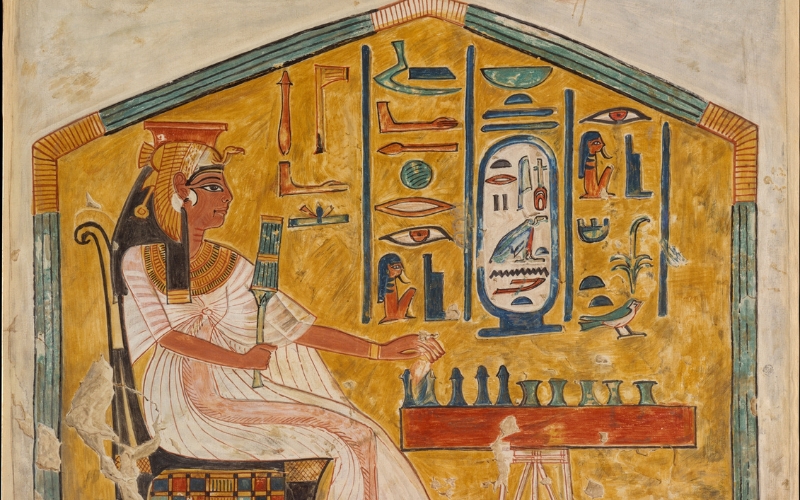
1. Nefertari Playing Senet: The Journey Beyond Death
One of the most famous paintings depicts Nefertari seated before a board game known as senet.
Senet was played in ancient Egypt, but it also developed powerful funerary associations.
In tomb paintings, the game could symbolize movement through the challenges of the afterlife.
The queen appears in elaborate clothing with carefully painted jewelry and a refined hairstyle.
Her opponent is not shown.
The scene therefore invites both a literal and symbolic interpretation.
It depicts a recognizable Egyptian activity while also referring to the soul’s passage beyond earthly life.
For visitors examining reproductions or photographs of QV66, the senet image is an excellent starting point.
It demonstrates how an ordinary-looking object could carry religious significance.
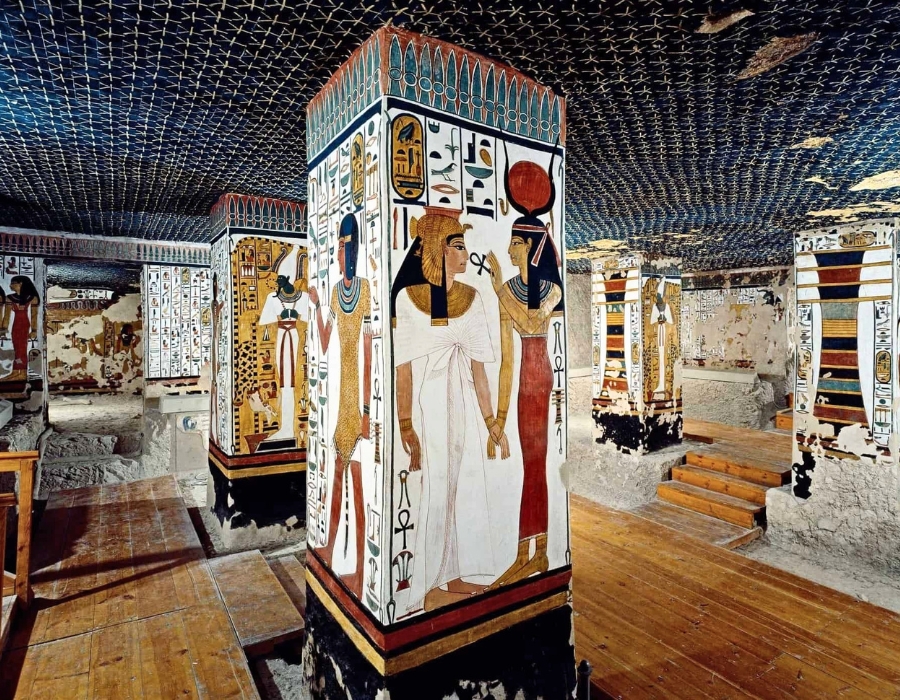
2. Nefertari With Hathor: Protection and Rebirth
Hathor appears prominently in the religious world represented inside Nefertari’s tomb.
She was associated with love, music, motherhood, divine femininity, and the protection of the dead.
In funerary contexts, Hathor could welcome deceased individuals into the next world.
Her association with Nefertari is especially significant because the queen also received a temple dedicated jointly to herself and Hathor at Abu Simbel.
Hathor’s presence in the tomb therefore connects Nefertari’s burial to her wider religious representation during life.
The queen is not merely being shown beside a popular goddess.
The imagery expresses a relationship intended to assist her after death.
3. Isis and Nefertari: Divine Protection
Isis was among the most important goddesses of ancient Egyptian religion.
She was associated with protection, magic, motherhood, and the resurrection of Osiris.
In royal funerary art, Isis could protect the deceased and support the process of rebirth.
Scenes involving Nefertari and Isis belong to this broader religious tradition.
The queen’s interaction with the goddess suggests divine acceptance and protection.
For travelers unfamiliar with ancient Egyptian religion, it helps to remember that gods and goddesses could have overlapping responsibilities.
A figure associated with motherhood in one context might also protect the dead in another.
This flexibility is central to understanding the major gods and goddesses of ancient Egypt.
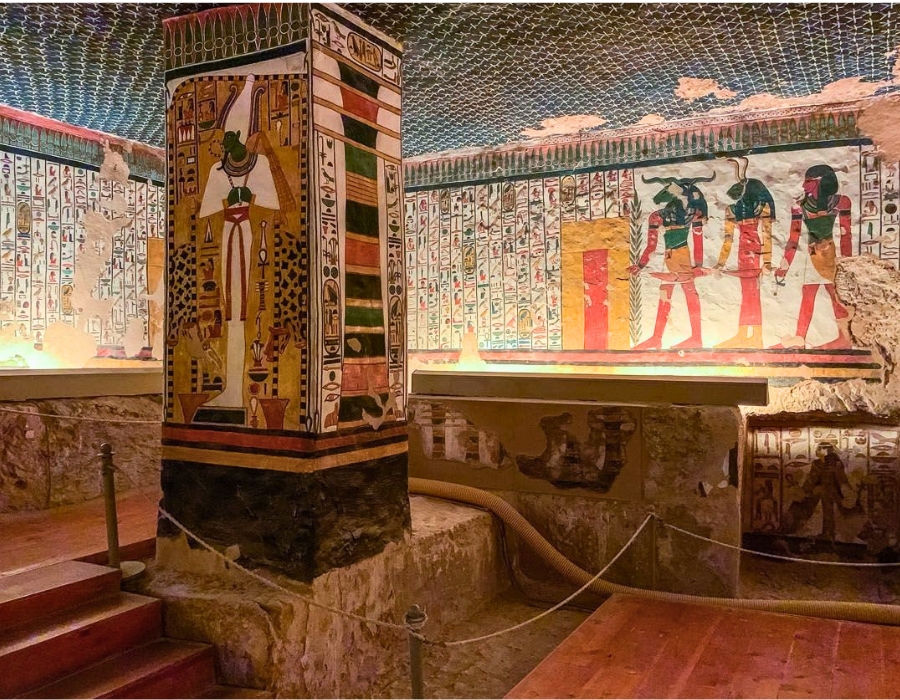
4. Osiris and the Promise of Eternal Life
Osiris was a central figure in Egyptian beliefs concerning death and resurrection.
He was associated with the realm of the dead and the possibility of continued existence after bodily death.
Nefertari’s burial decoration includes encounters with funerary deities and imagery connected with Osirian beliefs.
These scenes express the hope that the queen would join the divine world and participate in eternal renewal.
The Egyptians did not generally regard death as the complete destruction of existence.
Funerary rituals, tomb decoration, offerings, and spells were intended to preserve the individual and support a continuing life beyond death.
5. Anubis and the Protection of the Tomb
Anubis, commonly shown with the head of a jackal, was associated with embalming, burial, and the protection of the deceased.
His appearance in Egyptian funerary art reinforced ideas of ritual protection.
The presence of Anubis in royal tomb decoration also reflects the importance attached to preserving the body.
Ancient Egyptian beliefs connected the continued existence of the individual with successful funerary preparation.
However, not every depiction of Anubis represents the same ritual.
The meaning depends on the scene, inscriptions, and the deity’s relationship to other figures.
6. The Star-Covered Ceiling
One of QV66’s most striking visual features is its dark-blue ceiling decorated with stars.
The starry design evokes the heavens.
Such celestial imagery was common in Egyptian royal and religious architecture.
In funerary settings, it connected the deceased with the divine cosmos and the possibility of renewal.
The effect is particularly powerful because the tomb lies underground.
Visitors looking at photographs can see how the ceiling transforms an enclosed burial chamber into a symbolic heavenly environment.
The stars are part of the tomb’s religious meaning, not merely an aesthetic choice.
7. The Book of the Dead and Protective Texts
Some of the inscriptions in Nefertari’s tomb are associated with the Egyptian funerary texts commonly called the Book of the Dead.
This modern title describes a collection of spells, prayers, and ritual compositions rather than one fixed book used by every Egyptian.
Different tombs and manuscripts contained different selections.
The texts helped the deceased navigate dangers, recognize supernatural beings, and participate successfully in the afterlife.
In Nefertari’s tomb, inscriptions and painted scenes work together.
The images provide visual expressions of religious concepts, while the texts identify deities, describe ritual relationships, and reinforce the intended protection of the queen.
Readers should not assume that every painting illustrates a single exact passage from the Book of the Dead.
The tomb combines several related religious traditions.
8. The Queen’s Clothing, Jewelry, and Crown
Nefertari’s painted appearance provides valuable evidence about royal artistic ideals.
She is represented wearing elaborate dresses, necklaces, bracelets, and distinctive head ornaments.
Her clothing often appears as fine white linen with carefully painted folds.
The jewelry introduces contrasting colors and shapes.
Her crowns and headdresses express religious and royal associations.
It is important, however, to distinguish between artistic representation and physical archaeological evidence.
The paintings show how Egyptian artists wanted Nefertari to appear in an idealized sacred setting.
They do not prove that every depicted garment or piece of jewelry was recovered from her burial.
|
Detail in Nefertari’s tomb |
Historical meaning |
|---|---|
|
Star-covered ceiling |
Celestial symbolism and eternal existence |
|
Senet board game |
Passage through the afterlife |
|
Hathor |
Divine protection and renewal |
|
Isis |
Protective magic and resurrection beliefs |
|
Osiris |
Death, rebirth, and the divine afterlife |
|
Anubis |
Burial and funerary protection |
|
Hieroglyphic texts |
Sacred spells and religious identification |
|
White linen clothing |
Idealized royal presentation |
|
Jewelry and headdresses |
Royal status and religious symbolism |
Why Are the Colors in Nefertari’s Tomb So Remarkable?
The paintings in QV66 are celebrated for their vivid reds, yellows, blues, greens, and carefully controlled outlines.
Their visual impact comes from more than bright pigments.
Ancient Egyptian artists combined disciplined drawing, balanced composition, and layered surfaces to create figures that remain legible after thousands of years.
How Did Ancient Egyptian Artists Paint the Tomb?
The rock in the Valley of the Queens was not always suitable for painting directly.
Workers prepared surfaces by applying plaster over irregular limestone.
Artists could then create designs using painted outlines and carefully arranged areas of color.
Different sections of the tomb required different methods of preparation.
Scientific examination has identified variation in the composition and number of plaster layers.
This is important because the paintings do not exist as color applied directly to a solid, smooth rock surface.
They are part of a more complex structure.
Damage to the plaster can threaten the paintings even when the pigments themselves remain stable.
Why Do Nefertari’s Paintings Look Different From Ordinary Tomb Decorations?
Nefertari’s tomb belongs to a tradition of highly sophisticated royal painting.
Its decoration stands out because of its exceptional execution and extensive surviving imagery.
Faces are carefully modeled within Egyptian artistic conventions.
Jewelry and clothing contain numerous fine details.
Colors distinguish divine figures, architectural features, inscriptions, and symbolic elements.
The arrangement of the figures also produces a sense of movement through sacred spaces.
The result is a tomb designed not simply to contain a burial, but to express a complete religious vision.
Are the Tomb Paintings Original?
Much of the surviving painted decoration is ancient, but it has undergone extensive conservation.
The tomb was damaged before its modern discovery, and additional deterioration occurred afterward.
Conservators worked to stabilize original material rather than create an entirely new decorative scheme.
Visitors looking at photographs should understand that missing sections, uneven surfaces, and differences in preservation are part of the tomb’s history.
The survival of its paintings is extraordinary, but they have not remained untouched.
Who Discovered the Tomb of Queen Nefertari?
The tomb of Queen Nefertari was discovered in 1904 during excavations led by Italian archaeologist Ernesto Schiaparelli.
Schiaparelli was an important figure in the history of Egyptology and was associated with the Egyptian Museum in Turin, Italy.
His archaeological work in Egypt helped document monuments and objects that contributed to modern understanding of ancient Egyptian history.
The discovery of QV66 was especially significant because its paintings offered exceptional evidence of royal funerary art.
What Did Archaeologists Find in the Tomb?
The tomb had already been robbed in antiquity.
Its original burial equipment was therefore incomplete.
Despite this, archaeologists recovered objects and fragments that provided information about the queen’s burial.
These included remains of funerary equipment and human remains.
The surviving paintings were the tomb’s greatest artistic discovery.
They preserved religious scenes and representations that could be studied even though much of the original burial assemblage had disappeared.
Was Queen Nefertari’s Mummy Found?
Mummified leg remains were discovered among material recovered from the tomb.
They were taken to the Egyptian Museum in Turin.
A multidisciplinary scientific investigation published in 2016 examined the remains using several methods, including anatomical and chemical analysis.
The researchers concluded that the remains were most likely those of Queen Nefertari.
However, the identification is not absolutely certain.
The appropriate historical statement is that mummified remains found in QV66 are strongly consistent with Nefertari’s identity, but their attribution cannot be regarded as conclusively proven.
According to the museum’s collection record, these remains are not currently on public display.
Where Are the Artifacts From Nefertari’s Tomb?
Some archaeological material recovered during Schiaparelli’s excavations entered the collections of the Egyptian Museum in Turin, also known as Museo Egizio.
The museum preserves important objects and archival records connected with the Italian excavations.
Its historical photographs are particularly valuable because they document the tomb during the early twentieth century.
Comparing early excavation photographs with later conservation documentation helps researchers understand how the tomb changed over time.
This kind of material is essential for investigating damage, previous treatment, and the original archaeological context.
Travelers interested in original Egyptian artifacts can also explore our guide to Egypt’s archaeological museums, while remembering that objects from Egyptian excavations are held in collections around the world.
How Was Queen Nefertari’s Tomb Restored?
The Getty Conservation Institute and Egyptian archaeological authorities carried out a major conservation project at QV66 between 1986 and 1992.
The work addressed severe deterioration in the tomb’s painted surfaces.
It remains one of the best-documented examples of international collaboration in conserving ancient Egyptian wall paintings.
Why Did the Tomb Need Conservation?
Several factors contributed to the deterioration of Nefertari’s tomb.
The limestone and plaster contained salts that could respond to changes in moisture.
Over time, salt crystallization could weaken the connection between plaster and stone.
As the layers separated, sections of ancient painting became unstable.
Environmental fluctuations also contributed to deterioration.
Human activity created further risks through physical contact, dust, and damage during earlier periods.
By the 1980s, approximately one-quarter of the original painted decoration had been lost.
The remaining paintings required extensive scientific investigation and conservation.
What Did Conservators Actually Do?
The conservation team studied the tomb’s physical environment and the materials used in the ancient paintings.
Specialists investigated plaster composition, pigments, salts, humidity, and previous restoration materials.
Conservation treatments focused on stabilizing endangered surfaces and cleaning original material.
The objective was not to repaint the tomb to make it appear completely new.
Instead, the team sought to preserve the authenticity of surviving ancient decoration.
The project also produced extensive documentation.
Thousands of photographs, condition surveys, scientific records, and technical reports were assembled.
These archives continue to contribute to conservation research.
Why Is Visitor Access So Carefully Controlled?
Ancient painted tombs can be sensitive to environmental change.
Visitor activity introduces heat, moisture, dust, and other pressures into enclosed spaces.
The seriousness of these effects varies according to a tomb’s physical condition and environmental systems.
For a monument such as QV66, limiting visitor activity can be an important part of preventive conservation.
This explains why entrance restrictions, temporary closures, and specialized visitor procedures should not automatically be interpreted as failures in tourism management.
They may be necessary to protect fragile original material.
Preserving the tomb for future generations is more important than maintaining unrestricted access.
What Is House of Eternity: The Tomb of Nefertari?
House of Eternity: The Tomb of Nefertari is a publication associated with the Getty Conservation Institute’s work on QV66.
Published in 1996, it documents and interprets the queen’s tomb and its extraordinary decoration.
The phrase “House of Eternity” reflects the ancient Egyptian concept of a tomb as a permanent home for the deceased.
The publication is useful for readers who want to examine the tomb in greater detail.
It also illustrates why conservation photography and documentation remain important when physical access is restricted.
Queen Nefertari’s Tomb Tickets and Opening Status in 2027
Visitor information reviewed October 15, 2026. The 2027 reopening status of tomb QV66 has not been confirmed.
Travelers should not assume that Queen Nefertari’s tomb will be open during their 2027 visit.
Recent visitor information has described QV66 as closed for conservation, following restrictions and closure reports dating from 2024.
A reliable official announcement confirming unrestricted public access in 2027 could not be established during this research.
This distinction is important because the Valley of the Queens archaeological site and Nefertari’s individual tomb are not the same ticketed experience.
Visitors may be able to explore other tombs in the valley even when QV66 is inaccessible.
Can You Visit Nefertari’s Tomb in 2027?
Access to Nefertari’s tomb in 2027 remains unconfirmed.
Travelers should confirm the current status with the official Egyptian monument ticketing service or the relevant archaeological authorities shortly before their visit.
A tour description that includes the Valley of the Queens does not necessarily include admission to QV66.
Even if the tomb reopens, entry might be subject to separate tickets, limited visitor numbers, restricted viewing times, or conservation-related rules.
None of these potential arrangements should be treated as confirmed 2027 policies.
How Much Do Nefertari Tomb Tickets Cost?
A reliable 2027 ticket price for Queen Nefertari’s tomb has not been announced.
Historic websites sometimes quote separate premium ticket prices from previous years.
These figures should not be presented as current admission rates.
The general Valley of the Queens ticket is a separate matter.
The Egyptian monument ticketing service listed the following rates when checked in October 2026.
|
Admission category |
Listed price in October 2026 |
2027 planning note |
|---|---|---|
|
Valley of the Queens — international adult |
EGP 220 |
General archaeological-site admission; may change |
|
Valley of the Queens — eligible international student |
EGP 110 |
Student eligibility and documentation apply |
|
Queen Nefertari’s tomb, QV66 |
Not confirmed |
Do not assume availability or a price |
|
Separate QV66 premium admission |
Historically required when operating |
Future ticketing arrangement unconfirmed |
These figures are a historical planning reference, not a quotation for a future booking.
Does the Valley of the Queens Ticket Include Nefertari’s Tomb?
A standard Valley of the Queens ticket should not be assumed to include QV66.
When Nefertari’s tomb operated under a premium-access arrangement, admission was separate from the ordinary valley ticket.
Visitors planning a trip around this specific monument should confirm both access and ticket inclusions.
The safest approach is to treat the tomb as an optional opportunity until official entry arrangements are verified.
What Are the Valley of the Queens Opening Hours?
At the October 2026 research date, the Egyptian monument booking service listed a 6:00 AM opening for the Valley of the Queens.
The published last-entry times differed by season: 5:00 PM in summer and 4:00 PM in winter.
These times apply to the archaeological site generally and do not establish opening hours for QV66.
They may also change before 2027.
Travelers should arrive well before the posted final admission time and avoid scheduling the archaeological site at the very end of a sightseeing day.
Can You Take Photos Inside Nefertari’s Tomb?
Do not assume that general Egyptian monument photography policies apply to QV66.
Specialized tombs may have additional conservation rules, and photography permissions can change.
Flash, tripods, lighting equipment, filming, and commercial photography may be regulated differently.
If the tomb becomes accessible, follow the posted instructions rather than relying on older visitor reports.
For historical paintings, protecting the original surface takes priority over obtaining a photograph.
Is Queen Nefertari’s Tomb Worth Visiting?
If QV66 reopens under an approved visitor program, it would be an exceptionally valuable experience for travelers interested in ancient Egyptian painting, religion, and royal history.
Its main attraction is not the quantity of objects displayed.
The value lies in the tomb’s integrated decorative program, the exceptional skill of its painters, and the survival of so much original artwork.
However, visitors should also have realistic expectations.
The tomb is an underground archaeological space, not a modern museum with extensive explanatory displays.
Its importance is easier to appreciate when travelers understand the religious meaning of the scenes before entering.
Who Would Appreciate QV66 Most?
QV66 is especially relevant to visitors interested in Egyptian mythology, art history, archaeology, conservation, and ancient royal women.
It could also appeal to travelers who have already visited several Egyptian tombs and want to examine differences in artistic style and religious representation.
Families with children may find the vivid paintings memorable, although the enclosed space and any strict visiting rules would require preparation.
Who Might Prefer Another Attraction?
Visitors uncomfortable with underground chambers or enclosed spaces may prefer open-air temples.
Travelers who require step-free access should not assume that QV66 can accommodate wheelchairs or mobility aids.
The tomb’s physical layout includes descending passages and stairs.
Even if it reopens, its accessibility arrangements must be confirmed individually.
For visitors primarily interested in large-scale architecture, Abu Simbel or major Luxor temples may provide a more satisfying experience.
What Should Travelers Do if QV66 Remains Closed?
A closure does not prevent travelers from learning about Nefertari.
They can study documented images of her tomb, explore the Valley of the Queens where permitted, visit other significant West Bank monuments, and include the temple dedicated to Nefertari at Abu Simbel.
This alternative offers something valuable: an opportunity to understand the queen through both her funerary monument and her public religious representation.
Queen Nefertari’s Temple at Abu Simbel
The Small Temple of Abu Simbel, also called the Temple of Hathor and Nefertari, is one of the most important surviving monuments associated with Queen Nefertari.
It was commissioned during the reign of Ramesses II and carved directly into rock in southern Egypt.
The temple stands beside the Great Temple of Ramesses II near Lake Nasser.
For modern travelers, Abu Simbel provides one of the most direct ways to see how Nefertari was celebrated through monumental Egyptian architecture.
Where Is Nefertari’s Temple Located?
Nefertari’s temple is located at Abu Simbel in southern Egypt, in the Aswan Governorate near Lake Nasser.
The temple stands close to the much larger sanctuary of Ramesses II.
The two temples were designed as a monumental religious complex in ancient Nubia.
Abu Simbel is approximately 280 kilometers by road from Aswan, depending on the starting point and route.
It is commonly visited as a day trip from Aswan, although overnight stays near the site can provide a less hurried experience.
Our dedicated Abu Simbel temples guide provides additional background for travelers planning to explore the complex.
Why Was the Temple Dedicated to Hathor and Nefertari?
The temple was dedicated to Hathor and associated Nefertari with the goddess.
Hathor’s religious identity included protection, divine femininity, music, and joy.
The goddess could also represent important aspects of female divinity and kingship.
By presenting Nefertari within this sacred context, the monument elevated her religious image.
This was more than a commemorative building honoring a royal wife.
The temple formed part of a broader political and religious landscape in which Egyptian kings expressed divine legitimacy and royal authority.
Why Are Nefertari’s Statues Almost as Tall as Ramesses II?
The facade of the smaller temple includes six large standing statues.
Four represent Ramesses II and two represent Nefertari.
The queen is shown at a scale approaching that of the pharaoh.
This arrangement is unusual because Egyptian royal women were frequently depicted much smaller than the reigning king.
At Abu Simbel, the visual emphasis highlights Nefertari’s ceremonial and religious importance.
The design must be interpreted in its setting.
The facade was not an ancient declaration of equal constitutional power.
It was a carefully organized royal and divine image intended to communicate status, legitimacy, and sacred associations.
What Can You See Inside the Smaller Temple?
Inside the smaller temple, visitors encounter halls and chambers decorated with religious scenes involving the king, queen, and Egyptian deities.
The decoration is closely associated with Hathor.
Pillars and reliefs reinforce the religious character of the sanctuary.
Scenes show royal figures participating in ceremonies and interacting with divine beings.
Because the smaller temple receives less attention than the Great Temple, visitors sometimes spend too little time examining it.
The architectural details, royal figures, and religious imagery deserve careful attention.
A useful approach is to examine the exterior statues first, then look for the relationship between Nefertari and Hathor inside the monument.
Why Was Abu Simbel Built in Nubia?
Abu Simbel was part of Egypt’s monumental presence in Nubia during the New Kingdom.
The region was economically and strategically important to the Egyptian state.
Its resources, trade connections, and position along the Nile contributed to its significance.
Egyptian temples in Nubia expressed religious ideas while also communicating royal power.
Today, it is important to recognize that these monuments were created within a historical relationship involving Egyptian political domination and Nubian communities.
Understanding that context gives visitors a fuller interpretation of Abu Simbel than a purely romantic account of royal construction.
Was Nefertari’s Temple Moved?
Yes. The temples of Abu Simbel were relocated during the twentieth century to protect them from the rising waters associated with the Aswan High Dam.
An international UNESCO-supported rescue effort helped preserve major Nubian monuments.
The temples were dismantled into carefully documented sections and reconstructed at a higher location.
The relocation preserved their architectural and artistic significance while changing their original physical setting.
Abu Simbel became one of the most famous examples of international cooperation in archaeological preservation.
The two temples are part of the UNESCO World Heritage property known as the Nubian Monuments from Abu Simbel to Philae.
This is a different World Heritage property from the ancient Theban archaeological landscape containing Nefertari’s tomb.
What Is the Connection Between Abu Simbel and Lake Nasser?
Lake Nasser is the large reservoir formed by the Aswan High Dam.
The reservoir transformed the landscape of southern Egypt and northern Sudan.
Its creation threatened numerous archaeological sites, contributing to the international rescue campaign.
Today, travelers visiting Abu Simbel encounter both ancient Egyptian monuments and a dramatically altered modern landscape.
The history of Lake Nasser and southern Egypt helps explain why Abu Simbel stands where it does today.
Nefertari and Hathor: What Was Their Religious Connection?
The connection between Nefertari and Hathor is one of the most important elements of the queen’s surviving religious identity.
Hathor was a major goddess in ancient Egyptian religion.
She could be represented as a woman, a cow, or through symbols associated with the cow’s horns and solar disk.
Her responsibilities included motherhood, music, joy, protection, and the reception of the dead.
Nefertari’s association with Hathor appears in both her temple and funerary representation.
Was Queen Nefertari Worshipped as a Goddess?
Nefertari received an unusually elevated religious presentation, particularly at Abu Simbel.
Her imagery connected her closely with Hathor.
However, identifying the precise meaning of royal divinization requires care.
Ancient Egyptian theology did not always use the same distinctions between humans and gods that modern readers expect.
Royal individuals could participate in divine imagery and rituals while remaining historical human beings.
Nefertari’s representation at Abu Simbel demonstrates exceptional religious honor.
It does not mean that every Egyptian worshipped her as an independent goddess throughout the country.
Why Did Hathor Matter to Egyptian Queens?
Hathor embodied several qualities associated with ideal queenship.
These included beauty, motherhood, protection, and divine femininity.
Royal women could invoke these associations through ceremonial clothing, religious instruments, headdresses, and temple scenes.
Hathor’s role was not restricted to one dynasty or royal family.
Her worship developed over many centuries, making her a major figure in ancient Egyptian culture.
Travelers interested in Hathor’s temples can also examine the religious decoration of the Temple of Dendera, one of the most important surviving sanctuaries dedicated to the goddess.
Dendera’s surviving principal temple is much later than Nefertari’s lifetime, but it demonstrates the continuing importance of Hathor worship in Egypt.
Queen Nefertari vs. Nefertiti: Were They the Same Person?
Queen Nefertari and Queen Nefertiti were two different Egyptian royal women who lived during different periods of the New Kingdom.
They are frequently confused because their names sound similar and both became famous for royal portraiture and their relationships with powerful pharaohs.
Nefertiti was the Great Royal Wife of Akhenaten during the Eighteenth Dynasty.
Nefertari was the Great Royal Wife of Ramesses II during the Nineteenth Dynasty.
The difference is historical, not simply linguistic.
|
Comparison |
Queen Nefertari |
Queen Nefertiti |
|---|---|---|
|
Main historical period |
13th century BCE |
14th century BCE |
|
Dynasty |
Nineteenth Dynasty |
Eighteenth Dynasty |
|
Husband |
Ramesses II |
Akhenaten |
|
Associated city or region |
Luxor and Abu Simbel |
Akhetaten, modern Amarna |
|
Famous monument |
Tomb QV66 |
Painted portrait bust |
|
Religious association |
Hathor, Mut, and traditional Egyptian religion |
Aten-centered religious reforms |
|
Historical role |
Great Royal Wife and prominent royal consort |
Great Royal Wife with exceptional prominence under Akhenaten |
|
Burial identification |
QV66 is securely identified as her tomb |
Her final burial remains disputed |
|
Archaeological fame |
Tomb paintings and Abu Simbel |
Portraiture and the Amarna period |
Why Are Their Names So Similar?
Both names contain Egyptian elements associated with beauty.
The element nefer commonly relates to beauty, goodness, or perfection.
Egyptian names could share religious and linguistic components without indicating that their bearers were closely related.
Similarity in spelling does not establish a family connection.
Was Nefertari Related to Nefertiti?
There is no securely established direct family relationship between the two famous queens.
Nefertiti belonged to the Amarna period, while Nefertari lived later under Ramesses II.
Although theories about royal family connections sometimes appear in popular literature, Nefertari’s ancestry is too uncertain to support confident claims of direct descent from Nefertiti.
Which Queen Was More Powerful?
A simple ranking is misleading because the surviving evidence concerns different types of authority.
Nefertiti played an exceptionally prominent role in Akhenaten’s religious and royal imagery.
Some scholars have proposed that she may have exercised sovereign authority near the end of the Amarna period, although aspects of that reconstruction remain debated.
Nefertari’s known role is different.
Her influence is demonstrated through high royal status, major monuments, religious representation, and diplomatic correspondence.
Neither woman should be reduced to the beauty of her portraits.
Their historical importance comes from the positions they occupied in Egypt’s royal and religious institutions.
Queen Nefertari, Ahmose-Nefertari, and Other Royal Names
Queen Nefertari, the wife of Ramesses II, is also distinct from Queen Ahmose-Nefertari.
Ahmose-Nefertari lived much earlier, around the beginning of the Eighteenth Dynasty.
She was the wife of Pharaoh Ahmose I and the mother of Amenhotep I.
Ahmose-Nefertari became an important religious figure and received lasting veneration, especially in the Theban region.
Her name appears on objects and monuments associated with the early New Kingdom.
The fact that both women are called Nefertari does not mean they were the same person.
Was There a Nefertari in the Eighteenth Dynasty?
Yes. The name Nefertari was used by more than one royal woman.
In addition to Ahmose-Nefertari, a queen named Nefertari is associated with Pharaoh Thutmose IV during the Eighteenth Dynasty.
These earlier queens must not be confused with the famous wife of Ramesses II.
When identifying a queen, dynasty and royal spouse are more reliable than name alone.
|
Queen |
Dynasty |
Important relationship |
|---|---|---|
|
Ahmose-Nefertari |
Early Eighteenth |
Wife of Ahmose I |
|
Nefertari, wife of Thutmose IV |
Eighteenth |
Royal consort of Thutmose IV |
|
Nefertiti |
Eighteenth |
Great Royal Wife of Akhenaten |
|
Nefertari Meritmut |
Nineteenth |
Great Royal Wife of Ramesses II |
|
Cleopatra VII |
Ptolemaic |
Last active ruler of the Ptolemaic dynasty |
Was Nefertari Related to Cleopatra?
There is no known direct family relationship between Nefertari and Cleopatra VII.
They lived more than a thousand years apart.
Nefertari belonged to the New Kingdom in the 13th century BCE.
Cleopatra VII lived in the first century BCE and ruled during the final period of the Ptolemaic dynasty.
The two women also occupied different political positions.
Nefertari was a royal consort, while Cleopatra was a reigning monarch.
Both are important figures in the history of Egyptian queenship, but their political worlds were very different.
When Did Queen Nefertari Die?
Queen Nefertari probably died during the earlier portion of Ramesses II’s long reign, in the 13th century BCE.
The precise date remains uncertain.
Her death is often placed around the middle of the century, but specific years should be understood as historical reconstructions rather than securely recorded dates.
The surviving evidence suggests that Nefertari was no longer alive by a relatively early stage of Ramesses II’s reign.
She disappeared from the later historical record while the king continued ruling for several decades.
How Old Was Nefertari When She Died?
Her exact age is unknown.
Studies of mummified remains attributed to her suggest an adult woman around 40 years old.
However, because the identification of the remains is probable rather than certain, this should not be presented as a confirmed age at death.
The absence of a securely established birth date creates further uncertainty.
A precise age, birthday, or death anniversary cannot be supported from the available historical evidence.
How Did Queen Nefertari Die?
The cause of Nefertari’s death is unknown.
There is no reliable evidence confirming that she died from a particular disease, pregnancy complication, accident, or violent incident.
Stories offering detailed accounts of her final days generally go beyond what surviving sources can establish.
Her tomb records the religious arrangements intended to protect her after death, not a medical explanation of how she died.
What Happened After Nefertari’s Death?
Ramesses II continued ruling Egypt for many years.
Other royal women occupied prominent positions during the remainder of his reign.
Members of Nefertari’s family also continued to appear in royal monuments and titles.
Her own legacy survived through the tomb created for her burial and the temple associated with her name.
These monuments explain why she remains more familiar to modern audiences than many other royal women of the Nineteenth Dynasty.
Queen Nefertari’s Life: Historical Timeline
|
Period |
Event |
Historical significance |
|---|---|---|
|
Before 1279 BCE |
Nefertari probably married Ramesses before his accession |
Establishes her connection with the future royal household |
|
Around 1279 BCE |
Ramesses II became pharaoh |
Beginning of Nefertari’s documented prominence as Great Royal Wife |
|
Early reign |
Nefertari appeared in royal and religious scenes |
Evidence of high ceremonial status |
|
Around 1274 BCE |
Battle of Kadesh |
Major event in the reign of Ramesses II |
|
Following the conflict |
Egypt and the Hittites pursued improved relations |
Context for later diplomatic correspondence |
|
Around 1259 BCE |
Egyptian-Hittite peace treaty |
Important milestone in international diplomacy |
|
Later diplomatic exchanges |
Nefertari corresponded with Queen Puduhepa |
Evidence of royal female participation in diplomacy |
|
During Ramesses II’s reign |
Temple at Abu Simbel was completed |
Monumental association between Nefertari and Hathor |
|
13th century BCE |
Nefertari died; exact date unknown |
Her burial was prepared in QV66 |
|
1904 CE |
Ernesto Schiaparelli discovered QV66 |
Major moment in modern archaeological study |
|
1986–1992 |
Major international conservation campaign |
Stabilization and documentation of the wall paintings |
|
2016 |
Scientific research examined mummified remains from the tomb |
Strong but not conclusive support for identifying them as Nefertari |
|
2027 |
Future tourism access remains subject to conservation and official decisions |
Travelers must verify QV66 availability |
The timeline illustrates an important difference between ancient history and modern archaeology.
Events such as Ramesses II’s accession are supported by established chronological frameworks.
Details of Nefertari’s childhood, personal relationship, exact death date, and cause of death remain less certain.
Good historical interpretation depends on preserving that distinction.
Queen Nefertari and Moses: Is There a Biblical Connection?
There is no securely established historical evidence identifying Queen Nefertari as a figure in the biblical Exodus narrative.
Modern interpretations sometimes connect Ramesses II with the Pharaoh of the Exodus.
However, the identity of the biblical pharaoh remains debated, and the historical relationship between the Exodus traditions and known Egyptian rulers is unresolved.
The biblical narrative does not identify Nefertari by name.
Any suggestion that she personally knew Moses or participated in specific Exodus events is therefore speculative.
Was Ramesses II the Pharaoh of Moses?
Ramesses II is one of the rulers frequently proposed in modern discussions of the Exodus chronology.
The association is partly connected with historical geography and biblical references to place names.
Nevertheless, no universally accepted identification links Ramesses II definitively with the biblical pharaoh.
The topic requires careful treatment because religious tradition, literary interpretation, and archaeological evidence address different questions.
It is not historically sound to use the existence of Ramesses II as proof that every episode in the Exodus narrative occurred during his reign.
Did Queen Nefertari Appear in the Bible?
Queen Nefertari is not named in the Bible.
Some films, novels, and modern adaptations incorporate Egyptian royal characters into fictional interpretations of biblical events.
These portrayals should not be mistaken for ancient documentary evidence.
For readers interested in historically grounded accounts of Egyptian royalty, archaeological inscriptions and contemporary records provide a more reliable starting point.
Queen Nefertari in Books, Art, and Popular Culture
Nefertari continues to inspire modern writers, artists, historians, and filmmakers.
Her story combines recognizable historical figures with unusually beautiful surviving artwork.
That combination makes her a compelling subject for historical fiction.
However, popular portrayals often fill gaps in the record with imagined conversations, relationships, motives, and dramatic incidents.
Is Nefertari’s Tomb a Historical Source?
Photographs, archaeological reports, conservation publications, and academic research about QV66 are historical resources.
Modern novels inspired by Nefertari are works of fiction.
A fictional character may be based on a real person without preserving that person’s exact life.
Readers interested in Nefertari should distinguish between scholarly reconstruction and storytelling inspired by historical settings.
What Is Michelle Moran’s Novel Nefertiti About?
Nefertiti is a historical novel by Michelle Moran centered on Nefertiti and the Amarna period.
Its central subject is not Queen Nefertari Meritmut, the wife of Ramesses II.
The similarity between the two queens’ names can create confusion when readers search for Egyptian historical fiction.
Moran also wrote The Heretic Queen, which features a fictionalized Nefertari in the setting of Ramesses II’s reign.
The novels can introduce readers to historical settings, but their invented events should not be used as established biographical facts.
Why Are Nefertari’s Paintings So Widely Reproduced?
Nefertari’s tomb paintings combine immediately recognizable artistic qualities with sophisticated religious symbolism.
The figures are elegant, the colors are distinctive, and the compositions are visually balanced.
Her representations with Hathor and other deities are particularly popular in books and exhibitions.
The senet scene has also become one of the best-known images of ancient Egyptian funerary art.
Reproductions appear in museum displays, educational resources, publications, and modern artwork.
When selecting illustrations, publishers should identify whether an image is an original ancient painting, a modern facsimile, a photograph, or an artistic reconstruction.
These are different forms of visual evidence.
Where Can Travelers Explore Queen Nefertari’s Legacy in Egypt?
Travelers can explore Nefertari’s legacy primarily through the Valley of the Queens in Luxor and the Temple of Hathor and Nefertari at Abu Simbel.
Other important sites from Ramesses II’s reign help provide historical context.
The best route depends on how much time visitors have and whether they are concentrating on Luxor, Aswan, or a broader Egypt itinerary.
|
Attraction |
Location |
Relationship to Nefertari |
Suggested time |
|---|---|---|---|
|
Valley of the Queens |
Luxor West Bank |
Location of tomb QV66 |
45–90 minutes for the valley if open |
|
Ramesseum |
Luxor West Bank |
Mortuary temple of Ramesses II |
45–75 minutes |
|
Luxor Temple |
Luxor East Bank |
Ramesside royal monuments and reliefs |
60–90 minutes |
|
Karnak Temple |
Luxor East Bank |
Important royal and religious setting during Ramesses II’s reign |
2–3 hours |
|
Abu Simbel |
Southern Egypt |
Temple honoring Hathor and Nefertari |
1.5–2.5 hours on site |
These are suggested sightseeing allocations, not official guided-tour durations.
Valley of the Queens: Understand Her Burial Setting
Even when QV66 is inaccessible, the Valley of the Queens helps travelers understand the geographical context of royal burials.
The desert landscape reveals how Egyptian burial places were organized in areas separated from the main urban and temple districts.
Visitors can compare the valley’s setting with other major burial regions.
The significance of the site goes beyond any single tomb.
It was part of a larger royal necropolis serving the society of ancient Thebes.
Ramesseum: Explore the Reign of Her Husband
The Ramesseum mortuary temple was built for Ramesses II on the west bank of Luxor.
Its surviving architecture, statues, and reliefs help visitors understand the scale of the king’s monumental program.
It is not Nefertari’s burial place and should not be presented as a monument built specifically for her.
Its value lies in the wider historical context.
By visiting the Ramesseum, travelers can better appreciate the royal world in which Nefertari lived.
Luxor Temple: Examine Ramesside Royal Representation
At Luxor Temple, major architectural elements and royal imagery belong to the reign of Ramesses II.
The temple also contains important remains from earlier periods.
It provides an opportunity to study how different kings added to existing sacred monuments.
For visitors interested in Nefertari, Luxor Temple helps explain the religious ceremonies and public settings in which royal women could appear.
Karnak Temple: Understand the Religious World of Thebes
Karnak Temple was one of the most important religious complexes in ancient Egypt.
Its association with Amun and the Theban gods provides essential background for understanding Nefertari’s royal name and religious world.
The complex developed over many centuries.
Ramesses II contributed to its monumental history, but the surviving architecture represents the work of numerous rulers.
Karnak is particularly valuable for travelers who want to understand the relationship between pharaohs, temples, priests, and royal religious imagery.
Abu Simbel: See the Queen’s Monumental Image
For travelers primarily interested in Nefertari herself, the smaller temple at Abu Simbel is an especially important destination.
Unlike other monuments associated mainly with her husband, it explicitly honors the queen alongside Hathor.
It is therefore central to understanding her historical legacy.
How to Plan a Queen Nefertari-Themed Egypt Itinerary
A useful Nefertari-themed itinerary connects Luxor’s royal burial landscape with the temple at Abu Simbel.
These sites are too far apart to treat as one short sightseeing excursion.
A practical plan separates Luxor and Aswan into different travel days.
Option 1: One Day in Luxor — Nefertari and the Royal Necropolis
This option suits travelers with limited time in Luxor.
-
Colossi of Memnon: Begin with a short visit to the monumental statues of Amenhotep III to introduce the West Bank’s royal landscape.
-
Valley of the Queens: Explore the publicly accessible burial area. Do not assume that QV66 is available.
-
Ramesseum: Visit the mortuary temple of Ramesses II and examine the scale of his building program.
-
Temple of Hatshepsut: If time allows, finish with a contrasting example of royal female authority in ancient Egypt.
Suggested Luxor West Bank route. Stop order may be adjusted for operating hours, traffic, heat, and ticket availability.
The Colossi of Memnon make a convenient introductory stop.
The mortuary temple of Hatshepsut is an optional addition for travelers interested in comparing Nefertari’s position as a queen with Hatshepsut’s position as a ruling pharaoh.
Allow approximately four to six hours for this West Bank itinerary, depending on traffic, site conditions, and time spent at each attraction.
In very hot weather, an earlier start is preferable.
Option 2: Two Days in Luxor — Royal History and Religion
With two days, travelers can explore Nefertari’s historical setting in greater depth.
On the first day, focus on the West Bank.
Visit the Valley of the Queens, Ramesseum, and one or two additional royal monuments.
On the second day, concentrate on the East Bank.
Explore Karnak and Luxor Temple, paying attention to Ramesside additions and the religious role of royal women.
This approach gives travelers time to understand the difference between royal tombs, mortuary temples, and active religious sanctuaries.
For help combining these attractions, consult our guide to things to do in Luxor.
Option 3: Luxor and Aswan — Four to Five Days
This is a stronger option for travelers who want to connect Nefertari’s tomb with her temple.
Day 1 — Luxor West Bank
Explore the Valley of the Queens and the Ramesseum.
Consider another tomb or temple based on available time.
Day 2 — Luxor East Bank
Visit Karnak and Luxor Temple.
Use the day to understand the religious and political world of Ramesses II.
Day 3 — Travel to Aswan
Transfer south by road, train, or a suitable Nile cruise itinerary.
Spend the remainder of the day exploring Aswan.
Day 4 — Abu Simbel
Visit the two temples at Abu Simbel, giving particular attention to the smaller sanctuary of Hathor and Nefertari.
Day 5 — Additional Aswan Attractions
Consider Philae Temple or other important sites before continuing your journey.
The Temple of Philae offers a valuable comparison because it is another important sanctuary associated with a major Egyptian goddess, although its surviving principal architecture belongs to a much later period.
Travelers planning a longer journey can also consider a Luxor and Aswan Nile cruise alongside a separate Abu Simbel excursion.
A standard cruise should not be assumed to include the temples at Abu Simbel automatically.
How Do You Get From Aswan to Nefertari’s Temple at Abu Simbel?
Abu Simbel is usually reached from Aswan by road or, when services are available, by a domestic flight.
The most suitable transport option depends on budget, travel dates, available schedules, and personal preferences.
Traveling by Road
The road journey from Aswan to Abu Simbel typically takes approximately three to four hours in each direction.
Actual travel time depends on the starting location, traffic, road conditions, and any required stops.
Private vehicles offer more flexibility over departure times and return arrangements.
Organized excursions may be economical for travelers comfortable with fixed schedules.
Because the journey is long, plan for most of the day rather than treating Abu Simbel as a short local outing.
Traveling by Air
Domestic flights can reduce the time spent traveling overland when suitable services are operating.
However, flight frequencies, schedules, and available seats vary.
Airport transfers and check-in procedures also add to the total travel time.
A flight is therefore not automatically more convenient than a private road transfer.
Travelers should compare the complete door-to-door journey rather than the flight duration alone.
Is It Better to Stay Overnight at Abu Simbel?
An overnight stay can be worthwhile for photographers, travelers who dislike rushed schedules, and visitors who want to experience the temples with a more flexible timetable.
It also reduces the pressure of completing a long return road journey on the same day.
However, accommodation options are more limited than in Aswan.
Travelers should check available hotels, transport arrangements, and monument operating hours before committing to an overnight plan.
Can You Visit Abu Simbel on a Nile Cruise?
Some Nile cruise itineraries allow time for a separate Abu Simbel excursion from Aswan.
However, not all cruises include the visit in their package price.
Some Lake Nasser itineraries also incorporate Abu Simbel as part of a wider journey.
Always check the exact itinerary.
A cruise described as traveling between Luxor and Aswan does not necessarily visit Abu Simbel.
How Much Does It Cost to Explore Nefertari’s Legacy?
The cost depends on the monuments visited, transport arrangements, guiding services, and ticket prices in effect on the travel date.
For 2027, exact future ticket prices and operating conditions have not been confirmed.
At the October 2026 research date, the official Egyptian monument booking service listed the following standard international-adult admission prices.
|
Attraction |
October 2026 published adult admission |
Important limitation |
|---|---|---|
|
Valley of the Queens |
EGP 220 |
Does not establish QV66 access |
|
Queen Nefertari’s tomb |
Unconfirmed |
No verified 2027 ticket price |
|
Abu Simbel temple complex |
EGP 822 |
Subject to future price changes |
The published Abu Simbel student rate at the same research date was EGP 445.50 for eligible visitors.
Special event dates may have separate tariffs.
These figures are included to help travelers understand the different ticket categories, not as guaranteed 2027 rates.
What Other Costs Should Travelers Expect?
Site admission is only one component of a visit.
For Luxor, travelers should consider transport between the East and West Banks, private vehicles or taxis, guiding services, and entrance tickets for additional attractions.
For Abu Simbel, the main additional expense is often transport from Aswan.
A private Egyptologist guide may also add value for travelers who want detailed explanations of the inscriptions and religious imagery.
The best way to compare tour quotations is to request an itemized price showing exactly which admissions, transfers, and services are included.
What Is the Best Time to Explore Nefertari’s Monuments?
The cooler months are generally more comfortable for exploring Luxor and Abu Simbel.
Outdoor archaeological sites in Upper Egypt can become extremely hot during the summer.
Although the historical significance of the monuments is unchanged, weather can strongly influence how enjoyable the sightseeing experience feels.
|
Season |
General conditions |
Planning advice |
|---|---|---|
|
November–February |
Cooler days and generally comfortable sightseeing weather |
Good for extended archaeological visits |
|
March–April |
Temperatures rise; occasional dusty or windy conditions |
Start early and allow flexibility |
|
May–September |
Often very hot, particularly in Luxor and Aswan |
Prioritize early visits and rest breaks |
|
October |
Conditions generally become more comfortable |
A useful period for combining Luxor and Aswan |
These are broad climatic patterns, not forecasts for individual 2027 dates.
For monthly conditions, use the Egypt weather by month guide when selecting travel dates.
What Time of Day Is Best?
Early morning is usually a practical choice for outdoor sightseeing.
Temperatures are often lower, and travelers have more flexibility if a site requires extra time.
At Abu Simbel, the best arrival time depends on opening hours, visitor numbers, transport schedules, and photography preferences.
For Luxor’s West Bank, grouping nearby monuments helps reduce unnecessary driving during the hottest part of the day.
What Should You Bring?
For most visits to Luxor and Abu Simbel, travelers should carry comfortable walking shoes, drinking water, sun protection, a hat, and a light layer for cooler mornings.
A charged phone, identification, and the appropriate booking confirmation are also useful.
Inside archaeological monuments, avoid touching painted surfaces or leaning against ancient walls.
Follow any rules concerning bags, photography, and restricted areas.
Visitors with mobility requirements should confirm individual site conditions before booking.
Common Mistakes to Avoid When Researching Queen Nefertari
Several misconceptions can distort the history of Nefertari or create unrealistic travel expectations.
Confusing Nefertari With Nefertiti
These were separate queens from different dynasties.
Always identify them by their husbands and historical periods.
Assuming QV66 Is Open Because the Valley of the Queens Is Open
General archaeological-site admission does not guarantee access to every tomb.
Nefertari’s tomb requires separate status verification.
Treating Historical Ticket Prices as Current Prices
Older articles may contain premium ticket fees that no longer apply.
Check the current monument booking arrangements before making travel decisions.
Believing Every Romantic Story About Ramesses II and Nefertari
The monuments establish exceptional honor and royal prominence.
They do not reveal every private detail of the couple’s marriage.
Assuming All Nefertari Paintings Depict Daily Life
Most of the tomb’s imagery belongs to a funerary religious program.
Scenes can use familiar objects while conveying symbolic meanings.
Mistaking Artistic Reconstruction for Ancient Evidence
Modern illustrations, replicas, and historical novels may be useful introductions.
They should be distinguished from archaeological objects and ancient inscriptions.
Visiting Abu Simbel Without Allowing Enough Travel Time
Abu Simbel is a substantial journey from Aswan.
Travelers should organize transport and the return schedule before setting out.
Ignoring the Conservation Needs of Ancient Tombs
Fragile wall paintings cannot be treated like ordinary modern displays.
Rules governing visitor numbers, photography, and access exist to protect irreplaceable archaeological material.
Frequently Asked Questions About Queen Nefertari
1. What is Queen Nefertari most famous for?
Queen Nefertari is best known as the Great Royal Wife of Ramesses II, for her exquisitely painted tomb QV66 in Luxor’s Valley of the Queens, and for the smaller temple dedicated to her and Hathor at Abu Simbel. She is also historically important because surviving diplomatic correspondence connects her with the Hittite royal court.
2. What dynasty did Queen Nefertari belong to?
Queen Nefertari Meritmut belonged to Egypt’s Nineteenth Dynasty during the New Kingdom. She lived in the 13th century BCE and was the principal queen of Ramesses II. She should not be confused with the earlier Eighteenth Dynasty queen Ahmose-Nefertari or the famous Queen Nefertiti.
3. Where is Queen Nefertari buried?
Queen Nefertari was buried in tomb QV66 in the Valley of the Queens on the west bank of Luxor, Egypt. The tomb is celebrated for its funerary paintings depicting the queen, Egyptian deities, and religious scenes associated with the afterlife. Public access is subject to conservation decisions and must be confirmed before visiting.
4. Was Queen Nefertari more powerful than Nefertiti?
There is no reliable way to rank their authority directly. Nefertari was a prominent Great Royal Wife under Ramesses II, while Nefertiti held an exceptionally visible position during Akhenaten’s reign. Their political and religious environments differed, and the surviving evidence documents different forms of influence.
5. Did Queen Nefertari have a pyramid?
There is no known pyramid built as Nefertari’s burial place. She was buried in a rock-cut tomb in the Valley of the Queens. By the New Kingdom, Egyptian royal burial traditions had changed substantially from the pyramid-centered practices associated with many Old Kingdom kings.
6. What happened to Queen Nefertari’s mummy?
Only fragmentary human remains were recovered from her tomb. A scientific study published in 2016 concluded that mummified leg remains found in QV66 most likely belonged to Nefertari, although the identification cannot be proven with complete certainty. The remains are held by the Egyptian Museum in Turin and are listed as not on display.
7. What is the connection between Queen Nefertari and the goddess Hathor?
Nefertari was closely associated with Hathor through religious imagery and the smaller temple at Abu Simbel. Hathor was connected with divine femininity, protection, joy, and rebirth. The temple’s decoration presented the queen within this sacred tradition, emphasizing her exceptional religious and royal standing.
8. Was Queen Nefertari the only wife of Ramesses II?
No. Ramesses II had several royal wives, including Isetnofret, and a large family. Nefertari held the title Great Royal Wife and enjoyed extraordinary public prominence. The surviving monuments establish her importance but do not demonstrate that she was the king’s only wife.
9. Are Nefertari’s tomb and the Valley of the Kings the same place?
No. Nefertari’s tomb is located in the Valley of the Queens, a separate burial area from the Valley of the Kings. Both belong to the ancient Theban necropolis on Luxor’s West Bank. The Valley of the Kings is particularly associated with royal pharaohs’ tombs, while the Valley of the Queens contains burials of royal women and children.
10. Can travelers visit Nefertari’s temple at Abu Simbel in 2027?
The temple is part of the established Abu Simbel archaeological complex and is a major tourism attraction. However, 2027 access arrangements, ticket prices, and opening hours should be confirmed with the appropriate Egyptian authorities before travel. The smaller temple is normally visited alongside the Great Temple of Ramesses II.
11. How long should travelers spend learning about Nefertari in Egypt?
Travelers can explore Nefertari’s wider royal context during one or two days in Luxor. To include her temple at Abu Simbel, a four- or five-day Luxor–Aswan itinerary is more practical. The ideal duration depends on transport choices, other attractions, and whether travelers prefer a relaxed or intensive schedule.
12. Why is Queen Nefertari still important today?
Nefertari remains important because her surviving monuments document the artistic, religious, and political position of a prominent Egyptian queen. Her tomb preserves exceptional New Kingdom painting, her temple demonstrates unusual royal honor, and her diplomatic correspondence provides evidence of women’s roles in international relations during the late Bronze Age.
Conclusion: Why Queen Nefertari’s Legacy Still Matters
Queen Nefertari remains one of the most compelling women in ancient Egyptian history.
She lived during the powerful reign of Ramesses II, occupied a leading position in the royal household, participated in diplomatic correspondence, and received monuments of extraordinary artistic and religious significance.
Her tomb in the Valley of the Queens preserves an elaborate vision of the ancient Egyptian afterlife.
Her temple at Abu Simbel demonstrates how royal architecture could express status, sacred identity, and political authority.
Together, these monuments provide far more historical information than the romantic stories that often surround her name.
For travelers planning Egypt in 2027, the best approach is to explore Nefertari’s story in its wider setting: the temples and necropolises of Luxor, the monuments of Ramesses II, and the sanctuary dedicated to her at Abu Simbel.
Because access to QV66 remains uncertain, it should never be the sole reason for booking a particular itinerary.
If you would prefer to explore these historical sites with coordinated private transport and an Egyptologist guide, Egypt Time Travel can help arrange tailor-made Egypt holidays around your travel dates, interests, and available monument access.
Nefertari’s lasting importance is not dependent on whether her tomb is open to visitors. Her history survives in paintings, inscriptions, diplomatic records, and monumental architecture that continue to shape our understanding of ancient Egypt.
