

Quick Answer: Who was Hatshepsut in ancient Egypt?
Hatshepsut was one of ancient Egypt’s most influential female pharaohs, ruling during the Eighteenth Dynasty in the 15th century BCE. She began as regent for the young Thutmose III before assuming the full powers and titles of a king. Her reign became known for ambitious temple construction, international trade, religious monuments, and the remarkable Mortuary Temple of Hatshepsut at Deir el-Bahari in Luxor.
More than 3,400 years after her death, Hatshepsut remains one of the most fascinating rulers in Egyptian history. Her monuments show a woman who adopted the traditional symbols of kingship, including the royal crown, kilt, and ceremonial beard, while continuing to use her female identity in inscriptions.
Her achievements were substantial. She organized expeditions to the mysterious land of Punt, commissioned enormous obelisks at Karnak, and built a terraced temple that still dominates the cliffs of Luxor’s western desert.
Yet some of her statues were deliberately destroyed, and her royal names were removed from monuments decades after her death. Understanding why this happened reveals how ancient Egyptians viewed political authority, royal succession, and historical memory.
For travelers planning to visit Egypt in 2027, Hatshepsut’s story also provides a useful way to understand the relationship between Luxor’s temples, royal tombs, and museum collections.
Who Was Hatshepsut? Key Facts About the Female Pharaoh
Hatshepsut was a royal woman who became king of Egypt during the New Kingdom, one of the most powerful periods of ancient Egyptian civilization. She belonged to the Eighteenth Dynasty and ruled alongside her nephew and stepson, Thutmose III.
Her position was unusual because ancient Egyptian kingship was traditionally represented as male, even though women could hold considerable religious and political influence.
|
Fact |
Information |
|---|---|
|
Full royal name |
Maatkare Hatshepsut |
|
Common name |
Hatshepsut |
|
Name meaning |
Foremost of Noble Ladies |
|
Pronunciation |
Hat-shep-soot |
|
Historical period |
New Kingdom |
|
Dynasty |
Eighteenth Dynasty |
|
Dates |
Approximately 1479–1458 BCE, including the regency and co-rule; chronologies vary |
|
Position |
Queen, regent, and pharaoh |
|
Father |
Thutmose I |
|
Mother |
Queen Ahmose |
|
Husband |
Thutmose II |
|
Daughter |
Neferure |
|
Co-ruler and successor |
Thutmose III |
|
Important royal official |
Senenmut |
|
Throne name |
Maatkare |
|
Principal religious association |
Amun-Ra |
|
Most famous monument |
Mortuary Temple at Deir el-Bahari |
|
Other major achievements |
Punt expedition, Karnak obelisks, extensive temple construction |
|
Burial association |
Tomb KV20 in the Valley of the Kings |
|
Main location for visitors |
Luxor, Upper Egypt |
Hatshepsut’s reign belongs to the early New Kingdom, a period when Egypt expanded its political influence and invested heavily in royal religious monuments. Understanding the New Kingdom of Egypt helps explain the power structures that made her reign possible.
What Does the Name Hatshepsut Mean?
Hatshepsut means “Foremost of Noble Ladies.” The meaning reflects her royal female identity rather than the masculine titles she later adopted as pharaoh.
Her name is sometimes written as Hat Shep Sut, Hatschepsut, or Hatšepsut in different languages and transliteration systems.
During her reign as king, she also used the throne name Maatkare, which is commonly interpreted as “Maat is the ka of Ra.” The name connects her kingship with the concepts of cosmic order, royal vitality, and the sun god Ra.
Ancient Egyptian rulers normally possessed multiple royal names. These names were important religious and political statements, not merely alternative ways of identifying a person.
Was Hatshepsut a Queen or a King?
Hatshepsut was both a queen and a king at different stages of her life.
She first held the position of principal royal wife during the reign of Thutmose II. After his death, she became regent for the young Thutmose III.
Later, Hatshepsut adopted the full royal titulary and responsibilities of a pharaoh. Her monuments identify her as a king even when some inscriptions use feminine grammatical forms.
This distinction matters because Hatshepsut did not simply become a powerful queen who governed from behind the throne. She formally assumed the office of kingship.
How Did Hatshepsut Become Pharaoh of Egypt?
Hatshepsut became pharaoh through a gradual political transition that began after the death of her husband, Thutmose II. Initially, she governed as regent for Thutmose III, who had inherited the throne as a child.
Over the following years, Hatshepsut adopted the complete titles and ceremonial identity of an Egyptian king.
Her rise was not an ordinary succession from father to son. It was an unusual arrangement in which two members of the royal family occupied the political framework of kingship at the same time.
Hatshepsut’s Childhood and Royal Family
Hatshepsut was the daughter of Pharaoh Thutmose I and Queen Ahmose.
Thutmose I belonged to the early Eighteenth Dynasty, when the Egyptian monarchy was strengthening its control over Egypt and territories beyond its borders.
Growing up as a royal princess would have placed Hatshepsut within an environment dominated by court ceremony, temple institutions, royal administration, and political relationships.
The surviving evidence does not provide a detailed personal account of her childhood. We cannot confidently reconstruct her daily education, interests, or private thoughts.
However, her later career demonstrates familiarity with royal religious traditions and the administrative structure surrounding the Egyptian monarchy.
Her father also became an important figure in the way Hatshepsut explained her right to rule.
Marriage to Thutmose II
Hatshepsut married her half-brother Thutmose II, who succeeded Thutmose I as king.
Such marriages occurred within the Egyptian royal family and could reinforce dynastic legitimacy.
As the principal royal wife, Hatshepsut held a prestigious position. She was associated with the ceremonial and religious duties of queenship and had access to influential members of the royal court.
Hatshepsut and Thutmose II had a daughter named Neferure.
Thutmose II also had a son, Thutmose III, by another woman, commonly identified as Iset or Isis.
When Thutmose II died, Thutmose III inherited the kingship, but he was still young.
That created the political circumstances in which Hatshepsut rose to power.
Hatshepsut Becomes Regent for Thutmose III
A regent governs on behalf of a ruler who cannot yet exercise full authority.
Hatshepsut initially acted in this capacity for the young Thutmose III. Her position as a senior royal woman and former principal queen provided an established basis for exercising authority.
Early representations show her performing duties associated with queenship while participating in government.
Over time, however, her public role expanded.
She adopted royal titles, appeared in official imagery as a king, and began presenting her authority through the same religious framework used by male pharaohs.
Egyptologists generally place her assumption of full kingship within the early years of Thutmose III’s reign, often around his seventh regnal year, although the exact transition is debated.
Why Did Hatshepsut Declare Herself King?
The precise motivations behind Hatshepsut’s decision are not fully documented.
One interpretation is that she sought to preserve a stable monarchy during Thutmose III’s childhood. Another is that the existing regency no longer reflected the authority she exercised.
These explanations are not mutually exclusive.
Hatshepsut’s royal inscriptions emphasized continuity with her father, Thutmose I, and divine approval from Amun.
In other words, she presented her kingship as legitimate within established Egyptian religious and dynastic traditions.
It is misleading to reduce this complicated development to the idea that she simply stole the throne.
Thutmose III remained a recognized king during her rule, and monuments from the period show a continuing co-regency.
The unusual feature was that Hatshepsut became the dominant royal figure while Thutmose III continued to hold royal status.
Was Hatshepsut the First Female Pharaoh?
No. Hatshepsut was not the first woman known to have ruled Egypt as king.
Sobekneferu, who ruled near the end of the Twelfth Dynasty in the Middle Kingdom, lived several centuries before Hatshepsut and is one of the earliest clearly attested female pharaohs.
Other women in ancient Egyptian history also held exceptional political authority, although their circumstances differed.
What makes Hatshepsut particularly important is the length, visibility, artistic output, and monumental scale of her reign.
|
Female ruler |
Historical period |
Significance |
|---|---|---|
|
Sobekneferu |
End of the Twelfth Dynasty |
An early securely attested female ruler who assumed kingship |
|
Hatshepsut |
Eighteenth Dynasty |
Established a substantial reign with extensive royal monuments |
|
Twosret |
End of the Nineteenth Dynasty |
Exercised kingship during a period of dynastic uncertainty |
|
Cleopatra VII |
Ptolemaic Period |
The final active ruler of the Ptolemaic dynasty, with extensive political and diplomatic influence |
Hatshepsut was therefore part of a much longer history of female political power in Egypt.
The differences between royal wives, regents, and reigning monarchs are explored further in the history of ancient Egyptian queens.
Why Did Ancient Egyptian Kingship Favor Men?
Ancient Egyptian kingship was strongly associated with male religious identities, especially the living king’s relationship with Horus and his role in maintaining maat, the proper order of the universe.
Royal imagery followed established visual conventions. Pharaohs were normally depicted as youthful, powerful male figures, regardless of their real age or physical condition.
Queens could possess important religious titles, wealth, political influence, and access to the royal court.
However, becoming king required assuming an office whose traditional imagery and language were masculine.
Hatshepsut addressed this challenge by adopting the established visual symbols of kingship rather than inventing an entirely separate royal identity.
Her reign provides an especially revealing example of the relationship between gender, religious symbolism, and political legitimacy in ancient Egyptian culture.
Hatshepsut’s Life and Reign: Historical Timeline
Approximate chronology — ancient Egyptian dates vary among historians
-
Before approximately 1490 BCE — Birth and royal upbringing
Hatshepsut was born into the royal family of Thutmose I and Queen Ahmose.
-
Early 15th century BCE — Marriage and queenship
Hatshepsut became the principal royal wife of Thutmose II.
-
Approximately 1479 BCE — Regency begins
Following the death of Thutmose II, the young Thutmose III became king and Hatshepsut governed as regent.
-
Early years of the co-regency — Full kingship
Hatshepsut adopted the royal titulary of a pharaoh, including the throne name Maatkare.
-
During her reign — Building and trade
Monumental work expanded at Karnak and Deir el-Bahari. An important expedition to Punt was celebrated in temple reliefs.
-
Approximately 1458 BCE — End of her reign
Hatshepsut died, and Thutmose III continued ruling without her.
-
Later in Thutmose III’s reign — Removal of royal images
Hatshepsut’s royal names and representations were attacked in selected monuments, and many statues were destroyed.
-
19th–21st centuries — Archaeological recovery
Excavations, conservation, museum research, and the reconstruction of surviving sculpture restored much of the evidence for her reign.
The dates are approximate because scholars use different chronological reconstructions. What is firmly established is the sequence from royal wife to regent, then to pharaoh alongside Thutmose III.
What Were Hatshepsut’s Greatest Achievements?
Hatshepsut’s most important achievements were her extensive construction projects, development of royal religious monuments, international trade expeditions, and the preservation of political authority during an important stage of Egypt’s New Kingdom.
Her reign is often described as relatively peaceful compared with the large military campaigns of Thutmose III’s later independent reign.
However, relatively peaceful does not mean entirely without military activity. Evidence suggests Egyptian military operations continued during Hatshepsut’s rule, particularly in Nubia.
Her surviving monuments provide unusually rich evidence of the goals her government chose to emphasize.
|
Achievement |
Historical importance |
Where visitors can encounter evidence |
|---|---|---|
|
Mortuary Temple at Deir el-Bahari |
Established one of Egypt’s most distinctive royal temple complexes |
Luxor West Bank |
|
Expedition to Punt |
Publicized international trade and access to luxury materials |
Punt reliefs at Deir el-Bahari |
|
Karnak obelisks |
Displayed devotion to Amun and royal building power |
Karnak Temple |
|
Red Chapel |
Supported major religious processions and Amun’s ceremonial cult |
Karnak Open-Air Museum |
|
Monument restoration |
Linked her reign with the renewal of Egypt’s religious institutions |
Various surviving temple inscriptions |
|
Royal sculpture |
Adapted established pharaonic imagery to a female ruler |
Luxor, Cairo, New York, and other collections |
|
Divine-birth inscriptions |
Presented her kingship as approved by Amun |
Deir el-Bahari |
International Trade and Economic Activity
One of Hatshepsut’s most celebrated accomplishments was renewing and maintaining foreign trade connections.
Egypt’s wealth depended on agricultural production, taxation, control of resources, craft industries, and relationships with territories beyond the Nile Valley.
Luxury goods such as incense, ebony, valuable metals, and exotic materials had practical and religious uses.
Temples required incense and precious objects for rituals. Royal workshops used imported materials to manufacture high-status goods.
Foreign expeditions could therefore serve several purposes simultaneously: acquiring resources, reinforcing Egypt’s prestige, and displaying the effectiveness of the monarchy.
The expedition to Punt is the best-known example from Hatshepsut’s reign because she commemorated it so extensively.
Construction as a Form of Political Authority
Building monuments was an important responsibility of ancient Egyptian kings.
A pharaoh demonstrated devotion to the gods by commissioning sanctuaries, erecting obelisks, restoring temples, and providing offerings.
Hatshepsut followed this tradition on an ambitious scale.
Her projects also connected her reign with earlier rulers, particularly her father, Thutmose I.
Many monuments contained inscriptions identifying her royal names, religious relationships, and construction achievements.
These inscriptions helped communicate that Hatshepsut was fulfilling the established responsibilities of legitimate kingship.
What Was Hatshepsut’s Expedition to the Land of Punt?
Hatshepsut’s expedition to Punt was a major trading mission organized during her reign to obtain valuable goods from a region connected with the southern Red Sea.
The expedition is famous because reliefs at her mortuary temple describe the journey, the foreign landscape, the people encountered, and the products brought back to Egypt.
Punt was not a fictional kingdom invented by Hatshepsut. Egyptian contact with Punt existed long before her reign.
What distinguishes her expedition is the unusually detailed visual record that survives.
Where Was the Land of Punt?
The exact location of Punt remains debated.
Many scholars place it somewhere around the southern Red Sea and adjacent parts of northeast Africa, often considering regions associated with modern Eritrea, Ethiopia, Djibouti, Somalia, or surrounding coastal areas.
No single modern country can be identified with complete confidence as ancient Punt.
Egyptian texts and artistic representations provide clues about its environment, inhabitants, trade goods, and maritime connections.
However, ancient geographic descriptions do not always correspond neatly to modern political borders.
What Goods Did Hatshepsut Bring Back from Punt?
The reliefs record an assortment of valuable materials, including aromatic resins, living incense-producing trees, ebony, precious metals, animal products, and exotic animals.
|
Trade goods |
Why they mattered in ancient Egypt |
|---|---|
|
Incense and aromatic resins |
Religious offerings, purification, and ceremonial use |
|
Living incense trees |
Royal temple gardens and religious prestige |
|
Ebony |
Furniture, decorative objects, and elite craftsmanship |
|
Gold and other valuable materials |
Royal wealth, temple donations, and prestige |
|
Animal products |
Luxury goods and specialized craft production |
|
Exotic animals |
Displays of foreign contact and royal power |
An especially interesting feature of the reliefs is the depiction of trees being transported with their roots protected.
This suggests that the Egyptians sought living plants, not just finished incense products.
The scenes are sometimes described as evidence of an early recorded botanical transportation effort. It is more cautious, however, to describe precisely what the pictures show rather than claim that Hatshepsut invented botanical exploration.
What Do the Punt Reliefs Actually Show?
The reliefs include ships, cargo, foreign dwellings, landscape details, and people associated with Punt.
They also depict the local rulers commonly identified as Parehu and Ati.
The artistic record is valuable, but it must be understood as a royal monument rather than a neutral modern travel documentary.
The purpose of the decoration was to celebrate Hatshepsut’s success and connect the expedition with divine approval.
Scenes may contain recognizable geographic and cultural details while also following Egyptian artistic conventions.
For visitors, the most rewarding approach is to study the ships, trees, and cargo before looking at the larger political message.
The details show how the expedition was presented to the Egyptian public and religious institutions.
Why Was the Punt Expedition Politically Important?
The expedition helped Hatshepsut demonstrate that her reign could deliver the material prosperity and international connections expected from a successful pharaoh.
It also supplied goods associated with Amun’s temple cult.
The message extended beyond commerce.
By celebrating the expedition in monumental reliefs, Hatshepsut presented foreign trade as evidence that the gods supported her kingship.
This combination of economic achievement and religious legitimacy is central to understanding her reign.
Hatshepsut and Karnak Temple: Obelisks, Chapels and Royal Power
Hatshepsut commissioned important monuments at Karnak Temple, the main religious complex dedicated to Amun in ancient Thebes.
Karnak was not simply a collection of impressive buildings. It was one of Egypt’s most influential religious institutions, closely associated with the political authority of the pharaoh.
Hatshepsut’s relationship with its priesthood and cult was fundamental to the presentation of her kingship.
Today, visitors can identify some of her most important surviving work inside the vast Karnak Temple complex.
The Great Obelisks of Hatshepsut
Hatshepsut commissioned enormous granite obelisks as offerings to Amun.
An obelisk is a tall, tapering stone monument topped by a pyramid-shaped point known as a pyramidion.
Its form and religious symbolism were associated with the sun.
Hatshepsut’s obelisks were carved from granite, transported from the Aswan region, and erected at Karnak.
One of her surviving standing obelisks reaches approximately 30 meters in height.
The scale of this achievement becomes more impressive when considering the tasks involved: quarrying an enormous stone monolith, moving it over a long distance, transporting it by river, and raising it into position without modern lifting equipment.
The surviving monument provides direct evidence of the technical and organizational capabilities of Hatshepsut’s government.
The Red Chapel of Hatshepsut
The Red Chapel, also known by its French name Chapelle Rouge, was a royal shrine associated with the ceremonial boat of Amun.
It was constructed with distinctive red quartzite and decorated with scenes of religious rituals, royal offerings, and processions.
The chapel was dismantled in antiquity, and many of its blocks were reused in later buildings.
Recovered blocks enabled modern researchers to reconstruct the monument.
It can be associated with the Open-Air Museum area at Karnak, although travelers should verify access arrangements for that section before visiting.
The Red Chapel is especially important because its reliefs help explain the religious festivals in which the king participated.
Hatshepsut’s Relationship With Amun
Amun was the leading deity of Thebes and one of the most politically significant gods of the New Kingdom.
In Egyptian royal theology, the pharaoh maintained the relationship between the gods and the human world.
Hatshepsut’s inscriptions repeatedly emphasized Amun’s approval.
Her monuments presented her as a divinely sanctioned ruler, reinforcing the idea that her kingship belonged within the established religious order.
For readers interested in the wider Egyptian pantheon, the relationships between Amun, Ra, Hathor, Osiris, and other deities are explored in ancient Egyptian gods and goddesses.
Why Did Hatshepsut Call Herself the Daughter of Amun?
Hatshepsut’s claim to be the daughter of Amun was a religious justification for her royal authority.
The divine-birth scenes at Deir el-Bahari describe the god Amun as the source of her kingship and depict her birth within a sacred royal narrative.
These inscriptions should be understood in the context of Egyptian royal ideology.
They are not independent biological evidence, nor should they be treated as modern historical reporting.
Rather, they present Hatshepsut’s authority as consistent with the will of the gods.
The Divine-Birth Narrative
The divine-birth sequence associates Amun with Queen Ahmose and describes Hatshepsut’s conception and birth through religious imagery.
This tradition helped portray the ruler as possessing a special relationship with the divine world.
Royal legitimacy in ancient Egypt could depend on several overlapping factors, including family descent, succession, temple support, religious ritual, and public representation.
Hatshepsut’s divine-birth scenes brought these ideas together in an especially elaborate form.
Why Her Father Thutmose I Was Also Important
Alongside divine approval, Hatshepsut emphasized her descent from Thutmose I.
Her inscriptions presented her father as a source of dynastic legitimacy and described his support for her claim to kingship.
Modern historians distinguish these royal claims from independently verified events.
The important historical point is that Hatshepsut used her father’s royal identity to establish continuity between her rule and the preceding dynasty.
This was politically useful because she was presenting an unconventional succession as part of an established royal tradition.
Who Was Senenmut, and What Was His Relationship With Hatshepsut?
Senenmut was an influential administrator and royal official who served Hatshepsut and was associated with major building projects during her reign.
He also acted as a tutor and guardian figure for her daughter, Neferure.
His career demonstrates how royal officials could acquire exceptional authority through service to the Egyptian monarchy.
Senenmut held numerous administrative and religious titles, particularly within institutions connected with Amun.
He is closely associated with the design and construction of Hatshepsut’s mortuary temple at Deir el-Bahari.
Did Senenmut Design Hatshepsut’s Temple?
Senenmut is traditionally credited with designing or overseeing Hatshepsut’s mortuary temple.
The Egyptian Ministry of Tourism and Antiquities identifies him as its designer.
His administrative positions and association with major construction projects make this connection historically credible.
However, a monument of this scale would have involved many skilled workers, architects, administrators, stonecutters, artists, and craftsmen.
Attributing the entire artistic and engineering achievement to one individual oversimplifies how Egyptian royal construction operated.
Were Hatshepsut and Senenmut Lovers?
There is no conclusive historical evidence that Hatshepsut and Senenmut had a romantic relationship.
Their close professional association, his access to the royal household, and his exceptional advancement have encouraged modern speculation.
However, political influence and service to the royal family are not proof of an intimate relationship.
Some informal images and archaeological finds have been interpreted in connection with this theory, but these interpretations remain disputed.
A reliable biography should distinguish documented positions and inscriptions from modern speculation.
Senenmut’s significant role in Hatshepsut’s administration is historically important regardless of whether a personal relationship existed.
Why Was Senenmut Important to Hatshepsut’s Government?
Senenmut’s career illustrates the role of trusted officials in managing complex state institutions.
Royal construction required material supplies, skilled labor, transportation, planning, and administrative coordination.
Temple estates also possessed resources and personnel that required supervision.
His positions suggest that he operated within the relationship between royal government and the wealthy religious institutions of Thebes.
His prominence provides a useful perspective on Hatshepsut’s reign beyond the royal monuments themselves.
Why Was Hatshepsut Often Depicted as a Man?
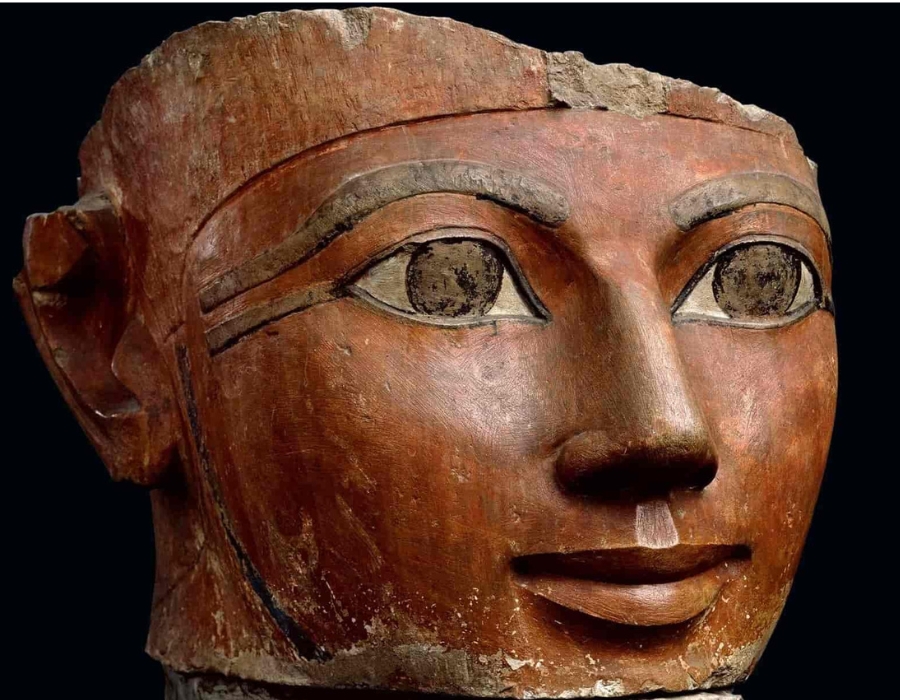
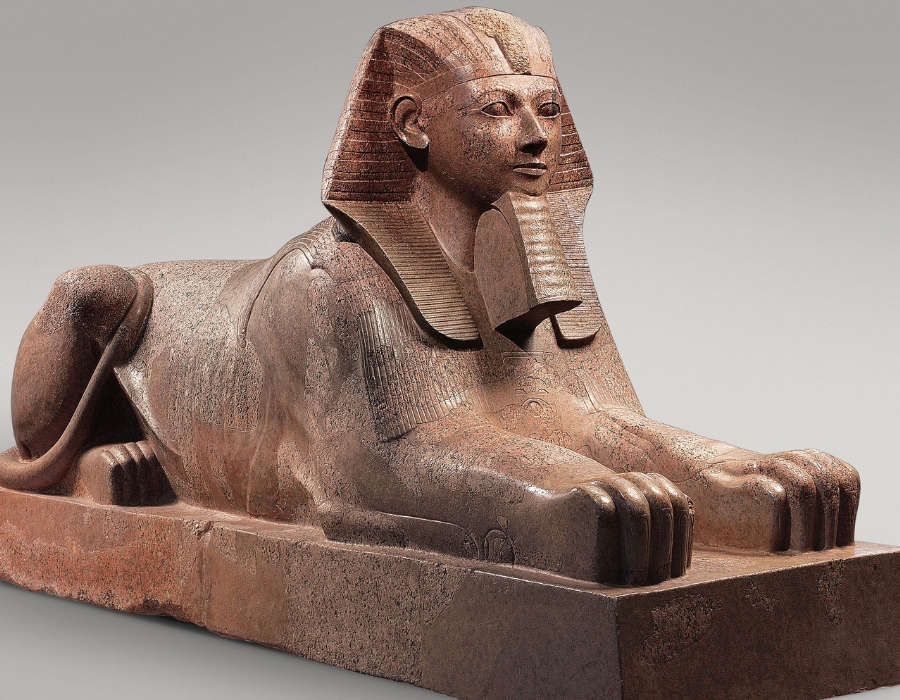
Hatshepsut was often represented with a male body, royal kilt, ceremonial beard, and traditional headdress because these were established visual symbols of Egyptian kingship.
Her representations were political and religious statements, not necessarily portraits of her actual appearance.
Some sculptures clearly present her with feminine features and female clothing, while others follow the masculine ideal of the pharaoh.
The variation is one of the most revealing aspects of her artistic legacy.
The Meaning of the False Beard
The ceremonial false beard was a traditional symbol of royal and divine authority.
It appeared in representations of male pharaohs and gods and was associated with the ritual identity of the ruler.
When Hatshepsut was depicted wearing a false beard, she was adopting the conventional appearance of kingship.
The beard did not mean that the Egyptians believed she was biologically male.
Nor does it demonstrate that she was trying to conceal her sex from the population.
Her personal name and some inscriptions continued to identify her as female.
Why Did Her Statues Look Different?
Hatshepsut’s artists produced several types of royal representation.
Some statues depict her with traditionally feminine features, dresses, and jewelry.
Others portray her as an idealized male king, with a muscular torso, royal kilt, or false beard.
There are also sculptures that combine royal masculine dress with subtler feminine physical characteristics.
The Metropolitan Museum of Art preserves important examples of these different representations.
The variations show that Hatshepsut’s official image developed within the established artistic language of the Egyptian monarchy.
How Can You Recognize a Statue of Hatshepsut?
The most reliable way to identify Hatshepsut is through inscriptions and archaeological context, not facial features alone.
Look for the following:
-
The name Hatshepsut: Her personal name, frequently enclosed in a royal cartouche.
-
The throne name Maatkare: One of the most recognizable names associated with her monuments.
-
The nemes headdress: A striped royal headcloth associated with kingship.
-
The ceremonial false beard: A symbol of royal authority in some statues.
-
Royal crowns: Including forms associated with Upper and Lower Egypt.
-
Offering gestures: Kneeling or standing figures presenting vessels to the gods.
-
Osiride forms: Mummiform royal statues associated with the god Osiris.
Identifying inscriptions is particularly important because different rulers often used similar artistic conventions.
Two royal statues may look almost identical in general style while representing entirely different pharaohs.
What Did Hatshepsut Actually Look Like?
Hatshepsut’s exact appearance cannot be reconstructed with certainty from her surviving statues.
Egyptian royal art was shaped by artistic conventions, religious symbolism, and political requirements.
A sculpture might emphasize youthful beauty, physical strength, royal dignity, or divine identity rather than realistic facial details.
Even portraits depicting Hatshepsut as a woman should not automatically be interpreted as accurate representations of her everyday appearance.
The archaeological record provides physical evidence, including a mummy officially identified as Hatshepsut, but this does not give historians a complete picture of her appearance during life.
The most responsible conclusion is that her monuments show how Hatshepsut wished kingship to be represented, rather than precisely what she looked like.
Hatshepsut and Thutmose III: Allies, Rivals or Co-Rulers?
Hatshepsut and Thutmose III were co-rulers for much of Hatshepsut’s reign.
Thutmose III was both her stepson and nephew. His father, Thutmose II, was Hatshepsut’s half-brother.
Their relationship combined family ties, political succession, and an unusual arrangement of royal authority.
Hatshepsut exercised dominant authority during her kingship, while Thutmose III remained an officially recognized king.
The evidence does not support reducing their entire relationship to a simple personal feud.
Did Hatshepsut Take the Throne From Thutmose III?
Hatshepsut assumed powers and titles normally associated with a reigning king, but Thutmose III was not permanently removed from the royal succession.
He continued to be represented and recognized within the monarchy.
After Hatshepsut died, Thutmose III ruled independently and became one of the most militarily successful pharaohs of the New Kingdom.
Describing Hatshepsut as someone who simply stole the throne overlooks the constitutional and religious complexity of ancient Egyptian royal government.
It also treats political relationships as personal conflicts without sufficient evidence.
What Happened After Hatshepsut Died?
After Hatshepsut’s death, Thutmose III continued his reign as sole king.
He later conducted major military campaigns and expanded Egyptian influence into the Levant.
Egypt’s political position developed considerably under his independent rule.
Hatshepsut’s monumental legacy did not disappear immediately.
However, toward the later part of Thutmose III’s reign, selected images and inscriptions associated with her kingship were deliberately damaged or removed.
This destruction shaped how later generations remembered the Eighteenth Dynasty.
Why Did Thutmose III Try to Erase Hatshepsut From History?
Selected monuments of Hatshepsut were deliberately altered after her death, and many statues representing her as king were destroyed.
The campaign is generally associated with the later reign of Thutmose III, approximately two decades after Hatshepsut’s death.
The exact motivation remains uncertain.
Possible explanations include the desire to reshape dynastic succession, reinforce the legitimacy of the male royal line, or reduce the visibility of Hatshepsut’s exceptional kingship.
What Evidence Shows That Her Memory Was Attacked?
Archaeologists have identified damaged statues, altered inscriptions, erased royal names, and scenes in which Hatshepsut’s images were removed or replaced.
Some of her statues were deliberately broken.
Fragments excavated around Deir el-Bahari were later studied and reconstructed, helping modern scholars understand the original sculptural program.
The fact that these images were attacked does not mean that every trace of Hatshepsut disappeared.
Many inscriptions, monuments, and archaeological objects survived.
Was Thutmose III Motivated by Revenge?
Personal revenge is a popular explanation, but it has not been proven.
The delay between Hatshepsut’s death and the main campaign against her royal imagery complicates the idea of an immediate emotional response.
If Thutmose III’s primary motivation had been personal hatred, the timing and selective nature of the destruction would require further explanation.
Historians have proposed political and dynastic motives, including the desire to present a more conventional sequence of kings.
These remain interpretations rather than established facts.
Why Was Erasing a Pharaoh’s Name So Significant?
In ancient Egyptian religious thought, names and images helped preserve the identity and memory of individuals after death.
Royal inscriptions were also records of political and religious authority.
Removing a pharaoh’s name could therefore affect both the religious presentation of that ruler and the historical narrative communicated by monuments.
The destruction of Hatshepsut’s statues was not merely damage to decorative art.
It altered physical evidence of her kingship.
Did the Attempt to Erase Hatshepsut Succeed?
Not completely.
Although much of Hatshepsut’s royal imagery was damaged, inscriptions and objects survived at Deir el-Bahari, Karnak, and other locations.
Modern excavations recovered broken sculptures and architectural fragments.
Scholars were able to compare inscriptions, reconstruct statues, and establish the sequence of events within her reign.
Ironically, the damaged monuments have become part of the evidence through which historians study ancient Egyptian politics and royal memory.
Hatshepsut’s history can now be reconstructed far more thoroughly than the people responsible for destroying her monuments could have anticipated.
When Did Hatshepsut Die, and What Happened to Her Body?
Hatshepsut died around 1458 BCE, although the exact circumstances of her death are not securely documented.
There is no reliable contemporary account describing her final illness or confirming a specific cause of death.
Modern medical interpretations of a mummy identified as Hatshepsut have suggested possible health problems, but such interpretations depend on accepting the mummy’s identification and cannot establish every detail of her final years.
Claims that she was murdered by Thutmose III are unsupported by convincing archaeological evidence.
Where Was Hatshepsut Buried?
Hatshepsut is closely associated with tomb KV20 in the Valley of the Kings.
KV20 is a complicated royal tomb, associated with Hatshepsut and her father, Thutmose I.
Its layout, burial materials, and inscriptions provide important evidence of royal funerary planning during the early Eighteenth Dynasty.
Hatshepsut’s original burial arrangements are not the same as the later location of the mummy identified as hers.
This distinction is frequently overlooked.
Her monumental mortuary temple at Deir el-Bahari was designed for religious worship and offerings, while her royal tomb was associated with the nearby mountain landscape.
Travelers studying the burial traditions of this period should understand the importance of the Valley of the Kings, where many New Kingdom pharaohs had their rock-cut tombs.
Was Hatshepsut’s Mummy Discovered?
A mummy found in tomb KV60 was publicly identified as Hatshepsut by Egyptian researchers in 2007.
The identification received considerable attention because investigators reported a match between a tooth associated with Hatshepsut and the remains of an unidentified female mummy.
CT scanning and other scientific examinations were also used in the investigation.
However, the identification has been debated, and some researchers have questioned whether the available evidence conclusively establishes the mummy’s identity.
Egyptian museum authorities recognize and display the mummy as Hatshepsut.
For historical accuracy, it is useful to distinguish the official identification from the wider scholarly question of how confidently it can be demonstrated.
Can Visitors See Hatshepsut’s Mummy Today?
The mummy officially identified as Hatshepsut is exhibited in the Royal Mummies Hall at the National Museum of Egyptian Civilization in Cairo.
The museum presents the royal remains in a dedicated exhibition environment emphasizing preservation, historical context, and respectful display.
Hatshepsut is among the important Eighteenth Dynasty figures represented in the collection.
Visitors interested in royal mummies can include the National Museum of Egyptian Civilization in a Cairo itinerary.
Exhibition access and gallery arrangements should be checked shortly before visiting in 2027.
What Is the Mortuary Temple of Hatshepsut?
The Mortuary Temple of Hatshepsut is a monumental royal temple built during her reign at Deir el-Bahari on the west bank of the Nile in Luxor.
Its ancient name, Djeser-Djeseru, is commonly translated as “Holy of Holies.”
The temple was designed for royal religious rituals, offerings, and the continuing funerary cult of Hatshepsut after her death. It also honored Amun and other deities, including Hathor and Anubis.
Its most distinctive architectural features are three terraces, long ramps, colonnaded porticoes, and a dramatic setting against the limestone cliffs of the Theban mountains.
Where Is Deir el-Bahari Located?
Deir el-Bahari is an archaeological area on Luxor’s West Bank.
It lies beneath the imposing cliffs of the Theban mountain range, within the wider ancient Theban necropolis.
The location is part of the UNESCO World Heritage property known as Ancient Thebes with its Necropolis.
Although Hatshepsut’s temple is the best-known structure in this area, Deir el-Bahari contains remains associated with other rulers, including Mentuhotep II and Thutmose III.
The complex is geographically separated from the Valley of the Kings, although the sites belong to the same broader West Bank archaeological landscape.
Why Did Hatshepsut Build Her Temple There?
Hatshepsut’s temple was positioned within a landscape of considerable religious importance.
The west bank of the Nile was traditionally associated with death, burial, and the setting sun.
Royal mortuary temples were commonly constructed in this area to support rituals for deceased kings.
Her temple also stood across the Nile from Karnak, the major sanctuary of Amun.
This relationship connected the temple with important religious processions between the east and west banks.
The nearby mortuary temple of Mentuhotep II provided another architectural and historical connection.
By building at Deir el-Bahari, Hatshepsut linked her reign with earlier Egyptian kingship, established religious traditions, and a visually powerful natural setting.
Was Hatshepsut’s Temple Her Tomb?
No. Hatshepsut’s mortuary temple was not the same as her burial tomb.
A mortuary temple was a place for worship, offerings, royal remembrance, and religious ceremonies.
A tomb was the burial place prepared for the deceased ruler’s body and funerary equipment.
The two structures could be closely related in religious purpose while being physically separate.
|
Feature |
Hatshepsut’s Mortuary Temple |
Hatshepsut’s Royal Tomb |
|---|---|---|
|
Main purpose |
Religious worship and funerary offerings |
Royal burial |
|
Location |
Deir el-Bahari |
Valley of the Kings |
|
Principal architectural form |
Terraces, colonnades, chapels |
Underground rock-cut chambers and corridors |
|
Important evidence |
Reliefs, statues, inscriptions, sanctuaries |
Sarcophagi, burial objects, archaeological deposits |
|
Tourist experience |
Major regularly visited monument |
KV20 is not a standard visitor tomb |
|
Historical significance |
Public presentation of her kingship |
Royal funerary arrangements |
This distinction is useful when exploring different types of ancient Egyptian temples.
What Makes Hatshepsut’s Temple Architecturally Unique?
Hatshepsut’s mortuary temple is especially famous for the way its architecture responds to the surrounding natural landscape.
Rows of columns, horizontal terraces, and central ramps create a carefully organized composition beneath steep limestone cliffs.
The temple appears to emerge from the base of the mountain rather than stand apart from it.
Its architectural form draws on earlier Egyptian traditions while expressing an unusually striking relationship between geometry and landscape.
The Three Terraces
The temple is arranged across three principal levels.
Each terrace has its own architectural and ceremonial role, and the levels are connected by broad ramps.
The horizontal lines of the terraces contrast with the vertical cliff face behind the building.
This relationship creates the familiar silhouette that makes the temple immediately recognizable in photographs.
The terraces originally formed part of a much richer designed environment than visitors see today.
Ancient decorative programs, planted areas, statues, processional spaces, and ceremonial elements contributed to its appearance.
Modern conservation and reconstruction have also influenced the visible condition of the monument.
The Colonnaded Porticoes
The temple contains long rows of columns supporting porticoes.
These covered architectural spaces frame some of the temple’s important relief programs.
Their proportions help organize the visitor’s movement through the complex.
The porticoes also provide a visual rhythm that connects the terraces to the cliffs.
For photographers, the relationship between the column rows, central ramps, and mountain background is one of the site’s most distinctive features.
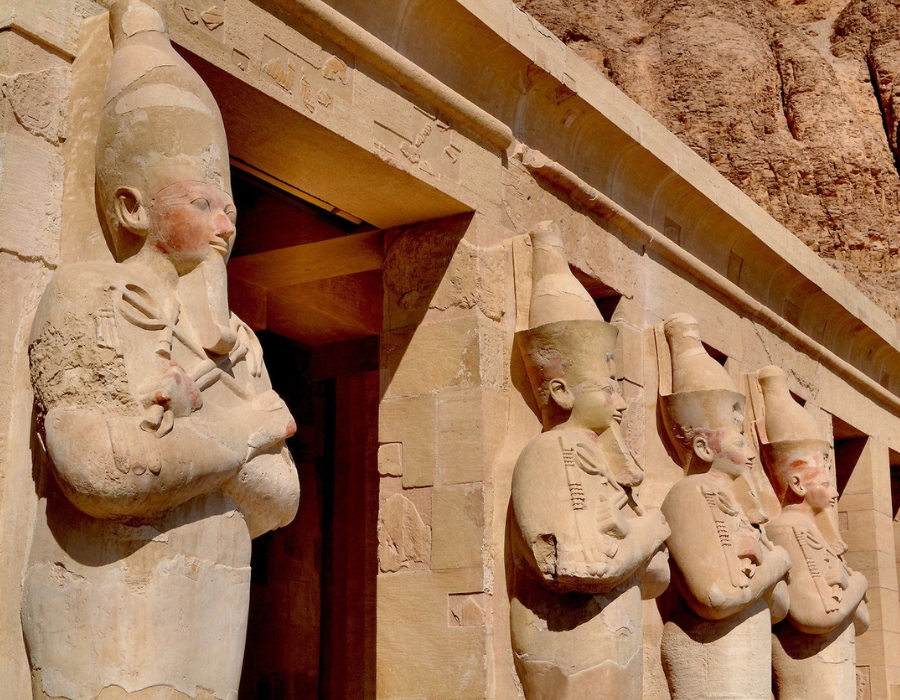
The Osiride Statues
One of the temple’s most recognizable sculptural features is its series of statues representing Hatshepsut in an Osiride form.
These figures associate her with Osiris, the god of the dead and regeneration.
Some statues stand against architectural pillars and present the ruler in a mummiform appearance.
The images reflect the temple’s funerary purpose and Hatshepsut’s expected continuation in the divine world after death.
The surviving statues are especially useful for understanding how the image of the king operated in Egyptian religious architecture.
The Sanctuary of Amun
A sanctuary dedicated to Amun lies along the central axis of the temple.
Its position emphasizes the importance of Amun within the religious program.
The sanctuary was connected with ceremonies involving divine worship and the visiting sacred image of the god.
Not every room or shrine at ancient Egyptian monuments is always accessible to the public.
Travelers should therefore treat entry into specific sanctuaries as dependent on conservation conditions and current site management.
What Should You Look for Inside Hatshepsut’s Temple?
A visit to Hatshepsut’s Temple is more rewarding when you understand what each major section was designed to communicate.
The building is not simply a beautiful architectural monument.
It is also a carefully organized statement about religion, legitimate kingship, international trade, and the ruler’s relationship with the gods.
|
Temple area |
What to look for |
What it explains |
|---|---|---|
|
Lower terrace and approach |
Overall architecture, terraces, ramps |
Monumental planning and royal processional design |
|
Middle terrace |
Reliefs of the Punt expedition |
Trade, foreign relations, and royal achievement |
|
Divine-birth reliefs |
Amun and the royal birth narrative |
Hatshepsut’s religious claim to kingship |
|
Hathor Chapel |
Hathor-related imagery and architectural details |
The role of goddesses in royal religion |
|
Anubis Chapel |
Funerary religious imagery |
Protection and the afterlife |
|
Upper terrace |
Osiride statues and royal court |
The ruler’s funerary identity |
|
Amun sanctuary |
Sacred architectural axis |
Amun’s central role in the temple cult |
1. Start With the Full Temple View
Before approaching the building, look at the relationship between the terraces and the cliffs.
The structure’s symmetry becomes clearer from a distance.
Notice how the central ramps align the successive levels.
This overall perspective helps explain the architectural ambition behind the complex before individual scenes distract from its larger design.
For photography, a reasonably wide composition usually communicates the monument better than a tightly cropped image of its entrance.
2. Study the Punt Expedition Reliefs
The Punt expedition scenes are among the temple’s most historically important decorations.
Look for ships, trade goods, foreign buildings, trees, and the individuals represented in the narrative.
The reliefs combine information about distant lands with the political message of successful royal leadership.
They also provide a rare opportunity to consider what ancient international travel looked like from the perspective of an Egyptian royal court.
A guide or accurate interpretive resource is especially valuable here because many details are difficult to identify without explanation.
3. Find the Divine-Birth Scenes
The divine-birth scenes explain how Hatshepsut publicly connected her kingship with Amun.
Rather than treating them as a straightforward biography, read them as part of a royal religious narrative.
They are designed to communicate legitimacy.
This distinction helps visitors understand why important Egyptian historical events are often described through images of gods, rituals, and symbolic actions.
4. Explore the Hathor Chapel
The Hathor Chapel was associated with a major Egyptian goddess whose roles included music, celebration, motherhood, protection, and divine femininity.
Hathor also possessed important regional and royal associations.
Her presence within Hatshepsut’s mortuary complex demonstrates that the temple honored more than one deity.
Architectural and decorative details associated with Hathor are among the complex’s most interesting features.
Access to individual chapel spaces may vary.
5. Look for the Anubis Chapel
Anubis was a god associated with embalming, burial protection, and the transition into the afterlife.
A sanctuary dedicated to Anubis fits naturally into the religious purpose of a royal mortuary temple.
Its decoration provides context for the beliefs surrounding the preservation and protection of the dead.
The chapel demonstrates that Hatshepsut’s monument functioned within a larger system of Egyptian funerary religion.
6. Examine the Upper Terrace Statues
The upper terrace contains some of the site’s most recognizable royal imagery.
The Osiride figures show Hatshepsut in a sacred form related to death and regeneration.
Look carefully at the crowns, body forms, posture, and relationship between the statues and the architecture.
These details are more informative than trying to judge whether the sculptures resemble a modern idea of a female portrait.
They were designed to communicate kingship and sacred identity.
7. Notice the Restored and Original Elements
Not everything visible at Hatshepsut’s Temple survives in its original condition.
Some statues and architectural features have been reconstructed, conserved, or assembled from excavated fragments.
This work is an important part of the monument’s modern history.
Compare sections with extensive restored surfaces against areas preserving ancient carving or pigment.
The difference helps reveal how archaeologists reconstruct the appearance of damaged monuments without treating all surviving materials as equally complete.
Is Hatshepsut’s Temple Worth Visiting in 2027?
Yes. Hatshepsut’s Temple is one of the most worthwhile historical attractions in Luxor, particularly for visitors interested in ancient Egyptian architecture, royal history, and visually impressive archaeological sites.
The temple offers a different experience from the royal tombs in the Valley of the Kings.
Instead of descending into underground chambers, visitors explore an open-air monumental structure that uses the surrounding mountain landscape as part of its design.
The most important reasons to visit are its distinctive architecture, surviving reliefs, association with a powerful female ruler, and proximity to other major West Bank monuments.
Who Will Enjoy Hatshepsut’s Temple Most?
The temple is especially suitable for visitors who enjoy architecture, photography, archaeology, and ancient political history.
Families with older children may find the story of Hatshepsut’s rise to kingship particularly engaging.
Visitors who prefer open-air monuments to enclosed tombs may also appreciate the experience.
However, the site can be physically demanding because of its exposed location, walking distances, ramps, and limited shade.
Travelers with mobility restrictions should investigate current conditions rather than assume that the existence of ramps means the entire temple is wheelchair accessible.
How Much Time Do You Need at Hatshepsut’s Temple?
Most visitors should allow approximately 60–90 minutes for a satisfying visit.
Travelers with a strong interest in reliefs, architecture, photography, or guided interpretation may prefer 90–120 minutes.
Recommended time on site
45–60 Minutes
Quick visit
60–90 Minutes
Typical visit
90–120 Minutes
Detailed visit
These are recommended planning durations, not fixed tour schedules.
A good visit gives you enough time to study the exterior, explore permitted terraces, examine selected reliefs, and appreciate the views.
If your itinerary is extremely rushed, the architectural setting alone remains impressive. However, visitors who do not examine the decorative program miss much of what makes Hatshepsut’s story distinctive.
Hatshepsut Temple Tickets and Opening Hours for 2027
Hatshepsut’s Temple is a ticketed archaeological attraction, and admission prices are subject to change.
As checked in October 2026, the official Egyptian monument ticketing system published the following entry prices.
|
Visitor category |
Published price, October 2026 |
|---|---|
|
Foreign adult |
EGP 440 |
|
Foreign eligible student |
EGP 220 |
|
Egyptian adult |
EGP 40 |
|
Egyptian student |
EGP 20 |
2027 planning note: These are the official prices visible during the October 2026 research check, not guaranteed prices for 2027. Reconfirm the applicable categories, student eligibility, and admission amount before purchasing.
The official ticketing information also lists free admission for children below six years old, subject to the applicable rules.
Travelers claiming a student concession should carry valid student identification and confirm the stated age restrictions.
What Time Does Hatshepsut’s Temple Open?
The official ticketing portal currently lists a daily opening time of 6:00 AM.
Published last-entry times differ by season:
|
Season |
Published opening |
Published last entry |
|---|---|---|
|
Summer |
6:00 AM |
5:00 PM |
|
Winter |
6:00 AM |
4:00 PM |
|
Ramadan |
6:00 AM |
4:00 PM |
These times reflect information checked in October 2026. They should not be interpreted as a confirmed operating schedule for every date in 2027.
The separately published last-entry time is not necessarily the same as the final closing or visitor-exit time.
Travelers should avoid arriving close to the last-entry cutoff, especially when planning to explore the upper levels.
Can You Buy Hatshepsut Temple Tickets Online?
The Egyptian monument ticketing system provides an online booking option for Hatshepsut’s Temple.
Tickets can be selected for the relevant visitor category and date.
Payment procedures, accepted methods, cancellation conditions, and available admission options may change.
For 2027, check the official government monument booking service shortly before visiting.
Avoid relying on old screenshots or outdated tour blogs for ticket prices.
Is Hatshepsut’s Temple Included in the Valley of the Kings Ticket?
Do not assume so.
Hatshepsut’s Temple and the Valley of the Kings are separately managed ticketed attractions.
A standard ticket to one site should not be assumed to cover the other.
Similarly, special royal tombs and other West Bank attractions may require additional admission.
Visitors booking a guided tour should check whether the advertised price includes entrance tickets or only transportation and guiding services.
How Do You Get to Hatshepsut’s Temple From Luxor?
Hatshepsut’s Temple is located on the west bank of the Nile, while many of Luxor’s hotels, the railway station, and Karnak Temple are on the east bank.
Most travelers reach the temple by private vehicle, taxi, or an organized West Bank tour.
Travel time depends on where you start, the route taken across the Nile, traffic, and the number of stops.
From Luxor’s East Bank
Visitors starting on the east bank generally need to cross the Nile before driving through the West Bank archaeological area.
The road bridge route is commonly used for private vehicles.
A ferry crossing may also be part of a locally arranged transfer, although this requires additional transport on the western side.
A private driver is often the most convenient choice if the same day includes the Valley of the Kings and several mortuary temples.
From Hotels on Luxor’s West Bank
Travelers staying on the West Bank are already on the same side of the Nile as Hatshepsut’s Temple.
This can reduce time spent crossing the river.
However, hotels and guesthouses are distributed across different villages and roads.
The actual travel time depends on the property’s location.
A West Bank stay can be particularly convenient for visitors planning several mornings at archaeological sites.
Can You Walk to Hatshepsut’s Temple?
Walking from central Luxor is not practical because the temple lies well beyond the main urban sightseeing area.
Walking between some West Bank sites may also involve exposed desert roads, limited shade, traffic, and substantial distances.
For most visitors, vehicle transport is more comfortable and efficient.
A guide and driver become particularly useful when combining several sites, because they reduce the time spent arranging transport between individual monuments.
For destination planning, see the main guide to Luxor, Egypt.
What Is the Best Time to Visit Hatshepsut’s Temple?
The best time of day to visit Hatshepsut’s Temple is usually early morning, particularly during warmer months.
The archaeological area is exposed, and much of the visitor route receives direct sunlight.
Early arrival can provide more comfortable temperatures and more flexibility to explore the terraces before the strongest daytime heat.
Best Time of Day
Early morning is generally recommended for comfort.
For photography, consider how the sun illuminates the façade and surrounding cliffs. The direction and strength of the light change during the morning, so the earliest possible arrival does not always produce the same image as a slightly later visit.
A useful compromise is to arrive during the early part of the day and allow enough time to photograph the full structure before moving closer.
Best Months to Visit
Luxor is generally more comfortable for extensive outdoor sightseeing between approximately October and April.
Summer temperatures can be extremely high.
|
Travel period |
Typical visitor experience |
Practical advice |
|---|---|---|
|
December–February |
Cooler days and pleasant sightseeing conditions, with potentially cool mornings |
Bring a light layer and allow time for popular attractions |
|
March–April |
Warming temperatures and good outdoor touring opportunities |
Start earlier as daytime temperatures increase |
|
May–September |
Very hot conditions, especially in exposed archaeological areas |
Prioritize early morning visits and limit midday outdoor activity |
|
October–November |
Autumn conditions becoming more comfortable for sightseeing |
Good period for longer West Bank excursions |
Weather varies by day, so use a current forecast rather than assuming an entire month will behave identically.
Visitors considering autumn can compare the practical conditions described in Egypt in November.
For wider itinerary planning, the Egypt weather by month guide can help compare conditions across destinations.
Is Hatshepsut’s Temple Accessible for Visitors With Limited Mobility?
Hatshepsut’s Temple presents significant accessibility challenges despite the presence of broad architectural ramps.
The site includes exposed outdoor surfaces, changes in level, considerable walking distances, and areas where modern accessibility may be limited by the historic structure.
The availability of a visitor transport service near the entrance, if operating, should not be confused with step-free access throughout the entire monument.
What Mobility Challenges Should Visitors Expect?
The main difficulties may include:
-
Long distances across open archaeological areas.
-
Sloping ramps and uneven surfaces.
-
Limited shaded resting areas.
-
Steps or thresholds at individual chapels.
-
Restrictions on access to certain historic spaces.
-
High temperatures that increase physical strain.
Visitors using wheelchairs should confirm the condition of the specific route they intend to follow and identify which areas are currently accessible.
A ground-level exterior visit may still be worthwhile for someone who cannot reach the upper terraces, but it should be planned around realistic access requirements.
For travelers requiring dedicated transport and site-by-site assistance, Egypt Time Travel also provides information about wheelchair-accessible Egypt tours.
Is the Temple Suitable for Seniors?
Many older travelers can comfortably visit Hatshepsut’s Temple, but suitability depends on individual mobility, heat tolerance, and walking endurance rather than age alone.
A slower visit with frequent breaks is usually preferable to a rushed excursion.
Arrange transport that minimizes unnecessary walking and avoid scheduling several demanding sites during the hottest hours.
Anyone with significant mobility concerns should discuss access limitations with their guide before the visit.
What Should You Wear and Bring to Hatshepsut’s Temple?
Hatshepsut’s Temple is an outdoor archaeological site in a dry desert environment.
Comfort, sun protection, and suitable footwear are more important than formal clothing.
A practical packing checklist includes:
-
Comfortable walking shoes with reliable grip.
-
Light, breathable clothing.
-
A sun hat and sunglasses.
-
Drinking water.
-
Sunscreen.
-
A fully charged phone or camera.
-
A small bag for essential items.
-
A light jacket during cooler winter mornings.
-
Valid identification if using a concession ticket.
There is no need to dress in ceremonial or formal clothing for an ordinary archaeological visit.
However, comfortable and respectful clothing is sensible for a full day of visiting historical and religious sites.
For a broader checklist, use the Egypt packing guide.
Hatshepsut Temple vs the Valley of the Kings: Which Should You Visit?
Hatshepsut’s Temple and the Valley of the Kings offer very different experiences.
Hatshepsut’s Temple emphasizes monumental architecture, royal ideology, religious rituals, and decorative reliefs.
The Valley of the Kings emphasizes underground royal tombs, burial practices, decorated chambers, and the ancient Egyptian afterlife.
|
Comparison |
Hatshepsut’s Temple |
Valley of the Kings |
|---|---|---|
|
Main historical theme |
Hatshepsut’s reign and royal religious architecture |
New Kingdom royal burial practices |
|
Main experience |
Open-air temple terraces and reliefs |
Underground rock-cut tombs |
|
Landscape |
Temple beneath dramatic cliffs |
Desert valley with tomb entrances |
|
Typical recommended time |
60–90 minutes |
Around 90–150 minutes, depending on tomb selection |
|
Physical considerations |
Walking, sun exposure, ramps |
Walking, stairs, inclines, enclosed passages |
|
Best for photography |
Monumental architecture and landscape |
Selected permitted tomb interiors and exterior views |
|
Main limitation |
Exposed heat and variable chapel access |
Separate tomb rules, restricted areas, and ticket variations |
Which is better for first-time visitors? Ideally, visit both.
If you have time for only one, choose the Valley of the Kings if decorated royal tomb interiors are your priority. Choose Hatshepsut’s Temple if you prefer monumental architecture, open-air sightseeing, and the story of a specific ruler.
What Other Attractions Should You Combine With Hatshepsut’s Temple?
Hatshepsut’s Temple fits naturally into a Luxor West Bank sightseeing day because several major archaeological sites are located within the same general area.
The most useful combinations depend on your available time, interests, and tolerance for outdoor sightseeing.
Valley of the Kings
The Valley of the Kings is the strongest complementary attraction.
It explains the royal burial system while Hatshepsut’s Temple illustrates the separate function of mortuary worship.
Visiting both helps connect Egyptian ideas of kingship, death, and the afterlife.
Colossi of Memnon
The Colossi of Memnon are two monumental seated statues associated with Amenhotep III’s mortuary temple.
They provide a useful introduction to the wider West Bank religious landscape and are often encountered along sightseeing routes.
Their scale also offers an interesting comparison with the sculptural program of Hatshepsut’s temple.
The monuments are described in the guide to the Colossi of Memnon.
Medinet Habu
Medinet Habu is famous for the mortuary temple of Ramesses III.
Its large temple structures and detailed military reliefs provide a different perspective on royal architecture during the New Kingdom.
For travelers who especially enjoy carved walls and temple history, Medinet Habu is an excellent additional stop.
The Ramesseum
The Ramesseum is the mortuary temple of Ramesses II.
It offers another opportunity to compare Egyptian royal monuments and understand how mortuary temple architecture developed across different reigns.
Readers interested in the construction projects of later kings can explore the Ramesseum.
A Practical Half-Day and Full-Day Luxor West Bank Itinerary
The best itinerary is one that allows enough time to appreciate the sites rather than simply collecting photographs at each entrance.
Half-Day Plan: Hatshepsut and the Valley of the Kings
Suggested duration: approximately 4–5 hours including local transfers, depending on your starting point
|
Order |
Activity |
Suggested time |
|---|---|---|
|
1 |
Valley of the Kings and selected tombs |
90–120 minutes |
|
2 |
Hatshepsut’s Temple |
60–90 minutes |
|
3 |
Colossi of Memnon, if convenient on your route |
15–25 minutes |
|
4 |
Return transfer |
Depends on hotel location |
This is a practical choice for travelers with limited time who want to understand both royal burial and mortuary worship.
If the day is particularly hot, prioritize the more demanding portions of the route early.
Full-Day Plan: West Bank Temples and Tombs
Suggested duration: approximately 6–8 hours including breaks and local transfers
|
Order |
Site |
Suggested duration |
|---|---|---|
|
1 |
Valley of the Kings |
90–150 minutes |
|
2 |
Hatshepsut’s Temple |
60–90 minutes |
|
3 |
Medinet Habu |
45–75 minutes |
|
4 |
Lunch or rest break |
45–60 minutes |
|
5 |
Colossi of Memnon |
15–25 minutes |
The order can be adjusted to account for weather, ticket arrangements, and the location of your accommodation.
Travelers who prefer a slower archaeological day can replace one of the major stops with a longer visit at Hatshepsut’s Temple.
A guide familiar with the West Bank is particularly useful for explaining the differences between the temples and the royal tombs.
Should You Combine Hatshepsut’s Temple With Karnak on the Same Day?
Yes, it is possible, but the itinerary becomes more demanding.
Karnak is on the opposite bank of the Nile and deserves substantial time of its own.
For visitors staying at least two days in Luxor, a better arrangement is often to devote one day to the West Bank and another to the East Bank.
This reduces unnecessary transfers and allows more time for the historical details at each site.
Travelers wanting an organized visit can compare Luxor day tours that include the temples and royal tombs relevant to their interests.
Where Else Can You See Hatshepsut’s Monuments and Artifacts?
Hatshepsut’s legacy extends far beyond her mortuary temple.
Important evidence survives in other Egyptian temples, royal tomb material, museum displays, inscriptions, and sculptures recovered during archaeological excavations.
Some objects remain in Egypt, while others are held by international museum collections.
Karnak Temple in Luxor
Karnak preserves monumental evidence of Hatshepsut’s religious building program.
The surviving obelisk and reconstructed Red Chapel are especially significant.
Visiting Karnak after Deir el-Bahari helps connect her political identity with the religious power of Amun.
National Museum of Egyptian Civilization in Cairo
The National Museum of Egyptian Civilization exhibits the mummy officially identified as Hatshepsut in its Royal Mummies Hall.
It offers a different kind of encounter with the ruler: one focused on burial, identification, and the preservation of ancient human remains.
The Egyptian Museum in Cairo
The Egyptian Museum’s published collection includes fragments of reliefs associated with Hatshepsut’s expedition to Punt.
Such objects are valuable because they preserve details of temple decoration that may no longer be visible in their original architectural context.
Check current exhibition information before visiting because individual objects may be relocated, studied, or temporarily unavailable.
The Egyptian Museum in Cairo is worth considering alongside other archaeological collections in the capital.
The Metropolitan Museum of Art in New York
The Metropolitan Museum of Art holds a particularly important group of statues and objects associated with Hatshepsut.
Its Egyptian Expedition excavated at Deir el-Bahari during the early twentieth century.
Among its best-known Hatshepsut objects are seated sculptures, royal sphinxes, standing figures, and statues depicting her in the conventional appearance of a male king.
Some sculptures were reconstructed from numerous excavated fragments.
These works are valuable because they show different approaches to representing Hatshepsut’s gender and royal identity.
Exhibition displays can change, so travelers should verify the location of individual objects before planning a museum visit around them.
How Did Archaeologists Rediscover Hatshepsut’s History?
Hatshepsut’s modern historical reconstruction depended on combining inscriptions, royal names, archaeological excavations, temple conservation, and the study of damaged sculptures.
Her monuments were not completely unknown before modern archaeology.
However, the surviving evidence was fragmented, and later modifications had complicated the historical record.
Early Archaeological Investigation
During the nineteenth and early twentieth centuries, scholars increasingly investigated the monuments and tombs of the Theban necropolis.
The inscriptions at Deir el-Bahari became important sources for reconstructing Hatshepsut’s reign.
Howard Carter examined tomb KV20 in the early twentieth century, contributing to the study of royal burial arrangements.
Archaeological discoveries established connections between the mortuary temple, Hatshepsut’s royal names, and the broader political history of the Eighteenth Dynasty.
Herbert Winlock and the Metropolitan Museum Excavations
Herbert E. Winlock was an important Egyptologist associated with the Metropolitan Museum of Art.
Excavations conducted by the museum’s Egyptian Expedition recovered numerous fragments of Hatshepsut’s monumental sculpture.
These discoveries helped reveal the original artistic program of her temple.
Researchers were able to identify broken representations of Hatshepsut and reconstruct many sculptures.
The work also provided evidence for the deliberate destruction of her statues.
This changed Hatshepsut’s modern historical image from that of a relatively obscure female ruler to one of the best-documented examples of unusual kingship in ancient Egypt.
The Polish-Egyptian Conservation Mission
A Polish-Egyptian archaeological and conservation mission began work at Hatshepsut’s Temple in 1961.
The project has made important contributions to studying, conserving, and presenting the monument.
Its work involves architectural research, decorated surfaces, reconstruction, and the preservation of original materials.
Long-term conservation is one reason the temple’s appearance should not be interpreted as an untouched survival from ancient times.
For travelers, understanding restoration adds a further dimension to the visit.
It shows how modern archaeological work protects the ancient structures while making them understandable to the public.
What Was Hatshepsut’s Greatest Legacy?
Hatshepsut’s greatest legacy was demonstrating that a woman could exercise the complete political and religious role of an Egyptian king within a monarchy whose visual traditions were overwhelmingly male.
Her reign also produced monuments that are among the most recognizable achievements of the New Kingdom.
The importance of her story extends beyond the fact that she was a female ruler.
It concerns the ways political legitimacy was established, how the monarchy communicated power through art, and how later kings could reshape official memory.
Political Legacy
Hatshepsut governed within an established dynastic system while adapting its rules to an unusual situation.
Her kingship demonstrates the flexibility and limitations of ancient Egyptian political traditions.
She did not abolish existing institutions.
Instead, she used them to establish her authority.
Architectural Legacy
The temple at Deir el-Bahari remains a major achievement in Egyptian architecture.
Its relationship with the surrounding cliffs, ceremonial terraces, and decorative program gives it a distinctive identity.
The obelisks and chapel at Karnak provide additional evidence of her government’s capacity to organize ambitious projects.
Artistic Legacy
Hatshepsut’s sculpture offers an unusually revealing record of royal representation.
Some statues emphasize the conventional male form of kingship.
Others preserve feminine titles and characteristics.
Together, they demonstrate that Egyptian royal art communicated an idealized political and religious role rather than functioning only as realistic portraiture.
Historical Legacy
The later attempt to remove Hatshepsut’s royal imagery shows the political importance of controlling public monuments and dynastic records.
Her eventual recovery by modern scholars also demonstrates the value of archaeology in testing historical narratives.
Even severely damaged or incomplete monuments can preserve evidence that written royal histories omit.
Hatshepsut vs Cleopatra, Nefertiti and Other Famous Egyptian Rulers
Hatshepsut is frequently compared with Cleopatra VII and Nefertiti because all three are internationally recognized women of ancient Egyptian history.
However, they lived during different periods and occupied different political positions.
|
Historical figure |
Approximate period |
Political role |
Best-known association |
|---|---|---|---|
|
Hatshepsut |
15th century BCE |
Reigning pharaoh |
Deir el-Bahari and Karnak |
|
Nefertiti |
14th century BCE |
Great Royal Wife of Akhenaten; possible later royal role remains debated |
Amarna Period and royal portraiture |
|
Cleopatra VII |
1st century BCE |
Reigning Ptolemaic queen |
Late Ptolemaic Egypt and Roman diplomacy |
|
Ramesses II |
13th century BCE |
Reigning pharaoh |
Monumental temples, military history, and Abu Simbel |
Hatshepsut vs Cleopatra: Who Ruled First?
Hatshepsut ruled more than 1,400 years before Cleopatra VII.
She belonged to Egypt’s native Eighteenth Dynasty during the New Kingdom.
Cleopatra VII belonged to the Greek-speaking Ptolemaic dynasty and ruled near the end of ancient Egypt’s period as an independent kingdom.
Both were politically important women, but their governments operated in very different historical environments.
Hatshepsut is best understood through royal temple religion and dynastic kingship.
Cleopatra’s reign is inseparable from the Mediterranean political struggles involving Rome.
Were Hatshepsut and Nefertiti Related?
Hatshepsut and Nefertiti did not live at the same time.
Nefertiti lived approximately a century after Hatshepsut, during the reign of Akhenaten.
Both belonged to the broader Eighteenth Dynasty, but there is no securely established direct relationship that would justify describing Nefertiti as Hatshepsut’s daughter or close relative.
Nefertiti is principally documented as Akhenaten’s Great Royal Wife.
Whether she later exercised kingship under another royal identity remains a subject of scholarly debate.
Was Hatshepsut the Queen of Sheba?
No historical evidence identifies Hatshepsut as the Queen of Sheba.
The Queen of Sheba belongs to a different literary and historical tradition associated with accounts of King Solomon.
Some speculative interpretations have attempted to connect the two figures, but these theories lack convincing chronological and archaeological support.
Hatshepsut should be studied through her own inscriptions, monuments, and the history of Egypt’s Eighteenth Dynasty.
Did Hatshepsut Live at the Same Time as Ramesses the Great?
No.
Ramesses II ruled in the Nineteenth Dynasty, roughly two centuries after Hatshepsut’s reign.
Both commissioned important monumental architecture, but they belonged to different stages of Egypt’s New Kingdom.
Their surviving monuments provide useful examples of how royal building programs developed over time.
Common Misconceptions About Hatshepsut
Several popular stories about Hatshepsut simplify or exaggerate the historical evidence.
Understanding these misconceptions makes the surviving archaeology easier to interpret.
|
Common claim |
More accurate explanation |
|---|---|
|
Hatshepsut was Egypt’s first female pharaoh |
Earlier female rulers, including Sobekneferu, are known |
|
She pretended to be a man |
She adopted traditional masculine royal imagery while remaining identifiable as female in inscriptions |
|
She stole the throne from Thutmose III |
She became the dominant co-ruler, while Thutmose III retained royal status |
|
Her reign had no military activity |
Her reign emphasized trade and construction, but military operations also occurred |
|
Senenmut was certainly her lover |
A romantic relationship has not been proven |
|
Thutmose III immediately destroyed her monuments |
Much of the major attack on her imagery occurred later in his reign |
|
Her temple was her burial tomb |
Deir el-Bahari was her mortuary temple; KV20 is the royal tomb associated with her |
|
Her mummy has been identified beyond all possible doubt |
Egyptian authorities recognize the identification, but scholarly questions remain |
|
Hatshepsut and Cleopatra were contemporaries |
They lived more than 1,400 years apart |
|
Her temple is inside the Valley of the Kings |
The temple is at Deir el-Bahari, a separate West Bank archaeological location |
These distinctions are useful because Hatshepsut’s real history is compelling without relying on exaggerated claims.
10 Fascinating Facts About Hatshepsut
1. Hatshepsut’s name retained a female meaning. Even after she adopted kingship, her personal name still meant “Foremost of Noble Ladies.”
2. She ruled alongside another king. Thutmose III remained a recognized monarch while Hatshepsut exercised the dominant political role.
3. Her mortuary temple stands across the Nile from Karnak. This geographical relationship reflected the importance of Amun’s religious processions.
4. Her temple recorded a major trading expedition. The Punt scenes include ships, goods, people, and living trees.
5. She commissioned enormous granite obelisks. One standing obelisk at Karnak reaches approximately 30 meters.
6. Her statues could portray both feminine and masculine characteristics. Egyptian artists used established royal symbols to express the office of kingship.
7. Her temple honored multiple deities. Amun, Hathor, Anubis, and Osiris were important within its religious program.
8. A major official helped manage her building projects. Senenmut held influential titles and was closely associated with her daughter’s upbringing.
9. Some of her statues were deliberately shattered. Archaeologists later recovered fragments and reconstructed significant examples.
10. Her legacy survives on two continents through major collections. Visitors can encounter monuments in Egypt and important sculptures in international museums, including New York’s Metropolitan Museum of Art.
Frequently Asked Questions About Hatshepsut
1. How do you pronounce Hatshepsut?
Hatshepsut is commonly pronounced Hat-shep-soot in English. Alternative spellings include Hatschepsut, Hat Shep Sut, and Hatšepsut because ancient Egyptian names are represented through modern transliteration systems. The standard English form is Hatshepsut, while her royal throne name was Maatkare.
2. How long did Hatshepsut rule Egypt?
Hatshepsut held authority for approximately two decades during the 15th century BCE, first as regent and then as pharaoh alongside Thutmose III. The period of full kingship was shorter than the entire regency and co-rule. Historians use slightly different chronological dates, so individual timelines may vary.
3. Was Hatshepsut a successful pharaoh?
Hatshepsut is generally considered a successful pharaoh because her reign produced extensive religious monuments, major architectural projects, significant artistic achievements, and documented foreign trade activity. Her government maintained political authority during an important period of Egypt’s New Kingdom. Evaluating ancient rulers requires considering the archaeological evidence rather than applying only modern standards of leadership.
4. Why is Hatshepsut called the woman who would be king?
The phrase describes Hatshepsut’s transition from royal wife and regent to a ruler who adopted the full titles and religious identity of an Egyptian king. It is also associated with Kara Cooney’s book The Woman Who Would Be King. Hatshepsut’s story is unusual because she exercised kingship within a political system whose public imagery was traditionally masculine.
5. Was Hatshepsut related to Tutankhamun?
Hatshepsut and Tutankhamun belonged to the Eighteenth Dynasty, but they lived during different generations. Tutankhamun ruled later in the dynasty, after the reigns of several intervening pharaohs. Their relationship should be understood through the broader royal family history rather than described as an immediate parent-child relationship.
6. Did Hatshepsut have children?
Hatshepsut had a daughter named Neferure with Thutmose II. Neferure held an important royal position and was associated with the official Senenmut, who acted as her tutor. Thutmose III was Hatshepsut’s stepson and nephew, not her biological son. There is no equally secure evidence identifying an additional biological son of Hatshepsut.
7. Can tourists enter Hatshepsut’s tomb?
KV20, the royal tomb associated with Hatshepsut in the Valley of the Kings, is not normally included among the standard tourist tombs. Visitors should not confuse access to the Valley of the Kings with permission to enter KV20. Her mortuary temple at Deir el-Bahari is the principal publicly visited monument associated with her.
8. Is Hatshepsut’s Temple the same as Deir el-Bahari?
Hatshepsut’s Temple is located at Deir el-Bahari, but the names do not describe exactly the same thing. Deir el-Bahari is the broader archaeological area containing multiple ancient monuments. The Mortuary Temple of Hatshepsut, called Djeser-Djeseru, is its best-known structure.
9. Can you visit Hatshepsut’s Temple from a Nile cruise?
Yes. Many Nile cruise itineraries that include Luxor allow time for West Bank sightseeing, which may include Hatshepsut’s Temple. However, individual cruise programs differ, and some prioritize the Valley of the Kings or other monuments. Confirm the exact excursions included, their duration, and whether admission is covered before booking.
10. What is the best way to visit Hatshepsut’s Temple?
For most first-time visitors, a morning visit with private or organized transportation is convenient. Allow around 60–90 minutes for the temple and consider pairing it with the Valley of the Kings. A qualified Egyptologist guide can help explain the Punt expedition, divine-birth scenes, royal sculpture, and architectural details that are difficult to interpret without context.
11. Is Hatshepsut’s Temple older than the Pyramids of Giza?
No. The major pyramids at Giza were constructed during the Old Kingdom, roughly a thousand years before Hatshepsut’s reign. Her mortuary temple belongs to the New Kingdom in the 15th century BCE. The two sites therefore represent different periods of ancient Egyptian architectural and religious development.
12. Where can you learn more about Hatshepsut before visiting Egypt?
Useful historical works include Joyce Tyldesley’s Hatchepsut: The Female Pharaoh, Kara Cooney’s The Woman Who Would Be King, and the Metropolitan Museum’s exhibition scholarship on Hatshepsut. Museum collections and archaeological publications provide valuable evidence for interpreting the ruler’s statues, inscriptions, family relationships, and monuments.
Conclusion: Why Hatshepsut Still Matters
Hatshepsut’s importance comes from far more than being a woman who became pharaoh.
Her reign illustrates how ancient Egyptian monarchy operated through religion, political authority, royal imagery, construction, and the management of historical memory.
She used established traditions of kingship to legitimize an exceptional position. Her government commissioned extraordinary monuments, maintained international connections, and left a substantial archaeological legacy.
The later destruction of her royal imagery adds another dimension to her history, demonstrating the political power of monuments and inscriptions long after a ruler’s death.
For travelers, Hatshepsut’s story is best understood by visiting the monuments connected with her life: the temple at Deir el-Bahari, her obelisks and chapel at Karnak, and the wider royal landscape of Luxor.
Planning an Egypt trip in 2027? Egypt Time Travel can help arrange tailor-made Egypt holidays that combine Hatshepsut’s monuments with the Valley of the Kings, Karnak Temple, and other historically significant sites at a pace that suits your interests.
For additional planning focused specifically on the monument, the Hatshepsut Temple visitor guide complements this biography with information about the site’s architecture, location, and sightseeing experience.
