
Quick Answer: Who was Queen Nefertiti in ancient Egypt?
Queen Nefertiti was one of ancient Egypt’s most influential royal women, serving as the Great Royal Wife of Pharaoh Akhenaten during the Eighteenth Dynasty, around the 14th century BCE. She played a prominent role in the worship of the sun god Aten and became famous for her beautifully preserved limestone bust. Although her historical importance is well established, her origins, final years, and burial place remain uncertain.
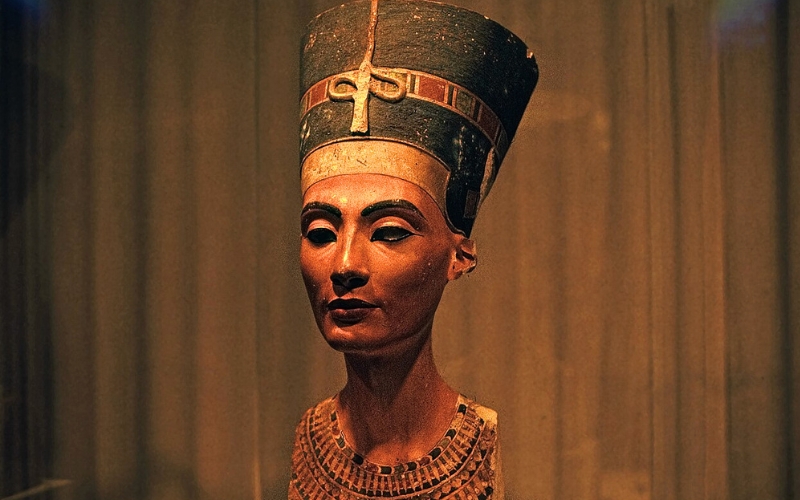
Few ancient Egyptian figures are as recognizable as Nefertiti. Her tall blue crown, elegantly modeled face, and striking painted bust have become symbols of ancient Egyptian art. Yet the real queen was much more than a celebrated portrait.
Nefertiti stood beside Akhenaten during one of Egypt’s most dramatic religious transformations. She appeared in temple scenes, participated in royal ceremonies, raised six daughters, and may have exercised authority beyond the traditional responsibilities of a queen.
Her story is also an archaeological puzzle. The bust discovered at Amarna in 1912 now stands in Berlin, while her tomb has never been securely identified. New research reported in September 2026 has renewed interest in possible hidden chambers near Tutankhamun’s burial, although the evidence remains disputed.
For travelers planning to explore Egypt in 2027, understanding Nefertiti adds another layer to the temples of Luxor, the ruins of Amarna, and the royal tombs of the New Kingdom.
Who Was Queen Nefertiti, and Why Was She Important?
Queen Nefertiti was the principal wife of Pharaoh Amenhotep IV, who later changed his name to Akhenaten. The couple ruled during the Eighteenth Dynasty of Egypt’s New Kingdom, when Egypt possessed considerable wealth, political influence, and artistic resources.
She is remembered for three major reasons: her exceptional prominence in royal imagery, her involvement in Akhenaten’s religious reforms, and the famous sculpted bust that preserved her image for more than three millennia.
Unlike many Egyptian queens who appeared mainly beside their husbands in ceremonial art, Nefertiti was repeatedly depicted performing important religious actions. Some representations even show her exercising royal power in ways normally associated with a pharaoh.
Her public image was therefore political as well as artistic.
Queen Nefertiti at a glance
|
Historical detail |
What we know |
|---|---|
|
Full name |
Neferneferuaten Nefertiti |
|
Name meaning |
Commonly translated as “The Beautiful One Has Come” |
|
Period |
New Kingdom |
|
Dynasty |
Eighteenth Dynasty |
|
Historical era |
14th century BCE |
|
Husband |
Pharaoh Akhenaten |
|
Known children |
Six daughters |
|
Royal title |
Great Royal Wife |
|
Main royal residence |
Akhetaten, modern Amarna |
|
Religious association |
Worship of the Aten |
|
Famous artwork |
Painted limestone bust |
|
Bust location |
Neues Museum, Berlin |
|
Tomb |
Not securely identified |
|
Possible later role |
Pharaoh Neferneferuaten, disputed |
Nefertiti lived within a royal world shaped by family relationships, religious institutions, diplomacy, palace administration, and the Egyptian concept of divine kingship.
Her husband’s decisions changed these institutions profoundly. His new religious policies centered on Aten, represented by the sun disk, and his foundation of a new capital reshaped royal life.
Nefertiti was not merely present while these changes happened. She was repeatedly represented as an essential participant.
To understand her place in Egyptian history, it helps to explore the wider New Kingdom of ancient Egypt, when major temples, royal tombs, and powerful dynasties transformed the Nile Valley.

What Does the Name Nefertiti Mean?
Nefertiti is commonly translated as “The Beautiful One Has Come” or “The Beautiful One Has Arrived.”
The name comes from ancient Egyptian language elements associated with beauty and arrival. Its meaning is often interpreted poetically today, but there is no reliable evidence that the name itself reveals where the queen was born.
Ancient Egyptian royal names could express religious ideas, aspirations, political messages, or desirable qualities.
Nefertiti’s name emphasized beauty and presence, while her later expanded name reflected the religious transformation associated with Akhenaten.
Why was she called Neferneferuaten Nefertiti?
The queen adopted the additional name Neferneferuaten, generally understood as “Beautiful Are the Beauties of Aten.”
This connected her royal identity directly to Aten, the solar deity promoted by Akhenaten.
The full name Neferneferuaten Nefertiti therefore expressed both her individual identity and her association with the new royal religion.
It also matters to the debate about her final years.
A later ruler used the name Neferneferuaten, leading some Egyptologists to propose that Nefertiti eventually became a pharaoh. However, sharing part of a royal name does not independently establish that the queen and the later ruler were the same person.
How do you pronounce Nefertiti?
In modern English, Nefertiti is commonly pronounced:
nef-er-TEE-tee
The modern pronunciation is conventional. The exact ancient Egyptian pronunciation cannot be fully reconstructed because the writing system generally omitted vowels.
German sources often refer to the queen as Nofretete. This is a different modern rendering of the same historical name, not another person.
Where Was Nefertiti Born, and Who Were Her Parents?
Nefertiti’s birthplace and parentage remain uncertain.
She probably came from a prominent family with access to the Egyptian royal court, but no surviving evidence conclusively identifies both of her biological parents.
One influential theory connects her to Ay, a senior court official who later became pharaoh after Tutankhamun. Ay’s wife, Tey, held a title associated with nursing or raising Nefertiti.
That connection suggests close relationships between the queen and Ay’s household, but it does not prove that Ay was her father.
Was Nefertiti Egyptian or a foreign princess?
Most reconstructions treat Nefertiti as a woman closely connected with Egypt’s royal elite.
Older theories proposed that she might have been a foreign princess, sometimes identifying her with a princess from Mitanni. These suggestions have not been convincingly established.
The Egyptian court maintained diplomatic marriages and international relationships, but Nefertiti’s personal origins cannot be determined simply from the appearance of her famous portrait or from later stories.
Her known titles and public career place her securely within Egyptian royal society.
Was Nefertiti born into royalty?
Possibly, but it is not certain.
Her later position as Great Royal Wife confirms that she achieved the highest-ranking marital status at Akhenaten’s court. It does not establish whether she was born a princess.
This is one of the basic limitations of writing a biography of Nefertiti: historians know much more about her public role after marriage than about her early life.
What was Nefertiti’s childhood like?
No reliable account describes Nefertiti’s childhood, education, or life before her marriage.
She may have received an elite upbringing appropriate to her future position, but details about her teachers, palace training, and early personal experiences are speculative.
Modern films and novels sometimes portray her childhood with great confidence. Those scenes should be understood as historical fiction unless supported by specific ancient evidence.
When Did Queen Nefertiti Live? A Historical Timeline
Nefertiti lived during the 14th century BCE, approximately 3,300 years ago.
Her husband Akhenaten is commonly dated to around 1353–1336 BCE, although chronological systems differ slightly between scholars.
Nefertiti’s exact birth and death dates are unknown. Consequently, dates attached to individual events in her life should often be treated as approximate.
|
Period or date |
Event |
Historical importance |
|---|---|---|
|
Before Akhenaten’s reign |
Nefertiti’s early life |
Her background is largely undocumented |
|
Around 1353 BCE |
Amenhotep IV becomes pharaoh |
Beginning of the royal period associated with Nefertiti |
|
Early regnal years |
Nefertiti appears prominently in royal imagery |
Evidence of her public religious role |
|
Around Year 5 |
Akhenaten establishes Akhetaten |
The court begins developing a new capital |
|
Middle of the reign |
Royal family becomes central to Amarna art |
Nefertiti and her daughters appear in important scenes |
|
Year 12 |
Royal family documented in ceremonial imagery |
Important evidence for the family and court |
|
Year 16 |
Nefertiti named as Great Royal Wife in a quarry inscription |
Establishes her presence late in Akhenaten’s reign |
|
Around 1336 BCE |
Akhenaten’s reign ends |
The succession becomes difficult to reconstruct |
|
Following years |
Possible rule of Neferneferuaten and Smenkhkare |
Identity and chronology remain debated |
|
Tutankhamun’s reign |
Restoration of traditional religious institutions |
Akhenaten’s reforms are gradually abandoned |
|
1912 CE |
Famous bust discovered at Amarna |
Renewed modern interest in Nefertiti |
|
1924 CE |
Bust first publicly exhibited in Berlin |
Her image becomes internationally recognized |
|
September 2026 |
New research on possible chambers near Tutankhamun’s tomb |
Reopens discussion without confirming Nefertiti’s burial |
The timeline demonstrates an important distinction.
The first part of Nefertiti’s adult life can be reconstructed through inscriptions and artwork. Her final years involve competing interpretations of incomplete evidence.
How Did Queen Nefertiti and Akhenaten Change Ancient Egypt?
Akhenaten began his reign under the name Amenhotep IV. During his rule, he increasingly promoted Aten as the supreme focus of state religion.
Nefertiti appeared beside him in scenes of worship, offerings, and royal celebration. Their association with Aten influenced how the royal family was presented to the Egyptian population.
What was the relationship between Akhenaten and Nefertiti?
Akhenaten and Nefertiti were husband and wife, political partners within the royal household, and central figures in the official worship of Aten.
Their relationship is unusually visible in surviving Egyptian art.
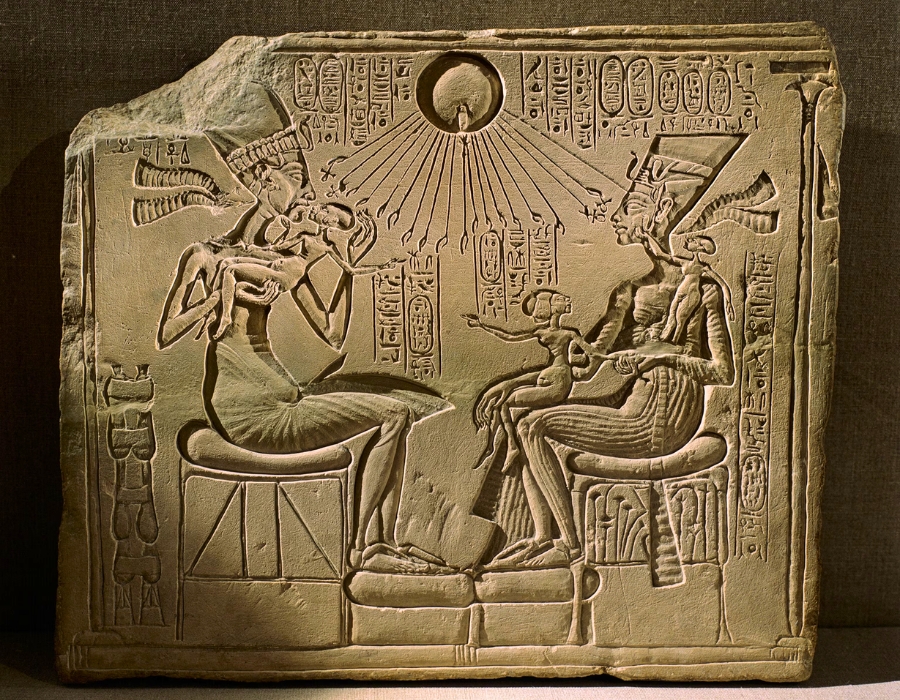
Scenes portray the couple sitting together, interacting with their children, making offerings, and receiving life-giving rays from the sun disk.
Some images appear affectionate by modern standards. However, they were also carefully constructed royal statements.
The scenes communicated fertility, stability, divine approval, and the special status of the royal family.
They cannot be interpreted simply as candid illustrations of the couple’s private marriage.
Was Nefertiti equal to Akhenaten?
Nefertiti had unusually high public visibility and religious importance, but complete political equality cannot be demonstrated.
She sometimes appears at a scale comparable to Akhenaten and is shown participating in ceremonies with unusual prominence.
Her independent ritual images indicate that she had significant religious status.
However, historians cannot automatically conclude that she possessed identical legal, military, or administrative authority.
Ancient Egyptian royal power combined ceremony, religion, inheritance, and political administration. Artistic representations reveal some parts of that system while leaving others uncertain.
What was the political role of Nefertiti?
Nefertiti’s documented political significance is strongest in royal ideology and public religious representation.
She supported the new cult, reinforced the royal family’s legitimacy, and served as a prominent figure in the image of the monarchy.
Some temple scenes show her defeating enemies, a symbolic action normally associated with pharaohs.
Such images suggest the royal court was presenting Nefertiti with an exceptional degree of authority.
They are not proof that she personally commanded an army or led a military campaign.
That distinction matters because royal artwork often illustrated ideal kingship rather than recording literal events.
Was Akhenaten’s marriage to Nefertiti unique?
Royal marriages were central to Egyptian politics. Queens could maintain influential households, participate in ceremonies, and strengthen the authority of reigning kings.
What makes Nefertiti unusual is how extensively she appears in religious contexts that resemble the actions of a king.
Her mother-in-law, Queen Tiye, had already demonstrated that a royal woman could achieve considerable prestige.
Nefertiti developed that precedent in a distinctive religious environment.
Visitors who want to understand the broader institution of monarchy can explore the history of ancient Egyptian pharaohs and compare Nefertiti’s role with other influential royal families.
What Religion Did Queen Nefertiti Follow?
Nefertiti participated in the royal worship of Aten, represented by the sun disk and associated with the life-giving power of sunlight.
Aten existed within Egyptian religious traditions before Akhenaten. What changed during his reign was the deity’s extraordinary elevation within official state worship.
Traditional temples and priesthoods, particularly those associated with Amun, lost prominence as the king concentrated religious authority around Aten.
Was Nefertiti involved in Egypt’s religious revolution?
Yes. Surviving reliefs and inscriptions place Nefertiti directly within the religious program promoted by Akhenaten.
She participated in rituals, appeared with the king before Aten, and received divine imagery associated with royal legitimacy.
The king and queen were presented as especially important intermediaries between Aten and humanity.
Their family became a central visual expression of the new religious order.
This was not simply a personal preference for another deity. It involved major changes to state-supported worship, temples, royal architecture, and the relationship between religious institutions and monarchy.
Who was Aten?
Aten was a solar deity represented by the visible sun disk.
In Amarna-period artwork, rays extend downward from the disk. Many terminate in small hands, sometimes holding the ankh, the Egyptian symbol of life.
These images communicate Aten’s life-giving relationship with the royal household.
The ankh also appears extensively in other periods of Egyptian religion. Travelers can recognize its wider significance through the history of ancient Egyptian symbols and their meanings.
Did Akhenaten and Nefertiti create monotheism?
Akhenaten’s religious program is frequently described as an early form of monotheism, but historians debate how closely it resembles later monotheistic religions.
The court emphasized Aten to an extraordinary degree and restricted or rejected aspects of traditional worship.
Yet the religious system was strongly centered on the king and royal household. It differed significantly from later Jewish, Christian, and Islamic traditions.
Terms such as monotheism, monolatry, and exclusive solar worship are used in discussions of the period, depending on how researchers interpret the evidence.
It is therefore too simple to claim that Akhenaten and Nefertiti invented all later monotheistic religions.
Was Queen Nefertiti a goddess?
Nefertiti was a historical queen, not an independent goddess in the traditional Egyptian pantheon.
Her royal image could carry divine associations, and her public role was closely connected with sacred kingship.
However, this should not be confused with deities such as Isis, Hathor, Sekhmet, or Bastet.
Descriptions of an “Egyptian goddess Nefertiti” often come from modern spiritual interpretations, symbolic artwork, or popular culture rather than the conventional classification of ancient Egyptian deities.
For context, the major gods and goddesses of ancient Egypt had complex mythologies, temples, festivals, and cults that existed before and after the Amarna period.
Was Nefertiti associated with Hathor or other goddesses?
Images of Nefertiti sometimes evoke the attributes of traditional Egyptian goddesses, particularly Hathor and other female divine figures.
Her ceremonial crowns and representations could express motherhood, fertility, protection, and religious authority.
These associations were part of the visual language of kingship.
They do not mean Nefertiti literally became Hathor or replaced every female deity.
Similarly, there is no established historical basis for describing Nefertiti as the wife of Horus or assigning her a separate divine mythology.
How Many Children Did Queen Nefertiti Have?
Queen Nefertiti and Akhenaten are known to have had six daughters.
Their children appear repeatedly in royal scenes at Amarna, sometimes seated with their parents or participating in ceremonies.
The prominence of the princesses is one of the most distinctive characteristics of Amarna-period imagery.
|
Daughter |
What is known |
|---|---|
|
Meritaten |
Eldest known daughter; later held important royal status |
|
Meketaten |
Died during the Amarna period; associated with mourning scenes in the Royal Tomb |
|
Ankhesenpaaten |
Later known as Ankhesenamun; married Tutankhamun |
|
Neferneferuaten Tasherit |
Her name means the younger Neferneferuaten |
|
Neferneferure |
Younger daughter whose later life is poorly documented |
|
Setepenre |
Youngest known daughter; disappears from the surviving record |
The daughters’ appearances in royal reliefs were not merely decorative.
They reinforced the image of the royal family as a source of continuity, fertility, and divine favor.
Who was Nefertiti’s most famous daughter?
Ankhesenpaaten is particularly important because she later married Tutankhamun and became known as Ankhesenamun.
Her name changed as the Egyptian court moved away from the exclusive promotion of Aten and restored the importance of Amun.
The change from Ankhesenpaaten to Ankhesenamun reflects a wider religious and political transformation.
Her marriage to Tutankhamun also connects Nefertiti’s family with one of the most famous archaeological discoveries in history.
What happened to Meritaten?
Meritaten, Nefertiti’s eldest known daughter, rose to a prominent royal position during the later Amarna period.
She has been connected with the short-lived ruler Smenkhkare, although the exact sequence of relationships and titles is complex.
Some theories about the final years of Akhenaten propose that Meritaten herself may have exercised exceptional political authority.
These interpretations remain debated.
Her importance is nevertheless clear: the eldest princess was part of the royal succession crisis that followed Akhenaten’s reign.
Did Nefertiti have a son?
No son of Nefertiti is securely documented.
Although various theories have attempted to identify Tutankhamun as her biological child, the evidence does not establish that relationship.
Tutankhamun is generally understood to have belonged to Akhenaten’s close royal family, and many historical reconstructions treat Nefertiti as his stepmother.
The exact genealogical relationships in the final years of the Eighteenth Dynasty remain complicated.
It is more accurate to distinguish Nefertiti’s six documented daughters from hypothetical additional children.

Was Queen Nefertiti the Mother of Tutankhamun?
There is no conclusive evidence that Nefertiti was Tutankhamun’s biological mother.
Tutankhamun belonged to the royal family of the late Eighteenth Dynasty and is commonly identified as a son of Akhenaten. His mother’s identity remains uncertain, although genetic investigations of royal mummies have informed modern reconstructions.
Because Nefertiti was Akhenaten’s principal wife, she is frequently described as Tutankhamun’s stepmother.
This is a plausible historical relationship, not a documented personal account of how they interacted.
How were Nefertiti and King Tut connected?
Their strongest known family connection is through Akhenaten and Nefertiti’s daughter Ankhesenpaaten.
Tutankhamun married Ankhesenpaaten, who later adopted the name Ankhesenamun.
Consequently, Nefertiti was the mother of Tutankhamun’s wife.
Depending on which reconstruction of Tutankhamun’s parentage is accepted, she may also have been his stepmother.
Did Tutankhamun know Nefertiti?
It is possible that Tutankhamun and Nefertiti lived within the same extended royal household.
However, no surviving text securely records their personal conversations, family affection, or political disagreements.
Tutankhamun was young when the Amarna era ended. His reign became closely associated with restoring the traditional gods and institutions that Akhenaten had diminished.
The relationship between the two historical figures is important, but modern portrayals should not turn reasonable possibilities into biographical certainties.
Why did Tutankhamun abandon Akhenaten’s religion?
During Tutankhamun’s reign, the Egyptian court restored worship of traditional deities, especially Amun, and renewed support for temples and priesthoods.
The changes occurred during a period of political reconstruction after Akhenaten’s death.
Tutankhamun was a young ruler, so powerful courtiers and senior officials probably played major roles in these decisions.
The restoration should not be reduced to the personal preferences of one child king.
To understand the surviving objects associated with this period, visitors can explore the Tutankhamun collection and displays at the Grand Egyptian Museum when planning a Cairo or Giza museum visit.
What Was Life Like for Queen Nefertiti in Amarna?
Queen Nefertiti lived for part of her royal career at Akhetaten, the new capital founded by Akhenaten in Middle Egypt.
The city is now known as Amarna or Tell el-Amarna.
Its foundation represented a major political and religious decision. Rather than continuing to govern exclusively from established royal centers, Akhenaten created a new city dedicated to Aten.
The city’s religious buildings, royal residences, roads, workshops, and neighborhoods were developed during a comparatively short period.
Why did Akhenaten build a new capital?
Akhenaten founded Akhetaten as a center for the worship of Aten and the royal institutions associated with his religious reforms.
The name Akhetaten means “Horizon of the Aten.”
The location offered an opportunity to create a ceremonial landscape closely connected with the new cult and less dependent on established religious centers.
Royal inscriptions on boundary stelae marked the territory of the new city and expressed the king’s intentions.
Nefertiti and the royal family became essential figures in the city’s imagery and religious ceremonies.
Today, travelers can explore the history and surviving archaeology of Akhetaten, the ancient city of Amarna.
Where did Nefertiti live in Amarna?
Nefertiti was associated with the royal residential and ceremonial spaces of Akhetaten.
The ancient city contained several palace complexes and royal buildings. Some were used for administration and ceremony, while others formed part of the royal residential landscape.
However, archaeologists cannot reconstruct an exact daily schedule for the queen or prove where she slept on individual nights.
The surviving buildings are important because they show the scale and organization of the royal court.
What did Nefertiti do every day?
No surviving diary records Nefertiti’s daily routine.
Her documented responsibilities include participation in royal religious ceremony and public representations of queenship.
As Great Royal Wife, she would also have occupied a senior position within a complex palace household.
It is reasonable to expect that her life involved attendants, ceremonial clothing, preparation for religious events, and responsibilities connected with her children and court.
The precise division of her time between religious, domestic, and administrative responsibilities remains unknown.
What did the royal palace look like?
Amarna’s royal buildings were far more colorful and elaborate than the low foundations visible today might suggest.
Archaeological discoveries include painted plaster, decorated floors, fragments of architecture, and objects connected with the royal household.
Some decorative scenes show plants, birds, and natural landscapes.
Open courtyards, ceremonial spaces, and residential sections helped organize palace life.
The original buildings combined mudbrick construction with stone architectural features and painted decoration.
Visitors should not expect an intact stone palace resembling Karnak Temple.
Much of Amarna survives as foundations and archaeological traces, which become meaningful when interpreted through plans, excavation reports, and reconstructed images.
What makes Amarna art different?
Amarna-period art is famous for its unusual combination of religious symbolism, expressive royal imagery, and distinctive human proportions.
Earlier Egyptian royal art generally emphasized established ideals of symmetry, strength, and timeless authority.
Artists working under Akhenaten explored elongated bodies, prominent facial features, intimate family scenes, and new compositions.
The resulting style can appear strikingly modern.
Yet this does not mean every portrait was intended to record physical appearance with photographic accuracy.
Amarna art was shaped by specific political and religious ideas.
One of its major innovations was the elevated role of the royal family as a visual expression of divine life.
Why Is the Bust of Queen Nefertiti So Famous?
Its fame comes from an unusual combination of craftsmanship, preserved color, elegant proportions, and the historical fascination surrounding its subject.
Created during the Amarna period, the bust shows Nefertiti wearing a tall blue crown decorated with bands of color.
Her neck is slender, her facial features are carefully modeled, and her expression appears composed.
The sculpture remains particularly striking because much of its painted surface survives.
Who made the bust of Queen Nefertiti?
The bust was discovered in a sculptor’s workshop at Amarna associated with Thutmose, an ancient Egyptian artist who worked during Akhenaten’s reign.
It is therefore commonly attributed to the workshop of Thutmose.
The precise contribution of the master sculptor and individual assistants cannot be established for every stage of its production.
The workshop setting is important because it suggests the sculpture may have served as a model or reference for other royal portraits.
When was the bust made?
The bust is generally dated to around 1340 BCE, during the reign of Akhenaten.
Different museum catalogues may give slightly different chronological ranges for the Amarna period.
The sculpture is therefore approximately 3,300 years old.
Its precise day or year of production is unknown.
What is the bust made of?
The sculpture has a limestone core covered with modeled and painted stucco.
Its surface was carefully finished with pigments to create lifelike details.
The surviving right eye includes an inlay made with rock crystal and other materials.
The bust is approximately 49 centimeters tall.
Its combination of stone, plaster, color, and fine detailing helps explain why it is considered a major achievement of ancient Egyptian sculpture.
Why is one eye missing?
The bust’s left eye lacks the detailed inlay visible in the right eye.
When the sculpture was discovered, the missing element prompted a search among the excavation debris.
The lost piece was not recovered.
One explanation is that the left eye was never completed, potentially because the sculpture functioned as an artistic model.
Another possibility is that an element was lost before discovery.
The precise reason remains debated.
Claims that Nefertiti was blind in one eye are not supported by the condition of the sculpture.
Why does Nefertiti wear a blue crown?
The tall, flat-topped blue crown is one of Nefertiti’s most distinctive royal attributes.
It visually communicates her elevated position within the monarchy and helps identify her in surviving images.
The crown includes decorative bands and royal symbolism, although some details are damaged or incomplete.
It should not be confused automatically with the blue khepresh crown traditionally associated with male pharaohs.
Ancient Egyptian crowns carried specific meanings, and their forms could vary between royal figures and historical contexts.
Was the bust created as an official royal portrait?
The sculpture was produced within a professional artistic environment closely associated with the Amarna royal court.
Its quality and the location of its discovery strongly connect it with royal portrait production.
However, its precise original function is still discussed.
It may have served as a workshop model, an artistic reference, or an object with another specialized purpose.
The unfinished appearance of the left eye has contributed to the workshop-model interpretation.
The important point is that the bust represents an ancient royal image, not a modern reconstruction.
How Was the Bust of Nefertiti Discovered?
The famous bust was found on December 6, 1912, during German excavations at Amarna directed by archaeologist Ludwig Borchardt.
It was discovered in a building associated with the sculptor Thutmose’s workshop.
The archaeological context contained additional sculptures and artistic models, making the find particularly valuable for understanding how ancient Egyptian artists worked.
What happened after the discovery?
The bust was taken to Germany following the division of excavated finds under the antiquities arrangements operating at the time.
James Simon, who financed the excavation, became associated with its ownership and eventual donation to the Berlin museum collection.
The bust was publicly displayed in Berlin in 1924 and became increasingly famous during the twentieth century.
Since the reopening of the restored Neues Museum in 2009, it has occupied a prominent display position there.
Why is Nefertiti’s bust in Germany instead of Egypt?
The bust is in Berlin because it was transferred to Germany after the 1912–1913 excavation and division of finds.
However, the circumstances and legitimacy of its removal remain controversial.
German museum authorities maintain that the object was acquired through the procedures applicable at the time.
Egyptian archaeologists and advocates for repatriation have challenged the fairness of the process and argued that the sculpture should return to Egypt.
This discussion raises wider questions about archaeology under colonial-era power structures, cultural ownership, conservation, and museum responsibility.
The disagreement is not merely about the location of an artwork. It concerns the authority to preserve and interpret a major piece of Egyptian cultural heritage.
Will the bust return to Egypt?
There is no confirmed transfer date for the original bust.
Calls for repatriation have continued, including renewed attention following major developments in Egypt’s museum sector.
German authorities have also emphasized the sculpture’s delicate physical condition as an important conservation concern.
Travelers should not assume that public campaigns or headlines announcing renewed requests mean that a transfer has been approved.
For 2027 planning, the published display location remains the Neues Museum in Berlin unless museum authorities announce otherwise.
What Did the Real Queen Nefertiti Look Like?
The famous bust provides an ancient representation of Nefertiti, but it does not establish her appearance with photographic certainty.
Artists working during the Amarna period used recognizable physical characteristics alongside artistic conventions and royal ideals.
The sculpture may preserve features associated with the queen, including the proportions of her face, neck, and nose. Nevertheless, its symmetry and careful finishing reflect deliberate artistic choices.
Is Nefertiti’s bust her real face?
The bust is a genuine ancient Egyptian sculpture depicting Queen Nefertiti.
It is not a modern facial reconstruction or a photograph of her actual appearance.
This distinction is essential.
An ancient portrait can preserve a person’s identity while still idealizing their face.
Without securely identified physical remains, scientists cannot directly compare the bust with Nefertiti’s skeletal structure.
Claims that a digital image reveals her exact original face should therefore be treated cautiously.
What color was Queen Nefertiti’s skin?
Nefertiti’s exact natural skin tone cannot be established from the surviving evidence.
The famous bust has warm painted skin tones, but ancient Egyptian artists followed established conventions when representing royal figures.
Pigment choices were influenced by symbolism, artistic traditions, and the intended visual effect.
The modern categories “Black” and “white” also do not map neatly onto the identities of people living in ancient Egypt.
Egypt was an African civilization with extensive connections to Nubia, the eastern Mediterranean, and western Asia.
Nefertiti’s historical identity is securely Egyptian in the cultural and political sense, while her precise ancestry remains uncertain.
Was Nefertiti a Black queen?
Descriptions of Nefertiti as a Black queen often reflect modern discussions of African history, representation, and identity.
Ancient Egypt was geographically part of Africa, and its population was diverse across different periods and regions.
However, there is insufficient evidence to assign Nefertiti a precise modern racial classification.
The same problem applies to confident claims that she was “white” in a modern European racial sense.
Responsible historical interpretation distinguishes ancient Egyptian identity from present-day racial labels.
Did Nefertiti wear makeup?
Royal Egyptian portraits frequently show carefully outlined eyes, decorative collars, elaborate crowns, and idealized grooming.
Cosmetics and personal adornment were important aspects of elite culture in ancient Egypt.
Black eye cosmetics, including kohl-like preparations, had decorative and cultural functions.
However, the painted details of Nefertiti’s bust should not automatically be interpreted as an exact record of her everyday makeup routine.
Why was Nefertiti considered beautiful?
Nefertiti became an international symbol of beauty largely because of the fame of her sculpted portrait.
The symmetry, refined details, strong profile, and preserved color contributed to its reputation.
The object’s twentieth-century exhibition history also shaped how modern audiences came to recognize her.
Her beauty was important to her royal image, but reducing Nefertiti to physical appearance overlooks her historical significance.
Her religious position, participation in royal ceremonies, and possible relationship to the succession are central to understanding her life.
What Happened to Queen Nefertiti?
Nefertiti’s final years are uncertain because the surviving historical record becomes fragmented near the end of Akhenaten’s reign.
For many years, historians debated whether the queen had died, lost political influence, or disappeared from public life before her husband.
An important inscription discovered at Dayr Abu Hinnis changed that discussion.
What does the Year 16 inscription tell us?
A quarry inscription dated to Year 16 of Akhenaten’s reign refers to Neferneferuaten Nefertiti as his Great Royal Wife.
The evidence was announced in 2012 and subsequently studied by Egyptologist Athena Van der Perre.
Its significance is considerable.
It demonstrates that Nefertiti was still being identified as the principal queen very late in Akhenaten’s reign.
Earlier theories that placed her death or permanent disappearance around Year 12 must therefore be reconsidered.
The inscription does not establish exactly when she died or what happened after Akhenaten’s final years.
Did Nefertiti die before Akhenaten?
There is no conclusive proof that Nefertiti died before Akhenaten.
The Year 16 inscription makes it clear that she was still recognized as Great Royal Wife near the end of his approximately 17-year reign.
It remains possible that she died shortly afterward.
It is also possible that she survived Akhenaten and assumed an additional political role.
Because no universally accepted burial or death record identifies her final years, neither outcome can be stated with certainty.
Was Nefertiti exiled?
There is no secure evidence that Nefertiti was exiled from the royal court.
Older theories sometimes interpreted her apparent disappearance from surviving records as evidence of political disgrace or removal.
The Year 16 inscription weakens explanations that require her to have been permanently displaced much earlier.
A gap in documentation does not automatically prove exile.
Did Nefertiti lose her position to another queen?
Akhenaten had other women in his household, including Kiya, who appears in surviving inscriptions and artifacts.
But the evidence does not establish that Kiya permanently replaced Nefertiti as Great Royal Wife.
Nefertiti continued to hold her principal royal title late in Akhenaten’s reign.
The relationships between Akhenaten’s wives, daughters, and possible successors were complicated, but dramatic stories of rivalry are often more speculative than the ancient record permits.
Did Queen Nefertiti Become a Pharaoh?
Some Egyptologists believe Nefertiti may have ruled Egypt as a pharaoh under the name Neferneferuaten.
This is one of the most important unresolved questions surrounding her biography.
The years immediately after Akhenaten were politically complicated, and the surviving royal names, titles, and monuments do not produce a universally accepted succession sequence.
Who was Pharaoh Neferneferuaten?
Neferneferuaten was a royal name associated with a ruler during the final years of the Amarna period.
Some inscriptions connected with this ruler use feminine grammatical forms and titles suggesting that a woman held pharaonic authority.
Nefertiti is a leading candidate because she already used Neferneferuaten as part of her royal name and had occupied an unusually prominent position during Akhenaten’s reign.
However, other interpretations of the evidence have been proposed.
The identification cannot currently be treated as an undisputed historical fact.
What evidence supports Nefertiti becoming pharaoh?
Several factors support the possibility:
-
Nefertiti already held an extraordinary religious and ceremonial position.
-
Her name included Neferneferuaten.
-
Later royal inscriptions indicate a ruler called Neferneferuaten.
-
Some royal titles associated with this figure have feminine forms.
-
The succession between Akhenaten and Tutankhamun remains incompletely understood.
Together, these factors make the theory plausible.
But they do not provide the equivalent of a complete royal biography or an undisputed inscription explicitly recording Nefertiti’s accession and reign.
Was Nefertiti called King Nefertiti?
Nefertiti was certainly a queen. She may also have held pharaonic authority later in life.
Ancient Egyptian kingship could be expressed through titles and symbols conventionally associated with male rulers, even when the holder was female.
If Nefertiti ruled as Neferneferuaten, she would belong among Egypt’s female pharaohs.
That remains a historical hypothesis rather than a confirmed identification.
Was Nefertiti the same person as Smenkhkare?
The exact relationship between Nefertiti, Neferneferuaten, and Smenkhkare remains disputed.
Smenkhkare appears as a ruler near the end of the Amarna period, but the duration and sequence of the relevant reigns are difficult to reconstruct.
Some older theories combined royal identities that are now often treated separately.
A careful account should not present Smenkhkare and Nefertiti as definitively the same individual.
How does Nefertiti compare with Hatshepsut?
Hatshepsut is a much more securely documented example of a female pharaoh.
She ruled in the Eighteenth Dynasty before Nefertiti and left extensive monuments and royal inscriptions.
Her reign provides strong evidence of a woman holding full pharaonic titles and authority.
Nefertiti’s possible later kingship is less securely documented.
The difference is not a judgment about either woman’s importance; it reflects the quantity and clarity of surviving historical evidence.
For travelers interested in female rulership, Hatshepsut’s mortuary temple in Luxor offers one of the most impressive places to examine how a woman presented herself as pharaoh.
Where Is Queen Nefertiti’s Tomb?
Queen Nefertiti’s tomb has not been conclusively identified.
Although several theories connect her with tombs or human remains from the late Eighteenth Dynasty, none has established a universally accepted burial place.
Researchers have considered possibilities at Amarna and in the Theban royal burial landscape near Luxor.
The mystery has attracted considerable attention because Nefertiti was such a prominent queen and because her final years remain poorly documented.
Was Nefertiti buried at Amarna?
Amarna contained a royal burial complex intended for Akhenaten and members of his family.
The Royal Tomb includes chambers and unfinished areas that have encouraged discussion about which royal individuals were intended to be buried there.
Meketaten, one of Nefertiti’s daughters, is associated with scenes of mourning in the tomb.
Some interpretations have considered whether additional spaces were intended for Nefertiti.
However, this does not establish that she was ultimately buried there.
The transfer or reuse of royal remains after the abandonment of Amarna further complicates the archaeological record.
Could Nefertiti be buried in the Valley of the Kings?
It is possible, but unproven.
The Valley of the Kings served as an important royal burial landscape during the New Kingdom.
Several tombs are associated with the late Eighteenth Dynasty, including the tomb of Tutankhamun and the historically complicated burial designated KV55.
The political changes after Akhenaten may have led to the relocation of royal burial equipment or remains.
Nevertheless, no tomb in the valley has been securely identified as Nefertiti’s final resting place.
Is Nefertiti buried behind Tutankhamun’s tomb?
This question remains unresolved, and the recent research deserves careful explanation.
In 2015, Egyptologist Nicholas Reeves proposed that Tutankhamun’s tomb, KV62, might contain concealed passages leading to additional royal burial chambers.
He suggested that the larger complex could have originally belonged to Nefertiti.
The theory attracted international attention because Tutankhamun’s tomb is unusually small for a royal burial and because certain architectural and decorative details invited further investigation.
Radar surveys produced conflicting interpretations.
A detailed investigation conducted in 2018 concluded that the available ground-penetrating radar data did not support hidden chambers immediately beyond the burial chamber walls.
For several years, that result significantly weakened the popular version of the theory.
What changed in September 2026?
Research reported in September 2026 presented new geophysical evidence suggesting that possible passages or chambers might exist beyond the known extent of Tutankhamun’s tomb.
The team, led by former Egyptian antiquities minister Mamdouh Eldamaty and including Nicholas Reeves, examined the tomb and surrounding terrain using methods including ground-penetrating radar and microgravity measurements.
The researchers interpreted certain subsurface anomalies as potentially consistent with a larger, previously unknown architectural complex.
The findings were discussed in the scientific journal Nature on September 17, 2026.
However, independent specialists urged caution, noting that additional data and verification would be necessary.
Most importantly, geophysical anomalies cannot identify the occupant of an undiscovered chamber.
Even if future investigation confirms additional rooms, it would not automatically prove that they belong to Nefertiti.
What the evidence establishes as of October 2026
|
Question |
Current evidence |
|---|---|
|
Has Nefertiti’s tomb been found? |
No confirmed identification |
|
Did earlier scans rule against hidden rooms? |
Yes, the 2018 investigation found no supporting radar evidence immediately beside the chamber |
|
Has new evidence appeared? |
Yes, a September 2026 study reported additional geophysical indications |
|
Are hidden chambers confirmed? |
No |
|
Has Nefertiti’s mummy been identified there? |
No |
|
Are new investigations possible? |
Yes, subject to archaeological permission and further research |
The most useful conclusion is that the theory has reopened as an archaeological question, not become a confirmed discovery.
What would archaeologists need to prove the theory?
Researchers would first need to establish whether the anomalies represent real human-made chambers rather than natural geological features or misleading instrument readings.
If chambers exist, investigators would need to document their architecture and contents using approved conservation methods.
Only then could inscriptions, burial equipment, human remains, or other evidence potentially establish a connection with Nefertiti.
A chamber without identifying material could remain anonymous.
Even a royal burial containing objects associated with the Amarna family would require careful interpretation.
Can travelers visit Nefertiti’s tomb in 2027?
No confirmed tomb of Nefertiti is available to visit.
Travelers can visit other royal tombs and archaeological sites connected with her period.
Tutankhamun’s tomb in the Valley of the Kings is a relevant historical location, but it should not be advertised as Nefertiti’s tomb.
If archaeological investigations progress during 2027, any changes to visitor access would depend on Egyptian authorities.
Visitors planning to explore the Valley of the Kings and its royal tombs should distinguish accessible monuments from proposed or unexcavated areas.
Has Queen Nefertiti’s Mummy Ever Been Found?
No mummy has been conclusively identified as Queen Nefertiti.
Several royal mummies and unidentified remains have attracted speculation, especially those connected with the late Eighteenth Dynasty.
Modern scientific examinations can reveal information about age, biological relationships, injuries, disease, and embalming methods.
However, identifying a historical individual requires more than a resemblance or a speculative family tree.
Could DNA identify Nefertiti?
DNA analysis could potentially contribute to an identification if a suitable sample and reliable comparative evidence were available.
But ancient DNA is often incomplete, degraded, or vulnerable to contamination.
Establishing a genetic relationship does not automatically establish a historical name.
A convincing identification would ideally combine genetic evidence with archaeology, inscriptions, chronology, and burial context.
Was Nefertiti the Younger Lady mummy?
The mummy commonly known as the Younger Lady, found in tomb KV35, has been central to research on Tutankhamun’s family.
Genetic studies have suggested close biological relationships between certain royal mummies and Tutankhamun.
However, the identification of the Younger Lady with a particular named woman remains debated.
The evidence does not securely identify her as Nefertiti.
Claims that the queen’s body has definitively been discovered should therefore be examined against the actual archaeological findings.
What about digital facial reconstructions?
Facial reconstructions based on ancient skeletal remains can be useful for education and research.
They generally combine anatomical modeling with interpretive choices about skin, hair, and facial appearance.
A reconstruction of an unidentified mummy cannot establish that the remains belong to Nefertiti.
Similarly, an AI-generated portrait based on the Berlin bust is an artistic interpretation, not a new archaeological discovery.
Why Did Nefertiti’s Influence Decline After the Amarna Period?
The religious and political system associated with Akhenaten did not survive in its original form.
After the end of the Amarna period, the Egyptian court gradually restored traditional religious institutions.
Aten’s exclusive prominence diminished, while Amun and other established gods returned to official favor.
The royal capital at Akhetaten was eventually abandoned.
What happened to Amarna?
Amarna had been created around the needs of Akhenaten’s court and religious project.
Once the court departed and royal patronage declined, much of the city’s political and ceremonial purpose disappeared.
Buildings were abandoned, and architectural materials were later removed or reused.
The city did not continue developing into one of Egypt’s enduring political capitals.
This relatively short lifespan is one reason archaeologists can study its layout and surviving remains with unusual clarity.
Was Nefertiti erased from Egyptian history?
The Amarna royal period was marginalized by later rulers, and names and monuments connected with Akhenaten’s reforms were damaged, dismantled, or reused.
However, the survival of Nefertiti’s portraits, inscriptions, and the ruins of Amarna prevents us from saying that she was completely erased.
Her modern rediscovery was made possible precisely because significant evidence survived.
Why is Nefertiti still important today?
Nefertiti is important because she provides an unusually revealing example of female royal authority within an ancient political and religious system.
Her surviving images help historians investigate how power was communicated through art.
Her association with Akhenaten helps explain one of ancient Egypt’s most unusual religious experiments.
Her uncertain later career also reminds us how much historical interpretation depends on incomplete records.
And her famous bust continues to shape discussions about artistic heritage, museum collections, and the movement of antiquities.
Nefertiti vs Nefertari, Hatshepsut and Cleopatra: Who Was Who?
Nefertiti is frequently confused with other famous Egyptian queens, particularly Nefertari.
The names are similar, but these women lived during different historical periods and belonged to different royal families.
|
Queen |
Historical period |
Known for |
Related site or object |
|---|---|---|---|
|
Nefertiti |
Eighteenth Dynasty, 14th century BCE |
Wife of Akhenaten, Aten worship, famous bust |
Amarna; bust in Berlin |
|
Hatshepsut |
Eighteenth Dynasty, 15th century BCE |
Female pharaoh with a well-documented reign |
Mortuary Temple at Deir el-Bahari |
|
Nefertari |
Nineteenth Dynasty, 13th century BCE |
Great Royal Wife of Ramesses II |
Tomb QV66; Small Temple at Abu Simbel |
|
Cleopatra VII |
Ptolemaic period, 1st century BCE |
Last active ruler of the Ptolemaic dynasty |
Alexandria and associated Ptolemaic sites |
Are Nefertiti and Nefertari the same person?
No. Nefertiti and Nefertari were different Egyptian queens.
Nefertiti was married to Akhenaten and lived during the Eighteenth Dynasty.
Nefertari was the Great Royal Wife of Ramesses II during the Nineteenth Dynasty.
Their royal careers were separated by several generations.
Nefertari is associated with a richly decorated tomb in the Valley of the Queens and a temple dedicated to her at Abu Simbel.
Nefertiti’s confirmed tomb remains unknown.
Was Nefertiti related to Ramesses II?
Nefertiti lived before Ramesses II, and no direct personal relationship between them is securely established.
Ramesses II belonged to a later dynasty.
His reign produced many monumental building projects, including the temples at Abu Simbel.
The similar names Nefertiti and Nefertari are a common source of confusion in searches about the Ramesside period.
Did Cleopatra and Nefertiti live at the same time?
No. Cleopatra VII lived more than 1,300 years after Nefertiti.
Cleopatra belonged to the Ptolemaic dynasty, which ruled Egypt following the conquest of Alexander the Great.
Nefertiti lived during the New Kingdom, long before the arrival of Greek and Roman political domination.
Both women became international symbols of Egyptian queenship, but their historical circumstances were very different.
Which Egyptian queen was the most powerful?
There is no single objective ranking of ancient Egyptian queens.
Hatshepsut is securely documented as a reigning pharaoh.
Nefertiti played an exceptional religious and ceremonial role and may have later exercised pharaonic authority.
Nefertari held prestige within the powerful court of Ramesses II.
Cleopatra VII was an independent political ruler operating within the Mediterranean world.
Their power took different forms, making direct comparisons difficult.
For a broader understanding of their contributions, explore the history of Egypt’s most influential queens.
Where Can You See Queen Nefertiti’s History in Egypt?
Although the original famous bust is in Berlin, travelers can explore several locations in Egypt connected with Nefertiti’s era.
The most important place is Amarna, where she lived during part of Akhenaten’s reign.
Luxor is also relevant because the religious history of the Eighteenth Dynasty is closely connected with Karnak and the Theban royal burial landscape.
Museums in Cairo and Giza provide wider context through objects from the New Kingdom and the Amarna period, subject to current displays.
|
Location |
Connection to Nefertiti |
Best suited for |
|---|---|---|
|
Amarna, Minya Governorate |
Ancient capital of Akhenaten and Nefertiti |
Dedicated archaeology enthusiasts |
|
Karnak Temple, Luxor |
Location associated with early Aten structures |
Travelers interested in religious history |
|
Valley of the Kings, Luxor |
Burial landscape associated with the late Eighteenth Dynasty |
First-time cultural travelers |
|
Egyptian Museum, Cairo |
Historical collections relevant to New Kingdom Egypt |
Museum and history enthusiasts |
|
Grand Egyptian Museum, Giza |
Wider royal and New Kingdom context, especially Tutankhamun |
Travelers exploring Egyptian royal history |
|
Neues Museum, Berlin |
Original famous bust of Nefertiti |
Visitors specifically seeking the sculpture |
Is Amarna worth visiting?
Amarna is especially worthwhile for travelers who want to understand Akhenaten and Nefertiti beyond museum objects and popular images.
The site preserves the landscape of the royal capital.
Visitors can explore archaeological areas associated with temples, palaces, boundary inscriptions, and elite tombs.
Unlike more monumental destinations, Amarna does not rely on massive standing temples or elaborate tourist infrastructure.
Much of its value lies in the relationship between ruins, geography, and historical interpretation.
A knowledgeable guide can help explain how the surviving remains fit together.
What can visitors see at Amarna?
The principal visitor areas include:
-
The North Tombs, containing scenes of royal ceremony and elite life.
-
The Royal Tomb, constructed for Akhenaten and members of his family.
-
The remains of the Small Aten Temple and surrounding central city.
-
The North Palace area.
-
Selected boundary stelae marking the territory of Akhetaten.
-
The Amarna Visitor Centre, which introduces the city’s history through displays and reconstructions.
Not every archaeological area is open to visitors, and some locations require difficult walks or vehicle access.
Amarna is not an archaeological site where all major monuments can be visited comfortably on foot.
What can travelers see at Karnak Temple?
Karnak is important because Akhenaten began his reign at Thebes and developed early structures associated with Aten worship before establishing the new capital.
Nefertiti appears in artwork connected with this early phase.
Many of the Aten buildings at Karnak were later dismantled, and surviving blocks have been studied or reused in different contexts.
Visitors should not expect to find an intact “Nefertiti Temple” standing within the complex.
Instead, Karnak provides an opportunity to understand the religious institutions that Akhenaten’s reforms challenged.
A visit to Karnak Temple and its ancient religious complexes is particularly useful for understanding the contrast between traditional Egyptian worship and the Amarna revolution.
Should you visit the Valley of the Kings?
Yes, especially if your itinerary already includes Luxor.
The Valley of the Kings allows travelers to explore the burial customs of Egypt’s New Kingdom rulers.
Tutankhamun’s tomb is especially relevant because of the disputed theories connecting his burial with Nefertiti.
However, the valley is not a confirmed location of Nefertiti’s tomb.
A visit should focus on the tombs that are actually open and the historical evidence associated with them.
Which museums in Egypt help explain Nefertiti’s period?
The Egyptian Museum in Cairo, the Grand Egyptian Museum in Giza, and the Luxor Museum can help travelers understand the history and artistic traditions of the New Kingdom.
Individual object displays can change because of conservation, transfers, and exhibition planning.
Travelers seeking a particular object associated with Nefertiti should verify the museum’s current collection information before visiting.
The original painted bust is not part of the Grand Egyptian Museum’s collection.
For those deciding how to organize a museum-focused visit, the comparison of the Egyptian Museum in Cairo and the Grand Egyptian Museum explains how their visitor experiences differ.
How to Visit Amarna in 2027
Amarna requires more preparation than major attractions in Cairo or Luxor.
It is located in Minya Governorate, in Middle Egypt, on the east bank of the Nile.
The archaeological area is geographically extensive, the monuments are separated by considerable distances, and some visitor routes involve uneven desert terrain.
For this reason, the most practical approach is a prearranged private vehicle and an informed local guide.
How far is Amarna from Cairo, Minya and Luxor?
The Amarna Project provides approximate distances that are helpful for initial route planning.
|
Starting point |
Approximate distance to Amarna |
Planning advice |
|---|---|---|
|
Minya |
60 km |
Practical regional base |
|
Cairo |
310 km |
Long excursion; overnight planning is preferable |
|
Asyut |
75 km |
Possible regional approach |
|
Luxor |
400 km |
Better as part of a planned multi-day journey |
Distances are approximate and do not guarantee travel times.
Road conditions, route choice, stops, and local arrangements may affect the journey.
A day trip from Cairo is possible in principle, but it involves substantial driving and leaves less time for archaeological exploration.
An overnight stay in Minya is often a more comfortable choice for visitors who want a full day at Amarna.
How much time should you spend at Amarna?
Allow approximately one full sightseeing day if you want to understand the main archaeological areas.
A shorter visit may cover selected highlights, but it is unlikely to provide the same understanding of the city.
A two-day visit is better for serious enthusiasts who want to explore more distant or less frequently visited areas, provided access is available.
A sensible one-day approach is to prioritize the Visitor Centre, selected city remains, the North Tombs, and the Royal Tomb, adjusting the sequence according to local conditions.
What are Amarna’s opening hours?
The Amarna Project currently lists standard visiting hours of 8:00 AM to 4:00 PM for the principal archaeological site, with possible variations on public holidays.
These are published arrangements available during the preparation of this guide in October 2026, not a guarantee for every date in 2027.
Tickets for major monuments are managed locally.
Check current arrangements through the responsible Egyptian authorities or your tour operator before travel.
How much does visiting Amarna cost?
A reliable total price depends on the current entrance fees, transportation arrangements, number of visitors, guide services, and whether accommodation is required.
Because an authoritative, comprehensive 2027 price could not be established, this guide does not provide a speculative admission figure.
For budgeting purposes, separate the following expenses:
-
Archaeological entrance tickets.
-
Private or organized transportation.
-
Licensed guiding services.
-
Accommodation in Minya or another regional city.
-
Meals, drinking water, and incidental purchases.
-
Any additional authorized access or permits applicable to the itinerary.
A quotation should clarify which services are included and whether entrance fees will be charged separately.
Is Amarna wheelchair accessible?
Amarna is challenging for many visitors with reduced mobility.
Large parts of the archaeological site consist of unpaved desert, uneven surfaces, exposed terrain, and limited shade.
The North Tombs and some boundary stelae require high staircases.
The Royal Tomb involves a descent, although some sections have handrails and modern access improvements.
The Visitor Centre offers a more manageable introduction and has wheelchair access to some areas.
Travelers requiring step-free access should not assume that the complete archaeological visit is possible.
Discuss specific mobility requirements before committing to the journey.
What should you bring to Amarna?
Prepare for an exposed archaeological environment rather than a conventional indoor museum.
Useful items include comfortable closed shoes, sun protection, drinking water, light clothing appropriate to the season, and a small bag.
A printed or offline site map can help explain the layout.
Travelers particularly interested in archaeology may benefit from reviewing a plan of the ancient city before arrival.
Photography restrictions may apply inside individual monuments or to particular equipment.
Always follow posted site rules.
What is the best time of year to visit Amarna?
The cooler months are generally more comfortable for exploring exposed archaeological areas in Middle Egypt.
Late autumn, winter, and early spring are usually preferable to the height of summer.
|
Season |
General conditions |
Recommendation |
|---|---|---|
|
December–February |
Cooler days; potentially cold mornings |
Very suitable for extended exploration |
|
March–April |
Often pleasant, but occasional wind and dust |
Good choice with weather flexibility |
|
May–September |
Hotter conditions and stronger sun exposure |
Plan carefully; avoid extended midday exposure |
|
October–November |
Generally more comfortable temperatures |
Good option for archaeology-focused travel |
These are broad climatic patterns rather than daily forecasts.
The best choice depends on personal heat tolerance and how much walking your itinerary involves.
Where Is the Original Nefertiti Bust Displayed in 2027?
The original painted bust of Queen Nefertiti is displayed at the Neues Museum on Museum Island in Berlin, according to the museum’s currently published information.
It is part of the Egyptian Museum and Papyrus Collection.
The sculpture is exhibited in the North Dome Room, where visitors can appreciate the portrait within a purpose-designed museum setting.
Can you see the bust in Egypt?
No. The famous original limestone bust is not currently displayed in Egypt.
Replicas, printed images, and other artistic representations may appear in Egyptian exhibitions or educational displays.
Those should not be confused with the original sculpture.
If seeing the famous bust itself is a major priority, plan around Berlin rather than assuming it can be included in a Cairo museum visit.
How much does it cost to see Nefertiti in Berlin?
The Neues Museum’s published general admission information during this research listed a standard ticket of €14, with reduced admission available for eligible visitors.
This is a reference price from October 2026 and should not be assumed to remain unchanged throughout 2027.
The museum may revise admission categories or ticketing procedures.
What are the museum’s opening hours?
As published in October 2026, standard opening hours are Tuesday through Sunday, 10:00 AM–6:00 PM, with regular Monday closure.
The museum has also announced a maintenance closure from March 15 to March 17, 2027.
Holiday schedules and other special arrangements can differ.
Visitors should verify their intended date before purchasing tickets or making travel plans.
Can you photograph the bust?
Photography is prohibited within the North Dome Room itself.
The museum currently permits photographs of the bust from adjoining rooms, subject to its visitor regulations.
This is an important detail for travelers hoping to photograph the sculpture.
Do not assume that photography policies in other museum galleries apply to this particular room.
How long should you allow for the museum?
Plan approximately two hours for an introductory visit to the Neues Museum, or longer if you want to explore its Egyptian collections and other exhibitions carefully.
The bust itself may require less viewing time, but surrounding displays give essential context.
For a visitor particularly interested in Nefertiti, the wider collection is useful because it connects her portrait with the art and history of the Amarna period.
How to Include Nefertiti’s History in an Egypt Itinerary
An itinerary focused on Nefertiti works best when it connects three historical themes: the traditional religious world she inherited, the revolutionary capital developed by her husband, and the royal burial traditions that continued afterward.
You do not need to visit every relevant location to appreciate her story.
The best itinerary depends on how much time you have and whether archaeology is a central reason for traveling.
Option 1: A Cairo and Luxor introduction
Recommended for first-time visitors with limited time
Start in Cairo or Giza with a museum visit covering the New Kingdom and Tutankhamun.
Continue to Luxor, where Karnak Temple provides the wider religious background for Akhenaten’s reforms.
Visit the Valley of the Kings to understand royal burial practices and the continuing archaeological questions connected with Tutankhamun.
This approach works well for travelers who want to explore Nefertiti’s history within a broader Egyptian journey rather than planning an expedition specifically around Amarna.
Option 2: A dedicated Amarna and Minya journey
Recommended for archaeology enthusiasts
Base yourself in Minya for at least one night.
Arrange a full day at Amarna, ideally with a guide knowledgeable about the site.
Begin with an introduction to the city’s geography, then explore selected temple remains, tombs, and other accessible monuments.
Allow additional time if you want to investigate the archaeological landscape in greater detail.
This itinerary offers the closest geographical connection to Nefertiti’s known royal life.
Option 3: A longer Ancient Egypt itinerary
Recommended for travelers with 10–14 days or more
A longer journey could combine Cairo and Giza, Minya and Amarna, Luxor, and Aswan.
This route allows visitors to compare different periods of Egyptian civilization without treating Nefertiti’s brief era as representative of all ancient Egyptian history.
In Luxor, focus on the contrast between traditional temples and the Amarna reforms.
In Aswan, explore monuments from other periods to understand the broader cultural and political development of Egypt.
A longer route can be developed around the principles of a 10-day Egypt itinerary, with additional time added for Middle Egypt where necessary.
Which itinerary should you choose?
|
Traveler type |
Best approach |
Main advantage |
|---|---|---|
|
First-time visitor |
Cairo/Giza + Luxor |
Covers major Egyptian landmarks and Nefertiti’s historical context |
|
Amarna enthusiast |
Minya + Amarna |
Strongest connection to her capital and royal life |
|
Museum-focused traveler |
Cairo/Giza museums; Berlin separately if possible |
Concentrates on surviving artifacts |
|
Archaeology specialist |
Longer multi-region itinerary |
Allows meaningful comparisons across different dynasties |
|
Family with younger children |
Museums and selected Luxor sites |
Generally easier logistics than a full Amarna excursion |
|
Traveler with mobility restrictions |
Assess museums and accessible sites individually |
Reduces difficult desert walking |
Amarna is not essential for everyone. A well-planned Cairo and Luxor itinerary may offer a more comfortable introduction, particularly for travelers visiting Egypt for the first time.
If you want Amarna included, Egypt Time Travel’s archaeology-focused Egypt tours provide a useful starting point for discussing a more specialized route.
Common Myths and Misconceptions About Queen Nefertiti
Nefertiti’s fame has inspired numerous stories, artistic interpretations, and theories.
Some are based on genuine historical questions. Others go far beyond the surviving evidence.
Recognizing the difference helps visitors understand the queen more accurately.
Myth 1: Nefertiti was famous only because she was beautiful
Her bust is internationally famous, but her documented religious status and possible political role make her historically significant beyond appearance.
Myth 2: The original Nefertiti bust is in Cairo
The original sculpture is displayed in Berlin. Egypt contains the archaeological site where it was discovered and other material relevant to her period.
Myth 3: Nefertiti’s tomb has been discovered
No tomb has been conclusively identified as hers. Research published in 2026 renewed interest in possible hidden chambers near Tutankhamun’s tomb but did not establish their existence or ownership.
Myth 4: Nefertiti was certainly a pharaoh
It is possible that she ruled as Neferneferuaten, but that identification remains disputed.
Myth 5: Nefertiti was Tutankhamun’s confirmed mother
Her six daughters are well documented. Her biological relationship to Tutankhamun has not been established, although she was the mother of his wife.
Myth 6: Nefertiti was a traditional Egyptian goddess
She was a historical royal woman with exceptional religious significance, not a separate deity like Isis or Hathor.
Myth 7: The bust’s missing eye proves Nefertiti had an eye condition
The missing inlay is a feature of the sculpture’s manufacture or history. It is not reliable medical evidence.
Myth 8: Nefertiti and Nefertari were one queen
They lived in different periods and married different pharaohs.
Myth 9: Every Amarna family portrait is a realistic snapshot
The images may communicate affection, but they also serve religious and political purposes.
Myth 10: Modern digital portraits show exactly how Nefertiti looked
Digital reconstructions involve interpretation and cannot establish an exact ancient appearance without stronger physical evidence.
Frequently Asked Questions About Queen Nefertiti
1. How old was Queen Nefertiti when she died?
Nefertiti’s age at death is unknown because her birth date and death date have not been securely established. Although she lived during the 14th century BCE, surviving inscriptions do not provide a reliable age or lifespan. Estimates presented as exact facts should be treated cautiously.
2. How did Queen Nefertiti die?
The cause of Nefertiti’s death is unknown. There is no confirmed historical account showing whether she died from illness, childbirth, injury, or another cause. Until her remains are securely identified and investigated, explanations of her death remain speculative.
3. How tall was Nefertiti?
Nefertiti’s height is unknown. The surviving painted bust measures approximately 49 centimeters, but this is the size of the sculpture, not the height of the queen. The elongated proportions seen in some Amarna-period artwork should not be treated as exact anatomical measurements.
4. Was Nefertiti older than Akhenaten?
There is no reliable evidence establishing the exact age difference between Nefertiti and Akhenaten. Her date of birth is unknown, and the surviving record does not provide enough information to determine which spouse was older.
5. Did Queen Nefertiti wear a crown every day?
Nefertiti is frequently represented wearing elaborate crowns and royal headdresses, but there is no reliable daily record of her clothing. Artistic images emphasize her ceremonial status. They do not establish exactly what she wore during ordinary activities within the palace.
6. Did Nefertiti personally build temples?
Nefertiti was associated with Aten temples and religious structures, including settings where she had an important ceremonial role. However, ancient royal building projects involved administrators, architects, laborers, and the monarchy. She should not be described as personally designing or constructing buildings without evidence.
7. What did Queen Nefertiti do for women in ancient Egypt?
Nefertiti provided an important example of visible female authority within the Egyptian monarchy. However, there is no clear evidence that she introduced a specific program of legal reforms for women. Her influence is most securely documented through royal imagery, religious status, and her possible involvement in the succession.
8. Did Queen Nefertiti know Cleopatra?
No. Nefertiti lived more than 1,300 years before Cleopatra VII. They belonged to different Egyptian dynasties and historical worlds. The association between them comes from their later fame as Egyptian queens, not from any personal relationship.
9. Did Nefertiti have a connection with the Ten Commandments?
There is no established historical evidence connecting Nefertiti personally with the Ten Commandments. Some popular theories compare Akhenaten’s Aten-centered religion with later biblical traditions, but these comparisons do not demonstrate that Nefertiti influenced or participated in events described in the biblical Exodus narrative.
10. What is the spiritual meaning of Nefertiti today?
In modern spiritual and artistic contexts, Nefertiti often symbolizes beauty, feminine strength, leadership, and transformation. These meanings reflect contemporary interpretations. They should be distinguished from her documented historical identity as a queen associated with the cult of Aten.
11. Are paintings, papyrus portraits and modern statues of Nefertiti authentic?
Some surviving ancient Egyptian reliefs and sculptures genuinely depict Nefertiti. Many papyrus paintings, decorative statues, and souvenir portraits sold today are modern reproductions or artistic interpretations. A modern object can be culturally meaningful without being an original antiquity.
12. What is the most important place to visit to understand Nefertiti?
Amarna is the most directly relevant archaeological destination because it contains the remains of Akhenaten’s capital, where Nefertiti held an important royal position. For the original famous bust, however, visitors must go to the Neues Museum in Berlin. Luxor provides further historical context through Karnak and the Valley of the Kings.
Conclusion: Why Queen Nefertiti Still Matters in 2027
Queen Nefertiti remains one of the most fascinating figures of ancient Egyptian history because the surviving evidence reveals both her exceptional importance and the limits of what historians can know.
She was Akhenaten’s Great Royal Wife, a central figure in the Aten religion, and the mother of six royal daughters. Her image became an enduring masterpiece of ancient Egyptian sculpture, while her possible role as a later pharaoh continues to attract serious historical debate.
The renewed archaeological research reported in 2026 adds another dimension to the search for her final resting place. But the distinction between a promising hypothesis and a confirmed discovery remains essential.
For travelers, Nefertiti’s story is best explored through the archaeological remains of Amarna, the royal and religious monuments of Luxor, and the surviving objects associated with the New Kingdom.
Those places reveal the political and cultural world in which she lived, even though her exact fate remains unknown.
Planning an Egypt trip focused on Nefertiti and the Amarna period? Egypt Time Travel can help develop a tailor-made Egypt journey combining archaeological sites, museums, and the country’s major historical landmarks according to your interests, dates, and travel requirements.
