
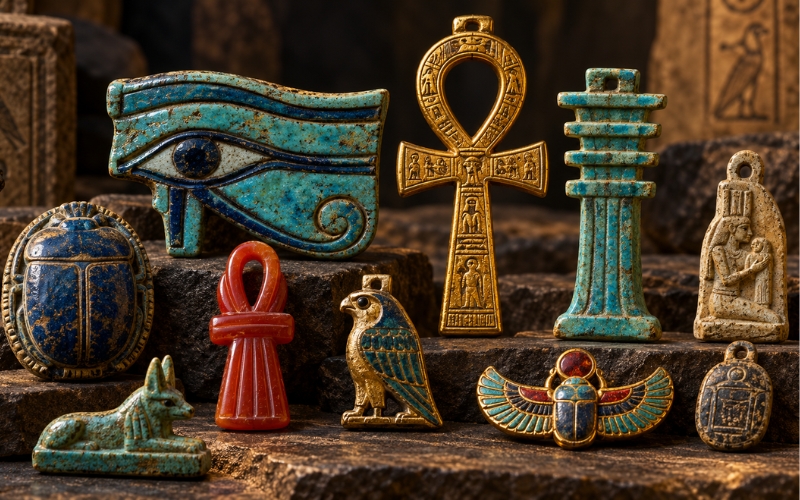
Quick Answer: What Are Ancient Egyptian Amulets?
Ancient Egyptian amulets were small protective objects believed to provide health, strength, safety, good fortune, and renewal. Egyptians wore them as jewelry, carried them as charms, and placed them within mummy wrappings to protect the deceased in the afterlife. Their meanings came from religious symbols, gods, animals, colors, and materials. Famous examples include the Eye of Horus, scarab beetle, ankh, djed pillar, and tyet knot.
A small blue eye, a carved beetle, or a red knot could mean much more to an ancient Egyptian than its size suggested. These objects were personal connections to beliefs about protection, healing, divine assistance, and life after death.
Some amulets were worn by children and adults. Others were made specifically for burial. A wealthy Egyptian might own elaborate gold jewelry decorated with protective symbols, while someone of more modest means could wear a simple blue-green faience charm.
What makes ancient Egyptian amulets especially interesting is the relationship between their appearance and their purpose. The Eye of Horus represented restoration after injury. The scarab reflected the renewal of the sun. The djed pillar symbolized stability, while a heart scarab addressed the deceased person’s judgment in the afterlife.
Understanding these differences reveals an important part of everyday Egyptian life and helps travelers recognize meaningful details in the country’s archaeological museums.
What Are Ancient Egyptian Amulets, and Why Were They Important?
Ancient Egyptian amulets were objects believed to transfer beneficial qualities or supernatural protection to their owners. They formed part of Egyptian religious practice for thousands of years, from early prehistoric traditions through the pharaonic periods and into Greco-Roman Egypt.
Most amulets were relatively small. They could be suspended from necklaces, incorporated into bracelets, attached to clothing, placed in fabric pouches, or positioned among the wrappings of a mummy.
Their designs were often familiar religious symbols. Others represented animals, deities, parts of the human body, or everyday objects.
Amulets were not necessarily separate from practical life. A scarab could function as a protective charm and as a seal used to make an impression in clay. A pendant could serve as personal decoration and communicate a religious hope.
Egyptians also used protective images on coffins, temple walls, furniture, and ritual equipment. Although these images shared symbolism with amulets, not every religious image was itself an amulet.
What was the purpose of Egyptian amulets?
The main purpose depended on the particular object.
Some were intended to protect against illness or danger. Others expressed the desire for life, stability, good health, fertility, or successful childbirth.
Funerary amulets could help safeguard the deceased person’s body, maintain bodily integrity, or support regeneration and continued existence after death.
An amulet’s significance might also depend on its color, material, inscription, or position on the body.
For example, the same protective eye symbol could appear in a living person’s necklace and in a burial. Its broad association with protection remained relevant, but its immediate context changed.
Were amulets considered magical?
Ancient Egyptians understood supernatural power through concepts that included heka, often translated as magic.
Heka was closely connected with religion and the functioning of the universe. It was not necessarily regarded as separate from the activities of the gods or from accepted religious practice.
An amulet might be considered effective because of its sacred shape, material, color, written signs, or the words and rituals associated with it.
The Egyptians believed such objects could provide real protection.
Modern historical interpretation explains those beliefs without treating their supernatural effectiveness as scientifically established.
What is the difference between an amulet and a talisman?
In modern usage, an amulet generally emphasizes protection, while a talisman may be intended to bring a desired benefit, such as strength or success.
However, the distinction is not always helpful when describing ancient Egyptian objects.
A scarab might be associated with protection, rebirth, and personal identity. A djed pillar could communicate stability while also supporting religious hopes for continued life.
Both terms can be used broadly, but the original context matters more than assigning a rigid modern category.
For related background, explore ancient Egyptian symbols and their meanings.
Why Did Ancient Egyptians Believe They Needed Amulets?
Ancient Egyptians lived with many of the same concerns that affect human life today: illness, family safety, childbirth, uncertainty, injury, and death.
Their religious traditions provided ways of responding to these concerns.
Amulets made particular hopes and beliefs visible through physical objects.
Protection during everyday life
An individual might wear a protective eye, divine figure, or other sacred symbol as part of daily clothing.
The object could express a desire for safety or provide reassurance through its religious meaning.
Protective objects were especially important in areas of life involving uncertainty.
This did not mean Egyptians relied only on charms. Ancient Egypt also developed medical practices, practical treatments, and specialized knowledge about the body.
Religious protection existed alongside other responses to illness and danger.
Protection during pregnancy and childbirth
Pregnancy and childbirth involved significant risks in the ancient world.
Deities such as Taweret and Bes became closely associated with protecting women, infants, and households.
Their images could appear in personal ornaments, domestic religious objects, and other forms of protective decoration.
The popularity of these figures reveals that Egyptian religion was not limited to royal temples and monumental ceremonies. It also addressed private family concerns.
Strength and well-being
Some amulets represented desirable qualities rather than protection from a specific danger.
The ankh symbolized life.
The djed pillar represented stability.
The papyrus column suggested freshness and vitality.
Wearing these symbols could express hopes for a long, healthy, and secure existence.
Protection after death
Death introduced another set of religious concerns.
Ancient Egyptians developed complex beliefs concerning the preservation of the body, the survival of personal identity, divine judgment, and the possibility of continued existence.
Funerary amulets formed part of the preparations for that transition.
Their forms and placement could relate to particular religious needs.
A heart scarab, for example, had a specialized role connected with the judgment of the dead, while a two-finger amulet was associated with protecting the incision made during mummification.
20 Ancient Egyptian Amulets and Their Meanings
Many Egyptian amulets are recognizable because their designs remained popular for centuries.
The following guide explains 20 important symbols and amulet types, including their historical meanings and the characteristics that help identify them.
Some could be used during life and after death. Others were particularly associated with funerary practices.
Ancient Egyptian Amulets and Their Meanings at a Glance
| Ancient Egyptian amulet | Main meaning | Typical historical use |
|---|---|---|
| Eye of Horus (Wedjat) | Protection, healing, restoration | Personal and funerary |
| Scarab Beetle | Rebirth, transformation, renewal | Jewelry, seals, burials |
| Heart Scarab | Protection during judgment | Funerary |
| Ankh | Life and vitality | Jewelry, religious imagery |
| Djed Pillar | Stability and endurance | Personal and funerary |
| Tyet Knot | Protection associated with Isis | Personal and funerary |
| Shen Ring | Encirclement, continuity, protection | Religious and royal |
| Sa Symbol | Protection | Personal and religious |
| Wadj Column | Freshness and regeneration | Personal and funerary |
| Heart Amulet | Protection of the heart | Funerary |
| Two-Finger Amulet | Healing the embalming incision | Funerary |
| Headrest Amulet | Protection of the head and renewal | Funerary |
| Bes Amulet | Household and family protection | Personal and domestic |
| Taweret Amulet | Pregnancy and childbirth protection | Personal and domestic |
| Heqet Frog | Birth, fertility, renewed life | Personal and funerary |
| Bastet Cat | Divine feline protection | Religious and personal |
| Isis Amulet | Maternal and divine protection | Personal and funerary |
| Horus the Child | Protection and survival | Personal and funerary |
| Cobra or Uraeus | Divine and royal protection | Royal, religious, funerary |
| Nefer Amulet | Goodness and favorable qualities | Personal and funerary |
These are broad associations rather than fixed meanings that apply equally to every artifact. Archaeologists also consider the object’s age, material, inscription, and original context.
1. Eye of Horus Amulet: Protection, Healing, and Restoration
The Eye of Horus, also called the Wedjat or Udjat Eye, is one of the most famous protective symbols from ancient Egypt.
Its design combines a stylized human eye with markings associated with the falcon, an animal closely connected with the god Horus.
The meaning comes from the mythological conflict between Horus and Seth.
In important versions of the story, the eye of Horus was damaged or taken during their struggle. The god Thoth restored the eye, making it complete again.
This act of restoration gave the symbol its close relationship with healing and wholeness.
The Egyptian term wedjat conveys the idea of something sound or restored.
What does the Eye of Horus amulet mean?
The Eye of Horus represents protection, healing, completeness, and regeneration. Ancient Egyptians believed it could help safeguard a living person or support the deceased during the journey into the afterlife.
Wedjat amulets appeared in several materials, including faience, stone, and precious metals.
Small examples were incorporated into necklaces and other jewelry. Others were placed on mummified bodies.
Some surviving examples are only a few centimeters across, yet their religious imagery is carefully executed.
How to recognize it: Look for the characteristic eyebrow, extended cosmetic line, and curved markings beneath the eye.
Eye of Horus vs. Eye of Ra
The Eye of Horus and Eye of Ra are related but distinct traditions within Egyptian mythology.
The Eye of Horus is particularly associated with restoration following injury.
The Eye of Ra expresses the solar god’s power and can be personified through protective or destructive divine figures.
Their meanings sometimes overlap, and simple left-eye versus right-eye rules do not reliably explain every ancient object.
For a clearer comparison, see the differences between the Eye of Ra and Eye of Horus.
2. Scarab Beetle Amulet: Rebirth and Transformation
The scarab beetle became an important symbol of regeneration because of its connection with the movement and renewal of the sun.
Ancient Egyptians observed dung beetles rolling balls across the ground.
This behavior helped inspire comparisons with the sun moving across the sky.
The emergence of young beetles from buried material also encouraged associations with new life.
The scarab became closely linked to Khepri, a manifestation of the rising sun.
The Egyptian word kheper is associated with becoming or coming into existence.
What does a scarab beetle amulet mean?
A scarab amulet represents renewal, transformation, and rebirth. Depending on its design and inscription, it could also function as a protective ornament or a personal seal.
Not all Egyptian scarabs had the same purpose.
Some were decorative objects worn on necklaces or rings.
Others had flat undersides engraved with hieroglyphs, symbols, or names.
These carved bases could be pressed into clay to create seal impressions.
A seal helped identify an owner or secure containers and documents.
This practical function makes scarabs particularly interesting because they connected religious symbolism with administrative life.
Some scarabs also carried royal names or commemorative inscriptions.
How to recognize it: Examine the beetle’s rounded body, head, and wing-case markings. If possible, inspect the underside for carved designs.
The meaning of the scarab beetle in ancient Egypt offers more context about its symbolism and history.
3. Heart Scarab Amulet: Protection During the Weighing of the Heart
A heart scarab was a specialized funerary amulet designed to support the deceased during judgment in the afterlife.
Although it resembles an ordinary scarab, its religious function was more specific.
Ancient Egyptians considered the heart essential to memory, thought, conscience, and personal identity.
In funerary belief, the deceased could face judgment in a ceremony commonly called the Weighing of the Heart.
The heart was weighed against the feather associated with Ma’at, the principle of truth and cosmic order.
A favorable outcome was necessary for successful continued existence.
The heart scarab helped address the danger that a person’s heart might testify against them.
What was written on heart scarabs?
Some examples were inscribed with words associated with Spell 30B of the Book of the Dead.
The spell appealed to the heart not to stand against its owner during judgment.
This is why heart scarabs should not be understood simply as ordinary beetle-shaped good luck charms.
Their purpose was directly related to funerary religion.
Heart scarabs were commonly made from stone or other materials and could be incorporated into elaborate pectorals.
Some were placed over the torso of the deceased.
How to recognize it: Heart scarabs are often larger than typical scarab seals. A flat base containing several lines of hieroglyphs may help identify a funerary example, although not every heart scarab is inscribed.
4. Ankh Amulet: The Symbol of Life
The ankh is among the most recognizable signs of ancient Egyptian civilization.
It resembles a cross topped by an oval loop.
The symbol represents life and appears frequently in Egyptian religious art and writing.
Deities are often depicted holding ankhs or presenting them toward kings.
These scenes communicate the gift or transmission of life.
The ankh’s meaning made it suitable for jewelry, ritual objects, and funerary contexts.
What is the meaning of an ankh amulet?
The ankh primarily represents life. In certain religious and funerary settings, it also expresses continued existence and the life-giving power of the gods.
Modern explanations frequently describe the ankh only as a symbol of eternal life.
Although that association is relevant to its funerary use, the ancient meaning was broader.
Ankh-shaped objects could be made from metal, stone, faience, and other materials.
Some were simple pendants. Others appeared within elaborate arrangements of sacred signs.
How to recognize it: The oval loop is the clearest feature distinguishing the ankh from a conventional cross.
The ankh also appears alongside the djed and was scepter in Egyptian imagery. Together, these signs communicate concepts associated with life, stability, and power.
5. Djed Pillar Amulet: Stability and Endurance
The djed pillar is an upright symbol with several horizontal bars near the top.
It represented stability, endurance, and permanence.
Over time, it developed a particularly strong association with Osiris, the god closely connected with death, resurrection, and restored life.
The djed was interpreted in religious traditions as representing the backbone of Osiris.
This association strengthened its connection with bodily integrity and continued existence.
The ritual raising of the djed pillar expressed the restoration of stability and order.
What does a djed pillar amulet mean?
A djed amulet symbolizes stability and endurance. In funerary contexts, its relationship with Osiris also connected it with resurrection and the preservation of the deceased.
Many small examples were made from blue or green faience.
Others were produced in stone or more expensive materials.
The djed was not limited to burial practices.
It appeared in decorative compositions, religious scenes, and personal ornaments.
How to recognize it: Look for the upright central body and a series of short horizontal crossbars at the top.
Djed pillar vs. ankh: The ankh symbolizes life, while the djed emphasizes stability. Their combination could express hopes for lasting life.
6. Tyet Amulet: The Knot of Isis
The tyet is often called the Knot of Isis or Girdle of Isis.
It resembles a looped knot with two downward-curving side elements.
The shape can look similar to an ankh, but the details are different.
The tyet became closely associated with Isis, one of the most important Egyptian goddesses.
Isis protected Horus, helped restore Osiris, and embodied powerful religious ideas about motherhood, protection, and regeneration.
These associations made the tyet particularly suitable for personal and funerary protection.
What does the tyet amulet mean?
The tyet represents protective power associated with Isis. In burial traditions, it could help express the protection and regeneration desired for the deceased.
Red stones such as carnelian were used for some examples.
Red was a meaningful color in Egyptian religious symbolism, although its interpretation was not identical in every context.
The connection between the knot, Isis, blood, and protective power appears in funerary traditions.
However, not every surviving tyet amulet was necessarily made from red stone.
Examples also exist in other materials.
How to recognize it: The tyet has a rounded upper loop and downward-curving side elements, giving it the appearance of a tied cloth knot.
7. Shen Ring Amulet: Eternity, Encirclement, and Protection
The shen sign resembles a loop of rope forming a circle with a short closing element.
Its central idea was encirclement.
In Egyptian religious symbolism, this could express protection, completeness, and continuity.
A related elongated form was used in the royal cartouche, which enclosed the names of kings.
The concept of surrounding something within a protected boundary contributed to the sign’s meaning.
What did the shen ring symbolize?
A shen amulet represented protective encirclement and continuity. Its circular form could also communicate the idea of something enduring.
The shen appeared in royal and divine imagery as well as amuletic objects.
Some Egyptian protective figures hold or appear near shen signs.
The symbol therefore belongs to a broader visual language of divine protection.
How to recognize it: Look for a circular rope-like loop with a short straight element forming its base.
Not every circular pendant is a shen ring. A secure identification depends on its particular shape and archaeological interpretation.
8. Sa Amulet: A Direct Symbol of Protection
The sa sign is associated with protection in Egyptian hieroglyphic writing.
It has a distinctive looped and folded appearance that differs from the more familiar ankh or scarab.
The sign appears in Egyptian protective imagery, including contexts involving divine protection and family safety.
Its symbolism is relatively direct compared with objects that have more elaborate mythological stories.
What was the purpose of a sa amulet?
A sa amulet expressed the desire for protection.
Its meaning was related to safeguarding the individual rather than representing one particular event in Egyptian mythology.
Sa signs appear in different materials and combinations.
Some were incorporated into personal ornaments or used alongside other religious images.
Because the form is less familiar to many modern visitors, it may be overlooked in museum collections.
How to recognize it: The most reliable approach is to compare the object with a properly identified sa symbol on a museum label or artifact catalogue.
Its unusual form can be difficult to distinguish from other stylized signs without context.
9. Wadj Amulet: The Papyrus Symbol of Freshness
The wadj amulet takes the form of a papyrus column or stem.
Papyrus was a familiar plant in the Nile environment.
Its association with water, vegetation, and fertile landscapes gave it important religious symbolism.
The Egyptian term wadj connects with greenness and freshness.
These qualities made the papyrus form appropriate for amulets associated with vitality.
What does a wadj amulet mean?
A wadj amulet represents freshness, vigor, and regeneration.
Green and blue-green materials could reinforce its symbolic association with life.
Small papyrus-column amulets were sometimes placed in funerary contexts.
Their purpose related to maintaining or renewing the qualities represented by the living plant.
Papyrus also had broader significance in Egyptian art and architecture.
Stylized plant forms appear in columns, decorative designs, and religious objects.
How to recognize it: Look for a slender upright stem with a stylized papyrus-shaped upper section.
10. Heart Amulet: Protecting the Center of Personal Identity
The heart had a particularly important place in ancient Egyptian religious thought.
Egyptians understood it as a center of thought, memory, feeling, and moral responsibility.
The heart was therefore closely connected with the identity of the individual.
In funerary beliefs, it also played an essential role in judgment.
Heart-shaped amulets were made to safeguard the heart and support the deceased.
What does an Egyptian heart amulet symbolize?
A heart amulet represents the protection of the heart and the preservation of the qualities associated with it.
Some examples were inscribed with funerary texts similar to those found on heart scarabs.
Others used the form itself as the primary symbol.
Ancient representations of the heart do not normally resemble the symmetrical modern Valentine’s Day heart.
They often appear more like a small vessel with projections or handles.
How to recognize it: Look for a stylized vessel-like shape that may include a narrow upper element or side projections.
Heart amulet vs. heart scarab: A heart amulet represents the heart itself, while a heart scarab uses the beetle form. Both can relate to judgment and funerary protection.
11. Two-Finger Amulet: Healing the Mummification Incision
The two-finger amulet is one of the most unusual objects found in Egyptian funerary contexts.
It represents two extended human fingers.
Unlike many symbols worn by living people, this particular amulet type was specifically associated with the dead.
The first examples are characteristic of Egypt’s Late Period, particularly from the Twenty-Sixth Dynasty onward.
During mummification, embalmers often made an incision on the left side of the torso to remove internal organs.
Two-finger amulets were sometimes positioned close to this area.
What did the two-finger amulet protect?
The two-finger amulet was believed to symbolically heal or protect the incision created during embalming.
Its placement helps explain its meaning.
Without knowing the archaeological context, two carved fingers might appear mysterious.
Their relationship with the embalming process provides a much more specific explanation.
Obsidian and other dark materials were commonly used.
Some examples were also gilded.
How to recognize it: Look for two adjoining human fingers carved in dark stone, glass, or another material.
This is a good example of why amulet identification requires attention to both shape and archaeological context.
12. Headrest Amulet: Protection and Reawakening
Ancient Egyptians used headrests as practical supports for the head while resting or sleeping.
Full-sized examples could be made from wood, stone, or other materials.
Miniature headrests also became funerary amulets.
These small objects transformed familiar household equipment into a symbol associated with protecting the deceased.
What does a headrest amulet mean?
A headrest amulet was intended to protect the head and assist the deceased in being raised or restored to life.
Some interpretations also connect the shape with the rising sun.
The curved support could evoke an image of elevation and renewal.
This relationship between an everyday object and a religious idea is characteristic of Egyptian amuletic practice.
Not every miniature headrest necessarily had the same use, but the funerary meaning is well established for this object type.
How to recognize it: The amulet resembles a small curved support resting on a short central column or base.
13. Bes Amulet: Protection of Children and Households
Bes was a protective deity closely associated with family life.
He often appears as a short, powerful figure with a distinctive face.
Unlike many Egyptian gods shown in profile, Bes is frequently represented facing forward.
This makes his image particularly recognizable on small amulets.
Bes was connected with protecting women and children, especially during childbirth.
His imagery also appears in settings related to music, dancing, and household celebrations.
What does a Bes amulet protect?
A Bes amulet was believed to help protect people from danger and harmful supernatural influences, especially in domestic and family contexts.
The deity’s striking appearance was part of his protective identity.
His image could be frightening to hostile forces while reassuring to the person seeking protection.
Small representations were made from faience, stone, and other materials.
The popularity of Bes demonstrates that ancient Egyptian religion involved ordinary households as well as temples.
How to recognize it: Look for a compact standing figure with a prominent face, broad features, and often a feathered headdress.
14. Taweret Amulet: Protection During Pregnancy and Childbirth
Taweret was a protective goddess with strong connections to pregnancy, childbirth, and motherhood.
She is usually represented as a standing pregnant hippopotamus-like figure with features borrowed from other powerful animals.
Her unusual appearance reflects an important principle of Egyptian protective imagery.
The strength of dangerous animals could be represented as a force that defended vulnerable people.
Taweret’s role was therefore protective rather than simply frightening.
What does a Taweret amulet mean?
A Taweret amulet invoked protection for pregnancy, birth, children, and the household.
Her image appeared in personal and domestic religious objects.
Although she was especially connected with childbirth, Taweret’s protective significance was broader than a single event.
Her popularity provides insight into the religious concerns of Egyptian families.
How to recognize it: Look for a standing pregnant hippopotamus with human-like limbs and distinctive animal features.
The details distinguish Taweret from ordinary hippopotamus figures in Egyptian art.
15. Heqet Frog Amulet: Fertility, Birth, and Renewal
Frogs were closely connected with the Nile environment.
Their appearance in large numbers around water and seasonal cycles made them suitable symbols of generation and renewed life.
The goddess Heqet, also spelled Heket, was associated with birth.
She could be represented as a frog or a woman with a frog’s head.
Small frog-shaped amulets drew on these associations.
What does an Egyptian frog amulet mean?
A frog amulet can represent fertility, childbirth, and renewal, particularly when associated with Heqet.
Some examples were worn as personal ornaments.
Others appear in funerary settings, where regeneration was an important religious concern.
It is worth remembering that animal symbolism did not always have one fixed meaning.
The object’s age, design, and original location may influence how it should be interpreted.
How to recognize it: Look for a crouching frog shape with a rounded body and recognizable hind legs.
Many surviving examples were carved in stone or made from glazed materials.
16. Bastet Cat Amulet: Feline Protection
Cats held an important place in ancient Egyptian religious imagery.
The goddess Bastet became closely associated with the domestic cat, although her identity and representation developed over time.
Bastet was a protective goddess with connections to household life, divine power, and religious devotion.
Small cat-shaped objects became especially prominent in some later periods of Egyptian history.
What does an ancient Egyptian cat amulet mean?
A cat amulet could invoke the protection of Bastet.
However, not every small Egyptian cat figure was intended to be worn as an amulet.
Some were votive offerings dedicated to a deity.
Others were religious figurines or decorative objects.
A votive offering was an object given in a religious context, often as an expression of devotion or a request for divine assistance.
This distinction is important when identifying cat artifacts.
How to recognize it: Look for a feline figure and examine whether it has a suspension loop or other evidence suggesting that it was worn.
For deeper historical context, explore the Egyptian goddess Bastet and her religious significance.
17. Isis Amulet: Divine and Maternal Protection
Isis was one of ancient Egypt’s most significant goddesses.
She played a central role in the mythology of Osiris and Horus.
According to these traditions, Isis helped restore Osiris and protected their son Horus from danger.
Her religious identity therefore combined powerful associations with motherhood, protection, healing, and restoration.
Small amulets could show Isis as a standing or seated goddess.
Others depicted her with the infant Horus.
What does an Isis amulet symbolize?
An Isis amulet represents divine protection, particularly through the goddess’s maternal and restorative roles.
In funerary contexts, her connection with Osiris also made her important to beliefs about rebirth.
Some Isis amulets used the goddess’s human form.
Others relied on symbols associated with her, including the tyet knot.
It is important to distinguish these forms rather than treating every Isis-related object as the same amulet type.
How to recognize it: Isis may wear a throne-shaped hieroglyph on her head. Other headdresses also occur, so the surrounding imagery and inscriptions matter.
The wider relationships between Isis, Osiris, Horus, and other Egyptian deities are explained in this guide to ancient Egyptian gods and goddesses.
18. Horus the Child Amulet: Protection and Survival
Horus the Child represents the god Horus in his youthful form.
He is sometimes known by the Greek-derived name Harpocrates in later traditions.
Egyptian myths describe the young Horus as vulnerable to dangers that threatened his survival.
He was protected by Isis and other divine figures.
These stories made his image meaningful in protective religious contexts.
What does a Horus the Child amulet mean?
An amulet representing Horus as a child could express protection, recovery, and overcoming danger.
He is often recognizable by the sidelock of youth and a finger raised toward his mouth.
This gesture belongs to Egyptian conventions for depicting children.
It should not automatically be interpreted as a modern gesture asking for silence.
Some protective images show Horus together with Isis or other gods.
Their arrangement reinforces the theme of divine care.
How to recognize it: Look for a youthful male figure with a sidelock of hair and the characteristic finger-to-mouth gesture.
19. Cobra or Uraeus Amulet: Royal and Divine Protection
The cobra was an important protective image in ancient Egyptian religion.
A rearing cobra could represent the goddess Wadjet, who was closely associated with Lower Egypt and the protection of kingship.
The raised cobra that appears on royal crowns is commonly called the uraeus.
Its significance included divine authority and the ability to repel enemies.
The cobra’s dangerous nature made it a suitable symbol for force directed against threats.
What does a cobra amulet mean?
An Egyptian cobra amulet could symbolize protective divine power.
Its meaning often related to Wadjet, the sun, or royal authority, depending on its design and context.
Cobra imagery also overlaps with religious traditions involving the Eye of Ra.
In these traditions, powerful divine forces could defend the sun god and maintain order.
How to recognize it: Look for a cobra with its head raised and its hood expanded.
The symbol is particularly recognizable on royal crowns and protective religious objects.
20. Nefer Amulet: Goodness, Beauty, and Well-Being
The nefer sign is an Egyptian hieroglyph associated with goodness, beauty, and favorable qualities.
Its form is often interpreted as combining features of the heart and windpipe.
The sign appears in Egyptian writing, personal names, and decorative compositions.
It could also be used as an amulet.
What does a nefer amulet mean?
A nefer amulet expresses desirable qualities such as goodness, beauty, or a favorable condition.
Its meaning was broader than the modern idea of a lucky charm.
Nefer signs could appear individually or alongside other protective and life-giving symbols.
The combination of signs may influence the interpretation of the complete object.
How to recognize it: Look for the distinctive upright form of the nefer hieroglyph, often with projecting elements near its upper section.
Because similar shapes can occur in Egyptian design, the museum’s identification remains important.
Which Ancient Egyptian Amulet Was the Most Powerful?
There was no single Egyptian amulet that was universally considered the most powerful for every purpose.
Different symbols addressed different needs.
The Eye of Horus was widely associated with protection and restoration.
The scarab symbolized regeneration and renewal.
The djed pillar expressed stability.
A heart scarab had a specialized role connected with judgment in the afterlife.
Comparing these objects as though they competed in a modern ranking overlooks their different religious functions.
The more useful question is which amulet was appropriate for a particular concern.
| Purpose | Relevant ancient Egyptian amulets |
|---|---|
| General protection | Eye of Horus, Sa |
| Life and vitality | Ankh, Wadj |
| Rebirth and renewal | Scarab, Eye of Horus |
| Stability | Djed Pillar |
| Motherhood and childbirth | Taweret, Bes, Heqet |
| Maternal divine protection | Isis, Horus the Child |
| Royal protection | Cobra, Uraeus |
| Protection during afterlife judgment | Heart Scarab, Heart Amulet |
| Mummification protection | Two-Finger Amulet, Headrest Amulet |
| Favorable qualities | Nefer |
A modern reader can understand these differences without accepting the historical supernatural claims as scientific facts.
What Were Ancient Egyptian Amulets Made Of?
The material of an Egyptian amulet was often just as meaningful as its shape.
Ancient Egyptian craftsmen used materials including faience, stone, gold, silver, electrum, glass, and other substances.
The choice could reflect cost, availability, technical skill, religious symbolism, or a combination of these factors.
Blue-green faience was particularly common, while elaborate gold and gemstone jewelry is especially well represented in elite and royal contexts.
Egyptian faience
Egyptian faience is one of the most characteristic materials used for ancient amulets.
Despite its ceramic-like appearance, it was primarily made from quartz-rich materials rather than ordinary clay.
The finished objects often have bright blue or green glazed surfaces.
These colors were significant in Egyptian religious symbolism.
Blue could evoke water and celestial associations.
Green could represent vegetation, freshness, and regeneration.
Faience was versatile and suitable for producing many small shapes.
Craftworkers could mold protective eyes, scarabs, divine figures, and other forms.
This flexibility helped make amulets available to people beyond wealthy households.
However, not every blue-green Egyptian object was faience. Similar colors could also be produced through other stones and materials.
Gold
Gold was highly valued in ancient Egypt.
Its visual qualities and resistance to corrosion made it appropriate for prestigious religious objects.
Gold could be associated with divine qualities and enduring existence.
Royal jewelry incorporated gold in settings, pendants, and elaborate pectorals.
The use of gold communicated wealth and craftsmanship, but the religious power associated with an amulet was not understood as depending on price alone.
A simple faience object could express the same symbolic idea as a costly gold example.
Carnelian
Carnelian is a red or orange variety of chalcedony.
Its warm color made it suitable for jewelry and certain protective symbols.
Red had complex meanings in ancient Egypt.
It could be associated with danger and powerful forces, but those same qualities could be used protectively in religious contexts.
Some tyet amulets were made from carnelian.
The material reinforced particular symbolic associations, although not every red Egyptian amulet had the same purpose.
Lapis lazuli
Lapis lazuli was prized for its deep-blue appearance.
It was used in Egyptian jewelry and decorative objects, including some items involving religious symbols.
Its color could communicate celestial or divine associations.
The use of imported materials also reflects the long-distance exchange networks that connected Egypt with other regions.
It is important not to mistake every dark-blue artifact for lapis lazuli.
Glass, faience, and other stones could produce visually similar results.
Green stones
Green-colored stones were frequently suitable for objects connected with vitality and regeneration.
The exact minerals varied.
The choice of material could reinforce the meaning of plant-related shapes such as the papyrus column.
However, green was not a universal indicator of one specific religious purpose.
Shape and context remained essential.
Obsidian and dark stones
Obsidian is a dark volcanic glass.
It was used for some specialized Egyptian amulets, including examples of the two-finger type.
Other dark stones could also be selected for funerary purposes.
A black amulet should not automatically be interpreted as a symbol of evil.
Dark materials could have different religious meanings, and their use depended on the individual object.
Glass
Glass became an important material in Egyptian jewelry and decoration.
Its ability to produce rich colors made it suitable for symbolic objects.
Glass amulets could imitate the appearance of more expensive materials while creating visually striking effects.
The period and manufacturing technique should be considered when interpreting a glass artifact.
Materials Comparison
| Material | Common appearance | Why it mattered |
|---|---|---|
| Faience | Blue, turquoise, green | Accessible material with regenerative color associations |
| Gold | Yellow metallic | Prestige, durability, divine qualities |
| Carnelian | Red or orange | Protective and life-related associations |
| Lapis Lazuli | Deep blue | Celestial associations and prestige |
| Green stones | Various shades of green | Freshness and regeneration |
| Obsidian | Dark, glassy | Specialized ritual and funerary uses |
| Glass | Wide color range | Decorative and symbolic flexibility |
| Steatite | Soft stone, sometimes glazed | Frequently used for carved scarabs and seals |
Important: The color of an amulet is a useful clue, but it cannot establish the object’s complete meaning by itself.
How Were Ancient Egyptian Amulets Made?
Ancient Egyptian amulets were produced through several manufacturing techniques.
The process depended on the material, intended shape, and level of detail.
A carved stone scarab required different techniques from a molded faience eye or a gold pendant.
Carving stone amulets
Craftworkers selected a suitable stone and gradually shaped it using tools and abrasive materials.
A scarab required forming the beetle’s body, head, and wing-case details.
The underside could be engraved with a name, image, or inscription.
If the amulet was intended for suspension, a hole might be drilled through the object.
Small carving details are especially useful to researchers because they reveal both technical skill and design conventions.
Producing faience amulets
Faience involved preparing a quartz-rich mixture that could be shaped into the desired form.
Molds were useful for producing repeated designs.
The shaped object was dried and fired to create its glazed appearance.
The exact techniques varied across Egypt’s long history.
The result could be a bright protective object with a recognizable religious shape.
Producing faience required technical knowledge, even when the finished amulet was inexpensive.
Metalworking and jewelry
Metal amulets could be made through shaping, hammering, casting, engraving, and other techniques appropriate to the object.
Goldsmiths also combined metal with stones, glass, or faience.
Elaborate pectorals could include several symbolic images within one carefully arranged composition.
These pieces demonstrate the close relationship between craftsmanship and religion.
Adding inscriptions
Not every Egyptian amulet had written text.
Some relied entirely on a recognizable symbol.
Others carried names, royal titles, protective words, or funerary formulas.
The underside of a scarab seal could contain practical identifying information.
The underside of a heart scarab might preserve a religious text connected with afterlife judgment.
These differences help explain the object’s function.
How Did Ancient Egyptians Believe Amulets Worked?
Ancient Egyptians believed that the protective qualities of an amulet could come from several connected features.
The shape might identify a sacred concept.
The material or color could reinforce its meaning.
Written words or ritual actions might contribute to its intended effectiveness.
The object could then be worn, carried, or positioned in a specific place.
Shape and symbolism
The clearest source of meaning was often the object’s shape.
An ankh represented life.
A djed pillar represented stability.
A scarab reflected renewal.
A divine figure connected the wearer with the deity represented.
This allowed Egyptians to communicate religious hopes through small physical objects.
Color and material
Colors could strengthen religious associations.
Blue and green often related to renewal, water, or vegetation.
Red could communicate powerful or protective qualities.
Gold could express enduring and divine characteristics.
However, these patterns were flexible rather than rigid rules.
A particular artifact’s context must be considered before assigning an interpretation.
Ritual words and actions
Some amulets were associated with spoken formulas, inscriptions, or ritual procedures.
These elements formed part of ancient Egyptian religious practice.
It would be inaccurate to claim that every amulet required one standardized ceremony to become effective.
Egyptian traditions developed over thousands of years and varied by object, period, and purpose.
Position on the body
Placement could be particularly important.
A protective necklace was visible as personal jewelry.
A heart scarab placed near the torso had a funerary function associated with the heart.
A two-finger amulet positioned near the embalming incision related to a specific concern about bodily integrity.
This explains why archaeologists study the original location of an amulet as carefully as its appearance.
Ancient Egyptian Amulets for the Living and the Dead
The difference between amulets worn during life and those placed in burials is one of the most important parts of the subject.
Some types served both groups.
Others had specialized funerary functions.
| Feature | Amulets for the living | Funerary amulets |
|---|---|---|
| Main purpose | Health, safety, family protection | Preservation, judgment, regeneration |
| Typical location | Jewelry, clothing, personal possessions | Mummy wrappings, coffins, body |
| Examples | Wedjat Eye, Bes, Taweret, Scarab | Heart Scarab, Two-Finger, Headrest |
| Materials | Faience, metal, stone, glass | Faience, stone, metal, glass |
| Religious concern | Present well-being | Continued existence after death |
Amulets worn during life
Protective ornaments could be part of ordinary clothing.
They might appear as necklaces, bracelets, pendants, or rings.
A personal seal could also carry symbolic meaning.
Some people may have kept amulets in wrapped bundles or attached them to other objects rather than wearing them visibly.
The variety of forms suggests that protective practices were integrated into daily life.
Amulets placed with the dead
Funerary amulets reflected beliefs about what happened after death.
Ancient Egyptians placed great importance on preserving the body and preparing the deceased for continued existence.
Protective objects could address different needs.
Some were associated with the heart.
Others protected parts of the body or invoked divine assistance.
These objects were often combined with coffins, funerary texts, and other burial equipment.
To understand their wider archaeological setting, it is useful to examine the role of canopic jars in ancient Egyptian burial customs.
Why were amulets placed inside mummy wrappings?
The placement of amulets among mummy bandages formed part of certain Egyptian funerary preparations.
Their intended functions included preserving bodily integrity and supporting the deceased’s transition into the afterlife.
Some objects were positioned on particular parts of the body.
Their placement could reflect a relationship between the object and the body area it was intended to protect.
However, mummification practices and amulet arrangements changed over time.
There was no single arrangement that applied to every Egyptian mummy throughout history.
Did everyone receive funerary amulets?
No.
Burial customs varied according to period, local traditions, wealth, and religious practice.
Some burials contained numerous protective objects.
Others contained fewer, simpler pieces or none that have survived.
The absence of an amulet does not prove that a person lacked religious beliefs.
Organic materials may have decayed, tombs may have been disturbed, and some objects may have been removed in antiquity.
Ancient Egyptian Amulets and the Book of the Dead
The Book of the Dead was not a single book written by one author.
It was a collection of funerary spells and texts that developed within Egyptian religious traditions.
Different copies could contain different selections of spells.
These texts were intended to help the deceased navigate the challenges of the afterlife.
Some amulets had direct relationships with particular funerary formulas.
The importance of the heart
Ancient Egyptian beliefs about judgment gave the heart a central role.
The heart was associated with the person’s thoughts, memory, and moral responsibility.
During judgment, it could be weighed against the feather of Ma’at.
This created a concern that the heart might speak against its owner.
Spell 30B and heart scarabs
Spell 30B is especially associated with heart scarabs.
Its purpose included preventing the deceased person’s heart from opposing them during judgment.
Some heart scarabs and heart-shaped amulets preserve versions of this text.
The inscription provides a valuable clue about the object’s function.
It connects the physical amulet to a specific religious belief.
Why inscriptions matter
Without the inscription, a heart scarab might appear to be an elaborate beetle-shaped ornament.
The funerary text reveals its intended purpose much more clearly.
This is why an artifact’s meaning cannot always be determined from appearance alone.
Egyptian amulets are best understood through the combination of physical form, historical context, and written evidence.
How Did Egyptian Amulets Change Across Different Dynasties?
Ancient Egyptian amulets were used over an exceptionally long period.
Their shapes and materials changed as Egyptian society, religion, and funerary traditions developed.
Some symbols remained recognizable for centuries, while new amulet types appeared in later periods.
Predynastic Egypt
Protective ornaments existed before the formation of the unified pharaonic state.
Early examples often involved animals and natural forms.
Their exact religious meanings are not always recoverable.
Scholars must avoid assuming that symbols used in later periods already carried identical meanings in prehistoric Egypt.
Nevertheless, these objects show that the tradition of protective personal ornaments had deep roots.
Old Kingdom
The Old Kingdom was the age of the great pyramid-building rulers.
Religious beliefs about kingship, divine power, and the afterlife were increasingly expressed through monumental architecture and funerary practices.
Protective ornaments and symbolic objects also formed part of Egyptian material culture.
Not all later funerary amulet traditions were fully developed at this stage.
The Old Kingdom of Egypt provides important context for the society in which these religious ideas developed.
Middle Kingdom
The Middle Kingdom saw significant developments in personal jewelry and scarab seals.
Scarab-shaped seals became important objects for practical and symbolic use.
Their undersides could carry names, titles, or decorative patterns.
The same object might identify an individual and also express religious protection.
Middle Kingdom jewelry also demonstrates the sophisticated workmanship of Egyptian craftspeople.
New Kingdom
The New Kingdom included rulers such as Hatshepsut, Amenhotep III, Akhenaten, and Tutankhamun.
Royal and elite jewelry from this period demonstrates elaborate combinations of religious symbols and precious materials.
The use of protective imagery was closely connected with religious beliefs about kingship and the afterlife.
Different symbols could appear together within a single pectoral or piece of funerary jewelry.
Third Intermediate Period
Protective and funerary amulets remained important.
A variety of divine, animal, and symbolic forms continued to appear.
Archaeological examples show the importance of religious objects among mummy wrappings and burial equipment.
The use of faience and other materials also remained significant.
Late Period
The Late Period was especially important for the development and widespread use of funerary amulets.
Specialized forms, including two-finger amulets, became prominent.
Some mummies received numerous protective objects arranged around the body.
These arrangements reflected complex concerns about bodily preservation and regeneration.
Ptolemaic and Roman Egypt
Amuletic traditions continued during periods of Greek and Roman rule.
Egyptian religious imagery interacted with changing cultural and artistic contexts.
Some Egyptian symbols also spread beyond Egypt and acquired additional meanings.
This long history helps explain their continuing recognition in modern jewelry and popular culture.
For a broader chronological overview, explore the history of ancient Egypt.
What Do Tutankhamun’s Amulets Reveal About Ancient Egyptian Beliefs?
The burial of Tutankhamun is one of the most famous archaeological discoveries connected with Egyptian funerary customs.
His tomb, KV62, was discovered in the Valley of the Kings in 1922 by Howard Carter’s team.
The burial contained an extraordinary collection of objects intended for the king’s continued existence after death.
Among the treasures were personal ornaments, elaborate jewelry, protective symbols, and funerary equipment.
These objects provide an important opportunity to study how religious imagery functioned within a royal burial.
What types of amulet symbolism appeared in Tutankhamun’s jewelry?
Royal jewelry could combine symbols associated with the sun, life, protection, divine assistance, and regeneration.
Scarab imagery was particularly meaningful because of its connection with rebirth.
Other designs incorporated divine figures or recognizable hieroglyphic symbols.
A single piece of jewelry could express several religious ideas.
The complete composition mattered more than the presence of one isolated symbol.
Were Tutankhamun’s amulets made only from gold?
No.
Although gold is among the most recognizable materials associated with his treasures, Egyptian royal jewelry used several substances.
Gemstones, glass, faience, and other materials contributed color and symbolic meaning.
The combination of materials demonstrated both technical skill and religious intention.
Some royal objects were extraordinarily elaborate, but many underlying symbols were also used by Egyptians outside the royal court.
Why were amulets placed with the king?
Royal funerary preparations were intended to protect the deceased ruler and support his continued existence.
Amulets formed part of a broader system involving coffins, burial equipment, religious texts, and rituals.
Their protective meanings were not simply decorative additions.
They expressed beliefs concerning the body, divine power, and regeneration.
Where can travelers see Tutankhamun’s treasures?
The Grand Egyptian Museum in Giza is a major location for exploring Tutankhamun’s royal objects and funerary equipment.
Its Tutankhamun Galleries connect the discovery of the tomb with the king’s life, burial, and religious beliefs.
For more information about the visitor experience, see the Tutankhamun exhibition at the Grand Egyptian Museum.
The original tomb is located in the Valley of the Kings in Luxor.
Visiting the tomb and viewing artifacts in a museum are different experiences.
The tomb provides archaeological context, while museum displays make it possible to examine individual objects and their craftsmanship.
Where Can You See Ancient Egyptian Amulets in Egypt in 2027?
Egypt’s archaeological museums are the best places to examine authentic amulets and understand how they were used.
Cairo, Giza, and Luxor offer particularly useful opportunities because of their museum collections and proximity to major archaeological sites.
The availability of individual artifacts can change.
Before planning a visit specifically to see a particular object, check current museum displays and access conditions.
Grand Egyptian Museum, Giza
The Grand Egyptian Museum is one of the most important places to explore ancient Egyptian religious beliefs and royal material culture.
Its main galleries present themes including kingship, society, and beliefs.
The Tutankhamun Galleries add important context for royal jewelry and funerary objects.
Visitors interested in amulets should pay particular attention to small artifacts and decorative details.
Look for scarabs, ankh signs, protective eyes, divine figures, and religious inscriptions.
It is also worth examining how objects are grouped within displays.
A combination of symbols can communicate a meaning that is not immediately obvious when each component is viewed separately.
Suggested visit duration: Allow at least half a day for a substantial visit to the museum. This is a planning recommendation rather than an official minimum.
The museum is also conveniently located for travelers exploring the Giza pyramid area.
Egyptian Museum in Tahrir Square, Cairo
The historic Egyptian Museum in central Cairo remains an important institution for studying Egypt’s archaeological collections.
Its objects cover a broad range of historical periods and include sculpture, jewelry, funerary equipment, and smaller artifacts.
For visitors interested in amulets, the museum’s extensive collections provide opportunities to compare different materials and styles.
Pay attention to carved stones, faience pieces, religious figures, and objects containing hieroglyphic inscriptions.
Smaller objects may initially seem less impressive than large statues, but their details often reveal more personal aspects of Egyptian religious life.
See the Egyptian Museum in Cairo visitor guide for additional planning information.
Luxor Museum
Luxor Museum is an excellent complement to visits around ancient Thebes.
Its collections provide context for the history and material culture of Upper Egypt.
The museum includes important objects associated with the New Kingdom and other periods.
Travelers interested in jewelry and smaller artifacts can benefit from comparing museum pieces with the monumental religious sites of Luxor.
Specific exhibits may change, so a particular amulet should not be assumed to be on display without confirmation.
The Luxor Museum guide can help visitors include it in a wider Luxor itinerary.
Mummification Museum, Luxor
Luxor’s Mummification Museum is especially relevant for understanding funerary protection.
Its exhibits explain the preservation of the body and the religious importance of mummification.
Protective amulets formed part of certain mummification traditions and could be positioned within mummy wrappings.
This museum is particularly helpful for understanding why objects such as heart scarabs and two-finger amulets were meaningful.
Rather than simply viewing a symbol, visitors gain context about the funerary process in which it was used.
Which museum is best for your interests?
| Museum | Best reason to visit |
|---|---|
| Grand Egyptian Museum | Royal treasures, Tutankhamun, religion and funerary artifacts |
| Egyptian Museum in Cairo | Broad archaeological collections and small historical objects |
| Luxor Museum | Upper Egyptian artifacts and New Kingdom history |
| Mummification Museum | Mummification practices and funerary protection |
What should travelers check before visiting in 2027?
Museum admission prices, operating hours, booking systems, photography rules, and exhibition arrangements may change.
Do not rely on outdated ticket screenshots or descriptions of galleries that have since been reorganized.
The Grand Egyptian Museum’s full public opening took place in 2025, but individual displays and visitor procedures can continue to change.
Some museums restrict photography in particular galleries.
For a 2027 trip, confirm the latest admission and access arrangements before traveling.
How to Identify an Ancient Egyptian Amulet in a Museum
Understanding Egyptian amulets makes museum visits more rewarding.
Instead of viewing every small object as an isolated piece of jewelry, consider what its physical details reveal.
Five questions are especially useful.
What shape does the object represent?
Begin with the basic form.
A beetle may suggest scarab symbolism.
An eye with characteristic markings may represent the wedjat.
A small upright pillar might be a djed.
An animal figure could relate to a particular deity.
Recognizing the shape provides the first clue, but it does not necessarily explain the full purpose.
What material was used?
Read the museum’s material description.
An amulet that appears to be turquoise may actually be made from faience.
A dark stone could be obsidian or another material.
The choice may reflect cost, technology, or religious symbolism.
Material identification is particularly important because many ancient substances can look similar.
Does it have a suspension hole?
A pierced hole or attachment loop may indicate that the object was intended to hang from a necklace or another support.
However, funerary objects could also be strung or attached to the body.
Suspension features are useful evidence, not absolute proof of everyday wear.
Is there an inscription?
An inscription may identify a person, deity, king, or religious text.
Scarab seals often have carved undersides.
Heart scarabs may include funerary spells.
Even a short inscription can change the interpretation of an artifact.
Where was the object discovered?
The original findspot is one of the most valuable pieces of archaeological information.
An amulet recovered from a house may have a different immediate context from one found among mummy bandages.
Its position in a burial may help explain which part of the body it was intended to protect.
This is why objects with documented excavation histories can be much more informative than similar items lacking provenance.
What Can Ancient Egyptian Amulets Tell Us About Everyday Life?
Amulets are among the most personal objects to survive from ancient Egypt.
Large monuments often emphasize kings, gods, and state religion.
Small charms reveal concerns that were relevant to individuals and families.
Family protection
Images of Bes and Taweret show that households sought divine protection during vulnerable stages of life.
Their association with childbirth and children reflects the importance of family well-being.
Protective religious practices were therefore connected with domestic life, not only official temple worship.
Personal identity
Seal scarabs could carry names or titles.
They connected a person’s identity with an object that might also have protective significance.
A single scarab could therefore reveal information about administration, ownership, and religious belief.
Social differences
Elite Egyptians could commission elaborate jewelry containing precious metals and stones.
Other people used less costly materials.
The survival of numerous faience amulets demonstrates how recognizable protective imagery could be produced without the expense of gold.
This does not mean every Egyptian owned the same charms, but it shows that amuletic practices extended beyond the royal court.
Religious relationships
An amulet showing a deity might reflect the protective qualities associated with that god or goddess.
A figure of Isis could communicate maternal protection.
A scarab could invoke the renewing power of Khepri.
These objects help researchers examine which religious ideas were relevant in particular communities and periods.
Personal hopes and fears
An Egyptian amulet was often an expression of something its owner wanted to preserve or achieve.
Protection from danger, a successful birth, bodily integrity, or continued existence after death were all meaningful concerns.
This human dimension helps explain why tiny artifacts can be historically important.
How Did the Nile Influence Ancient Egyptian Amulets?
The Nile environment shaped Egyptian religious symbolism.
The river supported agriculture, settlement, transportation, and much of daily life.
Its recurring natural cycles made renewal an important theme.
Plants and animals found in the Nile Valley became meaningful religious images.
Papyrus and fertility
Papyrus grew in wet environments and was associated with freshness and vegetation.
The wadj column incorporated the plant’s form into a recognizable amuletic symbol.
Its meaning reflected the qualities of living vegetation.
Frogs and new life
Frogs appeared in environments connected with water and seasonal renewal.
Their abundance and reproductive behavior made them suitable symbols for birth and regeneration.
The goddess Heqet drew on these associations.
Scarabs and the sun
The scarab’s symbolism came primarily from its behavior and the religious interpretation of solar renewal.
The beetle’s movements became associated with the sun.
Its image expressed the hope that life could emerge or begin again.
Natural cycles and the afterlife
Egyptians observed the recurring patterns of day and night, vegetation, and the changing Nile environment.
These cycles offered powerful models for thinking about regeneration.
Funerary beliefs used related concepts to express the possibility of existence beyond death.
The wider significance of these natural rhythms is explained in why the Nile River was important to ancient Egypt.
Can You Buy Authentic Ancient Egyptian Amulets in Egypt?
Tourists can buy modern reproductions and jewelry inspired by ancient Egyptian amulets.
Genuine archaeological antiquities are a different category.
Egypt has laws protecting its archaeological heritage, and antiquities are subject to strict restrictions on trade and export.
A seller’s claim that an object is thousands of years old does not establish that it is authentic or legally available for purchase.
For travelers, modern reproductions are the appropriate souvenir choice.
What is the difference between an ancient amulet and a replica?
An authentic ancient amulet is a historical object produced in antiquity.
Its identification may depend on archaeological context, material analysis, inscriptions, stylistic comparisons, and documented provenance.
A modern replica is newly manufactured.
It may closely resemble an Egyptian artifact, but it does not share the historical origin.
Modern reproductions can still be attractive and culturally meaningful.
Their value may come from craftsmanship, design, or the symbolism chosen by the buyer.
Can appearance prove authenticity?
No.
Ancient objects can appear well preserved, while modern reproductions can be deliberately aged.
Color, wear, and surface texture are not reliable standalone tests.
Even experienced specialists may require detailed examination and documentation to assess an artifact.
Tourists should avoid objects offered with unsupported stories about secret excavations, tomb discoveries, or undocumented antiquity sales.
Where can travelers buy Egyptian-inspired amulets?
Reputable museum gift shops, contemporary jewelry shops, and established craft retailers are sensible choices.
Traditional markets also sell necklaces, pendants, and decorative objects inspired by ancient Egyptian symbols.
Cairo’s Khan El Khalili Bazaar is a well-known shopping area where visitors can encounter Egyptian-style souvenirs.
Quality and materials vary, so compare items carefully.
For broader shopping advice, explore the guide to Egyptian souvenirs and traditional gifts.
Which Egyptian amulet is best as a souvenir?
The answer depends on the meaning you find most interesting.
An ankh makes a recognizable symbol of life.
A scarab expresses renewal.
An Eye of Horus symbolizes restoration and protection.
A djed pillar represents stability.
A tyet knot connects with the protective traditions associated with Isis.
Choosing an object for its historical meaning is more thoughtful than relying on unsupported modern promises about its supernatural effects.
How to Make an Ancient Egyptian Amulet Out of Clay
Making a simple Egyptian-style amulet is a useful educational project.
It allows children and adults to explore the relationship between shape and symbolism.
A clay replica is not equivalent to ancient Egyptian faience, which involved different materials and firing methods.
Nevertheless, a simple project can reproduce the basic appearance of a familiar symbol.
Materials needed
-
Air-dry modeling clay
-
A clean working surface
-
A blunt shaping tool
-
A small amount of water if suitable for the clay
-
Non-toxic paint
-
A paintbrush
-
Cord for hanging the finished piece
Children should work with adult supervision when using tools.
Step 1: Choose a symbol
Start with an ankh, djed pillar, or scarab.
The ankh is relatively easy because of its clear outline.
A scarab requires more detailed modeling.
Step 2: Shape the clay
Flatten a small piece of clay.
Cut or mold the outline of the selected symbol.
Make the object thick enough to remain strong after drying.
Step 3: Add the details
Use a blunt tool to create lines or patterns.
For a scarab, mark the wing cases and head.
For an Eye of Horus, add the distinctive markings around the eye.
For a djed, form the horizontal bars near the top.
Step 4: Make a hole
If you want to hang the finished piece, make a small hole before the clay dries.
Position it away from fragile edges.
Step 5: Allow it to dry
Follow the clay manufacturer’s instructions.
Do not heat an air-dry product unless the instructions specifically permit it.
Step 6: Paint the amulet
Turquoise, blue, and green can imitate the appearance of some Egyptian faience objects.
Gold-colored paint can create a decorative royal-inspired effect.
These finishes are modern artistic interpretations rather than authentic ancient manufacturing techniques.
Step 7: Explain its meaning
Attach a small label to the finished object.
For example:
Ankh: An ancient Egyptian symbol of life.
Scarab: A symbol connected with renewal and rebirth.
Djed: A symbol of stability and endurance.
This turns a decorative project into a simple lesson about Egyptian culture.
Common Misconceptions About Ancient Egyptian Amulets
Ancient Egyptian symbols appear frequently in modern jewelry, films, social media, and souvenir designs.
Unfortunately, simplified interpretations can sometimes obscure their historical meanings.
Were all Egyptian amulets good luck charms?
No.
Some amulets were protective, while others related to fertility, regeneration, stability, or funerary judgment.
The phrase “good luck charm” can be useful in casual conversation, but it does not describe the full range of ancient Egyptian uses.
Was every scarab a symbol of the afterlife?
No.
Scarab-shaped objects could serve as personal seals and ornaments during life.
Their regenerative symbolism was important, but ordinary seal scarabs were not identical to specialized heart scarabs.
Did only pharaohs wear amulets?
No.
Amulets were used across different parts of Egyptian society.
Materials, craftsmanship, and the number of objects available to individuals varied.
Royal jewelry was often more elaborate, but many underlying symbols were familiar beyond the royal court.
Did an ankh always mean immortality?
The ankh primarily meant life.
Its appearance in funerary and divine contexts could relate to continued existence, but the historical meaning was broader than immortality alone.
Is the Eye of Horus the same as the Hamsa?
No.
The Eye of Horus is an ancient Egyptian eye-shaped symbol associated with Horus.
The Hamsa is a hand-shaped protective symbol known in later Middle Eastern and Mediterranean traditions.
Both can be connected with protection, but their forms and historical backgrounds differ.
Was every Egyptian cat statue an amulet?
No.
Some cat-shaped objects functioned as amulets, while others were votive offerings or figurines associated with Bastet.
Their function depends on the artifact’s design and context.
Were expensive amulets believed to be more powerful?
There is no reliable universal ranking based on monetary value.
Gold and gemstones carried prestige and religious associations.
However, the intended qualities of an amulet could also depend on its sacred form, color, inscription, or ritual use.
Do we understand every Egyptian amulet?
No.
Many common types are well documented, but the meanings of some objects remain uncertain.
An artifact without a known archaeological context can be particularly difficult to interpret.
Museum descriptions may appropriately use phrases such as “possibly” or “probably.”
This reflects responsible scholarship rather than a weakness in the evidence.
Frequently Asked Questions About Ancient Egyptian Amulets
What are the most famous ancient Egyptian amulets?
The Eye of Horus, scarab beetle, ankh, djed pillar, and tyet knot are among the most recognizable ancient Egyptian amulets. Their meanings include protection, restoration, life, stability, and divine assistance. Specialized objects such as heart scarabs and two-finger amulets were particularly important in funerary traditions.
What did ancient Egyptian amulets protect people from?
Ancient Egyptians believed amulets could protect against illness, danger, harmful influences, and threats associated with death. Some were connected with pregnancy and childbirth, while others were intended to safeguard the deceased in the afterlife. The purpose depended on the symbol, material, religious context, and manner of use.
Which Egyptian amulet symbolizes rebirth?
The scarab beetle is one of the strongest ancient Egyptian symbols of rebirth. Its association with Khepri and the rising sun connected it with becoming and regeneration. The Eye of Horus also expressed restoration and renewal. Funerary contexts could give other symbols related meanings.
What does the Eye of Horus amulet mean?
The Eye of Horus represents healing, restoration, protection, and completeness. Its meaning comes from Egyptian myths in which the eye of Horus was damaged and later restored. Wedjat eye amulets were used during life and in funerary settings, making them among the most recognizable Egyptian protective objects.
What is the meaning of an ankh amulet?
An ankh amulet symbolizes life. In certain religious and funerary settings, it also communicates the idea of continued existence and divine life-giving power. The sign resembles a cross with an oval loop and appears in Egyptian jewelry, religious art, and hieroglyphic writing.
What is a heart scarab in ancient Egypt?
A heart scarab is a funerary amulet associated with the judgment of the deceased. Some examples contain versions of Spell 30B from the Book of the Dead, appealing to the heart not to oppose its owner during judgment. These objects were different from ordinary scarab seals worn or used during life.
Did ancient Egyptian magicians use amulets?
Protective objects were part of ancient Egyptian religious and magical practices, including traditions associated with heka. Specialist practitioners could use divine images, written formulas, spoken words, and protective objects. However, amulets were not restricted to specialists. Ordinary people also wore and used them.
What is the oldest Egyptian amulet?
Protective ornaments existed in Egypt before the beginning of the pharaonic dynasties. Early examples frequently incorporated natural or animal forms. It is difficult to identify one universally accepted oldest type because the archaeological record is incomplete and the religious meaning of prehistoric objects is not always clear.
Are Egyptian amulets still used today?
Ancient Egyptian symbols remain popular in contemporary jewelry, art, and personal spiritual practices. Modern uses do not necessarily reflect ancient Egyptian beliefs precisely. A present-day ankh or scarab pendant can have personal or cultural significance without being an authentic archaeological object.
Can tourists buy ancient Egyptian amulets?
Tourists can purchase modern reproductions inspired by Egyptian amulets. Genuine antiquities are subject to strict Egyptian heritage laws and export restrictions. Visitors should avoid objects advertised as archaeological finds without verified legal status. Reputable sellers of contemporary jewelry are the safer choice.
Where can you see ancient Egyptian amulets?
Ancient Egyptian amulets can be studied in archaeological museums, including major collections in Cairo, Giza, and Luxor. The Grand Egyptian Museum is particularly relevant for royal material culture, while other museums provide historical and funerary context. Individual display arrangements can change and should be checked before visiting.
How can you identify an authentic ancient Egyptian amulet?
Reliable identification depends on documented provenance, material, style, inscriptions, and archaeological context. A suspension hole or weathered appearance is not sufficient proof of authenticity. Museum records and professional assessment provide stronger evidence than seller claims or photographs alone.
Conclusion: Why Ancient Egyptian Amulets Still Matter
Ancient Egyptian amulets offer an unusually personal perspective on the beliefs of one of the world’s most influential ancient civilizations.
The Eye of Horus represented restoration and protection. The scarab expressed renewal. The ankh symbolized life, while the djed pillar communicated stability. The tyet knot invoked the protective associations of Isis.
Other amulets addressed more specialized concerns, from the protection of children to the preservation of the body and the judgment of the deceased.
These objects also demonstrate the relationship between Egyptian religion, everyday life, craftsmanship, and the natural environment.
For travelers visiting Egypt in 2027, learning about ancient Egyptian amulets can make museum visits far more meaningful. A tiny pendant becomes easier to understand when its shape, material, inscription, and original purpose are considered together.
Egypt Time Travel can help travelers explore the museums, temples, and archaeological sites connected with these traditions through tailor-made Egypt holidays designed around their interests and travel dates.
