
(+20) 102 800 2828 booking@egypttimetravel.com

Egypt History

Egypt History

Egypt has a far longer history than the majority of other countries. Many significant personalities have arisen, and numerous events have affected Egypt’s history and culture for more than 5000 years. We hope that this short review will inform you about the most renowned individuals and most significant events in Egypt’s lengthy history. It will motivate you to learn more about Egypt’s past, from ancient times to the present.
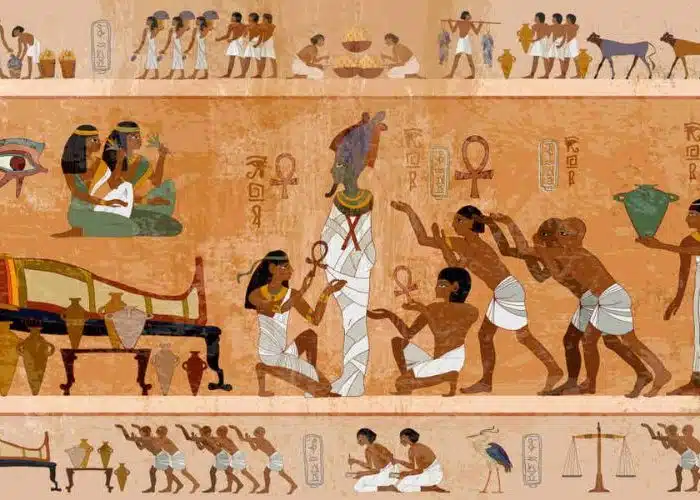
The Ancient Egyptian culture is one that has been well preserved through the years. It is said to have influenced many aspects of Western culture today. Egyptian mythology is very much alive today in popular culture. The story of Osiris and Isis are told in movies, books, and even cartoons for children to enjoy.
The pharaohs of Egypt ruled as the country's greatest rulers for thousands of years. They had the status of kings or emperors, were the political and religious leaders of both Upper and Lower Egypt, and controlled both regions. The pharaoh was often referred to as "one of the gods."

Ancient Egyptian History

Ancient Egypt

Ancient Egypt – History, Civilization, & Geography

Ancient Egypt evolved between 5500 and 7th century B.C. along the middle and lower channel of the Nile River. It ruled vast swaths of land from the western and eastern deserts to the Red Sea and the Sinai Peninsula during its peak growth.
Old Kingdom of Egypt - History, Civilization & Culture

Old Kingdom of Egypt – History, Civilization & Culture

The Old Kingdom, also known as the Ancient Empire, included dynasties III, IV, V, and VI between 2700 and 2200 BC. As the first of Egypt's three main eras known as "kingdoms" (the others being the Middle and New Kingdoms), it attained its initial height of civilization in terms of complexity and accomplishment.

Middle Kingdom of Egypt: The Pharaohs Who Reunited a Nation

The Middle Kingdom of Egypt was a major period of ancient Egyptian history, dating approximately from 2055 to 1650 BC. It began with the reunification of Egypt under Pharaoh Mentuhotep II and included the later Eleventh, Twelfth, and Thirteenth Dynasties. The era became famous for political stability, powerful pharaohs, pyramid construction, distinctive royal sculpture, agricultural development, international trade, and some of ancient Egypt's greatest literature.
Egypt New Kingdom

Egypt New Kingdom – Characters, Religion & Military Campaigns

When reunited Egypt during the reign of Ahmose I around 1550 BC, it was called the New Kingdom, and it lasted until 1070 BC, when the Libyan kings took the throne of Egypt.
Eye of Horus

Eye of Horus: Meaning, Myth, Symbolism and Ancient Egyptian Protection

The Eye of Horus is an ancient Egyptian symbol of protection, healing, restoration, and well-being. Also called the Wedjat or Udjat eye, it represents the eye of the falcon god Horus, which was injured during his struggle with Seth and later restored. Ancient Egyptians believed the healed eye could offer protection, support regeneration, and symbolize the return of wholeness after suffering or disorder.
Eye of Ra

Eye of Ra: Meaning, Powers, Myths & Ancient Egyptian Symbolism

The Eye of Ra is an ancient Egyptian symbol of solar power, divine protection, royal authority, and the sun god Ra's ability to defend cosmic order. Unlike a simple eye-shaped emblem, the Eye of Ra could act as an independent goddess, taking forms associated with Sekhmet, Hathor, Wadjet, and other deities. It represented both the sun's life-giving energy and its potentially destructive force.
Queen Nefertari

Who Was Queen Nefertari? Life, Tomb & Legacy

Quick Answer: Who was Queen Nefertari of Ancient Egypt? Queen Nefertari Meritmut was the Great Royal Wife of Pharaoh Ramesses II during Egypt’s Nineteenth Dynasty, in the 13th century BCE. She was an influential royal consort known for her diplomatic role, the magnificent paintings inside her tomb (QV66) in Luxor’s Valley of the Queens, and the temple dedicated to her and the goddess Hathor at Abu Simbel. Her monuments preserve one of ancient Egypt’s most remarkable royal legacies. Queen Nefertari was more than the wife of one of Egypt’s most powerful pharaohs. Her name appeared in royal inscriptions, her image decorated important temples, and her correspondence reached the royal court of the Hittite Empire. More than 3,200 years later, two monuments explain why she remains so important: her painted tomb in Luxor and the smaller temple at Abu Simbel, where statues of the queen stand nearly as tall as those of Ramesses II. Her story also raises fascinating questions. How much political influence did she hold? What do her tomb paintings reveal about ancient Egyptian beliefs? Was she really Ramesses II’s favorite wife? And what can travelers see of her legacy in 2027? Who Was Queen Nefertari in Ancient Egypt?...
King Khufu

King Khufu: The Pharaoh Behind Egypt’s Great Pyramid

Quick Answer: Who was King Khufu, and why is he famous? King Khufu, also known as Cheops, was an ancient Egyptian pharaoh of the Fourth Dynasty who ruled around 2589–2566 BC. He is best known for commissioning the Great Pyramid of Giza, the largest Egyptian pyramid and the only surviving Wonder of the Ancient World. His reign represents a peak of Old Kingdom engineering, royal power, and architectural achievement. Few rulers in history are remembered through a monument as recognizable as the Great Pyramid. Yet the man responsible for it remains surprisingly difficult to understand. Khufu commanded the resources needed to build a pyramid originally standing approximately 146.5 meters (481 feet) high. His workers organized massive limestone deliveries, constructed chambers deep within the monument, and created a royal funerary complex that transformed the Giza Plateau. And yet one of the clearest surviving representations of the king himself is an ivory statuette measuring just 7.5 centimeters. That contrast makes Khufu’s story especially interesting. Archaeologists know extraordinary details about his building project, but relatively little about his personality, childhood, or death. Today, travelers can explore his pyramid at Giza, see a royal ship associated with his burial complex at the Grand Egyptian...
Queen Nefertiti

Queen Nefertiti

The Eye of Ra is an ancient Egyptian symbol of solar power, divine protection, royal authority, and the sun god Ra's ability to defend cosmic order. Unlike a simple eye-shaped emblem, the Eye of Ra could act as an independent goddess, taking forms associated with Sekhmet, Hathor, Wadjet, and other deities. It represented both the sun's life-giving energy and its potentially destructive force.
Queen Hatshepsut

Hatshepsut: The Female Pharaoh Who Changed Ancient Egypt

Hatshepsut was one of ancient Egypt's most influential female pharaohs, ruling during the Eighteenth Dynasty in the 15th century BCE. She began as regent for the young Thutmose III before assuming the full powers and titles of a king. Her reign became known for ambitious temple construction, international trade, religious monuments, and the remarkable Mortuary Temple of Hatshepsut at Deir el-Bahari in Luxor.
Ancient Egyptian Amulets

Ancient Egyptian Amulets: 20 Symbols and Their Meanings

Ancient Egyptian amulets were small protective objects believed to provide health, strength, safety, good fortune, and renewal. Egyptians wore them as jewelry, carried them as charms, and placed them within mummy wrappings to protect the deceased in the afterlife. Their meanings came from religious symbols, gods, animals, colors, and materials. Famous examples include the Eye of Horus, scarab beetle, ankh, djed pillar, and tyet knot.
Anubis

Anubis: The Jackal God Who Protected Ancient Egypt’s Dead

Anubis was the ancient Egyptian god of mummification, funerary rituals, tomb protection, and the journey into the afterlife. Usually portrayed as a black jackal or a man with a jackal's head, Anubis protected the deceased, oversaw embalming, and assisted with the weighing of the heart during judgment. Rather than representing evil, he symbolized protection, preservation, and the hope of rebirth after death.
Egyptian Gods Family Tree

Egyptian Gods Family Tree: Who Was Related to Whom?

Anubis was the ancient Egyptian god of mummification, funerary rituals, tomb protection, and the journey into the afterlife. Usually portrayed as a black jackal or a man with a jackal's head, Anubis protected the deceased, oversaw embalming, and assisted with the weighing of the heart during judgment. Rather than representing evil, he symbolized protection, preservation, and the hope of rebirth after death.

Check our Egypt Travel Deals.

  • 3 Days Cairo Tour Package - Cairo Private Tours

    3 Days Cairo Tour Package – Cairo Private Tours

    3 Days
    Book a short 3-day tour of Cairo and visit the best tourist attractions in Cairo, such as the Pyramids of Giza, the Egyptian Museum, Old Cairo, the Citadel, and Mohamed Ali Mosque.
    Start From$435
  • 8 days cairo luxor hurghada
    7% Off

    8 Days Travel Package Deal to Cairo, Luxor & Hurghada

    8 Days / 7 Nights
    Discover Luxor's best attractions and spend some nights in Cairo and Hurghada for 8 days. Explore the pyramids of Giza and the most prominent landmarks of Cairo, then travel to Luxor to explore the best sights there and then, head to spend some time at the picturesque Red Sea beach in Hurghada.
    Start From$1,500$1,420
  • 12 Days Pyramids, Nile & Sharm - Trip to Egypt

    12 Days Pyramids, Nile & Sharm – Trip to Egypt

    12 Days
    If you are looking for the perfect vacation in Egypt, here is a 12-day tour of Cairo, Luxor, Aswan, and Sharm El-Sheikh. Enjoy the beauty of the ancient Egyptian civilization found in Cairo inside the Pyramids Complex and Salah El Din Castle, then go to the tempting Red Sea beaches in Sharm El Sheikh, and sail the Nile River between Luxor and Aswan.
    Start From$2,580
  • 10% Off

    8 Days Pyramids & Nile Cruise by Air- Top Travel Deal

    8 Days
    Discover the best of ancient Egypt, from Cairo to Aswan with a fascinating 8-day trip to Cairo and Nile Cruise. Join us as we explore some of the greatest historical sites across Egypt, including the Pyramids of Giza, the Sphinx, the Karnak Temple, Luxor, the High Dam, Philae Island, and much more.
  • 5 Days Cairo and Alexandria Tour Package
    5% Off

    5 Days Cairo and Alexandria Tour Package

    5 Days
    This tour package to Egypt is one of the best tours in Egypt to enjoy a wonderful holiday. In this 5-day tour in Cairo and Alexandria, you will visit the pyramids of Giza and the Coptic and Islamic monuments in Old Cairo in addition to the famous landmarks of Alexandria.
    Start From$650$600
  • 10 Days Cairo, Nile Cruise & Hurghada- Top Holiday to Egypt
    7% Off

    10 Days Cairo, Nile Cruise & Hurghada- Top Holiday to Egypt

    10 Days / 9 Nights
    Take a perfect vacation and spend 10 days in Egypt on a tour to Cairo and Nile Cruise Hurghada among some of the most beautiful destinations with Egypt Time Travel. Do not miss the opportunity and book the best 10 days in your life with the best prices and the best services.
    Start From$1,940$1,810
  • 5 Days Cairo & Luxor - Best Travel Deals to Egypt

    5 Days Cairo & Luxor – Best Travel Deals to Egypt

    5 Days / 4 Nights
    Spend 5 amazing days between Cairo and Luxor, where you can visit some of the most popular attractions in Egypt. Visit the Pyramids of Giza and stand between the legs of the Great Sphinx, and visit the Egyptian Museum. Then you will visit the beautiful city of Luxor, where you will visit the Valley of the Kings and explore the Karnak Temple; Luxor Temple, the Temple of Hatshepsut, and much more on a journey of fun and adventure that you will never forget.
    Start From$860

Travel & experience more with our
Egypt Cheap Tours!

Discover a variety of cheap Egypt packages organized with Egypt Time Travel, which guarantee you visits to the best tourist attractions in Egypt.
Egypt Time Travel to Egypt
Great Team

Egypt Time Travel has a team with great experience in the field of tourism for 20 years.

Egypt Time Travel
Amazing Sights

Enjoy visiting the best and wonderful tourist attractions in the Middle East especially in Egypt.

destination
Frequent Tours

We have a wide variety of travel packages and tours that suit all companies and individuals.

tour guide
Best Local guides

We have the best local tour guides in various languages in all destinations of the Middle East.

Egypt Time Travel why us
Egypt Day Tours, Day Trips in Egypt
What you can't miss during your daily tour in Egypt?

Incredible places to visit in Egypt.

Discover the best places with a history and a very rich heritage that can be seen in Egypt, it’s so amazing and amazing that you can’t forget it. Explore the best places you should visit during your day trip in Egypt: Full article to read Egypt Tourist Attractions

  • Pyramids of GizaPyramids of Giza is the last extant of the Seven Wonders of the Ancient World. This is indeed one of the most identifiable landmarks of Egypt that shouldn’t be missed during your holiday to Egypt.
  • Egyptian MuseumEgyptian Museum of Cairo is a treasure house of the Pharaonic world. It is one of the greatest museum collections in the world. It is the most important place to see in Egypt.
  • Luxor’s Karnak Temple & Valley of the KingsNoted for the Valley of the Kings, Memorial Temple of Hatshepsut, and the Karnak Temple, Upper Egypt’s, Nile-side town of Luxor has an array of tourist attractions. Know why Luxor still happens to fascinate the archaeologists and historians not only in Egypt but across the world.
  • Islamic CairoThe scenic, narrow lanes of Egypt’s Islamic Cairo is brimming with monuments, mosques, and madrasa. Islamic Cairo has an opulent history waiting for you to explore.
  • AswanThe most tranquil town of Egypt in Aswan. Relish the soothing breeze and the chilled out atmosphere of the place. You can visit Elephantine Island, Nubian villages, and riding a camel on the East Bank.
Egypt Day Tours, Day Trips in Egypt
Egyptian food to try during your Egypt Day Tour

Top Egyptian Dishes & Cuisines.

You will reveal the country’s incredible cuisine, from classics like kebab and falafel to traditional favorites like Shawerma, Hawawshi, and Kushari. Here the best local Egyptian food you should try. Full article to read Meals in Egypt

  • FuulThe most popular street food snack in Egypt, fuul is a paste of mashed broad (fava) beans flavored with garlic and olive oil. It is ladled out of large copper pots, often into pockets of pitta bread, and typically sold as an inexpensive takeaway sandwich.
  • TaamiyaAnother Egyptian streetfood staple, known elsewhere as falafel, taamiya is made with mashed fava beans and parsley. It is made in the shape of flat discs rather than round balls and is typically eaten as a sandwich with salad.
  • KoshariA mix of rice, brown lentils, and macaroni topped with fried onions and a spicy tomato sauce, koshari is normally eaten in dedicated koshari restaurants that serve the dish exclusively.
  • FiteerFiteer is a light, flaky multilayered bread made from dough stretched paper-thin and folded several times. It is served stuffed with minced meat or cheese or just plain brushed with samneh (ghee) or dusted with icing sugar.
  • ShawarmaShawarma is a large cone of pressed lamb or chicken that is rotated vertically in front of a flame grill. As the meat is cooked it is sliced off and mixed on a griddle with chopped tomato, onion, and parsley before being rolled in a large disc of flatbread and wrapped in foil to take away.
✦ FESTIVE SPECIAL ✦
🎄 Christmas in Egypt 2027 Magical Holiday Offers, Nile Cruises & Festive Tours
Explore Christmas Tours ↗