
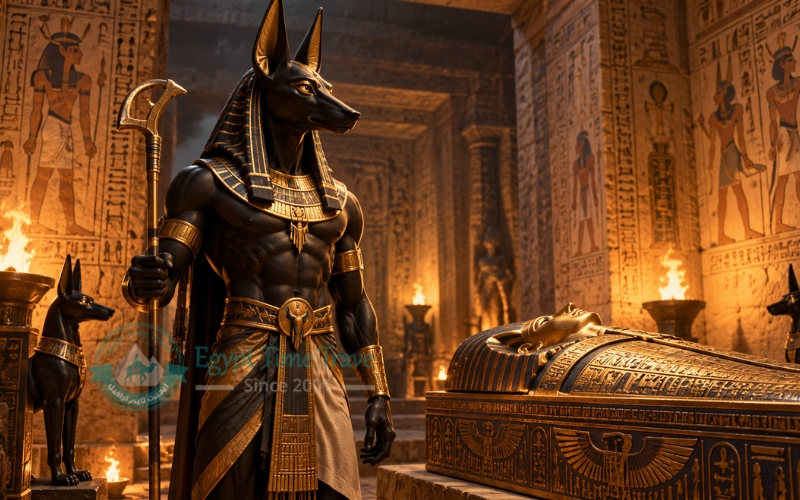
Quick Answer: Who Was Anubis in Ancient Egypt?
Anubis was the ancient Egyptian god of mummification, funerary rituals, tomb protection, and the journey into the afterlife. Usually portrayed as a black jackal or a man with a jackal’s head, Anubis protected the deceased, oversaw embalming, and assisted with the weighing of the heart during judgment. Rather than representing evil, he symbolized protection, preservation, and the hope of rebirth after death.
Imagine entering an ancient Egyptian tomb and encountering a black jackal resting silently above a burial shrine. Its ears are alert, its body is still, and its presence appears both watchful and reassuring.
For ancient Egyptians, this was Anubis, one of the most recognizable and important deities in their religious world.
Long before the famous pharaohs of the New Kingdom, Anubis had already become closely associated with protecting burial places. His image appeared on coffins, funerary equipment, amulets, and the walls of sacred monuments.
One of the finest surviving representations was discovered in the tomb of Tutankhamun. Today, the remarkable black-and-gold Anubis shrine is listed in the collection of the Grand Egyptian Museum near the Giza Pyramids.
Understanding Anubis reveals something fundamental about ancient Egyptian culture: death was not necessarily considered the end of existence. It was a transition that required preparation, protection, moral judgment, and divine assistance.
The story of Anubis connects Egyptian mythology with real archaeological discoveries, the development of mummification, and monuments that travelers can still explore in 2027.
Who Is Anubis, the Egyptian God of the Dead?
Anubis was an ancient Egyptian funerary deity responsible for protecting the dead and overseeing important stages of burial and the afterlife. His principal responsibilities included embalming, guarding tombs, guiding the deceased, and participating in the judgment that determined their fate beyond death.
The ancient Egyptians generally represented Anubis in two forms: a complete black canine resting on a shrine or a human figure with the head of a jackal-like animal.
Both images communicated the same central idea: Anubis was a powerful guardian standing between the world of the living and the realm of the dead.
Although modern descriptions frequently call him the Egyptian god of death, that label is incomplete. Anubis did not simply cause death or rule over it. He helped protect the deceased and prepare them for continued existence.
Essential facts about Anubis
|
Attribute |
Description |
|---|---|
|
Egyptian name |
Inpw, conventionally rendered Anpu or Inpu |
|
Greek-derived name |
Anubis |
|
Main responsibilities |
Embalming, mummification, tomb protection, funerary rituals, and guidance of the dead |
|
Traditional appearance |
Black jackal-like canine or jackal-headed man |
|
Main symbolism |
Protection, preservation, regeneration, and transition |
|
Associated deities |
Osiris, Isis, Nephthys, Thoth, Ma’at, and Horus |
|
Important religious texts |
Pyramid Texts, Coffin Texts, and Book of the Dead |
|
Important cult locations |
Cynopolis and the Memphite necropolis, particularly Saqqara |
|
Famous surviving artifact |
Anubis shrine from Tutankhamun’s tomb |
|
Places to explore his history |
Grand Egyptian Museum, Saqqara, Hatshepsut Temple, and funerary monuments around Luxor |
Anubis was not a pharaoh, a historical king, or a human priest. He was a deity worshipped for thousands of years, with religious functions that developed as Egyptian beliefs changed.
He was also not the same god as Osiris, even though both were closely connected with the afterlife.
To understand the distinction, it helps to explore Anubis’s name, appearance, and relationship with Egyptian funerary traditions.
What Does the Name Anubis Mean?
The name Anubis comes through ancient Greek from an Egyptian divine name conventionally reconstructed as Inpw, often written in English as Anpu, Inpu, or Anup.
Because the ancient Egyptian writing system generally did not record vowels in the same way modern English does, scholars cannot reconstruct every detail of the original pronunciation with certainty.
The familiar English name Anubis reflects a later Greek rendering rather than the precise pronunciation used by Egypt’s earliest worshippers.
Anubis, Anpu, and Inpu: Are They the Same God?
Yes. Anubis, Anpu, and Inpu refer to the same ancient Egyptian deity.
The variations come from differences in language, historical period, and modern systems of representing Egyptian words.
-
Inpw: A conventional Egyptological transliteration of the ancient name.
-
Inpu: A modern vocalized rendering commonly found in educational material.
-
Anpu: Another widely used English rendering of the Egyptian name.
-
Anubis: The familiar Greek-derived form used in English.
These names do not indicate separate gods or different religious personalities.
Ancient Egyptian religious texts also describe Anubis through titles emphasizing his responsibilities rather than relying on his personal name alone.
How Was Anubis Written in Hieroglyphs?
The Egyptian name of Anubis was written using hieroglyphic signs representing sounds, often accompanied by a sign depicting a canine deity as a visual identifier.
In Egyptian writing, such identifying signs are called determinatives. They help readers understand the meaning or category of a word without necessarily adding sounds to its pronunciation.
This distinction matters because hieroglyphs were not simply decorative pictures.
They formed a sophisticated writing system that combined phonetic signs, semantic indicators, and visual conventions.
Anubis could also appear in inscriptions through a canine image associated with a divine standard or shrine. The precise form varied according to the period and inscription.
Travelers examining tomb walls should remember that the appearance of a jackal-like animal does not automatically mean every nearby inscription names Anubis. Other Egyptian deities also had canine forms.
What Was Anubis the God Of?
Anubis was primarily the god of embalming and funerary protection. His powers concerned the preservation of the body, the safety of burial places, and the deceased person’s successful passage into the afterlife.
Rather than possessing one narrowly defined responsibility, Anubis appeared at several stages of the ancient Egyptian journey from death to rebirth.
1. God of mummification and embalming
Anubis was regarded as the divine patron of embalmers.
Ancient Egyptians believed that preserving a person’s body was closely connected with the possibility of continued existence after death.
The physical body was not the whole person, but it was an important element of the individual’s identity.
Anubis’s protection helped ensure that burial preparations were performed correctly and that the deceased would not suffer destruction or corruption.
Priests involved in funerary rituals could represent Anubis symbolically, sometimes wearing canine-headed masks while performing sacred duties.
2. Protector of tombs and cemeteries
Anubis guarded the places where the dead were buried.
Ancient Egyptian cemeteries were usually situated beyond inhabited areas, frequently along the desert margins of the Nile Valley.
Such locations created a powerful association between the desert, wild canines, burial grounds, and the realm beyond ordinary human life.
Images of Anubis placed near tomb entrances, coffins, or funerary equipment represented divine protection against threats to the deceased.
These threats could include physical disturbance as well as supernatural dangers imagined within Egyptian religious beliefs.
3. Guardian of the deceased
Anubis was believed to protect the dead throughout the funerary process.
His responsibilities did not necessarily end when a body was placed inside its tomb.
Religious texts and funerary imagery present Anubis as an enduring guardian whose assistance helped the deceased navigate an unfamiliar supernatural world.
That protective role explains why his image could appear on burial equipment even when another deity, particularly Osiris, was central to the overall religious composition.
4. Guide to the afterlife
Anubis also functioned as a guide or escort of the dead.
Ancient Egyptians imagined the afterlife as a complex environment with gates, guardians, divine beings, and obstacles.
Reaching a desirable existence beyond death required more than simply entering a tomb.
Funerary spells, correct ritual preparation, divine protection, and favorable judgment all contributed to the journey.
Anubis could assist the deceased through this process and lead them toward the judgment associated with Osiris.
5. Participant in the weighing of the heart
One of Anubis’s most famous responsibilities was attending the balance used during the weighing of the heart.
In many surviving illustrations, the jackal-headed god operates or steadies the scales.
The deceased person’s heart is weighed against a representation of Ma’at, the principle of truth, justice, and cosmic order.
The result determines whether the deceased can proceed toward a blessed afterlife.
Anubis is therefore closely associated with judgment, although Osiris normally occupies the position of presiding ruler in these scenes.
Was Anubis the Egyptian God of War?
No. Anubis was not principally a war god.
Although some Egyptian deities had overlapping responsibilities, the surviving religious evidence consistently connects Anubis most strongly with cemeteries, embalming, funerary rituals, and the afterlife.
Deities such as Montu and the protective warrior goddess Sekhmet had much more explicit associations with warfare, conflict, and destructive divine power.
Modern games and fantasy artwork sometimes portray Anubis as an armored warrior carrying weapons.
Those depictions are creative reinterpretations, not reliable descriptions of his main function in ancient Egyptian religion.
Why Does Anubis Have the Head of a Jackal?
Anubis has a jackal-like head because ancient Egyptians associated wild canines with desert burial grounds and transformed that relationship into a symbol of supernatural protection.
Jackals and other wild canines could be seen near cemeteries, where scavenging animals sometimes disturbed shallow burials.
This presented an obvious danger to a society that placed enormous religious importance on preserving the dead.
Egyptians responded by associating a powerful divine guardian with the very animals that threatened burial places.
In symbolic terms, the creature most capable of disturbing a grave also became the one entrusted with protecting it.
This transformation is one of the most revealing features of Anubis’s mythology.
Was Anubis a jackal, a dog, or a wolf?
Anubis is traditionally described as a jackal-headed god, although the precise zoological identity of the animal represented in Egyptian religious art is more complicated.
The creature resembles a slender wild canine with a narrow muzzle, upright ears, and a distinctive body shape.
Older interpretations generally identified it as a jackal.
Modern zoological classifications complicate that description because some North African canines historically called golden jackals are now recognized as African golden wolves.
Ancient Egyptian artists, however, were creating recognizable religious imagery rather than scientifically precise species illustrations.
The most accurate practical description is that Anubis was a canine-headed deity traditionally identified with the jackal.
He was not normally represented as a domestic dog breed, a fox, a wolf in the modern fantasy sense, or a cat.
Why was the animal shown lying down?
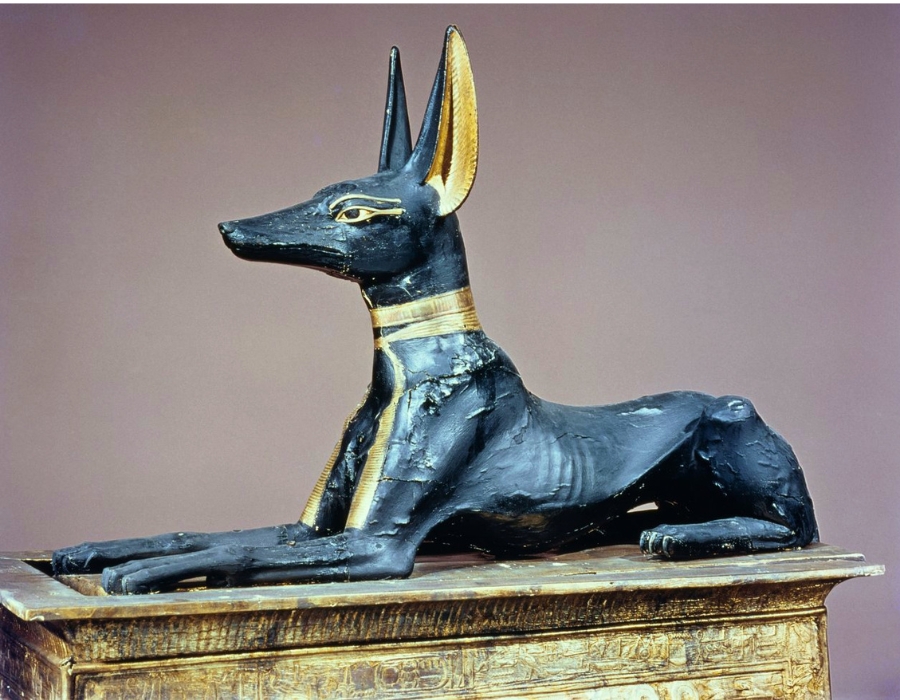
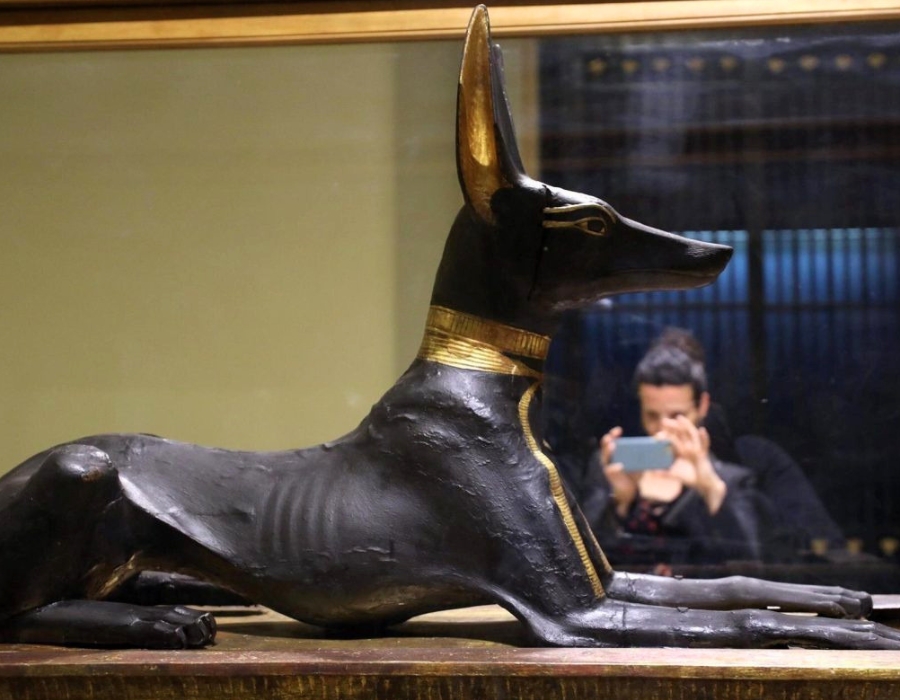
One of the most recognizable Anubis images shows a black canine resting on its stomach, with its front legs extended and head raised.
This position conveys watchfulness.
The body appears still, but the erect ears and alert head suggest that the animal is ready to react.
The image frequently appears above a shrine-shaped base or on funerary equipment.
For someone entering a burial chamber, the symbolism would have been clear: the dead remained under divine supervision.
The reclining canine image also became a recognizable identifier of Anubis in religious art.
Anubis versus Wepwawet: How can you tell them apart?
Anubis was not the only ancient Egyptian god depicted as a canine.
Wepwawet, whose name is usually translated as “Opener of the Ways,” was another important deity associated with processions, royal power, and routes into the afterlife.
|
Feature |
Anubis |
Wepwawet |
|---|---|---|
|
Principal role |
Embalming and protection of the dead |
Opening paths and leading processions |
|
Typical canine image |
Black, often reclining |
Frequently standing on a standard |
|
Main association |
Cemeteries and funerary preparation |
Processions, royal symbolism, and passage |
|
Religious relationship |
Protects and prepares the deceased |
Opens a route or facilitates passage |
|
Identification clue |
Reclining canine on a shrine |
Standing canine on a processional standard |
These are useful visual clues, not absolute rules.
Ancient Egyptian artistic traditions varied, and both gods could appear in more than one form.
If an object has an inscription, its text may provide a more reliable identification than appearance alone.
This is particularly important when examining small statues, amulets, or damaged reliefs.
Why Is Anubis Black? The Meaning Behind His Most Famous Symbol
Anubis is black primarily because the color represented regeneration, preservation, and the possibility of renewed life in ancient Egyptian religious symbolism.
The color was connected with the fertile dark soil deposited by the Nile, which sustained Egyptian agriculture and made renewed growth possible.
Black also had associations with the transformed appearance of preserved bodies.
Together, these ideas connected Anubis with both physical preservation and spiritual renewal.
Black did not automatically symbolize evil
In many modern films, black clothing and dark animal imagery are used to suggest villains or threatening supernatural beings.
Applying that symbolism directly to ancient Egypt creates a misleading interpretation.
Egyptian religious colors carried meanings that depended on their context.
Black could signify fertility, regeneration, and continuity. Green was also closely connected with new growth and rebirth, which helps explain why Osiris was frequently depicted with green skin.
Gold could represent divine permanence and the imperishable qualities associated with the gods.
Anubis’s black appearance therefore belongs to a broader visual language rather than a simple good-versus-evil color scheme.
For more context, explore the meaning of ancient Egyptian symbols and how religious ideas appeared in Egyptian art.
Did ancient Egyptians worship a black jackal?
The black color of Anubis was a sacred artistic convention.
It does not mean ancient Egyptians believed that every living jackal in Egypt had black fur.
Actual canines in northeastern Africa could have different natural coat colors.
The divine image was deliberately distinguished from the animal that helped inspire it.
This is an important difference between observing wildlife and interpreting religious art.
What do white, red, and winged Anubis images mean?
Modern searches frequently show white Anubis figures, red jackal-headed warriors, winged Anubis statues, and other unusual combinations.
Not all of these designs belong to established ancient Egyptian iconography.
White or pale canine images may sometimes relate to other Egyptian gods, particularly Wepwawet, or to different artistic contexts.
Red versions are often modern decorative interpretations, although red itself carried several meanings in ancient Egyptian religion.
Winged versions of Anubis should also be evaluated carefully. Wings were important Egyptian protective symbols, but they were not a defining feature of Anubis’s standard appearance.
If an object is advertised as an ancient Egyptian Anubis representation, its inscription, archaeological context, material, and provenance matter more than the seller’s title.
The Origins of Anubis: How Old Is the Jackal God?
Anubis was one of the earliest major funerary deities of ancient Egypt, with his worship and protective functions established in the early dynastic and Old Kingdom religious traditions.
His exact historical origin cannot be assigned to one identifiable individual or one precisely dated event.
The religion of ancient Egypt developed over centuries, incorporating local beliefs, regional cults, ritual practices, and changing ideas about kingship and the afterlife.
Anubis’s position within that religious system also evolved.
Early Dynastic Period: The beginnings of a divine guardian
During Egypt’s earliest dynastic history, burial customs were already becoming increasingly elaborate.
Royal tombs and elite cemeteries reflected a growing concern with protecting the body and providing the deceased with resources for continued existence.
Canine-associated funerary imagery developed within this environment.
Anubis became closely connected with the idea of a guardian deity responsible for the cemetery and the dead.
Because the evidence is fragmentary, it would be misleading to describe one specific ceremony or named priest as the invention of Anubis worship.
Old Kingdom: Anubis in the Pyramid Texts
During the Old Kingdom, particularly the Fifth and Sixth Dynasties, the Pyramid Texts preserved important aspects of royal funerary religion.
These inscriptions are among the earliest extensive collections of religious texts surviving from ancient Egypt.
Anubis appears in this broader tradition as an established funerary deity associated with burial, the body, and the sacred cemetery.
The texts reveal that the king’s successful transition after death depended on divine assistance.
They also demonstrate that ancient Egyptian funerary beliefs were already sophisticated long before the famous tombs of the New Kingdom.
For travelers interested in this period, the Old Kingdom of Egypt provides the historical background for the pyramid builders and their religious traditions.
Middle Kingdom: Osiris becomes increasingly central
By the Middle Kingdom, Osiris occupied an increasingly prominent position as ruler of the dead and a central figure in hopes for resurrection.
This did not eliminate Anubis from Egyptian religion.
Instead, Anubis continued to perform important protective and funerary duties within a religious system increasingly centered on Osiris.
The two gods developed a complementary relationship.
Osiris embodied successful resurrection and the ideal of continued life, while Anubis protected and prepared the deceased for that possibility.
Religious ideas also became more widely represented in the funerary equipment and texts of people outside the royal family.
New Kingdom: Anubis becomes a familiar image in tomb art
The New Kingdom, approximately 1550–1070 BCE, produced many of the Egyptian funerary artworks familiar today.
During this period, the Book of the Dead became a major collection of spells used in burial contexts.
Anubis frequently appeared in illustrations accompanying funerary texts, particularly scenes involving the preparation of the mummy and judgment of the deceased.
The tombs of Luxor’s west bank preserve evidence of this artistic tradition.
The discovery of Tutankhamun’s tomb in 1922 later brought one of the most impressive physical representations of Anubis to worldwide attention.
Late Period and Ptolemaic Egypt: Continued worship
Anubis remained important long after the New Kingdom.
During the Late Period and subsequent Ptolemaic era, animal cults, votive offerings, and regional religious traditions continued to develop.
The Anubis-associated sacred animal necropolis at Saqqara provides substantial archaeological evidence of this activity.
Later Egyptian religion also interacted with Greek beliefs.
Anubis could be associated with Hermes, the Greek god who also had a role in guiding souls.
This religious combination eventually produced the syncretic figure known as Hermanubis.
Anubis through Egyptian history
|
Historical period |
Approximate dates |
Significance for Anubis |
|---|---|---|
|
Early Dynastic Period |
c. 3100–2686 BCE |
Development of early funerary traditions and canine guardian imagery |
|
Old Kingdom |
c. 2686–2181 BCE |
Anubis appears in established royal funerary traditions |
|
Middle Kingdom |
c. 2055–1650 BCE |
His duties increasingly complement the central afterlife role of Osiris |
|
New Kingdom |
c. 1550–1070 BCE |
Detailed representations appear in funerary texts, tombs, and royal burial equipment |
|
Late Period |
664–332 BCE |
Anubis worship and sacred animal cults remain significant |
|
Ptolemaic Period |
332–30 BCE |
Traditional worship continues alongside Greek-Egyptian religious interaction |
|
Roman Egypt |
From 30 BCE |
Anubis remains part of Egyptian and Egyptian-inspired religious imagery |
Dates are approximate and may vary among historical chronologies.
Anubis’s long history shows how a deity could remain important even while religious leadership, political power, and funerary customs changed dramatically.
Anubis and Osiris: Why Are Both Connected to the Dead?
Anubis and Osiris were closely associated with the afterlife, but they performed different religious functions.
Anubis was especially responsible for preparing, protecting, and guiding the deceased. Osiris was the divine ruler of the dead and the central figure in the hope of resurrection.
Their relationship is best understood as cooperation rather than competition.
The myth of Osiris and the role of Anubis
According to ancient Egyptian religious traditions, Osiris was killed by his brother Seth, sometimes written Set.
The myth survives in different versions and developed over a long period.
Isis, the wife and sister of Osiris, sought to recover and restore his body.
Nephthys, another important goddess in the Osiris cycle, also participated in mourning and protection.
In later versions of the tradition, Anubis assisted with the preservation and preparation of Osiris’s body.
This established a powerful mythological model for Egyptian mummification.
Just as Osiris underwent a transformation associated with restored existence, the deceased hoped to experience a successful transition after death.
Anubis’s embalming role therefore had a significance extending beyond the physical treatment of a body.
The ritual was a sacred act connected with divine restoration.
Did Anubis resurrect Osiris?
It would be inaccurate to say that Anubis independently resurrected Osiris in every version of the myth.
The restoration of Osiris involved multiple divine participants, especially Isis, and different texts emphasized different actions.
Anubis’s characteristic contribution was connected with preservation and funerary preparation.
Egyptian mythology was not a single fixed narrative recorded in one authoritative book.
Stories varied according to religious tradition, historical period, and local cult.
This is why simplified modern retellings sometimes disagree about exactly which deity performed each action.
Did Osiris replace Anubis?
Osiris became the more prominent ruler of the afterlife, but he did not make Anubis irrelevant.
The change was largely a shift in religious emphasis rather than the complete replacement of one deity by another.
Anubis retained essential responsibilities as divine embalmer and protector.
The distinction is visible in judgment scenes: Osiris often sits enthroned as the presiding authority, while Anubis attends the scales.
Both remain necessary within the symbolic sequence.
Anubis vs. Osiris
|
Question |
Anubis |
Osiris |
|---|---|---|
|
Who was he? |
Canine-headed funerary deity |
Divine ruler of the dead |
|
Main function |
Embalming, protection, and guidance |
Resurrection, judgment, and the afterlife |
|
Common appearance |
Black canine or jackal-headed man |
Mummiform ruler, often with green or black skin |
|
Major symbols |
Jackal, shrine, embalming imagery |
Atef crown, crook, flail, mummy wrappings |
|
Judgment scene |
Attends or operates the balance |
Presides over the outcome |
|
Main religious idea |
Safe transition and preservation |
Renewed existence and divine order |
The difference also helps explain why Egyptian burial equipment could feature both gods without any contradiction.
Who Were the Parents of Anubis?
Anubis’s parentage varies across Egyptian religious traditions. In a well-known later account, he is the son of Osiris and Nephthys, but other sources associate him with different divine parents, including Ra.
This variation reflects the long development of Egyptian mythology rather than a historical dispute about an actual human family.
Was Anubis the son of Osiris and Nephthys?
The tradition identifying Osiris and Nephthys as the parents of Anubis is particularly familiar through later accounts.
In the version related by the Greek writer Plutarch, Nephthys gives birth to Anubis after a relationship with Osiris.
Isis later finds and cares for the child.
This story connects Anubis closely with the Osirian family and helps explain his role as protector of Osiris.
However, Plutarch wrote during the Roman imperial period, long after the earliest evidence for Anubis worship.
His account should not be treated as the only original Egyptian explanation of the god’s origins.
Was Ra the father of Anubis?
Some Egyptian traditions identify Anubis as a son of Ra, the solar deity.
This illustrates how divine genealogy could vary depending on the religious context.
Egyptian gods frequently had different family relationships in different local or historical traditions.
Those variations were not necessarily viewed as mutually exclusive in the same way a modern historical biography would be.
Is Anubis related to Isis?
Yes, in several mythological traditions Anubis is closely associated with Isis.
In the later narrative recorded by Plutarch, Isis becomes his adoptive or protective mother.
More broadly, Anubis and Isis both play roles in the restoration and protection of Osiris.
Their relationship reflects shared funerary responsibilities rather than a single universally accepted genealogy.
Anubis and Bastet: Were they related?
Some ancient traditions associate the goddess Bastet with Anubis’s parentage, but this is not the most widely recognized family relationship.
Bastet was primarily associated with protection, the household, cats, and aspects of divine power.
Anubis was associated with the cemetery, embalming, and funerary care.
Their different animal imagery sometimes leads modern audiences to imagine them as a paired cat-and-jackal couple.
That is not a standard ancient Egyptian myth.
To understand the distinction, explore Bastet, the Egyptian cat goddess.
Did Anubis have a wife or children?
Anput, also written Anupet, was a female deity associated with Anubis and sometimes regarded as his consort.
Kebechet, also rendered Qebehut, appears in some traditions as a daughter of Anubis.
Kebechet was connected with purification and refreshing water, ideas relevant to the care of the deceased.
As with other Egyptian divine relationships, the surviving evidence reflects traditions that varied across time and place.
Anubis and Horus: Were they brothers?
Anubis and Horus were not universally described as brothers.
In traditions where Anubis is a son of Osiris, the gods may be understood as sharing a father, since Horus is commonly identified as the son of Osiris and Isis.
However, their relationship depends on the specific mythological tradition.
Horus was predominantly associated with kingship, the sky, and the living pharaoh.
Anubis was predominantly associated with funerary protection.
Their religious functions could intersect in mortuary texts and judgment scenes, but they remained distinct deities.
Readers who want to compare Egypt’s broader divine family can explore the guide to ancient Egyptian gods and goddesses.
Anubis and the Weighing of the Heart: How Did Egyptian Judgment Work?
The weighing of the heart was an ancient Egyptian judgment ritual in which a deceased person’s heart was measured against a symbol of Ma’at, representing truth, justice, and cosmic order.
Anubis attended the balance, while Thoth recorded the result and Osiris presided over the judgment.
This scene is among the most recognizable images in Egyptian funerary art.
It also reveals that ancient Egyptians regarded moral conduct as an important part of the hope for life after death.
Step 1: The deceased enters the Hall of Judgment
In the famous judgment tradition described in Spell 125 of the Book of the Dead, the deceased enters a divine setting associated with Osiris.
The person must demonstrate that they have lived according to the principles of Ma’at.
Ma’at was both a goddess and a central Egyptian concept describing proper order, truth, fairness, and harmony.
The judgment involved more than a simple statement of belief.
It represented an assessment of the deceased person’s moral standing.
Step 2: The deceased declares their innocence
The Book of the Dead includes a declaration commonly called the Negative Confession.
The deceased states that they have not committed a series of wrong actions.
These declarations concern offenses such as stealing, violence, dishonesty, injustice, and other conduct that could disturb social or cosmic order.
A group of 42 divine assessors appears in important versions of the judgment tradition.
The exact wording and presentation of these declarations varied among surviving manuscripts.
They should not be understood as a single universal code that every Egyptian repeated in precisely the same form.
Step 3: Anubis attends the scales
The heart was regarded as an important center of thought, emotion, identity, and moral awareness.
In many judgment illustrations, Anubis brings the heart to the balance or carefully attends the weighing process.
On the opposite side appears the feather of Ma’at or another representation of the goddess.
The image expresses the idea that the deceased person’s moral character must be consistent with truth and justice.
Anubis is often shown steadying the balance, emphasizing the correctness of the procedure.
This role made him a guardian of the judgment process, not merely a threatening figure awaiting the dead.
Step 4: Thoth records the outcome
Thoth, the god associated with knowledge, writing, and divine recordkeeping, usually appears near the weighing scene.
He is commonly depicted with the head of an ibis or in other recognizable forms.
His responsibility is to record or announce the result.
In the surviving papyrus of Ani, for example, Anubis attends the balance while Thoth stands nearby with scribal equipment.
The scene combines several distinct divine responsibilities into one visual narrative.
Step 5: Osiris receives the justified deceased
When the judgment is favorable, the deceased is considered worthy of proceeding into the blessed afterlife.
Osiris, typically shown seated on a throne, receives or presides over the successful person.
The desired result was not simply escaping punishment.
It was achieving a form of enduring, renewed existence.
Egyptian religious traditions imagined different aspects of the afterlife, including an idealized realm frequently described as the Field of Reeds.
This realm reflected the possibility of a peaceful, productive existence under divine order.
Step 6: What happens if the heart fails?
The judgment scene often includes Ammit, a supernatural creature associated with the destruction of the unworthy.
Ammit combines the features of dangerous animals, commonly a crocodile, lion, and hippopotamus.
In the traditional explanation, a heart found unworthy may be consumed by Ammit.
This represents the loss of the hoped-for eternal existence, sometimes described as a second death.
It is important not to confuse Ammit with Anubis.
Anubis conducts or supervises a protective funerary function. Ammit represents the feared consequence of unsuccessful judgment.
Understanding the main figures in the judgment scene
|
Figure |
How to recognize them |
Main role |
|---|---|---|
|
Anubis |
Black canine head, usually near the scales |
Attends and operates the balance |
|
Ma’at |
Feather or goddess with an ostrich feather |
Represents truth and cosmic order |
|
Thoth |
Ibis-headed figure carrying scribal equipment |
Records the judgment |
|
Osiris |
Enthroned, mummiform deity with royal insignia |
Presides over the afterlife judgment |
|
Ammit |
Composite creature with crocodile, lion, and hippopotamus features |
Threatens the unsuccessful deceased |
|
The deceased |
Human figure appearing before the gods |
Undergoes judgment |
Did Anubis decide who went to the afterlife?
Anubis participated in the judgment process but was not usually portrayed as its sole final authority.
The distinction matters because modern descriptions frequently claim that Anubis personally decided whether every person entered heaven or hell.
That comparison imposes a simplified modern framework onto a more complex ancient Egyptian system.
The judgment involved several gods, symbolic actions, funerary texts, and expectations about moral conduct.
Osiris occupied a central position as ruler of the dead.
Anubis ensured the proper conduct of important stages of the journey and judgment.
Did the Egyptians believe this literally happened?
Ancient Egyptian funerary texts express religious beliefs about divine judgment and continued existence after death.
They are not records of historically verifiable supernatural events.
The paintings and papyri show how Egyptians represented their hopes, fears, moral values, and ideas about the universe.
For modern readers, the scene offers historical evidence of those beliefs.
For ancient worshippers, it formed part of a meaningful religious system supported by ritual practice.
Anubis and Mummification: How Did the Divine Embalmer Protect the Dead?
Anubis was the divine protector of the embalming process, helping transform a deceased person’s body into a ritually prepared and protected mummy.
Mummification was important because Egyptians believed that continued existence required the preservation of identity and the appropriate treatment of the body.
The process combined practical methods of preservation with religious ceremonies.
Not every Egyptian received the same type or quality of mummification.
Treatment depended on historical period, resources, social circumstances, and local customs.
Why was the body preserved?
Ancient Egyptian ideas about the person included several interconnected elements.
The physical body remained important as a recognizable foundation for continued identity.
Concepts commonly described as the ka and ba also formed part of Egyptian understandings of existence.
The ka was associated with vital life force, while the ba represented another aspect of individual identity and mobility.
These terms cannot be translated perfectly into modern concepts such as body and soul.
The Egyptian religious system understood the person as a combination of elements whose continued relationship mattered after death.
Preserving the body, maintaining offerings, and performing correct rituals helped support this ideal.
What happened during mummification?
Methods changed significantly during Egypt’s long history.
For some periods and social groups, elaborate embalming involved removing internal organs, drying the body with natron, treating the remains with oils or resins, and wrapping the body in linen.
The process could also involve amulets placed within the wrappings.
Here is a simplified outline of a developed embalming tradition:
-
Preparation: The body was taken to a place used for funerary treatment and prepared for preservation.
-
Internal treatment: In certain traditions, embalmers removed selected organs or treated them according to established techniques.
-
Drying: Natron, a naturally occurring salt mixture, helped remove moisture from the body.
-
Treatment and wrapping: The body was treated with appropriate substances and wrapped in linen, sometimes with protective amulets.
-
Religious ceremonies: Priests performed rites intended to preserve the deceased’s identity and enable continued existence.
-
Burial: The prepared mummy was placed in its coffin or burial setting with the required funerary equipment.
This sequence is a general explanation, not an identical procedure followed in every century.
The often-repeated duration of approximately 70 days reflects an important Egyptian embalming tradition, but actual practices and burial arrangements varied.
Why did priests wear Anubis masks?
Priests could wear canine-headed masks to represent Anubis during funerary rituals.
This was a form of ritual impersonation.
The priest did not simply dress as a recognizable character.
By assuming the appearance of the deity, the officiant could symbolically perform an action under the authority or identity of Anubis.
Surviving representations and archaeological examples provide evidence for these ceremonial practices.
The use of masks helps explain how Egyptian mythology directly influenced the actions of actual religious specialists.
What was the Opening of the Mouth ceremony?
The Opening of the Mouth was a funerary ritual intended to restore the deceased person’s abilities in the afterlife.
It could be performed in connection with a mummy, coffin, or statue.
The ceremony symbolically enabled important functions such as breathing, speaking, seeing, and receiving nourishment.
Different priests participated in its rituals, and Anubis could appear in associated funerary imagery.
The ceremony reveals that Egyptian burial practices were not limited to stopping physical decay.
They also sought to reestablish the deceased person’s ability to function in the next existence.
How were canopic jars connected to Anubis?
Canopic jars were used in certain periods to preserve internal organs removed during mummification.
Their contents were protected by funerary deities, particularly the Four Sons of Horus.
Anubis did not simply represent one of those four sons.
His connection came through the wider system of embalming and funerary protection.
The relationship is worth understanding because both Anubis and the canopic jars frequently appear in discussions of Egyptian mummification.
For a closer explanation of the organs, protective deities, and different jar designs, see canopic jars in ancient Egypt.
Did Anubis physically create the first mummy?
Religious tradition associates Anubis with preparing and protecting Osiris’s body, but it would be misleading to describe that myth as a verified historical account of the invention of mummification.
Egyptian methods of preserving bodies developed over many generations.
Some early burials benefited from natural drying in the desert sand.
Later techniques became increasingly elaborate.
The mythology gave religious meaning to preservation practices; it does not provide a precise historical date or inventor for embalming.
What Are the Main Symbols of Anubis?
The principal symbols associated with Anubis include the black canine, embalming materials, shrine imagery, and the ritual equipment of Egyptian funerary religion.
Other objects, such as the ankh and was-scepter, sometimes appear alongside Anubis but were shared symbols used by many deities.
Knowing the difference helps travelers understand Egyptian paintings and avoid common misidentifications.
The black jackal
The black canine is the most direct visual symbol of Anubis.
Its association with burial grounds explains the animal choice, while the black color communicates preservation and regeneration.
A reclining jackal on a shrine strongly suggests a funerary context.
It is one of the easiest Anubis representations to identify in a museum.
The ankh: Symbol of life
The ankh is an ancient Egyptian sign associated with life.
It has a looped upper section and a cross-shaped lower structure.
Anubis may be depicted holding an ankh, but the symbol is not exclusive to him.
Many gods and goddesses carry ankhs, and the sign frequently appears in scenes connected with divine life and the king’s well-being.
When Anubis holds an ankh, the combination expresses the broader religious relationship between funerary protection and continued existence.
Anubis and the ankh are connected through the Egyptian concept of life beyond death, not because the ankh was invented specifically for Anubis.
The was-scepter: Divine authority
The was-scepter is a long staff commonly seen in ancient Egyptian religious art.
It frequently has a distinctive animal-headed upper section and a forked lower end.
The symbol generally expresses authority, power, and divine dominion.
Anubis can appear holding the scepter in human-bodied representations.
The exact meaning of a particular image depends on the inscription and artistic context.
The imuit fetish: A more unusual funerary symbol
A less familiar symbol associated with Anubis is the imuit, also written imiut.
It is generally represented as an animal skin attached to a pole and placed in a vessel or support.
The symbol has strong funerary and protective associations.
Its precise historical development and complete religious significance remain subjects of interpretation.
The imuit is especially interesting because it demonstrates that Anubis’s symbolism extended beyond the familiar jackal-headed figure.
Ancient Egyptian religious art could communicate divine presence through objects and emblems as well as recognizable human or animal bodies.
The shrine and funerary chest
Anubis was frequently represented resting upon a rectangular shrine-shaped structure.
This composition expressed his guardianship over burial equipment and sacred places.
It became particularly famous through the funerary shrine discovered in Tutankhamun’s tomb.
A viewer should pay attention to the combination of animal, base, and decorative inscriptions.
Together, they create a religious composition rather than an ordinary statue of an animal.
The weighing scales
The balance is closely associated with Anubis because of his participation in the judgment of the dead.
However, the scales do not belong exclusively to him.
Their importance comes from the judgment process involving Ma’at, Thoth, Osiris, and the deceased.
An image of Anubis standing near the balance therefore communicates more than his personal identity.
It represents a complete religious event.
Linen and embalming materials
Mummy wrappings and objects used in funerary preparation also connect with Anubis.
These associations emphasize his practical religious responsibilities.
Ancient Egyptian artists often communicated a god’s identity through actions and context, not just one recognizable symbol.
Anubis attending a mummy can therefore be just as identifiable as Anubis shown in canine form.
Anubis in the Book of the Dead: What Do the Ancient Texts Actually Say?
The Book of the Dead is a modern name for an ancient Egyptian collection of funerary spells intended to help the deceased obtain a successful afterlife.
Anubis appears in this religious tradition because he protects the dead and participates in the judgment process.
The original Egyptian title is commonly translated as the Book of Coming Forth by Day.
Unlike a single modern book written by one author, the collection developed across time and existed in many different manuscript arrangements.
Not every surviving copy contains the same selection of spells or illustrations.
What does Spell 125 describe?
Spell 125 is especially important because it concerns judgment and the deceased person’s declaration of innocence before divine authorities.
Its accompanying illustrations may depict the weighing of the heart.
Anubis appears near the balance in famous surviving examples.
Thoth records the outcome, while Osiris presides over the afterlife setting.
The scene visually connects moral conduct with the hope of continued existence.
The Papyrus of Ani
The Papyrus of Ani is a famous New Kingdom manuscript now associated with the British Museum’s collection.
Its judgment illustration includes Anubis attending the scales as Ani’s heart is weighed against the feather representing Ma’at.
The image is especially useful for understanding the different responsibilities of the gods.
Anubis handles the weighing process.
Thoth records the result.
Osiris occupies the position of divine ruler.
The deceased hopes to receive a favorable judgment.
The Papyrus of Hunefer
The Papyrus of Hunefer is another important New Kingdom funerary manuscript.
Its illustrations include scenes of funerary preparation and judgment.
Anubis appears in this visual tradition as a protector and participant in the deceased person’s transition.
Comparing the papyri of Ani and Hunefer reveals similarities, but also differences in artistic arrangement and ritual emphasis.
That variation is typical of Egyptian funerary manuscripts.
Was there an ancient Egyptian Book of Anubis?
There was no single universally recognized ancient Egyptian scripture titled the Book of Anubis equivalent to the Book of the Dead.
Anubis appears in many funerary texts, inscriptions, spells, and religious scenes.
Modern books may use titles such as The Book of Anubis for fiction, spiritual interpretation, or collections of material.
Those publications should not automatically be confused with ancient Egyptian manuscripts.
Was Anubis mentioned in the Bible?
Anubis is not a named figure in the biblical texts in the way he is in Egyptian funerary inscriptions.
Egypt appears extensively in biblical history and religious narratives, but that does not establish a direct role for Anubis in those accounts.
Modern comparisons between Anubis and biblical descriptions of death or judgment are interpretations, not evidence that the traditions describe the same deity.
For historical accuracy, it is important to distinguish Egyptian religious sources from later religious comparisons.
Was Anubis Evil, Dangerous, or a Protector?
Anubis was primarily a protective deity, not an embodiment of evil.
He was associated with death because his responsibilities concerned burial, mummification, and the journey into the afterlife.
For ancient Egyptian worshippers, those duties offered reassurance that the deceased would receive care and protection.
Why does Anubis look frightening in modern films?
The jackal head, dark color, and association with tombs make Anubis visually suitable for horror films and fantasy stories.
Modern entertainment often exaggerates those features.
He may appear as a monstrous warrior, a villain commanding armies, or a supernatural force attacking the living.
These portrayals do not accurately summarize ancient Egyptian religious beliefs.
The historical Anubis was more closely associated with guardianship and ritual protection.
Was Anubis feared by ancient Egyptians?
Egyptian gods could inspire reverence and fear because they possessed supernatural authority.
Anubis was no exception.
However, fear of divine power is not the same as believing that a deity is evil.
The presence of Anubis on funerary objects suggests that people sought his help.
They wanted protection for the deceased and the proper performance of burial rituals.
Did Anubis kill people?
Anubis was not principally portrayed as a god who traveled through Egypt causing human deaths.
His characteristic activities occurred in the context of death after it had happened.
He protected the body, oversaw rituals, and assisted the deceased.
A modern story in which Anubis hunts the living should be treated as fiction unless it can be connected with a specific ancient source.
Did Anubis judge good and evil?
Anubis participated in a judgment system concerned with moral order.
That does not mean he represented a universal cosmic battle between good and evil.
Egyptian religion included distinctive ideas about justice, divine authority, ritual correctness, and the continuation of life.
The judgment of the heart was connected with Ma’at, not a modern framework imposed on Egyptian mythology.
How Did Ancient Egyptians Worship Anubis?
Ancient Egyptians honored Anubis through funerary rituals, religious offerings, sacred images, and cult practices associated with cemeteries and embalming.
Worship varied across regions and historical periods.
Anubis did not require every worshipper to visit one particular temple.
His importance throughout Egypt was closely connected with the widespread need for burial and funerary protection.
Anubis and the ancient priesthood
Priests involved in funerary procedures carried out specialized religious responsibilities.
Some were associated with embalming, purification, offerings, and ceremonies intended to help the deceased.
Anubis’s presence could be represented through sacred images, ritual titles, or masks.
The religious significance of a priest’s actions came from the Egyptian understanding that correct ritual conduct helped maintain divine order.
This was not merely an artistic performance.
Within the belief system, it was an essential religious responsibility.
Offerings to Anubis
Offerings formed an important part of ancient Egyptian religious practice.
Depending on time and setting, these could include food, drink, incense, and other materials appropriate to ritual contexts.
Funerary texts frequently express the desire that the deceased receive offerings and continue to be sustained after death.
Anubis could be invoked to help ensure proper burial and the continuing protection of the tomb.
Why were dogs mummified for Anubis?
At some Egyptian religious centers, especially Saqqara, large numbers of dogs and other canines were mummified and deposited in sacred animal catacombs.
Many of these animals served as votive offerings associated with Anubis.
A person might present such an offering as an act of religious devotion or a request for divine assistance.
Archaeological research has shown that these animal cults involved complex practices of acquisition, care, mummification, and deposition.
Not all animal mummies represented beloved household pets.
Some were raised or obtained specifically for religious offerings.
Others could have received different treatment based on their status within a temple cult.
Cynopolis: An important center of Anubis worship
Cynopolis, a Greek name meaning “City of the Dog,” was an important center associated with Anubis worship in Middle Egypt.
Its historical importance demonstrates the regional character of Egyptian religion.
Some gods had particularly strong associations with individual cities or districts while also receiving worship elsewhere.
Cynopolis was not the only place where Anubis was honored.
He remained a widely recognized funerary deity across Egypt.
For modern travelers, Cynopolis is primarily of historical interest rather than a major conventional sightseeing stop comparable to the Giza Pyramids or Luxor’s temples.
The Anubieion at Saqqara
The Anubieion was a religious complex associated with Anubis in the North Saqqara area.
It became particularly important during later periods of Egyptian history.
The associated dog catacombs offer evidence of large-scale votive animal burial practices.
Archaeological investigations have examined the underground galleries, animal remains, and wider organization of the cult.
The site reveals that Anubis worship involved real infrastructure, economic activity, religious specialists, and pilgrims.
This is a useful reminder that Egyptian mythology was not confined to stories and pictures.
It influenced the construction and operation of sacred places.
Visitor note: The archaeological existence of the Anubieion does not mean its underground catacombs are routinely open to tourists. Access must be checked separately, and visitors should not assume they can enter excavation areas.
What Is the Spiritual Meaning of Anubis Today?
Anubis is commonly interpreted in modern spiritual symbolism as representing protection, transition, guidance, and the acceptance of mortality.
These themes have historical connections with his ancient funerary functions.
However, contemporary spiritual interpretations are not automatically equivalent to documented Egyptian beliefs.
Protection during change
Anubis was historically associated with protecting people during the transition from life to death.
Modern audiences sometimes extend that idea to major personal changes, endings, or periods of uncertainty.
As a contemporary symbolic interpretation, this can be meaningful.
It should not be presented as a verified ancient Egyptian ritual practice unless there is specific historical evidence.
Guidance and personal transformation
Because Anubis guided the deceased, modern symbolic interpretations sometimes connect him with finding direction through unfamiliar circumstances.
The historical foundation is his role as an escort and guardian in funerary beliefs.
The modern psychological interpretation is a separate development.
Justice and personal responsibility
The weighing of the heart provides another reason Anubis is associated with personal reflection.
The ancient judgment scene placed moral conduct at the center of the deceased person’s hopes for the afterlife.
Modern readers may interpret this as a reminder to act truthfully or consider the consequences of their actions.
The connection is understandable, but the original Egyptian concept involved a complete religious system centered on Ma’at.
Anubis tattoo meaning
An Anubis tattoo commonly represents protection, mortality, respect for ancient Egyptian culture, or a personal connection with ideas of transformation.
The meaning depends on the person choosing the design.
Popular tattoo variations include a black jackal head, a full jackal-headed figure, Anubis holding an ankh, or a scene featuring the scales of judgment.
Ancient Egyptian religious symbolism can inform these designs, but modern tattoo styles do not necessarily reproduce ancient art accurately.
Anyone wanting a historically informed tattoo should look at actual Egyptian reliefs, statues, and papyri rather than relying entirely on fantasy illustrations.
Is Anubis a symbol of protection or death?
Historically, Anubis represents both funerary protection and the transition associated with death.
These ideas were interconnected.
His association with the dead was precisely why his protection mattered.
Reducing the deity to only darkness, death, or supernatural danger removes the more important protective meaning of his religious role.
Where Can You See Anubis in Egypt in 2027?
Travelers can explore the history of Anubis through original funerary artifacts, temple reliefs, tomb paintings, and ancient cemetery complexes.
The most useful places include the Grand Egyptian Museum near Giza, Hatshepsut Temple in Luxor, the Valley of the Kings, and Saqqara.
These sites offer different experiences.
Some display movable artifacts, while others preserve the original architectural and religious settings in which Anubis was worshipped or depicted.
1. Grand Egyptian Museum: The Anubis Shrine of Tutankhamun
The Grand Egyptian Museum, located near the Giza Pyramids, is one of the most important places for understanding Anubis through surviving royal funerary equipment.
Its official collection identifies a remarkable artifact called Anubis on a Chest within the Tutankhamun Galleries.
Historical artifact: New Kingdom, Eighteenth Dynasty
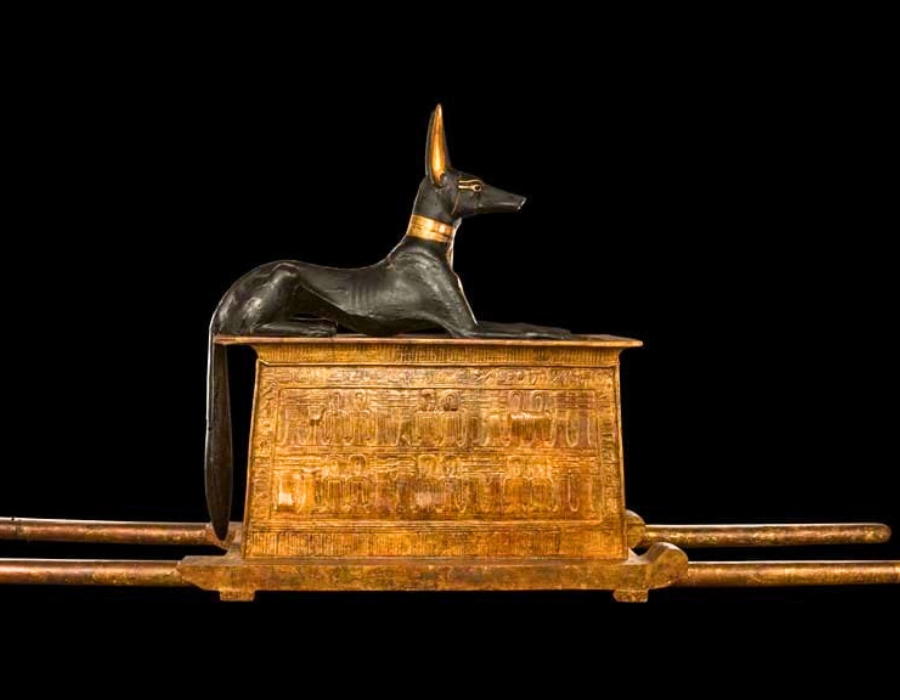
The object shows Anubis in the form of a black reclining canine, with gold details emphasizing important features.
The figure rests above a shrine-shaped wooden chest placed on a gilded sledge with carrying poles.
This combination made the object both a religious image and part of an elaborate funerary assemblage.
Where was the Anubis shrine discovered?
Howard Carter discovered the shrine inside the tomb of Tutankhamun, KV62, in the Valley of the Kings in 1922.
The shrine was positioned near the entrance to the tomb’s Treasury.
Its placement was significant because it presented the guardian deity as a protective presence near objects associated with the deceased king’s burial.
The artifact is cataloged as Carter object 261 in the excavation records.
The shrine illustrates how the mythological role of Anubis was translated into physical funerary equipment.
What makes the statue special?
Unlike a flat representation in a painting, this figure gives Anubis a powerful three-dimensional presence.
The animal has an elongated body, tall ears, and an alert head.
The contrast between the dark surface and gilded details draws attention to the deity’s watchfulness.
The underlying chest also had a practical funerary function.
Its compartments held ritual objects and jewelry associated with the royal burial.
Rather than being an isolated decorative sculpture, the complete object belonged to the system of protection surrounding Tutankhamun.
What should travelers look for?
When examining the shrine, concentrate on the animal’s posture, ears, facial details, and relationship with the chest beneath it.
The most interesting question is not simply why the object is shaped like a jackal.
It is why this particular image was placed within the king’s burial assemblage.
The answer connects Anubis with the protection of the tomb and the safe transition of the deceased pharaoh.
For more background on the royal collection, explore the guide to Tutankhamun’s treasures at the Grand Egyptian Museum.
Planning for 2027: The Grand Egyptian Museum’s online collection lists the Anubis chest in its Tutankhamun Galleries. Check the museum’s current display information and visitor arrangements before your visit, as exhibit access and gallery arrangements may change.
2. Hatshepsut Temple: The Chapel of Anubis in Luxor
Location: Deir el-Bahari, Luxor West Bank
The Mortuary Temple of Hatshepsut is one of the most rewarding monuments for seeing Anubis represented in his original religious and architectural context.
The temple was constructed during the Eighteenth Dynasty for Hatshepsut, one of ancient Egypt’s most notable female pharaohs.
Its terraces rise against the cliffs of Deir el-Bahari on the western side of the Nile.
The monument includes a chapel dedicated to Anubis.
This chapel is especially important because it demonstrates how a royal mortuary complex incorporated several deities with different religious responsibilities.
Where is the Chapel of Anubis?
The principal Chapel of Anubis is located toward the northern end of the temple’s middle terrace, also described as its second level.
This location places it within the architectural setting of a mortuary monument designed for royal commemoration and religious worship.
The chapel includes representations of Anubis and scenes involving offerings.
In some reliefs, Anubis appears with a human body and canine head.
The imagery illustrates his role in funerary protection and divine ritual.
Why did Hatshepsut honor Anubis?
Hatshepsut’s temple was not dedicated exclusively to the queen.
Its religious program also honored major deities associated with kingship, divine authority, and the afterlife.
Because Anubis was a protective funerary god, his inclusion in the complex was appropriate to the temple’s mortuary purpose.
The chapel helps visitors understand that Egyptian temples were not simply monuments celebrating powerful rulers.
They were carefully designed religious spaces where architecture, ritual, and divine symbolism worked together.
Visitor advice
Allow approximately 60–90 minutes for a general visit to Hatshepsut Temple, and more if you intend to study the reliefs.
The Anubis Chapel deserves special attention, but the temple’s other decorated spaces are equally valuable for understanding the broader religious context.
Access to individual interior areas can vary because of conservation or visitor-management requirements.
Before visiting, confirm which chapels are open rather than assuming that every part of the complex is accessible.
Explore the full Temple of Hatshepsut guide for additional historical context.
3. Valley of the Kings: Anubis and Royal Burial Traditions
Location: Luxor West Bank
The Valley of the Kings was a major royal burial area during Egypt’s New Kingdom.
Its tombs preserve some of the most important surviving evidence for ancient Egyptian beliefs about death, divine protection, and the journey into the next world.
Although the exact scenes vary from tomb to tomb, royal funerary decoration can include Anubis and other deities associated with the deceased’s protection.
The valley is particularly important because it was the original resting place of Tutankhamun’s Anubis shrine.
Can you see Anubis inside Tutankhamun’s tomb?
Tutankhamun’s famous Anubis shrine was removed from KV62 after the excavation of the tomb.
Travelers should not expect to find the original shrine still standing in the Treasury.
The tomb itself remains historically important because it provides the archaeological context in which the object was discovered.
Tutankhamun’s mummy also remains in the tomb rather than having been transferred with the movable funerary treasures to the Grand Egyptian Museum.
The distinction between the original burial site and the museum collection is essential for planning.
What other tombs contain funerary imagery?
Numerous royal and non-royal tombs across the Theban necropolis preserve scenes depicting funerary gods, protective rituals, and the deceased before divine figures.
Anubis may appear in some of these religious programs.
However, not every tomb contains a prominent Anubis image, and not every decorated tomb is open to visitors.
It is better to select tombs based on their confirmed accessibility and specific artistic contents than to assume that every ticketed tomb will include the same scene.
If your main interest is understanding Egyptian funerary religion, combine the Valley of the Kings with Hatshepsut Temple and an appropriate archaeological museum.
4. Saqqara: Discover the Ancient Cult of Anubis
Location: South of Cairo, in the Memphite necropolis
Saqqara offers a different perspective on Anubis from the museum displays of royal artifacts.
This enormous archaeological landscape contains pyramids, tombs, burial complexes, and remains of religious activity spanning much of ancient Egyptian history.
The site is particularly relevant because the wider North Saqqara area included the Anubieion and catacombs associated with canine offerings.
Why is Saqqara important to Anubis?
Saqqara demonstrates that Anubis worship extended beyond the funerals of kings.
During later periods, sacred animal cults attracted worshippers and supported religious practices involving votive offerings.
Excavations of the dog catacombs have revealed extensive underground burial galleries and large quantities of animal remains.
The research provides information about religious devotion, animal mummification, temple economies, and the organization of sacred burial areas.
Can tourists visit the dog catacombs?
The existence of the catacombs does not establish that they are open as a regular public attraction.
They should be treated primarily as an archaeological research area unless official visitor access is specifically confirmed.
Tourists can still explore the wider Saqqara landscape and learn about the evolution of Egyptian burial practices through its accessible monuments.
The Step Pyramid of Djoser and surrounding funerary complexes provide essential background for understanding the development of royal tombs.
A visit to the Saqqara necropolis is particularly useful for travelers interested in how beliefs about preservation and the afterlife shaped Egyptian architecture.
5. Egyptian Museum in Tahrir Square: Understanding Funerary Collections
Location: Downtown Cairo
The Egyptian Museum in Tahrir Square remains historically significant for its collection of ancient Egyptian objects.
It was the long-standing display location of many famous antiquities, including important material from Tutankhamun’s tomb.
However, major collection transfers to the Grand Egyptian Museum have changed what travelers can expect to see in Tahrir.
Older guidebooks, photographs, and travel articles may still show the Anubis shrine in its former display setting.
Those images should not be used as proof of its present location.
For visitors specifically hoping to see Tutankhamun’s black-and-gold Anubis shrine, the Grand Egyptian Museum’s current collection information is the more relevant reference.
The Egyptian Museum in Cairo can still contribute to understanding Egyptian funerary culture, but visitors should check current collection displays rather than relying on outdated artifact lists.
Which Anubis-related attraction should you choose?
|
Place |
Best reason to visit |
Suggested time |
Important limitation |
|---|---|---|---|
|
Grand Egyptian Museum |
See Tutankhamun’s Anubis shrine and royal funerary objects |
Half day for a substantial museum visit |
Confirm current exhibit arrangements |
|
Hatshepsut Temple |
Study Anubis in an original temple chapel |
60–90 minutes for a general visit |
Chapel access may vary |
|
Valley of the Kings |
Understand royal tombs and funerary beliefs |
2–3 hours for a focused selection |
Not every tomb has Anubis imagery |
|
Saqqara |
Explore the development of burial practices and the setting of later animal cults |
2–3 hours for a selective visit |
Anubis catacombs are not assumed open |
|
Egyptian Museum, Tahrir |
Explore wider funerary and historical collections |
1.5–3 hours |
Major artifacts have moved to the GEM |
The suggested times are editorial planning estimates, not official visit durations. They exclude some transfers, waiting, and extended guided explanations.
How to Plan an Anubis-Themed Egypt Itinerary in 2027
Travelers interested in Anubis will get the most value by combining museums with the original archaeological places where Egyptian funerary beliefs shaped temples and burial practices.
For a short visit, prioritize the Grand Egyptian Museum and Hatshepsut Temple.
For a deeper journey, add Saqqara and selected tombs on the Luxor West Bank.
Option 1: One day in Giza and Cairo
Best for: First-time visitors with limited time
Begin at the Grand Egyptian Museum, concentrating on Tutankhamun’s funerary equipment and the Anubis shrine.
Study the relationship between the artifact, its burial context, and the broader Egyptian ideas of protecting the dead.
If time allows, continue to the Giza Plateau.
The pyramids provide the earlier historical context of royal funerary architecture, although they should not be treated as temples dedicated to Anubis.
This combination helps travelers connect religious beliefs with the enormous monuments built to support royal burial and continued existence.
A museum-focused visit and a full exploration of the pyramids can easily fill a day.
Avoid adding too many unrelated Cairo attractions if your priority is to understand the artifacts properly.
Option 2: Two days exploring Egyptian funerary beliefs
Best for: Travelers interested in archaeology and Egyptian religion
Day 1 — Grand Egyptian Museum and Giza
Start with the Tutankhamun collection and the Anubis shrine.
Continue to the Giza Plateau to understand how royal burial monuments developed centuries before Tutankhamun.
Pay particular attention to how pyramids, mortuary temples, and surrounding tombs formed religious complexes.
Day 2 — Saqqara
Travel to Saqqara to explore the wider history of ancient Egyptian burial practices.
Focus on accessible monuments that illustrate the development of tomb architecture, funerary decoration, and the role of the necropolis.
Your guide can explain the Anubieion and the archaeological evidence for canine cults without suggesting that the excavated catacombs are automatically open.
The two-day structure keeps the visit geographically sensible by grouping Giza-area attractions and the southern Memphite necropolis.
Option 3: A four-day Cairo and Luxor history trip
Best for: Travelers who want artifacts and original temple reliefs
|
Day |
Main area |
Experience |
|---|---|---|
|
Day 1 |
Giza |
Grand Egyptian Museum and Anubis shrine |
|
Day 2 |
Saqqara |
Pyramids, tombs, and the historical context of the Anubieion |
|
Day 3 |
Cairo to Luxor |
Intercity transfer and a manageable introduction to Luxor |
|
Day 4 |
Luxor West Bank |
Hatshepsut Temple, Anubis Chapel, and selected royal tombs |
This itinerary is a useful introduction rather than a complete tour of Egypt.
A traveler interested in every major funerary site would benefit from additional time.
The Cairo-to-Luxor journey also requires practical planning.
Travelers may choose a domestic flight or a suitable rail service, depending on available schedules, comfort preferences, and budget.
Check confirmed transport times before committing to a tightly arranged itinerary.
When is the best time for these visits?
Egypt’s cooler months, particularly approximately October through April, are generally more comfortable for outdoor archaeological exploration.
Luxor and Saqqara can become very hot during the summer.
Museum visits are less directly affected by outdoor temperatures, although transport and queues still require consideration.
For winter travel, popular monuments may attract substantial visitor numbers during peak holiday periods.
A useful approach is to schedule outdoor sites earlier in the day and leave more flexible time for large museum visits.
Do you need a guide to understand Anubis?
A guide is not essential for every visitor, but a knowledgeable Egyptologist can make a substantial difference when interpreting funerary symbols.
Without context, a relief may appear to show only a person with an animal head.
With proper explanation, the same scene can reveal information about a specific ritual, the deceased person’s hopes, and the relationship between several deities.
For a trip centered on the history of ancient Egyptian religion, prioritize a guide who is comfortable discussing archaeological evidence and explaining the differences between documented beliefs and modern mythology.
Travelers interested in a broader selection of archaeological sites can compare ancient Egypt tours that include Cairo and Luxor.
How Much Does It Cost to Explore Anubis-Related Sites in 2027?
There is no single Anubis attraction ticket covering all the relevant monuments in Egypt.
The cost depends on which museums and archaeological sites you visit, your nationality or eligibility for different ticket categories, transportation arrangements, and whether you hire a guide.
Rather than quoting unverified 2027 admission prices, it is more useful to identify the expenses that affect the trip.
|
Expense |
When it applies |
Planning advice |
|---|---|---|
|
Grand Egyptian Museum ticket |
Visiting the Tutankhamun collection |
Check the museum’s official ticket categories and availability |
|
Hatshepsut Temple admission |
Visiting the Luxor monument |
Verify the latest entry conditions |
|
Valley of the Kings tickets |
Entering selected royal tombs |
Some tombs may require additional tickets |
|
Saqqara admission |
Exploring accessible archaeological monuments |
Confirm what the chosen admission covers |
|
Transport |
Moving between Cairo, Saqqara, Giza, and Luxor |
Allow for distance and travel time |
|
Egyptologist guide |
Detailed interpretation |
Check credentials, language, and itinerary |
|
Domestic flight or train |
Combining Cairo and Luxor |
Compare confirmed schedules before booking |
For travelers visiting Egypt in 2027, ticketing and transport arrangements should be checked close to the travel date.
Do not use old social media price lists or assume that one general entrance ticket includes all special tombs and museum experiences.
For a broader estimate of accommodation, transportation, sightseeing, and guiding expenses, consult the Egypt trip cost guide.
Anubis vs. Other Egyptian Gods: Who Did What?
One reason Anubis is frequently misunderstood is that several Egyptian gods shared responsibilities connected with death, protection, rebirth, and divine order.
Understanding their different roles makes temple decoration easier to interpret.
|
Deity |
Main association |
Relationship to Anubis |
|---|---|---|
|
Osiris |
Ruler of the dead and resurrection |
Anubis protects and prepares the deceased for the Osirian afterlife |
|
Isis |
Protection, magic, and restoration |
Associated with restoring Osiris and related funerary traditions |
|
Nephthys |
Mourning, protection, and funerary rites |
Connected with Anubis’s parentage in some traditions |
|
Horus |
Kingship, sky, and royal legitimacy |
Appears within related divine family and funerary traditions |
|
Thoth |
Writing, knowledge, and recordkeeping |
Records the outcome of the heart judgment |
|
Ma’at |
Truth, justice, and cosmic order |
Her feather or image represents the standard of judgment |
|
Bastet |
Feline-associated protection and divine power |
Occasionally linked through particular genealogical traditions |
|
Wepwawet |
Opening pathways and leading processions |
Another canine deity with distinct but sometimes overlapping functions |
|
Ammit |
Destruction of the unworthy |
Represents the feared result of failed judgment, not Anubis himself |
Anubis and Horus
Horus generally represents a different sphere of Egyptian religious life, especially kingship and divine legitimacy.
He is commonly depicted as a falcon or falcon-headed man.
Anubis is distinguished by his canine appearance and funerary responsibilities.
The two gods could both appear in texts and scenes concerned with the divine protection of the king.
Anubis and Bastet
Bastet’s cat symbolism and Anubis’s jackal symbolism have inspired many modern paired illustrations.
Historically, their most familiar religious functions differed.
Both could be protective deities, but that shared quality does not establish a universal romantic or marital relationship.
Anubis and Thoth
Anubis and Thoth are closely connected in the weighing-of-the-heart scene.
Anubis tends the balance.
Thoth records the result.
Their cooperation communicates the importance of order and correctness within Egyptian judgment traditions.
Anubis and the scarab beetle
Anubis and the scarab are both connected to Egyptian funerary beliefs, but they represent different ideas.
Anubis protects the dead and oversees funerary processes.
The scarab, particularly in association with Khepri, often symbolizes renewal, transformation, and the rising sun.
Heart scarab amulets could also have special importance in funerary contexts and the judgment of the deceased.
For a fuller explanation, explore the meaning of the scarab beetle.
Common Myths and Misconceptions About Anubis
The popularity of Anubis in films, games, tattoos, and online mythology has produced many simplified or inaccurate claims.
Separating historical evidence from modern interpretation can make ancient Egyptian religion considerably more interesting.
Myth: Anubis was the supreme ruler of the underworld
Anubis was one of Egypt’s most important funerary gods, but Osiris became the central ruler of the dead in major Egyptian religious traditions.
Anubis’s responsibilities remained essential without requiring him to occupy Osiris’s position.
Myth: Anubis was a demon
Anubis was a recognized Egyptian deity associated with sacred protection and funerary care.
Calling him a demon imposes a later or foreign religious category on an ancient Egyptian god.
Myth: Every black jackal in Egyptian art is Anubis
A black reclining canine often represents Anubis, but identification should consider inscriptions, posture, context, and the possibility of other canine deities.
Myth: Anubis was the Egyptian version of the Grim Reaper
Anubis did not simply appear to cause death or collect souls in the way the Grim Reaper is commonly portrayed.
His functions were more closely connected with embalming, guarding burial places, and assisting the deceased.
Myth: Anubis personally wrote the Book of the Dead
The Book of the Dead was a collection of funerary spells developed and transmitted through Egyptian religious and scribal traditions.
It was not a book historically authored by Anubis.
Myth: Anubis was worshipped only by pharaohs
Anubis’s importance extended beyond royal funerals.
His worship, protective imagery, and associated rituals appeared in non-royal burial contexts and religious cults.
The archaeological evidence from Saqqara makes this particularly clear.
Myth: The giant Anubis statues seen online are all ancient monuments
Some enormous Anubis figures shown online are modern installations, props, temporary displays, or digitally created artworks.
Their appearance does not prove they are ancient monuments.
When evaluating such images, check whether the object has an archaeological provenance and a documented collection history.
Myth: Anubis was a real human king
Anubis was a mythological deity, not a historically documented pharaoh.
Ancient Egyptian priests performed rituals associated with him, but that does not mean a human king named Anubis ruled Egypt.
How Is Anubis Represented in Modern Popular Culture?
Anubis remains one of the most recognizable Egyptian gods in contemporary entertainment.
His canine head and black silhouette allow artists to communicate an Egyptian-inspired identity immediately.
That visual familiarity has made him popular in books, television, video games, animation, and decorative art.
Anubis in movies and television
Modern screen adaptations often present Anubis as a dark supernatural figure, a warrior, or a mysterious guardian.
These stories may borrow Egyptian names and imagery without following ancient religious accounts.
The television series House of Anubis, for example, is a modern mystery drama rather than a historical source about Egyptian religion.
Its title should not be confused with evidence about an ancient temple or religious institution.
Anubis in video games
Games frequently transform Anubis into a combat character, magical being, or armored guardian.
Such representations are designed for storytelling and gameplay.
They may include weapons, special abilities, and relationships with other gods that do not correspond to documented Egyptian traditions.
When researching ancient Egyptian religion, compare the game interpretation with surviving monuments and funerary texts.
Anubis in modern art and tattoos
Contemporary designs often combine Anubis with pyramids, hieroglyphs, ankhs, scarabs, wings, and geometric patterns.
These combinations may be aesthetically appealing, but they should not all be treated as ancient religious compositions.
A historically informed representation should be based on an actual statue, papyrus illustration, temple relief, or other documented ancient object.
Frequently Asked Questions About Anubis
Is Anubis a god or a pharaoh?
Anubis was an ancient Egyptian god, not a pharaoh. He was associated with mummification, tomb protection, funerary rituals, and the journey into the afterlife. Pharaohs were human rulers who held an important sacred role within Egyptian kingship. Anubis was a divine figure worshipped across different periods of Egyptian history.
What does Anubis mean in ancient Egyptian mythology?
Anubis represents protection, preservation, and the safe transition from death to the afterlife. His role as a divine embalmer reflects the ancient Egyptian belief that proper treatment of the deceased helped secure continued existence. His black canine image also communicates regeneration and guardianship.
Is Anubis a dog or a cat?
Anubis was a canine-headed deity, traditionally described as having the head of a jackal. He was not a cat god. Ancient Egyptian religious art commonly depicts him as a black reclining canine or a human figure with a canine head. Bastet is the deity more famously associated with domestic cats.
Why did Egyptians choose a jackal for Anubis?
Ancient Egyptians associated wild canines with desert burial grounds. Since these animals could disturb graves, their connection with a protective funerary deity carried powerful symbolism. Anubis transformed the threatening presence of a cemetery animal into the image of a divine guardian responsible for protecting the dead.
What animal was Anubis based on?
Anubis was based on a jackal-like wild canine associated with Egypt’s desert environment. The precise zoological identification is uncertain because ancient artistic conventions do not always correspond to modern species classifications. The traditional term “jackal god” remains widely used in Egyptology and museum interpretation.
Was Anubis a good or bad god?
Anubis was primarily regarded as a protective god. He was responsible for guarding burial places, overseeing mummification, and assisting the deceased. Although he was associated with death and divine judgment, he was not traditionally an evil deity. His presence in tombs represented protection and religious reassurance.
What is the relationship between Anubis and Cleopatra?
Anubis was worshipped long before Cleopatra VII ruled Egypt during the first century BCE. Traditional Egyptian religion remained important during the Ptolemaic period, the dynasty to which Cleopatra belonged. However, there is no established historical basis for treating Anubis as Cleopatra’s personal divine partner or linking them through a specific romantic myth.
Did Anubis have a temple in ancient Egypt?
Yes. Anubis was associated with religious centers and sacred spaces, including Cynopolis and the Anubieion at Saqqara. The Mortuary Temple of Hatshepsut in Luxor also includes a chapel dedicated to him. These locations demonstrate that his worship formed part of both regional religious traditions and royal funerary monuments.
Is the Anubis statue from Tutankhamun’s tomb real?
Yes. The famous black-and-gold Anubis shrine is an authentic ancient Egyptian funerary object discovered in Tutankhamun’s tomb in 1922. It features a reclining canine figure above a shrine-shaped chest. The Grand Egyptian Museum identifies the object in its Tutankhamun collection as Anubis on a Chest.
Can you visit the Temple of Anubis at Saqqara?
The Anubieion and its associated animal catacombs are important archaeological remains at Saqqara, but they should not be assumed to be open for regular public visits. Travelers can explore accessible parts of the wider Saqqara archaeological site. Any special access to excavation areas requires separate verification.
How is Anubis different from the Greek god Hades?
Anubis and Hades are associated with death in different religious traditions, but their primary functions are not identical. Hades is principally the Greek ruler of the underworld. Anubis is an Egyptian god of embalming, tomb protection, and guidance of the deceased. Osiris more closely occupies the position of ruler of the dead in major Egyptian traditions.
What is the connection between Anubis and Hermes?
Anubis and the Greek god Hermes shared an association with guiding souls. During the interaction between Egyptian and Greek religious traditions, aspects of the two deities were combined in the figure known as Hermanubis. This was a historical example of religious syncretism, not evidence that the two gods were originally identical.
What is the difference between Anubis and Anubias?
Anubis is an ancient Egyptian deity associated with mummification and the afterlife. Anubias is a genus of aquatic and semi-aquatic plants commonly used in aquariums. Despite their similar spelling, the words refer to entirely different subjects. Someone searching for information about the Egyptian jackal god should use Anubis.
Where is the best place to learn about Anubis in Egypt?
The Grand Egyptian Museum is an excellent starting point because its Tutankhamun collection includes the celebrated Anubis shrine. Hatshepsut Temple in Luxor offers an opportunity to understand Anubis in his original temple context, while Saqqara provides archaeological background on burial practices and animal cults.
Why Anubis Still Matters Thousands of Years Later
Anubis remains important because his image preserves one of ancient Egypt’s most enduring religious ideas: death required care, protection, and preparation rather than abandonment.
His responsibilities connected the physical act of embalming with broader questions about identity, morality, and the possibility of continued existence.
The black jackal was more than a frightening animal or an unusual artistic symbol.
It represented a guardian whose presence promised that the deceased would not face the uncertain journey alone.
For modern visitors, Anubis provides a useful way to understand some of Egypt’s most remarkable surviving objects and monuments.
The funerary shrine from Tutankhamun’s tomb demonstrates his role in royal burial. The chapel at Hatshepsut Temple reveals his place in sacred architecture. Saqqara illustrates how his worship extended into the religious lives of wider Egyptian communities.
These different settings reveal that Anubis was not merely a character in a myth. He was part of a religious system that influenced art, architecture, burial customs, and beliefs for thousands of years.
Travelers hoping to connect these places can use an Egypt trip planner to organize Cairo, Giza, Saqqara, and Luxor into a realistic itinerary.
For visitors who prefer private transportation and expert historical interpretation, Egypt Time Travel can help arrange a customized journey focused on the monuments and religious traditions of ancient Egypt.
