
Quick Answer: What is the hieroglyphic alphabet?
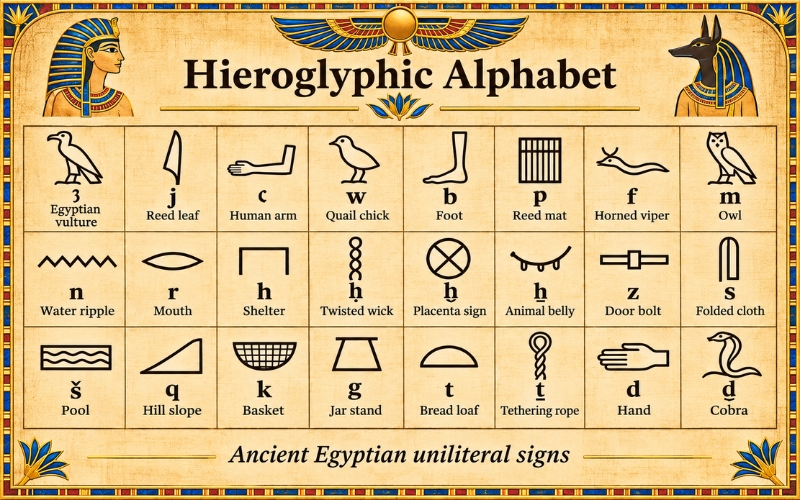
The hieroglyphic alphabet is a beginner-friendly name for the collection of ancient Egyptian signs that represent individual consonant sounds. Egyptian writing traditionally included 24 basic single-consonant signs, but hieroglyphics was not a modern 26-letter alphabet. It combined sound signs, whole-word signs, and meaning indicators. Learning these symbols helps you recognize royal names, understand simple inscriptions, and appreciate the writing carved into Egypt’s temples and tombs.
Look closely at an Egyptian inscription and you may recognize an owl, a reed leaf, a human arm, or a bird. These are not necessarily pictures describing the objects themselves. An owl can represent the sound m, a mouth can represent r, and a water ripple can represent n.
That distinction changes everything.
Ancient Egyptian hieroglyphs recorded a real language, not a collection of mysterious illustrations. The system developed more than 5,000 years ago and remained in use across extraordinary changes in Egyptian history.
Understanding even a few signs can make visits to the pyramids, Luxor’s temples, and the tombs of ancient pharaohs much more rewarding.
This Hieroglyphic Alphabet Guide explains the real Egyptian sound signs, how the popular A–Z charts work, what hieroglyphics symbols mean, how translations are produced, and where you can recognize authentic inscriptions during an Egypt trip in 2027.
What Are Hieroglyphics? Definition and Meaning
Hieroglyphics is the name commonly used for the ancient Egyptian writing system that combined pictures, sounds, and symbols to represent language. A single written sign is called a hieroglyph; the plural is hieroglyphs.
The more precise term for the writing system is Egyptian hieroglyphic script. The words hieroglyphic and hieroglyphics are widely used in everyday English, although Egyptologists generally prefer hieroglyphs when referring to the signs themselves.
The English word comes from Greek terms meaning approximately “sacred carvings.” Greek observers encountered these signs on monuments and in religious settings, which influenced the name.
Ancient Egyptians, however, did not consider writing merely decorative. It served religious, political, administrative, historical, and personal purposes.
Hieroglyphic inscriptions could record:
-
The names and titles of kings and queens.
-
Prayers, offerings, and religious ceremonies.
-
Royal victories and building projects.
-
Instructions and statements about the afterlife.
-
Names of gods, places, and important individuals.
-
Dates, quantities, and events.
-
Commemorations of people and their achievements.
A carved inscription identifying a pharaoh and a painted text inside a tomb might use the same underlying writing system, even though their purposes were very different.
What Is the Difference Between a Hieroglyph and Hieroglyphics?
A hieroglyph is an individual sign. Hieroglyphs are multiple signs. Hieroglyphic writing is the system that organizes those signs into meaningful language.
For example, an Egyptian owl sign is a hieroglyph. A group containing an owl, a water ripple, and several other signs can form part of a written word or phrase.
The symbols do not automatically create meaning simply because they appear together. Their sound values, grammatical relationships, and context determine how an inscription is read.
This distinction matters because popular images of Egyptian writing sometimes present random signs as a meaningful message.
A genuine inscription follows linguistic conventions. Decorative hieroglyph patterns may only imitate the appearance of writing.
Why Did Ancient Egyptians Use Pictures for Writing?
The earliest Egyptian writing developed in a society where images already carried cultural and political significance.
Animals, tools, plants, architectural objects, and human body parts provided recognizable forms for written signs. These images could represent sounds as well as ideas.
A picture of an owl was therefore useful not because a sentence was necessarily about owls, but because the sign could represent a particular consonant.
Over time, Egyptian scribes standardized many signs and developed sophisticated conventions for combining them.
The result was a script that could record personal names, complex religious compositions, administrative information, poetry, and historical narratives.
Explore the broader development of Egypt’s civilization in our guide to Ancient Egypt and its history.
Are Egyptian Hieroglyphs an Alphabet?
Ancient Egyptian hieroglyphs contained an alphabet-like collection of single-consonant signs, but the complete writing system was not a true alphabet like modern English.
Egyptologists traditionally identify 24 basic uniliteral signs, meaning signs that represent one consonant each.
A uniliteral sign is the closest ancient Egyptian equivalent to an alphabet letter.
However, Egyptian scribes also used:
-
Biliteral signs representing two consonants.
-
Triliteral signs representing three consonants.
-
Logograms representing complete words.
-
Determinatives helping identify a word’s meaning.
A complete ancient Egyptian inscription could combine several of these functions in the same word.
Why There Was No Original Egyptian A–Z Alphabet
The modern English alphabet contains 26 letters, including dedicated letters for vowels.
Ancient Egyptian writing usually did not record vowels. Its sound system also included consonants that English does not represent with individual letters.
For example, English has several familiar vowels represented by A, E, I, O, and U. Ancient Egyptian did not use equivalent hieroglyphic vowel letters in its conventional spelling system.
Conversely, ancient Egyptian distinguished several consonants that modern English commonly groups under H or approximates with combinations such as KH and SH.
As a result, a modern Egyptian alphabet chart displaying 26 English letters is an educational approximation, not a historical alphabet copied directly from an ancient document.
This does not make the chart useless.
An A–Z chart can help students recognize basic shapes, understand sound correspondences, and create decorative versions of modern names. It simply needs to be labeled accurately.
What’s an Advantage of an Alphabet Over Hieroglyphics?
A writing system that uses a small, consistent set of letters can generally be simpler to learn and apply to unfamiliar words than one requiring knowledge of hundreds of signs and multiple writing conventions.
A primarily alphabetic system also reduces the number of distinct symbols needed for ordinary spelling.
Egyptian hieroglyphic writing, however, offered capabilities that a simple letter-by-letter system does not provide in the same way.
Its determinatives could clarify meaning, while its visual arrangement supported religious and monumental presentation.
The comparison is not between primitive pictures and advanced letters. Hieroglyphics was a highly developed writing system with different conventions and purposes.
The important difference is that Egyptian hieroglyphic writing never limited itself to its 24 single-consonant signs.
Ancient Egyptian Hieroglyphics Alphabet A–Z for Beginners
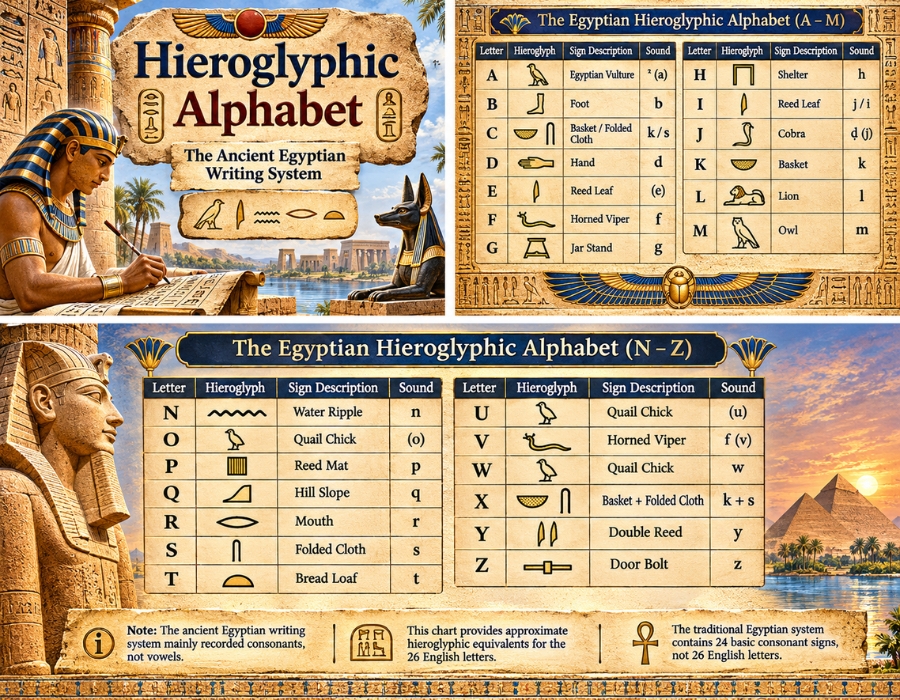
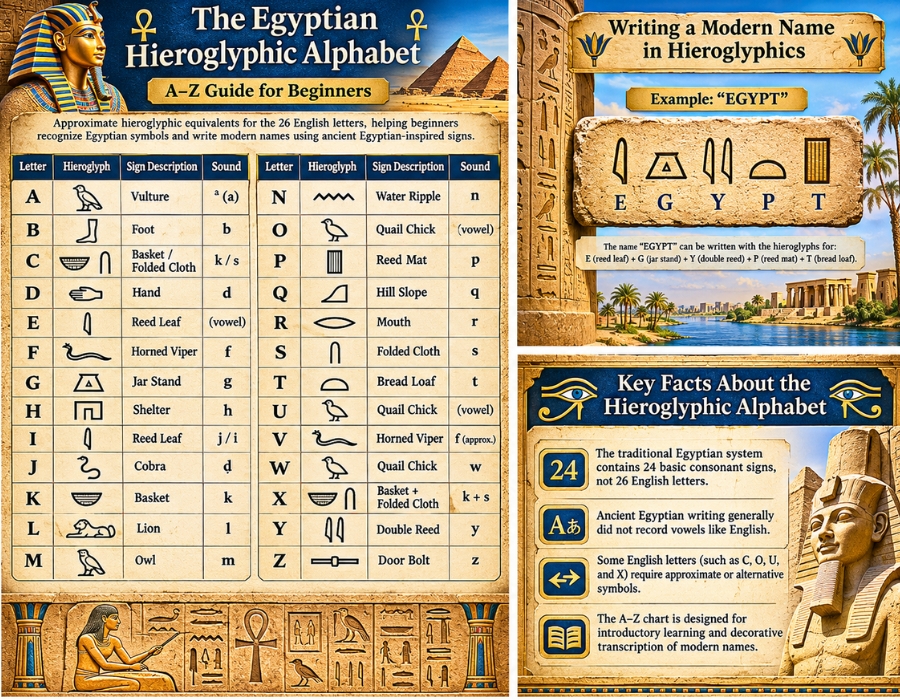
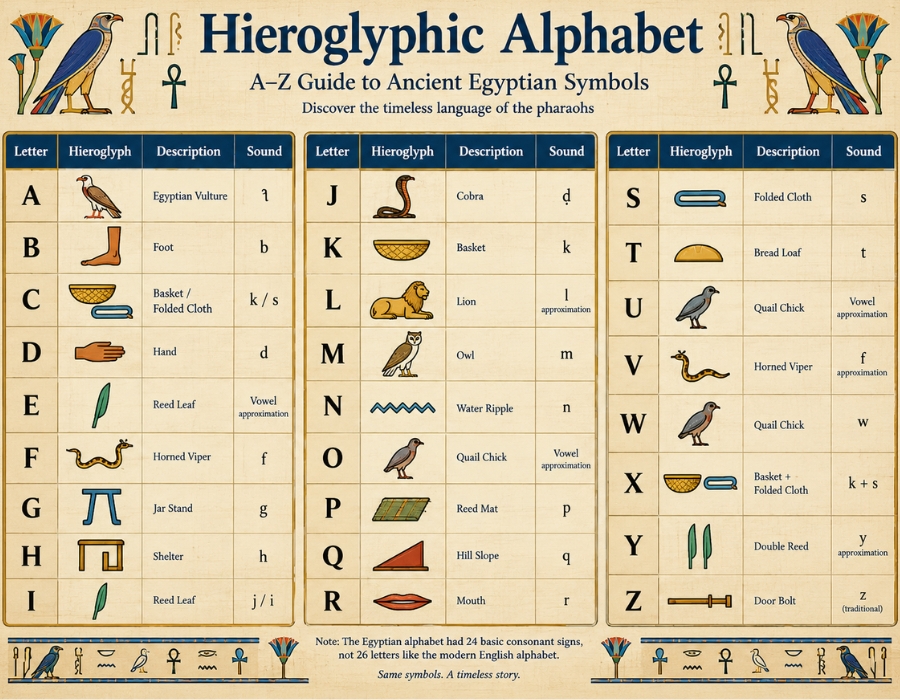
The ancient Egyptian hieroglyphic alphabet was not identical to the modern English alphabet. The following chart provides approximate hieroglyphic equivalents for all 26 English letters, helping beginners recognize Egyptian symbols and write modern names using ancient Egyptian-inspired signs.
Complete Egyptian Hieroglyphics Alphabet A–Z Chart
Important Notes About the Egyptian Alphabet
The chart is designed for introductory learning and decorative transcription of modern names.
Ancient Egyptian writing generally did not record vowels like English, so letters such as E, O, and U require approximations. Some letters, including C and X, can be represented by more than one Egyptian sign.
Remember: The traditional ancient Egyptian uniliteral system contains 24 basic consonant signs, not 26 English letters. Understanding this difference is essential when learning to read authentic hieroglyphics on Egyptian temples, tombs, and monuments.
This A–Z hieroglyphics alphabet helps explain why the same Egyptian sign sometimes appears beside several English letters.
For example, O, U, and W may all use the quail chick in simplified charts because their sounds do not correspond neatly to the ancient Egyptian system.
Similarly, ancient Egyptian did not possess the modern English V sound as a separate standard consonant, so an F sign is commonly used as a substitution.
What Is A in the Hieroglyphic Alphabet?
The sign most commonly used for the English letter A in beginner charts is the Egyptian vulture: .
Its traditional Egyptological transliteration is ꜣ, a consonantal sound rather than the English vowel A.
The human-arm sign, , represents another consonant, ꜥ, that is also sometimes simplified as an A-like sound in popular learning materials.
These are distinct Egyptian signs.
If you are writing a modern name, the vulture is a common decorative choice for A. When reading an ancient inscription, however, you should preserve the distinction between ꜣ and ꜥ.
Are Hieroglyphic Letters the Same as English Letters?
No. Similarities in introductory charts do not mean the two languages share exactly the same sounds.
The English letter C can sound like K in cat or S in city. An Egyptian-style transcription needs to consider the intended sound rather than copy C as though it has one unchanging value.
English combinations such as SH can sometimes correspond more naturally to an individual Egyptian sign than to separate S and H signs.
This sound-based approach is particularly important when translating foreign names.
How to Write Your Name in Egyptian Hieroglyphics
Writing your name in hieroglyphics is a popular introduction to ancient Egyptian writing.
The most useful approach is to represent the sounds of the name, rather than assume that every English spelling has an exact Egyptian equivalent.
There are five basic steps.
Step 1: Say the Name Aloud
Start by identifying how the name is pronounced.
Consider the difference between the letter C in Catherine and Cecilia.
The first begins with a K sound, while the second begins with an S sound.
Using the same hieroglyph for both would ignore an important pronunciation difference.
Names containing silent letters create a similar problem.
The written English spelling is therefore a starting point, not always the correct sequence of sounds.
Step 2: Match the Main Consonants
Use the hieroglyphic alphabet chart to identify the closest Egyptian consonant signs.
For a simplified example, consider the name Mark.
This produces a basic sound sequence that can serve as a starting point for a decorative representation.
A beginner version could also insert the vulture symbol for the written letter A.
The two approaches answer slightly different questions: one prioritizes consonant sounds, while the other visually represents an English spelling.
Step 3: Decide How to Treat Vowels
Ancient Egyptian writing did not normally record vowel sounds in the way modern English does.
Therefore, adding an Egyptian sign for every English vowel produces a modern approximation rather than an authentic ancient spelling.
For modern personal names, using vowel approximations can make the result easier to recognize.
For historically accurate Egyptian-language translations, it is better to follow established scholarly spellings.
Step 4: Arrange the Signs Correctly
Hieroglyphs could be written horizontally or vertically.
They could also be grouped to fit rectangular spaces, rather than arranged in a straight line like English handwriting.
For a beginner’s decorative name, a simple horizontal arrangement is easiest to understand.
A historically styled inscription requires attention to the direction of reading, sign orientation, spacing, and arrangement.
Step 5: Understand What You Have Created
A name represented through approximate phonetic signs is best described as a hieroglyphic transliteration or transcription, not a translation of the name’s meaning.
For example, representing the sounds of the name Rose does not automatically produce the ancient Egyptian word for a rose.
Similarly, writing a modern first name inside an oval cartouche does not make it an ancient royal name.
The result can be attractive and educational while remaining a modern adaptation.
Should You Put Your Name Inside a Cartouche?
A cartouche is an elongated oval enclosure, usually with a line closing one end, that was used especially for royal names.
Ancient Egyptian pharaohs typically had multiple names and titles, including two principal names that were commonly enclosed in cartouches.
Modern hieroglyphic souvenirs often place a visitor’s name inside the same shape.
That is an artistic convention inspired by royal inscriptions.
It is not a claim that ancient Egyptian scribes would have written the modern name in that exact way.
If you are choosing a personalized souvenir, ask whether the hieroglyphs represent the spelling or pronunciation of your name and whether the sign sequence has been checked.
How Do Egyptian Hieroglyphs Work?
Hieroglyphic writing is easier to understand once you recognize that signs can perform different jobs.
The meaning of a hieroglyph depends on its role within the word or inscription.
Three main categories explain much of the system.
Phonograms: Symbols Representing Sounds
A phonogram represents one or more sounds.
The owl sign, , commonly represents the consonant m. It does not necessarily mean that the text is discussing an owl.
Phonograms can contain:
-
One consonant: uniliteral signs.
-
Two consonants: biliteral signs.
-
Three consonants: triliteral signs.
For example, the house sign can represent the consonant sequence pr.
This means an Egyptian scribe could use one symbol where an introductory alphabet chart might lead you to expect two.
Recognizing these multi-consonant signs is an essential step beyond memorizing the basic alphabet.
Logograms: Symbols Representing Words
A logogram represents a complete word.
For example, the house sign can represent the Egyptian word for house when used in the appropriate context.
The same sign may also function phonetically elsewhere.
A short vertical stroke can accompany certain word signs to indicate that the pictured object is intended as a word.
This creates an important distinction.
A picture in a hieroglyphic inscription is not automatically a symbol with one fixed symbolic meaning. It may be recording a word or contributing sounds to another word.
Determinatives: Symbols That Clarify Meaning
Determinatives are signs used to indicate the general meaning or category of a word.
They normally appear after the word’s phonetic components and are not pronounced separately.
For example, a sign depicting a seated person can help identify a word referring to a human being or a person’s role.
Other determinatives can suggest categories such as:
-
People or occupations.
-
Animals.
-
Buildings and settlements.
-
Movement.
-
Deities.
-
Abstract concepts.
Because ancient Egyptian writing generally omitted vowels, different words could have similar consonantal spellings.
Determinatives helped readers distinguish them.
Why Can One Hieroglyph Have Different Meanings?
A single hieroglyph can function as a phonogram, logogram, or determinative depending on the context.
This is one of the most important principles in Egyptian hieroglyphs translation.
Consider the sign depicting a mouth.
In one context, the mouth represents the consonant r.
In another, it can contribute to writing the word referring to a mouth.
If you translate every mouth sign as the English word mouth, you will misunderstand numerous inscriptions.
The correct interpretation requires examining the signs around it.
For a broader explanation of visual motifs and religious emblems, see our guide to ancient Egyptian symbols and their meanings.
How to Read Hieroglyphics: A Beginner’s Step-by-Step Method
You can begin learning how to read hieroglyphics without memorizing hundreds of signs.
Start with the basic structure, recognize common consonants, and gradually move toward real words.
Step 1: Find the Direction of Reading
Egyptian hieroglyphs could be arranged in horizontal rows or vertical columns.
Horizontal text might run from right to left or left to right. Vertical columns are read from top to bottom, with the order of columns depending on the orientation.
The easiest rule is to look at the human and animal signs. Read toward the direction their faces are pointing.
If the birds face right, begin on the right and read toward the left.
If they face left, begin on the left and read toward the right.
This convention helps readers identify the starting point of an inscription.
The rule becomes particularly useful on temple walls where two symmetrical inscriptions face one another.
Step 2: Recognize Hieroglyphic Groups
Egyptian scribes arranged signs into visually balanced groups, sometimes called quadrats.
One tall sign might stand beside two shorter signs. Several symbols could occupy the same visual block.
This arrangement was not random.
The shapes were organized to use space attractively while preserving the sequence of the written language.
Beginners sometimes read symbols in the wrong order because they assume every sign must be interpreted from left to right, one after another.
Instead, first identify the overall reading direction and then examine how the individual groups are arranged.
Step 3: Identify the Sound Signs
Look for familiar uniliteral signs.
You might notice an owl, water ripple, reed leaf, hand, or mouth.
Use the alphabet chart to identify their consonantal values.
Do not immediately turn each sign into an English word.
At this stage, the task is simply to identify sounds.
A short inscription may contain several easy consonant signs alongside more complex ones you have not yet learned.
Step 4: Check for Multi-Consonant Signs
Not every sign represents a single consonant.
Some of the most common Egyptian signs represent two or three consonants.
The sign , associated with the word ꜥnḫ (often written ankh in English), is a well-known example of a sign that can represent a complete consonantal sequence and the concept of life.
A beginner relying only on individual alphabet signs may be confused by words containing these more compact signs.
Learning commonly repeated two- and three-consonant signs makes reading much faster.
Step 5: Look for Determinatives
The final sign in a word may help identify its meaning rather than add a pronounced sound.
A seated god can indicate a divine name. A person sign may indicate that the preceding group refers to a human.
This does not mean every Egyptian word ends with a determinative, but many do.
Recognizing them helps separate words and avoid incorrect translations.
Step 6: Use Grammar and Historical Context
Egyptian hieroglyphic inscriptions are not simply strings of nouns.
They contain grammar, verb forms, pronouns, titles, and conventional expressions.
For example, a name appearing on a coffin may form part of a funerary offering formula. The same name on a temple wall may appear within a royal dedication.
Context affects the interpretation.
Ask yourself:
-
Is the inscription from a temple, tomb, statue, or papyrus?
-
Does it contain a royal cartouche?
-
Is a god or king depicted beside it?
-
Does the writing appear as part of a repeated formula?
-
Could the signs belong to a personal name or title?
-
Is the inscription damaged or incomplete?
A reliable reading combines the signs with the language and archaeological context.
Step 7: Separate Transliteration, Pronunciation, and Translation
These three terms describe different stages of understanding an inscription.
Transliteration converts Egyptian signs into a standardized modern scholarly notation.
Pronunciation attempts to describe how a word may have sounded. The original vowels are often uncertain.
Translation expresses the meaning in another language, such as English.
For example, the Egyptian consonantal sequence nfr is commonly translated as beautiful, good, or perfect, depending on context.
Modern readers often pronounce this sequence approximately as “nefer.”
That convenient pronunciation does not mean we know exactly how every ancient Egyptian speaker pronounced the word.
Understanding these differences prevents many of the mistakes made by casual online translators.
Hieroglyph Translator: How to Translate Egyptian Hieroglyphics Correctly
A hieroglyph translator can be useful for learning symbols, identifying possible sound values, or experimenting with modern names.
However, not every tool advertised as a hieroglyphics translator performs the same task.
Some convert English letters into decorative Egyptian signs. Others transliterate existing hieroglyphic sequences. More specialized tools assist researchers in analyzing ancient Egyptian texts.
These functions are not interchangeable.
English-to-Hieroglyphics Translators
An English-to-hieroglyphics translator commonly takes a modern word or name and replaces its letters with approximate Egyptian signs.
For example, a tool might use the owl sign for M and the water ripple for N.
This is useful for basic alphabet exercises and personalized decorations.
It is not a complete translation into ancient Egyptian.
If you enter a sentence such as “I love Egypt,” a letter-substitution tool may output a sequence of hieroglyphs representing the English spelling.
An ancient Egyptian scribe would not have written that English sentence through direct letter replacement.
A genuine translation requires choosing ancient Egyptian vocabulary and grammar appropriate to the intended meaning and historical period.
Hieroglyphics-to-English Translators
A tool that attempts to translate actual ancient Egyptian text faces a more difficult task.
It must determine:
-
Which signs appear in the inscription.
-
Whether each sign represents a sound, word, or determinative.
-
Where word boundaries occur.
-
Which grammatical constructions are present.
-
What historical language stage is involved.
-
Whether signs are damaged, unusual, or incorrectly copied.
Egyptian inscriptions can contain complex expressions and spellings that differ by period, region, or religious context.
Automatic systems may produce plausible-looking English that is not supported by the original text.
This makes verification particularly important.
Which Type of Hieroglyph Translator Should You Use?
|
Your goal |
Best approach |
Main limitation |
|---|---|---|
|
Write your name in hieroglyphs |
Phonetic name converter |
Produces an approximation |
|
Learn the Egyptian alphabet |
Uniliteral sign chart |
Does not explain complete Egyptian grammar |
|
Identify a temple symbol |
Sign reference or Egyptological dictionary |
Visual identification alone may be insufficient |
|
Convert hieroglyphs into scholarly letters |
Transliteration tool |
Does not automatically explain meaning |
|
Translate an ancient inscription |
Egyptological language resources and expert interpretation |
Requires context and grammatical analysis |
|
Prepare a historical inscription for publication |
Specialist hieroglyphic typesetting and academic verification |
Accurate sign order and transcription are essential |
For basic writing exercises, a simple translator may be sufficient.
For a tattoo, publication, permanent inscription, educational display, or significant personal project, have the result checked by someone with relevant Egyptological knowledge.
Can AI Translate Egyptian Hieroglyphs?
AI can assist with identifying signs, suggesting transliterations, and explaining known vocabulary.
Its accuracy depends on the quality of the input and the availability of reliable references.
A clear photograph of a recognizable inscription may provide useful clues, but unusual signs, damaged surfaces, and complex grammar can produce errors.
An AI-generated translation should therefore be treated as a preliminary interpretation unless it has been checked against established scholarly material.
For real archaeological texts, the strongest approach is to compare the proposed reading with published transcriptions, dictionaries, and academic translations.
How to Translate a Hieroglyphic Inscription From a Photograph
Follow this practical process:
-
Identify the archaeological site and object if possible.
-
Establish the direction of reading.
-
Record the individual signs without guessing their meaning.
-
Compare uncertain signs with a recognized sign list.
-
Convert the signs into scholarly transliteration.
-
Identify word boundaries, grammar, and determinatives.
-
Compare the reading with documented translations of similar inscriptions.
-
Mark uncertain passages rather than invent missing words.
A photograph showing only the middle of a temple inscription may not contain enough information for a reliable translation.
If you are collecting ancient Egypt images and hieroglyphics for a research project, preserve the original photograph and record the site’s name, date, monument, and precise location of the text.
Those details can be as valuable as the symbols themselves.
Egyptian Hieroglyphs Translation: A Real Example With Anubis
The name of Anubis demonstrates why Egyptian hieroglyphs cannot always be translated through a simple letter-by-letter chart.
Anubis was the ancient Egyptian deity strongly associated with embalming, burial, and the protection of the dead.
The English name Anubis comes through Greek.
In Egyptian, the name is conventionally transliterated jnpw, although shortened spellings and different scholarly transcription conventions occur.
The written name can include phonetic signs and a determinative identifying the deity.
Why the Name Is Not Written as English A-N-U-B-I-S
The ancient Egyptian language did not spell the name using the modern English letters.
Its original written form follows Egyptian sound and spelling conventions.
A direct English A–Z conversion would produce a decorative representation of the English name rather than the historical Egyptian spelling.
This example also explains why understanding the historical form of a name matters when learning hieroglyphics.
A modern translation may use a familiar Greek-derived name even when the Egyptian original looks different.
What Does the Anubis Symbol Mean?
Anubis is commonly represented as a black canine or a human figure with a canine head.
Such images can appear in religious scenes, funerary art, and signs connected to the deity.
The animal-shaped representation is not automatically a single alphabet letter.
Depending on its function, it may identify the god, act as part of a written name, or appear as a larger religious image.
For more historical context, explore Anubis, the ancient Egyptian god of mummification.
How This Helps You Read Other Divine Names
The same basic principle applies to other Egyptian deities.
Names such as Osiris, Isis, Horus, Ra, and Thoth have established historical spellings that do not always correspond neatly to their modern English forms.
When examining a temple inscription, look for the combination of phonetic signs, divine determinatives, titles, and surrounding religious imagery.
The visual context can help identify the deity, but the written name still needs to be interpreted linguistically.
Explore the relationships among these deities in our guide to ancient Egyptian gods and goddesses.
Ancient Egypt and Hieroglyphics: How the Writing System Developed
Egyptian hieroglyphic writing emerged around the late fourth millennium BCE, approximately 3200 BCE, during the period when early Egyptian political institutions and royal authority were developing.
The earliest evidence includes inscriptions on labels, vessels, and other objects associated with early elite and royal contexts.
Over the following centuries, hieroglyphic writing became increasingly standardized and capable of recording extensive religious, political, and historical texts.
Its history spans several major periods.
|
Historical period |
Approximate dates |
Development of writing |
|---|---|---|
|
Early Dynastic Period |
c. 3100–2686 BCE |
Early royal names, titles, labels, and administrative uses |
|
Old Kingdom |
c. 2686–2181 BCE |
Monumental inscriptions and religious texts, including Pyramid Texts |
|
Middle Kingdom |
c. 2055–1650 BCE |
Religious, literary, and administrative writing traditions |
|
New Kingdom |
c. 1550–1069 BCE |
Extensive royal temple inscriptions and elaborate funerary texts |
|
Late Period |
664–332 BCE |
Continued religious and monumental uses |
|
Ptolemaic Period |
332–30 BCE |
Elaborate temple inscriptions and expanded religious sign conventions |
|
Roman Egypt |
30 BCE onward |
Continued hieroglyphic use in certain temple and priestly contexts |
Dates are approximate, and historical period boundaries may vary among Egyptological chronologies.
The Earliest Egyptian Hieroglyphs
Some of the earliest evidence of Egyptian writing comes from Abydos, an important early royal and religious center in Upper Egypt.
Small labels associated with royal burials reveal that written signs were already being used to identify objects, commodities, places, and people.
These early inscriptions were often brief.
They were not yet the long historical accounts or religious compositions that tourists encounter at later monumental sites.
As the Egyptian state developed, writing became increasingly important for royal identification, ceremonial display, and administration.
The association between writing and government helps explain why so many surviving inscriptions refer to kings, officials, institutions, and offerings.
Hieroglyphics During the Old Kingdom
The Old Kingdom is famous for the large pyramid complexes associated with rulers such as Khufu, Khafre, and Menkaure.
Hieroglyphic writing was used in royal and elite contexts during this period.
One of its most important religious developments was the appearance of the Pyramid Texts, first preserved extensively inside the pyramid of King Unas near the end of the Fifth Dynasty.
These texts contain spells and statements concerning the king’s passage into the afterlife.
They demonstrate that hieroglyphic writing could communicate complex religious ideas rather than merely identify a monument or person.
A useful distinction for travelers is that the Great Pyramid of Khufu is not the same kind of text-bearing monument as the later pyramids containing Pyramid Texts.
If your main interest is reading ancient writing, some tombs and later funerary monuments are more rewarding than the interior of the Great Pyramid.
Explore the historical context of King Khufu and the Fourth Dynasty.
Hieroglyphics During the New Kingdom
The New Kingdom produced some of Egypt’s best-known temple inscriptions.
Royal building programs and religious ceremonies were recorded on enormous temple walls, columns, gateways, and statues.
The inscriptions often worked together with painted or carved scenes.
A king might be shown presenting offerings to a deity while the accompanying hieroglyphs identify the participants and record the words associated with the ritual.
The texts served political and religious purposes simultaneously.
They presented rulers as legitimate representatives of divine order and preserved their names within sacred spaces.
The period also produced extensive funerary material, including copies of compositions now commonly grouped under the title Book of the Dead.
These texts were not all identical. Individual manuscripts could contain different selections of spells.
When Did Egyptians Stop Using Hieroglyphics?
Hieroglyphic writing gradually declined as Egypt experienced religious, cultural, administrative, and linguistic changes during the Greco-Roman and Late Antique periods.
One of the most significant surviving dates is 394 CE, when the last securely dated known hieroglyphic inscription was carved at Philae.
The inscription is associated with Esmet-Akhom, a priest connected with the temple’s continuing religious traditions.
This does not mean every form of the Egyptian language disappeared in 394 CE.
The Egyptian language continued in its Coptic stage, written principally using letters derived from Greek with additional signs.
Hieroglyphic literacy itself eventually ceased to be transmitted as a living tradition.
The script would remain unreadable to modern scholars for many centuries.
Why Were Papyrus and Hieroglyphics Important in Ancient Egypt?
Papyrus and Egyptian writing enabled information to be recorded, preserved, and communicated across the kingdom.
Papyrus was a writing material produced from the papyrus plant, which grew in the Nile environment.
Egyptian scribes used papyrus sheets and rolls to record information with ink and writing tools.
However, papyrus and hieroglyphics are not the same thing.
Papyrus is a material. Hieroglyphics is a script.
Many surviving papyrus documents were written in cursive scripts such as hieratic or Demotic, rather than in elaborate monumental hieroglyphs.
How Papyrus Helped Ancient Egyptian Administration
Stone inscriptions were durable but labor-intensive to produce.
Papyrus allowed scribes to prepare documents that could be transported, consulted, and stored more conveniently.
Written records supported activities such as:
-
Recording deliveries of food and materials.
-
Maintaining administrative correspondence.
-
Tracking workers and supplies.
-
Documenting legal matters and agreements.
-
Preserving religious and literary compositions.
-
Recording agricultural information and economic obligations.
The ability to preserve written information helped institutions function across distances and generations.
A temple, estate, or administrative office could maintain records beyond the memory of an individual official.
Hieroglyphics and Farming in Ancient Egypt
Agriculture was central to Egypt’s economy.
The Nile’s seasonal flooding historically affected cultivation, while irrigation, land management, and agricultural production required organization.
Scribes recorded information connected with land, grain, livestock, and deliveries.
These activities helped institutions manage resources and obligations.
However, everyday agricultural documents were often written in quicker cursive scripts.
It would therefore be inaccurate to imagine Egyptian farmers routinely carving detailed hieroglyphic records into stone.
Most agricultural workers were not professional scribes.
The relationship between hieroglyphics and farming is best understood as part of the wider development of written administration.
For more context, explore why the Nile River was essential to ancient Egypt.
Why Hieroglyphics Was Important for Religion
Egyptians believed that words, names, and images could carry religious significance.
Written names could contribute to preserving a person’s identity, while funerary texts helped communicate religious ideas about death and rebirth.
Temple inscriptions presented offerings, praises, and ceremonial relationships between rulers and deities.
The signs were therefore not simply a convenient means of recording speech.
In sacred settings, writing could itself participate in religious practice.
This helps explain the careful arrangement of inscriptions and their close relationship with carved scenes.
Who Could Read and Write Hieroglyphics in Ancient Egypt?
Literacy was limited in ancient Egypt, and trained scribes were among the people most closely associated with reading and writing.
Scribes worked within government, temples, estates, and other institutions.
Learning to write required considerable training, especially when mastering the forms and conventions of different Egyptian scripts.
Hieroglyphic literacy was a specialized skill.
Not everyone who lived among Egypt’s temples and monuments could read the inscriptions carved on them.
What Did Ancient Egyptian Scribes Do?
Scribes performed a variety of duties.
Some prepared accounts, copied documents, and maintained administrative records.
Others worked in religious institutions or participated in producing texts for monuments and funerary objects.
They could be associated with the recording of supplies, labor, property, taxes, correspondence, and official decisions.
Scribal expertise carried social prestige because writing was essential to institutional organization.
It was also closely connected with education and professional advancement.
The position of scribe should not be confused with a single occupation performed in exactly the same way across three thousand years.
Responsibilities varied according to period, institution, and rank.
How Were Scribes Trained?
Students learned signs, vocabulary, writing conventions, and the forms of documents used in their professional environment.
Practice could involve copying model texts and exercises.
Writing materials included papyrus, wooden writing boards, and ostraca, which are pieces of pottery or stone used as writing surfaces.
Scribal tools commonly included palettes, writing implements, and inks.
Hieratic was especially important for many everyday written activities because it was better suited to rapid writing than formal monumental hieroglyphs.
Training was therefore more complex than memorizing an Egyptian A–Z chart.
Did Pharaohs Know How to Read Hieroglyphics?
Some rulers may have received substantial education, but it is not possible to assume that every pharaoh personally read or wrote hieroglyphs fluently.
Royal literacy and education varied, and evidence is uneven.
A monument bearing a king’s name does not prove that the king physically carved or wrote the inscription.
Royal texts were produced through established workshops, scribal practices, and artistic programs.
The pharaoh’s authority was central to the message, but the writing itself often involved professional specialists.
Hieroglyphs and the Afterlife in Ancient Egypt
Ancient Egyptian funerary beliefs help explain why some of the most elaborate surviving hieroglyphs appear in tombs and burial objects.
Egyptian religious traditions described death as a transition requiring protection, appropriate rituals, and the continuation of identity.
Hieroglyphic texts recorded prayers, offerings, sacred names, and instructions related to these beliefs.
The written word could have a religious function as well as a linguistic one.
Why Were Hieroglyphs Written Inside Tombs?
Tomb inscriptions could identify the deceased, describe their achievements, record offerings, and preserve religious texts.
They might also name gods and include statements intended to support the deceased in the afterlife.
Some tomb walls combine writing with scenes of agricultural work, food production, family life, and offering ceremonies.
The pictures and inscriptions often form a connected program.
A scene of food or agricultural abundance can reflect both everyday life and the desire for continued provision after death.
This is one reason tomb inscriptions provide evidence about ancient Egyptian society as well as religion.
The Pyramid Texts and Coffin Texts
The Pyramid Texts are among the earliest extensive surviving collections of ancient Egyptian funerary religious writing.
They first appear prominently in late Old Kingdom royal pyramids.
Later, the Coffin Texts expanded the use of funerary compositions, including on coffins belonging to nonroyal individuals.
Over time, further developments contributed to the tradition commonly described as the Book of the Dead.
These collections were not identical books arranged in one fixed sequence.
They represent changing funerary traditions and different ways of expressing religious ideas.
The hieroglyphic writing in such texts offers historians evidence for Egyptian beliefs, language, and ritual practice.
The Book of the Dead and the Weighing of the Heart
The Book of the Dead is a modern name for collections of ancient Egyptian funerary spells.
Some surviving copies include the famous scene showing the deceased’s heart being weighed against the feather associated with Ma’at, the concept and goddess of truth and cosmic order.
In the wider religious narrative, this judgment was connected with the deceased’s moral standing and hoped-for continued existence.
Thoth, often depicted with an ibis head, could appear as the divine recorder.
Anubis and Osiris were also central figures in funerary beliefs.
Understanding the names and inscriptions associated with these scenes makes the artwork much easier to interpret.
Why Was Preserving a Person’s Name Important?
Ancient Egyptian identity involved more than the physical body.
Names, images, memory, and religious provisions played meaningful roles in beliefs about continued existence.
A person’s name carved into a tomb or funerary object could help preserve their identity.
This is also why the deliberate removal of names and images could carry powerful political and symbolic significance.
Royal names were sometimes altered, erased, or replaced as part of later political and religious developments.
For travelers, damaged inscriptions can therefore be historically interesting rather than simply incomplete.
A missing name may reveal a later attempt to change how a ruler was remembered.
Discover the relationship between royal burials and funerary art in our guide to the Valley of the Kings.
Ancient Egyptian Hieroglyphics Symbols and Their Meanings
Not every famous Egyptian symbol belongs to the 24-sign hieroglyphic alphabet.
Some symbols can function as written signs, while others appear primarily as religious images, amulets, or decorative motifs.
Understanding the difference helps prevent misleading interpretations.
|
Symbol |
Common meaning or association |
Important distinction |
|---|---|---|
|
Ankh |
Life |
Also functions as a hieroglyphic sign |
|
Djed pillar |
Stability and endurance |
Closely associated with Osiris |
|
Was scepter |
Power and dominion |
Appears as a religious emblem and written sign |
|
Eye of Horus |
Protection, healing, restoration |
Not a simple alphabet letter |
|
Scarab beetle |
Becoming, transformation, renewal |
Can carry phonetic and religious significance |
|
Shen ring |
Encircling protection and eternity |
Related conceptually to royal-name enclosures |
|
Lotus |
Renewal and regeneration in some contexts |
Also appears in writing and numerical notation |
|
Feather of Ma’at |
Truth and cosmic order |
Meaning depends on religious context |
|
Sun disk |
The sun, divinity, and solar associations |
May function in names and inscriptions |
|
Cat |
Animal associated with domestic life and certain goddesses |
Does not always identify the goddess Bastet |
What Does the Ankh Hieroglyph Mean?
The ankh is one of the most recognizable Egyptian signs.
It is commonly associated with life and appears frequently in religious art.
Deities may be depicted holding the ankh or presenting it toward a king.
The sign can also function as part of written Egyptian language.
Its meaning is not simply “eternal life” in every context, although the broader association with life and divine power contributed to its religious importance.
The ankh illustrates how Egyptian writing and religious imagery could overlap.
What Does the Eye of Horus Mean?
The Eye of Horus is commonly associated with protection, restoration, and healing.
Its mythological significance is connected with Horus and the wider religious traditions surrounding Osiris and Seth.
It appears in amulets and protective contexts.
The Eye of Horus should not be confused with the ordinary eye-shaped signs that can serve other linguistic functions in hieroglyphic writing.
Two images may both resemble eyes but carry different meanings depending on their form and use.
Explore the Eye of Horus and its ancient Egyptian symbolism.
What Does the Scarab Beetle Represent?
The scarab beetle was strongly associated with renewal and transformation.
The connection is linked to Egyptian observations of the beetle and its association with the solar deity Khepri.
Scarab-shaped objects were widely used as amulets, seals, and decorative items.
Some carried inscriptions, while others functioned as protective or symbolic objects.
A scarab should therefore not automatically be interpreted as a letter or a complete sentence.
Its role depends on the object and its archaeological context.
What Does a Cat Mean in Egyptian Hieroglyphics?
Cats appeared in ancient Egyptian art, domestic life, religious imagery, and written language.
The ancient Egyptian word commonly transliterated as mjw or miw referred to a cat, with related forms and spelling variations.
The word’s meaning was not determined simply by choosing a single alphabet letter.
Cat imagery is also associated with Bastet, a goddess whose forms and religious significance changed across Egyptian history.
However, not every ancient image of a cat represents Bastet.
Some depict ordinary domestic animals.
Read more about Bastet, the Egyptian cat goddess.
Why Did Egyptian Symbols Have Several Meanings?
Egyptian religious and artistic symbols developed across long periods.
Their interpretation depended on context, tradition, material, and location.
A sign could have a phonetic function in one inscription and a religious association in another setting.
Similarly, an amulet could communicate an idea without forming a complete written statement.
This flexibility is one reason Egyptian hieroglyphs and their meanings cannot be reduced to a simple dictionary of pictures.
Hieroglyphics Numbers: How Ancient Egyptians Counted
Ancient Egyptians used a decimal-based numerical system with distinct signs for powers of ten.
Unlike modern positional notation, traditional hieroglyphic numbers were principally additive.
A number could be represented by repeating signs and combining their values.
For example, the number 23 could be expressed using two symbols for ten and three unit strokes.
Actual numerical arrangements could vary according to writing orientation and available space.
Did Ancient Egyptian Numbers Have Zero?
The standard ancient Egyptian hieroglyphic number system did not use a positional zero in the same way that modern decimal notation does.
It relied on combinations of signs representing quantities.
This differs from writing 203 today, where the zero indicates an empty tens position.
Ancient Egyptian mathematicians nevertheless developed sophisticated methods of measurement and calculation.
Written mathematical documents provide evidence for arithmetic, fractions, geometry, and practical calculations.
Where Can You See Ancient Egyptian Numbers?
Numerical signs can appear in administrative and economic records, offerings, commemorative inscriptions, and other texts.
Large quantities were sometimes used in ritual formulas, including expressions requesting abundant offerings.
When reading a religious text, a number may therefore carry a ceremonial meaning as well as its mathematical value.
Recognizing the numerical signs allows you to distinguish quantities from ordinary sound signs.
How Did the Rosetta Stone Unlock Egyptian Hieroglyphics?
The Rosetta Stone helped scholars decipher ancient Egyptian hieroglyphs because it preserved substantially the same decree in three different scripts.
The stone was discovered in 1799 near Rashid, also known as Rosetta, in Egypt’s Nile Delta.
Its inscription dates to 196 BCE, during the reign of Ptolemy V.
The decree was recorded in:
-
Egyptian hieroglyphic script.
-
Egyptian Demotic script.
-
Ancient Greek.
An important distinction: The Rosetta Stone contains three scripts, but not three separate languages. Hieroglyphic and Demotic record Egyptian, while the third inscription records Greek.
Why Was the Greek Inscription So Important?
By the time the Rosetta Stone attracted modern scholarly attention, the ability to read ancient Egyptian hieroglyphs had been lost.
Ancient Greek, however, was understood.
The Greek version helped scholars identify the subject of the decree and compare recognizable names and passages with the Egyptian versions.
This provided a foundation for investigating how Egyptian signs represented sounds and words.
The stone was especially valuable because the different scripts communicated closely related content.
It offered more evidence than an isolated inscription whose subject was unknown.
Who Deciphered Egyptian Hieroglyphics?
The decipherment was a cumulative scholarly achievement.
Several researchers contributed to the process, including Thomas Young and Jean-François Champollion.
Young made important progress in identifying phonetic elements, including their role in royal names.
Champollion’s major breakthrough came in 1822.
He recognized that phonetic signs played a much broader role in Egyptian writing than had previously been understood.
His knowledge of Coptic, the later stage of the Egyptian language, also contributed to his analysis.
The Rosetta Stone was a key piece of evidence, but the decipherment involved comparison with other inscriptions and language research as well.
How Did Royal Names Help Scholars?
Royal names offered valuable points of comparison.
A Greek inscription could identify a ruler whose name also appeared inside a hieroglyphic cartouche.
By comparing repeated signs in known names, scholars could test possible sound values.
Names such as Ptolemy and Cleopatra were particularly useful.
The approach demonstrated that hieroglyphs were not merely symbolic illustrations.
They could represent the sounds used to write names, including names of foreign origin.
Why Was the Rosetta Stone Discovery So Important?
Before the decipherment, many ancient Egyptian written records remained inaccessible to scholars.
Understanding the script opened a vast body of evidence concerning Egyptian rulers, religion, government, society, and historical chronology.
It allowed researchers to read texts that had previously been interpreted primarily through their visual appearance.
The breakthrough transformed Egyptology.
Modern research continues to refine the understanding of Egyptian vocabulary, grammar, historical texts, and specific inscriptions.
The Rosetta Stone itself is held by the British Museum in London. Travelers exploring the Egyptian Delta can also discover the historical setting of Rosetta, known today as Rashid.
Hieroglyphics vs. Hieratic, Demotic, and Coptic
Ancient Egypt did not rely on one unchanged writing style throughout its history.
Different scripts developed for different purposes and periods.
Understanding these differences helps travelers recognize why not every ancient Egyptian text resembles a temple inscription.
|
Writing system |
Main characteristics |
Typical contexts |
|---|---|---|
|
Hieroglyphic |
Formal pictorial script using phonetic and semantic signs |
Temples, monuments, tombs, religious texts |
|
Hieratic |
Cursive Egyptian script developed for efficient writing |
Papyrus documents, administration, literature, religion |
|
Demotic |
Later cursive script with highly abbreviated forms |
Legal, administrative, literary, and other texts |
|
Coptic |
Later stage of the Egyptian language written principally with Greek-derived letters and additional signs |
Religious literature and other texts in Late Antique and later Egypt |
How Is Hieratic Different From Hieroglyphics?
Hieratic developed as a cursive way of writing Egyptian.
Its signs were generally faster to write than detailed monumental hieroglyphs.
Scribes used it for many types of documents, particularly on papyrus and other writing surfaces.
Hieratic and hieroglyphic could record the same Egyptian language.
The distinction is primarily one of script, although linguistic forms and conventions also changed over time.
The existence of hieratic helps explain why a temple wall and an administrative letter from ancient Egypt can look very different.
What Was Demotic Writing?
Demotic was a later Egyptian script that became widely used during the first millennium BCE.
It developed highly abbreviated forms suited to writing on papyrus and other materials.
Demotic was used for legal documents, administration, correspondence, literary texts, and other purposes.
The Demotic inscription on the Rosetta Stone occupies the middle section of the monument.
It is not simply a poorly drawn version of hieroglyphics.
It is a distinct historical script with its own conventions.
Is Coptic the Same as Ancient Egyptian?
Coptic represents the latest historical stage of the Egyptian language.
Unlike traditional hieroglyphic writing, Coptic was written mainly using letters derived from Greek, supplemented by additional letters for Egyptian sounds.
Because Coptic records vowels more explicitly than earlier Egyptian scripts, it has been particularly valuable in studying the pronunciation and history of Egyptian.
The relationship between Egyptian hieroglyphics and Coptic illustrates an important point: a language can survive changes in its writing system.
For a broader introduction to Egypt’s linguistic history, explore the languages spoken in Egypt.
Where to See Authentic Egyptian Hieroglyphs in 2027
The best places to see Egyptian hieroglyphs are archaeological sites where inscriptions survive in their original architectural or funerary settings.
Some monuments contain short royal inscriptions. Others preserve extensive religious texts, historical scenes, and rows of royal names.
For a first-time visitor, the most rewarding sites are not necessarily those with the most famous pyramids.
If your primary interest is understanding ancient Egyptian writing, choose temples and decorated tombs where inscriptions are clearly visible and closely connected to the surrounding scenes.
The Best Egyptian Sites for Hieroglyphics
|
Site |
Location |
What makes the inscriptions interesting |
|---|---|---|
|
Saqqara |
Near Cairo |
Pyramid Texts, decorated tombs, and Old Kingdom inscriptions |
|
Giza Plateau |
Giza |
Royal names, funerary contexts, and inscriptions in associated tombs |
|
Karnak Temple |
Luxor |
Large royal inscriptions, divine names, and religious scenes |
|
Luxor Temple |
Luxor |
Monumental inscriptions connected with kingship and religious ceremonies |
|
Valley of the Kings |
West Bank of Luxor |
Elaborate funerary texts and painted hieroglyphs |
|
Temple of Seti I |
Abydos |
Royal cartouches, religious texts, and the Abydos King List |
|
Dendera Temple |
Near Qena |
Detailed religious inscriptions and astronomical imagery |
|
Edfu Temple |
Edfu |
Extensive Ptolemaic religious inscriptions |
|
Kom Ombo Temple |
Kom Ombo |
Religious imagery and inscriptions associated with multiple deities |
|
Philae Temple |
Aswan |
Ptolemaic inscriptions and the latest securely dated known hieroglyphic text |
|
Abu Simbel |
Southern Egypt |
Monumental royal inscriptions associated with Ramesses II |
Not every part of every site is open to visitors at all times. Access to individual chambers and decorated areas may be affected by conservation measures or visitor-management decisions.
For 2027 travel, check current opening arrangements before building an itinerary around one specific inscription.
Saqqara: Discover Early Religious Writing
Saqqara is particularly important for understanding the development of Egyptian funerary texts.
The necropolis served Memphis and includes monuments from different periods of Egyptian history.
The pyramid of Unas is famous for preserving early Pyramid Texts.
In appropriate accessible areas, visitors can encounter inscriptions that provide direct evidence of ancient Egyptian ideas about royal death and the afterlife.
Saqqara also contains decorated tombs with scenes and inscriptions relating to work, offerings, and daily activities.
These provide an excellent contrast with royal religious writing.
If you want to understand how Egyptian hieroglyphs were used beyond monumental temple walls, Saqqara is an especially valuable destination.
Explore our guide to the Saqqara Necropolis.
Giza: Hieroglyphs Near the Great Pyramids
The Giza Plateau is one of the world’s most recognizable archaeological landscapes.
Its principal pyramids were constructed for Old Kingdom rulers, including Khufu, Khafre, and Menkaure.
However, visitors should not expect the interior of the Great Pyramid of Khufu to resemble a richly decorated New Kingdom tomb.
The Great Pyramid’s accessible interior spaces are largely austere rather than covered with colorful hieroglyphic scenes.
For written and artistic evidence, consider the wider funerary landscape, including surrounding tombs and associated monuments.
The royal cemetery helps explain how names, titles, and funerary traditions were integrated into Old Kingdom society.
Our Giza Necropolis guide provides more historical context for the plateau.
Karnak Temple: Read Royal Names and Monumental Inscriptions
Karnak is one of the most rewarding Egyptian archaeological sites for understanding the relationship between writing, religion, and kingship.
Its monumental architecture developed under numerous rulers.
Walls, gateways, columns, and other structures preserve inscriptions naming kings and gods, recording ceremonies, and presenting religious and political messages.
Look for cartouches associated with rulers and the repeated appearance of divine names.
The visual relationship between a king and a deity is often easier to understand when you study the nearby hieroglyphs.
Karnak is also an excellent place to practice identifying the direction of reading.
Symmetrical compositions and inscriptions facing different directions demonstrate how hieroglyphic writing adapted to architectural design.
Valley of the Kings: Hieroglyphs in Color
The Valley of the Kings near Luxor contains royal tombs dating principally to the New Kingdom.
Several tombs preserve extensive decorated surfaces with religious scenes and inscriptions.
Some feature texts relating to the sun god’s nightly journey and the regeneration of the deceased ruler.
The combination of color, figure painting, and writing can be striking.
Rather than trying to decipher entire walls, focus on identifying repeated elements such as royal cartouches, divine figures, and short groups of signs.
Tomb access varies, and some tombs require separate tickets or may be temporarily closed.
Photography rules should be checked at the site.
Abydos: The Famous King List and Royal Cartouches
The Temple of Seti I at Abydos is particularly important for visitors interested in Egyptian royal names.
Its famous Abydos King List contains cartouches identifying a selected sequence of Egyptian kings.
The list served a religious and political purpose, commemorating rulers recognized as legitimate predecessors.
It is not a neutral, complete modern history of every ruler of Egypt.
Some rulers and dynasties were intentionally excluded.
This makes the inscriptions valuable evidence not only for royal chronology but also for how ancient Egyptians represented the legitimacy of kingship.
The surrounding temple contains extensive reliefs and religious texts.
A visitor who has learned to recognize cartouches will find Abydos especially rewarding.
Read about the archaeological setting in our guide to the Temple of Abydos.
Dendera: Religious Writing and Complex Symbolism
Dendera Temple, principally associated with Hathor, contains elaborate reliefs and inscriptions.
Its decoration reflects the sophisticated religious imagery of later Egyptian temple traditions.
The inscriptions are particularly valuable for understanding how hieroglyphic signs continued to develop during the Ptolemaic and Roman periods.
Some later religious texts use complex and specialized writing conventions.
This makes Dendera fascinating but potentially challenging for beginners attempting direct translation.
Focus first on identifying recognizable divine imagery, repeated signs, and the surrounding architectural context.
Not every unusual symbol represents a mysterious new language. Some belong to established Egyptian religious and writing traditions.
Philae Temple: One of the Last Chapters of Hieroglyphic Writing
Philae, near Aswan, is one of the most historically important sites for understanding the final phases of Egyptian hieroglyphic writing.
Its temples are especially associated with Isis and the continuation of traditional religious practices into the Roman and Late Antique periods.
The site’s inscriptions include the latest securely dated known hieroglyphic text, from 394 CE.
This makes Philae significant not only for its architecture but also for the history of the Egyptian language and religion.
Visitors can examine the visual relationship between inscriptions, royal imagery, and temple ritual.
Philae also provides an opportunity to understand how Egyptian religious traditions continued long after the age of the great Old Kingdom pyramids.
Discover the history of the Temple of Philae.
Which Site Should You Choose?
Your best choice depends on what you want to learn.
-
For beginners: Karnak offers monumental inscriptions and recognizable royal and religious imagery.
-
For early Egyptian writing: Saqqara provides important Old Kingdom contexts.
-
For colorful funerary texts: The Valley of the Kings is particularly rewarding.
-
For royal-name recognition: Abydos offers an exceptional collection of cartouches.
-
For complex later religious writing: Dendera provides valuable examples.
-
For the final centuries of hieroglyphic use: Philae is especially significant.
If your main interest is identifying individual signs, choose a site where a guide can help you examine a few well-preserved inscriptions closely.
Trying to translate an entire temple wall during a short visit is unrealistic.
Recognizing a royal name, understanding a repeated religious formula, or identifying a determinative can be more rewarding than taking dozens of photographs without context.
How to Recognize Hieroglyphics When Visiting Egyptian Temples
A little preparation can make a major difference when exploring an archaeological site.
You do not need professional training to recognize basic patterns.
The following approach is practical for first-time visitors.
Start With Cartouches
Look for the oval outlines surrounding royal names.
Cartouches help establish that a group of signs refers to a king or queen.
They are particularly useful because royal names recur throughout monuments.
Be aware that a royal name may appear in different forms or alongside additional titles.
Identify the Direction of the Text
Find birds or human figures within the writing.
Their orientation generally tells you where to begin reading.
Do not confuse the orientation of a large carved deity with the direction of every nearby column.
Examine the signs belonging to the specific inscription you want to read.
Compare Repeated Sign Groups
Look for signs that appear repeatedly across different parts of the monument.
These may belong to royal names, divine names, titles, or ritual expressions.
Repetition is useful because Egyptian religious monuments often contain conventional phrases and formulas.
If you recognize the same group in several places, you can begin identifying its function.
Look for Signs Near Offering Scenes
Many Egyptian temple walls show rulers presenting offerings to deities.
The accompanying inscriptions may identify the king, the deity, the offering, or words associated with the ceremony.
This connection makes the writing easier to understand.
Instead of studying the signs in isolation, ask what the surrounding scene is communicating.
Use a Guide Who Can Explain the Inscriptions
A knowledgeable Egyptologist guide can help distinguish a historical reading from a simplified visitor explanation.
Ask to see one short inscription explained from beginning to end.
A useful explanation should identify the main signs, explain the reading direction, and show how the translation relates to the scene.
This provides a stronger learning experience than receiving only general descriptions of gods and pharaohs.
Common Hieroglyphics Myths and Translation Mistakes
Egyptian writing has inspired countless modern images, stories, and speculative interpretations.
Some misunderstandings arise from oversimplified alphabet charts. Others come from unusual carvings, damaged inscriptions, or modern designs that resemble ancient writing.
Myth: Every Hieroglyph Is a Picture of Its Meaning
False.
A sign can represent a sound rather than the object it depicts.
The owl does not necessarily mean owl.
The mouth does not necessarily mean mouth.
A proper reading depends on the sign’s role within the inscription.
Myth: There Was an Exact Ancient Egyptian Alphabet From A to Z
False.
The Egyptian writing system contained single-consonant signs, but its structure was not equivalent to modern English spelling.
A contemporary A–Z chart is useful as an introductory approximation.
It should not be presented as a complete historical writing system.
Myth: The Abydos Hieroglyphs Show Helicopters or Aircraft
Certain overlapping carvings at Abydos are sometimes claimed to resemble helicopters or other modern machines.
The well-known example is understood as a palimpsest: an inscription associated with Seti I was altered during the reign of Ramesses II.
Later deterioration exposed elements of both inscriptions, creating unusual combined shapes.
These overlapping signs are not reliable evidence of ancient aircraft or advanced modern technology.
The explanation comes from the documented practice of altering and recarving royal inscriptions.
Myth: Egyptian Hieroglyphics Were Discovered in the Grand Canyon
Claims about ancient Egyptian artifacts or hieroglyphic inscriptions in the Grand Canyon are connected with a long-running story that appeared in an American newspaper in 1909.
There is no accepted archaeological evidence establishing that ancient Egyptians created such inscriptions or established settlements in the Grand Canyon.
The story should not be presented as a verified archaeological discovery.
Genuine Egyptian inscriptions must be evaluated through documented archaeological evidence, not visual resemblance or repeated internet claims.
Myth: Alien Hieroglyphics Prove Contact With Extraterrestrials
Unusual Egyptian carvings are sometimes interpreted through modern science-fiction imagery.
This approach often ignores the historical writing system, damaged surfaces, and the possibility that separate inscriptions overlap.
Egyptologists interpret hieroglyphs using linguistic evidence, archaeology, comparative texts, and historical context.
An unfamiliar sign is not evidence of an extraterrestrial language.
Mistake: Using a Decorative Hieroglyphic Font as a Translator
A hieroglyphics font can display Egyptian signs or imitate their visual style.
It does not automatically translate English into ancient Egyptian.
Replacing Latin letters with pictorial characters may create an attractive design, but it does not establish grammatical correctness.
Likewise, a seamless hieroglyphics pattern used in wallpaper, packaging, or design software may contain signs arranged for visual effect rather than meaningful text.
If authenticity matters, use verified sign sequences.
Mistake: Assuming Every Museum Label Gives a Word-for-Word Translation
Museum labels are often written to help visitors understand the significance of an object.
A short English summary may explain the overall content of an inscription without reproducing every word.
Ancient texts can include repeated titles, offering formulas, epithets, and references that are difficult to communicate in a brief label.
For detailed research, distinguish a general explanatory caption from a complete scholarly translation.
Mistake: Treating Historical Spelling as Completely Fixed
Egyptian writing changed across centuries.
The same personal name or word may appear in different spellings, grammatical forms, or sign arrangements.
Different transliteration systems can also make a familiar name look different in modern publications.
A variation does not necessarily mean one inscription is fraudulent or incorrectly translated.
It may reflect historical language development or accepted scholarly convention.
Learning Hieroglyphics: A Practical Study Plan
Learning the basics of the Egyptian hieroglyphic alphabet is an achievable goal for beginners.
Reading complex religious texts requires considerably more study.
The most effective approach is to build your knowledge in stages.
First Stage: Learn the Basic Signs
Begin with the traditional single-consonant signs.
Concentrate on recognizing each shape and recalling its sound value.
Pay attention to the differences between visually similar signs.
Practice identifying the owl, water ripple, mouth, reed, hand, and bread loaf.
Afterward, add less familiar sounds.
Avoid memorizing only the decorative English A–Z chart because some of its correspondences are approximations.
Second Stage: Learn How Signs Form Words
Study the difference between phonograms, logograms, and determinatives.
Learn a small group of common two- and three-consonant signs.
Practice identifying the direction of reading.
Examine how signs are grouped.
The goal is to recognize basic word structure rather than translate long passages immediately.
Third Stage: Study Genuine Short Inscriptions
Use well-documented examples with published transliterations and translations.
Royal names, simple titles, and short offering formulas can provide manageable exercises.
Compare the original hieroglyphs, scholarly transliteration, and English translation.
Ask why each sign appears and what role it performs.
This develops skills that an automatic alphabet converter cannot provide.
Fourth Stage: Understand Basic Egyptian Grammar
To progress beyond isolated names, you need familiarity with the ancient Egyptian language itself.
Egyptian grammar includes pronouns, different forms of nouns, verb constructions, and conventions for expressing relationships.
Middle Egyptian is commonly used as an introductory stage for formal study.
It provides a foundation for reading a substantial range of classical Egyptian texts.
A recognized introductory grammar and sign list are more useful for serious learning than collecting random online alphabet diagrams.
Recommended Reading for Beginners
For general historical context, Temples, Tombs, and Hieroglyphs: A Popular History of Ancient Egypt by Egyptologist Barbara Mertz introduces Egypt’s historical world and its monuments.
For learning the script, choose educational material prepared by established museums, universities, or Egyptological researchers.
Look for resources that distinguish uniliteral signs from other sign types and include genuine transliteration examples.
A printable hieroglyphic alphabet PDF can be convenient for practice, but it should clearly state whether the chart represents actual Egyptian consonants or decorative modern English equivalents.
A historical guide and a language-learning resource serve different purposes. Both are useful, but one does not replace the other.
Frequently Asked Questions About the Hieroglyphic Alphabet
How Many Hieroglyphs Are There in the Egyptian Alphabet?
The traditional Egyptian single-consonant set contains 24 basic signs. However, the complete hieroglyphic writing system included many hundreds of signs, with the repertoire expanding and changing over time. A beginner’s 24-sign chart is therefore only a starting point. Full inscriptions also use multi-consonant signs, logograms, determinatives, and specialized forms.
How Do You Pronounce Hieroglyphics?
The English word hieroglyphics is commonly pronounced approximately “hy-ruh-GLIF-iks.” The singular hieroglyph is pronounced approximately “HY-ruh-glif.” These are modern English pronunciations, not reconstructions of ancient Egyptian speech. Egyptologists use specialized transliteration conventions when discussing Egyptian phonetic values.
Did Hieroglyphics Have Spaces and Punctuation?
Traditional Egyptian hieroglyphic writing generally did not use spaces and punctuation in the same systematic way as modern English. Readers relied on knowledge of signs, grammar, word structure, and context. Signs were also arranged into visually balanced groups. Modern scholarly editions often insert spaces and punctuation to help readers understand the text.
Can You Type Egyptian Hieroglyphics on a Computer?
Yes. Many Egyptian hieroglyphs have Unicode characters and can be used in compatible text applications. Specialist fonts and typesetting tools are helpful for advanced layouts. However, font support varies across devices. A symbol that appears correctly on one computer may display as a missing-character box on another. Complex historical sign arrangements may also require specialized software.
Are Egyptian Hieroglyphics the Same as Arabic?
No. Ancient Egyptian hieroglyphic writing and the Arabic script are different writing systems. Arabic became dominant in Egypt many centuries after the development of hieroglyphics. Modern Egyptian Arabic belongs to the Semitic branch of the Afro-Asiatic language family, while ancient Egyptian belongs to the Egyptian branch. The languages have historical linguistic relationships at a broad family level but are not interchangeable.
Are Egyptian Hieroglyphs Related to Mayan Hieroglyphs?
Both Egyptian and Maya writing systems combine signs that can represent sounds and words, but they developed in different cultural and geographical settings. Maya writing is not simply a version of Egyptian hieroglyphics. Similar English terminology reflects features of their visual writing systems rather than evidence of direct historical contact.
Can Hieroglyphics Be Translated Into Any Language?
Ancient Egyptian texts can be translated into modern languages when their vocabulary, grammar, and historical context are understood. Translation is not limited to English. However, the quality of a translation depends on the condition of the original inscription and the expertise used to interpret it. Some texts remain incomplete, ambiguous, or disputed.
Is It Difficult to Learn Egyptian Hieroglyphics?
Recognizing a small collection of single-consonant signs is relatively approachable. Reading complete ancient Egyptian texts is more demanding because it requires vocabulary, grammar, historical knowledge, and familiarity with additional signs. Beginners can make meaningful progress by learning common royal names and short inscriptions before studying more complicated texts.
Can Children Learn the Hieroglyphic Alphabet?
Yes. Children can begin with simple exercises identifying signs such as the owl, water ripple, and reed leaf. They can also try writing modern names using a clearly labeled phonetic approximation. It is helpful to explain that the pictures represent sounds as well as ideas. Older students can progress to authentic short inscriptions with accompanying translations.
Can You Use Hieroglyphics for a Tattoo?
Yes, but a permanent design should be checked carefully before it is used. Many popular translators produce decorative letter substitutions rather than authentic Egyptian-language expressions. A phrase translated from English may require different vocabulary and grammar from a name transcription. If historical accuracy is important, consult a qualified Egyptologist or specialist in ancient Egyptian language.
Were All Ancient Egyptian Hieroglyphs Religious?
No. Although hieroglyphs are strongly associated with temples and tombs, Egyptian writing was used for royal identification, historical records, titles, commemorations, and other purposes. Different scripts were preferred for many everyday administrative tasks. The surviving concentration of religious and monumental inscriptions partly reflects which materials and settings preserved writing across thousands of years.
Can You Still Read Hieroglyphics at Egyptian Archaeological Sites?
Yes. Many ancient inscriptions can be studied on surviving temples, tombs, statues, and other monuments. Their condition varies, and some areas are restricted to protect fragile surfaces. A visitor who recognizes common signs and royal cartouches can begin identifying features without mastering the entire language. Professional interpretation remains important for complex passages.
Conclusion: Learning to See Ancient Egypt Through Its Writing
The hieroglyphic alphabet offers one of the most accessible introductions to ancient Egyptian language and history.
Its traditional 24 single-consonant signs provide a foundation, but the full system was far richer than an English A–Z conversion chart.
Hieroglyphs could record sounds, words, names, royal titles, and religious meanings. They could preserve important information while also contributing to the visual and sacred character of a monument.
For travelers exploring Egypt in 2027, learning a few common signs can transform the experience of visiting a temple or tomb.
Start with the owl, mouth, water ripple, and reed leaf. Learn how to identify cartouches and recognize the direction of reading. Then look for authentic examples at Saqqara, Karnak, Abydos, the Valley of the Kings, and Philae.
The aim is not to become fluent in an afternoon. It is to begin recognizing the language behind the symbols.
If ancient inscriptions are a particular interest, Egypt Time Travel can help arrange an archaeology-focused Egypt tour with time for an Egyptologist guide to explain the writing in its original setting.
For broader travel arrangements, you can also use our Egypt trip planning guide to organize the destinations that best match your interests.
