
Quick Answer: What are the Colossi of Memnon in Luxor?
The Colossi of Memnon are two enormous seated statues of Pharaoh Amenhotep III, built approximately 3,400 years ago on the west bank of Luxor, Egypt. Standing roughly 18 meters tall today, they originally marked the entrance to his vast mortuary temple. The statues became famous when the northern Colossus reportedly produced mysterious sounds at sunrise, inspiring the ancient legend of the singing statues of Memnon.
Two giant stone figures sit beside the road leading into Luxor’s ancient Theban Necropolis. Their faces have been damaged by centuries of exposure, their original crowns have disappeared, and much of the enormous temple they once guarded lies in ruins. Yet the Colossi of Memnon remain among the most recognizable monuments in Upper Egypt.
What makes these statues particularly remarkable is the number of historical stories connected to them. They began as symbols of Egyptian royal authority, became associated with a Greek warrior from the Trojan War, attracted Roman emperors who hoped to hear them sing, and now form part of a major archaeological conservation project.
For visitors planning a trip in 2027, the Colossi offer more than a brief photography stop. The restoration of additional monumental statues within Amenhotep III’s temple complex has renewed attention to the original scale of this extraordinary archaeological site.
This guide explains the Colossi of Memnon’s history, meaning, architecture, location, singing legend, recent restoration, and everything travelers should know before visiting.
Colossi of Memnon: Essential Facts for 2027
| Feature | Details |
|---|---|
| Monument | Colossi of Memnon |
| Location | West Bank of Luxor, Egypt |
| Archaeological site | Kom el-Hettan |
| Original subject | Pharaoh Amenhotep III |
| Historical period | New Kingdom, Eighteenth Dynasty |
| Approximate construction | 14th century BCE |
| Approximate age | 3,400 years |
| Number of famous original statues | Two |
| Approximate surviving height | 18 meters (59 feet), including their bases |
| Estimated original height | Around 21 meters, including original elements |
| Estimated original weight | Approximately 720–750 metric tons each |
| Original stone | Quartzite |
| Original function | Monumental statues at the entrance to Amenhotep III’s mortuary temple |
| Famous historical feature | The northern statue reportedly produced sounds at sunrise |
| UNESCO status | Part of Ancient Thebes with its Necropolis |
| Typical visit duration | 10–20 minutes |
| Roadside entrance fee | Traditionally free |
| Best time to visit | Early morning |
| Best season | October through April |
| Recent development | Two additional alabaster colossi re-erected in December 2025 |
2027 travel note: The original roadside statues and the wider archaeological temple complex are not necessarily subject to the same visitor arrangements. Confirm access conditions before planning to explore the recently restored sections.
What Are the Colossi of Memnon?
The Colossi of Memnon are two monumental sculptures representing Amenhotep III, one of the most powerful pharaohs of ancient Egypt’s Eighteenth Dynasty.
Both statues portray the king sitting upright on a throne, with his hands resting on his knees and his gaze directed eastward toward the Nile and the rising sun.
Their enormous size was intentional. In ancient Egyptian culture, monumental royal statues communicated authority, religious power, stability, and the continuing presence of the king.
The Colossi were originally positioned at the entrance to Amenhotep III’s mortuary temple, a vast religious complex on the western bank of the Nile.
Today, the two figures appear almost isolated in the surrounding landscape. However, they once belonged to an enormous architectural complex containing courtyards, gateways, columns, monumental sculptures, and ceremonial spaces.
Understanding this original setting changes how visitors see the statues.
They were not simply decorative sculptures. They formed part of a carefully planned religious and political statement created during one of ancient Egypt’s most prosperous periods.
What does the word Colossi mean?
The word colossus describes an exceptionally large statue.
Colossi is the plural form.
The Colossi of Memnon therefore refers to the two giant seated figures.
The name is commonly used for both statues together, although an individual figure may be called a Colossus of Memnon.
Their familiar name comes from a Greek mythological identification rather than their original Egyptian identity.
How many Colossi of Memnon are there?
The famous Colossi of Memnon consist of two original quartzite statues.
However, Amenhotep III’s mortuary temple originally contained many additional monumental sculptures.
Archaeologists have recovered and restored several royal statues within the larger complex.
Two additional seated alabaster colossi were re-erected in December 2025.
This does not mean that the original pair has become a group of four identical monuments.
The two roadside statues remain the famous Colossi of Memnon, while the newly restored figures belong to another part of Amenhotep III’s temple.
Why are the Colossi important?
The Colossi are significant for several reasons.
They preserve evidence of Amenhotep III’s monumental building program, demonstrate ancient Egyptian stoneworking and engineering, and reveal how royal sculpture communicated religious and political ideas.
They also preserve a remarkable record of cultural change.
Greek and Roman travelers associated the northern statue with Memnon, a legendary warrior. The statue’s reported sound at sunrise made it an important ancient attraction.
Its surviving inscriptions provide evidence of visitors who traveled to Egypt almost two thousand years ago.
Modern archaeology has added another chapter through the investigation and conservation of the surrounding temple complex.
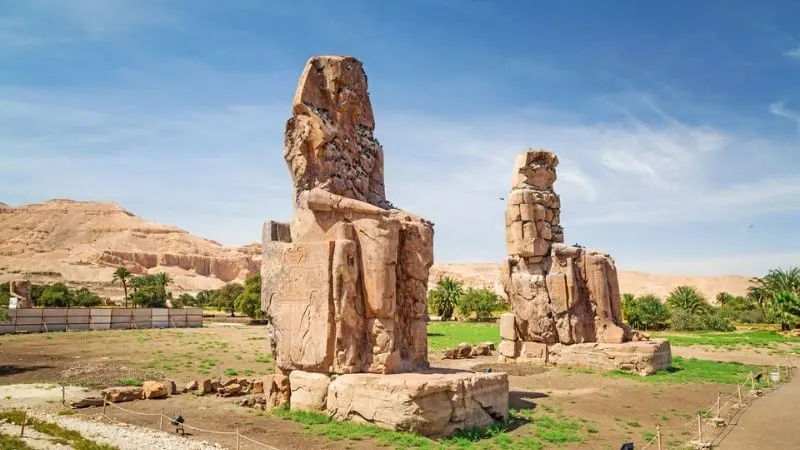
Where Are the Colossi of Memnon Located?
The Colossi of Memnon are located at Kom el-Hettan on the west bank of the Nile in Luxor, Upper Egypt.
They stand within the archaeological landscape known as the Theban Necropolis, a region containing royal tombs, mortuary temples, ancient cemeteries, and other monuments associated with the city of Thebes.
The statues face east toward the Nile Valley, while the desert hills and major royal burial areas lie farther west.
Their location makes them a convenient stop during a west-bank sightseeing excursion.
Travelers exploring Luxor and its ancient history will find that the Colossi help connect the city’s geography with its religious traditions.
Why are the Colossi on Luxor’s west bank?
The western side of the Nile held particular religious significance in ancient Egypt.
The setting sun was associated with death, the afterlife, and regeneration. These ideas influenced the development of royal funerary monuments on the west bank of ancient Thebes.
The area became home to the Valley of the Kings, royal mortuary temples, elite tombs, and settlements connected with funerary activities.
The east bank contained major ceremonial temples, including Karnak and Luxor Temple.
However, the separation between the two banks was not absolute. Ancient Thebes was a complex urban and religious landscape, and different activities occurred on both sides of the river.
Amenhotep III’s mortuary temple was part of the wider western Theban religious landscape.
Are the Colossi inside the Valley of the Kings?
No. The Colossi of Memnon are not inside the Valley of the Kings.
They stand on the western Theban plain, while the royal burial chambers are located farther into the desert hills.
The two places served different purposes.
The Colossi belonged to Amenhotep III’s mortuary temple, which supported religious ceremonies associated with the king.
The Valley of the Kings contained rock-cut royal tombs designed for burial.
Because the sites are connected by established sightseeing roads, they are frequently visited during the same excursion.
How far are the Colossi from central Luxor?
The Colossi lie across the Nile from Luxor’s principal east-bank hotel districts.
Travel time depends on the starting location, traffic, and the chosen river-crossing route.
For planning purposes, travelers staying on the east bank can often allow approximately 30–60 minutes to reach the statues by road.
This is a general travel allowance rather than a fixed journey time.
Visitors staying on the west bank may be considerably closer.
Who Built the Colossi of Memnon?
Pharaoh Amenhotep III commissioned the Colossi during Egypt’s Eighteenth Dynasty, approximately in the fourteenth century BCE.
Amenhotep III ruled during a period of economic prosperity, international diplomacy, religious construction, and major artistic achievement.
His reign is generally dated to approximately 1390–1353 BCE, although precise dates can vary slightly between historical chronologies.
The statues formed part of his ambitious mortuary temple project.
Who was Amenhotep III?
Amenhotep III was the son of Pharaoh Thutmose IV and Queen Mutemwiya.
He inherited a powerful kingdom and ruled during a period when Egypt maintained extensive diplomatic relationships with other major states of the ancient Near East.
His principal wife was Queen Tiye, who became an important figure in the royal court.
Amenhotep III invested heavily in royal architecture and artistic production.
His monuments communicated the wealth and authority of the Egyptian state while reinforcing his religious position.
The Colossi are among the most recognizable surviving examples of this construction program.
To understand his historical setting, explore the development of Egypt’s New Kingdom.
Why did Amenhotep III build such enormous statues?
The statues were intended to communicate royal authority through their exceptional scale.
A visitor approaching the temple would encounter two seated figures towering above the surrounding landscape.
Their formal posture presented the king as stable, powerful, and enduring.
The statues also had religious significance because they stood within a complex dedicated to the king’s continuing cult.
Their size was therefore more than an artistic choice.
It was part of a deliberate architectural message connecting kingship, religious authority, and permanence.
Were the Colossi built during Amenhotep III’s lifetime?
Yes. The statues were commissioned during Amenhotep III’s reign.
His mortuary temple was part of a larger program of royal construction developed while he was alive.
The temple supported ceremonies connected with his kingship and the religious cult associated with him.
Amenhotep III also contributed to other major monuments in ancient Thebes.
His architectural legacy can be explored further at Luxor Temple, where significant elements of his building program survive.
Was Amenhotep III related to Akhenaten?
Amenhotep III is generally identified as the father of Amenhotep IV, who later became known as Akhenaten.
Akhenaten introduced major religious changes associated with the worship of the Aten.
This relationship places Amenhotep III near an important turning point in Egyptian religious history.
The Colossi belong to the established royal and religious traditions of the New Kingdom, before the transformations associated with the Amarna Period.
How Tall and Heavy Are the Colossi of Memnon?
The Colossi of Memnon are commonly described as approximately 18 meters, or 59 feet, tall in their surviving condition.
Their original height may have reached approximately 21 meters when including architectural elements that no longer survive.
Different measurements appear in publications because some refer to the surviving sculpture, while others include the pedestal or reconstructed original dimensions.
The figures originally had more complete royal crowns and upper sculptural elements.
Their present appearance reflects substantial damage accumulated over thousands of years.
How much does each Colossus weigh?
Archaeological estimates place the original weight of each statue at approximately 720–750 metric tons.
These are estimates rather than precise measurements of the surviving monuments.
The enormous mass illustrates the engineering capabilities of ancient Egyptian builders.
Extracting, transporting, carving, and erecting such large blocks required skilled labor, sophisticated planning, and considerable resources.
What are the Colossi made of?
The two original Colossi were carved from quartzite, a hard, quartz-rich stone sometimes described as siliceous sandstone.
This material differs from the Egyptian alabaster used for some of the additional royal statues restored within the surrounding temple complex.
The distinction is important because recent reports about the restored alabaster colossi may be confused with the original roadside pair.
Quartzite is extremely durable, but the Colossi demonstrate that even very hard stone can deteriorate through earthquakes, weathering, structural movement, and historical repairs.
Where did the stone come from?
Geological research identifies the Gebel el-Ahmar quarry region near modern Cairo as the likely source of the original quartzite.
Studies of the stone’s mineral composition have helped establish its geological origin.
The considerable distance between the quarry region and Luxor demonstrates the logistical scale of Amenhotep III’s construction program.
Transporting such heavy materials required careful organization and an effective system for moving stone across long distances.
How did ancient Egyptians move these giant statues?
Egyptian builders used advanced methods for quarrying and transporting massive stone objects.
Evidence from ancient Egyptian construction demonstrates the use of sledges, ropes, prepared routes, organized labor, and sophisticated engineering techniques.
The Nile was a major transport corridor for stone and other building materials.
However, the exact transportation sequence used for the Colossi of Memnon remains uncertain.
There is no complete surviving document explaining every stage of their journey from quarry to temple.
It is therefore better to recognize the achievement without presenting speculative details as established facts.
Were the statues carved from single stones?
The principal original figures were carved from enormous monolithic blocks.
A monolith is an object formed primarily from one large piece of stone.
The surviving statues, however, are not entirely unchanged.
The northern Colossus underwent substantial reconstruction during the Roman period.
Its present appearance includes later stonework, making it important to distinguish the original Egyptian sculpture from subsequent repairs.
What Do the Colossi of Memnon Symbolize?
The Colossi symbolize Egyptian kingship, political authority, religious power, stability, and the enduring presence of the pharaoh.
Their meaning was communicated through artistic conventions that Egyptian viewers would have recognized.
The statues were not intended merely as realistic portraits.
Their pose, headdress, smaller family figures, throne decoration, and monumental setting formed a unified statement about royal identity.
The seated royal pose
Amenhotep III is represented sitting upright with his hands resting on his knees.
This formal posture communicates control, balance, and permanence.
Egyptian royal sculpture frequently used similar poses to express the stability of kingship.
The king appears calm and powerful rather than engaged in physical action.
The monument’s authority comes from his enduring presence.
The royal headdress
The Colossi wear the nemes headdress, a recognizable symbol of Egyptian kingship.
Their original appearance included additional crown elements that are no longer preserved intact.
Royal headdresses communicated status and helped identify the ruler.
The damaged crowns and upper sections visible today are the result of later destruction and deterioration.
They were not originally designed to look incomplete.
The smaller statues of the royal family
Smaller sculptural figures appear beside the legs of Amenhotep III.
These include representations associated with Queen Tiye, his principal wife, and Queen Mutemwiya, his mother.
Their inclusion emphasized royal identity and family relationships.
The smaller scale follows Egyptian artistic conventions in which relative size could express hierarchy and importance.
These figures are easy to overlook because the enormous seated king dominates the composition.
However, they provide important information about the original design.
The throne decorations
The sides of the thrones contain imagery associated with the unity of Upper and Lower Egypt.
One important motif is the sema-tawy, which represents the binding together of the two lands.
Plant forms traditionally associated with Egypt’s geographical regions appear in this symbolic imagery.
The design expresses the pharaoh’s responsibility for maintaining political and cosmic order.
These details show that Egyptian monumental sculpture communicated specific ideas rather than relying only on impressive size.
Why do the statues face the rising sun?
The Colossi face east toward the Nile and sunrise.
This orientation was part of the temple’s architectural arrangement.
Sunrise also held important associations with renewal and regeneration in Egyptian religion.
The statues’ position therefore fits the wider religious setting of a royal mortuary temple.
However, their orientation should not be reduced to a single symbolic explanation.
It also related to the location and design of the original entrance.
The Lost Mortuary Temple of Amenhotep III
The Colossi originally stood before one of the most ambitious mortuary temples built in ancient Egypt.
Known as the Mortuary Temple of Amenhotep III or the Temple of Millions of Years, the complex occupied an enormous area at Kom el-Hettan.
Archaeological research indicates that the temple extended across approximately 35 hectares.
Its original architecture included monumental gateways, courtyards, columns, colossal statues, and ceremonial spaces.
Most of that structure has disappeared.
The surviving Colossi are therefore only a small part of the original complex.
What was an Egyptian mortuary temple?
A mortuary temple was a religious establishment associated with the continuing cult of a king after death.
Priests performed rituals, presented offerings, and maintained sacred spaces connected with the deceased ruler.
Such temples also communicated royal religious identity during a king’s lifetime.
They were different from tombs.
A tomb provided a burial place, while a mortuary temple supported religious ceremonies connected with the king.
Understanding the broader traditions of ancient Egyptian temples helps explain why Amenhotep III devoted enormous resources to this complex.
Was Amenhotep III buried beneath the Colossi?
No. Amenhotep III was not buried beneath the Colossi of Memnon.
His tomb is known as WV22, located in the Western Valley within the larger Valley of the Kings region.
The Colossi marked the entrance to his mortuary temple rather than his burial chamber.
This distinction is important because ancient Egyptian royal funerary complexes could involve separate structures with connected religious purposes.
What did the original temple look like?
Imagine approaching the temple during Amenhotep III’s reign.
The enormous seated Colossi would have formed an imposing monumental entrance.
Beyond them stood a sequence of architectural spaces containing additional colossal figures, pylons, courtyards, and columns.
Religious decoration represented the king in association with Egyptian gods, ceremonies, and royal traditions.
The temple’s architecture created a carefully organized ceremonial landscape.
Much of its original appearance has to be reconstructed from surviving foundations, stone fragments, architectural blocks, and archaeological documentation.
Nevertheless, the evidence demonstrates that the complex was far more elaborate than the two roadside statues suggest.
Why was the temple so enormous?
Amenhotep III ruled during a period when the Egyptian state controlled considerable resources.
Monumental building was an important way of expressing royal authority.
The temple’s scale reflected the availability of craftsmen, labor, stone, transport systems, and administrative organization.
Its architecture also supported religious ceremonies associated with the king.
The immense size was therefore connected with both political power and religious purpose.
What happened to the mortuary temple?
The destruction of Amenhotep III’s temple occurred through a combination of events.
Archaeological evidence indicates that a major ancient earthquake contributed to extensive damage, often associated with a date around 1200 BCE.
Stone blocks were later removed and reused in other construction projects.
The site also experienced long periods of abandonment and environmental deterioration.
Groundwater, salt, vegetation, and changing agricultural conditions affected surviving archaeological remains.
Its destruction should not be attributed to one event alone.
The temple’s present condition reflects centuries of structural damage, dismantling, and environmental change.
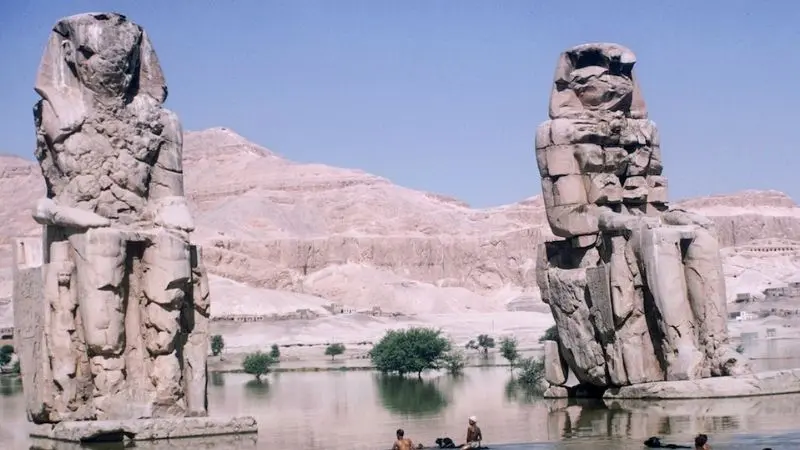
Was the temple destroyed by the Nile?
Nile flooding and groundwater affected the site, particularly during later periods.
However, modern studies of the ancient landscape suggest that the original temple was positioned on relatively elevated ground.
Changes in environmental conditions became increasingly important after the temple had already suffered damage and dismantling.
It is therefore misleading to explain the loss of the entire complex simply as a result of annual Nile flooding.
The archaeological history is more complicated.
Why did the Colossi survive?
The enormous quartzite statues survived while much of the surrounding architecture was damaged or reused.
Their exceptional mass contributed to their survival, although both sculptures suffered extensive deterioration.
The northern statue underwent major repairs during the Roman period.
Their present condition reflects the long history of the monument rather than complete preservation.
The contrast between the surviving statues and the lost temple is one of the most striking features of the archaeological site.
Why Are They Called the Colossi of Memnon?
The name comes from Greek mythology.
Greek and Roman visitors associated the northern statue with Memnon, a legendary warrior connected with the Trojan War.
The identification became especially influential because of the unusual sound reportedly produced by the statue at sunrise.
The original Egyptian sculptures represented Amenhotep III, not Memnon.
The later name reflects how Greek and Roman travelers interpreted the monument through their own mythology.
Who was Memnon in Greek mythology?
Memnon was a legendary king associated with Aethiopia.
In Greek mythology, he fought on the Trojan side during the Trojan War.
He was eventually killed by the Greek hero Achilles.
His mother was Eos, the goddess of dawn.
The story of Memnon’s death became associated with the grief of his divine mother.
When travelers heard that a damaged Egyptian statue produced sounds at sunrise, they connected the phenomenon with Memnon.
They interpreted the sound as his voice greeting or calling to Eos.
Who was Memnon’s mother?
Memnon’s mother was Eos, the Greek goddess of dawn.
His father was Tithonus.
The association with Eos explains why the timing of the statue’s reported sound became so important.
A sound heard shortly after sunrise appeared consistent with a myth involving the goddess of dawn.
This connection helped transform an Egyptian royal statue into a famous destination within the Greek and Roman world.
Is Memnon the same as Agamemnon?
No. Memnon and Agamemnon are different figures.
Memnon was a warrior associated with the Trojan side of the Trojan War.
Agamemnon was the Greek king of Mycenae and one of the leaders of the Greek forces.
Neither was the Egyptian pharaoh represented by the Colossi.
The historical sculptures depict Amenhotep III.
The association with Memnon developed many centuries after their construction.
Why did Greek travelers rename an Egyptian monument?
Greek and Roman travelers often interpreted unfamiliar monuments through their existing cultural traditions.
Egyptian buildings and statues were already ancient when these visitors encountered them.
Their original religious meaning was not always fully understood.
The reported sunrise sound encouraged travelers to connect the northern statue with a familiar myth.
The name survived even after the acoustic phenomenon apparently ceased.
Why Did the Colossi of Memnon Sing?
The northern Colossus of Memnon reportedly produced a ringing or musical sound shortly after sunrise.
Ancient writers recorded the phenomenon, and visitors traveled to the monument hoping to hear it.
The sound appears to have developed after the statue suffered substantial structural damage.
One widely discussed scientific explanation involves changes in temperature and moisture affecting fractures within the stone.
The exact physical mechanism remains uncertain.
When did the singing begin?
The phenomenon is traditionally linked to earthquake damage around 27 BCE.
The northern statue suffered major damage, including fractures and the loss of upper sections.
Ancient reports of sounds from the monument became important during the following Roman period.
Travelers associated the sound with Memnon’s voice.
This episode occurred long after the original temple had already experienced serious damage and deterioration.
What did the singing statue sound like?
Ancient descriptions vary.
Some observers compared the sound to a metallic strike.
Others described something resembling a musical string or resonant note.
The traditional term singing statue does not necessarily mean that the monument produced a melody or human speech.
A brief ringing, cracking, or vibrating sound may be a more realistic interpretation.
The precise sound cannot be reconstructed because the original damaged condition of the statue no longer exists.
What caused the mysterious sound?
One plausible explanation is that the stone reacted to temperature changes around sunrise.
As sunlight warmed the monument, different areas may have expanded at slightly different rates.
Moisture within cracks could also have affected the stone’s behavior.
Movement or friction along fractured surfaces might have created audible vibrations.
However, this explanation cannot be tested under the exact original conditions.
The thermal mechanism is plausible, but it should not be described as conclusively proven.
Did the statue sing every morning?
There is no reliable evidence that the statue produced a sound every morning without exception.
Ancient accounts suggest that some visitors heard the phenomenon while others did not.
Environmental conditions may have influenced when the sound occurred.
This unpredictability added to the monument’s reputation.
Travelers could arrive hoping to experience something unusual without knowing whether it would happen.
Can visitors hear the Colossi sing in 2027?
Visitors should not expect the famous ancient sound.
The phenomenon is generally believed to have ceased after substantial repairs to the northern statue during the Roman period.
Modern reports of occasional noises do not demonstrate that the original acoustic effect has returned.
The best reasons to visit at sunrise today are the lighting, cooler weather, and historical atmosphere.
The Colossi of Memnon and Their Roman Visitors
The singing statue became one of the most famous monuments visited by travelers in Roman Egypt.
Its reputation attracted officials, writers, members of the imperial court, and other visitors interested in unusual historical experiences.
Many recorded their visits through inscriptions carved on the monument.
These inscriptions now provide valuable evidence of ancient travel, language, belief, and society.
What did Strabo write about the statue?
Strabo was a Greek geographer and historian who visited Egypt in the late first century BCE.
He recorded an early account of the sound associated with the northern Colossus.
His writings helped establish the historical record of the phenomenon.
Other ancient authors, including Pliny the Elder and Pausanias, also discussed the statue.
Their accounts demonstrate how widely the monument’s reputation spread.
However, these ancient descriptions are historical observations rather than scientific recordings.
Did Roman Emperor Hadrian visit the Colossi?
Yes. Emperor Hadrian visited the Colossi during his journey through Egypt in 130 CE.
His wife, Sabina, and members of the imperial party accompanied him.
By this period, the statue’s reputation was well established.
Hearing the sound could be interpreted as an extraordinary or meaningful experience.
The imperial visit demonstrates how important the monument had become within the Roman world.
Who was Julia Balbilla?
Julia Balbilla was an educated woman and poet associated with Hadrian’s imperial entourage.
She accompanied the imperial party during its journey through Egypt.
Balbilla composed four Greek poems connected with the singing Colossus.
These poems were inscribed on the monument.
They provide an important example of literary expression preserved directly at an archaeological site.
Her work also offers evidence of women’s participation in the intellectual and cultural life of the Roman imperial elite.
Why are there Greek and Latin inscriptions on the statues?
Ancient visitors left inscriptions to commemorate their experiences.
Some recorded hearing the statue’s sound.
Others included names, dates, official titles, or poetic compositions.
Researchers have documented more than one hundred Greek and Latin inscriptions associated with the monument.
They are important historical sources because they reveal who visited the Colossi and why the experience mattered.
These inscriptions should not be confused with permission for modern visitors to leave markings.
Today, carving or writing on the statues would damage protected archaeological heritage.
Why did the statue stop singing?
The northern Colossus underwent substantial reconstruction during the Roman imperial period, traditionally associated with Emperor Septimius Severus around the end of the second century CE.
The repairs altered the statue’s physical structure.
Additional stone courses were placed above the damaged sections.
The famous sound reportedly ceased around this period.
If the acoustic phenomenon depended on fractures or changes in temperature, the reconstruction may have altered the necessary conditions.
The relationship is plausible, although the exact explanation remains uncertain.
The Colossi of Memnon as an Ancient Tourist Attraction
The Colossi are an unusual example of an Egyptian monument becoming famous for a purpose entirely different from its original function.
Amenhotep III built the statues as part of a royal religious complex.
Greek and Roman visitors came because the northern statue appeared to speak.
Modern travelers visit to understand ancient Egyptian history, archaeology, architecture, and the singing-statue legend.
The monument therefore illustrates how cultural interpretations can change over time.
Why did Roman travelers visit?
Some wanted to hear the reported sound.
Others were interested in Egyptian antiquity, Greek mythology, or the possibility of experiencing something regarded as extraordinary.
Visitors often recorded their presence through inscriptions.
The surviving evidence shows that traveling to famous monuments and commemorating an experience was already established in antiquity.
Ancient and modern visitor experiences
| Feature | Greek and Roman Period | Modern Luxor |
|---|---|---|
| Main attraction | Reported singing of the northern statue | Ancient Egyptian sculpture and history |
| Cultural interpretation | Memnon and Eos | Amenhotep III and New Kingdom Egypt |
| Preferred time | Sunrise | Morning for light and comfort |
| Visitor record | Inscriptions | Photography and travel accounts |
| Main historical interest | Mythology and extraordinary sounds | Archaeology, architecture, and conservation |
| Monument condition | Damaged and later repaired | Weathered and scientifically documented |
The comparison makes the Colossi relevant not only to Egyptian history but also to the history of travel itself.
What Changed at the Colossi of Memnon Before 2027?
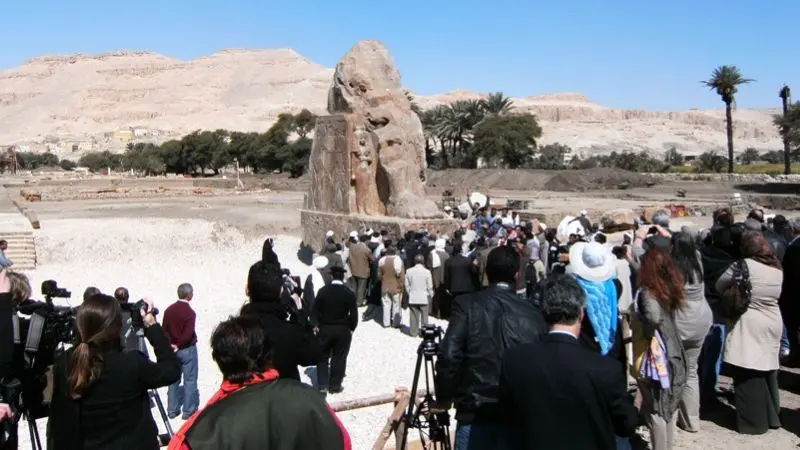
One of the most significant recent developments was the restoration and re-erection of two additional colossal statues of Amenhotep III in December 2025.
The statues had originally stood at the third pylon of the mortuary temple.
They were reconstructed through extensive archaeological investigation and conservation.
Their restoration helps visitors understand the extraordinary scale of the original complex.
It also makes the wider archaeological landscape increasingly important to the site’s interpretation.
The December 2025 restoration
On December 14, 2025, two restored alabaster statues were publicly unveiled at Kom el-Hettan.
They had been recovered in a fragmented condition.
Conservation specialists documented and reassembled the ancient stone elements.
The northern restored alabaster colossus measures approximately 14.5 meters tall, including its base.
The southern figure measures approximately 13.6 meters.
These dimensions demonstrate that the original temple contained multiple groups of enormous royal statues.
Are the newly restored statues the original Colossi?
No.
The familiar roadside Colossi are the two original quartzite sculptures positioned at the main entrance.
The recently restored alabaster figures belonged to another monumental gateway within the temple.
They represent the same pharaoh but differ in location, stone material, size, and conservation history.
The temple originally contained many additional royal and divine sculptures.
How were the statues restored?
The project involved documenting surviving fragments, studying their original positions, stabilizing damaged stone, and reconstructing the sculptures.
Specialist archaeological and engineering methods were required because of the weight and condition of the material.
The work also included preparing foundations and supports.
The objective was to preserve original archaeological evidence while recovering the statues’ architectural context.
Restoration does not mean replacing all missing ancient material or creating entirely new sculptures.
Who carried out the conservation project?
The Colossi of Memnon and Amenhotep III Temple Conservation Project began in 1998 under the direction of Egyptologist Hourig Sourouzian.
It has involved cooperation with Egyptian archaeological authorities and international research institutions.
The conservation program has included excavation, documentation, stone treatment, reconstruction, environmental protection, and long-term site management.
Work continued during 2026 through cooperation involving the Egyptian Ministry of Tourism and Antiquities, the German Archaeological Institute, and Johannes Gutenberg University Mainz.
What other archaeological discoveries have been made?
Research at Kom el-Hettan has revealed numerous fragments of royal and divine statues, monumental architectural blocks, and decorative elements.
Particularly important discoveries include statues associated with Sekhmet, the lion-headed Egyptian goddess.
Archaeologists have also investigated the remains of temple gateways, courtyards, foundations, and other structures.
These findings help reconstruct the original religious and ceremonial landscape.
They also demonstrate that the temple’s history extends far beyond the two surviving roadside statues.
Can tourists see the restored temple in 2027?
The two original roadside Colossi remain the familiar visitor attraction.
Access to the wider temple complex may be more restricted.
Active conservation areas, archaeological excavations, and newly restored monuments may require supervised access or special arrangements.
The December 2025 unveiling does not guarantee that every section will be independently accessible in 2027.
Travelers interested in the restored alabaster statues should confirm current access rules before visiting.
What Can Visitors Actually See at the Colossi of Memnon?
Most travelers encounter two enormous seated figures rising above the western Theban plain.
Their weathered appearance is striking, but several smaller details are worth examining.
The two seated royal figures
The most obvious feature is the enormous scale of the sculptures.
Both statues portray Amenhotep III in a formal seated position.
Their original placement created a symmetrical monumental entrance.
The surviving figures demonstrate the ambition of Egyptian royal architecture.
The northern statue and Roman repairs
The northern Colossus is especially important because of its singing-statue history.
Its upper sections contain evidence of Roman reconstruction.
These repairs changed the monument’s structure and appearance.
The statue therefore preserves evidence of both Egyptian construction and later intervention.
The royal family figures
Smaller figures beside the pharaoh’s legs represent members of the royal family.
Their presence is easily missed when viewing the entire monument.
Recognizing them helps visitors understand the original sculptural design.
The throne decoration
Surviving throne reliefs include symbols connected with Egyptian political unity.
These details demonstrate that royal sculpture carried specific religious and political meanings.
Ancient visitor inscriptions
Greek and Latin inscriptions associated with the northern Colossus preserve evidence of ancient tourism.
Some are difficult to identify from normal visitor positions.
Their historical value lies in the names, poems, and observations they record.
The surrounding temple landscape
The archaeological remains behind the statues belong to Amenhotep III’s original mortuary temple.
Depending on access arrangements, visitors may observe restored structures or conservation areas from permitted locations.
This wider landscape is essential for understanding the original purpose of the Colossi.
How Long Should You Spend at the Colossi of Memnon?
Most travelers need approximately 10–20 minutes to visit the original roadside Colossi.
A longer visit may be worthwhile for people interested in sculptural details, archaeology, or photography.
| Available Time | Suggested Experience |
|---|---|
| 5 minutes | Quick view and photograph |
| 10 minutes | Observe both statues and their setting |
| 15–20 minutes | Learn the history and examine visible details |
| 20–30 minutes | More detailed explanation and photography |
| 45–60 minutes or more | Extended experience if additional temple sections are accessible |
A short but informed visit is usually more rewarding than spending a long time without understanding the monuments.
A practical 20-minute visit
Begin with a wide view of both statues.
Notice their symmetry and eastward orientation.
Examine the southern figure and the surviving smaller sculptures.
Continue to the northern Colossus and consider its Roman repairs and acoustic history.
Spend a few minutes looking toward the surrounding temple remains.
Finish with photographs from permitted viewing areas.
This simple approach provides a useful introduction to the monument without disrupting a larger sightseeing itinerary.
Colossi of Memnon Entrance Fee in 2027
The original roadside Colossi of Memnon have traditionally been free to view.
They are generally visited from an open area beside the road rather than through the formal admission system used at major tombs and temples.
However, this arrangement should not be confused with access to every part of Amenhotep III’s mortuary temple.
The wider archaeological complex may have different rules.
For 2027, visitors should confirm current arrangements if they intend to explore areas beyond the original statues.
What expenses should you expect?
| Expense | Visitor Guidance |
|---|---|
| Original roadside Colossi | Traditionally free |
| Wider temple complex | Access and fees require confirmation |
| Taxi or private driver | Cost depends on route and arrangements |
| Guided excursion | Varies by duration and inclusions |
| Nearby archaeological sites | Separate tickets may be required |
| Personal photography | Generally possible from permitted areas |
| Professional filming | May require additional authorization |
If a travel company charges for a visit to the Colossi, the price may include transport, guiding, other site tickets, or a complete west-bank itinerary.
It should not automatically be interpreted as an admission fee for the original roadside statues.
What are the opening hours?
The original Colossi stand in an open roadside setting and have generally been accessible without a conventional ticket gate.
However, the wider archaeological complex may have formal restrictions or operating hours.
Travelers should not assume unrestricted access to all areas at any time.
Daylight visits are the most practical choice.
Morning visits are particularly appealing because of the weather and lighting.
How to Get to the Colossi of Memnon
The Colossi are located on an established sightseeing route through Luxor’s west bank.
Most visitors arrive by private driver, taxi, or organized excursion.
Independent travelers can also cross the Nile by ferry or boat and arrange onward transport.
Visiting from Luxor’s east bank
A private vehicle can travel across the Nile using the road bridge and continue toward the west-bank archaeological sites.
This is convenient for travelers visiting several monuments in one day.
Before leaving, confirm whether the transport arrangement includes waiting time and the return journey.
Taking the ferry
Travelers may cross the Nile using a public ferry or private boat.
After reaching the west bank, additional transport is usually needed.
This approach can suit independent travelers, but it requires coordination.
The Colossi are not immediately beside the principal ferry landing.
Visiting with a guide
A knowledgeable guide can explain the monuments’ Egyptian meaning, Greek name, Roman inscriptions, and modern conservation.
Guiding is not essential for viewing the statues, but it can make the experience substantially more informative.
A guided Luxor day tour can also combine the Colossi with nearby archaeological attractions.
Can you walk to the statues?
Walking may be possible from nearby accommodation on the west bank.
However, walking from central Luxor’s east bank is not practical without first crossing the Nile.
The surrounding area can also be extremely hot during summer.
Travelers should consider actual walking distances, road conditions, and available shade.
Can you visit during a Nile cruise?
Yes. The Colossi are frequently incorporated into west-bank excursions associated with Nile cruises.
A typical sightseeing program may also include the Valley of the Kings and Hatshepsut Temple.
However, exact inclusions vary between itineraries.
Travelers planning a Luxor and Aswan Nile cruise should confirm which attractions are included before booking.
Can you visit from Cairo or Hurghada?
Yes, but the travel time makes it sensible to combine the Colossi with several major Luxor attractions.
From Cairo, travelers generally need to reach Luxor by domestic flight, train, or other arranged transport.
From Hurghada, a road excursion is possible, although it involves substantial travel.
The Colossi alone do not justify such long journeys.
They are best included in a broader Luxor sightseeing program.
Best Time to Visit the Colossi of Memnon in 2027
Early morning is generally the best time to visit the Colossi of Memnon.
The statues face east, so morning sunlight often illuminates their fronts.
Temperatures are also usually more comfortable before midday.
October through April is generally the most pleasant period for extensive outdoor sightseeing in Luxor.
Which season is best?
| Season | Typical Conditions | Recommendation |
|---|---|---|
| December–February | Mild days and cooler mornings | Excellent for sightseeing |
| March–April | Increasing warmth; occasional dusty weather | Visit early |
| May–August | Very hot daytime temperatures | Keep the visit short and early |
| September–October | Gradual transition toward cooler conditions | Morning visits recommended |
| November | Generally comfortable outdoor weather | Excellent for west-bank excursions |
Seasonal conditions vary.
Travelers should review forecasts close to departure rather than relying entirely on historical averages.
For broader planning, see Egypt’s weather by month.
Is sunrise worth visiting?
Sunrise can be attractive for photography because of the monuments’ orientation.
The changing light may highlight surviving sculptural details.
However, sunrise is not necessary for an ordinary sightseeing visit.
Travelers should also remember that the ancient singing phenomenon is not a regular modern experience.
Is winter a good time to visit?
Winter is one of the most comfortable seasons for exploring Luxor’s outdoor archaeological sites.
Mornings may be cool, particularly before the sun becomes strong.
A light layer can be useful during early departures.
Travelers planning a winter holiday can consult the guide to Egypt in January.
What about summer?
Summer temperatures in Luxor can be extremely high.
The Colossi stand in an exposed location with limited natural shade.
Visit early, carry drinking water, and avoid unnecessarily long exposure during the hottest hours.
A private air-conditioned vehicle can make a summer west-bank excursion considerably more comfortable.
Colossi of Memnon Photography Tips
The Colossi are among Luxor’s most recognizable photography subjects.
Their enormous scale, weathered surfaces, and surrounding landscape provide opportunities for memorable images.
Photograph both statues together
A wide view helps show the original pair and their symmetrical arrangement.
Include enough surrounding landscape to establish their scale and setting.
Capture the smaller details
Photograph the surviving royal figures, throne decorations, and differences between the northern and southern statues.
These details help tell the monument’s history.
Use morning sunlight
Morning light often illuminates the statues’ fronts and can reveal more detail.
Later conditions may produce stronger shadows or silhouettes.
Both can be effective, depending on the intended photograph.
Show the monument’s scale
A wider composition can help communicate the statues’ height.
Do not cross protective barriers or enter unsafe positions to achieve a particular angle.
Can you use a drone?
Do not assume drone operation is permitted.
Egypt has restrictions and authorization requirements concerning drone equipment and aerial photography.
Travelers should confirm current rules before carrying or operating such equipment.
Ordinary photography from approved visitor areas is the more straightforward option.
Are the Colossi of Memnon Worth Visiting in 2027?
Yes. The Colossi of Memnon are worth visiting for most travelers exploring Luxor’s west bank.
They combine ancient Egyptian royal sculpture, monumental engineering, Greek mythology, Roman travel history, and modern archaeological conservation.
Their roadside location also makes them easy to include in a larger sightseeing itinerary.
However, visitors should understand what the experience involves.
The Colossi are not a complete temple with extensive decorated interiors.
They are two monumental sculptures standing in front of the remains of a much larger ancient complex.
Who will enjoy the visit most?
The Colossi are especially suitable for travelers interested in:
-
Ancient Egyptian history and royal monuments.
-
Archaeological discoveries and conservation.
-
Greek and Roman mythology.
-
Monumental sculpture and engineering.
-
Photography and historical landscapes.
-
Short sightseeing stops during a Luxor excursion.
Families may also enjoy the story of the singing statues and the extraordinary size of the figures.
Who might want to skip the stop?
Travelers with extremely limited time who prefer decorated tomb interiors may choose to prioritize the Valley of the Kings.
Visitors looking for an extensive temple complex may find Karnak or Medinet Habu more rewarding.
The Colossi are most valuable when included in a wider exploration of the west bank.
How do the Colossi compare with other Luxor attractions?
| Attraction | Main Experience | Suggested Visit |
|---|---|---|
| Colossi of Memnon | Monumental royal statues and historical legend | 10–30 minutes |
| Valley of the Kings | Decorated royal tombs | 1.5–3 hours |
| Hatshepsut Temple | Terraced mortuary temple architecture | 45–90 minutes |
| Ramesseum | Royal mortuary temple ruins | 45–75 minutes |
| Karnak Temple | Large religious complex | 1.5–3 hours |
| Luxor Temple | Monumental temple architecture | 1–1.5 hours |
These are suggested sightseeing durations, not official limits.
Accessibility and Visiting with Families
The Colossi can be easier to include in an itinerary than attractions requiring extensive walking or underground tomb access.
However, the roadside setting does not guarantee complete accessibility.
Ground conditions, parking arrangements, and barriers may affect the experience.
Wheelchair accessibility
Some visitors using wheelchairs may be able to view the statues from nearby accessible positions or a vehicle.
However, uneven or dusty surfaces may create difficulties.
Accessible facilities should not be assumed to be available directly at the monument.
Travelers requiring assistance can consider arrangements through wheelchair-accessible Egypt tours.
Visiting with children
The short visit makes the Colossi suitable for many families.
Children may be interested in the statues’ size and the story of their mysterious sound.
Parents should supervise children carefully because the monument stands near a road.
Climbing the statues is not permitted.
Visiting with older travelers
The limited walking required for a basic viewing stop may appeal to older travelers.
Comfortable transport, stable footing, and avoiding intense heat are important considerations.
A brief visit with a knowledgeable guide can provide substantial historical value without requiring an extended walk.
Best Attractions Near the Colossi of Memnon
The Colossi are surrounded by major monuments associated with ancient Thebes.
Combining these attractions provides a better understanding of the relationship between royal tombs, mortuary temples, and ceremonial architecture.
Valley of the Kings
The Valley of the Kings contains burial chambers of numerous New Kingdom pharaohs.
Its decorated tombs reveal important aspects of Egyptian beliefs concerning death and the afterlife.
The Valley of the Kings is one of the most important attractions to combine with the Colossi.
Temple of Hatshepsut
Hatshepsut’s mortuary temple at Deir el-Bahari is famous for its terraces, colonnades, and dramatic setting beneath limestone cliffs.
It provides a valuable comparison with Amenhotep III’s mortuary temple.
The Temple of Hatshepsut is particularly rewarding for travelers interested in New Kingdom architecture.
The Ramesseum
The Ramesseum was the mortuary temple of Ramesses II.
It preserves significant architectural remains and fragments of monumental royal sculpture.
Visiting the Ramesseum helps explain how Egyptian mortuary temples functioned and how their design developed.
Medinet Habu
Medinet Habu contains the mortuary temple of Ramesses III.
Its decorated gateways, courtyards, and walls preserve important evidence of royal ceremonies and Egyptian religious traditions.
The substantial surviving architecture helps visitors imagine the original scale of other west-bank temple complexes.
Luxor Museum
Luxor Museum displays ancient Egyptian sculpture and archaeological objects from the region.
It offers an opportunity to appreciate artistic details that may be difficult to see on heavily weathered outdoor monuments.
A visit to Luxor Museum complements the experience of the Colossi.
Karnak Temple
Karnak is located on the east bank of Luxor.
Its enormous religious complex contains monumental architecture created over many centuries.
Amenhotep III contributed to its development.
The Karnak Temple complex offers a wider understanding of the religious landscape of ancient Thebes.
Suggested Colossi of Memnon Itineraries for 2027
The Colossi are best visited as part of a geographically efficient west-bank itinerary.
The ideal plan depends on available time, interests, weather, and mobility.
Half-Day West Bank Highlights
Best for: First-time visitors with approximately four to five hours available.
| Stop | Attraction | Suggested Duration |
|---|---|---|
| 1 | Colossi of Memnon | 15–20 minutes |
| 2 | Valley of the Kings | 90–120 minutes |
| 3 | Temple of Hatshepsut | 45–75 minutes |
| 4 | Return transfer or optional brief stop | According to available time |
This route introduces visitors to royal sculpture, burial chambers, and mortuary temple architecture.
The Valley of the Kings should generally receive the largest time allocation.
Full-Day West Bank Archaeology
Best for: Travelers interested in Egyptian history.
Begin with the Colossi of Memnon.
Continue to the Valley of the Kings and explore selected tombs.
Visit Hatshepsut Temple before taking a lunch or rest break.
Spend the afternoon at Medinet Habu or the Ramesseum.
This approach allows visitors to compare different types of royal monuments without unnecessary river crossings.
Two Days in Luxor
Best for: Travelers who prefer a more relaxed sightseeing pace.
Day 1 — West Bank
Visit the Colossi of Memnon, Valley of the Kings, Hatshepsut Temple, and another west-bank monument if time permits.
Day 2 — East Bank
Explore Karnak Temple and Luxor Temple.
Add Luxor Museum according to your interests and available time.
For additional ideas, see the guide to things to do in Luxor, Egypt.
Colossi of Memnon After a Hot Air Balloon Flight
Some travelers combine an early hot air balloon experience in Luxor with west-bank sightseeing.
The Colossi may be a convenient stop afterward, depending on the balloon operator’s landing point and transfers.
Balloon operations depend on weather and aviation permissions.
Allow flexibility in case schedules change.
Common Mistakes to Avoid at the Colossi of Memnon
Expecting the statues to sing
The famous acoustic phenomenon belongs to the monument’s historical record.
Modern visitors should not expect to hear it.
Confusing Memnon with Amenhotep III
The statues represent Amenhotep III.
Memnon is the mythological hero with whom later Greek and Roman travelers associated the monument.
Assuming the entire temple has been restored
Important statues and architectural remains have been restored, but the complete mortuary temple has not been rebuilt.
Assuming all temple areas are open
The original roadside statues and the surrounding archaeological complex may have different access arrangements.
Confirm restrictions before planning an extended visit.
Visiting during extreme midday heat
The site offers limited shade.
Early morning is generally more comfortable, particularly during summer.
Planning an entire day around the statues
Most visitors need only 10–30 minutes for the original Colossi.
Combine the stop with other west-bank attractions.
Ignoring the smaller sculptural details
The figures beside the pharaoh’s legs and surviving throne decorations are important parts of the monument’s meaning.
Climbing or touching the monuments
Ancient stone surfaces are vulnerable to damage.
Follow barriers and avoid physical contact with fragile archaeological features.
Why the Colossi of Memnon Still Matter Today
The Colossi of Memnon are more than surviving royal sculptures.
They demonstrate how historical monuments can acquire different meanings across thousands of years.
During Amenhotep III’s reign, they communicated royal authority and religious permanence.
After the decline of the temple, they survived as enormous reminders of a lost architectural complex.
Greek and Roman travelers associated them with mythology and a mysterious sound.
Modern archaeology now studies the site through stone analysis, architectural reconstruction, conservation, and historical interpretation.
A monument with several historical identities
The Colossi have been understood as royal Egyptian statues, guardians of a mortuary temple, representations associated with the mythological Memnon, a Roman-era tourist attraction, and important archaeological monuments.
These identities reflect different periods of history.
Together, they create a more complete understanding of the site.
Why does conservation matter?
Ancient stone monuments face continuing threats from moisture, salt, temperature changes, environmental deterioration, and human activity.
Protecting them requires scientific investigation and long-term conservation planning.
The restoration of additional statues at Kom el-Hettan shows how archaeological research can recover important information from damaged monuments.
The goal is not simply to make ancient ruins look new.
It is to preserve original material and improve understanding of the historical landscape.
Frequently Asked Questions About the Colossi of Memnon
1. How old are the Colossi of Memnon?
The Colossi of Memnon are approximately 3,400 years old. They were commissioned during the reign of Amenhotep III in Egypt’s Eighteenth Dynasty, around the fourteenth century BCE. Their surviving condition reflects thousands of years of damage, environmental exposure, and historical repairs.
2. Which Egyptian pharaoh is represented by the Colossi of Memnon?
The Colossi represent Pharaoh Amenhotep III, a ruler of ancient Egypt’s New Kingdom. They originally stood at the entrance to his mortuary temple in Luxor. Their name comes from a later Greek association with the legendary warrior Memnon.
3. Why did the Colossi of Memnon sing?
The northern statue reportedly produced sounds after suffering major damage in antiquity. Temperature changes affecting cracks in the stone are a plausible explanation. Greek and Roman travelers associated the sound with Memnon calling to his mother, Eos, the goddess of dawn.
4. Can you hear the Colossi of Memnon sing today?
The original singing phenomenon is not expected today. It is generally believed to have ceased following Roman-period reconstruction of the northern statue. Sunrise remains a good time to visit for photography and comfortable temperatures, but not for an expected sound.
5. Are the Colossi of Memnon free to visit?
The original roadside statues have traditionally been free to view. However, additional archaeological areas within Amenhotep III’s mortuary temple may have separate access rules. Visitors planning a 2027 trip should confirm current arrangements.
6. How long does it take to visit the Colossi of Memnon?
Most travelers spend approximately 10–20 minutes at the original roadside statues. A longer visit of 20–30 minutes allows time for historical interpretation, closer observation, and photography.
7. Are the Colossi of Memnon a UNESCO World Heritage Site?
Yes. The Colossi are part of Ancient Thebes with its Necropolis, a UNESCO World Heritage property inscribed in 1979. The wider area includes major temples, tombs, and archaeological monuments associated with ancient Thebes.
8. Are the Colossi the largest statues in Egypt?
The Colossi of Memnon are among Egypt’s largest surviving ancient royal sculptures. However, other enormous monuments, including the seated statues of Ramesses II at Abu Simbel, are also notable for their dimensions. Rankings depend on original height, surviving condition, and weight.
9. What is the difference between the Colossi of Memnon and Abu Simbel?
The Colossi of Memnon represent Amenhotep III and originally marked the entrance to his mortuary temple in Luxor. The monumental statues at Abu Simbel represent Ramesses II and form part of a rock-cut temple complex in southern Egypt. The Abu Simbel Temple belongs to a different reign and architectural tradition.
10. Can you visit the Colossi of Memnon without a guide?
Yes. The original statues can normally be viewed independently. A guide is useful for explaining Amenhotep III, the singing-statue legend, royal family figures, Roman inscriptions, and the surrounding temple remains.
11. Are the Colossi of Memnon accessible to wheelchair users?
Some visitors using wheelchairs may be able to appreciate the statues from nearby viewing areas or a vehicle. However, ground conditions and access arrangements may present difficulties. Confirm the specific viewing route before visiting.
12. Is 2027 a good year to visit the Colossi of Memnon?
Yes. The Colossi remain an important Luxor attraction, and the restoration of additional alabaster statues in December 2025 has added archaeological interest to the surrounding complex. Travelers should confirm which areas are accessible during their 2027 visit.
Final Thoughts: Should You Visit the Colossi of Memnon in 2027?
The Colossi of Memnon deserve a place in most first-time Luxor itineraries.
Their enormous size is impressive, but their greatest value lies in the history they preserve.
They connect Amenhotep III’s royal building program with Egyptian religious architecture, Greek mythology, Roman travelers, and modern archaeological conservation.
The two famous statues also provide a reminder of a much larger temple that once dominated the surrounding landscape.
For visitors in 2027, the restoration of additional royal sculptures at Kom el-Hettan offers another reason to appreciate the importance of the site.
A visit does not need to be long. Approximately 20 minutes with clear historical context can provide a rewarding experience.
The most practical approach is to visit during a morning west-bank excursion and combine the Colossi with nearby monuments such as the Valley of the Kings and Hatshepsut Temple.
Travelers who prefer private transportation and an Egyptologist guide can include the Colossi in tailor-made Egypt holidays arranged around their interests and travel dates.
The Colossi of Memnon have survived long after the enormous temple they once guarded disappeared. Their continuing importance comes from what they reveal about ancient Egyptian power, changing cultural beliefs, and the ongoing responsibility to protect Egypt’s archaeological heritage.
