
Quick Answer: What is the Egyptian creation myth?
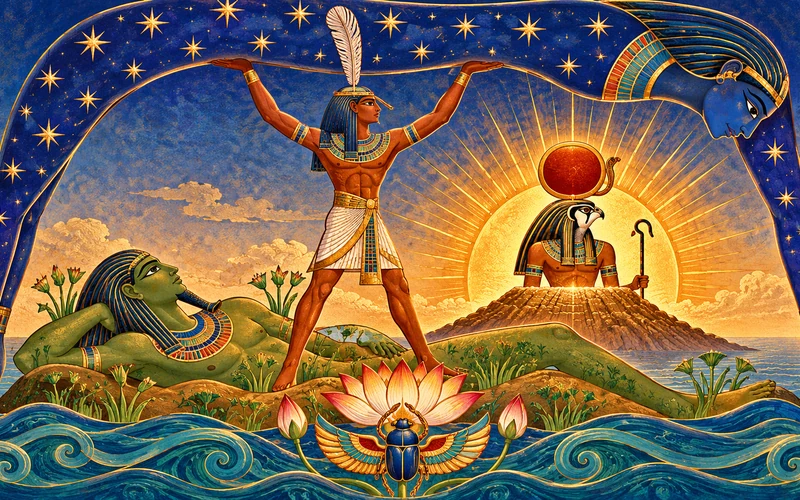
The Egyptian creation myth explains how the universe emerged from the primordial waters of Nun. Ancient Egyptians developed several creation traditions: Atum brought forth the gods at Heliopolis, the Ogdoad preceded the first sunrise at Hermopolis, Ptah created through thought and speech at Memphis, and Amun became the supreme creator in Theban theology. These stories explained the origins of life, cosmic order, and the divine world.
Imagine a universe without a sky, land, sunrise, or even time as humans experience it. To ancient Egyptians, existence began with a limitless expanse of dark, primordial water containing the possibility of everything that would eventually exist.
From those waters came the first land, the first light, and the divine forces responsible for maintaining the world.
But there was no single Egyptian creation myth.
Ancient Egypt developed different explanations across major religious centers, and these traditions could coexist rather than cancel one another out. A priest in Heliopolis might emphasize Atum, while a priest in Memphis understood Ptah as the ultimate creator.
These ancient Egyptian creation myths shaped religious beliefs for thousands of years. They also influenced temple architecture, royal ideology, burial practices, astronomical imagery, and the symbolic meaning of the Nile.
Understanding them changes how visitors experience Egypt. A temple ceiling becomes a representation of the cosmos, a scarab symbolizes the rising sun, and a royal tomb tells a story about creation happening again.
What Did Creation Mean in Ancient Egyptian Religion?
For ancient Egyptians, creation was not simply an event that happened once in the distant past. It was an ongoing process that needed to be renewed and protected.
The universe was understood as an organized world surrounded by forces that existed before creation. The gods established its structure, while divine and human responsibilities helped preserve its stability.
Three concepts are especially important for understanding Egyptian mythology.
Nun: The Primordial Waters Before Creation
Nun, sometimes written Nu, represented the limitless primeval waters from which creation emerged.
Before the first sunrise, the world had no established boundaries between land and sky. There were no familiar natural cycles, cultivated fields, or organized human societies.
Nun was not simply a large ocean that existed somewhere on Earth. It represented a primordial state before the ordered cosmos had taken shape.
Egyptian religious imagery sometimes portrays Nun as a male deity, particularly when showing the first appearance of the sun.
However, the concept was broader than an individual god. The primeval waters remained a continuing reality beyond the created world.
This distinction matters because Egyptian creation mythology did not always describe creation as the production of something from absolute nothingness.
Instead, the universe emerged from a state containing unrealized possibilities.
Zep Tepi: The First Time
The Egyptian expression zep tepi, often translated as “the First Time,” refers to the primordial era when the gods established the order of existence.
It was an idealized beginning associated with the emergence of divine authority and the creation of a functioning cosmos.
The concept helped explain why religious rituals frequently referred to the earliest actions of the gods.
A temple ceremony could symbolically repeat an act performed at the beginning of existence. A royal coronation could connect the living king with divine kingship established in mythical time.
The First Time was therefore more than a chronological starting point. It provided a model of how the world ought to function.
Ma’at: The Order That Made Life Possible
Ma’at represented truth, justice, proper balance, and cosmic order.
The word could refer to an abstract principle or the goddess who personified it.
Once creation had emerged from the primordial state, Ma’at described the harmony that allowed the universe to operate.
The regular appearance of the sun, the appropriate succession of rulers, the functioning of social relationships, and the observance of religious duties could all be understood within this larger framework.
Opposing Ma’at was isfet, a concept associated with disorder, wrongdoing, and disruption.
The struggle between order and disorder was never considered permanently finished.
That is why Egyptian mythology gives so much attention to renewal. The daily sunrise, annual agricultural cycles, temple offerings, and royal rituals all reflect the importance of keeping the created world functioning.
The central idea: Egyptian creation mythology explains not only how existence began but also why the world needs continuing balance.
The Heliopolitan Egyptian Creation Myth: Atum and the First Gods
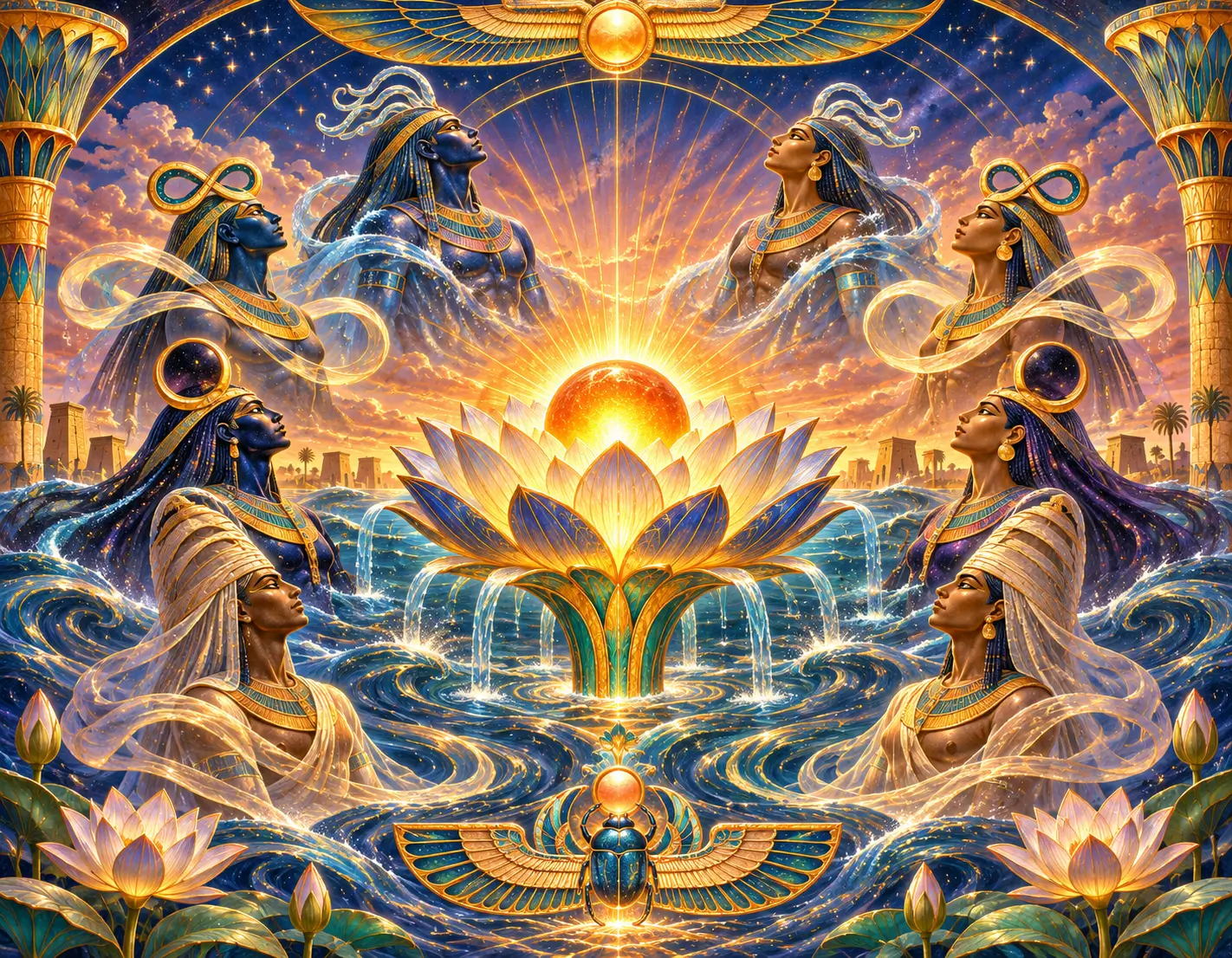
The creation tradition associated with Heliopolis is among the best-known ancient Egyptian explanations of how the universe began.
Heliopolis, called Iunu in ancient Egyptian, was a major religious center in the region of present-day Cairo.
Its priests developed a theological system centered on Atum, the creator associated with the sun, and a group of nine major deities known as the Great Ennead.
The Heliopolitan account is particularly useful because it connects the appearance of the sun with the gradual formation of the natural world and a divine family.
The First Appearance of Atum
According to Heliopolitan tradition, Atum existed within the primordial waters before the established cosmos appeared.
He was described as self-generated, meaning that he came into existence without being born from an ordinary divine couple.
Atum emerged at the beginning of creation, associated with the first mound of land rising from the waters.
This primeval elevation gave the creator a place from which to begin organizing existence.
For the Egyptians, the image of land emerging from water was especially meaningful.
The annual inundation of the Nile once covered fields with water. As the floodwaters receded, fertile land appeared again, allowing cultivation to resume.
The relationship between the Nile flood and the primordial mound helps explain why the image carried such religious power, although the mythological waters of Nun were not simply the Nile itself.
The first land was a symbol of possibility becoming reality.
Atum was frequently connected with the sun god Ra, and the combined name Ra-Atum expressed a relationship between the creator and the solar cycle.
The next stage of the creation story involved the production of the first divine pair.
How Atum Created Shu and Tefnut
Atum brought forth two deities:
-
Shu: Associated with air and the atmosphere.
-
Tefnut: Associated with moisture and related cosmic forces.
Ancient religious texts preserve several descriptions of this creative act.
In some accounts, Atum produces the pair through bodily processes such as spitting or sneezing. Other versions use imagery of self-generation.
These descriptions may sound unusual to modern readers, but their meaning is important.
Atum creates from his own being because no separate world or established family yet exists.
The divine elements necessary for life emerge from the creator himself.
Shu and Tefnut represent a movement toward a structured universe. Air and moisture become identifiable components of the world rather than undifferentiated possibilities.
Their appearance also establishes the first major divine relationship in the Heliopolitan family.
Together, they become the parents of the next generation.
How Geb and Nut Became Earth and Sky
Shu and Tefnut produce Geb and Nut.
Geb represents the earth, while Nut represents the sky.
This pairing is one of the most recognizable relationships in all Egyptian mythology.
Egyptian religious art frequently portrays Geb as a reclining male figure beneath Nut, a goddess whose body arches overhead.
Shu appears between them, holding the sky above the earth.
The scene represents the separation and ordering of major cosmic regions.
Without this separation, the familiar structure of the world would not exist.
The earth becomes a defined place. The sky stretches overhead. The atmosphere occupies the space between them.
In Egyptian thought, the world was not merely filled with gods. Major aspects of nature could themselves be divine beings.
That is why depictions of Geb and Nut can function simultaneously as religious art and representations of the universe.
Nut’s body was also associated with the movement and renewal of the sun.
In several traditions, she receives the sun at the western horizon and gives birth to it again in the east.
The image connects the original creation of the cosmos with the repeated creation of each new day.
The Birth of Osiris, Isis, Seth, and Nephthys
Geb and Nut become the parents of four central deities:
-
Osiris
-
Isis
-
Seth, also written Set
-
Nephthys
These gods introduce relationships involving kingship, family, death, protection, conflict, and restoration.
Osiris becomes closely associated with divine kingship, death, resurrection, and the afterlife.
Isis is associated with powerful protective magic, motherhood, and the restoration of life.
Seth possesses complicated associations that include desert regions, storms, strength, and disruptive forces.
Nephthys is frequently connected with protection, mourning, and funerary rites.
Their later mythological relationships become central to the story of Osiris’s death and the struggle over the Egyptian throne.
The Heliopolitan creation myth therefore leads naturally into other major stories of Egyptian religion.
The formation of the world creates the setting in which divine kingship and human existence become meaningful.
The Egyptian Ennead Family Tree Explained
The Great Ennead consists of Atum and eight divine descendants.
|
Generation |
Deities |
Main associations |
|---|---|---|
|
Primordial creator |
Atum |
Creation, solar power, self-generation |
|
First generation |
Shu and Tefnut |
Air and moisture |
|
Second generation |
Geb and Nut |
Earth and sky |
|
Third generation |
Osiris and Isis |
Kingship, restoration, protection, afterlife |
|
Third generation |
Seth and Nephthys |
Desert, disruptive power, protection, funerary associations |
The nine deities form a theological family, but Egyptian divine relationships are not always identical across every surviving religious text.
A particularly important distinction concerns Horus.
Horus, the son of Isis and Osiris in the familiar Osiris cycle, is essential to Egyptian mythology but is not one of the nine members of the standard Heliopolitan Ennead.
His role belongs to the next stage of the divine family narrative.
For a more detailed explanation of these connections, explore the Egyptian gods family tree, including the relationships between major gods and goddesses.
Was Atum the Same God as Ra?
Atum and Ra were closely associated but were not simply interchangeable in every context.
Atum frequently represented the creator and could be linked with the completed or evening phase of the sun.
Ra represented the powerful solar deity whose daily movement sustained the world.
Egyptian theology allowed gods to share identities and functions through combinations such as Ra-Atum.
This flexibility helps explain why a person reading different ancient texts may encounter Atum, Ra, or Ra-Atum in descriptions of creation.
The variations do not necessarily indicate an error or a completely different religion.
They reflect Egyptian ways of describing different aspects of divine power.
Other solar manifestations include Khepri, associated especially with the rising sun.
Together, these figures express the sun’s changing appearance and its continuing capacity for renewal.
The Hermopolitan Creation Myth: The Eight Gods and the First Sunrise
The Egyptian creation myth associated with Hermopolis presents a different explanation for the emergence of existence.
Hermopolis stood in Middle Egypt, near the modern archaeological area of el-Ashmunein in Minya Governorate.
The city was known in ancient Egyptian as Khemenu, commonly understood as the City of Eight.
The name refers to a group of eight primordial deities called the Ogdoad.
Rather than beginning with a divine family descended from Atum, Hermopolitan theology emphasizes the conditions that existed before the ordered universe appeared.
Who Were the Eight Gods of Hermopolis?
The Ogdoad consists of four male-female pairs.
Each pair represents an aspect of the primordial state.
|
Divine pair |
Primordial association |
Meaning |
|---|---|---|
|
Nun and Naunet |
Primeval waters |
The watery state preceding creation |
|
Heh and Hauhet |
Infinity or boundlessness |
The absence of defined limits |
|
Kek and Kauket |
Darkness |
The absence of light |
|
Amun and Amaunet |
Hiddenness |
What remains concealed or imperceptible |
These names reflect a commonly presented form of the Ogdoad. Earlier texts preserve variations, including a pair named Tenem and Tenemet in place of Amun and Amaunet.
Consequently, the list should not be treated as entirely fixed across every historical period.
The male members of the Ogdoad were sometimes depicted with frog heads, while the female members appeared with serpent heads.
These forms emphasized associations with primeval waters and the conditions preceding familiar earthly life.
The Ogdoad did not necessarily represent eight separate creators working in a modern, human sense.
Their identities expressed fundamental qualities of the universe before creation became organized.
They embodied the state from which the first world could emerge.
How Did the First Sun Appear?
One important group of Hermopolitan traditions describes the sun appearing from a lotus flower.
In this imagery, a primeval mound rises from the surrounding waters.
A lotus emerges, opens, and reveals the young solar deity.
The opening flower becomes a powerful symbol of the first sunrise.
Other related traditions describe the sun appearing from a cosmic egg.
These accounts should not be forced into one fixed narrative sequence. The lotus and egg are alternative or overlapping images of divine emergence, appearing in different textual and artistic contexts.
Both express a similar principle: life and light emerge from a previously concealed state.
The lotus was particularly suitable for this symbolism because its opening and closing could evoke the recurring movement of the sun.
The cosmic egg offered another image of life developing within an apparently enclosed form.
The first appearance of sunlight transformed the primordial conditions into an ordered cosmos.
What had been hidden became visible.
What had been undifferentiated acquired recognizable form.
What Was Thoth’s Role in Hermopolitan Creation?
Thoth was the principal deity associated with Hermopolis.
He was connected with writing, knowledge, calculation, sacred language, and the moon.
Some later accounts associate Thoth with the organization of creative forces or the processes that brought cosmic order into existence.
However, it would be misleading to say that Thoth personally created the entire universe in every Hermopolitan version.
The earliest and later surviving traditions are more complex.
His importance also reflects the relationship between divine knowledge and the organization of existence.
In ancient Egyptian thought, correct names, sacred words, and divine understanding were not merely descriptions of reality.
They could have creative and protective power.
This concept becomes especially important when examining the Memphite creation tradition.
The Difference Between the Ennead and the Ogdoad
The Ennead and Ogdoad are often confused because both are important groups of Egyptian gods.
Their functions differ.
The Heliopolitan Ennead describes a creator and successive generations of deities who establish the structure of the world.
The Hermopolitan Ogdoad emphasizes primordial forces associated with the state before the emergence of the sun and ordered existence.
Both systems address creation, but they approach it from different perspectives.
The distinction is useful when studying Egyptian religious imagery.
Nine gods appearing together may refer to the Heliopolitan divine family, while eight figures associated with the primordial waters may represent the Ogdoad.
Yet the number of figures alone is not sufficient to identify every scene. Inscriptions, surrounding symbols, and the artwork’s historical context also matter.
The Memphite Creation Myth: How Ptah Created the World Through Words
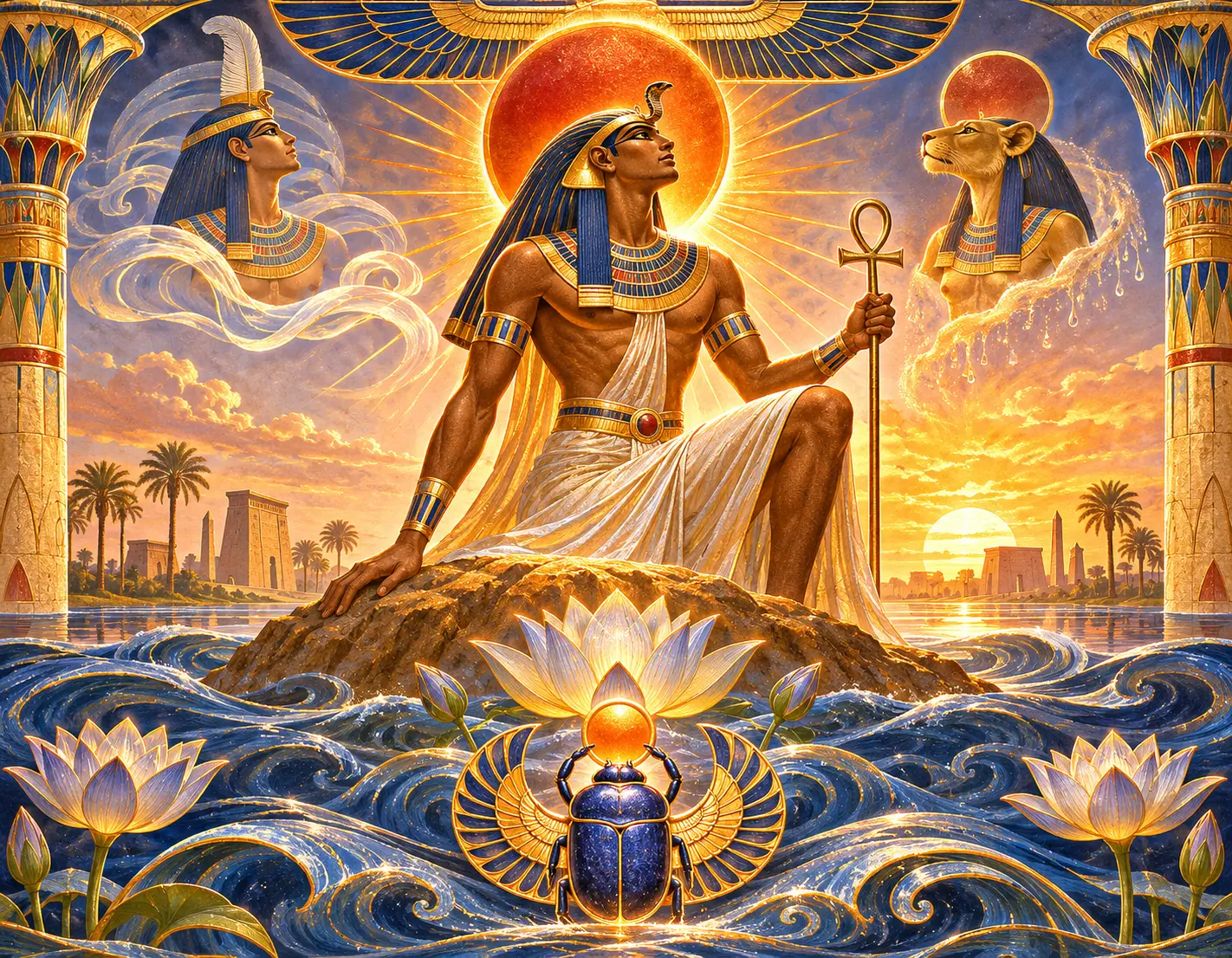
The Memphite creation tradition offers one of ancient Egypt’s most intellectually distinctive explanations of the universe.
Memphis was an important political and religious center near the southern edge of modern Greater Cairo.
Its principal creator deity was Ptah, a god strongly associated with craftsmanship, artisans, and the creative power required to give form to things.
The Memphite tradition emphasizes the idea that creation could occur through divine thought and speech.
Ptah’s Heart and Tongue: The Power of Divine Creation
In Egyptian thought, the heart was understood as a center of intelligence, intention, and understanding.
The tongue gave expression to what had been conceived.
In the Memphite creation account, Ptah brings existence into being through these faculties.
His heart forms the intention, and his tongue expresses the creative command.
The process involves more than a god simply speaking ordinary words.
It presents thought, language, and divine authority as fundamental creative powers.
The concept also helps explain why writing, naming, and spoken ritual formulas held such importance in ancient Egyptian religion.
A properly expressed sacred name could possess religious significance because words were understood to participate in the power they described.
Ptah’s creation includes the divine world and the organized activities of human existence.
His association with artisans makes the theology especially meaningful: just as a craftsperson plans and produces an object, the creator conceives and brings the cosmos into form.
What Is the Shabaka Stone?
The Shabaka Stone is among the most important surviving sources for Memphite theology.
It is a stone inscription associated with King Shabaka, also spelled Shabako, of Egypt’s Twenty-Fifth Dynasty, during the eighth century BCE.
The inscription presents Ptah as the supreme creative force and explains how divine thought and speech brought gods and other aspects of existence into being.
The surviving stone is held by the British Museum in London.
It is notable for its damaged surface, which was affected by later reuse.
The inscription itself claims to preserve an older religious document. However, scholars do not universally accept that the surviving composition originated in the Old Kingdom.
Its original composition date remains a matter of historical interpretation.
This distinction is important.
The Shabaka Stone provides valuable evidence for Egyptian creation theology, but it should not be used as proof that every detail of its surviving text was formulated at the earliest stage of Egyptian civilization.
Did Ptah Create Atum?
In Memphite theology, Ptah could be presented as the ultimate creator responsible for bringing Atum and the other gods into existence.
This establishes Ptah’s authority in relation to the divine system associated with Heliopolis.
It does not mean that the Egyptians universally abandoned Atum’s creative role.
Instead, the Memphite tradition places Ptah at a deeper level of explanation.
Atum remains a major creator within Heliopolitan theology, while Ptah represents the divine intelligence and creative speech responsible for the wider order of existence in the Memphite account.
For modern readers, the difference illustrates how Egyptian religious traditions could accommodate several levels of divine causation.
One account explains creation through divine generation.
Another explains it through intention and language.
Both could carry religious meaning.
Why Was Memphis Important to Egyptian Religion?
Memphis held enormous political and religious significance, particularly during the Old Kingdom of Egypt.
Its connection with kingship, administration, and religious institutions helped establish Ptah as one of Egypt’s major deities.
The city’s religious importance continued well beyond the Old Kingdom.
Its theological traditions also connected divine creativity with the practical world of builders, sculptors, metalworkers, and other skilled craftspeople.
That relationship is particularly relevant to Egypt’s monumental architecture.
The construction of temples and statues was not simply a technical activity. Such objects could serve sacred purposes through their forms, inscriptions, rituals, and relationships with the gods.
Memphite theology helps explain why artistic creation and religious creation were closely associated.
The Theban Creation Myth: Amun, the Hidden Creator
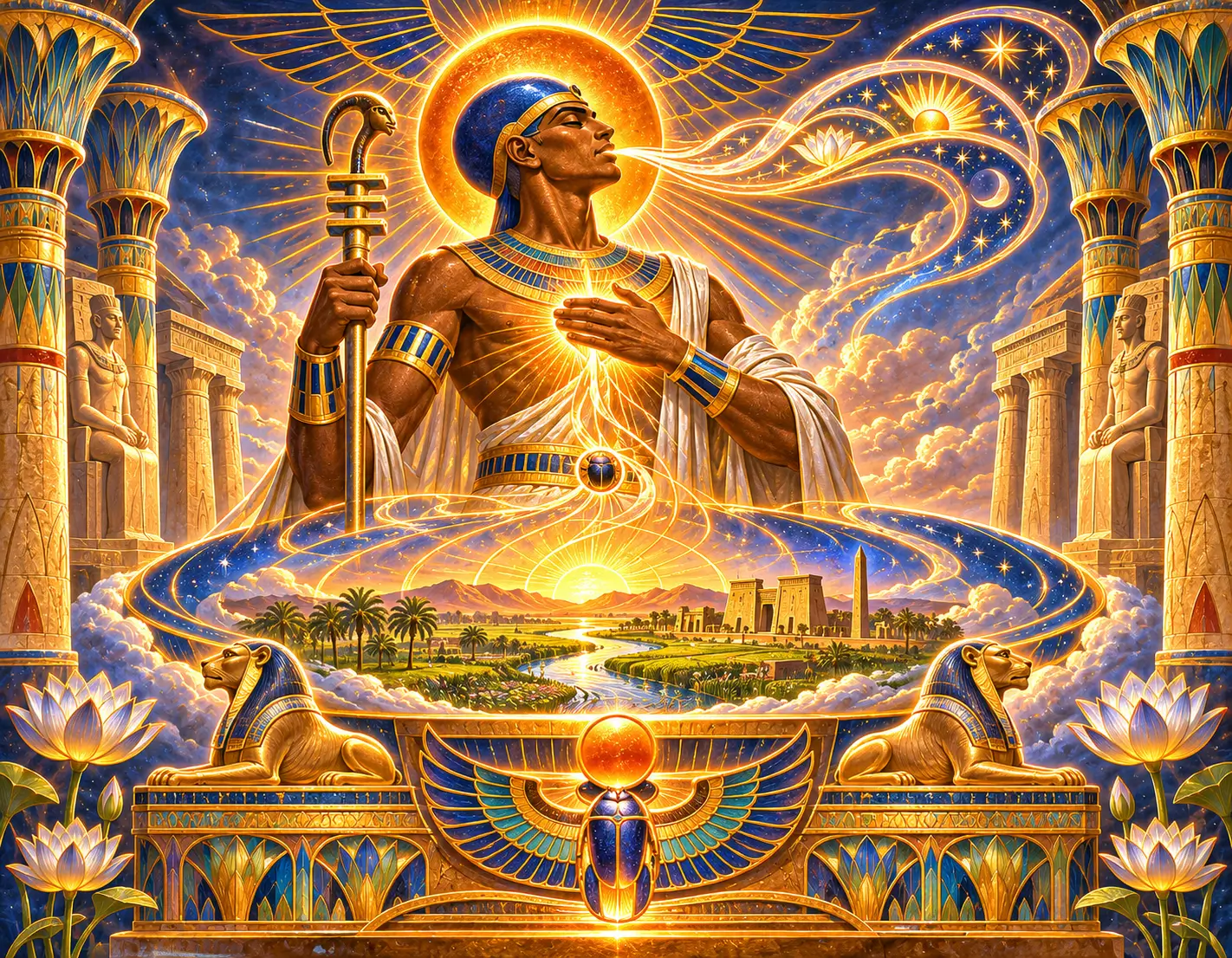
Thebes, known in ancient Egyptian as Waset and located in present-day Luxor, developed another influential religious perspective.
The city’s most important deity was Amun.
As Thebes became increasingly powerful, particularly during the Middle and New Kingdoms, Amun’s religious importance expanded.
He was eventually associated with Ra as Amun-Ra, a major expression of divine kingship and supreme creative authority.
How Did Amun Become a Creator God?
Amun’s name is generally connected with the idea of hiddenness.
His identity therefore expressed a divine reality that could not be fully perceived.
In Theban theology, Amun could be understood as the unseen power behind visible creation.
Later religious accounts elevated him beyond the role of a local protective deity.
He could be described as a primordial creator who preceded other gods and brought the fundamental forces of existence into being.
In some traditions, Amun was associated with the primordial waters and the origin of the sun.
This did not erase the importance of solar mythology.
Instead, Theban theologians developed connections between Amun, Ra, Ptah, and other creative deities.
The result was a sophisticated system in which different divine names could express different manifestations of creative power.
How Was Amun Connected to the Ogdoad?
Amun also appears among the primordial pairs of the Hermopolitan Ogdoad.
This creates an interesting relationship between Hermopolitan and Theban theology.
In the Ogdoad, Amun and Amaunet can represent hiddenness as an aspect of the primordial state.
In later Theban traditions, Amun becomes the supreme creator associated with the origin of the Ogdoad itself.
These positions reflect different theological contexts.
They should not be flattened into a single chronological family tree.
The same deity could occupy different positions depending on the religious tradition, historical period, and purpose of the text.
This flexibility was one reason Egyptian religion could develop numerous creation accounts without requiring every tradition to be reconciled into a single narrative.
Karnak Temple and the Theology of Amun-Ra
The religious importance of Amun is especially visible at Karnak Temple in Luxor.
Karnak was one of ancient Egypt’s most important temple complexes and the principal center of Amun’s worship at Thebes.
The complex developed over many centuries.
Its massive gateways, courts, obelisks, sanctuaries, and decorated halls reflect the changing relationships between kings and the gods.
Ancient Egyptian temples were also understood symbolically as ordered sacred spaces within the larger cosmos.
At Karnak, religious architecture helped express divine authority and the relationship between the world of the gods and the world of human beings.
Travelers who understand the creation traditions can therefore appreciate the site on more than an architectural level.
The sanctuary, sacred lake, temple axis, inscriptions, and solar imagery belong to a religious environment concerned with cosmic order and its renewal.
Not every relief at Karnak illustrates the original creation myth directly. Many scenes concern kingship, offerings, festivals, and specific rituals.
However, those activities operated within the broader theological world in which Amun’s creative power was fundamental.
Other Egyptian Creator Gods: Khnum, Neith, Ra, and Khepri
The four major creation traditions do not represent every ancient Egyptian explanation of life’s origins.
Egyptian religious traditions were diverse, and individual deities could possess creative roles beyond their best-known associations.
Understanding these figures provides a more complete picture of the ancient Egyptian myth of creation.
Khnum: The Potter Who Formed Life
Khnum was a ram-headed god associated with the Nile, fertility, and the creative act of shaping living beings.
He was especially important in the region of Elephantine Island near Aswan.
In Egyptian religious art, Khnum could be represented forming bodies on a potter’s wheel.
The image connects creation with craftsmanship.
Just as a potter shapes wet clay into a recognizable object, Khnum forms living beings through divine skill.
In some representations, he creates both the body of a person and the person’s ka, a vital aspect of existence.
Khnum’s role did not necessarily replace the creator gods of Heliopolis, Memphis, or Thebes.
Instead, he provided another explanation of how life could be formed within an already established divine cosmos.
His mythology was also closely connected to the Nile’s life-giving waters.
This makes his cult particularly interesting in Aswan, where the ancient Egyptians encountered the river near their southern frontier.
Neith: A Primordial Goddess of Creation
Neith was an important Egyptian goddess associated with Sais in the Nile Delta.
She possessed a long religious history and was connected with warfare, protection, and creative power.
Some later Egyptian theological traditions present Neith as a primordial creator.
Her creative role is especially important in certain local traditions, including theological material associated with Esna.
In these accounts, creation could be understood through the activity of a powerful female deity who existed before the established world.
This challenges the oversimplified idea that every Egyptian creation myth began with a male sun god.
Ancient Egyptian religion contained multiple models of creation, including traditions that emphasized female creative authority.
Neith’s significance also demonstrates how regional religious identities continued to develop over time.
Ra: The Sun God Who Sustained Creation
Ra was among the most influential deities in ancient Egyptian religion.
His association with the sun made him central to the daily renewal of existence.
Ra’s relationship with creation appears in several forms.
He could be identified with Atum, associated with the first appearance of the sun, or represented through different solar manifestations.
But his importance extended beyond the universe’s beginning.
Each day, the sun’s appearance demonstrated the continuing operation of cosmic order.
In mythological accounts of the solar journey, Ra travels across the sky and passes through the dangerous regions of the night before returning at dawn.
His nighttime journey connects the original creation of the world with the possibility of renewed existence.
Readers interested in the solar deity’s protective and potentially destructive power can explore the meaning of the Eye of Ra.
Khepri: Creation Through Transformation
Khepri was a solar deity strongly associated with the rising sun.
He was commonly represented as a scarab beetle or as a figure with a scarab head.
The scarab’s relationship with Egyptian religious symbolism reflects ideas of emergence, transformation, and renewed life.
Ancient observers could see scarab beetles associated with rolling balls of dung, within which certain species reproduce.
The behavior provided a powerful analogy for the sun’s movement and the appearance of life.
Khepri’s name is associated with coming into being or becoming.
That makes him especially relevant to Egyptian creation mythology.
Rather than presenting creation only as an event in the distant past, Khepri symbolizes the universe’s ability to renew itself.
The morning sun is a new beginning, repeating the original transition from darkness to light.
This symbolism helps explain why scarabs became common religious and funerary objects.
For further context, see the significance of the scarab beetle in ancient Egypt.
How Were Humans Created in Ancient Egyptian Mythology?
Ancient Egyptian mythology contains several explanations for the creation of human beings.
Unlike modern summaries that sometimes present one fixed story, the surviving evidence does not establish a universally accepted narrative describing exactly how the first humans appeared.
Two particularly memorable traditions involve divine tears and the shaping of bodies from clay.
Did Humans Come From Ra’s Tears?
In some Egyptian religious texts, humanity is associated with tears produced by the creator or the creator’s divine eye.
The story reflects both religious symbolism and Egyptian wordplay.
The ancient Egyptian words associated with people and weeping had a phonetic resemblance.
This allowed religious writers to connect human origins with a creative act of the god.
Different texts give different contexts for the tears.
In some traditions, they are associated with the divine eye and its return. Other accounts emphasize the creator’s power to bring life into existence from his own body.
The story should not be simplified into a universal claim that every ancient Egyptian believed Ra cried once and thereby created all humanity.
The broader idea is that humans ultimately derive their existence from divine creative power.
Were Humans Made From Clay?
Khnum’s potter imagery provides another important model.
In scenes associated with Khnum, living beings are shaped as if fashioned from clay on a potter’s wheel.
This analogy connects humanity with the earth and the life-giving potential of water.
It also presents creation as an act requiring intention, skill, and form.
These qualities are consistent with Khnum’s role as a divine craftsman.
The clay model and the tears model should not necessarily be interpreted as competing versions of a single historical event.
They reflect different religious explanations of how human existence depends on the gods.
Were Humans Created Before or After the Gods?
In the Heliopolitan account, the divine genealogy explains how fundamental features of the cosmos and major divine relationships appeared.
Humanity becomes part of the organized world established through these creative acts.
However, Egyptian religious sources do not always provide a precise sequence for the appearance of the first humans.
Many texts refer to humanity without describing the moment of its original creation.
Some emphasize the creator’s concern for living beings, while others focus on the maintenance of life after creation.
The distinction is important when interpreting the stories.
Modern retellings often arrange scattered mythological episodes into a continuous narrative. That can make the material easier to understand, but the result should not be mistaken for a single original Egyptian text.
Why Did the Creation of Humanity Matter?
Human existence was closely tied to the maintenance of Ma’at.
The relationship between humanity and the gods involved responsibilities as well as divine protection.
Kings were expected to maintain cosmic order through just rule and religious obligations.
Temple communities performed rituals and offerings intended to sustain relationships with the gods.
Individuals could express the principles of Ma’at through ethical conduct, honesty, and appropriate treatment of others.
Creation mythology therefore provided a religious foundation for social life.
The world was not simply an environment in which humans happened to exist.
It was an ordered cosmos in which human actions had moral and religious significance.
The Symbols Behind Egyptian Creation Myths
One of the most distinctive features of ancient Egyptian creation myths is their reliance on visible natural imagery.
Water, sunlight, flowers, birds, eggs, and raised land could all express aspects of cosmic emergence.
These symbols help explain Egyptian religious artworks that might otherwise appear mysterious to modern visitors.
The Primordial Mound: The First Land
The primeval mound represents the appearance of stable land within the primordial waters.
Its emergence establishes a place where creation can begin.
The image also connects with ancient Egyptian experiences of the Nile flood and the appearance of fertile ground.
In some traditions, the mound is especially associated with the solar creator.
At Heliopolis, a sacred object known as the Benben was connected with this idea.
The Benben represented the primordial elevation and the first appearance of solar power.
Its symbolism also influenced Egyptian architectural and religious forms, including associations with obelisks and pyramidions.
It would be inaccurate, however, to claim that every Egyptian pyramid was explicitly designed as a direct representation of one identical creation myth.
Pyramid symbolism developed through several overlapping ideas involving the sun, kingship, resurrection, and ascension.
The primordial mound is one important part of that wider religious context.
The Lotus Flower: Life Emerging From Darkness
The lotus is one of the most recognizable symbols associated with Egyptian creation.
In some creation traditions, the young sun appears from a lotus opening above the primordial waters.
The flower represents emergence, light, and the movement from concealment to visibility.
Its imagery is particularly prominent in versions associated with Hermopolitan cosmology.
The lotus also has a broader role in Egyptian decorative and religious art.
Lotus motifs appear on architectural elements, objects, and funerary imagery.
Not every lotus represents the original creation event.
Its meaning depends on the surrounding scene and its context.
However, the flower’s ability to evoke renewed life made it a natural symbol of regeneration.
The Cosmic Egg: Life Before Its First Appearance
The cosmic egg is another image associated with the emergence of the sun and the beginning of existence.
An egg contains life that has not yet appeared openly.
This makes it a suitable symbol for the transition from hidden possibility to manifest creation.
Different traditions connect the cosmic egg with different deities and primordial processes.
It is therefore better to understand the egg as a recurring creative symbol than to treat it as a single object with one fixed origin story.
The lotus and cosmic egg can communicate related concepts while belonging to different versions of Egyptian theology.
The Bennu Bird: Emergence and Renewal
The Bennu, sometimes written Benu, was a sacred bird associated with Heliopolis and solar symbolism.
It was connected with ideas of creation and renewal.
The bird’s identity and religious significance influenced later comparisons with the phoenix of classical mythology.
However, the Bennu should not be described as identical in every respect to the later phoenix tradition.
Its original Egyptian meaning belongs to a particular religious environment centered on solar emergence and rebirth.
The Bennu could be linked with the Benben and with forms of the creator god.
Its imagery also demonstrates how bird symbolism contributed to Egyptian ideas about divine transformation.
The Sun Disc: The First Light and Every New Day
The sun disc represents one of the most fundamental forces in Egyptian creation mythology.
The first sunrise marks the transformation of the primordial state into an illuminated, ordered world.
Every later sunrise repeats an aspect of that foundational event.
The movement of the sun also establishes natural cycles that regulate life.
Day follows night.
The seasons continue.
Agricultural activity becomes possible within a predictable environment.
In religious language, these familiar processes could be understood as demonstrations of divine power.
For visitors examining temple reliefs, the solar disc may have additional meanings connected with kingship, protection, and specific gods.
It should therefore be interpreted as part of the complete scene rather than as an isolated decorative symbol.
For a broader explanation of Egyptian religious imagery, explore the meanings of ancient Egyptian symbols.
Why the Nile River Influenced Egyptian Creation Beliefs
The Nile was central to ancient Egyptian civilization, and the river’s natural cycles provide important context for understanding creation imagery.
The annual flood historically brought water and fertile sediment to agricultural land.
When the floodwaters receded, fields became available for cultivation.
The sequence made water, emerging land, and renewed growth especially meaningful images.
Ancient Egyptians could recognize a relationship between the recurring agricultural cycle and the religious idea of existence arising from primordial waters.
However, the connection should be understood carefully.
Nun was not simply another name for the Nile.
Nun represented primordial waters associated with the state before the ordered cosmos.
The Nile was a real river with geographical, economic, and religious importance.
Their symbolism could overlap, but their identities were not identical.
Flooding, Fertility, and the Renewal of Life
Ancient Egyptian agriculture depended heavily on water management and the river’s annual inundation before modern dams transformed the system.
The flood could renew fertility and support cultivation, although exceptionally low or high floods could also create serious problems.
This relationship helped explain the importance of water-related deities and rituals.
Khnum, for example, possessed associations with the Nile and the region near the First Cataract.
Hapy was a divine personification of the Nile inundation.
These gods were not interchangeable with Nun, but their religious importance reflects the vital role of water in Egyptian life.
The experience of seasonal renewal made creation an intelligible part of the natural world.
It gave visible form to ideas that could otherwise have remained entirely abstract.
Did the Ancient Egyptians Believe Creation Happened Every Year?
The Egyptians distinguished the primordial creation from the recurring renewal of existence.
The world did not literally have to be destroyed and rebuilt every agricultural year for creation symbolism to remain meaningful.
Instead, seasonal cycles could reflect the continuing power of the original creative act.
The Nile flood, plant growth, solar movement, and ritual calendar all provided opportunities to express renewal.
This relationship between mythology and the environment helps explain why the Nile River was important to ancient Egypt.
For travelers, the connection offers a useful way to understand Egyptian temples and monuments.
The river was not only a transportation route or agricultural resource.
It formed part of the natural environment that shaped how Egyptians imagined the universe.
How Creation Became the Foundation of Egyptian Religion and the Afterlife
Egyptian creation myths influenced far more than explanations of the universe’s beginning.
They helped shape ideas about death, resurrection, kingship, sacred space, and the continuing relationship between the human and divine worlds.
The same principle appears repeatedly: existence can emerge from darkness, stillness, or a state that seems to contain no visible life.
Why Sunrise Was Connected to Resurrection
The Egyptian sun god’s daily journey provided an important model for rebirth.
At sunset, the sun disappeared beyond the western horizon.
During the night, religious texts described the sun traveling through the underworld, encountering divine beings and dangerous forces.
At dawn, it returned to the eastern horizon.
The recurring journey demonstrated that disappearance did not necessarily mean permanent destruction.
Renewal was possible.
This idea became especially important in Egyptian funerary theology.
The deceased hoped to overcome the dangers of the afterlife and participate in a renewed form of existence.
The sun’s reappearance offered a powerful religious model for this transformation.
Solar rebirth and the resurrection associated with Osiris were different but often interconnected aspects of Egyptian afterlife beliefs.
Why Egyptian Tombs Contain Images of the Cosmos
Royal tombs were not decorated only with scenes of daily life or portraits of the dead.
Many included complex religious compositions concerning the gods, the heavens, and the nighttime journey of the sun.
These images expressed the deceased king’s hoped-for transformation and continuing existence.
Astronomical ceilings could represent the organized heavens.
Solar boats showed the sun god traveling through different regions.
Scenes involving Nut could express protection, the sky, and renewed birth.
The imagery drew upon ideas that also appeared in creation theology.
The Valley of the Kings in Luxor contains some of the most impressive surviving examples.
Tombs such as KV9, associated with Ramesses V and Ramesses VI, preserve extensive religious and astronomical decorations.
The tomb of Seti I, KV17, is another important example of royal funerary imagery, although access conditions and separate ticketing requirements should always be checked.
These monuments make the relationship between creation and the afterlife visible.
How Temples Represented an Ordered Universe
Ancient Egyptian temples were more than buildings used for religious gatherings.
Their architecture and rituals could express the organization of the cosmos.
Certain architectural elements evoked primordial forms, sacred landscapes, or divine realms.
Temple sanctuaries provided an especially significant setting for the interaction between deities and their human representatives.
Rituals performed by priests and kings helped maintain relationships with the gods.
Offerings, purification, sacred processions, and formal recitations could be understood as activities that renewed divine order.
This does not mean that every temple used identical symbolism.
Egyptian sacred architecture developed over thousands of years, and local religious traditions influenced its meaning.
However, creation and renewal provided a recurring foundation.
Understanding these beliefs adds another dimension to the experience of visiting ancient Egyptian temples.
Where Do We Find the Original Egyptian Creation Myths?
There is no single surviving ancient Egyptian book containing a complete, universally accepted creation story.
Modern descriptions are reconstructed from religious texts, inscriptions, funerary compositions, artistic representations, and material preserved from different periods.
This is one of the most important facts to understand about the Egyptian myth of creation.
The Pyramid Texts
The Pyramid Texts are among the earliest substantial surviving collections of ancient Egyptian religious writings.
They first appear in royal pyramids of the late Fifth Dynasty, during the Old Kingdom, around the twenty-fourth century BCE.
These inscriptions were intended to assist the deceased king in achieving a successful existence after death.
They include references to creation, the solar gods, the primordial mound, Atum, and other aspects of the divine world.
The Pyramid Texts are especially important for understanding the development of Heliopolitan religious ideas.
However, they are not a continuous narrative beginning with the first moment of the universe and ending with the creation of humanity.
They are collections of religious utterances serving particular funerary purposes.
Their references to creation therefore appear within a wider ritual context.
Some of the most important surviving examples are found in the pyramids of kings at Saqqara.
The Coffin Texts
The Coffin Texts became especially prominent during the Middle Kingdom.
They contain religious compositions intended to protect the deceased and facilitate existence beyond death.
Many were written on coffins, although related material appears in other contexts.
The collection preserves significant references to creation, divine powers, the nature of existence, and relationships between gods.
Some passages are especially important for understanding Atum, Shu, the primordial waters, and the emergence of humanity.
The Coffin Texts also demonstrate that Egyptian religious thought was not static.
Ideas could be expanded, rearranged, and adapted to different funerary settings.
Their importance lies partly in showing how creation theology continued to develop beyond the earliest royal pyramid inscriptions.
The Book of the Dead
The Book of the Dead is a modern name for a collection of ancient Egyptian funerary compositions.
It became widely used from the New Kingdom onward.
Individual copies could vary considerably in their selection and arrangement of spells.
The purpose was to help the deceased navigate the afterlife and achieve a successful transformation.
The collection contains religious ideas relevant to creation and renewal, including solar and cosmic imagery.
However, it should not be described as an Egyptian equivalent of a single fixed creation scripture.
Its contents are primarily funerary in purpose.
Creation themes appear because the possibility of renewed life depended upon the continuing creative powers of the gods.
Temple Inscriptions and the Shabaka Stone
Temple inscriptions provide additional evidence for local creation traditions.
They can describe the relationships between gods, explain sacred places, and express the creative authority of a particular deity.
Late Period, Ptolemaic, and Roman-period temples preserve especially elaborate theological compositions.
Such texts may record older religious ideas while also expressing developments associated with their own periods.
The Shabaka Stone is particularly important for the Memphite account centered on Ptah.
Together, these sources explain why historians cannot reduce Egyptian creation mythology to a single literary work.
A Practical Timeline of the Surviving Evidence
|
Historical period |
Approximate dates |
Importance for creation traditions |
|---|---|---|
|
Old Kingdom |
c. 2686–2181 BCE |
Pyramid Texts preserve early religious references, including Heliopolitan ideas |
|
Middle Kingdom |
c. 2055–1650 BCE |
Coffin Texts provide additional cosmological and creative material |
|
New Kingdom |
c. 1550–1069 BCE |
Extensive royal tomb imagery and funerary texts express solar renewal |
|
Third Intermediate and Late Periods |
c. 1069–332 BCE |
Further theological developments, including the Shabaka Stone |
|
Ptolemaic Period |
332–30 BCE |
Detailed temple inscriptions preserve and elaborate local creation traditions |
|
Roman Period in Egypt |
30 BCE–fourth century CE |
Egyptian temples and religious texts continue to transmit older and evolving ideas |
Dates are approximate, and the development of particular traditions does not always correspond exactly to the surviving date of a text.
An account recorded in a later temple may incorporate much older concepts.
Equally, an old-sounding religious claim cannot automatically be assigned to the earliest period of Egyptian history.
This historical approach helps readers distinguish genuine ancient evidence from modern retellings.
For a broader understanding of the society behind these religious traditions, see our guide to ancient Egyptian culture.
Where Can Travelers See Egyptian Creation Mythology in Egypt?
Many surviving Egyptian monuments express the same religious ideas found in the creation traditions.
Some locations are especially important because they were original centers of worship.
Others preserve paintings, inscriptions, architectural symbolism, or objects that help explain those beliefs.
The best places depend on whether you are interested in the original cult centers, religious artworks, or the relationship between creation and the afterlife.
The Best Archaeological Sites for Understanding Creation Myths
|
Destination |
Creation connection |
What travelers can experience |
Suggested time |
|---|---|---|---|
|
Ancient Heliopolis, Cairo |
Atum, Ra, Ennead, primordial mound |
Surviving obelisk and archaeological context |
45–90 minutes |
|
Memphis archaeological area |
Ptah and Memphite theology |
Remains and monuments associated with the ancient city |
45–90 minutes |
|
Saqqara |
Early royal religion and Pyramid Texts |
Old Kingdom pyramids and funerary monuments |
2–4 hours |
|
Karnak Temple, Luxor |
Amun-Ra, cosmic order, Theban theology |
Major temple architecture and divine inscriptions |
2–3 hours |
|
Valley of the Kings, Luxor |
Solar rebirth and renewal |
Painted royal tombs and funerary texts |
2–3 hours |
|
Dendera Temple, near Qena |
Celestial imagery and divine renewal |
Astronomical ceilings and religious reliefs |
1.5–2 hours on-site |
|
Elephantine Island, Aswan |
Khnum, Nile fertility, creative power |
Temple remains, Nilometer, archaeological landscape |
1.5–2 hours |
These durations are editorial planning estimates, not official tour lengths. They exclude substantial road travel, security procedures, queues, and any site-specific access restrictions.
Heliopolis: The City Where Atum Began Creation
Ancient Heliopolis was one of Egypt’s principal centers of solar worship.
The site is located in the area of Ain Shams and Matariya within Greater Cairo.
Much of the ancient religious complex has disappeared or lies beneath later development.
One of the most important surviving monuments is the obelisk of Senusret I, a ruler of the Twelfth Dynasty.
The obelisk provides a physical connection with the ancient solar cult.
Heliopolis is therefore highly significant historically, even though it does not offer the monumental experience of Karnak or the Giza pyramids.
Travelers should not expect to find a fully preserved temple showing the complete Heliopolitan creation myth.
The value of visiting lies in understanding the original religious landscape.
Best for: Travelers especially interested in the origins of Egyptian theology, archaeology, and the sun cult.
Planning advice: Combine this visit with other eastern Cairo activities when practical. Heliopolis is not part of the usual Giza Plateau visitor circuit.
Memphis and Saqqara: Understanding Ptah and Early Royal Religion
The ancient city of Memphis was a major center of Egyptian kingship and the worship of Ptah.
Its archaeological remains offer context for the religious environment in which Memphite theology developed.
Visitors can explore surviving monuments in the Memphis archaeological area.
However, the complete theological narrative of Ptah’s creation is not displayed as a single preserved monument at the site.
The Shabaka Stone, one of the most important surviving witnesses to this tradition, is in London.
Nearby Saqqara adds another important dimension.
Its pyramids and royal burial monuments connect visitors with the early development of Egyptian kingship and funerary religion.
The Pyramid of Djoser is particularly important for understanding the architectural development of royal burial complexes.
For travelers interested in the Pyramid Texts, Saqqara also contains later Old Kingdom pyramids associated with some of the earliest surviving religious inscriptions.
The precise monuments open to visitors and any entry into interior chambers should be confirmed before departure.
Best for: Archaeology enthusiasts interested in creation, kingship, and the development of Egyptian religious writing.
Planning advice: Memphis and Saqqara can be combined in a single archaeological excursion from Cairo. Allow additional time for Dahshur or other sites only if your schedule permits.
Karnak and Luxor: The Religious World of Amun
Luxor provides some of the strongest surviving evidence for the religious importance of Amun-Ra.
Karnak is particularly valuable because it preserves the monumental setting of Amun’s principal cult.
The architecture, reliefs, and sacred spaces demonstrate the relationship between the gods and royal authority.
At Luxor Temple, religious traditions involving Amun were also central to ceremonies and festivals.
The two temples were connected by a ceremonial processional route.
Visiting both helps explain why Thebes became such an influential religious center.
Travelers interested in Egyptian creation theology should pay attention to the differences between an original creation narrative and rituals intended to maintain cosmic order.
Both belong to the same religious system, but they are not identical.
Best for: First-time visitors who want to combine major monuments with meaningful historical interpretation.
Planning advice: Explore Karnak and Luxor Temple on the east bank, preferably with a guide familiar with Egyptian religious history.
Valley of the Kings: Watching the Sun Be Reborn
The Valley of the Kings provides an extraordinary opportunity to encounter Egyptian ideas about rebirth.
Some royal tombs preserve elaborate paintings showing the sun’s journey through the nighttime world.
KV9, the tomb used by Ramesses VI, is particularly well known for its rich astronomical and funerary decorations.
Its ceiling and wall scenes help explain how ancient Egyptians connected the daily solar cycle with the possibility of resurrection.
The tomb of Seti I also preserves important celestial imagery.
However, which tombs are accessible can change, and some require separate admission.
The Valley of the Kings is an active archaeological and conservation environment.
Visitors should never assume that every famous tomb will be included in a standard ticket.
Best for: Travelers interested in Egyptian mythology, funerary religion, and the relationship between astronomy and the afterlife.
Planning advice: Choose tombs based on the religious scenes you most want to see rather than visiting only the most famous names.
Dendera Temple: The Sky in Egyptian Religious Art
The Temple of Dendera is one of Egypt’s most impressive places for studying celestial symbolism.
Located near Qena, north of Luxor, the temple complex is principally associated with Hathor.
Its well-preserved architectural decoration includes significant astronomical imagery.
The ceilings provide an opportunity to understand how ancient Egyptian religious art represented the sky and divine order.
The famous circular Dendera Zodiac is now in the Louvre in Paris; the temple preserves other original astronomical decorations, while a replica occupies the former zodiac’s location.
Dendera is not simply a temple dedicated to the original creation of the universe.
Its significance lies in the wider relationship between the heavenly world, divine renewal, and religious symbolism.
Best for: Travelers fascinated by Egyptian astronomy, religious art, and temple decoration.
Planning advice: Dendera is best considered as a dedicated excursion from Luxor or part of a broader Upper Egypt route. Allow extra time for road transfers.
Elephantine Island: Exploring Khnum’s Creative Power
Elephantine Island stands in the Nile at Aswan.
The island was an important ancient religious and administrative center.
Khnum, the ram-headed god associated with Nile fertility and divine craftsmanship, was among its principal deities.
The archaeological site contains remains associated with the worship of Khnum and other local gods.
Visitors can also encounter evidence of the island’s importance in monitoring the Nile.
The Nilometer reflects the practical need to understand the river’s changing water levels.
This combination of religious and environmental history makes Elephantine particularly valuable.
It provides a connection between the mythology of creation and the physical Nile landscape.
Best for: Travelers interested in Egyptian gods, river history, archaeological remains, and quieter cultural exploration.
Planning advice: A visit is most convenient while staying in Aswan, with boat access arranged according to local conditions.
What About the Egyptian Museums?
Museum collections provide another valuable way to understand creation imagery.
Objects such as papyri, coffins, scarabs, statues, and religious reliefs can preserve details that are difficult to observe at archaeological sites.
In Cairo, the Egyptian Museum in Tahrir Square remains an important historic collection.
The Grand Egyptian Museum near Giza also offers a substantial collection of ancient Egyptian objects within a modern exhibition setting.
For 2027, visitors should consult current museum information before choosing which collection to prioritize.
Specific objects may be moved, undergoing conservation, unavailable for viewing, or displayed in different galleries.
Rather than assuming that one museum contains every creation-related artifact, look for collections explaining divine figures, funerary beliefs, solar symbolism, and religious life.
How to Explore Egyptian Creation Mythology on a 2027 Trip
Travelers do not need to visit every ancient religious center to understand Egyptian creation traditions.
The most useful itinerary connects a few carefully selected sites.
Option 1: One Day in Cairo for Ancient Religious History
For a full-day archaeological excursion, focus on Memphis and Saqqara.
Begin with the ancient Memphis area to understand Ptah’s religious importance.
Continue to Saqqara to explore the development of royal funerary architecture and Old Kingdom beliefs.
This combination provides an introduction to creation theology, early kingship, and the surviving religious evidence.
Visitors primarily interested in Atum and Heliopolis may prefer a separate visit to Matariya.
Trying to combine Matariya, Memphis, Saqqara, and the main Giza Plateau attractions in one relaxed day is generally unrealistic because of the distances and traffic involved.
Option 2: Two Days in Luxor for Creation and Rebirth
Day 1: The world of Amun-Ra
Explore Karnak and Luxor Temple.
Concentrate on the role of Amun, temple symbolism, religious ceremonies, and the relationship between royal authority and cosmic order.
Day 2: The solar afterlife
Visit the west bank and the Valley of the Kings.
Select accessible tombs featuring astronomical or solar religious imagery.
Connect the scenes with the belief that the sun was renewed each morning.
Travelers with more time can include Dendera as an additional excursion rather than compressing everything into these two days.
Option 3: Half a Day in Aswan for Khnum and the Nile
Visit Elephantine Island to examine its archaeological landscape and the religious importance of Khnum.
The experience works especially well when combined with broader sightseeing in Aswan.
It provides a different perspective from the solar theology of Heliopolis or Thebes.
Here, the emphasis is on river fertility, divine craftsmanship, and the origins of living beings.
Which Experience Should You Choose?
|
Your main interest |
Recommended experience |
Why it fits |
|---|---|---|
|
Understanding the first creator gods |
Heliopolis and Memphis |
Original centers associated with Atum and Ptah |
|
Early religious texts |
Saqqara |
Connection with Old Kingdom royal funerary traditions |
|
Great temples and divine kingship |
Karnak and Luxor Temple |
Strong links with Amun-Ra |
|
Creation, astronomy, and rebirth |
Valley of the Kings |
Solar and celestial funerary imagery |
|
Detailed religious ceiling decoration |
Dendera |
Exceptional celestial and divine representations |
|
Human creation and Nile fertility |
Elephantine |
Strong association with Khnum |
|
Comparing gods and religious objects |
Cairo’s major museums |
Collections covering different periods and traditions |
For travelers planning a historical itinerary, Egypt Time Travel offers archaeology-focused Egypt tours that can provide a starting point for exploring the country’s ancient sites.
A private itinerary can also be customized around particular interests, such as religious inscriptions, solar temples, ancient mythology, or royal burial traditions.
Common Misconceptions About Ancient Egyptian Creation Myths
Modern retellings often combine different Egyptian traditions into a single story. That approach can be convenient, but it sometimes creates misunderstandings.
The following distinctions are especially important.
Misconception: Ancient Egypt had one official creation story.
Egyptian religion preserved multiple creation traditions, and different religious centers emphasized different creative deities.
Misconception: Nun represented evil.
The primordial waters represented an unformed state containing the possibility of creation. Although they could be associated with dangerous disorder, Nun was not simply an evil god fighting against goodness.
Misconception: The Egyptians believed all gods had one consistent family tree.
Divine genealogy varied between traditions. Gods could share functions, combine identities, or occupy different theological positions in different contexts.
Misconception: Every temple depicts the moment the universe was created.
Many temple scenes concern offerings, kingship, protection, divine festivals, and the preservation of order. Creation ideas influence these subjects without making every relief a creation scene.
Misconception: The Book of the Dead is the complete Egyptian creation story.
The Book of the Dead is a collection of funerary compositions. It contains relevant religious ideas but is not a single chronological account of the world’s origins.
Misconception: Egyptian creation myths never changed.
Egyptian religious traditions developed across centuries. Older concepts continued to be used while local priesthoods, rulers, and religious communities expanded their meanings.
Recognizing these differences allows visitors to appreciate Egyptian mythology as a sophisticated religious tradition rather than a single collection of fixed stories.
Frequently Asked Questions About Egyptian Creation Myths
1. Who was the first god in Egyptian mythology?
There is no universally accepted first god across all Egyptian creation traditions. Atum was the self-generated creator in Heliopolitan theology, while Ptah held supreme creative authority in the Memphite account. Hermopolitan traditions emphasized primordial divine pairs, and later Theban theology elevated Amun. Nun, the primordial waters, existed before the organized world in several traditions.
2. What existed before the world in Egyptian mythology?
Many ancient Egyptian creation traditions describe Nun, the limitless primordial waters, as existing before the ordered universe. This state was associated with darkness and the absence of familiar cosmic boundaries. Some traditions personified different aspects of this state as divine beings. Egyptian religious sources do not provide one universally agreed account of anything preceding Nun.
3. What is the difference between Atum and Amun?
Atum was the principal creator associated with Heliopolis and the divine genealogy of the Ennead. Amun was the major god of Thebes and became a supreme creator within Theban theology. Atum had strong solar associations, while Amun’s name emphasized hiddenness. Both could be linked with Ra, but their identities and religious histories were different.
4. Did the Egyptians believe the sun was born from a lotus flower?
Some Egyptian creation traditions describe the young sun emerging from a lotus flower that opened above the primordial waters. The imagery is particularly associated with Hermopolitan cosmology and related solar traditions. Other accounts describe the sun’s emergence through different symbols, including a cosmic egg or the actions of a self-generated creator.
5. Why were frogs and snakes associated with the Egyptian creation myth?
Frogs and snakes were used in some representations of the Hermopolitan Ogdoad, the eight primordial deities associated with the state before creation. Male members could appear with frog heads and female members with serpent heads. These forms communicated relationships with primeval waters and the potential for life to emerge from the primordial environment.
6. Did Horus create the universe?
Horus was not the principal creator in the best-known Heliopolitan, Hermopolitan, Memphite, or Theban creation systems. He was particularly important as a sky and kingship deity and, in the famous Osiris cycle, as the son of Isis and Osiris. His roles varied across Egyptian traditions, so individual references should be interpreted in their local and historical context.
7. How are the Egyptian creation myth and the Osiris myth connected?
The Heliopolitan creation account includes Osiris, Isis, Seth, and Nephthys among the descendants of the primordial creator Atum. The Osiris cycle focuses on divine kingship, death, restoration, and the struggle over succession. Creation establishes the divine world, while the Osiris tradition explores how authority and renewed life operate within that world.
8. Did Egyptians believe the sky was a goddess?
Yes. Nut was a major Egyptian sky goddess. She was frequently depicted arching above the earth god Geb, sometimes separated from him by Shu. Her body could represent the heavens, and some religious traditions described her receiving the sun at sunset and giving birth to it again at dawn. These images are central to Egyptian cosmology.
9. Is the Egyptian creation myth older than the pyramids?
Some Egyptian religious ideas almost certainly existed before the surviving texts that record them, but their precise origins cannot always be established. The earliest substantial surviving Pyramid Texts date to the late Fifth Dynasty, after the construction of the Great Pyramid of Khufu. This does not mean every idea recorded in those texts originated at that time.
10. Can you see the Shabaka Stone in Egypt?
The Shabaka Stone, an important source for the Memphite creation tradition, is held by the British Museum in London. Travelers visiting Egypt can explore the archaeological remains of Memphis, the religious center associated with Ptah, but should not expect to find the original Shabaka Stone there.
11. Which Egyptian creation myth is the most famous?
The Heliopolitan creation tradition involving Atum and the Ennead is among the most widely discussed. Its sequence of divine generations makes it relatively easy to explain. However, Hermopolitan, Memphite, and Theban creation traditions were also historically important and offer different understandings of how existence began.
12. Which places should mythology lovers visit in Egypt in 2027?
Karnak Temple, the Valley of the Kings, Saqqara, Dendera Temple, Memphis, and Elephantine Island are particularly rewarding for travelers interested in Egyptian religious beliefs. Ancient Heliopolis is also important but has fewer surviving monuments. Museum collections can supplement these sites. Check current access, ticketing arrangements, and the availability of specific tombs and galleries before visiting.
Conclusion: What the Egyptian Creation Myth Tells Us About Ancient Egypt
The Egyptian Creation Myth Guide reveals a civilization that understood the origins of existence through several interconnected religious traditions.
At Heliopolis, Atum emerged from the primordial waters and brought forth the divine generations.
At Hermopolis, the primordial forces of the Ogdoad preceded the first appearance of sunlight.
At Memphis, Ptah created through divine intelligence and speech.
At Thebes, Amun became an expression of the hidden creative power behind the cosmos.
These ancient Egyptian creation myths were not merely attempts to explain what happened at the beginning of time.
They also explained the importance of cosmic order, the divine origins of life, the movement of the sun, and the possibility of renewal after death.
For travelers, understanding these beliefs gives Egyptian monuments greater meaning. A temple is more than an impressive building, a royal tomb is more than a burial place, and a religious symbol often represents an entire understanding of existence.
The most rewarding way to explore these stories is to connect their religious meaning with the archaeological sites where ancient Egyptians worshipped, recorded, and represented their gods.
If you are organizing a history-focused visit in 2027, use Egypt Time Travel’s guide to planning a trip to Egypt to develop an itinerary that combines major monuments with the religious traditions that shaped them.
