
Quick Answer: What is the Suez Canal?
The Suez Canal is a man-made, sea-level waterway in Egypt connecting the Mediterranean Sea with the Red Sea across the Isthmus of Suez. The Suez Canal Authority lists its current overall length as 193.3 km, with a maximum water depth of 24 m. Opened in 1869, it gives ships a much shorter route between Europe and Asia than sailing around Africa. Few places in modern Egypt explain the country’s geography and global importance as clearly as the Suez Canal.
A ship entering at Port Said on the Mediterranean can travel south through a largely artificial waterway, pass Lake Timsah and the Bitter Lakes, and emerge near Suez into the Red Sea system. In doing so, it crosses the narrow land bridge between Africa and Asia without navigating around the Cape of Good Hope.
The canal is also much more than an engineering shortcut. Its story connects ancient Egyptian waterways, 19th-century European imperial ambitions, Egyptian labor, the British occupation, Gamal Abdel Nasser’s nationalization of the canal company, the 1956 Suez Crisis, the wars of 1967 and 1973, modern expansion projects and the 2021 grounding of the Ever Given.
For travelers, the most important point is that the Suez Canal is not a conventional sightseeing attraction like the Pyramids of Giza or Karnak Temple. It is strategic national infrastructure. The best experience comes from understanding the canal through Ismailia’s museums and historical buildings, the waterfront geography of the canal cities and carefully planned visits that respect security and photography restrictions.
If the history behind Egypt’s landmarks interests you as much as the monuments themselves, Egypt Time Travel’s broader guide to Egyptian history provides useful context for the ancient, Ottoman, colonial and modern eras that meet in the Suez story.
What Exactly Is the Suez Canal?
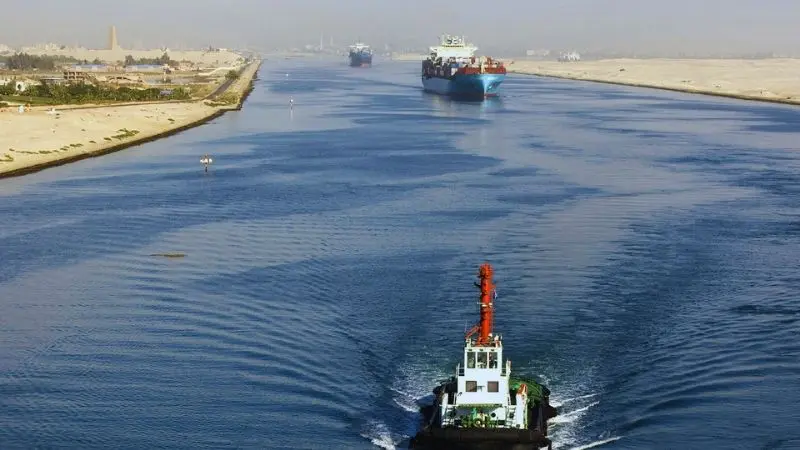
The Suez Canal is an artificial waterway running north–south through northeastern Egypt.
It connects:
Mediterranean Sea → Suez Canal → Gulf of Suez → Red Sea → Indian Ocean
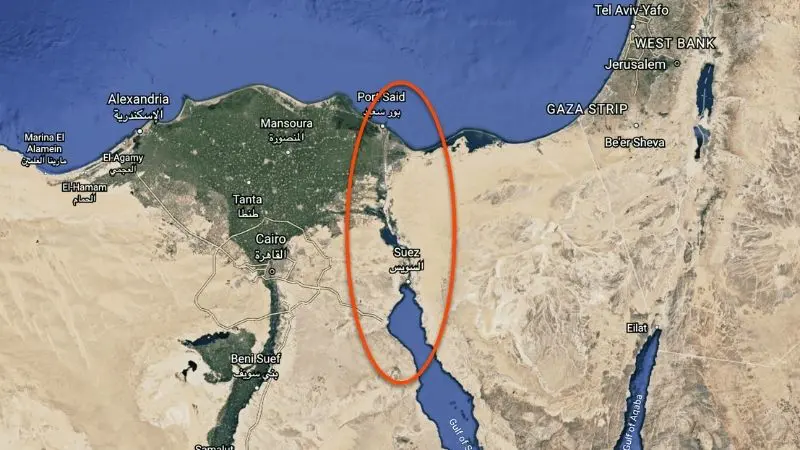
The northern entrance lies around Port Said. The southern end reaches the Gulf of Suez near the city of Suez.
The canal crosses the Isthmus of Suez, the land bridge between mainland Egypt in Africa and the Sinai Peninsula in Asia. For that reason, the canal is commonly treated as part of the geographical boundary between Africa and Asia.
The Suez Canal Authority describes it as an artificial sea-level canal and the shortest maritime connection between Europe and regions around the Indian and western Pacific oceans.
Suez Canal facts at a glance
| Question | Answer |
|---|---|
| Where is the Suez Canal? | Egypt |
| What does it connect? | Mediterranean Sea and Red Sea |
| Is the Suez Canal man-made? | Yes |
| When did construction begin? | 25 April 1859 |
| When was it completed? | August 1869 |
| When did it officially open? | 17 November 1869 |
| How long is the Suez Canal? | 193.3 km according to the Suez Canal Authority |
| Maximum water depth | 24 m |
| Water-surface width | Official SCA FAQ lists 313 m |
| Navigational channel width | Official SCA FAQ lists roughly 200–210 m |
| Does it have locks? | No |
| Who owns it? | The Egyptian government |
| Who operates it? | Suez Canal Authority |
| Typical vessel transit time | Around 12–16 hours according to SCA |
| Is a canal pilot required? | Yes for normal vessel transits, with limited exceptions |
The official dimensions should not be interpreted as saying every point of the canal is exactly the same width. Its geometry changes by section, and bypasses, lakes, parallel channels and expansion projects mean that cross sections vary.
Where Is the Suez Canal in Egypt?
The canal runs through the northeastern part of Egypt between the Nile Delta and the Sinai Peninsula.
Three cities are especially important to understanding its geography.
Port Said: the Mediterranean gateway
Port Said developed at the northern entrance to the new canal during its construction in the 19th century.
This is where Mediterranean shipping enters or leaves the canal system. Port Said and nearby Port Fouad are therefore among the clearest places for travelers to understand the relationship between the canal, the Mediterranean and Egypt’s maritime history.
Cruise passengers arriving in northern Egypt can also compare options through Egypt Time Travel’s Port Said shore excursions.
Ismailia: the canal’s historical center
Ismailia lies beside Lake Timsah approximately midway along the canal corridor.
It became an administrative center during construction and remains closely associated with the Suez Canal Authority. The SCA headquarters, historical buildings, Suez Canal Museum and several canal institutions make Ismailia arguably the best base for someone who wants to understand the canal rather than simply see water and passing ships.
Suez: the southern gateway
The city of Suez lies near the canal’s southern connection with the Gulf of Suez and Red Sea system.
Farther along the Gulf of Suez, Ain Sokhna has developed into an important port and coastal destination. Cruise visitors using this part of Egypt can review Sokhna Port shore excursions when deciding whether to continue toward Cairo or spend time around the Red Sea coast.
Is the Suez Canal Man-Made?
Yes. The modern Suez Canal is a man-made waterway.
It was excavated through the Isthmus of Suez in the 19th century rather than formed by a natural river.
That answer needs one qualification: builders used existing natural depressions and lakes along the route, including Lake Timsah and the Bitter Lakes. So the canal system combines artificial channels with natural geographical features that were incorporated into the route.
This is why describing the Suez Canal as either a “river” or a completely uniform trench is misleading.
It is an engineered maritime corridor made from cut channels, widened areas, lake sections, bypasses and duplicated stretches.
What Does the Suez Canal Connect?
The Suez Canal directly connects the Mediterranean Sea with the Red Sea.
More broadly, that connection creates a maritime route linking:
- Europe and the North Atlantic
- the Mediterranean
- the Red Sea
- the Arabian Sea
- the Indian Ocean
- South Asia
- Southeast Asia
- East Asia
Before the modern canal existed, ships moving between major European and Asian ports generally had to sail around the southern tip of Africa.
That geographical fact explains nearly everything about the Suez Canal’s economic value.
The canal does not create trade by itself. It reduces the distance, time, fuel consumption and operating cost required for many voyages between Europe and Asia.
Why Is the Suez Canal So Important?
The canal matters because geography gives it something few pieces of infrastructure possess: the ability to shorten an entire intercontinental shipping route.
UN Trade and Development reported that in 2023 approximately 10% of world maritime trade by volume and about 22% of global seaborne container trade passed through the Suez Canal. Those shares fluctuate with global demand and, especially since late 2023, with security conditions in the Red Sea.
That distinction is important. You may see websites claim that “12%,” “15%” or another fixed percentage of world trade always passes through Suez. There is no single permanent percentage. Different sources measure different things—total trade, maritime trade, container trade, tonnage or value—and traffic can change sharply from year to year.
The canal saves ships from sailing around Africa
Without the Suez route, many Europe–Asia voyages must divert around the Cape of Good Hope.
UNCTAD has documented how Red Sea disruptions pushed vessels onto those longer routes, increasing distances, vessel demand, fuel requirements, insurance exposure and carbon emissions.
It is a major source of revenue for Egypt
Ships pay tolls to transit the canal.
Those revenues are important to Egypt’s economy and foreign-currency earnings. The exact amount changes with vessel numbers, ship types, toll policies and geopolitical conditions, so travelers should be cautious about articles that repeat an old annual revenue figure as though it were permanent.
It is strategically important
The canal links major maritime regions while sitting beside the Sinai Peninsula and close to the eastern Mediterranean.
This has made it strategically important in imperial competition, two world wars, Arab–Israeli conflicts and modern geopolitical crises.
It affects people far beyond Egypt
A disruption in Suez can influence shipping schedules, port congestion, freight prices, manufacturing supply chains and deliveries thousands of kilometers away.
The six-day Ever Given blockage in March 2021 offered one unusually visible example. The 400-meter vessel became wedged across a southern stretch of the canal and halted traffic until it was refloated on 29 March.
When Was the Suez Canal Built?
Construction of the modern Suez Canal began on 25 April 1859.
The waters of the Mediterranean and Red Sea systems were connected in August 1869, and the canal was formally inaugurated on 17 November 1869.
The project therefore took approximately ten years.
The Suez Canal Authority says roughly 74 million cubic meters of soil were excavated during the original work.
Suez Canal construction timeline
| Date | Event |
|---|---|
| 1854 | Said Pasha grants Ferdinand de Lesseps the first concession |
| 1858 | Universal Company of the Maritime Canal of Suez established |
| 25 April 1859 | Excavation begins |
| 18 November 1862 | Mediterranean water reaches Lake Timsah |
| 18 August 1869 | Waters of the two sea systems meet |
| 17 November 1869 | Formal inauguration of the canal |
The canal has never been a finished engineering object in the sense of “built once and left unchanged.”
Its width, depth, bypasses and navigational infrastructure have been repeatedly modified as ships became larger.
Who Built the Suez Canal?
The simplest answer—“Ferdinand de Lesseps built the Suez Canal”—is incomplete.
Ferdinand de Lesseps was the French diplomat and entrepreneur who promoted the modern project and obtained the concessions that enabled the canal company to build it. The physical canal was created through Egyptian land, Egyptian resources, engineering organization and a vast labor force in which Egyptian workers played the central role.
The Universal Company of the Maritime Canal of Suez was established in 1858 to execute and operate the project.
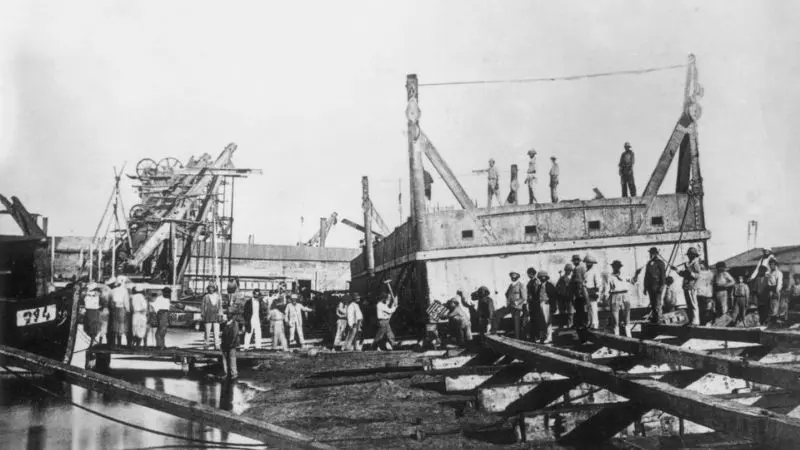
The early construction period relied heavily on Egyptian corvée labor under extremely harsh conditions before mechanized excavation and dredging became increasingly important.
The Suez Canal Authority’s own history explicitly notes the participation of Egyptian laborers and describes the conditions as exceptionally difficult.
Modern historical scholarship also treats the human cost carefully. Exact death figures frequently repeated online are disputed, and there is no sound reason to present a precise six-figure death toll as settled fact. Contemporary research instead supports describing forced labor, disease, inadequate supplies and significant mortality without inventing certainty where the historical record does not provide it.
So who deserves credit?
A more accurate answer recognizes several actors:
- Said Pasha granted de Lesseps the initial concession.
- Ferdinand de Lesseps organized and promoted the project.
- The Suez Canal Company financed and administered construction.
- Egyptian workers carried out a huge share of the excavation and physical labor.
- Engineers and dredging crews developed increasingly mechanized methods as the project advanced.
- Egypt itself supplied the land, labor and substantial financial participation.
That fuller answer is both historically stronger and more useful than treating the canal as the achievement of one European individual.
Why Was the Suez Canal Built?
The main reason was simple: to create a shorter maritime route between Europe and Asia.
European shipping and commercial interests wanted to avoid the long voyage around Africa.
Egypt’s rulers also saw potential benefits in infrastructure, trade and Egypt’s geographical position between the Mediterranean and Red Sea worlds.
But the project was never purely a technical transport scheme.
It became entangled with:
- Egyptian state finance
- French economic influence
- British imperial interests
- access to India
- European colonial competition
- control over maritime trade
The canal’s history therefore cannot be separated from the power politics of the 19th century.
Did Ancient Egyptians Build a Canal Before the Suez Canal?
Yes—but the ancient canal was not the modern Suez Canal and did not follow exactly the same route.
Long before 1859, rulers attempted to connect the Nile Valley with the Red Sea through eastern Egypt.
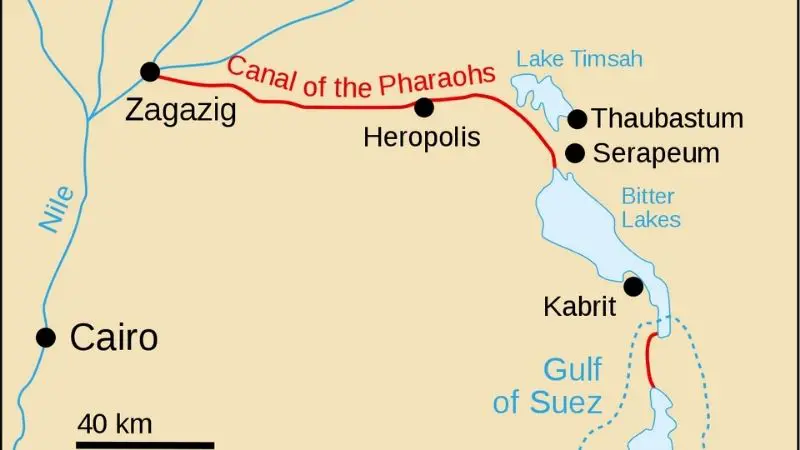
This earlier waterway is often called the Canal of the Pharaohs, Ancient Suez Canal, Pharaohs’ Canal or Nile–Red Sea Canal.
Instead of directly cutting a sea-to-sea line between the Mediterranean and Red Sea as the modern Suez Canal does, ancient systems generally linked branches of the Nile eastward through the Wadi Tumilat region toward the Bitter Lakes and Red Sea.
Which kingdom built a canal connecting the Nile to the Red Sea?
The history evolved over many periods rather than one single project.
Egyptian official historical accounts trace early ideas to Senusret III of the Twelfth Dynasty and later describe work associated with Necho II, Darius I, Ptolemy II, Roman authorities and Islamic rulers.
The chronology of the earliest phases is debated, however.
There is firmer evidence for the Persian king Darius I, whose administration developed a navigable Nile–Red Sea link through Wadi Tumilat and marked it with monumental canal stelae. Encyclopaedia Iranica describes a route from the Nile around Bubastis/Zagazig through Wadi Tumilat and the lake system toward the Red Sea.
Ancient canal versus modern Suez Canal
| Ancient Nile–Red Sea canals | Modern Suez Canal |
|---|---|
| Connected Nile system toward Red Sea | Directly connects Mediterranean and Red Sea |
| Routes and navigability changed over centuries | Continuous modern maritime route |
| Associated with multiple rulers | Built mainly 1859–1869 |
| Used for regional transport and trade | Designed for international seagoing shipping |
| Depended partly on changing Nile channels | Independent of Nile navigation |
This is one of the most interesting misconceptions around the Suez Canal.
The ancient Egyptians did not build the current 193.3-km canal thousands of years ago. What they and later rulers created were earlier canal systems demonstrating that eastern Egypt had been used as a water-transport corridor long before the 19th century.
How Was the Suez Canal Built?
Building the canal required excavating across desert terrain, depressions and lake areas without the earth-moving machinery available to modern megaprojects.
The first years were particularly labor-intensive.
Workers excavated sections manually, constructed freshwater infrastructure to support the work zones and gradually connected separate sections of the route.
Mechanical dredging later became far more important, accelerating excavation.
Water from the Mediterranean reached Lake Timsah in November 1862. By August 1869 the connected route had been established, and the formal inauguration followed three months later.
Why freshwater mattered
One of the project’s less glamorous but critical engineering problems was drinking water.
Thousands of workers were operating through an arid corridor without a reliable local freshwater supply.
Construction of freshwater channels connected to the Nile was therefore essential not only for settlement growth but for keeping the canal project functioning.
This helps explain why Ismailia became much more than a temporary construction camp.
How Long Is the Suez Canal?
The official Suez Canal Authority FAQ gives the canal’s current length as 193.30 kilometers, or roughly 120 miles.
The canal was shorter when it opened.
SCA development records list the original 1869 length at approximately 164 km, showing how extensions, bypasses and navigational improvements changed the route over time.
That is why older books sometimes give a different number from modern sources.
When answering “How long is the Suez Canal?” for current readers, 193.3 km is the appropriate official figure.
How Wide Is the Suez Canal?
There is no single width that accurately describes every section.
The Suez Canal Authority’s FAQ currently gives:
- 313 m for water-surface width
- approximately 200–210 m for the navigational channel
SCA’s detailed development tables also show section-dependent widths because the canal includes bends, bypasses, parallel sections and later enlargement work.
For travelers, the visual effect varies dramatically.
Some parts look surprisingly narrow beside a giant container ship, while the Bitter Lakes and duplicated sections feel much more open.
How Deep Is the Suez Canal?
The Suez Canal Authority lists the canal’s maximum water depth as 24 m.
Depth has increased substantially since 1869.
SCA records indicate that the original canal was only around 8 m deep. Increasing ship size repeatedly forced Egypt and earlier canal administrations to widen and deepen the channel.
Modern canal development should therefore be understood as a continuing process rather than a single “expansion.”
Does the Suez Canal Have Locks?
No. The Suez Canal does not use locks like the Panama Canal.
It is a sea-level canal.
Ships travel through the waterway without being raised or lowered through a staircase of lock chambers.
That gives the Suez Canal a fundamentally different operating design from Panama.
Suez Canal vs Panama Canal
| Feature | Suez Canal | Panama Canal |
|---|---|---|
| Main connection | Mediterranean–Red Sea | Atlantic–Pacific |
| General design | Sea-level canal | Lock canal |
| Locks | No | Yes |
| Ships raised above sea level | No | Yes |
| Main constraint | Channel dimensions, traffic management, navigation | Locks, channel dimensions, water supply and navigation |
The absence of locks does not mean ships simply enter and travel wherever they want.
Traffic is tightly managed by the Suez Canal Authority, pilots are normally required aboard transiting vessels, and ship movement is coordinated through convoys and available passing/duplicated sections.
How Does the Suez Canal Work?
A commercial transit is carefully managed rather than being comparable to driving through an open highway.
The Suez Canal Authority coordinates vessel arrival, pilotage, convoy organization, navigation and traffic control.
According to the SCA FAQ, a normal transit takes approximately 12 to 16 hours, and a canal pilot is compulsory for vessels except specified limited categories.
Why convoys are used
Large ships need safe spacing, pilot coordination and predictable traffic movement.
Although substantial portions of the canal now allow more flexible two-way operations, not every part behaves like a completely separate northbound and southbound motorway.
Lakes, bypasses and duplicated sections help vessels pass and reduce waiting.
What happens if a ship loses control?
Tugs, pilots, traffic control and salvage capabilities are part of the canal’s operational system.
The 2021 Ever Given incident showed why redundancy matters. A ship becoming immobilized across a sufficiently narrow single-channel section can disrupt traffic far beyond Egypt.
Subsequent southern-sector work has included an additional duplicated stretch and widening intended to improve navigation safety and emergency handling.
What Is the New Suez Canal?
The phrase New Suez Canal does not mean Egypt built a completely separate Mediterranean-to-Red-Sea canal.
It refers mainly to a major expansion project completed in 2015.
The project included:
- approximately 35 km of new parallel channel
- widening and deepening of additional bypass sections
- about 72 km of total project works at the time
The objective was to increase two-way navigation capacity and reduce delays.
Further development continued afterward.
In late 2024 and early 2025, the Suez Canal Authority announced a 10-km duplicated section around the Small Bitter Lakes and widening work elsewhere in the southern sector. SCA said the extra duplicated section extended the New Suez Canal’s doubled length from 72 km to 82 km and could add capacity for roughly six to eight vessels per day.
For a 2027 article, this distinction is important.
A page that ends its engineering story in 2015 is already incomplete.
Who Owns the Suez Canal Today?
The Suez Canal is fully owned by the Egyptian government.
The Suez Canal Authority explicitly states that the canal is completely owned by the Egyptian government and that no canal shares are traded on the stock market.
That answers a surprisingly common question:
Does Britain own part of the Suez Canal?
No.
Does France own the Suez Canal?
No.
Is it privately owned?
No.
Who runs the Suez Canal?
The Suez Canal Authority, or SCA.
The SCA describes itself as an independent public authority established in 1956. It manages, operates, maintains and develops the canal and issues its navigation rules.
Why Do People Think Britain or France Owns the Canal?
Because both countries played enormous historical roles in the canal company.
French investors were heavily involved in the original enterprise.
In 1875, facing serious financial problems, Khedive Ismail sold Egypt’s large shareholding to the British government.
Britain later occupied Egypt in 1882, while French commercial interests remained influential in the canal company.
For decades, control over the canal became inseparable from British imperial strategy because it provided a shorter maritime connection with British possessions and trade routes toward India and Asia.
That foreign-dominated era ended politically with Egypt’s nationalization of the Suez Canal Company in 1956.
What Happened When Egypt Nationalized the Suez Canal?
On 26 July 1956, Egyptian President Gamal Abdel Nasser nationalized the Suez Canal Company.
The nationalization decree transferred the company’s money, rights and obligations to the Egyptian state and provided for compensation to shareholders based on the previous Paris stock-market value.
The decision came amid tensions involving Egypt, Britain, France and the United States, including financing of the Aswan High Dam and the wider struggle over post-colonial influence in the Middle East.
Britain and France strongly opposed Nasser’s action.
In October 1956 Israel invaded Sinai. Britain and France subsequently intervened militarily.
International diplomatic pressure, including strong pressure from the United States and United Nations action, contributed to a ceasefire and withdrawal.
Why was the Suez Crisis historically important?
The crisis did not merely decide who administered a shipping channel.
It became a major moment in:
- Egyptian nationalism
- Arab politics
- decolonization
- the decline of British and French imperial power
- Cold War diplomacy
- the rise of Nasser’s regional influence
For travelers trying to understand modern Egypt, the Suez Crisis is as important politically as the canal’s construction is technologically.
Was the Suez Canal Ever Closed?
Yes.
The canal has been disrupted or closed at several points in its history.
The longest modern closure followed the June 1967 war.
Navigation stopped in 1967 and did not resume until 5 June 1975, after extensive clearance of mines, wreckage and other wartime hazards.
The SCA identifies this as the canal’s longest closure.
During those years, ships had to use alternative routes around Africa.
That period demonstrated a fundamental truth that remains relevant today: companies may depend heavily on Suez, but global shipping can reroute when military or security conditions make the canal corridor unattractive.
The trade-off is usually longer voyages and higher costs.
What Happened to the Ever Given in 2021?
On 23 March 2021, the giant container ship Ever Given ran aground in the southern part of the Suez Canal and became wedged across the waterway.
At roughly 400 m long, the vessel blocked traffic in both directions.
Salvage crews used dredging, tugboats and tidal conditions to refloat it. Navigation resumed on 29 March after approximately six days of disruption.
The incident became one of the most recognizable global news images of the decade because it made the canal’s importance visible in a single photograph: one enormous ship sitting diagonally between two sandy banks while hundreds of vessels waited.
Did the Ever Given cause the Suez Canal expansion?
No.
Egypt had already completed the major New Suez Canal project in 2015.
However, the blockage reinforced arguments for additional redundancy and improvements in the southern sector, where the grounding occurred. Later projects included widening and an additional duplicated stretch.
Is the Suez Canal Open in 2026—and What Could Change for 2027?
Yes. The Suez Canal remains operational.
In September 2026, the Suez Canal Authority reported that navigation was proceeding normally and that several major shipping services had begun returning after earlier Red Sea disruptions.
SCA also reported that net tonnage of container ships using the canal during January–August 2026 had increased 54.2% compared with the same period of 2025, reaching approximately 72.1 million net tons.
That should not be interpreted as proof that regional shipping has permanently normalized.
Security around the Red Sea and Bab el-Mandeb remained volatile in early October 2026, with renewed conflict affecting the southern Red Sea approaches.
For 2027, the most responsible conclusion is therefore:
The canal itself continues to operate, but the volume and mix of ships using it can change quickly depending on security conditions farther south in the Red Sea.
That is why an article updated for 2027 should not simply state a fixed daily ship count or assume all major shipping lines use Suez at the same rate.
Why Did Suez Canal Traffic Fall During the Red Sea Crisis?
The canal was not necessarily closed.
Instead, many shipping companies chose to avoid the southern Red Sea and Bab el-Mandeb because of attacks and geopolitical risk.
To reach Suez from the Indian Ocean, ships normally pass through the Bab el-Mandeb Strait between Yemen and the Horn of Africa.
If that approach becomes too risky, avoiding the Suez Canal may become part of a wider route diversion around the Cape of Good Hope.
UNCTAD reported that Suez tonnage was still about 70% below 2023 levels in May 2025, illustrating how dramatically route choice can change even when the canal itself remains available.
This is also why asking “Is the Suez Canal open?” and asking “Are ships using the Suez Canal normally?” are two different questions.
Can Tourists Visit the Suez Canal?
Yes, but visiting the Suez Canal is different from visiting an archaeological attraction.
You do not normally buy one ticket that gives unrestricted access to “the canal.”
It is a functioning strategic transport corridor covering almost 200 km.
A useful canal-focused trip is better built around:
- a canal city
- a museum or historical exhibition
- authorized/public waterfront areas
- modern and historic canal architecture
- an understanding of local security and photography rules
For most travelers, Ismailia provides the strongest educational experience.
Suez Canal Museum in Ismailia
The Suez Canal Museum is one of the best additions to a canal-focused itinerary.
The museum occupies a restored historical building originally constructed in the 1860s and associated with the company that administered construction of the canal.
The Suez Canal Authority announced a public soft opening in March 2024, stating that the museum contained around 2,000 artifacts and objects across 12 halls covering the canal’s history through different periods. Its official website continued to list museum activity and official visits during 2025 and 2026.
Expect the museum to provide much more context than simply standing beside the canal.
Themes include:
- ancient canal projects
- construction
- canal-company history
- historical documents
- engineering
- nationalization
- later development
- modern navigation
Because opening arrangements and visitor procedures can change, verify current hours and admission details directly before a 2027 visit rather than relying on an old travel blog.
The Suez Canal Historical Exhibition in Ismailia
The Suez Canal Authority also operates a Historical Exhibition in Ismailia.
It occupies a 19th-century building associated with early canal administration and contains photographs, scale models, documentary material and displays covering construction, inauguration, nationalization and development.
At the time of research, the official SCA page listed opening from 9:00 a.m. to 3:00 p.m., with Friday and Saturday as weekly holidays, and listed admission as free. Because these are visitor details that can change, confirm them again before travel in 2027.
For travelers who enjoy documentary history, it may be more informative than a quick canal-side photograph.
Is Port Said Worth Visiting for the Suez Canal?
Port Said is worthwhile if you want to see the canal in its wider Mediterranean context.
The city grew because of the canal and still reflects that maritime identity.
Its appeal differs from Ismailia.
Choose Port Said if you are interested in:
- the Mediterranean entrance
- port activity
- the canal’s relationship with international shipping
- 19th- and 20th-century urban history
- the Port Said/Port Fouad cityscape
Choose Ismailia if you are more interested in:
- museums
- canal-company history
- engineering
- Lake Timsah
- the Suez Canal Authority story
- a more concentrated historical interpretation
Neither should automatically replace Egypt’s major first-time attractions.
If your trip is already focused on northern Egypt, compare the canal region with Alexandria’s attractions before deciding which coastal-history experience better matches your interests.
Is Suez City Worth Visiting?
Suez is historically important because it anchors the canal’s southern end beside the Red Sea system.
It was also heavily affected by Egypt’s 20th-century wars.
For most first-time international tourists, however, Suez is usually less straightforward as a stand-alone sightseeing destination than Cairo, Alexandria or Luxor.
The value is strongest for travelers specifically interested in:
- military history
- maritime history
- the Gulf of Suez
- engineering
- modern Egyptian history
- the geography of the canal’s southern entrance
If your priority is the Red Sea as a holiday destination rather than canal engineering, Egypt Time Travel’s Red Sea guide is the more useful next step.
Can You Take Photos of the Suez Canal?
This is one area where travelers should be especially careful.
The Suez Canal is strategic infrastructure, and Egyptian photography rules around canals, bridges, military facilities and sensitive installations can be stricter than many visitors expect.
Australia’s official Smartraveller advice currently specifically warns that photographing bridges and canals, including the Suez Canal, is illegal, as is photographing military personnel, installations or equipment.
The practical rule for travelers is simple:
Do not assume that because you can see a ship or canal facility, you are permitted to photograph it.
Follow signs, guides, police and local authorities. Avoid drones entirely unless you possess the specific legal permissions required for their use in Egypt.
At museums and official visitor areas, ask before photographing displays or exterior canal infrastructure.
Is the Suez Canal Area Safe for Tourists in 2027?
There is no useful one-word answer because the canal extends through several governorates and security zones.
As of October 2026, government travel advisories distinguish between western canal cities and areas farther east toward Sinai.
For example, the UK FCDO advises against all but essential travel to parts of Ismailia Governorate east of the Suez Canal, while Australian advice applies a higher warning level to eastern Ismailia and advises against travel to North Sinai. Canadian guidance similarly identifies higher-risk areas east of the canal in parts of Port Said, Ismailia and Suez governorates.
This does not mean all canal cities are automatically prohibited tourist destinations.
It means travelers should avoid treating the canal as an informal road-trip corridor where they can cross bridges, checkpoints and desert roads without planning.
For a 2027 visit:
- check your own government’s Egypt travel advisory
- stay within established visitor areas
- use legitimate transportation
- carry identification
- expect checkpoints on some routes
- follow instructions immediately
- do not photograph sensitive infrastructure
- avoid attempting to enter restricted canal facilities
Security conditions can change much faster than historical information, so this is one section that should be reviewed whenever the article receives a meaningful update.
What Is the Best Time to Visit the Suez Canal Region?
For sightseeing rather than shipping, the cooler months are generally more comfortable.
October to April
This is usually the easiest period for walking around Ismailia, Port Said or waterfront areas.
Days tend to be more comfortable than midsummer, especially for travelers combining museums with outdoor sightseeing.
May to September
Visits are still possible, but heat and humidity can make long outdoor periods less appealing.
The canal cities can feel more humid than Upper Egyptian destinations such as Luxor and Aswan because of their proximity to large bodies of water.
For a dedicated canal history trip, weather matters less than museum hours, local access and security arrangements.
How Much Time Should You Spend at the Suez Canal?
For most travelers, one full day is enough to understand the canal at a meaningful level if the day is focused on Ismailia.
Two days work better if you want to combine Ismailia with Port Said.
Half day
Suitable only if you are already in the canal region.
Focus on one museum or historical exhibition plus a permitted public view.
One day
Best for history-focused travelers.
Use Ismailia as the center of the visit and combine:
- Suez Canal Museum
- historical exhibition if open
- canal-company architecture
- Lake Timsah/canal geography
- a legal viewing opportunity
Two days
Best for enthusiasts.
Day 1: Ismailia
Museum and canal history.
Day 2: Port Said
Mediterranean entrance and maritime city context.
Always confirm current route advisories before building a multi-city canal itinerary.
Should First-Time Visitors Add the Suez Canal to an Egypt Itinerary?
Not automatically.
This is one of the most important decisions generic travel articles rarely discuss.
Add the Suez Canal if you:
- love modern history
- are interested in geopolitics
- follow maritime trade
- enjoy engineering
- have already visited Egypt’s major ancient sites
- have at least 10–14 days in Egypt
- are staying in northern Egypt
- want to understand Egypt beyond pharaonic monuments
Skip it on a short first trip if you:
- have only five to seven days
- have not yet visited Giza
- have not explored Cairo
- are trying to fit Luxor and Aswan into the same trip
- mainly want Ancient Egyptian sites
- would be disappointed by a working waterway rather than a conventional attraction
For most first-time travelers, the main attractions in Cairo deserve priority before a dedicated Suez Canal day.
Once Cairo, Giza and the Nile Valley are covered, the canal becomes a much stronger second-trip or extended-itinerary addition.
Browse Egypt itineraries if you are deciding where an extra northern-Egypt day fits most logically.
Suez Canal vs Alexandria: Which Is Better for Travelers?
These destinations satisfy different interests.
| Choose the Suez Canal region if you prefer | Choose Alexandria if you prefer |
|---|---|
| Modern Egyptian history | Greco-Roman history |
| Engineering | Archaeology |
| Global shipping | Mediterranean culture |
| Geopolitics | Historic architecture |
| Nasser and the Suez Crisis | Alexander the Great and the Ptolemies |
| Canal museums | Catacombs, citadels and museums |
| Maritime infrastructure | A broader conventional city break |
If you have only one spare day after Cairo, Alexandria usually offers a larger concentration of conventional sightseeing.
If you already know Egypt well or specifically care about the 19th and 20th centuries, the canal can be more intellectually rewarding.
What Will You Actually See at the Suez Canal?
Do not expect the entire canal to look dramatic.
Much of it is a long, engineered waterway between flat sandy banks.
The scale becomes impressive when a huge container ship passes.
From certain viewpoints, a fully laden vessel can appear almost too large for the narrow ribbon of water beneath it.
Elsewhere, the Great Bitter Lake, Small Bitter Lake and Lake Timsah change the visual character entirely.
The experience is therefore less like visiting a monument and more like understanding a living geographic system.
The most compelling images combine:
- an enormous ship
- deep blue canal water
- pale desert
- service roads
- tugs
- navigation markers
- the almost perfectly linear engineered landscape
That visual contrast is one reason the Suez Canal works particularly well for Google Discover photography.
Common Suez Canal Misconceptions
“The Suez Canal is a natural river.”
False. It is an artificial maritime canal.
“The canal connects directly to the Nile.”
The modern Suez Canal does not.
Ancient canal systems linked the Nile toward the Red Sea, which is probably the source of some confusion.
“Ferdinand de Lesseps personally built the canal.”
He led and promoted the enterprise, but the canal required a large workforce, Egyptian resources, engineers, dredging crews and a corporate organization.
“Britain still owns the canal.”
False. The Egyptian state owns it, and the Suez Canal Authority manages it.
“The Suez Canal has locks.”
False.
It is a sea-level canal.
“The New Suez Canal is a second independent canal.”
Not exactly.
It is primarily a parallel and expanded section of the existing canal system rather than a separate sea-to-sea waterway.
“The Suez Canal is closed whenever Red Sea shipping declines.”
False.
A canal can remain operational while shipping companies voluntarily reroute because of security threats elsewhere in the Red Sea.
That distinction has been especially important since 2023.
Why the Suez Canal Matters to Egypt Beyond Shipping
The canal’s importance is not limited to toll revenue.
It helped create and shape entire cities.
Port Said expanded around the northern entrance.
Ismailia grew as an administrative and operational center.
Suez became strategically tied to Egypt’s maritime, military and industrial geography.
The canal corridor also influences roads, tunnels, bridges, ports, logistics zones, shipyards and industrial development.
Understanding that regional geography helps travelers see why “the Suez Canal” is not simply 193 km of water.
It is an economic and urban corridor linking Mediterranean Egypt with the Red Sea.
For broader trip planning, the Egypt travel guide helps place the canal region alongside Cairo, the Nile Valley, Alexandria and the Red Sea resorts.
The Suez Canal and Egypt’s National Identity
The canal has carried different meanings at different times.
In the 19th century it was promoted internationally as an engineering triumph.
For European powers it became a commercial and imperial artery.
For Egyptian workers it also represented difficult labor and unequal power.
Under British influence, the canal became closely associated with foreign control.
Nasser’s 1956 nationalization transformed it into a symbol of Egyptian sovereignty.
Its closure after 1967 connected it with war and displacement.
Its 1975 reopening under Anwar Sadat became a symbol of reconstruction.
The 2015 expansion was framed around development and future shipping capacity.
That changing meaning is why the canal deserves to be studied as history rather than merely measured in kilometers.
The Suez Canal in 2027: What Travelers Should Watch
Three things matter most.
1. Red Sea security
Regional security affects how many shipping lines choose the route even when the canal itself remains open.
As of October 2026, this remains the largest uncertainty surrounding 2027 shipping traffic.
2. Canal development
Southern-sector expansion and duplicated sections have continued changing the navigational system beyond the well-publicized 2015 project.
3. Visitor access
Museum hours, official visit procedures, photography rules and road-security arrangements can change.
Verify those immediately before a canal-focused trip rather than relying entirely on an article published months earlier.
A Practical Suez Canal Itinerary for History Lovers
For travelers with enough time, this is a more realistic approach than attempting to “drive the entire canal.”
Morning: Ismailia and the Suez Canal Museum
Start with the museum.
Understanding the chronology first makes everything outside easier to interpret.
Focus on:
- ancient canal precedents
- de Lesseps and the concessions
- construction
- inauguration
- nationalization
- war and closure
- reopening
- modern development
Midday: Historic Ismailia
Look at the urban landscape created around canal administration.
The city’s architecture and layout help explain that canal construction required permanent communities, offices and services—not simply excavation machinery.
Afternoon: Historical Exhibition
If operating and accessible on your travel date, use the Suez Canal Authority’s Historical Exhibition to deepen the 19th- and 20th-century story.
Late afternoon: Understand the canal landscape
Use only an authorized/public viewing area and follow local photography rules.
Seeing one large ship pass after learning the history is more meaningful than simply arriving at the bank without context.
Should You Book a Guided Suez Canal Visit?
A guide becomes especially useful here because much of the value is interpretive.
Without context, a visitor may simply see water, sand and ships.
A knowledgeable guide can explain:
- which section you are looking at
- why Ismailia exists
- where the original canal route ran
- how the Bitter Lakes fit into navigation
- what changed in 1956
- what happened between 1967 and 1975
- what the 2015 project actually added
- how current navigation differs from the original canal
A guide or organized vehicle can also make dealing with checkpoints and current access rules more straightforward.
If you’d prefer to add the canal to a longer Egypt journey, Egypt Time Travel can customize the itinerary around current access conditions, your travel dates and the rest of your Cairo or northern-Egypt program rather than forcing the canal into a standard first-time itinerary.
Frequently Asked Questions About the Suez Canal
What country is the Suez Canal in?
The Suez Canal is entirely in Egypt. It crosses the Isthmus of Suez between the Mediterranean Sea and Red Sea and separates mainland African Egypt from the Sinai Peninsula in Asia.
When was the Suez Canal built?
Construction began on 25 April 1859. The main excavation was completed in 1869, and the Suez Canal officially opened on 17 November 1869. The project took about ten years.
Who built the Suez Canal?
The modern canal was promoted by French diplomat Ferdinand de Lesseps and constructed under the Suez Canal Company, but Egyptian labor and Egyptian resources were fundamental to the project. It is inaccurate to credit a single person with physically “building” the canal.
Is the Suez Canal man-made?
Yes. The Suez Canal is an artificial sea-level waterway. It incorporates natural lake areas, but the maritime connection across the Isthmus of Suez was created through large-scale excavation and engineering.
How long is the Suez Canal?
The Suez Canal Authority currently lists the canal’s overall length as 193.3 km, approximately 120 miles.
How wide is the Suez Canal?
Width varies by section. The Suez Canal Authority FAQ lists a water-surface width of 313 m and navigational-channel width of roughly 200–210 m, while detailed engineering dimensions differ along different sections.
How deep is the Suez Canal?
The Suez Canal Authority lists the maximum water depth as 24 m. The canal has been repeatedly deepened since its 1869 opening to accommodate larger ships.
Who controls the Suez Canal today?
The Suez Canal Authority manages and operates the waterway. The canal itself is fully owned by the Egyptian government.
Does the Suez Canal have locks?
No. The Suez Canal is a sea-level waterway and does not require ships to pass through locks.
How long does it take a ship to cross the Suez Canal?
The Suez Canal Authority says a vessel normally takes approximately 12 to 16 hours to transit the canal. Actual operating circumstances can vary.
Why was the Suez Canal built?
The principal purpose was to create a shorter maritime connection between Europe and Asia by linking the Mediterranean Sea with the Red Sea and eliminating the need for many ships to sail around the Cape of Good Hope.
What was the Canal of the Pharaohs?
The Canal of the Pharaohs is a modern name for ancient waterways that connected the Nile system eastward toward the Red Sea. It was not identical to the modern Suez Canal. Different phases are associated with Egyptian, Persian, Ptolemaic, Roman and early Islamic rulers.
Conclusion: Is the Suez Canal Worth Understanding Before Visiting Egypt?
The Suez Canal is one of the best places to understand that Egypt’s importance did not end with the pharaohs.
A man-made waterway opened in 1869 transformed maritime geography, helped shape European imperial strategy, became a central symbol of Egyptian sovereignty in 1956, closed for eight years after the 1967 war, expanded for increasingly large ships and remains tied to the security of global trade today.
For a first seven-day Egypt trip, the canal will rarely outrank Giza, Cairo or the Nile Valley.
For travelers interested in engineering, geopolitics, modern Egyptian history or maritime trade, however, an Ismailia- or Port Said-focused visit can reveal a side of Egypt many itineraries never explain.
And that may be the most compelling fact about the Suez Canal in 2027: it is simultaneously a piece of history, an active Egyptian institution and a waterway whose importance becomes visible every time world shipping is forced to imagine life without it.
