
Quick Answer: What is the Necropolis of Saqqara in Egypt?
The Necropolis of Saqqara is an extensive ancient Egyptian burial ground approximately 40 kilometers southwest of Cairo, best known for the Step Pyramid of Djoser, Egypt’s earliest pyramid. Once the principal cemetery of Memphis, Saqqara contains royal pyramids, decorated tombs, underground burial galleries, and religious monuments spanning thousands of years. Visitors in 2027 can explore one of Egypt’s most historically important archaeological landscapes.
Saqqara is where some of the most important developments in Egyptian pyramid construction, funerary architecture, and burial traditions can be traced. Its monuments reveal how the ancient Egyptians transformed simple tombs into enormous stone structures, developed religious texts for the afterlife, and celebrated the lives of powerful officials through elaborate wall carvings.
Unlike the famous pyramids of Giza, Saqqara offers a wider chronological journey through Egyptian civilization. Here, an early royal pyramid stands near richly decorated mastabas, later royal tombs, New Kingdom memorial chapels, and underground galleries created for sacred bulls.
For travelers planning an Egypt itinerary in 2027, Saqqara offers more than a photograph of an ancient pyramid. It provides the historical background necessary to understand how Egypt’s monumental burial traditions developed and why those traditions remained important for thousands of years.
What Is Saqqara, and Why Is Its Necropolis Important?
Saqqara is an archaeological site and ancient cemetery associated with Memphis, one of the principal political and religious centers of ancient Egypt.
The word necropolis comes from Greek roots meaning “city of the dead.” Archaeologists use the term for an extensive burial area containing multiple tombs, cemeteries, monuments, and sometimes ritual buildings.
In ancient Egypt, a necropolis was more than a place to bury the deceased. It was a religious landscape where families and priests performed ceremonies, presented offerings, and maintained connections between the living and the dead.
The Saqqara Necropolis is particularly important because it preserves evidence of the evolution of Egyptian burial architecture.
Its archaeological remains include:
-
Early Dynastic tombs from the formative period of Egyptian civilization.
-
The Step Pyramid of Djoser from the Third Dynasty.
-
Royal pyramids from the Fifth and Sixth Dynasties.
-
Mastaba tombs belonging to nobles and high-ranking officials.
-
Religious inscriptions known as the Pyramid Texts.
-
New Kingdom temple-tombs associated with influential administrators.
-
The Serapeum, where sacred Apis bulls were buried.
-
Later monuments and evidence of continued religious activity.
These remains make Saqqara one of the most significant ancient Egyptian necropolises.
What Is a Necropolis in Ancient Egypt?
An ancient Egyptian necropolis was usually established outside a major settlement, often on the desert margin.
The Egyptians connected death with continued existence in the afterlife. Tombs were therefore designed to preserve the deceased person’s identity, provide a place for offerings, and support religious rituals believed to assist their transformation after death.
The western side of the Nile was frequently associated with funerary landscapes because the setting sun symbolized death and renewal. However, burial practices varied by region and historical period.
The Saqqara Necropolis demonstrates this religious geography particularly well. It occupied desert ground overlooking the agricultural lands and settlements associated with Memphis.
Other famous Egyptian necropolises include the Giza Necropolis, the royal burial landscape of Dahshur, and the Valley of the Kings near Luxor.
Saqqara is distinctive because it contains monuments from numerous periods rather than representing just one generation of royal tomb builders.
What Does the Name Saqqara Mean?
The origin of the name Saqqara is not completely certain.
One widely accepted explanation connects the name with Sokar, an ancient Egyptian funerary deity closely associated with the Memphite region.
Sokar became connected with Osiris and other religious traditions concerning death, transformation, and rebirth.
The site’s modern name therefore reflects an ancient religious association, although the exact linguistic development remains a subject of interpretation.
Saqqara, Sakkara, Sakara, and Saqqarah: Are They the Same Place?
Yes. Saqqara, Sakkara, Sakara, Saqqarah, and Saqara are common alternative Latin-alphabet spellings of the same archaeological area.
Travelers may encounter expressions such as Sakkara Necropolis, Sakara Pyramid, Sakkara Pyramids, or Saqqara Egypt in guidebooks, travel websites, and maps.
These variations exist because Arabic names can be transliterated into English in several ways.
Saqqara is the spelling most commonly used in contemporary English-language archaeological and tourism references.
When searching for the location or organizing transportation, use “Saqqara Necropolis” or “Step Pyramid of Djoser” to identify the intended destination.

Where Is Saqqara Located in Egypt?
The Saqqara Necropolis is in Giza Governorate, approximately 40 kilometers southwest of central Cairo, near the ancient city of Memphis.
The archaeological area occupies a limestone desert plateau above the Nile Valley.
Although Saqqara is commonly described as a Cairo attraction, it is not situated in central Cairo. Visitors must travel southwest through the greater metropolitan region and surrounding agricultural areas to reach the archaeological site.
The distance from the Giza Pyramids is shorter than the distance from many neighborhoods in eastern Cairo, making the two locations geographically convenient for travelers staying around Giza.
However, road conditions, hotel location, and traffic can substantially influence the actual journey.
Saqqara Location at a Glance
| Location or landmark | Relationship to Saqqara |
|---|---|
| Central Cairo | Approximately 40 km to the northeast, depending on the reference point |
| Giza Pyramids | Northeast of Saqqara |
| Ancient Memphis | In the nearby Nile Valley |
| Dahshur Necropolis | South of Saqqara |
| Abusir Pyramid Field | North of Saqqara |
| Nile River | East of the desert burial landscape |
Saqqara is part of a much larger archaeological region containing several pyramid fields.
Understanding this geography helps travelers appreciate why ancient Egyptian rulers repeatedly selected the western desert edge for their funerary monuments.
Why Was Saqqara Built Near Memphis?
Memphis was one of Egypt’s most influential ancient cities and a major center of royal administration, religious activity, and craftsmanship.
Its location near the junction of the Nile Valley and Delta helped establish its political importance.
The city’s principal deity, Ptah, was associated with creation and skilled craftsmanship.
Saqqara served as a major burial area for the rulers, officials, priests, and other individuals connected with Memphis.
The proximity between the living city and its desert cemetery allowed relatives and religious personnel to visit tombs, perform rituals, and maintain funerary cults.
Today, visitors can explore the remains of ancient Memphis alongside Saqqara to understand the relationship between the city of the living and the burial ground of the dead.

History of Saqqara: From Early Egyptian Tombs to Monumental Pyramids
The history of Saqqara reaches back to the beginning of Egypt’s dynastic civilization.
Its earliest cemeteries preserve evidence of powerful people living during the period when Egyptian kingship, administration, and religious traditions were becoming more established.
Over time, Saqqara developed into one of the most important royal and elite burial landscapes in Egypt.
The archaeological record shows important changes in architecture, religious beliefs, artistic traditions, and the relationship between rulers and their officials.
Early Dynastic Saqqara: Before the Pyramids
During the First and Second Dynasties, approximately the early third millennium BCE, important burials were established in the Saqqara region.
Large rectangular tombs known as mastabas appeared on the desert plateau.
These structures commonly contained an above-ground superstructure built of mudbrick and an underground burial area.
Some early tombs included storage spaces for objects that were intended to accompany the deceased.
Archaeologists have debated whether particular early Saqqara tombs belonged to kings or influential officials, especially when royal associations appear in tomb furnishings or inscriptions.
The important point is that substantial funerary architecture existed at Saqqara long before the first pyramid.
The mastaba tradition provided the architectural starting point for later developments.
The Third Dynasty: Djoser Changes Egyptian Architecture
During the Third Dynasty, usually dated to the 27th century BCE, King Djoser commissioned an extraordinary funerary complex.
Instead of following the traditional single-level mastaba design, his builders developed a structure consisting of multiple stacked levels.
The result was the Step Pyramid.
Traditionally associated with Imhotep, the monument introduced monumental stone architecture on an unprecedented scale in Egypt.
Its surrounding structures included ceremonial courtyards, chapels, gateways, and carefully arranged ritual spaces.
The entire complex became an architectural expression of royal power and the king’s hoped-for existence after death.
Fourth Dynasty: The Development of True Pyramids
Djoser’s pyramid was a major step toward the smooth-sided pyramids that became famous during the Fourth Dynasty.
Later builders experimented with increasingly sophisticated pyramid designs.
King Sneferu’s monuments at Dahshur, particularly the Bent Pyramid and Red Pyramid, demonstrate important stages in this process.
These developments helped establish the architectural techniques used for the Great Pyramid of Khufu at Giza.
For travelers interested in how pyramid building evolved, Saqqara and Dahshur Necropolis complement each other particularly well.
Saqqara illustrates the beginning of monumental pyramid construction, while Dahshur displays crucial innovations in creating the smooth-sided form.
Fifth and Sixth Dynasties: A New Religious Emphasis
Royal pyramid building continued at Saqqara during the later Old Kingdom.
These monuments were often smaller than the largest Fourth Dynasty pyramids, but their interiors and surrounding burial complexes became increasingly significant.
The Pyramid of Unas is particularly important because it preserves the earliest known example of the Pyramid Texts inside a royal pyramid.
The Pyramid of Teti contains further examples of these religious inscriptions.
At the same time, officials such as Mereruka and Kagemni received elaborate burial monuments.
The decoration of these tombs reveals important aspects of administration, agriculture, social hierarchy, ritual practice, and elite family life.
To understand the wider political and architectural setting, explore the Old Kingdom of Egypt.
New Kingdom Saqqara: Tombs for Powerful Officials
Saqqara remained important long after the Old Kingdom.
During the New Kingdom, roughly 1550–1069 BCE, high-ranking officials built tomb complexes here.
These monuments often differed from earlier mastaba tombs.
Some resembled small temples with courtyards, decorated walls, and chapels used for offerings and remembrance.
Among the most historically significant individuals associated with this cemetery were Horemheb, who became pharaoh, and Maya, a senior official during Tutankhamun’s reign.
Their monuments demonstrate how Saqqara continued to serve influential individuals even when Egypt’s main royal burial traditions had shifted to other regions.
Late Period, Ptolemaic, and Coptic Saqqara
The necropolis remained active through later phases of Egyptian history.
Animal burials became especially important in certain areas, reflecting changing religious practices and the continuing significance of sacred animals.
The Serapeum preserves evidence of the elaborate funerary treatment given to Apis bulls.
Catacombs and other burial areas also demonstrate continued religious activity during the Late and Ptolemaic periods.
Saqqara’s later history includes Christian occupation, represented by the remains of the Monastery of Apa Jeremiah.
This long sequence is one reason the Saqqara archaeological site offers such a remarkable perspective on Egyptian history: its monuments do not belong to a single century or even a single millennium.
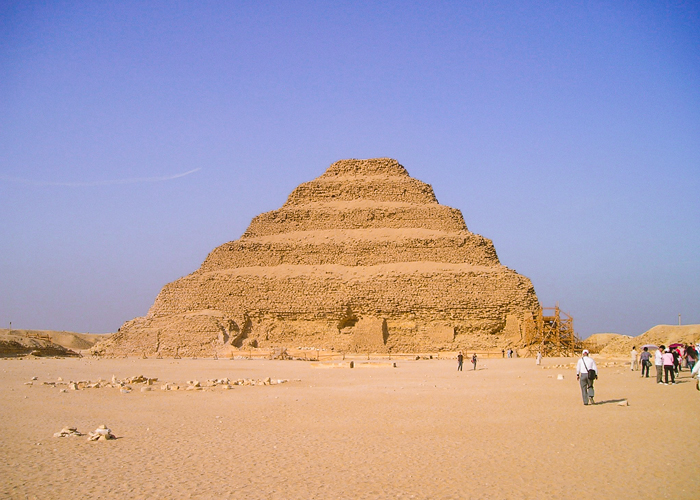
The Step Pyramid of Djoser: Saqqara’s Most Famous Monument
The Step Pyramid of Djoser is the central attraction of Saqqara and one of the most historically important monuments in Egypt.
Built during the Third Dynasty, it represents the transformation of the traditional mastaba into a monumental stepped stone pyramid.
The pyramid originally rose approximately 60 meters above the surrounding plateau.
Its distinctive form consists of six progressively smaller levels.
Unlike the smooth-sided pyramids of Giza, Djoser’s pyramid makes its layered construction visually apparent.
This architectural form provides a striking illustration of the development of Egyptian royal tomb design.
Who Built the Step Pyramid of Saqqara?
The Step Pyramid was commissioned for King Djoser, also known by the royal name Netjerykhet.
Its design is traditionally credited to Imhotep, an important official remembered for his association with architecture, scholarship, and religious traditions.
Although the precise details of his contribution cannot be reconstructed with certainty, ancient Egyptian tradition strongly connected Imhotep with Djoser’s reign and monumental building program.
In later periods, Imhotep gained an extraordinary religious reputation and eventually received divine honors.
For a deeper explanation of the monument’s structure and significance, see the Pyramid of Djoser guide.
How Was the Step Pyramid Constructed?
The Step Pyramid was not necessarily conceived in its final six-level form from the beginning.
Archaeological study indicates that its design developed through several building stages.
The original structure began as a mastaba-like monument.
Successive extensions and modifications transformed it into a much taller stepped pyramid.
This progressive construction helps explain why Saqqara is so important to the history of architecture.
The builders were adapting familiar tomb forms while working on a much greater scale and experimenting with the structural possibilities of stone.
Stone construction itself was not invented at Saqqara, but the Djoser complex represents a crucial advance in its large-scale monumental use.
What Is Inside the Step Pyramid?
Below the Step Pyramid lies an extensive underground system of passages, shafts, and burial spaces.
The royal burial chamber is located deep beneath the structure.
Other underground chambers and galleries demonstrate the complexity of Djoser’s funerary arrangements.
Some spaces originally featured decorative elements, including blue faience tiles associated with royal palace architecture.
These underground features reflect the importance of providing the deceased king with an enduring ritual environment.
Not every underground area is accessible to tourists.
Visitor routes are controlled for conservation and safety, and entry to the pyramid’s interior may require an additional ticket.
Travelers should confirm the permitted route before purchasing access.
Can Visitors Enter the Pyramid of Djoser in 2027?
Interior access has been offered following major restoration work, but availability may change because of conservation requirements or operational restrictions.
When permitted, visitors follow designated routes rather than exploring the complete network of ancient passages.
Underground spaces can involve steps, confined areas, uneven surfaces, and conditions that may be uncomfortable for visitors with mobility difficulties or claustrophobia.
The exterior of the pyramid remains the essential experience for most first-time visitors.
If interior access is important to your itinerary, verify its availability and specific ticket before your visit.
The Djoser Pyramid Complex: What Surrounds the First Pyramid?
The Step Pyramid is only one component of a much larger ceremonial and funerary landscape.
Its surrounding enclosure contained structures that reflected aspects of royal authority, palace architecture, religious festivals, and the king’s relationship with the gods.
The complex was intended to serve the deceased ruler beyond his lifetime.
Today, the surviving architectural elements help explain how ancient Egyptian builders thought about the symbolic environment of kingship.
The Entrance Colonnade
The entrance colonnade is among the most recognizable features of Djoser’s complex.
Its stone columns have forms inspired by bundled plant stalks, demonstrating how builders translated traditional architectural shapes into limestone.
Walking through this passage provides an unusually direct encounter with early monumental Egyptian design.
The closely spaced columns and carefully arranged corridor create a dramatic transition into the ceremonial spaces beyond.
The Great Court
The large courtyard south of the Step Pyramid formed an important part of the royal complex.
Its open space emphasizes the scale of the monument and the deliberate arrangement of the surrounding architectural features.
The court is also valuable for understanding how ceremonial spaces were integrated into Egyptian royal tomb complexes.
Rather than thinking of the pyramid as an isolated stone monument, visitors should consider the entire enclosure as a designed religious environment.
The Heb-Sed Festival Structures
The Heb-Sed, or Sed Festival, was associated with the renewal and reaffirmation of royal power.
Djoser’s complex contains ceremonial buildings and symbolic structures connected with this royal festival tradition.
These features suggest that the king’s funerary complex was designed to support the eternal renewal of kingship.
For visitors, they reveal that ancient Egyptian pyramids were connected with sophisticated religious ideas rather than simply being enormous containers for royal burials.
The South Tomb
The South Tomb is an additional subterranean monument within Djoser’s enclosure.
Its purpose has been interpreted in different ways, and it should not be described as a second confirmed burial place for Djoser.
The monument has ritual and symbolic associations with the wider complex.
Its underground architecture is especially interesting to travelers studying the relationship between royal burial spaces and ceremonial monuments.
Access is separate from the general experience of walking around the Step Pyramid, and visitors should verify ticketing and opening arrangements.
The Enclosure Wall
Djoser’s complex was surrounded by an extensive limestone enclosure wall.
The wall featured carefully designed recesses and architectural details that echoed forms associated with early Egyptian royal buildings.
Its scale reinforces the extraordinary ambition of the project.
The enclosure was not simply a practical boundary. It helped define a sacred royal space separated from the surrounding necropolis.
Other Important Pyramids at Saqqara
The Step Pyramid receives most of the attention, but the Saqqara plateau contains several additional royal pyramid complexes.
These monuments reveal how burial architecture evolved after Djoser.
Some preserve important inscriptions, while others are historically significant because of their construction methods, surrounding temples, or association with influential kings.
Not every pyramid is regularly accessible to visitors, and some appear today as low mounds rather than recognizable pyramid shapes.
Pyramid of Unas: The Birthplace of the Pyramid Texts
The Pyramid of Unas, also known as Wenis, belongs to the end of the Fifth Dynasty.
Its exterior is much smaller and less imposing than Djoser’s Step Pyramid.
Its historical importance lies primarily beneath the surface.
The interior contains the earliest known example of the Pyramid Texts inscribed inside a royal pyramid.
These inscriptions consist of religious formulas, declarations, and ritual texts intended to help the deceased king reach the afterlife.
Their appearance represents a major development in the surviving written evidence for Egyptian royal funerary beliefs.
The hieroglyphic columns were arranged across the walls of the burial spaces, creating a sacred textual environment.
For anyone interested in the relationship between religion and writing, the Pyramid of Unas is one of Saqqara’s most important monuments.
Visitor advice: If the interior is open, this pyramid deserves serious consideration. Its significance is not obvious from the exterior, so understanding the Pyramid Texts beforehand greatly improves the experience.
Pyramid of Teti: A Royal Tomb with a Surprising Interior
Teti was the first ruler of the Sixth Dynasty.
His pyramid complex was constructed near other important Old Kingdom monuments.
The pyramid originally had a more recognizable geometric form, but the removal of its casing stones and damage to its core substantially changed its appearance.
Today, the exterior resembles a mound of rubble more than a perfectly preserved pyramid.
The interior, however, preserves important features.
Its burial chamber includes a ceiling decorated with stars, reflecting the celestial symbolism of Egyptian royal funerary religion.
The chamber walls contain Pyramid Texts intended to support the king’s transformation after death.
The contrast between the damaged exterior and the sophisticated surviving interior is one of the most interesting features of the monument.
Pyramid of Userkaf
Userkaf, the first ruler of the Fifth Dynasty, constructed his pyramid complex near Djoser’s monuments.
His pyramid is not as visually striking today as the Step Pyramid.
Nevertheless, its location demonstrates the continuing prestige of Saqqara as a royal burial ground.
The complex also illustrates changes in Old Kingdom pyramid building and the relationship between royal funerary architecture and other religious institutions.
Visitors interested primarily in monumental scenery may focus on Djoser, but those studying the sequence of royal architecture can gain valuable historical context from Userkaf.
The Unfinished Pyramid of Sekhemkhet
The unfinished pyramid associated with King Sekhemkhet is another important Third Dynasty monument.
Its remains show that other royal building projects followed Djoser’s architectural innovations.
Because construction did not reach the intended height, the surviving structure differs dramatically from the completed Step Pyramid.
It is often described as an unfinished or buried pyramid.
The monument illustrates that the evolution of Egyptian pyramid architecture was not a simple, uninterrupted progression.
Political circumstances, royal reign lengths, construction decisions, and other factors influenced what was completed.
This area is not necessarily included in ordinary tourist routes.
Pyramids of Pepi I and Pepi II
The southern part of the Saqqara region contains pyramids and funerary monuments associated with later Sixth Dynasty rulers.
The complexes of Pepi I and Pepi II provide further evidence of royal burial traditions near the end of the Old Kingdom.
Their surviving architecture and inscriptions contribute to our understanding of the development of pyramid complexes.
These monuments are particularly relevant to archaeological specialists and travelers arranging a more comprehensive exploration of Saqqara.
However, they should not automatically be treated as attractions open to ordinary visitors.
Access depends on the specific location, archaeological work, and applicable permissions.
What Makes the Pyramids of Saqqara Different?
| Pyramid | Historical period | Main significance | What travelers should understand |
|---|---|---|---|
| Djoser | Third Dynasty | Early monumental stone pyramid | Origin of the stepped royal pyramid |
| Userkaf | Fifth Dynasty | Continued royal use of Saqqara | Changes in pyramid traditions |
| Unas | Fifth Dynasty | Earliest known Pyramid Texts in a pyramid | Development of funerary inscriptions |
| Teti | Sixth Dynasty | Pyramid Texts and decorated burial chamber | Religious meaning of the pyramid interior |
| Sekhemkhet | Third Dynasty | Unfinished pyramid project | Early architectural experimentation |
| Pepi I and Pepi II | Sixth Dynasty | Later Old Kingdom pyramid complexes | Continuity of royal funerary traditions |
Important: The table describes archaeological significance, not a guaranteed list of monuments open for tourist entry.
For most visitors, Djoser is the essential landmark, while Unas and Teti add substantial historical depth when accessible.
Saqqara Tombs: What Can You See Beyond the Pyramids?
The tombs of Saqqara are among the site’s most rewarding attractions.
Many travelers arrive primarily to see the Step Pyramid but discover that the decorated mastaba tombs reveal even more about everyday life in Ancient Egypt.
Whereas royal pyramids emphasize kingship, monumental power, and the afterlife, elite tombs frequently contain scenes depicting agriculture, hunting, fishing, craftsmanship, food production, offerings, and family relationships.
These images were not simply decorative.
They formed part of a religious system intended to provide the deceased with the resources and activities necessary for continued existence.
Tomb of Mereruka: A Glimpse into Old Kingdom Society
Mereruka was a high-ranking official and vizier during the Sixth Dynasty.
He was connected to the royal family through marriage to a daughter of King Teti.
His elaborate mastaba contains approximately 30 rooms, including areas associated with members of his family.
The scale of the tomb reflects Mereruka’s political importance.
Its carved scenes represent activities such as fishing, hunting, herding, and food preparation.
Some images feature animals and agricultural activities with remarkable attention to detail.
One especially memorable architectural feature is the life-size representation of Mereruka associated with the tomb’s offering space.
The tomb offers an exceptional opportunity to study the relationship between Egyptian art, elite status, religious beliefs, and representations of daily life.
Best for: Visitors who want to understand Egyptian civilization beyond the achievements of its kings.
Tomb of Kagemni: Detailed Scenes of Ancient Life
Kagemni was another important official associated with the early Sixth Dynasty.
His tomb is known for carefully carved reliefs depicting scenes from the natural world and agricultural life.
These include activities and animals represented with striking observational detail.
Fish, birds, livestock, and other elements of daily existence appear within a funerary context.
The scenes were selected as part of the symbolic program of the tomb rather than being a neutral documentary record.
Nevertheless, they provide valuable information about the activities that ancient Egyptian artists considered appropriate to represent.
Kagemni’s tomb is an excellent example of why the Saqqara tombs deserve time and attention.
Tomb of Ti: Craftsmanship and Everyday Activities
Ti was an important official of the Fifth Dynasty.
His mastaba is especially famous for its relief decoration.
The scenes include agricultural activities, food production, boating, and work associated with the Nile environment.
These compositions are valuable because they show how artists represented coordinated labor, natural resources, and the economic life of ancient Egypt.
Visitors can observe the organization of figures into registers and the careful arrangement of individual scenes.
The tomb also demonstrates the high technical standard of Old Kingdom relief carving.
Tomb of Ptahhotep
Ptahhotep was a senior official associated with the Fifth Dynasty.
His name is also familiar from the ancient Egyptian wisdom literature traditionally attributed to a figure of that name.
The tomb’s decoration includes scenes relevant to elite life, agriculture, and the presentation of offerings.
Its architectural and artistic features offer further evidence of the sophistication of Old Kingdom nonroyal burial monuments.
Travelers interested in Egyptian administration and ethical traditions may find Ptahhotep particularly interesting.
However, the relationship between the historical official and the authorship of the literary work should not be treated as fully established.
Tomb of Mehu
The tomb of Mehu belongs to the Sixth Dynasty and is associated with an important official.
Its reliefs present scenes of daily activities, nature, and funerary ritual.
The tomb is another example of how Egypt’s elite used carefully designed burial chapels to preserve their identity and status.
Where accessible, Mehu provides a valuable complement to the more famous mastabas of Mereruka and Kagemni.
New Kingdom Tomb of Horemheb
Horemheb was a powerful military commander before becoming pharaoh at the end of the Eighteenth Dynasty.
During his earlier career, he commissioned a tomb at Saqqara.
After becoming king, Horemheb was ultimately buried in the Valley of the Kings.
His Saqqara monument therefore reflects the period before his accession to the throne.
Its architectural form differs from Old Kingdom mastabas, resembling a temple with ceremonial spaces and a chapel.
The surviving reliefs include scenes associated with his official position and his relationship with the royal court.
The tomb offers an unusual connection between the Memphite elite cemetery and the political world of the late Eighteenth Dynasty.
Tomb of Maya
Maya was an important administrator during the reign of Tutankhamun.
He served in a senior financial position and was involved in royal administration.
His Saqqara tomb belongs to the New Kingdom cemetery.
Like several other monuments in this area, it combines funerary symbolism with architectural features resembling contemporary temples.
The tomb is relevant to visitors interested in the administrative world surrounding Tutankhamun and the decades following the Amarna Period.
It also helps demonstrate that the Saqqara Necropolis remained important long after the principal royal tombs had shifted to other regions.
How Do You Choose Which Saqqara Tombs to Visit?
Not every traveler needs to enter every available tomb.
The best choice depends on personal interests and time.
| Traveler interest | Recommended priority | Main reason |
|---|---|---|
| Daily life in Ancient Egypt | Mereruka or Kagemni | Agricultural and natural-world reliefs |
| Fine Old Kingdom art | Ti or Ptahhotep | Detailed tomb decoration |
| Egyptian administration | Mereruka and Maya | Powerful officials and royal connections |
| New Kingdom history | Horemheb | Military and political history |
| Religious symbolism | Unas or Teti pyramid interiors | Pyramid Texts and funerary ideas |
| First visit with limited time | One richly decorated mastaba | Strong introduction without exhausting the schedule |
A practical approach is to choose one or two well-preserved tombs that offer different experiences.
Ask which are open on the day rather than designing an itinerary around monuments that may be temporarily closed.
The Serapeum of Saqqara: Underground Tombs of the Sacred Apis Bulls
The Serapeum is one of the most unusual monuments in the Saqqara Necropolis.
Unlike royal pyramids and human tombs, the Serapeum was used for the burial of sacred Apis bulls.
These animals were associated with Ptah, the important Memphite deity connected with creation and craftsmanship.
The Apis bull was considered a living manifestation of the deity.
When an Apis bull died, it could receive elaborate funerary treatment, including mummification and ceremonial burial.
Its successor was identified through established religious traditions.
What Is Inside the Serapeum?
The monument contains underground corridors and burial chambers.
Large stone sarcophagi occupy spaces within the galleries.
Their enormous scale is one of the most memorable aspects of the monument.
The experience differs considerably from visiting a pyramid exterior.
Inside the Serapeum, travelers encounter a carefully constructed subterranean environment dedicated to sacred-animal burial.
The site offers valuable insight into the intersection of religion, monumental engineering, and ritual practice.
Who Built the Serapeum?
The Serapeum developed over an extended period rather than being the work of a single ruler.
Its history reaches back to the New Kingdom, with later additions and use continuing into the Ptolemaic era.
The priesthood and royal authorities played important roles in the religious practices associated with the Apis cult.
Prince Khaemwaset, a son of Ramesses II, is among the historical figures associated with activity at the Serapeum.
He is especially interesting because of his involvement with ancient monuments and religious institutions.
Is the Serapeum Worth Visiting?
Yes, especially for travelers interested in Egyptian religion, sacred animals, and underground monuments.
Its appeal comes from the extraordinary relationship between the scale of the galleries and the religious significance of the animals buried there.
It is less suitable for travelers who dislike confined underground spaces.
Access and ticket arrangements should be checked beforehand, particularly because official descriptions of inclusive ticket coverage may differ.
The Imhotep Museum at Saqqara
The Imhotep Museum provides important archaeological context for the wider Saqqara site.
Named after the famous official associated with Djoser’s Step Pyramid, it displays objects connected with different phases of Saqqara’s long history.
The museum helps visitors understand the people who built, decorated, used, and later studied the necropolis.
Its collections include artifacts and archaeological material that complement the surviving monuments outside.
What Can Visitors Learn at the Museum?
Museum displays can help explain:
-
Architectural developments during the Old Kingdom.
-
The use of objects in Egyptian funerary rituals.
-
Artistic and religious traditions associated with Saqqara.
-
Archaeological discoveries made in the surrounding area.
-
The work of researchers and conservators who have investigated the necropolis.
Objects that might seem difficult to interpret at their original findspots often become more understandable when displayed with archaeological explanations.
Is the Imhotep Museum Open?
The museum reopened following a development and rehabilitation project completed in 2025.
Improvements included exhibition and visitor facilities, with greater attention to accessibility and visitor circulation.
For 2027, travelers should still confirm operating arrangements and whether the museum is included with their chosen Saqqara admission ticket.
Practical recommendation: Consider visiting the museum near the beginning of your tour for historical orientation or at the end to consolidate what you have learned.
Ancient Egyptian Burial Practices at Saqqara
The Saqqara Necropolis offers an unusually broad perspective on the beliefs that shaped Egyptian funerary architecture.
Ancient Egyptians generally believed that death did not necessarily mean the end of personal existence.
Preserving identity, maintaining ritual offerings, and preparing for the afterlife were important concerns in many periods of Egyptian history.
These beliefs changed over time and differed according to social status.
Saqqara preserves evidence of several stages in that development.
What Is a Mastaba Tomb?
A mastaba is a rectangular funerary structure with a generally flat roof and sloping sides.
Many examples were built above underground burial chambers.
The visible superstructure could contain rooms or chapels where offerings were presented.
Mastabas are important because they predate and overlap with the development of royal pyramids.
The Step Pyramid of Djoser evolved from architectural ideas associated with earlier mastaba designs.
Understanding this connection helps explain the broader sequence of Egyptian monumental tomb construction.
Why Were Tomb Walls Decorated?
Tomb decoration had religious as well as social purposes.
Scenes depicting food, animals, agriculture, ceremonies, and family life helped express the ideal existence that the deceased hoped to maintain.
Images could also communicate wealth, occupation, status, and relationships with the royal administration.
The decoration was therefore more than an artistic record of ordinary activities.
It formed part of a symbolic environment designed to support the deceased.
What Is a False Door?
A false door is a carved architectural feature commonly found in ancient Egyptian tomb chapels.
It resembles a doorway but does not function as a normal passage.
In funerary belief, the false door was associated with communication between the world of the living and the deceased.
Offerings could be placed before it as part of the tomb cult.
False doors often included names, titles, and other information identifying the tomb owner.
They are among the most meaningful features to examine inside Saqqara’s mastabas.
Why Were Food and Animals Shown in Tombs?
Agricultural abundance was closely connected with the ideal afterlife.
Tomb artists depicted grain production, livestock, fishing, hunting, baking, and other activities that represented prosperity and the resources necessary for continued existence.
The images were selected and arranged according to artistic and religious conventions.
Consequently, they should not be interpreted as photographs of ancient daily life.
They nevertheless preserve valuable evidence concerning tools, activities, social roles, animals, and cultural ideals.
What Are the Pyramid Texts?
The Pyramid Texts are collections of ancient Egyptian religious inscriptions associated with royal funerary practices.
They include recitations, protective formulas, and passages concerning the king’s transformation and journey beyond death.
The earliest surviving examples inside a pyramid are found in the Pyramid of Unas at Saqqara.
Later royal monuments continued the tradition.
These inscriptions are essential to understanding ancient Egyptian religious thought because they preserve beliefs about the sky, the gods, the deceased king, and the afterlife.
They also represent an important stage in the history of funerary literature.
Saqqara’s UNESCO World Heritage Significance
Saqqara forms part of the UNESCO World Heritage property officially named “Memphis and its Necropolis – the Pyramid Fields from Giza to Dahshur.”
The property was inscribed on the World Heritage List in 1979.
It includes a much larger funerary landscape than Saqqara alone.
The archaeological region contains pyramid complexes, rock-cut tombs, mastabas, temples, and other monuments associated with ancient Memphis.
Its importance lies partly in the extraordinary evidence it preserves for the development of monumental Egyptian funerary architecture.
Saqqara’s Step Pyramid represents an early achievement in large-scale stone building, while later monuments across the broader pyramid fields demonstrate subsequent innovations.
Is Saqqara a Separate UNESCO World Heritage Site?
No. Saqqara is included within the larger Memphis and its Necropolis World Heritage property.
It is not listed as an entirely separate World Heritage inscription.
This distinction matters because travelers often see Saqqara described as a UNESCO site without an explanation of its relationship with the wider archaeological landscape.
The designation recognizes the outstanding importance of the connected monuments associated with Memphis and the pyramid fields.
Why Is Saqqara Important to Archaeologists Today?
Saqqara contains archaeological evidence from many different periods.
Excavations have revealed burial shafts, coffins, inscriptions, tomb structures, architectural remains, and religious objects.
Different parts of the necropolis provide evidence about specific historical questions.
Old Kingdom mastabas inform research into elite administration and artistic conventions.
Royal pyramids preserve information about architecture and funerary belief.
New Kingdom tombs provide evidence of powerful officials and changing memorial traditions.
Later animal cemeteries illuminate religious practices that became especially prominent in subsequent periods.
Because the archaeological area is extensive, not all its remains have been fully investigated.
Saqqara remains an active subject of archaeological research and conservation.
Saqqara Archaeological Discoveries: What Makes the Site So Remarkable?
Saqqara has attracted significant attention in recent years because of discoveries involving coffins, burial shafts, mummies, religious objects, and decorated tombs.
Such finds reinforce the importance of the area as a long-lived burial landscape.
However, archaeological discoveries should be understood within their historical and scientific context.
A newly excavated coffin, for example, may belong to a much later period than the Step Pyramid.
Discoveries from different centuries or dynasties should not be presented as evidence of one single burial event.
Why Are Archaeologists Still Finding Tombs at Saqqara?
The necropolis occupies an extensive area that was used repeatedly over thousands of years.
Burial grounds expanded, older monuments were reused or modified, and new cemeteries developed in different locations.
Sand accumulation and later construction also affected the visibility of ancient remains.
These conditions help explain why important archaeological evidence can survive beneath the modern surface.
Advances in archaeological recording, conservation, and scientific analysis also allow researchers to extract information from material that earlier excavations could not study in the same way.
Are All Newly Discovered Tombs Open to Tourists?
No.
Archaeological discoveries do not automatically become public attractions.
Newly identified areas may require investigation, documentation, stabilization, conservation, and safety assessments.
Some remains are fragile, inaccessible, or unsuitable for public entry.
Visitors planning a trip specifically around a recent discovery should verify whether that location has actually opened to tourists.
An exciting archaeological announcement should never be confused with confirmation of public access.
Can Visitors See Archaeologists Working?
Saqqara is an active archaeological landscape, but research work is not a guaranteed visitor experience.
Excavation activity depends on project schedules, permits, conservation priorities, staffing, and other operational factors.
Some projects take place in restricted areas away from ordinary visitor routes.
Travelers should respect barriers and avoid approaching archaeological teams or entering working areas without permission.
Visiting the Necropolis of Saqqara in 2027: Essential Information
Saqqara is best experienced as a large archaeological landscape rather than a single monument.
Planning the visit carefully makes a considerable difference.
The monuments are spread across a desert area, and some of the most interesting tombs and underground galleries are not immediately beside the Step Pyramid.
A realistic itinerary should therefore consider available time, transportation, ticket categories, individual monument access, and weather conditions.
Saqqara Visitor Information
| Question | Practical answer |
|---|---|
| Where is Saqqara? | Approximately 40 km southwest of central Cairo |
| What is the main attraction? | The Step Pyramid of Djoser |
| How long should visitors spend? | Approximately 2–4 hours for a normal visit |
| Can you enter pyramids? | Some interiors may be accessible with the appropriate ticket |
| Are there separate tomb tickets? | Yes, certain tombs and monuments have additional admission categories |
| Is Saqqara suitable for children? | Yes, with realistic walking expectations and appropriate supervision |
| Is a guide worthwhile? | Particularly useful for historical interpretation |
| Can Saqqara be combined with Dahshur? | Yes, commonly on a full-day itinerary |
| Is every tomb open? | No, access can vary |
| Are 2027 fees confirmed? | Travelers must reconfirm official prices for their dates |
Saqqara Opening Hours
The Ministry of Tourism and Antiquities currently lists the Saqqara archaeological site as operating daily from 8:00 a.m. to 4:00 p.m.
Other official monument listings may show different operating or last-admission times for individual locations.
Ramadan arrangements and special operating schedules may also differ.
Therefore, visitors should not assume that every tomb remains accessible until the site’s general closing time.
For a comfortable visit, arrive in the morning.
If your itinerary includes multiple tombs or underground monuments, start early enough to allow for separate ticket checks and possible restrictions.
2027 planning note: Confirm opening times again shortly before traveling. The hours above reflect available official information checked in October 2026, not a guarantee for every date in 2027.
Saqqara Entrance Fees and Ticket Prices for 2027 Planning
Entrance fees are one of the most important practical details to understand before visiting Saqqara.
The site uses different ticket categories, and the main archaeological-area ticket should not be assumed to include every interior, tomb, or underground monument.
The Egyptian Ministry of Tourism and Antiquities publishes admission categories for foreign adults and qualifying students.
The following amounts are based on its published information available in October 2026.
They are a planning reference, not confirmed 2027 prices.
Saqqara Ticket Price Reference
| Ticket category | Foreign adult | Foreign student |
|---|---|---|
| Saqqara archaeological area | EGP 600 | EGP 300 |
| Nobles’ tombs and New Kingdom tombs category | EGP 400 | EGP 200 |
| Tomb of Mereruka | EGP 200 | EGP 100 |
| Step Pyramid of Djoser interior | EGP 280 | EGP 140 |
| South Tomb in Djoser’s complex | EGP 300 | EGP 150 |
| Serapeum | EGP 340 | EGP 170 |
| Published inclusive ticket | EGP 1,400 | EGP 700 |
Prices shown are the published October 2026 reference rates for foreign visitors and may change before or during 2027.
The precise monuments included in the inclusive ticket should be confirmed before purchasing.
Official descriptions have not always been completely consistent about inclusions, particularly concerning additional underground monuments.
Do not assume the inclusive pass covers the Step Pyramid interior, South Tomb, or every other extra without checking the current ticket description.
How Much Does a Saqqara Visit Cost?
The total cost depends on the monuments selected.
Using the published reference rates:
-
The general archaeological-area ticket for a foreign adult is EGP 600.
-
General admission plus Djoser’s pyramid interior would total EGP 880.
-
General admission plus the Serapeum would total EGP 940.
-
General admission plus both those additions would total EGP 1,220.
These calculations are examples using the October 2026 ticket categories. They are not quotations for a 2027 visit.
Transportation, guide services, meals, and other personal expenses are additional.
A traveler who wants several premium tombs and underground monuments should compare individual tickets with the current inclusive-pass coverage.
Do Students Receive Discounts at Saqqara?
Qualifying students may receive reduced admission rates.
The official ticketing information states that students should carry valid identification and meet the applicable age conditions.
The published ticketing rules specify a maximum student age of 24.
Travelers should verify their eligibility before relying on discounted prices.
International student identification requirements and documentary rules may be checked at the point of entry.
Are Children Allowed to Enter Saqqara for Free?
The official ticketing platform states that children younger than six may receive free entry under its published policy.
However, age policies and rules for special attractions should be checked for the actual travel date.
Families should also remember that free admission does not necessarily mean every underground monument is suitable for young children.
Should You Buy Tickets in Advance?
Visitors should use authorized ticketing channels and confirm current payment arrangements.
Booking in advance can be helpful when the official platform supports the relevant ticket and date.
However, separate monument categories may create confusion if travelers purchase tickets without understanding what each one includes.
For a customized archaeological itinerary, determine which tombs you want to enter before finalizing ticket purchases.
Avoid relying on outdated screenshots, unofficial prices, or tour descriptions that do not specify whether entrance fees are included.
How to Get to Saqqara from Cairo or Giza
Most international visitors reach Saqqara by private vehicle, taxi, or organized tour.
The archaeological area is located outside central Cairo, so transportation should be arranged with the site’s geographic layout in mind.
The main challenge is not simply reaching the entrance.
Visitors also need a practical way to move between different monument clusters and return to their accommodation.
Private Car and Driver
A private car with a driver is generally the most convenient option.
It provides flexibility for changing the itinerary, adding nearby attractions, and traveling between different areas of Saqqara.
This arrangement is especially useful for families, older travelers, or visitors planning to combine Saqqara with Memphis and Dahshur.
When arranging the vehicle, specify that the driver should remain available for the complete archaeological visit.
A one-way transfer may not meet your needs.
Taxi or Ride-Hailing Service
A taxi or app-based car service may be possible for reaching Saqqara.
However, arranging a reliable return journey can be less straightforward than in central Cairo.
The site is spread out, and vehicles may be needed between distant sections.
If using a driver, agree on the full itinerary, waiting arrangements, and return transport before departure.
Check whether the quoted price covers just the transfer or the complete excursion.
Guided Saqqara Tour
A guided visit can be particularly valuable because the monuments cover several periods of Egyptian history.
An Egyptologist guide can explain why different tombs were constructed, how the royal pyramid developed, and what the reliefs mean.
Without interpretation, visitors may overlook the significance of structures that appear to be ordinary ruins or small chambers.
For travelers with limited time, the strongest advantage of a guide is the ability to prioritize monuments according to historical importance and current access.
Private Cairo day tours can be planned around Saqqara and the surrounding archaeological sites.
Public Transportation
Public transportation is generally less convenient for a comprehensive Saqqara visit.
Even if travelers reach a nearby settlement, the archaeological monuments may still require additional road transport.
Because the site contains widely separated sections, relying entirely on local transport can consume valuable sightseeing time.
For first-time international visitors, prearranged transportation is usually the more practical solution.
Best Time to Visit Saqqara Necropolis
The most comfortable months for exploring Saqqara are generally from October through April.
During this period, daytime temperatures in the Cairo region are usually more suitable for walking around exposed archaeological monuments.
Saqqara is a desert archaeological site with limited shade in many sections.
Hot weather can make long walks, stairs, and underground visits more physically demanding.
Visiting Saqqara in Winter
December, January, and February are attractive months for visiting.
The relatively cooler daytime conditions are often well suited to walking around the pyramid complexes.
However, mornings can be chilly, and exposed desert areas may feel breezy.
A light jacket or additional layer can be helpful, especially during early visits.
Visitors should still bring sunscreen and drinking water.
Visiting Saqqara in Spring
March and April often provide pleasant sightseeing conditions.
However, spring can also bring occasional dust or sand-laden winds.
These may reduce visibility and make exposed sites less comfortable.
When strong winds are forecast, allow flexibility for outdoor photography and walking.
Visiting Saqqara in Summer
Summer visits require more careful timing.
Late morning and afternoon heat can be intense, particularly in exposed areas with little shade.
Start close to opening time when practical.
Wear lightweight clothing, use sun protection, and carry sufficient drinking water.
Avoid trying to visit every monument during the hottest part of the day.
What Is the Best Time of Day?
Morning is usually the best choice.
Arriving early offers several advantages:
-
More comfortable temperatures during warmer months.
-
Better flexibility for visiting monuments with restricted access.
-
More time to explore before closing.
-
Useful morning light for architectural photography.
-
A more relaxed schedule if you plan to continue to Memphis or Dahshur.
For a broader overview of seasonal differences, consult the best time to visit Egypt guide.
How Long Do You Need at Saqqara?
Most travelers should allow approximately two to four hours for a normal Saqqara visit.
A shorter visit can focus on Djoser’s Step Pyramid and a limited selection of nearby monuments.
A longer visit offers more time for decorated tombs, museum displays, and special underground attractions.
Suggested Visit Durations
| Available time | Recommended experience |
|---|---|
| 90 minutes | Djoser complex and main exterior viewpoints |
| 2 hours | Djoser plus one additional accessible monument |
| 3 hours | Djoser, selected tombs, and museum time |
| 4 hours | Broader archaeological visit with additional tombs or Serapeum |
| Full day | Saqqara combined with Memphis and Dahshur |
These are planning estimates rather than fixed tour durations.
Road transfers inside the site, ticket arrangements, guide explanations, and individual visitor pace may change the schedule.
A traveler interested primarily in seeing the Step Pyramid may be satisfied with a relatively short visit.
Someone studying Old Kingdom art or ancient Egyptian religious inscriptions could spend substantially longer.
Suggested Saqqara Itinerary for First-Time Visitors
A well-planned itinerary should begin with the most important monument and then move toward attractions that match the traveler’s interests.
Trying to visit every listed tomb is usually unnecessary.
The goal is to experience meaningful differences between royal pyramids, elite tombs, and later funerary monuments.
Option 1: Essential Saqqara Visit — Approximately 2 Hours
First stop: Djoser’s Step Pyramid Complex
Explore the principal exterior viewpoints, enclosure features, and surviving ceremonial structures.
Focus on the architectural relationship between the pyramid and its surrounding complex.
Second stop: A Selected Tomb or Nearby Pyramid
Choose an accessible tomb with well-preserved reliefs or an appropriate royal pyramid interior.
The purpose is to see a different aspect of Saqqara’s history rather than repeat the same experience.
Final stop: Museum or Additional Historical Context
If time permits, use the Imhotep Museum to place the monuments within the wider history of the site.
This itinerary is appropriate for travelers who have additional sightseeing planned later in the day.
Option 2: Detailed Saqqara Archaeological Visit — Approximately 4 Hours
Start: The Step Pyramid of Djoser
Spend sufficient time understanding the evolution from mastaba tombs to monumental stone pyramids.
Consider the interior only if access is available and suitable.
Continue: Unas or Teti
Choose an accessible royal pyramid that reveals the role of the Pyramid Texts.
This adds an important religious dimension to the visit.
Next: Mereruka, Kagemni, or Another Decorated Mastaba
Explore scenes representing ancient Egyptian agriculture, officials, and funerary beliefs.
Continue: The Serapeum
If open and included in your ticket arrangements, examine the underground galleries associated with sacred Apis bulls.
Finish: Imhotep Museum
Review archaeological objects and historical interpretation before departing.
This itinerary is especially suitable for travelers interested in architecture, archaeology, and Egyptian religion.
Option 3: Full-Day Saqqara, Memphis, and Dahshur Tour
A full-day excursion can connect three important parts of the ancient Memphite landscape.
Morning: Saqqara
Begin with Djoser’s Step Pyramid and selected tombs while temperatures are generally more comfortable.
Late Morning: Memphis
Visit the archaeological remains associated with the ancient city and examine monuments that illustrate its political and religious importance.
Afternoon: Dahshur
Continue south toward the Bent Pyramid and Red Pyramid.
These monuments help explain the development of smooth-sided pyramids after the innovations represented by Djoser’s Step Pyramid.
The route forms a meaningful architectural narrative from early pyramid development to more advanced royal construction.
The exact order can be adjusted according to opening hours, hotel location, and ticket arrangements.
Saqqara vs Giza Pyramids vs Dahshur: Which Should You Visit?
Saqqara, Giza, and Dahshur are connected historically, but they offer different visitor experiences.
A traveler interested mainly in iconic Egyptian landmarks may prioritize Giza.
Someone curious about the origins of pyramids and ancient Egyptian tomb decoration will often find Saqqara especially rewarding.
Dahshur is particularly important for understanding architectural experimentation during the Fourth Dynasty.
Comparison of Egypt’s Major Pyramid Sites
| Feature | Saqqara | Giza | Dahshur |
|---|---|---|---|
| Main attraction | Step Pyramid of Djoser | Great Pyramids and Sphinx | Bent Pyramid and Red Pyramid |
| Historical emphasis | Early pyramid development and long-term burial traditions | Monumental Fourth Dynasty royal pyramids | Transition toward successful true pyramids |
| Tomb decoration | Major attraction | Available at selected monuments | Not the primary visitor focus |
| Most famous pyramid form | Stepped | Smooth-sided | Smooth-sided and transitional |
| Ideal audience | Archaeology and history enthusiasts | First-time Egypt visitors | Pyramid architecture enthusiasts |
| Typical time allocation | 2–4 hours | Approximately 2–4 hours or more | Approximately 1–2 hours |
Is Saqqara Better Than Giza?
Neither archaeological site is universally better.
Giza is essential for travelers who want to experience the Great Pyramid of Khufu and the Great Sphinx.
Saqqara offers a different kind of historical depth.
Its tombs, inscriptions, and variety of burial monuments reveal developments that are less immediately visible at Giza.
If you have only enough time for one pyramid site on a first trip to Egypt, Giza may be the more recognizable choice.
If you are particularly interested in Egyptian history, the combination of Giza and Saqqara is much stronger than either site alone.
Why Visit Both Saqqara and Dahshur?
Together, Saqqara and Dahshur reveal a crucial sequence in Egyptian architectural history.
The Step Pyramid represents early monumental pyramid construction.
The Bent Pyramid at Dahshur illustrates the challenges involved in producing a stable smooth-sided structure.
The Red Pyramid demonstrates an important achievement in that development.
This chronological connection turns an ordinary sightseeing day into an explanation of how Egyptian builders developed increasingly ambitious royal monuments.
For those interested in the eventual achievements at Giza, the Pyramid of Cheops provides the later Fourth Dynasty perspective.
Is Saqqara Worth Visiting in 2027?
Saqqara is particularly worthwhile for travelers who want more than the most recognizable monuments of Ancient Egypt.
Its strongest advantage is the variety of historical experiences available in one archaeological area.
Visitors can explore the origins of pyramid construction, examine decorated Old Kingdom tombs, learn about funerary inscriptions, and encounter religious traditions that continued long after the earliest pyramids were built.
Who Will Enjoy Saqqara Most?
Archaeology enthusiasts: Saqqara provides opportunities to study architecture, burial practices, inscriptions, and historical change.
Ancient Egyptian history enthusiasts: The site contains monuments connected with several dynasties and important political figures.
First-time visitors with a full day available: Saqqara adds essential context to a visit to Giza.
Photographers: The stepped pyramid, limestone structures, desert plateau, and tomb reliefs offer varied subjects where photography is permitted.
Families with older children: The monuments can make Egyptian history easier to visualize, particularly when the visit includes clear explanations and breaks.
Travelers who prefer quieter historical experiences: Some areas may feel less concentrated than the busiest viewpoints at Giza, although visitor numbers vary.
Who Might Prefer a Shorter Visit?
Visitors with limited mobility may find the exposed terrain and steps demanding.
Families with very young children may prefer a shorter program emphasizing the exterior monuments.
Travelers who are not especially interested in history may find a focused Step Pyramid visit more enjoyable than several hours of tomb interpretation.
Those with only one sightseeing morning in Cairo should prioritize according to their personal interests rather than attempting to combine too many distant attractions.
Accessibility and Mobility Considerations at Saqqara
Saqqara presents accessibility challenges because it is an extensive archaeological landscape.
Visitors may encounter uneven stone surfaces, desert sand, changes in ground level, steps, and restricted entrances.
Some underground monuments involve narrow passages or descending routes.
Accessibility differs substantially from one attraction to another.
Can Wheelchair Users Visit Saqqara?
Parts of the archaeological site may be accessible with appropriate assistance, but the entire necropolis should not be described as wheelchair accessible.
The main outdoor experience is different from entering individual tombs and pyramids.
The Imhotep Museum has benefited from visitor-facility improvements, but travelers should verify actual access routes and facilities for their requirements.
Wheelchair users and visitors with mobility limitations should arrange transportation that minimizes unnecessary walking.
Detailed planning is especially important for those considering underground monuments.
Egypt Time Travel’s wheelchair-accessible Egypt tours can provide a starting point for discussing suitable archaeological experiences and realistic site limitations.
Is Saqqara Suitable for Senior Travelers?
Yes, for many senior travelers, provided the itinerary is adapted to individual mobility and comfort.
A private vehicle, manageable walking distances, shade breaks, and carefully selected monuments can make the visit considerably more comfortable.
It is often preferable to explore a smaller number of important sites thoroughly rather than attempt to see every available tomb.
Are the Underground Tombs Difficult to Enter?
Some tombs and pyramid interiors require descending stairs, moving through narrow passages, or navigating uneven surfaces.
These conditions can be challenging for visitors with joint problems, balance difficulties, claustrophobia, or other mobility concerns.
Visitors should ask about the specific monument before buying additional tickets.
The exterior archaeological experience remains valuable even when underground access is unsuitable.
Photography at Saqqara: Best Subjects and Practical Tips
Saqqara offers strong photographic opportunities because of its distinctive architecture and open desert setting.
The Step Pyramid is the most recognizable subject, but the surrounding colonnades, enclosure walls, and relief-covered tombs also deserve attention.
Photography rules may differ between outdoor monuments and enclosed archaeological spaces.
Best Subjects for Saqqara Necropolis Photos
The Step Pyramid from the main court: This composition emphasizes the six-tiered structure and its relationship with the surrounding ritual complex.
Entrance colonnade: Repeating stone columns create strong perspective and demonstrate early Egyptian architectural design.
Decorated mastaba reliefs: These photographs can communicate details of daily life and ancient craftsmanship when photography is permitted.
The desert plateau: Wide views help illustrate how the necropolis relates to the surrounding landscape.
The Serapeum galleries: Where photography is allowed, the stone sarcophagi and underground corridors provide a distinctive architectural subject.
Is Photography Allowed Inside Saqqara?
The official ticketing information permits ordinary mobile-phone photography under its general visitor rules.
However, particular tombs, museum spaces, equipment types, or restricted zones may have additional conditions.
Flash restrictions should be respected, especially around fragile painted or decorated surfaces.
Professional filming and specialized equipment may require permission.
Visitors should follow posted signs and instructions from archaeological-site staff.
Best Photography Conditions
Morning light is generally useful for photographing limestone architecture.
A slightly wider composition often works better than a close-up because it helps communicate the scale of the monument.
For Saqqara Necropolis photos intended for editorial use, include some images showing the relationship between individual structures rather than presenting every monument in isolation.
Avoid photographing visitors without appropriate consideration for privacy and local guidance.
What to Wear and Bring to Saqqara
A visit to Saqqara usually involves outdoor walking and exposure to sun, wind, and dry conditions.
Practical clothing and footwear can make the experience more comfortable.
Clothing Recommendations
Choose comfortable clothing suitable for the season.
In warmer months, lightweight and breathable fabrics are helpful.
During winter, an additional layer can be useful in the morning.
Comfortable shoes with good grip are more appropriate than delicate sandals because archaeological surfaces may be uneven.
What to Bring
-
Drinking water appropriate for the weather and visit duration.
-
Sunscreen and sunglasses.
-
A hat for exposed outdoor areas.
-
Comfortable footwear.
-
A charged phone.
-
Accepted identification for any student ticket.
-
Your tickets or booking confirmation.
-
Any personal medication you may need.
-
A light jacket during cooler months.
Travelers who expect to spend several hours at archaeological sites may find a small backpack more convenient than carrying several loose items.
For broader packing recommendations, see what to pack for Egypt.
Common Mistakes to Avoid When Visiting Saqqara
The most common problems at Saqqara involve unrealistic schedules, incomplete ticket planning, and misunderstandings about the size of the site.
Assuming Saqqara Is Just One Pyramid
Saqqara contains a large collection of archaeological monuments.
A short stop at Djoser’s Step Pyramid provides only part of the experience.
For travelers interested in Egyptian history, at least one decorated tomb or historically significant additional pyramid is strongly recommended.
Assuming the Main Ticket Covers Everything
Different areas and interiors may require different ticket categories.
Always confirm what is included before purchasing a special-access ticket.
Visiting Too Late in the Day
Late arrivals may have limited time to explore the wider site.
Individual monuments may have different access conditions or visitor cutoffs.
Morning visits generally offer more flexibility.
Planning to Walk Between Every Monument
Saqqara’s archaeological remains are spread across an extensive area.
A vehicle can be useful for connecting different clusters.
Do not assume that every monument is within a short walk of the Step Pyramid.
Ignoring the Tomb Reliefs
Some visitors concentrate exclusively on pyramids and miss the detailed artistic evidence preserved inside mastabas.
These tombs often provide the clearest surviving representations of occupations, agriculture, family relationships, and ritual practices.
Treating Every Pyramid as Open
Some royal pyramids are accessible through designated visitor routes, while others are closed, under conservation, or not part of normal tourist itineraries.
Access should never be assumed based solely on the existence of a monument.
Planning Too Many Archaeological Sites in One Day
Combining Saqqara, Memphis, and Dahshur can be realistic.
Adding Giza, multiple museums, and extensive Cairo sightseeing to the same schedule can make the day unnecessarily rushed.
Choose a route that allows meaningful time at the attractions most important to you.
Nearby Attractions to Combine with Saqqara
Saqqara is part of a broader archaeological region that can be explored through a carefully planned itinerary.
Several nearby locations provide important historical connections.
Memphis: The Ancient Capital
Memphis was one of Egypt’s most important administrative and religious centers.
Its surviving archaeological remains are much less extensive than the original ancient city, but the location helps explain why the Saqqara necropolis developed nearby.
A visit to Memphis gives travelers context for the people and institutions associated with Saqqara’s tombs.
Dahshur: The Evolution of Pyramid Construction
Dahshur is particularly valuable for visitors interested in the architectural history of pyramids.
The Bent Pyramid and Red Pyramid represent crucial stages in the development of smooth-sided royal pyramids.
Combining Saqqara and Dahshur makes the architectural relationship easier to understand.
Abusir: A Fifth Dynasty Pyramid Landscape
Abusir lies north of Saqqara and contains important Fifth Dynasty pyramid complexes.
The site is relevant to the changing patterns of royal funerary construction.
However, access may be restricted or more limited than at the principal tourist monuments of Saqqara.
Visitors should verify whether any proposed Abusir stop is officially accessible.
Giza: Egypt’s Most Famous Pyramid Complex
Giza is home to the Great Pyramid of Khufu, the Pyramid of Khafre, the Pyramid of Menkaure, and the Great Sphinx.
It is one of the most recognizable archaeological landscapes in the world.
Saqqara and Giza complement each other because they demonstrate different stages and expressions of Egyptian royal monument building.
For visitors developing a longer Cairo itinerary, the things to do in Giza guide provides additional planning ideas.
How to Include Saqqara in an Egypt Itinerary
The best way to include Saqqara depends on the number of days available and the traveler’s interests.
For short stays in Cairo, Saqqara is usually best planned as a dedicated half-day or part of a full-day archaeological excursion.
Visitors staying longer can separate Giza and Saqqara into different days.
Two Days in Cairo
Prioritize the Giza Pyramids and essential Cairo attractions according to personal interests.
Saqqara can be included if archaeology is a principal reason for visiting Egypt, but doing so may require reducing other sightseeing.
Three Days in Cairo
A three-day stay provides more flexibility.
One day can focus on Giza, another on museums or historic Cairo, and a third on Saqqara, Memphis, and Dahshur.
This arrangement offers a balanced introduction to monumental architecture and Egyptian history.
Four or Five Days in Cairo
Longer stays allow more detailed exploration without rushing.
Travelers can devote additional time to individual tombs, museums, and the broader ancient Memphite region.
An extended Cairo stay can also accommodate different interests, such as religious heritage, Islamic architecture, and archaeological study.
The Cairo itinerary guide can help organize these experiences into a practical schedule.
Including Saqqara in a Longer Egypt Tour
Saqqara can fit naturally into a broader journey through Egyptian history.
A comprehensive itinerary might follow the development of royal power and funerary beliefs from Memphis and the pyramid fields to Luxor and the Nile Valley.
This creates a chronological connection between Old Kingdom monuments and the temples and royal tombs of later periods.
For travelers particularly interested in archaeological interpretation, Egypt archaeology tours provide a useful starting point for comparing specialist experiences.
Frequently Asked Questions About Saqqara Necropolis
1. What Is the Saqqara Necropolis Famous For?
The Saqqara Necropolis is best known for the Step Pyramid of Djoser, regarded as Egypt’s earliest pyramid. It is also famous for its Old Kingdom mastaba tombs, the Pyramid Texts inside the Pyramid of Unas, and the underground Serapeum galleries. Together, these monuments reveal major developments in Egyptian architecture, religion, and burial traditions.
2. Where Is Saqqara in Egypt?
Saqqara is located approximately 40 kilometers southwest of central Cairo in Giza Governorate. It occupies a desert plateau west of the Nile Valley, near the ruins of ancient Memphis. Travelers usually reach the archaeological site by private car, taxi, or organized excursion from Cairo or Giza.
3. When Was Saqqara Built?
Saqqara was not built at one specific time. Its history extends from the Early Dynastic Period through later phases of ancient Egyptian civilization. The famous Step Pyramid of Djoser was constructed during the Third Dynasty in the 27th century BCE. Other monuments were added over many centuries, reflecting changing burial customs and religious traditions.
4. How Many Pyramids Are at Saqqara?
Saqqara contains numerous royal pyramid complexes, including monuments associated with Djoser, Userkaf, Unas, Teti, and later rulers. The precise total depends on how incomplete, ruined, and geographically associated monuments are counted. The Step Pyramid is the best-known example, but the site is much more extensive than a single pyramid complex.
5. Is Saqqara Older Than the Giza Pyramids?
Yes. Djoser’s Step Pyramid at Saqqara predates the great Fourth Dynasty pyramids of Giza. It represents an earlier stage in monumental Egyptian pyramid architecture. The large smooth-sided pyramids at Giza were built later, following architectural developments that included experiments at Dahshur.
6. Can You Go Inside the Saqqara Pyramids?
Some pyramids at Saqqara have offered interior access through designated visitor routes, including Djoser’s Step Pyramid and other selected monuments. Access depends on conservation conditions, operational arrangements, and ticket categories. Visitors should confirm which interiors are open on their travel date and whether the route is physically suitable for them.
7. Are Saqqara Tombs Worth Visiting?
Yes. The decorated tombs are among Saqqara’s most informative attractions. Mastabas such as those of Mereruka, Kagemni, and Ti contain reliefs depicting agriculture, animals, crafts, offerings, and other aspects of elite Egyptian life. These monuments explain social and religious traditions that cannot be understood from the pyramid exteriors alone.
8. What Is the Difference Between a Pyramid and a Necropolis?
A pyramid is a specific type of monumental structure, often associated with royal burial in Ancient Egypt. A necropolis is a broader cemetery or burial landscape that may contain pyramids, tombs, temples, chapels, and ritual structures. Saqqara is a necropolis containing multiple pyramids as well as numerous other funerary monuments.
9. How Much Is the Entrance Fee to Saqqara in 2027?
Confirmed entrance fees for every date in 2027 are not yet available. The Egyptian Ministry of Tourism and Antiquities listed general admission for foreign adults at EGP 600 in the information checked in October 2026, with separate charges for certain interiors and tombs. Visitors should verify updated fees and ticket inclusions before traveling.
10. How Long Does It Take to Explore Saqqara?
A normal Saqqara visit takes approximately two to four hours. Two hours may be enough for Djoser’s Step Pyramid and a limited selection of nearby monuments. Visitors interested in multiple tombs, the Serapeum, and the Imhotep Museum should allow more time. A combined visit with Memphis and Dahshur generally works best as a full-day excursion.
11. Is Saqqara Suitable for Families with Children?
Saqqara can be an enjoyable historical destination for families, especially when children are interested in pyramids and Egyptian stories. However, the site includes exposed desert areas, uneven surfaces, and monuments that require walking or descending stairs. Families should choose a manageable itinerary, bring water and sun protection, and avoid assuming that every underground space is appropriate for young children.
12. Why Are There So Many Tombs at Saqqara?
Saqqara served as a major burial area for Memphis over a very long period. Kings, nobles, priests, officials, and other individuals used different parts of the necropolis as burial traditions evolved. The site’s importance, geographic position, and continued religious associations contributed to the accumulation of numerous tombs and funerary monuments.
Final Thoughts: Why the Necropolis of Saqqara Deserves a Place in Your Egypt Trip
The Necropolis of Saqqara is one of the most important places in Egypt for understanding the origins and development of monumental burial architecture.
Djoser’s Step Pyramid reveals a turning point in construction techniques. The tombs of Mereruka and other officials preserve detailed representations of ancient society. The Pyramid Texts demonstrate the growing importance of written funerary religion, while the Serapeum illustrates the extraordinary role of sacred animals in Egyptian belief.
Together, these monuments tell a much broader story than a single pyramid could.
For a 2027 visit, allow sufficient time to see the Step Pyramid and at least one additional monument that reveals a different aspect of the necropolis. Confirm current ticket arrangements and accessibility, particularly if you want to enter underground structures.
Travelers who prefer private transportation and expert historical interpretation can arrange a customized itinerary through Egypt Time Travel’s tailor-made holidays, combining Saqqara with Memphis, Dahshur, Giza, or other sites according to their interests.
A thoughtfully planned visit to Saqqara provides a deeper understanding of the civilization that eventually created some of the world’s most extraordinary ancient monuments.
