
Quick Answer: What is the story of the Holy Family in Egypt?
The Gospel of Matthew says that Joseph took Mary and the child Jesus to Egypt after an angel warned him that King Herod intended to kill the child. Matthew does not identify their Egyptian route or say exactly how long they stayed. The detailed journey through Sinai, the Nile Delta, Cairo, Middle Egypt, and Assiut comes mainly from centuries of Coptic Christian tradition and is commemorated today through churches, monasteries, and pilgrimage sites across Egypt.
Most visitors arrive in Egypt thinking first of pyramids, pharaohs, and Nile temples. The story of the Holy Family in Egypt reveals another historical landscape: Roman-era cities, Coptic churches, desert monasteries, village wells, mountain sanctuaries, and pilgrimage traditions stretching from the Mediterranean approaches to Upper Egypt.
Egypt’s modern Holy Family route connects approximately 25 principal points traditionally associated with the journey. These include Tell Basta, Sakha, Wadi El Natrun, Matariya, Old Cairo, Maadi, Gabal El-Tair, Al-Muharraq, and Dronka.
But understanding the route requires one important distinction.
The Flight into Egypt is biblical. The detailed itinerary is traditional.
That difference does not make the route less meaningful. It makes it more interesting: travelers are encountering not only a New Testament story but also more than 1,500 years of Egyptian Christian memory, worship, art, and pilgrimage.
What Does the Bible Actually Say About the Holy Family in Egypt?
The New Testament gives only a short account of the Holy Family’s time in Egypt.
According to Matthew 2, after the Magi departed, an angel appeared to Joseph in a dream and warned him to take Jesus and Mary to Egypt because Herod intended to kill the child. Joseph left during the night and remained in Egypt until Herod’s death.
Afterward, another dream instructed Joseph to return to the land of Israel. The family ultimately settled in Nazareth.
Matthew therefore establishes four core points:
-
Joseph, Mary, and Jesus fled to Egypt.
-
Their flight was connected with the threat from Herod.
-
They remained in Egypt until after Herod’s death.
-
They later returned and settled in Nazareth.
Matthew does not identify Tell Basta, Sakha, Wadi El Natrun, Matariya, Old Cairo, Maadi, Minya, or Assiut.
It does not state that the Holy Family stayed three years, three and a half years, or three years and eleven months.
It does not provide a map.
The geographical detail familiar to Egyptian Christians developed through Coptic tradition, local memory, later religious texts, and pilgrimage practice.
That distinction is particularly important for travelers who want to understand a site both spiritually and historically.
Why Did Mary and Joseph Flee to Egypt?
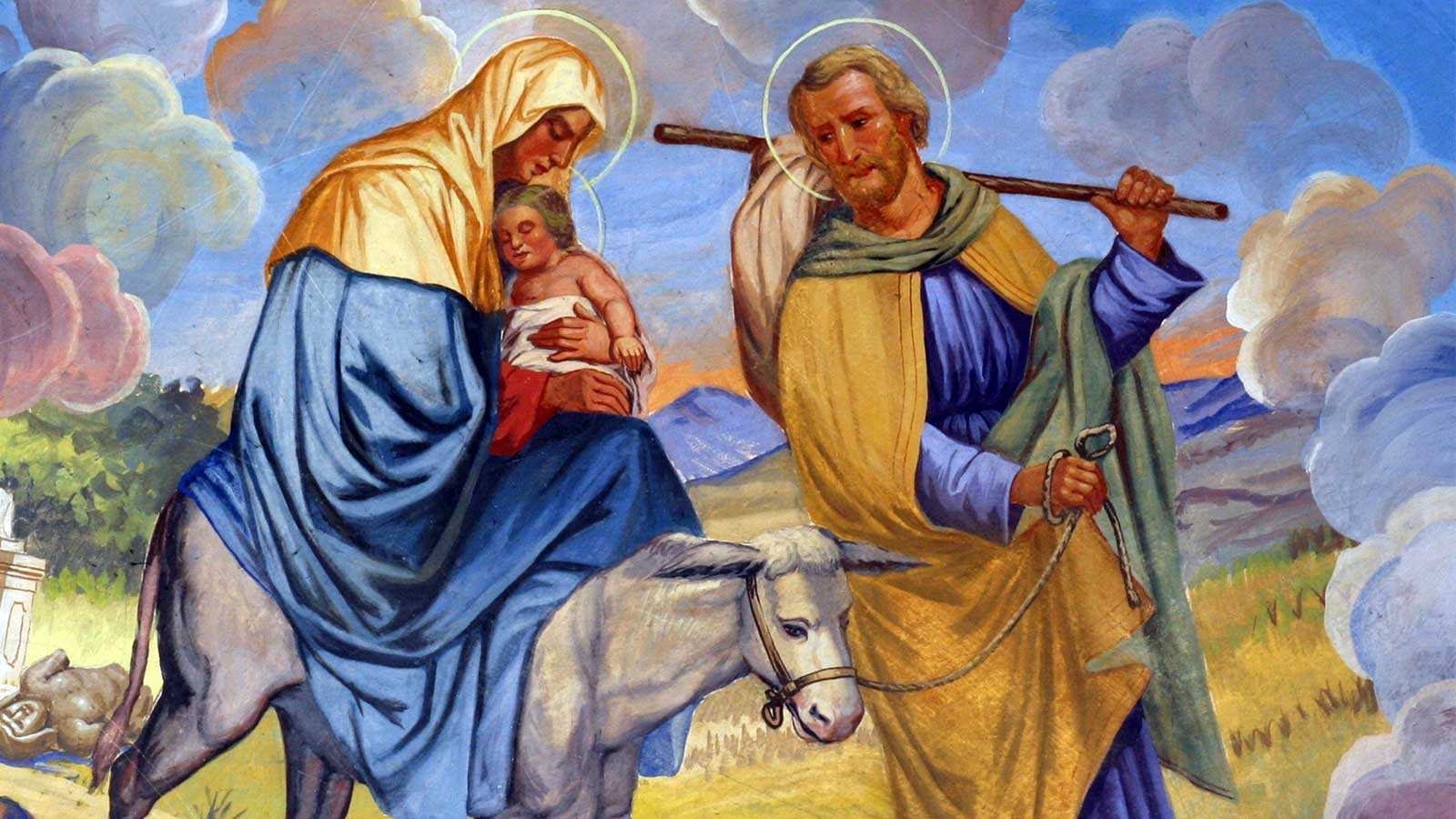
Mary and Joseph went to Egypt because, according to Matthew, King Herod intended to kill Jesus and an angel warned Joseph to flee with the child and his mother.
Egypt made geographical sense as a place of refuge because it lay beyond Herod’s direct jurisdiction and had long-established Jewish communities.
Matthew also connects the episode with the biblical phrase “Out of Egypt I called my son.”
The story creates a striking reversal in biblical geography.
Egypt is remembered elsewhere in scripture as a place from which the Israelites departed, yet in Matthew it becomes a place of refuge for Jesus.
For Egyptian Christians, that connection became deeply important. The passage of the Holy Family through Egypt came to be understood not merely as an escape but as a blessing of the land.
How Long Was the Holy Family in Egypt?
The exact duration is not known from the Bible. Coptic and later Christian traditions commonly describe a stay of more than three years, but traditional calculations vary.
This is one of the most frequently searched questions about the Holy Family in Egypt, and it is also one of the subjects that should not be presented with false certainty.
The Gospel of Matthew does not provide a duration.
Different Coptic traditions and later sources give estimates ranging from approximately three and a half years to almost four years.
Therefore, questions such as:
-
How long was Jesus in Egypt?
-
How many years did Jesus stay in Egypt?
-
How long did Mary and Joseph stay in Egypt?
-
How long did the Holy Family live in Egypt?
do not have a single securely documented historical answer.
For travelers, the most responsible summary is:
The Holy Family is traditionally believed to have remained in Egypt for more than three years, but the exact duration is not stated in the Bible.
What Is the Holy Family Route in Egypt?
The Holy Family Route is the modern pilgrimage and cultural-tourism route linking places that Coptic tradition associates with the family’s passage through Egypt.
The traditional journey moves from the northeastern approaches of Egypt through the Nile Delta, west toward Wadi El Natrun, into Cairo, and then south along the Nile Valley to Middle and Upper Egypt.
It should not be imagined as a single marked hiking trail.
Instead, it is a network of geographically separated pilgrimage destinations connected by tradition.
For modern travelers, the route is best understood in regional sections.
| Route Section | Important Traditional Stops | What Travelers Encounter Today | Practical Value |
|---|---|---|---|
| Northeastern entry | Rafah, Al-Arish, Farma | Ancient route traditions and archaeological landscapes | Historically important but affected by serious travel restrictions |
| Eastern Nile Delta | Tell Basta, Mostorod, Belbeis | Wells, churches, and local traditions | Possible as specialized excursions |
| Central/Northern Delta | Samannoud, Sakha | Churches, sacred objects, and pilgrimage traditions | Best with private transport |
| Western Delta | Wadi El Natrun | Major Coptic monasteries | One of the strongest day trips from Cairo |
| Greater Cairo | Matariya, Old Cairo, Maadi | Mary’s Tree, churches, crypts, and Nile-side traditions | Essential for first-time pilgrims |
| Middle Egypt | Deir Al-Garnus, Gabal El-Tair, Al-Ashmunein | Cave traditions, churches, and monasteries | Best as an overnight extension |
| Assiut region | Al-Muharraq, Dronka | Major monasteries and pilgrimage centers | Important for a deeper multi-day itinerary |
Travelers should not assume that every traditional point is equally accessible or suitable for tourism in 2027.
Where Did the Holy Family Enter Egypt?
Coptic tradition places the entry through northeastern Egypt, associated with the northern Sinai region and ancient Farma, or Pelusium.
Traditional accounts describe the family moving from the region of Palestine toward the northeastern edge of Egypt before entering the Nile Delta.
For travelers, however, the historical starting point and the sensible modern starting point are different.
Should tourists follow the route through North Sinai?
For most international travelers in 2027, North Sinai should not form part of a normal Holy Family tourist itinerary unless official security guidance changes significantly.
The practical pilgrimage therefore usually begins farther west, in the Delta or Cairo.
This is a good example of the difference between following the traditional map and planning a responsible modern trip.
Tell Basta: One of the First Major Delta Stations
Tell Basta, near Zagazig in Sharqia Governorate, represents one of the principal northeastern Delta stops in the traditional journey.
The location is ancient Bubastis, an important city long before Christianity.
Coptic tradition associates the family’s visit with a spring or well and with stories of pagan idols falling as Jesus entered the city.
The interest here is not only religious.
Tell Basta brings two layers of Egyptian history into the same landscape: the pharaonic city of Bubastis and the later Christian memory of the Holy Family.
That layered character is one of the strongest reasons to include the Delta in a longer pilgrimage rather than treating the journey purely as a sequence of churches.
Mostorod and Belbeis: Local Memory Along the Eastern Delta
After Tell Basta, traditional accounts connect the Holy Family with Mostorod and Belbeis.
Mostorod is associated with a spring and with a tradition that Mary washed the child Jesus there.
The location is also traditionally connected with the family’s return journey.
Belbeis, farther into the eastern Delta, is traditionally connected with a tree under which the Holy Family rested.
These places illustrate an important characteristic of the Holy Family journey: many sites are remembered not because monumental first-century buildings survive, but because a specific local tradition became attached to a well, tree, cave, or later church.
For travelers, that changes the experience.
You are not visiting an archaeological complex comparable to Karnak or Giza.
You are visiting a living devotional landscape.
Samannoud and Sakha: Two Important Northern Delta Stops
Samannoud and Sakha carry some of the most distinctive traditions on the northern section of the route.
In Samannoud, tradition preserves stories involving a stone vessel and a well associated with the family’s stay.
At Sakha, the story centers on a stone traditionally believed to preserve the footprint of the child Jesus.
These Delta sites are rarely as simple to visit independently as central Cairo attractions.
A traveler attempting to combine Tell Basta, Samannoud, and Sakha in a single day should expect substantial road time, local navigation, and variable access.
For most international visitors, a private vehicle and guide familiar with Coptic pilgrimage sites will make the day much more efficient.
Why Is Wadi El Natrun Important to the Holy Family Route?
Wadi El Natrun matters because Coptic tradition says the Holy Family passed through the desert valley, while centuries later the same landscape became one of the great centers of early Christian monasticism.
This distinction is important.
The present monasteries were not standing when Jesus, Mary, and Joseph would have passed through Egypt.
The major monastic communities developed in later Christian centuries.
The result is one of the richest Christian landscapes in Egypt.
Wadi El Natrun became associated with early desert monasticism, and major monasteries survive there today, including communities associated with Saint Bishoy, the Syrians, Baramos, and Saint Macarius.
For many travelers, Wadi El Natrun is more rewarding than trying to check off several minor pilgrimage stops.
It combines:
-
Holy Family tradition;
-
early Christian monastic history;
-
active religious communities;
-
historic churches;
-
desert architecture;
-
Coptic art and manuscripts;
-
a landscape very different from Cairo.
Egypt Time Travel’s guide to the Wadi El Natrun monasteries provides useful background if you want to understand the monastic landscape separately from the Holy Family story.
How much time should you allow for Wadi El Natrun?
Allow most of a day from Cairo if visiting several monasteries.
Do not try to turn the visit into a rapid photo stop. These remain religious communities rather than conventional tourist attractions.
Schedules, services, and access arrangements can change, so confirm arrangements close to the date of travel.
Matariya and Mary’s Tree: Holy Family Tradition Inside Modern Cairo
Matariya is one of the easiest places to understand how an ancient sacred tradition can survive inside a modern metropolis.
Coptic tradition holds that the Holy Family rested beneath a tree at Matariya and that a spring appeared nearby.
Today, the visitor experience is very different from a remote monastery.
Matariya lies within Greater Cairo.
Traffic, dense neighborhoods, and modern buildings surround the site, making the contrast part of the experience: a pilgrimage tradition associated with the first century survives inside one of Africa’s largest urban areas.
Matariya works particularly well as part of a broader Cairo Holy Family day rather than as a standalone excursion.
Old Cairo Is the Strongest First Stop for Most Travelers
If you have time for only one place connected with the Holy Family in Egypt, make it Old Cairo.
The district concentrates Christian history, Roman remains, and several major religious monuments within a relatively compact area.
Coptic tradition associates the crypt beneath the Church of Saints Sergius and Bacchus with the family’s stay.
Travelers interested in the wider district should first understand Coptic Cairo as a historical area rather than approaching each church in isolation.
Church of Saints Sergius and Bacchus — Abu Serga
The Church of Saints Sergius and Bacchus, commonly called Abu Serga, stands above a crypt traditionally associated with the Holy Family.
That crypt is the emotional center of the visit.
Coptic tradition holds that the family sheltered at the location during their time in the area.
The present church is later, of course; a first-century family cannot literally have sheltered inside a church constructed in subsequent centuries.
The correct relationship is:
traditional resting place → later Christian sanctuary → modern pilgrimage site.
This simple distinction keeps the story historically responsible without dismissing its devotional importance.
Egypt Time Travel has a dedicated guide to the Church of St. Sergius and Bacchus for travelers who want more architectural and historical detail.
The Hanging Church
The nearby Hanging Church is one of the most famous Coptic churches in Egypt and forms part of the wider Old Cairo religious landscape.
It is not important because Mary and Joseph supposedly entered the exact building standing today.
Rather, it represents the later Christian history that developed around the Roman fortress of Babylon and the sacred geography associated with Coptic Cairo.
You can explore its history separately in the Hanging Church in Cairo guide.
How long should you spend in Coptic Cairo?
Allow at least two to three hours.
A half day is better if you want time for churches, the Coptic Museum, and the surrounding district without rushing.
Readers planning a broader visit can combine the area with the main sights of Old Cairo.
Maadi: Where Tradition Meets the Nile
The Church of the Virgin Mary in Maadi represents a major transition in the traditional story.
According to Coptic tradition, the family moved south from Old Cairo to Maadi and continued their journey toward Upper Egypt by boat on the Nile.
Stone steps descending toward the river are traditionally associated with the departure point.
Maadi therefore gives travelers something that many other route sites do not: a direct geographical sense of movement.
You can stand near the Nile and understand why the river becomes central to the southern portion of the traditional route.
It also helps explain why the Holy Family route is so geographically unusual.
This is not a short pilgrimage contained within one city.
The narrative crosses deserts, Delta waterways, urban Cairo, and hundreds of kilometers of Nile Valley.
How Did the Holy Family Travel Through Egypt?
No detailed contemporary travel record survives.
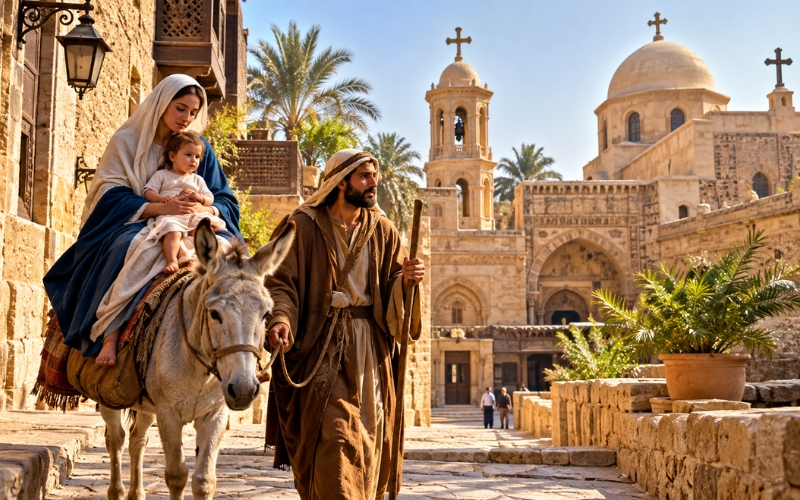
Traditional narratives describe movement on foot, using a donkey, and, for parts of the Nile Valley, boats.
Modern reconstructions often describe the wider route as extending more than 2,000 kilometers.
Exact distances and transport details should be treated as traditional reconstruction rather than precise historical measurements.
More important for travelers is understanding the terrain.
The route involves several distinct landscapes:
| Landscape | Traditional Route Role | Modern Traveler Experience |
|---|---|---|
| Sinai | Entry from the northeast | Highly restricted for modern tourism in northern areas |
| Nile Delta | Early villages and towns | Road-based pilgrimage |
| Western desert edge | Wadi El Natrun | Monastery excursions |
| Cairo | Major sacred cluster | Easy to integrate into a city itinerary |
| Nile Valley | Southward movement | Long-distance road or rail travel today |
| Minya and Assiut | Major southern pilgrimage sites | Best with additional overnight stays |
This geography is why attempting to “do the Holy Family Route” in two days is unrealistic.
Gabal El-Tair: A Dramatic Holy Family Site Above the Nile
Gabal El-Tair, near Samalut in Minya Governorate, is among the most visually impressive southern sites on the route.
Coptic tradition associates the location with a cave where the Holy Family rested.
A church and monastery complex later developed at the mountain.
The attraction is partly spiritual and partly geographical.
Unlike an urban church in Cairo, Gabal El-Tair provides a powerful relationship between sanctuary and landscape.
The Nile lies below, while the church occupies an elevated setting overlooking the valley.
Local Coptic tradition also preserves stories associated with a handprint and with a rock said to have been prevented from falling on the family.
These accounts should be understood as religious traditions rather than archaeological proof.
For visitors continuing toward Assiut, Gabal El-Tair is usually more worthwhile than trying to stop at every minor traditional station.
Al-Ashmunein and the Middle Egypt Section
The traditional journey then continues through sites in Middle Egypt, including Al-Ashmunein, known in antiquity as Hermopolis Magna.
This part of the route is particularly interesting for travelers who enjoy historical layering.
The landscape contains memories of:
-
ancient Egyptian religious centers;
-
Greek and Roman Egypt;
-
early Christianity;
-
later Coptic monasticism;
-
modern pilgrimage.
These sites are less practical for the typical first-time Egypt visitor than Coptic Cairo or Wadi El Natrun.
They become worthwhile when the Holy Family journey itself is a central purpose of the trip.
Why Is Al-Muharraq Monastery So Important?
Al-Muharraq Monastery is one of the most important Holy Family pilgrimage destinations because Coptic tradition identifies the area around Mount Qussqam as one of the family’s longest stays in Egypt.
The monastery lies in Assiut Governorate.
Coptic tradition states that the family remained in the area for several months.
That duration gives Al-Muharraq a special status.
Many route stations represent a short stop or passing tradition. Al-Muharraq represents a temporary home.
For pilgrims, that difference matters.
The site’s religious importance is consequently greater than its appearance on a simple map might suggest.
Was Al-Muharraq literally the first church in the world?
Claims surrounding the monastery are sometimes stated too strongly online.
Coptic tradition regards the sanctuary and altar at Al-Muharraq as exceptionally ancient and sacred.
However, travelers should distinguish devotional claims from conventional archaeological dating of standing church architecture.
A useful interpretation preserves the site’s religious meaning without converting every traditional claim into an independently established archaeological fact.
Dronka and the Traditional Return Journey
Mount Dronka, southwest of Assiut, is associated with the return phase of the Holy Family story.
Traditional accounts say the family passed through Dronka before eventually moving north again toward Old Cairo, Matariya, and the northeastern route back toward Palestine.
Today, Dronka is an important Christian pilgrimage center.
It is particularly associated with major Marian celebrations.
The wider Holy Family festival traditions remain part of living Egyptian heritage rather than something preserved only in museums.
Is the Holy Family Route a UNESCO World Heritage Site?
No. The entire Holy Family Route should not be described as a UNESCO World Heritage Site.
This is an important distinction because some travel pages combine several different claims.
UNESCO recognition relates to festivals associated with the Journey of the Holy Family in Egypt as intangible cultural heritage.
That recognition concerns living traditions and festivals associated with the journey.
It is different from a World Heritage inscription of a physical route, church, or group of monuments.
For travelers, this distinction is important because it separates:
living cultural heritage
from
World Heritage monument status.
When Is the Holy Family Celebrated in Egypt?
The Coptic commemoration of the Holy Family’s entry into Egypt is associated with 1 June, corresponding to 24 Bashans in the Coptic calendar.
Celebrations connected with the journey take place in different communities and may include religious services, processions, community gatherings, and pilgrimage traditions.
For culturally curious travelers, this creates two different ways to experience the route.
You can visit during quieter months when churches and monasteries are easier to explore slowly.
Or you can deliberately travel around a major celebration, accepting larger crowds and hotter weather in exchange for seeing the route as living heritage.
Is June the Best Time to Follow the Holy Family Route?
Not necessarily.
June may be spiritually significant, but it is not usually the most comfortable month for a multi-day journey through Middle and Upper Egypt.
For sightseeing, the cooler season is generally easier.
Travelers planning extensive time in Cairo, Minya, and Assiut should consult the best time to visit Egypt and choose between climatic comfort and attendance at specific religious celebrations.
For most travelers focused on churches, monasteries, and historical sites rather than a particular feast, October through April is usually the more comfortable planning window.
That is an editorial travel recommendation rather than an official religious rule.
What Is a Holy Family Painting or Flight into Egypt Painting?
The Holy Family’s escape to Egypt has inspired Christian art for centuries.
In Western Christian art, the subject is commonly called The Flight into Egypt.
Typical paintings show Mary carrying the infant Jesus while traveling with Joseph, often with Mary riding a donkey.
Other compositions depict the Rest on the Flight into Egypt, showing the family pausing beneath trees or beside water.
Egyptian Coptic representations can place stronger emphasis on Egypt itself and on the journey as part of the country’s sacred history.
For travelers, icons and church paintings add a useful visual layer to the route.
The artwork does not function as a literal map.
Instead, it shows how different Christian communities imagined the same short biblical episode.
That makes religious art particularly useful for understanding how a few verses in Matthew developed into a much larger devotional tradition.
Does a Holy Family Map Show the Historically Proven Route?
Not exactly.
A Holy Family in Egypt map generally illustrates the traditional Coptic itinerary rather than a route established through contemporary first-century records.
Modern pilgrimage maps commonly show a broad sequence running from the northeastern approaches through the Delta and Cairo, then south through Middle Egypt toward Assiut.
Maps are still extremely useful.
They answer an important question that text often hides: just how geographically extensive the tradition is.
The journey is not simply “Bethlehem to Cairo.”
It creates a large sacred geography stretching across Egypt.
A useful map could show:
Farma → Tell Basta → Mostorod → Belbeis → Samannoud → Sakha → Wadi El Natrun → Matariya → Old Cairo → Maadi → Middle Egypt → Gabal El-Tair → Al-Muharraq → Dronka
The map legend should clearly state:
Traditional Holy Family Route according to Coptic tradition and modern Egyptian pilgrimage mapping.
That line prevents the graphic from implying greater historical certainty than the evidence supports.
How Many Holy Family Sites Should You Actually Visit?
Do not choose sites by quantity.
Choose them by how much they add to the story.
For most first-time travelers, five experiences explain the route better than an exhausting attempt to visit every traditional point:
-
Abu Serga and Coptic Cairo — strongest introduction to the Cairo tradition.
-
Matariya — tree and spring tradition in the modern city.
-
Maadi — connection between Cairo and the Nile journey.
-
Wadi El Natrun — Holy Family tradition combined with major monastic history.
-
Al-Muharraq or Gabal El-Tair — deeper pilgrimage experience in Middle or Upper Egypt.
Samannoud, Sakha, Tell Basta, and smaller Delta locations become more valuable for travelers specifically following the pilgrimage route rather than visitors simply wanting a Christian heritage overview.
How Many Days Do You Need for a Holy Family Tour of Egypt?
The right duration depends on whether the Holy Family story is one element of your Egypt holiday or the main reason for traveling.
| Available Time | Recommended Focus | Best For |
|---|---|---|
| Half day | Coptic Cairo | First-time visitors with limited time |
| 1 day | Matariya + Coptic Cairo + Maadi | Strong introduction |
| 2 days | Cairo sites + Wadi El Natrun | Christian heritage travelers |
| 3–4 days | Cairo + Wadi El Natrun + selected Delta sites | Pilgrims wanting more depth |
| 5–7 days | Add Minya/Gabal El-Tair and Assiut | Serious Holy Family pilgrimage |
| 8–10 days | Broader Delta, Cairo, Middle Egypt, and Assiut route | Travelers making the pilgrimage the main purpose of the trip |
These are planning recommendations, not official pilgrimage durations.
The full traditional route should not be confused with a conventional weeklong sightseeing circuit.
Road distances, religious schedules, and rural access can make seemingly nearby sites consume most of a day.
A Practical 1-Day Holy Family Itinerary in Cairo
For travelers with one available day, Cairo gives the strongest return on time.
Morning: Matariya
Begin at Mary’s Tree and understand the northern Cairo tradition before traffic becomes heavier.
Spend enough time to see the site rather than simply taking a photograph.
Late morning to early afternoon: Coptic Cairo
Continue to Old Cairo.
Prioritize Abu Serga and its crypt, then the Hanging Church and surrounding Roman and Coptic remains.
A broader Cairo itinerary can help you decide where this day fits within a longer stay.
Late afternoon: Maadi
Finish beside the Nile at the Church of the Virgin Mary in Maadi.
The geographical sequence makes sense:
Matariya → Old Cairo → Maadi → Nile
Even though this is only a small portion of the wider traditional route, it gives the visitor a coherent story rather than a disconnected collection of churches.
A 3-Day Holy Family Itinerary
A three-day itinerary can add the monastic landscape and part of the Delta.
| Day | Route | Main Experience |
|---|---|---|
| Day 1 | Matariya – Coptic Cairo – Maadi | Core Cairo traditions |
| Day 2 | Wadi El Natrun | Desert monasteries and Coptic monastic history |
| Day 3 | Tell Basta – selected Delta sites | Earlier traditional route and local pilgrimage culture |
This itinerary is best with private transport.
Trying to build it entirely around public transportation can consume too much time and makes smaller religious sites unnecessarily difficult to coordinate.
A 6- or 7-Day Holy Family Pilgrimage
Travelers whose main purpose is the Holy Family journey should extend south.
A realistic route might be:
Day 1: Coptic Cairo
Day 2: Matariya, Mostorod, and Maadi
Day 3: Tell Basta, Samannoud, and/or Sakha
Day 4: Wadi El Natrun
Day 5: Travel toward Minya and Gabal El-Tair
Day 6: Middle Egypt sites and Al-Muharraq
Day 7: Assiut/Dronka or return toward Cairo
The exact order may be adjusted for access, accommodation, and church schedules.
If you prefer someone else to handle the road logistics and religious-site coordination, Egypt Time Travel offers a dedicated Holy Family tour in Egypt that can serve as the commercial next step after researching the history.
Can the Holy Family Route Be Combined With a Normal Egypt Holiday?
Yes, and this is often the best choice.
Not every traveler needs a pilgrimage-only itinerary.
A balanced first trip might combine:
-
Coptic Cairo and Maadi;
-
Giza and ancient Egyptian sites;
-
Luxor and the Nile Valley;
-
one monastery excursion;
-
a Red Sea stay if time allows.
That gives the journey broader historical context.
Egypt’s Christian period did not replace pharaonic Egypt. It developed within the same Nile landscape many centuries later.
Travelers especially interested in sacred travel can also compare the route with other Egypt spiritual tours, but a Holy Family pilgrimage is much more specifically rooted in Christian history and Coptic tradition.
What Should Travelers Expect at Churches and Monasteries?
Expect active religious spaces, not open-air archaeological attractions.
Some churches may be holding liturgies, prayers, weddings, funerals, or other services.
Monasteries may restrict parts of their compounds.
Photography rules can differ from one location to another.
Dress respectfully, keep voices low, and ask before photographing clergy, worshippers, icons at close range, or sensitive interior areas.
Avoid treating crypts, altars, relics, and devotional objects merely as photo opportunities.
For women and men alike, clothing that covers shoulders and knees is a sensible baseline for religious visits.
A lightweight scarf can also be useful, although requirements differ by site.
Is the Holy Family Route Suitable for Non-Christians?
Yes.
You do not have to be Christian to find the route meaningful.
The journey reveals a major part of Egyptian cultural history that is often overshadowed internationally by pharaonic monuments.
Non-Christian visitors can approach it through:
-
religious history;
-
Coptic art;
-
architecture;
-
archaeology;
-
pilgrimage studies;
-
desert monasticism;
-
social history;
-
Egyptian identity.
The wider cultural importance of the route extends beyond a single religious community.
Respectful behavior matters more than personal belief.
Is the Holy Family Route Good for Families?
It can be, but route selection matters.
Coptic Cairo works well for older children interested in stories and history because several landmarks lie relatively close together.
Long Delta driving days and Upper Egypt pilgrimage days are more demanding.
Families traveling with young children may be better served by:
Coptic Cairo + Matariya + Maadi + Wadi El Natrun
rather than trying to cover every stop.
If you’re traveling with children more generally, the Egypt with kids guide can help balance religious heritage with activities that suit different ages.
What About Seniors or Travelers With Limited Mobility?
Accessibility varies substantially.
Modernized visitor areas may be relatively easy to navigate, while old churches, crypts, monasteries, and mountain sites may involve steps, uneven floors, or restricted vehicle access.
The crypt at Abu Serga, for example, is below the main church level.
Mountain and rural sites can be more difficult.
Do not rely on a generic claim that the “Holy Family Route is accessible.”
Instead, check each planned site individually.
Travelers with mobility requirements may find Egypt Time Travel’s broader guide to wheelchair accessibility in Egypt useful when planning transport and accommodation.
Common Misconceptions About the Holy Family in Egypt
“The Bible lists all the places the Holy Family visited.”
It does not.
Matthew says the family went to Egypt and later returned, but does not describe the Egyptian itinerary.
“The Holy Family stayed in Egypt for exactly three years and six months.”
That is a traditional figure, not a duration stated by Matthew.
Other traditional calculations differ.
“Every church on the route existed when Jesus was there.”
No.
Many churches and monasteries were established centuries later at locations associated by tradition with the family.
Wadi El Natrun is an especially clear example: its great monastic communities belong to the Christian monastic era, not the time of Jesus.
“The entire Holy Family Route is a UNESCO World Heritage Site.”
No.
UNESCO recognition concerns festivals associated with the journey as intangible cultural heritage rather than the entire physical route as a World Heritage Site.
“You can follow the entire route safely from Rafah to Assiut.”
That should not be assumed.
Regional security conditions can change, and travelers should verify current official travel advice before including northern Sinai in an itinerary.
“The route is one continuous walking path.”
It is better understood as a network of sacred places.
Modern travelers usually move between clusters by road.
What Travelers Commonly Get Wrong When Planning the Route
The biggest mistake is trying to see too many stops.
A pilgrimage should not become a race through church courtyards.
Spend more time at fewer sites.
The second mistake is ignoring geography.
Sakha, Wadi El Natrun, Old Cairo, and Assiut may all belong to the same spiritual route, but they are not a compact sightseeing zone.
The third mistake is assuming every church operates like a ticketed tourist attraction.
It does not.
Religious services come first.
The fourth mistake is reading miracle traditions as though they were archaeological site labels.
A better approach is to understand the language being used:
“Matthew states” when referring to the New Testament.
“Coptic tradition holds” when discussing the detailed route or miracles.
“The present church commemorates” when discussing a later building on a traditionally sacred location.
That vocabulary makes the experience richer rather than less spiritual.
Why the Holy Family Route Matters Beyond Religion
The Holy Family route provides a framework for understanding the continuity of Egyptian history.
At Tell Basta, the traveler encounters an ancient Egyptian city remembered within a Christian tradition.
At Wadi El Natrun, the landscape introduces the rise of Christian monasticism.
At Old Cairo, Roman fortifications, Coptic churches, Jewish history, and early Islamic monuments exist within a relatively small area.
At Maadi, the Nile becomes the connecting geographical feature.
In Middle and Upper Egypt, the route passes landscapes where pharaonic, Greco-Roman, Coptic, and modern Egyptian communities occupied the same river corridor across different periods.
That is why the Holy Family route should not be marketed only as “a religious tour.”
It is also an unusually effective way to understand Egypt as a civilization made of overlapping historical layers.
Readers wanting broader context can explore the history of ancient and later Egypt before traveling.
Is Following the Holy Family Route Worth It?
Yes, for the right traveler.
It is particularly worthwhile if you are interested in Christianity, Coptic heritage, pilgrimage, monasteries, religious art, or lesser-visited parts of Egypt.
It may be less suitable if your first visit is very short and your priorities are the Pyramids, Grand Egyptian Museum, Luxor, and a Nile cruise.
In that case, add Coptic Cairo as an introduction rather than attempting the complete route.
The experience becomes significantly more rewarding when you understand what each site represents.
Do not measure it by the number of monuments.
Measure it by the connections:
biblical refuge → Coptic memory → sacred site → living community → modern pilgrimage.
Frequently Asked Questions About the Holy Family in Egypt
Where in Egypt did Jesus live?
The Bible does not identify a specific Egyptian town where Jesus lived. Coptic tradition associates the Holy Family with numerous locations from the Nile Delta through Cairo and south into Middle Egypt and Assiut, with Al-Muharraq traditionally regarded as one of their longest places of residence.
Did Jesus go to Cairo?
Matthew says only that Jesus was taken to Egypt. Coptic tradition places the Holy Family in areas that are now part of Greater Cairo, including Matariya, Old Cairo, and Maadi. The crypt beneath Abu Serga in Old Cairo is one of the best-known pilgrimage sites associated with the family’s stay.
How many years did Jesus stay in Egypt?
The New Testament does not give a number. Coptic traditions commonly describe a period of more than three years, but exact traditional estimates differ.
What is the most important Holy Family site in Cairo?
For most visitors, Abu Serga in Coptic Cairo is the most important because its crypt is traditionally associated with the family’s shelter. The surrounding district also contains the Hanging Church, Coptic Museum, and Roman fortress remains.
Where did Mary and Joseph stay in Egypt?
No biblical source identifies their Egyptian accommodation. Coptic tradition connects the family with numerous resting places, caves, wells, and settlements. Major present-day pilgrimage locations include Old Cairo, Gabal El-Tair, and Al-Muharraq Monastery.
Did the Holy Family travel on the Nile?
Coptic tradition says that parts of the journey were made by boat and specifically links Maadi with a departure toward Upper Egypt.
What is the best Holy Family site for first-time visitors?
Coptic Cairo is the best starting point because it combines Abu Serga, the Holy Family crypt, the Hanging Church, Roman Babylon, and other major Christian monuments within one district.
Can I see the entire Holy Family Route in one trip?
Yes in principle, but a meaningful trip requires several days and careful transport planning. For most international visitors, the practical route should focus on the Delta, Cairo, Wadi El Natrun, Minya, and Assiut rather than attempting every traditional stop.
Is June 1 important to the Holy Family in Egypt?
Yes. The Coptic Church commemorates the entry of the Holy Family into Egypt on 1 June, corresponding to 24 Bashans in the Coptic calendar.
Is there a real map of the Holy Family’s journey in Egypt?
There are modern and church-supported maps of the traditional route, but they should be understood as maps of Coptic religious tradition rather than a precisely documented first-century itinerary.
Final Thoughts: Following the Holy Family in Egypt in 2027
The story of the Holy Family in Egypt begins with only a few verses in Matthew, yet in Egypt those verses developed into an extraordinary sacred geography.
The traditional route crosses villages, cities, deserts, and the Nile Valley.
It connects Mary’s Tree in Matariya with the crypt of Abu Serga, the monasteries of Wadi El Natrun, the Nile at Maadi, the cliffs of Gabal El-Tair, and Al-Muharraq in Assiut.
The most rewarding way to experience it is not to ask whether every local tradition can be proved archaeologically.
Instead, understand the different layers clearly.
Matthew gives the biblical foundation.
Coptic Christianity preserves the detailed route.
Churches and monasteries preserve centuries of devotion.
Modern Egypt has developed many of these locations as pilgrimage and cultural-tourism destinations, while the associated festivals remain part of living heritage.
For a first visit, begin with Coptic Cairo, Matariya, and Maadi.
Add Wadi El Natrun if you have another day.
Continue toward Minya and Assiut when the Holy Family journey is one of the main reasons for your trip.
Before traveling in 2027, verify current regional security guidance and individual church or monastery access rather than relying on an older itinerary.
If you would prefer private transport and an itinerary built around the sacred sites that are realistic for your travel dates, Egypt Time Travel can customize a Holy Family pilgrimage around Cairo, the Delta, Middle Egypt, and Assiut rather than forcing every traditional stop into one rushed program.
