
Quick Answer: Key Facts About Visiting Mosques in Egypt
- Most famous mosque in Egypt: Al-Azhar Mosque in Cairo, founded in 970–972 AD and home to Al-Azhar University, one of the oldest continuously operating universities in the world.
- Largest mosque in Egypt: Egypt’s Islamic Cultural Center (Masjid Misr, also called the Grand Mosque), located in the New Administrative Capital east of Cairo, with a capacity reported at roughly 130,000–137,000 worshippers.
- Most visited historic mosque by tourists: The Muhammad Ali Mosque (Alabaster Mosque) inside the Citadel of Salah al-Din, thanks to its Ottoman-style dome, panoramic views of Cairo, and easy access as part of a Citadel ticket.
- How many mosques does Egypt have? Estimates vary by source and year, ranging from roughly 114,000 (2016 figures) to over 140,000 today, since the Ministry of Awqaf (Religious Endowments) has been building and renovating thousands of mosques annually.
- Dress code: Modest clothing covering shoulders and knees is required at every mosque. Women are generally expected to cover their hair inside the prayer hall; a headscarf is either required or strongly recommended depending on the mosque. Shoes come off before entering any prayer hall.
- Cost: Some historic mosques, like Al-Azhar, are free or ask for a small donation. Others, like the Muhammad Ali Mosque, are included in a paid Citadel admission ticket. Prices change over time, so always confirm current fees with the Egyptian Ministry of Tourism and Antiquities or at the ticket window.
- Best time to visit: Early morning on a weekday, outside the five daily prayer times and well before or after the extended Friday midday prayer window.
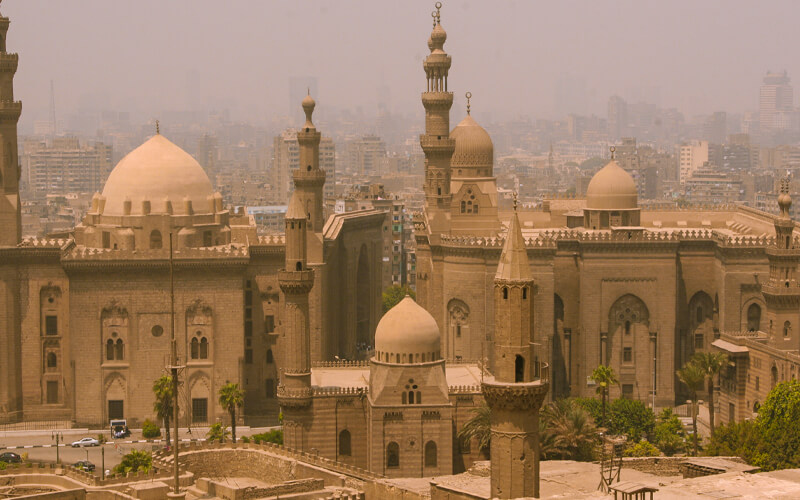
Visiting mosques in Egypt is one of the most rewarding things you can do in Cairo. The city is home to hundreds of historic mosques spanning more than 1,300 years of Islamic architecture, and many of the most important ones — including Al-Azhar Mosque, the Muhammad Ali Mosque, and the Ibn Tulun Mosque — welcome non-Muslim visitors every day of the week. This guide covers exactly which mosques to visit, what it costs, how to dress, when mosques are open to tourists, and how to plan a respectful, well-timed visit whether you have half a day or a full week in Cairo.
Egypt has more mosques than almost any country on earth relative to its population, and Cairo alone has been nicknamed “the city of a thousand minarets” for centuries. Yet only a handful of these mosques are set up for tourism, offer historical or architectural significance, and are genuinely worth the trip. This article focuses on those.
Why Visit Mosques in Egypt?
Mosques in Egypt are not simply religious buildings set aside for sightseeing. Most of the mosques travelers visit are still active places of worship, which is part of what makes visiting them so distinctive. You are not walking through a museum reconstruction — you are stepping into a building where the call to prayer still sounds five times a day, where students still study Quranic recitation, and where daily life and centuries of history sit side by side.
For travelers interested in architecture, Egypt’s mosques trace an unbroken design timeline: the simple courtyard mosques of the early Islamic period, the towering minarets and geometric brickwork of the Mamluk era, the Ottoman-influenced domes of the 19th century, and the enormous modern mega-mosques built in the past decade. Seeing three or four mosques from different eras in a single day gives you a compressed lesson in Islamic architectural history that’s hard to find anywhere else in the world.
How Many Mosques Are There in Egypt?
Egypt’s mosque count is one of the most frequently searched facts about the country, and the honest answer is that it depends on which year and which source you check. A widely cited figure places the total at around 114,000 mosques as of 2016, with roughly 83,000 affiliated with the Ministry of Endowments (Awqaf). More recent estimates put the number well above 130,000, and some sources suggest over 140,000, since Egypt’s government has continued an active mosque-building and renovation program, reportedly opening or restoring thousands of mosques every year since 2014.
For comparison, Cairo alone is believed to have well over a thousand mosques, which is where its historic nickname, “the city of a thousand minarets,” comes from — a description that undersells the real number today.
Because exact figures shift year to year and vary depending on whether small prayer rooms are counted alongside full mosques, treat any specific number as an estimate rather than a fixed fact, and check the Egyptian Ministry of Awqaf for the most current official statistics if you need a precise figure.
The Most Famous Mosques in Egypt (And Where to Find Them)
Almost all of Egypt’s most historically significant and visually stunning mosques are concentrated in Cairo, particularly in the Islamic Cairo district and around the Citadel of Salah al-Din. Below are the mosques that consistently rank as the most important to see.
Al-Azhar Mosque
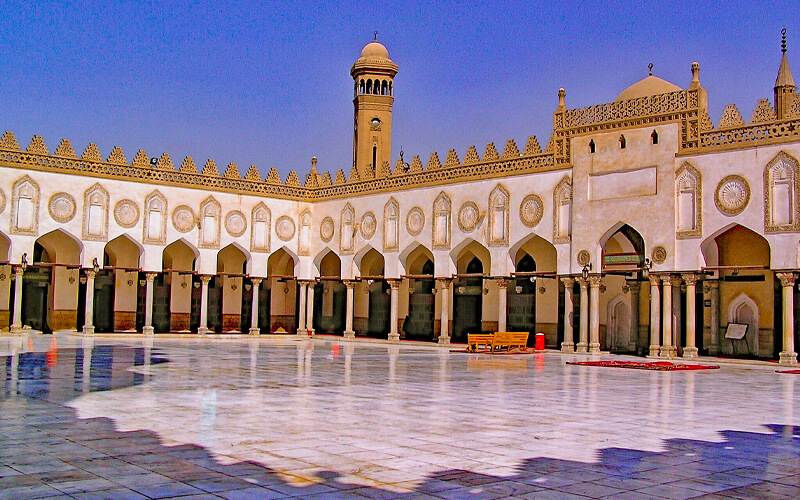
Al-Azhar Mosque is arguably the most famous mosque in Egypt and one of the most significant in the Islamic world. It was built by the Fatimid dynasty and completed around 970–972 AD, making it one of the oldest mosques in Cairo still in active use. Attached to the mosque is Al-Azhar University, widely regarded as one of the oldest continuously operating universities on earth and one of the leading centers of Sunni Islamic scholarship globally.
- What to expect: A serene courtyard with white marble, a working religious school where you’ll see students studying the Quran, layered architecture reflecting Fatimid, Mamluk, and Ottoman renovations over the centuries, and a genuinely peaceful atmosphere just steps from the busy Khan El Khalili bazaar.
- Cost: Entry is generally free for worshippers. Non-Muslim visitors may be asked for a small donation or a modest entrance fee at certain times, though this has varied by source and season, so confirm the current policy on arrival.
- Good to know: If your clothing doesn’t meet the dress code, mosque staff typically provide a robe to wear over your clothes at no extra charge.
Muhammad Ali Mosque (The Alabaster Mosque)
The Muhammad Ali Mosque, also called the Alabaster Mosque, sits at the highest point of the Citadel of Salah al-Din on Muqattam Hill and is the mosque most tour itineraries in Cairo include. It was commissioned by Muhammad Ali Pasha, the 19th-century ruler credited with modernizing Egypt, and was built between roughly 1830 and 1848, largely completed the year before his death.
Designed by the Istanbul architect Yusuf Bushnak, the mosque draws heavily on Ottoman imperial mosque design, most visibly in its large central dome and twin minarets, which at 84 meters are among the tallest in Egypt. The lower walls and courtyard are clad in honey-toned alabaster quarried near Beni Suef, which gives the mosque both its nickname and its glow at certain times of day.
- What to expect: A vast, carpeted prayer hall lit by a ring of hanging lamps, an open Ottoman-style courtyard, the marble tomb of Muhammad Ali Pasha, and one of the best panoramic viewpoints over Cairo, where on a clear day you can glimpse the Pyramids of Giza in the distance.
- Cost: Entry is included in the general Citadel admission ticket, which also covers the Mosque of al-Nasir Muhammad, the Mosque of Sulayman Pasha, and several museums inside the complex. There is no separate ticket for the mosque itself. Ticket prices for the Citadel have changed several times in recent years, so check the official rate before you go rather than relying on any single published figure.
- Good to know: The clock tower in the outer courtyard was a gift from French King Louis-Philippe, given in exchange for the ancient obelisk that now stands in Paris’s Place de la Concorde. It has famously never kept accurate time — a detail guides love to point out.
Ibn Tulun Mosque
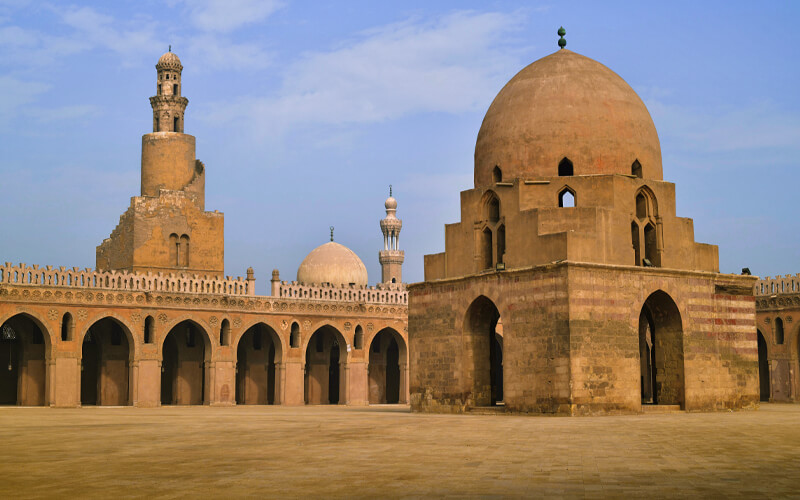
Built between 876 and 879 AD, the Ibn Tulun Mosque is the oldest mosque in Cairo that survives in its original form, and it’s the largest mosque in the city by land area. Unlike the more ornate mosques built later, Ibn Tulun’s design is deliberately simple: a huge open courtyard surrounded by arcades, with a distinctive spiral minaret modeled on examples from Samarra, Iraq, where the mosque’s patron, Ahmad ibn Tulun, had previously governed.
- What to expect: Far fewer crowds than Al-Azhar or the Muhammad Ali Mosque, an enormous open-air courtyard that gives a strong sense of scale, and the option to climb the spiral minaret for one of the best rooftop views in Islamic Cairo.
- Why visit: If you only see two mosques in Cairo, Ibn Tulun paired with the Muhammad Ali Mosque gives you a striking contrast between the austere, early Islamic style and the ornate, Ottoman-influenced style of nearly a thousand years later.
Sultan Hassan Mosque and Madrasa
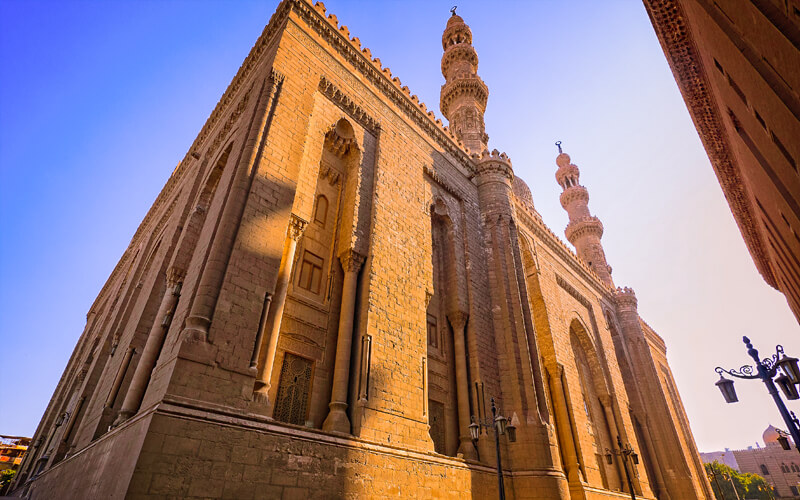
Located just below the Citadel and near the Al-Rifa’i Mosque, the Sultan Hassan Mosque is considered one of the finest examples of Mamluk architecture in the world, built in the 14th century. Its scale is imposing — the entrance portal alone rises higher than most modern buildings in the surrounding neighborhood — and the interior is known for its soaring vaulted halls and carved stonework.
- What to expect: Massive stone architecture, four internal courtyards each dedicated to a different school of Islamic law, and a quieter, more contemplative visit compared to the busier tourist mosques nearby.
Al-Rifa’i Mosque
Built in phases between the late 19th and early 20th centuries, the Al-Rifa’i Mosque sits directly across from the Sultan Hassan Mosque and is the resting place of several members of Egypt’s royal family, including King Farouk, as well as the last Shah of Iran, Mohammad Reza Pahlavi.
- What to expect: Marble-clad interiors, a design that echoes the older Mamluk style nearby despite being much newer, and a quieter historical significance tied to modern Egyptian and regional royalty rather than medieval history.
Amr ibn al-As Mosque
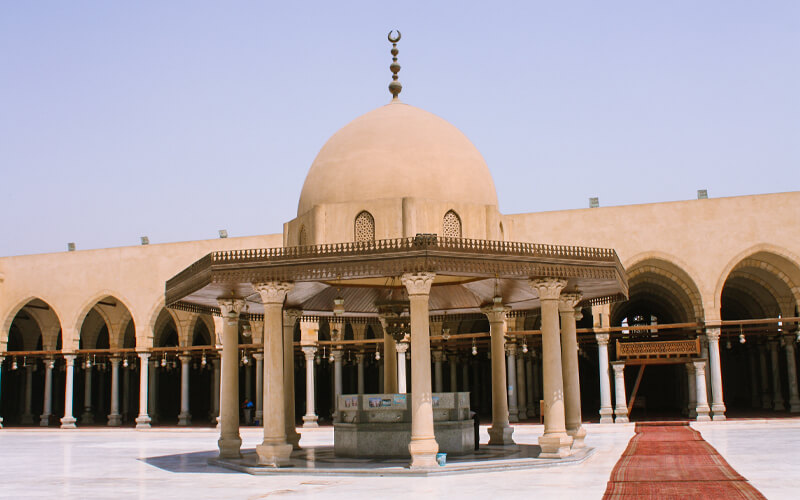
Located in Old Cairo (Fustat), the Amr ibn al-As Mosque was founded in 642 AD, making it the oldest mosque in Egypt and in the entire African continent. The current structure has been rebuilt and expanded many times over the centuries, so little of the original 7th-century building remains, but the site itself carries enormous historical weight as the birthplace of Islamic Cairo.
- What to expect: A working neighborhood mosque rather than a polished tourist attraction, which for many visitors is exactly the appeal — a chance to see a mosque used the way most Egyptian mosques are used daily.
Al-Hakim Mosque
Built by the Fatimid Caliph al-Aziz and completed by his son, al-Hakim bi-Amr Allah, in 1013 AD, this mosque is considered the second-largest historic mosque in Cairo after Ibn Tulun. It has been restored more than once, most notably in the 20th century, and today has a cleaner, almost minimalist appearance compared to Cairo’s older monuments.
The Grand Mosque of the New Administrative Capital (Masjid Misr)
Opened in March 2023, Egypt’s Islamic Cultural Center — anchored by Masjid Misr, commonly called the Grand Mosque — is the newest major religious landmark in the country and is widely reported as the largest mosque in Egypt and in Africa. Reported figures place its capacity at approximately 130,000 to 137,000 worshippers across its prayer hall and surrounding courts, with a total site area of roughly 467,000 to 476,000 square meters.
The mosque holds three Guinness World Records: the world’s heaviest chandelier, the world’s largest chandelier by diameter, and the tallest wooden minbar (pulpit) in the world.
- What to expect: A modern architectural experience on a genuinely massive scale, minarets reported at around 140 to 148 meters tall, and a very different atmosphere from the historic mosques of Islamic Cairo — polished, monumental, and purpose-built for the new capital rather than shaped by centuries of organic growth.
- Good to know: This mosque is located outside central Cairo in the New Administrative Capital, roughly 45 minutes to over an hour by car depending on traffic and your starting point, so it works best as a dedicated half-day trip rather than an add-on to an Islamic Cairo walking tour.
Al-Fattah Al-Aleem Mosque
Also located in the New Administrative Capital and inaugurated in January 2019, the Al-Fattah Al-Aleem Mosque is frequently described as the second-largest mosque in Egypt, with a reported indoor capacity of around 17,000 worshippers and additional outdoor prayer space that pushes total capacity considerably higher depending on the source. Its central dome is reported as the largest mosque dome in Egypt and Africa, and it has four minarets standing roughly 95 meters tall.
What to expect: A striking all-white modern design that blends historical Islamic architectural references — echoes of Fatimid and Ayyubid style — with contemporary construction techniques.
Egypt’s Biggest and Most Beautiful Mosques Compared
| Mosque | Location | Built | Reported Capacity | Best Known For |
|---|---|---|---|---|
| Egypt’s Islamic Cultural Center (Grand Mosque / Masjid Misr) | New Administrative Capital | 2019–2023 | ~130,000–137,000 | Largest mosque in Egypt and Africa; 3 Guinness World Records |
| Al-Fattah Al-Aleem Mosque | New Administrative Capital | 2019 | ~17,000 indoors | Africa’s largest mosque dome; modern architecture |
| Al-Azhar Mosque | Islamic Cairo | 970–972 AD | Thousands | Oldest active university mosque; center of Islamic learning |
| Muhammad Ali Mosque | Citadel of Salah al-Din | 1830–1848 | Thousands | Ottoman-style dome; panoramic city views; alabaster cladding |
| Ibn Tulun Mosque | Sayyida Zeinab, Cairo | 876–879 AD | Thousands | Largest mosque in Cairo by land area; spiral minaret |
| Sultan Hassan Mosque | Near the Citadel | 1356–1363 AD | Thousands | Mamluk architecture; monumental scale |
| Amr ibn al-As Mosque | Old Cairo (Fustat) | 642 AD | Thousands | Oldest mosque in Egypt and Africa |
Capacity figures for the historic mosques are not consistently published the way modern mega-mosque figures are, since their significance is architectural and historical rather than about worshipper volume. Treat all capacity numbers, including for the newest mosques, as approximate, since different official and media sources report slightly different totals.
What Is the Largest Mosque in Egypt?
Egypt’s Islamic Cultural Center, home to Masjid Misr (the Grand Mosque), in the New Administrative Capital is the largest mosque in Egypt. Inaugurated in March 2023, it covers a site of roughly 467,000 to 476,000 square meters and is reported to accommodate approximately 130,000 to 137,000 worshippers, making it not only the largest mosque in Egypt but also one of the largest in Africa and among the largest in the world outside Mecca and Medina.
What Is the Most Famous Mosque in Egypt?
Al-Azhar Mosque is the most famous mosque in Egypt. Founded in 970–972 AD by the Fatimid dynasty, it is one of the oldest mosques in the Islamic world still in continuous use and is home to Al-Azhar University, a leading center of Sunni Islamic scholarship for over a thousand years. Its combination of historical age, religious authority, and central location in Islamic Cairo makes it the mosque most associated with Egypt internationally, ahead of even the Muhammad Ali Mosque, which is more visually iconic in tourist photography but younger and less religiously significant.
Planning Your Mosque Visit: Practical Information
Dress Code
Every mosque in Egypt that welcomes tourists expects modest dress, and this is not optional or loosely enforced at the major sites.
- For everyone: Cover your shoulders and knees. Avoid shorts, sleeveless tops, and tight or sheer clothing.
- For women: Bring a scarf or shawl to cover your hair before entering the prayer hall. Some mosques, like Al-Azhar, will lend a robe if your outfit doesn’t meet the dress code, but it’s easier and faster to come prepared.
- For men: Long trousers and a shirt with sleeves are the safest choice. Shorts are generally not accepted inside prayer halls.
- Footwear: You will remove your shoes before entering any mosque’s prayer hall. Wear shoes that are easy to slip on and off, and consider socks you don’t mind walking in on stone or carpet.
Entry Fees
Entry fees vary significantly by mosque and change periodically, so specific prices should always be confirmed close to your travel dates rather than taken from any single online source.
- Al-Azhar Mosque: Generally free for worshippers, with non-Muslim visitors sometimes asked for a small fee or donation.
- Muhammad Ali Mosque: Included in the general Citadel of Salah al-Din admission ticket, which also covers several other mosques and museums inside the complex.
- Ibn Tulun, Sultan Hassan, and Al-Rifa’i Mosques: Typically charge a modest individual entrance fee for non-Egyptian visitors, often discounted for students with valid international ID.
- The Grand Mosque and Al-Fattah Al-Aleem Mosque: As government-run religious sites in the New Administrative Capital, these have generally been free to enter, though this can change, particularly around special events.
For current, accurate pricing, check the Egyptian Ministry of Tourism and Antiquities website or ask your hotel or licensed tour operator before you go.
Opening Hours and Prayer Time Closures
Most tourist-accessible mosques operate on a similar general schedule, though hours can shift slightly by season and location:
- Typical visiting hours run from around 8:00 or 9:00 AM until 5:00 or 5:30 PM.
- Mosques close briefly to visitors during each of the five daily prayer times, each lasting roughly 20 to 40 minutes.
- Friday midday prayer draws the largest crowds of worshippers and typically closes mosques to tourist visits for an extended window, often from around 11:30 AM to 2:00 PM.
- During Ramadan, hours can shift further, and some mosques become significantly busier in the evenings.
How Long to Spend at Each Mosque
| Mosque | Typical Visit Length | Notes |
|---|---|---|
| Al-Azhar Mosque | 30–60 minutes | Combine with Khan El Khalili next door |
| Muhammad Ali Mosque | 60–90 minutes | Add time for Citadel views and nearby museums |
| Ibn Tulun Mosque | 45–60 minutes | Climb the minaret if open |
| Sultan Hassan Mosque | 45–60 minutes | Pair with Al-Rifa’i Mosque across the street |
| The Grand Mosque (New Capital) | 90 minutes–half day | Includes travel time from central Cairo |
Getting There
Most of Cairo’s historic mosques cluster in Islamic Cairo and around the Citadel, both reachable by taxi or rideshare apps like Uber and Careem in 15 to 30 minutes from central Cairo or Zamalek, depending on traffic.
Neither the Citadel nor most of Islamic Cairo has a direct metro stop, so a short taxi connection from the nearest station is usually required. The mosques in the New Administrative Capital are considerably farther out and are best reached by car, typically 45 minutes to over an hour from downtown Cairo.
Who Should Visit Mosques in Egypt?
Visiting mosques suits a wide range of travelers, but the experience differs depending on what you’re looking for.
- History and architecture enthusiasts will get the most out of Ibn Tulun, Al-Hakim, Sultan Hassan, and Al-Azhar, where centuries-old design details are still intact.
- First-time visitors to Cairo with limited time should prioritize the Muhammad Ali Mosque for its accessibility, views, and inclusion in the standard Citadel ticket, paired with Al-Azhar if time allows.
- Travelers interested in modern architecture and engineering will find the Grand Mosque and Al-Fattah Al-Aleem Mosque worth the drive out to the New Administrative Capital.
- Travelers with mobility limitations should note that many historic mosques have uneven stone floors, steps, and courtyards without ramps, so check accessibility in advance if this is a concern.
- Muslim travelers may want to time visits around prayer times to join congregational prayer, while non-Muslim travelers should plan visits between prayer windows to avoid disrupting worship.
Common Mistakes to Avoid
- Arriving without a scarf or long clothing: While some mosques lend robes, not all do, and you may waste time finding a workaround.
- Visiting during Friday midday prayers: This is when mosques are busiest with worshippers and often closed to tourists for the longest stretch of the week.
- Photographing worshippers without permission: Photography of the architecture is usually fine, but always ask before photographing people who are praying.
- Talking loudly or treating the mosque as a photo backdrop: These are active religious sites, not stage sets, and loud behavior is considered disrespectful.
- Assuming every mosque is open to non-Muslims: A small number of religiously significant sites, such as the interior of the Mosque of Sayyidna al-Hussein, which is believed by many to hold a relic connected to the Prophet’s grandson, restrict non-Muslim entry into certain areas out of respect for the site’s religious significance.
- Skipping the Citadel’s other buildings: Since the Muhammad Ali Mosque ticket usually covers the wider Citadel complex, skipping the military museum or the older mosques inside means missing value you’ve already paid for.
Expert Tips for a Better Mosque Visit
- Go early. Arriving right at opening, especially on a weekday, gets you softer light for photography, thinner crowds, and a genuinely quieter atmosphere before tour buses arrive.
- Pair mosques by neighborhood rather than jumping across the city. Al-Azhar and Khan El Khalili sit together; Sultan Hassan, Al-Rifa’i, and the Muhammad Ali Mosque cluster around the Citadel; Ibn Tulun is a short trip from both.
- Bring small Egyptian pound notes for donations, optional guides, or shoe-covering fees at sites that request them, since not every mosque has card payment available.
- If you want historical context rather than just architecture, hire a licensed Egyptology or Islamic history guide for at least one mosque, since inscriptions and design choices often carry meaning that isn’t obvious without explanation.
- If you’re visiting during Ramadan, expect a livelier evening atmosphere around mosques after sunset, but also expect shifted daytime hours and larger crowds at iftar time.
- Carry water and expect heat, particularly between May and September, since courtyards and stone floors offer little shade at midday.
Frequently Asked Questions
What is the most famous mosque in Egypt?
Al-Azhar Mosque in Cairo is the most famous mosque in Egypt. Founded in 970–972 AD, it is one of the oldest continuously active mosques in the Islamic world and is attached to Al-Azhar University, a major center of Islamic scholarship for over a thousand years.
What is the largest mosque in Egypt?
Egypt’s Islamic Cultural Center, home to Masjid Misr (the Grand Mosque) in the New Administrative Capital, is the largest mosque in Egypt. It opened in March 2023 and is reported to hold approximately 130,000 to 137,000 worshippers.
How many mosques does Egypt have?
Estimates vary, ranging from around 114,000 in 2016 to more than 140,000 in recent estimates, since Egypt’s government has continued building and renovating thousands of mosques each year. There is no single fixed, universally agreed-upon number.
Can non-Muslims visit mosques in Egypt?
Yes. Most major mosques in Egypt, including Al-Azhar Mosque, the Muhammad Ali Mosque, Ibn Tulun Mosque, and Sultan Hassan Mosque, welcome non-Muslim visitors outside of prayer times, provided visitors follow the dress code and behave respectfully. A small number of religiously sensitive sites restrict non-Muslims from certain interior areas.
What should I wear to visit a mosque in Egypt?
Wear clothing that covers your shoulders and knees. Women should bring a scarf to cover their hair before entering the prayer hall. Avoid shorts, sleeveless tops, and tight or sheer fabric. You will also need to remove your shoes before entering any prayer hall.
Is it free to visit mosques in Egypt?
Some mosques, like Al-Azhar, are free or ask only for a small donation. Others, like the Muhammad Ali Mosque, are included in a paid admission ticket to a larger complex, such as the Citadel of Salah al-Din. Fees vary and change over time, so confirm current pricing before your visit.
What is the difference between the Muhammad Ali Mosque and Al-Azhar Mosque?
The Muhammad Ali Mosque, built between 1830 and 1848, is a 19th-century Ottoman-style mosque known for its dome, alabaster cladding, and panoramic Citadel views. Al-Azhar Mosque, founded in 970–972 AD, is far older, holds greater religious and educational significance as the seat of Al-Azhar University, and is considered the most historically important mosque in Egypt.
How long does it take to visit the Muhammad Ali Mosque?
Most visitors spend 60 to 90 minutes at the Muhammad Ali Mosque, including time to explore the courtyard, prayer hall, and tomb. If you plan to explore the rest of the Citadel complex, including nearby museums and other mosques, budget an additional hour or two.
What is the best time of day to visit mosques in Egypt?
Early morning on a weekday, shortly after opening, is generally the best time. This avoids the largest tour groups, offers softer natural light for photography, and sidesteps the extended closure around Friday midday prayers.
Are there mosques near the Pyramids of Giza?
The historic and monumental mosques covered in this guide are located in central and old Cairo and in the New Administrative Capital, not directly at the Giza Plateau. Travelers combining pyramid visits with mosque tours typically treat them as separate excursions on different parts of a Cairo itinerary.
What is the oldest mosque in Egypt?
The Amr ibn al-As Mosque in Old Cairo (Fustat), founded in 642 AD, is the oldest mosque in Egypt and in Africa, though the current structure has been rebuilt and expanded many times since its original construction.
Can I take photos inside mosques in Egypt?
Photography of the architecture is generally permitted at the major tourist-accessible mosques, but always ask before photographing people who are praying, and be mindful of posted restrictions, which can vary by site and by time of day.
Conclusion
Egypt’s mosques range from a 7th-century foundation in Old Cairo to a 21st-century mega-mosque built to serve a brand-new capital city, and visiting even a handful of them gives you a genuine sense of how Islamic architecture and religious life have evolved in Egypt over more than 1,300 years. Al-Azhar Mosque and the Muhammad Ali Mosque remain the two essential stops for most travelers, while Ibn Tulun, Sultan Hassan, and Al-Rifa’i reward anyone with an extra day in Cairo. If your itinerary allows for a half-day trip beyond the city center, the Grand Mosque in the New Administrative Capital shows a completely different, ultra-modern side of Egyptian religious architecture.
Whichever mosques you choose, the fundamentals stay the same: dress modestly, plan around prayer times, confirm current entry fees before you go, and approach each site as an active place of worship rather than only a photo opportunity. Doing so makes for a smoother visit and a more meaningful one.
