
Quick Answer: What Does the Ouroboros Mean?
The Ouroboros Meaning is a serpent or dragon shown with its tail in its mouth, creating a closed circle. Today it commonly represents cycles, renewal, infinity, wholeness, and the connection between endings and beginnings. Its earliest securely documented tail-in-mouth examples come from ancient Egyptian funerary imagery, where the serpent was associated with Mehen, protection, the sun’s regeneration, and the ordered cosmos rather than one fixed meaning of “eternity.”
A snake consuming its own tail looks like an image that should be easy to explain. It is a circle with no obvious beginning or end, so calling it a symbol of eternity feels natural.
The history is considerably more interesting.
The word Ouroboros is Greek, but one of the earliest securely dated examples of the tail-in-mouth serpent appears in ancient Egyptian funerary imagery associated with Tutankhamun during the Eighteenth Dynasty. Behind that image lies an even older Egyptian tradition involving Mehen, the protective coiled serpent connected with the sun god Re.
That distinction matters.
The familiar internet definition—”eternity, infinity, life, death and rebirth”—describes important later interpretations of the Ouroboros, but it should not automatically be projected back onto every Egyptian image of a circular serpent. A major Egyptological study argues that Egyptian examples are better understood through their individual religious contexts, especially protection, enclosure, solar regeneration, funerary transformation, and cosmic boundaries.
For readers exploring ancient Egyptian symbols, the Ouroboros is therefore especially valuable: it demonstrates how the meaning of an image can change dramatically as it moves between cultures and historical periods.
What Is the Ouroboros?
The Ouroboros is an image of a snake, serpent, or sometimes dragon turning back upon itself so that its mouth meets or consumes its tail.
Its circular body is what gives the image much of its later symbolic power. The head and tail—beginning and ending—meet at the same point.
The English word comes from Greek ouroboros, constructed from words associated with “tail” and “devouring” or “eating.” The American Heritage Dictionary renders the sense as a serpent “eating its tail,” while modern dictionaries define the Ouroboros as the circular symbol of a snake or dragon consuming its own tail.
The name is therefore Greek.
The image, however, has a much older history.
| Feature | Quick Explanation |
|---|---|
| Form | Serpent or dragon with tail in its mouth |
| Name | Greek: “tail-devouring” |
| Earliest famous example | New Kingdom Egypt, especially Tutankhamun’s second gilded shrine |
| Egyptian association | Mehen, protection, solar and funerary regeneration |
| Later meanings | Cycles, eternity, unity, transformation, wholeness |
| Alchemical meaning | Unity and transformation of matter |
| Modern use | Spirituality, philosophy, psychology, jewelry and tattoos |
Calling the Ouroboros simply an “Egyptian infinity symbol” misses much of this history.
Its meaning changed as the image moved from ancient Egyptian funerary theology into the wider Mediterranean world and eventually into alchemy, philosophy, psychology, art, and modern popular culture.
Did the Ouroboros Originate in Ancient Egypt?
The strongest historical evidence places the earliest famous and securely dated tail-in-mouth Ouroboros imagery in ancient Egypt, although the history of coiled protective serpents is older than the specific icon.
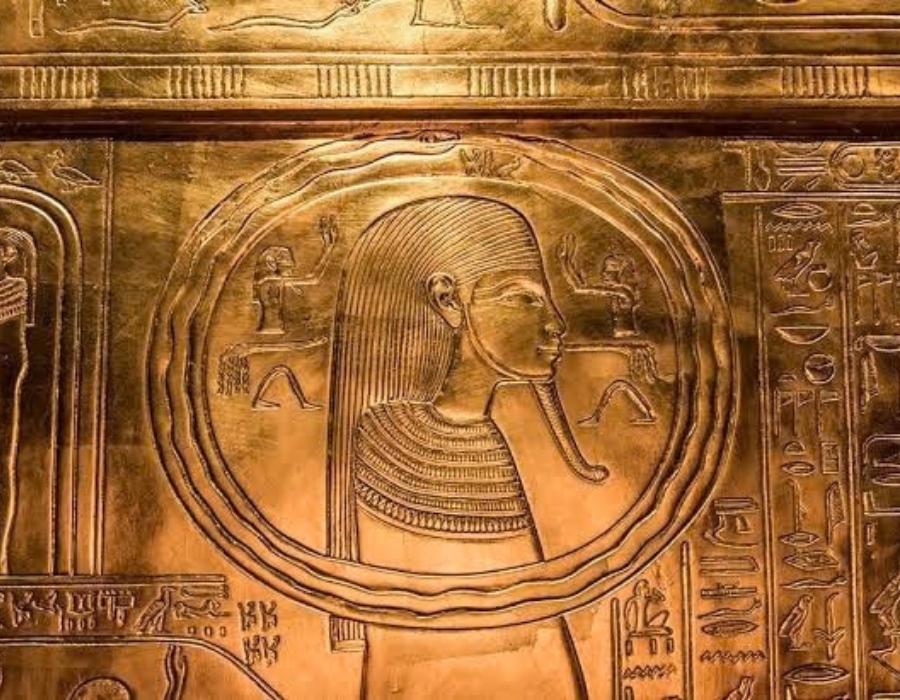
One widely cited example appears on the second gilded shrine of Tutankhamun, from the Eighteenth Dynasty in the fourteenth century BCE. Academic research from the University of Chicago describes the image as the first appearance of the tail-in-mouth form in the Eighteenth Dynasty and identifies its older Egyptian religious background with Mehen, “the coiled one.”
This is an important distinction:
The recognizable Ouroboros image does not represent the beginning of Egyptian serpent symbolism.
Snakes had already occupied important protective, royal, divine, dangerous, and cosmic roles for centuries.
Mehen is a particularly important example.
The Metropolitan Museum of Art explains that the ancient Egyptian game of Mehen, represented by a coiled serpent, was played during the Predynastic Period and Old Kingdom. The serpent referred to a protective deity connected with Re’s nocturnal journey.
So the historical sequence is better understood as:
ancient serpent traditions → Mehen and protective coiling → New Kingdom tail-in-mouth imagery → later Mediterranean Ouroboros → alchemical and modern interpretations
That is more accurate than saying Egyptians suddenly invented a standalone symbol called “the Ouroboros” with a dictionary definition meaning eternity.
Why Is Tutankhamun So Important to the History of the Ouroboros?
Tutankhamun’s burial provides one of the most important surviving pieces of evidence for understanding the Egyptian Ouroboros.
The pharaoh ruled during Egypt’s New Kingdom and was buried in KV62 in the Valley of the Kings. Among the extraordinary funerary equipment placed around his burial were several large gilded shrines surrounding the king’s sarcophagus and coffins.
The second gilded shrine contained scenes from a composition now generally called the Enigmatic Book of the Netherworld.
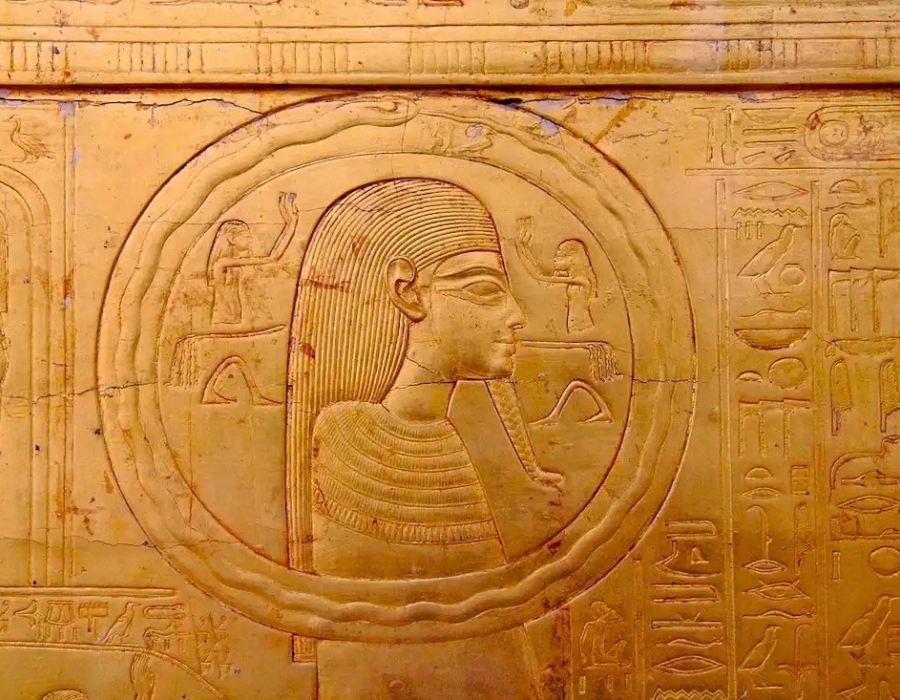
One extraordinary scene includes a huge mummiform figure whose head and feet are enclosed by serpents with their tails in their mouths.
Egyptologist Erik Hornung describes both serpents as Mehen and identifies the scene as the earliest known representation of the Ouroboros.
Two Ouroboros Serpents, Not One
The composition is particularly interesting because it does not present a single snake floating alone as a decorative emblem.
There are two encircling serpents.
One surrounds the upper part of the great divine or mummiform figure.
Another encloses the lower part around the feet.
Both belong to a larger religious composition involving the hidden world, the sun, death, divine transformation, and the regeneration necessary for continued existence.
That context changes how the image should be interpreted.
The serpent is not merely saying “infinity.”
It is doing something.
It encloses.
It protects.
It creates a boundary.
And it participates in an image concerned with the mysterious transition between death and renewed life.
The exact interpretation of the enormous central figure has been discussed by Egyptologists. It has been read as Tutankhamun in a transformed state and as a divine union involving Re and Osiris. What matters for understanding the Ouroboros is that the serpents are explicitly connected with Mehen and belong to a funerary-cosmological scene rather than existing as isolated symbols.
For more context on the young king and his surviving burial collection, see the guide to the Tutankhamun exhibition and treasures at the Grand Egyptian Museum.
What Is the Enigmatic Book of the Netherworld?
The Enigmatic Book of the Netherworld is the modern name given to an unusual ancient Egyptian funerary composition found on Tutankhamun’s second gilded shrine.
It belongs to the broader religious world of New Kingdom texts that describe what happens to the sun and divine beings during the night.
Ancient Egyptians did not imagine sunset as the simple disappearance of the sun.
The sun god passed into the hidden realm, the Duat, where a sequence of transformations, dangers, encounters, and renewals took place before sunrise.
These ideas appear in several compositions conventionally known today as Books of the Netherworld, including the Amduat and Book of Gates.
The Tutankhamun composition is unusual enough to have acquired the modern label “Enigmatic.”
Its Ouroboros-like serpents only make sense when read inside that theological environment.
They are part of a story about boundaries, hidden transformation and regeneration.
This is why extracting the snake and declaring that it simply means “eternity” strips away much of what made the Egyptian scene meaningful.
Readers interested in this religious landscape can explore the broader world of ancient Egyptian gods and goddesses, where solar, funerary, protective and destructive divine powers frequently overlap.
Who Was Mehen in Ancient Egypt?
Mehen was a protective Egyptian serpent deity whose name is generally translated as “the coiled one.”
This makes Mehen central to the Egyptian background of the Ouroboros.
The Metropolitan Museum describes Mehen as a serpent associated with Re and explains that the coiled form could evoke protection—the snake wrapping around what it guards. The Mehen board game itself represents a serpent divided into spaces and is documented from very early Egyptian history.
The key idea is enclosure.
A serpent’s body can form a boundary around something valuable.
That boundary can separate what is protected inside from danger outside.
This gives the image a logic very different from the modern notion of a snake endlessly eating itself.
Mehen Existed Before the Classic Ouroboros Image
Mehen’s religious roots predate Tutankhamun by many centuries.
This means it would be misleading to say that Mehen was invented as an Egyptian version of the Greek Ouroboros.
The historical relationship runs the other way.
Later scholars use the Greek term Ouroboros to describe a particular tail-in-mouth configuration that appears within a much older Egyptian serpent tradition.
That is why “Ouroboros” is useful as a visual label, but potentially misleading if treated as the ancient Egyptians’ own universal name for a single standardized symbol.
Why the Difference Matters
Imagine finding a Christian halo in a medieval painting and explaining the entire painting simply as “a circle meaning infinity.”
The shape may support that interpretation, but the original religious context contains far more information.
The same caution applies to the Egyptian Ouroboros.
Form matters.
But context matters more.
What Did the Ouroboros Mean in Ancient Egypt?
There was probably no single universal definition applying to every ancient Egyptian tail-in-mouth serpent.
The meaning depended on the serpent, the object, the deity being enclosed, the accompanying texts, the religious composition and the historical period.
A detailed Egyptological study by Dana Michael Reemes argues that scholars should be cautious about treating the Egyptian Ouroboros as an independent symbol with one fixed meaning. Across Egyptian contexts, one of the strongest recurring ideas is protective enclosure.
That enclosure could operate at several levels.
| Egyptian Context | Likely Function or Association |
|---|---|
| Around Re or solar imagery | Protection and solar regeneration |
| Around Osiris or funerary imagery | Protection of the dead and renewed existence |
| Around divine figures | Sacred enclosure |
| Around the cosmos | Boundary between ordered space and what lies beyond |
| Funerary equipment | Protection during transformation in the afterlife |
| Tail-in-mouth circular form | Completion, containment and cyclic process |
None of these interpretations excludes cyclicity.
Ancient Egyptian religion was deeply concerned with recurring processes.
Day followed night.
The sun disappeared and returned.
The Nile’s environmental rhythms structured life.
Kingship renewed itself.
The dead hoped to participate in divine regeneration.
Osiris represented a form of renewed existence after death.
But saying that Egyptian religion contains cycles is different from claiming that every Ouroboros was a fixed hieroglyph meaning “eternity.”
That distinction is one of the most important things to understand about the symbol.
Did the Ancient Egyptian Ouroboros Really Mean Eternity?
It can be connected with ideas that later readers describe as eternity or cyclic continuation, but “Ouroboros = eternity” should not be treated as a simple ancient Egyptian translation.
This is where modern explanations often move too quickly.
The familiar interpretation of the Ouroboros as a universal “serpent of eternity” became especially influential in post-antique European symbolism.
Reemes’ Egyptological study argues that the idea of the Egyptian Ouroboros as a discrete emblem specifically representing endless time was shaped heavily by later classical and Renaissance interpretations. The study instead identifies protective enclosure as a major organizing principle in Egyptian examples.
That does not make “eternity” an incorrect modern meaning.
It means we should distinguish two questions:
What does the Ouroboros mean today?
and
What was a particular circular serpent doing in a particular Egyptian scene?
Those are not necessarily the same question.
Modern Meaning
Today the Ouroboros commonly communicates:
- infinity;
- recurring cycles;
- renewal;
- death and rebirth;
- self-containment;
- wholeness;
- continuity;
- unity of opposites;
- transformation.
Ancient Egyptian Context
In pharaonic Egyptian art, depending on the example, the same visual structure could emphasize:
- enclosure;
- divine protection;
- regeneration;
- solar transformation;
- funerary protection;
- cosmic boundaries;
- the containment of sacred space.
The difference is subtle but important.
Why Does the Ouroboros Eat Its Own Tail?
The simplest visual answer is that placing the tail inside the mouth closes the serpent’s body into a continuous ring.
The image no longer has an obvious starting or ending point.
That makes it exceptionally powerful for later philosophical interpretations involving infinity, recurrence and self-renewal.
But the Egyptian explanation should not be reduced to literal self-cannibalism.
Ancient representations often focus less on the act of “eating” and more on the closed encircling form.
That circle surrounds something.
In the Tutankhamun example, the enclosure is theologically meaningful.
Later traditions increasingly emphasized another visual paradox: the serpent is simultaneously consuming and sustaining itself.
The thing that destroys is also the thing that continues.
The end becomes the beginning.
That contradiction helped make the Ouroboros especially attractive to alchemists and later philosophers.
Ra, Osiris and the Logic of Death Followed by Renewal
Understanding the Egyptian Ouroboros requires understanding how ancient Egyptians imagined the sun’s nightly transformation.
Re, or Ra, was one of ancient Egypt’s central solar gods.
Every sunset could be understood as an entry into a hidden nocturnal realm.
Every sunrise demonstrated successful regeneration.
Osiris, meanwhile, embodied one of Egyptian religion’s most important models of death followed by renewed divine existence.
When solar and Osirian ideas interact in New Kingdom funerary theology, death is not simply an ending.
It becomes a condition through which renewal is possible.
This does not mean Egyptians believed death was insignificant. Their funerary literature shows the opposite: successful passage required protection, knowledge, divine assistance and correct transformation.
That helps explain why a protective serpent such as Mehen is so appropriate.
Renewal has to be defended.
The sun must survive the night.
The dead must pass through danger.
Order must be maintained against forces seeking to undo it.
The Ouroboros-like enclosure therefore becomes part of a much larger religious system rather than a decorative philosophical logo.
For a broader historical framework, Egypt Time Travel’s overview of ancient Egypt provides useful context for the civilizations, dynasties and religious traditions in which these ideas developed.
Ouroboros vs Mehen: Are They the Same Thing?
Not exactly.
Mehen is an ancient Egyptian divine serpent. Ouroboros is a Greek term now used to describe a serpent whose tail meets or enters its mouth.
A depiction of Mehen can take an Ouroboros-like form, but the two terms are not perfect synonyms.
| Mehen | Ouroboros |
|---|---|
| Ancient Egyptian deity/entity | Greek descriptive term adopted for a visual motif |
| Name means roughly “the coiled one” | Name means roughly “tail-devouring” |
| Associated with protection of Re | Can have many meanings depending on culture |
| Exists in Egyptian tradition before the classic tail-in-mouth image | Familiar tail-in-mouth form is later |
| Religious identity | Iconographic form |
| Primarily Egyptian | Later used across Mediterranean and European traditions |
The Tutankhamun image is a perfect example of the overlap.
Modern scholars call the tail-in-mouth serpents ouroboroi, while the Egyptian scene identifies them with Mehen.
So:
Mehen can appear in Ouroboros form, but Ouroboros should not simply be treated as another name for Mehen in every period or culture.
Ouroboros vs Apep: Two Serpents With Almost Opposite Roles
One of the easiest mistakes in discussions of Egyptian mythology is assuming that all large or cosmic serpents represented the same thing.
They did not.
Apep, also known through the Greek form Apophis, was the dangerous serpent associated with chaos and opposition to the solar order.
He attacked Re during the nocturnal journey and had to be defeated or restrained so the sun could rise again.
Mehen performs almost the opposite function.
Mehen protects.
Apep threatens.
| Feature | Mehen / Ouroboros-Type Imagery | Apep / Apophis |
|---|---|---|
| General role | Protective | Hostile |
| Relationship with Re | Encloses or protects Re | Opposes Re |
| Symbolic direction | Preservation of order | Threat of chaos |
| Common visual logic | Coiling, enclosing | Attacking, restrained or defeated |
| Tail-in-mouth required? | Sometimes in Ouroboros forms | No |
| Religious character | Beneficial/protective | Dangerous/adversarial |
Ancient Egyptian religion contained both positive and negative serpent powers.
The British Museum notes more broadly that snakes in Egyptian religious iconography could represent either beneficial or dangerous power, while Apep was the classic enemy of the solar god.
That is why “snake = evil” is completely inadequate for Egyptian symbolism.
Ouroboros vs the Uraeus: Another Important Egyptian Serpent Difference
The uraeus is another famous Egyptian snake image, but it should not be confused with the Ouroboros.
The uraeus is normally represented as an upright cobra, particularly on the forehead or crown of a king or deity.
It is strongly associated with royal authority and divine protection.
The Metropolitan Museum identifies the cobra with the goddess Wadjet and describes the royal uraeus as one of the central visual symbols of kingship.
By contrast, the Ouroboros closes the serpent into an enclosing form.
So the two may share protective associations while functioning visually in different ways.
| Uraeus | Ouroboros-Type Serpent |
|---|---|
| Upright cobra | Circular or enclosing serpent |
| Closely associated with kingship | More variable contexts |
| Often linked with Wadjet | Egyptian examples often linked with Mehen |
| Protective royal power | Protective enclosure, regeneration or cosmic context |
| Usually appears on crowns/headgear | Frequently surrounds another entity |
This variety becomes clearer when looking at the broader system of Egyptian symbols and their meanings rather than trying to interpret every serpent through a single modern definition.
Ouroboros, Scarab and Rebirth: Similar Ideas, Different Symbols
Ancient Egyptian symbols can overlap in theme without being interchangeable.
The scarab, for example, became strongly connected with becoming, transformation and solar renewal.
The Ouroboros can also appear in regenerative contexts.
That does not mean they communicate exactly the same thing.
The scarab’s symbolism developed around the scarab beetle, divine becoming, and particularly the god Khepri.
The Ouroboros-type serpent emphasizes enclosure, continuity, boundaries, or cyclical form depending on its setting.
Readers who want to compare the two should see the detailed guide to the scarab beetle meaning.
The difference illustrates an important rule for interpreting ancient Egyptian art:
similar concepts do not make two symbols equivalent.
Egyptian religious imagery often communicates through networks of related ideas rather than one-to-one dictionary definitions.
How Did the Ouroboros Move Beyond Pharaonic Egypt?
Egypt did not exist in cultural isolation.
Over centuries, Egyptian, Greek, Roman, Near Eastern and Mediterranean religious and intellectual traditions interacted.
The Ouroboros became one of the visual ideas that survived this changing world.
By the Greco-Roman period, the tail-eating serpent appeared in magical, religious and amuletic contexts.
A Late Roman magical gem now held by the British Museum, for example, shows an Ouroboros enclosing a symbolic composition that includes Osiris and other divine imagery. The museum dates the object to the fourth or fifth century CE and places its production in the eastern Mediterranean.
Another British Museum magical gem from the third century CE combines an Ouroboros with several Egyptian or Egyptianized divine images.
These objects show something important.
The Ouroboros did not remain frozen in its New Kingdom context.
It was reused.
Reinterpreted.
Combined with new religious systems.
And gradually turned into a portable symbolic image understandable outside the specific funerary theology of Tutankhamun’s age.
That process is one reason it is dangerous to talk about “the meaning of the Ouroboros” as though the symbol had one unchanged definition for more than 3,000 years.
Why Did the Ouroboros Become Important in Alchemy?
Alchemy gave the Ouroboros one of its most influential later interpretations.
A famous image associated with the Chrysopoeia of Cleopatra, attributed to the tradition of Cleopatra the Alchemist, places the Greek phrase hen to pan—”the All is One”—inside an Ouroboros.
The surviving manuscript witnesses are medieval, although the composition belongs to a much earlier Greco-Egyptian alchemical tradition generally associated with Late Antiquity. Academic discussion places the alchemical composition as early as approximately the third century CE, while the best-known manuscript copy is much later.
Cleopatra the Alchemist should not be confused with Cleopatra VII, the famous Ptolemaic queen.
They are different figures.
“The All Is One”
For alchemical readers, the Ouroboros became an ideal way to represent transformation occurring within a unified system.
Matter changes into matter.
Separation leads back toward recombination.
Creation and dissolution can belong to the same process.
The serpent therefore became useful for expressing ideas such as:
- unity;
- transformation;
- return;
- the relationship between opposites;
- a process whose end returns to its beginning.
This alchemical reading had an enormous influence on how later Europe understood the symbol.
When people today say that the Ouroboros means “the unity of all things,” they are often drawing—directly or indirectly—from these later intellectual traditions rather than simply repeating an Eighteenth Dynasty Egyptian idea.
Is the Ouroboros Greek or Egyptian?
The most accurate short answer is:
The name is Greek; the earliest famous tail-in-mouth imagery is Egyptian.
That distinction resolves much of the confusion.
The Greek term describes a serpent consuming its tail.
But images with this visual structure are attested in New Kingdom Egypt centuries before the later Greek alchemical tradition.
At the same time, ancient Egypt already possessed much older traditions of sacred and protective serpents such as Mehen.
So saying “the Ouroboros is Greek” because the name is Greek is incomplete.
Saying “the Greeks had nothing to do with it” is equally incomplete.
A better historical model is:
Egyptian religious imagery → Mediterranean transmission and reinterpretation → Greek terminology and alchemical development → later European symbolism
The symbol’s extraordinary longevity comes from this ability to be reinterpreted without losing its recognizable circular form.
Does the Ouroboros Mean Life, Death and Rebirth?
It can today, but the phrase should be used carefully when discussing ancient Egypt.
The image works exceptionally well as a metaphor for life, death and renewal because the creature’s end physically returns to its beginning.
In later symbolic traditions, that reading becomes natural and powerful.
Ancient Egyptian funerary religion also contains strong concepts of death followed by transformation and renewed existence.
The two ideas therefore fit together.
What should be avoided is claiming that an ancient Egyptian artist created every Ouroboros specifically as a pictogram whose literal translation was “life, death and rebirth.”
Ancient Egyptian imagery is more contextual than that.
A better explanation would be:
The Egyptian tail-in-mouth serpent could participate in religious scenes concerning protection, death, solar regeneration and renewed existence; later traditions increasingly turned its circular form into a broader symbol of cyclical life, death and rebirth.
That preserves both the ancient context and the legitimate modern interpretation.
Does the Ouroboros Represent Infinity?
In modern symbolism, yes.
The Ouroboros is widely used to communicate infinity because its circular body appears to have no terminal point.
But it is not the same symbol as the mathematical ∞ sign.
The mathematical infinity symbol is a sideways figure eight.
The Ouroboros is an animal forming a closed ring.
Ouroboros vs Infinity Symbol
| Ouroboros | Infinity Symbol |
|---|---|
| Serpent or dragon | Abstract mathematical sign |
| Ancient religious and symbolic imagery | Mathematical notation |
| Closed circular or sometimes figure-eight body | Figure eight |
| Can represent cycles and regeneration | Represents unboundedness/infinity |
| Meaning changes by historical context | Primarily mathematical, later widely symbolic |
Modern artists sometimes draw the Ouroboros as a figure eight, deliberately combining the two ideas.
That is a contemporary symbolic choice rather than the standard form of the earliest Egyptian example.
What Is the Spiritual Meaning of the Ouroboros Today?
Modern spiritual interpretations of the Ouroboros are diverse and should be described as modern interpretations, not presented as literal ancient Egyptian doctrine.
People may use the Ouroboros to represent:
- personal transformation;
- cycles of growth;
- release and renewal;
- wholeness;
- self-knowledge;
- balance between opposing forces;
- continuity through change;
- unity;
- the return of endings into beginnings.
The image is attractive because it supports several apparently contradictory readings.
It is whole, yet consuming itself.
It destroys, yet continues.
It closes inward, yet creates an infinite visual cycle.
It can represent stability or transformation.
Depending on context, it can even represent something negative: a destructive habit or system that feeds upon itself.
That flexibility is one reason the symbol has survived so successfully.
But none of these modern personal meanings should automatically be attributed to Tutankhamun’s funerary artisans.
What Does an Ouroboros Tattoo Mean?
An Ouroboros tattoo most commonly represents cycles, renewal, continuity, transformation or the connection between endings and new beginnings.
Some people choose it after a major life transition.
Others use it as a philosophical symbol of infinity or wholeness.
An alchemical design may emphasize “the All is One.”
An Egyptian-inspired version may emphasize Mehen, protection, solar renewal or ancient funerary imagery.
The meaning therefore depends heavily on the design.
A historically Egyptian Ouroboros tattoo is different from:
- an alchemical Ouroboros;
- a dragon Ouroboros;
- an infinity-shaped Ouroboros;
- a Norse world-serpent design;
- a modern minimalist snake circle.
Anyone wanting an explicitly ancient Egyptian design should research the original imagery rather than automatically adding unrelated hieroglyphs, pyramids, ankhs and scarabs around it.
Ancient Egyptian art becomes more interesting, not less, when its symbols are kept within their real contexts.
Is the Ouroboros Evil?
No evidence supports treating the Ouroboros as inherently evil.
A serpent may look threatening to modern viewers, but ancient Egyptian snake symbolism was not divided into a simple “snake equals evil” system.
Some serpents represented danger.
Others were protective.
Apep was an enemy of the solar order.
Mehen protected the solar god.
Wadjet’s cobra could defend royal power.
The Ouroboros-type Mehen around a sacred figure therefore belongs to a protective and regenerative environment rather than simply representing evil.
At the same time, modern artists can intentionally use a self-eating snake as an image of self-destruction, addiction, repeating mistakes or a system consuming itself.
That is a legitimate modern metaphor.
It is not a universal historical definition.
Is the Ouroboros the Same as Jörmungandr?
No.
Jörmungandr is the world serpent of Norse mythology.
It is sometimes represented in an Ouroboros-like position because it encircles the world and is described in relation to its own tail.
The visual similarity is obvious.
The mythological identity is different.
Mehen belongs to Egyptian religion.
Jörmungandr belongs to Norse mythology.
The generic modern term Ouroboros describes a visual form that can appear in more than one cultural tradition.
It should not erase the identity of the specific serpent being represented.
A Short Timeline of the Ouroboros
The history becomes much clearer when separated into phases.
| Period | Development |
|---|---|
| Predynastic/Old Kingdom Egypt | Mehen and coiled-serpent traditions are already present; the Mehen game reflects a protective serpent concept |
| New Kingdom, 18th Dynasty | Tail-in-mouth Mehen serpents appear on Tutankhamun’s second gilded shrine |
| Later pharaonic Egypt | Enclosing serpent imagery continues in funerary and religious settings |
| Ptolemaic/Roman periods | Egyptian, Greek and Mediterranean religious traditions increasingly interact |
| Late Roman period | Ouroboros appears on magical gems and amuletic compositions |
| Late Antiquity / alchemical tradition | Ouroboros becomes associated with alchemical unity and transformation |
| Medieval manuscript transmission | Alchemical Ouroboros imagery is copied and preserved |
| Renaissance and early modern Europe | Eternity and cyclical time become increasingly standardized interpretations |
| 19th–20th centuries | Occultism, art, comparative religion and psychology expand its meanings |
| Modern period | Tattoos, jewelry, fiction, branding and spirituality reuse the symbol globally |
The timeline shows why no single sentence can represent every historical meaning of the Ouroboros.
Five Meanings Commonly Associated With the Ouroboros—and How Historical They Are
1. Protection
This is especially important for ancient Egyptian contexts.
Mehen’s coils protect or enclose the solar deity and participate in funerary protection.
For pharaonic Egyptian material, this is one of the meanings that deserves far more attention than it usually receives online.
2. Renewal
Renewal fits strongly with solar and funerary theology.
The sun’s return after darkness and the transformation of the dead are central Egyptian religious themes.
But renewal should be understood within a specific religious context rather than as a vague motivational slogan.
3. Eternity
This became one of the best-known later definitions.
It fits the closed shape perfectly, but scholars caution against assuming that “eternity” was the single original Egyptian meaning.
4. Unity
Unity becomes especially explicit in the alchemical tradition, most famously in the Ouroboros associated with the formula “the All is One.”
This is therefore historically important, but later than Tutankhamun.
5. Self-Transformation
Personal transformation is especially common in modern psychology, spirituality and tattoo culture.
It is a reasonable contemporary interpretation.
It should not be described as though an Eighteenth Dynasty Egyptian text explicitly defined the serpent in those terms.
Why the Ouroboros Is Often Misunderstood
The biggest problem is not that popular definitions are completely wrong.
It is that several centuries of interpretation are often compressed into one sentence.
A typical explanation might say:
“The ancient Egyptian Ouroboros represented eternity, infinity, rebirth, self-sufficiency, spiritual enlightenment and the unity of opposites.”
Some of those ideas belong strongly to later alchemy.
Some reflect modern spirituality.
Some can reasonably connect to Egyptian regenerative theology.
Others are much harder to demonstrate directly in pharaonic sources.
The result is historical flattening.
A more useful approach asks four questions:
Where is this particular image from?
When was it made?
What is inside the serpent’s circle?
What accompanying text or deity identifies its role?
Once those questions are asked, the symbol becomes far more interesting.
Common Misconceptions About the Ouroboros
| Claim | Better Explanation |
|---|---|
| “Ouroboros was an Egyptian hieroglyph for infinity.” | It was not a standard hieroglyph translating simply as “infinity.” |
| “The Egyptians called it Ouroboros.” | Ouroboros is a Greek term. |
| “Ouroboros and Mehen are identical.” | Mehen is an Egyptian serpent deity; Ouroboros describes a tail-in-mouth form. |
| “Every Ouroboros means eternity.” | Meaning depends on period and context. |
| “The Ouroboros is evil because it is a snake.” | Egyptian snakes could be protective or hostile. |
| “Apep is the Egyptian Ouroboros.” | Apep is a hostile chaos serpent and is distinct from protective Mehen imagery. |
| “Cleopatra VII created the alchemical Ouroboros.” | Cleopatra the Alchemist is a different figure. |
| “The infinity sign comes directly from the Ouroboros.” | They are distinct symbols, although modern art sometimes combines them. |
| “The snake is always literally eating itself.” | In Egyptian examples, the closed or enclosing form may matter more than literal self-consumption. |
Correcting these misconceptions provides much more information than simply repeating that the symbol means eternity.
What Can Travelers See in Egypt in 2027?
The Ouroboros is a historical symbol, but its story connects with places and museum collections travelers can actually explore.
Grand Egyptian Museum
The most important museum connection is Tutankhamun.
The Grand Egyptian Museum’s official Tutankhamun Galleries focus on the discovery, identity, burial, daily life and afterlife of the young king. The museum states that these galleries include his funerary equipment, including coffins and shrines. Official guided-tour information also says the galleries bring together more than 5,000 objects from Tutankhamun’s tomb.
Because specific objects, panels and gallery arrangements can change, anyone traveling specifically to study the Ouroboros image should confirm the current display position with the museum before visiting.
Egypt Time Travel also has a dedicated page covering Grand Egyptian Museum tours for travelers who want to include the museum in a larger Cairo itinerary.
Valley of the Kings
Tutankhamun’s tomb, KV62, is in the Valley of the Kings on Luxor’s West Bank.
The famous funerary objects were removed from the tomb after its discovery and conservation, so travelers should not expect to walk into KV62 and find the gilded shrines standing around the sarcophagus exactly as Howard Carter encountered them.
The value of visiting the Valley of the Kings is different.
It provides the geographical and funerary context.
Here, New Kingdom rulers created monumental royal tombs associated with precisely the sort of afterlife theology in which the Mehen/Ouroboros imagery belongs.
Luxor and New Kingdom Funerary Religion
A serious archaeological itinerary can combine the Valley of the Kings with other monuments around ancient Thebes.
That makes the Ouroboros much easier to understand because the traveler sees the religious environment around it rather than treating the serpent as an isolated logo.
For visitors whose priority is archaeology and symbolic interpretation rather than a standard sightseeing schedule, Egypt Time Travel’s best archaeology tours of Egypt provide a more natural next step.
How to Recognize the Ouroboros in Egyptian Art
Do not identify every coiled snake as an Ouroboros.
Look first for the defining characteristic:
Does the serpent’s head meet or hold its own tail?
Then examine the context.
A useful identification process is:
- Check whether the serpent forms a completely closed or nearly closed ring.
- Look closely at the mouth and tail.
- Identify what figure, disk, text or deity is enclosed.
- Determine whether the scene is funerary, solar, magical, royal or cosmological.
- Look for inscriptions naming the serpent or associated deity.
- Check the object’s date before applying a later alchemical interpretation.
- Separate ancient iconography from modern reconstructions.
This prevents a common visual mistake: calling every circular Egyptian serpent an Ouroboros even when it does not actually place its tail in its mouth.
It also prevents the opposite mistake—ignoring a tail-in-mouth form because it does not look exactly like a modern tattoo.
Why Serpents Were So Powerful in Ancient Egyptian Symbolism
Snakes occupy an unusual symbolic position because the same animal can inspire fear and protection.
A cobra can kill.
A cobra can also guard.
A serpent can represent chaos.
Another serpent can defend the sun against chaos.
This flexibility made snakes ideal for Egyptian religious art.
Their physical form also lends itself naturally to symbolism.
A snake can stretch out.
Coil.
Surround.
Rise.
Strike.
Disappear into the ground.
Shed its skin.
These visible behaviors can be adapted into very different religious ideas.
The Ouroboros represents just one branch of this enormous serpent vocabulary.
Understanding that wider system helps explain why reducing the Ouroboros to “snake = rebirth because snakes shed their skin” is inadequate.
Egyptian artists were using the serpent’s entire physical and mythological vocabulary, not just one biological feature.
Why the Circle Matters
The Ouroboros is powerful partly because a circle already suggests completeness.
A circle creates an inside and an outside.
It encloses.
It separates.
It protects.
It also returns continuously to itself.
When the circle is made from a living serpent rather than a geometric line, those properties become dynamic.
The boundary can act.
The enclosure can protect.
The circle becomes divine.
Later interpreters focused heavily on endlessness.
Ancient Egyptian examples frequently make the enclosed space itself equally important.
This is one reason protective enclosure offers such a productive interpretation of Egyptian Ouroboros imagery.
The serpent is not only forming a circle.
It is forming a circle around something.
Ouroboros and the Egyptian Idea of Order
Ancient Egyptian religion frequently contrasts ordered existence with disruptive forces.
Modern scholars often use the Egyptian concept maat when discussing truth, balance, justice and cosmic order.
Against that order stand forms of disruption or chaos.
The Ouroboros should not automatically be equated with maat, because that would create another oversimplification.
But protective serpent imagery can participate in the defense of ordered existence.
Mehen encloses.
Apep threatens.
Re continues his cycle.
Sunrise confirms that cosmic functioning has not collapsed.
Seen from that perspective, the Ouroboros is not simply an abstract statement that “time is infinite.”
It can be part of the machinery through which sacred order survives transformation.
What Makes the Tutankhamun Ouroboros So Unusual?
Its importance comes from the combination of age, context and survival.
The image is not a small isolated amulet.
It appears within one of history’s most remarkable royal funerary assemblages.
Tutankhamun died during the New Kingdom.
His tomb was discovered in 1922 with an extraordinary quantity of burial equipment still present.
The second gilded shrine gives us a rare opportunity to study a tail-in-mouth serpent inside a detailed religious composition rather than as an object separated from its original function.
That archaeological context matters enormously.
It allows scholars to compare:
- image;
- inscription;
- burial environment;
- associated deities;
- related underworld books;
- royal funerary beliefs.
This makes the Tutankhamun example far more informative than a later image copied without context.
Why “Ouroboros Meaning” Has More Than One Correct Answer
If someone asks, “What does the Ouroboros mean?”, the correct answer depends on the question behind the question.
If they mean:
What does it mean in modern symbolism?
The answer may be cycles, infinity, renewal and wholeness.
If they mean:
What does it mean in alchemy?
Unity, recurring transformation and the relationship between apparently opposite states become more important.
If they mean:
What does the Tutankhamun Ouroboros mean?
Mehen, enclosure, protection, the solar-funerary cycle and the transformation of the divine/deceased figure are more useful starting points.
If they mean:
What does an Ouroboros tattoo mean?
The wearer may intentionally assign it a personal meaning.
Context does not weaken symbolism.
Context makes symbolism meaningful.
Frequently Asked Questions About the Ouroboros
What does Ouroboros mean?
The Ouroboros is a serpent or dragon whose mouth meets or consumes its own tail. Modern interpretations commonly associate it with cycles, renewal, infinity, wholeness and the return of endings into beginnings. Ancient Egyptian examples require more specific interpretation and are strongly connected with protective enclosure, Mehen and funerary or solar regeneration.
Where did the Ouroboros originate?
The earliest famous securely dated tail-in-mouth Ouroboros imagery comes from ancient Egypt, especially the second gilded shrine of Tutankhamun from the Eighteenth Dynasty. Older Egyptian traditions involving coiled protective serpents such as Mehen existed centuries before this particular visual form.
Is Ouroboros an Egyptian word?
No. Ouroboros is Greek, meaning approximately “tail-devouring.” The term is now used by scholars and general writers to describe ancient Egyptian tail-in-mouth serpent imagery, but it was not simply the universal Egyptian name of the symbol.
What was the Egyptian Ouroboros called?
The Tutankhamun serpents are identified with Mehen, an Egyptian protective serpent whose name means approximately “the coiled one.” Some later scholarly discussions also refer to Egyptian expressions describing a “tail-in-mouth” condition, but Mehen and Ouroboros should not be treated as universal synonyms.
Was the Ouroboros found in Tutankhamun’s tomb?
Yes. A famous early example occurs on Tutankhamun’s second gilded shrine as part of the Enigmatic Book of the Netherworld. Two tail-in-mouth Mehen serpents enclose the upper and lower parts of a large mummiform or divine figure.
What does a snake eating its own tail symbolize?
Today, a snake eating its own tail commonly symbolizes continuity, cycles, infinity, renewal and the connection between endings and beginnings. Historically, meaning varies. In Egyptian funerary contexts, enclosure and divine protection can be as important as the later concept of eternity.
Is Mehen the same as Ouroboros?
Not exactly. Mehen is an ancient Egyptian protective serpent deity or divine serpent. Ouroboros is a Greek term describing the tail-in-mouth visual form. Mehen can be represented in an Ouroboros-like form, as in imagery associated with Tutankhamun.
Is the Ouroboros the same as Apep?
No. Mehen and Apep have very different roles. Mehen protects the solar deity, while Apep or Apophis represents a hostile serpent threatening Re’s nightly journey and cosmic order. Egyptian serpent symbolism includes both beneficial and dangerous beings.
Does the Ouroboros mean infinity?
Infinity is one of the Ouroboros’s most common later and modern meanings because the serpent forms an apparently endless loop. However, scholars caution against assuming that “infinity” or “eternity” was the single original meaning of every ancient Egyptian example.
Is the Ouroboros a symbol of rebirth?
It can symbolize rebirth or renewal, particularly in modern usage and when interpreted through solar and funerary cycles. Ancient Egyptian scenes involving Re, Osiris and Mehen certainly participate in ideas of regeneration, but the Ouroboros should not be treated as a one-word hieroglyph translating simply as “rebirth.”
What is the spiritual meaning of an Ouroboros tattoo?
A modern Ouroboros tattoo can represent renewal, transformation, continuity, wholeness, survival through change or the belief that endings create new beginnings. Its exact meaning belongs to the wearer and may draw from Egyptian, alchemical, philosophical or purely personal symbolism.
Is the Ouroboros evil?
No. The Ouroboros is not inherently an evil symbol. In important ancient Egyptian examples it is associated with protective Mehen. Ancient Egyptian serpent imagery could be beneficial or hostile depending on the serpent and context, which is why Mehen should not be confused with the destructive serpent Apep.
Conclusion: The Ouroboros Means More Than Eternity
The Ouroboros meaning cannot be reduced to one word.
Today, the snake eating its own tail can represent infinity, cycles, renewal, wholeness, transformation, life, death and rebirth.
But its Egyptian history is more precise—and more interesting.
One of the earliest securely documented tail-in-mouth examples appears on the funerary equipment of Tutankhamun, where the serpents belong to the religious world of Mehen, Re, Osiris, the Netherworld, divine protection and regeneration. The image is not simply an isolated Egyptian icon labeled “eternity.”
Over centuries, that ancient serpent moved into Greek and Roman magical traditions, alchemy, philosophy, European symbolism, psychology and modern culture. Each period added another layer.
That changing history is exactly why the Ouroboros has survived.
The serpent returns to its own beginning, and every culture that adopted it found a new way to interpret the circle.
Travelers who want to explore that symbolism in its wider archaeological context can combine Cairo’s Tutankhamun collection with Luxor and the Valley of the Kings through an ancient Egypt tour focused on the monuments, beliefs and objects that gave these images their original meaning.
